Birth in Nanlanling
Born into the Lanling Xiao lineage; exhibits robust physical presence and calm resolve in early childhood.
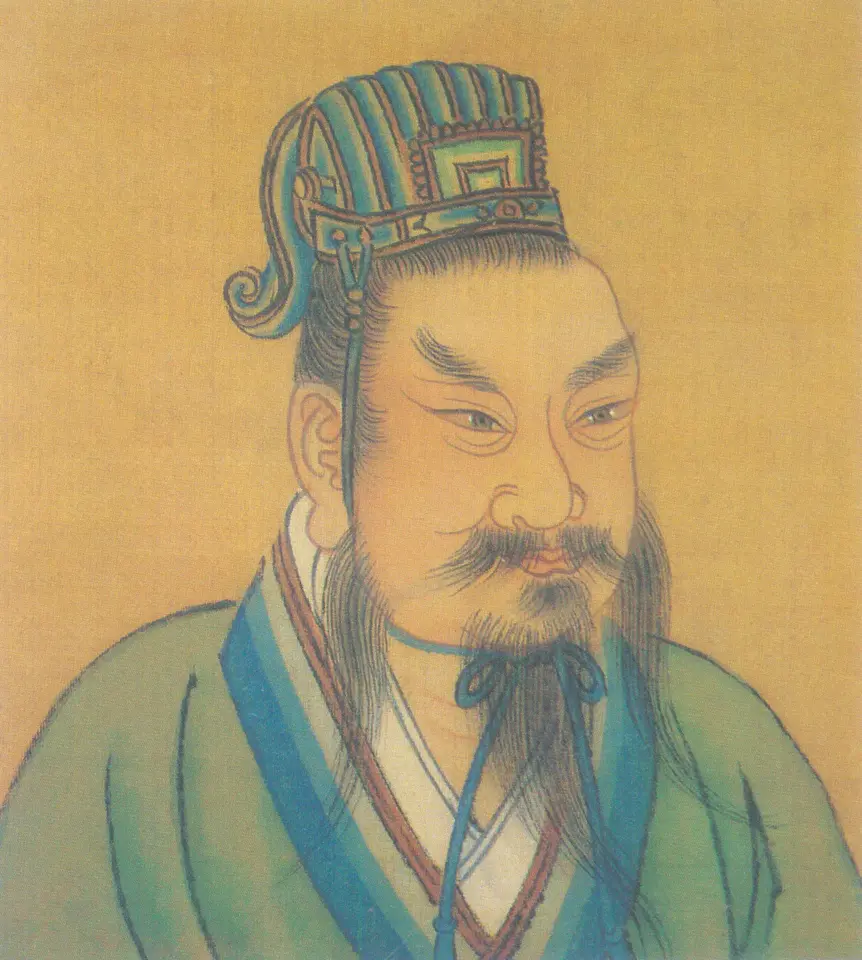
427 CE–482 CE
萧道成
Xiao Daocheng (萧道成, 427 – April 11, 482), courtesy name Shaobai and known in his youth by the sobriquet Doujiang, was the founding emperor of the Southern Qi dynasty during the Northern and Southern Dynasties period. Born into the aristocratic Xiao lineage of Nanlanling, he studied the Confucian classics under the renowned master Lei Cizong before embarking on a distinguished military career in the service of Liu Song. He…
Xiao Daocheng (萧道成, 427 – April 11, 482), courtesy name Shaobai and known in his youth by the sobriquet Doujiang, was the founding emperor of the Southern Qi dynasty during the Northern and Southern Dynasties period. Born into the aristocratic Xiao lineage of Nanlanling, he studied the Confucian classics under the renowned master Lei Cizong before embarking on a distinguished military career in the service of Liu Song. He repeatedly proved his operational brilliance in quelling domestic rebellions and halting aggressive northern thrusts by the Xianbei Northern Wei dynasty, steadily advancing through the high military command to become General of the Right Guards and General of the Capital Army. Following the demise of Emperor Ming of Song, Xiao Daocheng was named one of four regent ministers alongside Yuan Can, Chu Yuan, and Liu Bing, holding supreme command over the imperial palace guards and the capital garrison. Confronting the erratic brutality and murderous paranoia of the young sovereign Liu Yu (Emperor Houfei), Xiao Daocheng preemptively organized a palace strike in 477, terminating Liu Yu's tyrannical reign and placing Emperor Shun on the throne. He subsequently crushed widespread counter-rebellions launched by General Shen Youzhi in Jingzhou and loyalist minister Yuan Can at Shitou Castle, consolidating undisputed mastery over the southern empire. In 479, Xiao Daocheng formally accepted the abdication of Emperor Shun, inaugurating the Southern Qi dynasty and adopting the era name Jianyuan. As emperor, he enacted thorough fiscal and administrative reforms, rigorously purging falsified household registers, enforcing radical palace frugality, patronizing Confucian learning, and maintaining a steadfast defensive perimeter along the Huai River against Northern Wei. Passing away in 482 at the age of fifty-six, he was interred at Tai'anling and remembered as one of the most restrained and capable sovereigns of the Southern Dynasties.
Born into the Lanling Xiao lineage; exhibits robust physical presence and calm resolve in early childhood.
Enters the Confucian academy of Lei Cizong in Jiankang, mastering the Rites and Zuo Zhuan.
Joins his father Xiao Chengzhi's garrison command in Yuzhang, mastering military logistics and battle strategy.
Commands a detached force against Qouchi, seizing Langao and Wuxing forts; inherits his father's barony.
Defeats Xue Andu's rebel coalition and drives back Northern Wei expeditionary forces along the northern frontier.
Appointed General of the Right Guards and designated one of four regents upon Emperor Ming's deathbed testament.
Survives Emperor Houfei's lethal threats; collaborates with palace attendants to assassinate the tyrant on the Double Seventh night.
Quells Yuan Can's uprising at Shitou Castle and orchestrates the collapse of Shen Youzhi's massive southern army.
Receives the throne from Emperor Shun, proclaiming the Southern Qi dynasty and assuming the title of Emperor Gao.
Dies on April 11 at age fifty-six; succeeds by crown prince Xiao Ze and buried at Tai'anling in Danyang.
Xiao Daocheng was born in 427 during the Yuanjia era of the Liu Song dynasty, descending from the distinguished Xiao clan of Nanlanling. The clan claimed ancestry from Xiao He, the renowned founding chancellor of the Western Han dynasty, having migrated south across the Yangtze during the Yongjia collapse of the Western Jin. Xiao Daocheng's father, Xiao Chengzhi, was an accomplished battlefield commander who served as Grand Administrator of Hanzhong and fought valiantly against the Northern Wei invasions led by Emperor Taiwu. Xiao Daocheng exhibited an imposing stature and extraordinary poise from his earliest youth, speaking sparingly yet commanding immediate respect among his peers.
In 439, at the age of thirteen, Xiao Daocheng was sent to the prestigious academy at Jilong Mountain in the imperial capital of Jiankang, where he studied under the eminent Confucian classicist Lei Cizong. He immersed himself in the ethical and statecraft doctrines of the Classic of Rites and the Zuo Zhuan, developing an abiding reverence for scholarly governance and traditional administrative norms. In 440, when his father was dispatched to govern and garrison Yuzhang, Xiao Daocheng departed the academy to accompany the expeditionary army. Throughout grueling marches and garrison duties across the Jiangnan and Han River valleys, he observed tactical maneuvers, troop provisioning, and military discipline, forging a rare synthesis of scholarly erudition and practical martial skill.
In 442, at sixteen years of age, Xiao Daocheng received his first independent military commission from Emperor Wen of Song, leading a detached column to suppress restive hill tribes harassing prefectures north of the Mian River. Moving his forces with speed and tactical agility, he ambushed hostile encampments in rugged mountain passes, securing a swift and complete pacification. In 444, when Northern Wei cavalry probed the northern marches of Xuzhou, Xiao Daocheng advanced his division to Qiujianshan. Facing massed Xianbei heavy armored cavalry, he deployed tightly formed ranks of heavy crossbowmen, unleashing devastating volleys before launching a decisive counter-charge that shattered the enemy advance guard.
During Northern Wei's massive southward offensive in 450, Emperor Taiwu besieged the fortress of Runan, and Emperor Wen appointed Xiao Daocheng to coordinate relief detachments. Encountering the main Northern Wei field army beneath the slopes of Guanshan, Xiao Daocheng organized a stubborn defensive perimeter against overwhelming odds, conducting an orderly fighting withdrawal that preserved his entire division. In 452, he led an expeditionary corps into the northwest against the state of Qouchi, storming the mountain fortresses of Langao and Wuxing with conspicuous gallantry. Following his father's death, he inherited the noble title of Baron of Jinxing and transitioned into capital administration, serving successively as Court Gentleman and Magistrate of Jiankang.
In 465, Prince Liu Yu ascended the throne as Emperor Ming following the assassination of the tyrannical Qianfeidi, sparking a nationwide civil war as provincial military governors rallied around Prince Liu Zixun. Xue Andu, the military governor of Xuzhou holding the linchpin stronghold of Pengcheng, declared allegiance to Liu Zixun and invited Northern Wei armies across the Yellow River. With the northern frontier collapsing, Emperor Ming promoted Xiao Daocheng to General Supporting the State and dispatched him to take supreme operational command of the vital fortress of Huaiyin. Situated at the junction of the Huai River and the Grand Canal, Huaiyin represented the final bulwark shielding Jiankang from northern cavalry.
Upon arriving at the front, Xiao Daocheng confronted an encirclement by Northern Wei forces under General Yu Yuan. Rather than succumbing to panic, he systematically repaired moats, raised ramparts, and strictly enforced martial law. In 467, he launched a sorties at Nüshiting, inflicting heavy casualties upon Northern Wei assault units. Over subsequent years, Xiao Daocheng transformed Huaiyin into an impregnable defensive nexus, digging deep trenches, stockpiling granaries, and personally sharing meager frontline rations with his common soldiers. His unblemished probity, tactical prudence, and benevolent treatment of civilian populations earned him universal devotion across the borderlands, anchoring the defensive perimeter of the southern empire.
Xiao Daocheng's soaring prestige and tight control over battle-hardened frontier divisions eventually aroused the lethal jealousy of Emperor Ming. In his declining years, Emperor Ming became consumed by paranoid insecurity, systematically butchering his own brothers, cousins, and senior imperial generals to secure the succession for his infant heir. In 470, widespread rumors circulated through the Jianghuai basin claiming that Xiao Daocheng possessed the facial features of an emperor and that his frontier garrisons plotted to proclaim him sovereign. Intensely alarmed, Emperor Ming repeatedly dispatched confidential imperial envoys carrying imperial delicacies and jars of wine to Huaiyin, secretly instructing them to observe his demeanor and poison him if treason was suspected.
Aware of the monarch's deadly designs, Xiao Daocheng's staff officers pleaded with him to close the mountain passes, declare autonomy, or solicit northern aid for self-preservation. Xiao Daocheng remained completely unruffled, recognizing that premature rebellion would alienate the southern aristocracy. He received the palace emissaries with consummate courtesy, openly consuming the imperial wine and delicacies in front of the assembled ranks without the slightest sign of hesitation or fear. Concurrently, he voluntarily disbanded redundant border units and dispatched captured war spoils directly to the imperial treasury. Convinced of his absolute subservience, Emperor Ming dismissed his suspicions and confirmed Xiao Daocheng's regional command, allowing him to navigate the deadly political crosscurrents unscathed.
In 472, Emperor Ming fell critically ill. Recognizing the precarious state of the dynastic throne, the dying emperor summoned Xiao Daocheng back to the imperial capital, elevating him to General of the Right Guards and naming him co-regent alongside Chancellor Yuan Can, Chu Yuan, and Liu Bing to guide the ten-year-old sovereign Liu Yu (Emperor Houfei). The imperial court entrusted civil affairs to Yuan Can and Chu Yuan, while Xiao Daocheng commanded the palace guard and the capital army. The four senior statesmen were universally acknowledged as the "Four Nobles" (Si Gui). Xiao Daocheng reorganized the palace guard with strict meritocratic discipline, winning the unswerving fidelity of the professional officer corps.
In 474, Prince Liu Xiufan of Guiyang launched an armed rebellion from Jiangzhou, mobilizing tens of thousands of seasoned river troops to seize Jiankang. Rebel vanguard units routed several imperial armies and encamped directly beneath the city walls. Xiao Daocheng took command of the forward bastion of Xinting, directing the defense from the watchtowers with complete composure. He orchestrated a daring ruse, instructing allied officers Huang Hui and Zhang Jing'er to stage a feigned defection into Liu Xiufan's command pavilion, where they decapitated the rebel leader. With their commander slain, the rebel forces disintegrated, and Xiao Daocheng led a general sortie that crushed the uprising. In recognition of his heroism, the court created him Duke and elevated him to Commander of the Capital Army.
As Emperor Houfei reached adolescence, his behavioral depravity grew increasingly unhinged. The teenage emperor roamed the capital streets at night accompanied by violent ruffians, armed with spears and cudgels, casually dismembering innocent pedestrians and monks to satisfy his bloodlust. Liu Yu harbored an intense hatred for Xiao Daocheng's stern authority, frequently raiding his private residence with armed entourages. On the night of August 1, 477, Liu Yu broke into Xiao Daocheng's headquarters, forced the general to strip to the waist, and drew a bow fitted with a bone-tipped arrow, using Xiao's navel as a target and nearly piercing his torso before laughing and walking away. The emperor subsequently ordered his inner guards to assemble troops to storm the residence and massacre the entire Xiao clan.
Confronted with imminent destruction, Xiao Daocheng acted with decisive resolve. He forged secret alliances with the emperor's abused personal attendants, including Yang Yufu and Yang Wanqing. On the night of the Double Seventh festival, while Liu Yu lay in a drunken stupor inside the Renshou Palace, Yang Yufu seized the emperor's dagger and severed his head, smuggling the severed prize out of the forbidden precinct in a wooden chest to Xiao Daocheng's headquarters. Before dawn, Xiao Daocheng deployed elite palace guards to secure every imperial gate and official registry. He convened the civil and military ministers, proclaimed Liu Yu's unpardonable crimes, and installed Liu Zhun (Emperor Shun) on the throne. Xiao Daocheng was appointed Grand Marshal and Minister of the Imperial Household, assuming absolute dictatorial authority over the Liu Song state.
Xiao Daocheng's ascendancy provoked fierce armed resistance from provincial aristocrats and loyalist diehards. In the winter of 477, Shen Youzhi, the military governor of Jingzhou and Xiangzhou, mobilized an armada of over one hundred thousand troops at Jiangling, proclaiming a holy campaign to liberate the young emperor. Simultaneously in Jiankang, Chancellor Yuan Can and Liu Bing secretly formed an underground network with disgruntled palace officers, plotting to capture Shitou Castle and mount a coordinated pincer attack against Xiao Daocheng's headquarters. The survival of Xiao Daocheng's faction hung by a thread.
Demonstrating consummate crisis management, Xiao Daocheng dispatched his trusted commander Dai Sengjing to lead elite commandos over the warehouse walls of Shitou Castle under cover of darkness, eliminating Yuan Can and crushing the insurrection within the capital. Regarding Shen Youzhi's massive expedition, Xiao Daocheng accurately discerned that the enemy troops were weary and vulnerable to logistical exhaustion. He instructed the defenders of Yingcheng to conduct a resolute defense behind fortified walls while dispatching naval units to sever Shen Youzhi's supply lines and circulate imperial amnesties. After months of futile sieges, Shen Youzhi's army disintegrated from desertion, and Shen fled into the woods where he hanged himself. Xiao Daocheng had extinguished the last viable military opposition to his dynastic elevation.
Following his comprehensive victories, Xiao Daocheng was promoted to Grand Commander, awarded the Nine Bestowments, and granted the title of Duke of Qi with ten commanderies as his appanage. In early 479, Emperor Shun advanced him to King of Qi and invested him with supreme ministerial powers. The mandate of the Liu Song dynasty had expired, having spent decades in fratricidal bloodshed and administrative decay; the southern aristocracy and bureaucracy overwhelmingly gravitated toward Xiao Daocheng's firm, competent leadership.
On May 29, 479, Emperor Shun issued an imperial decree formally abdicating the throne. Xiao Daocheng mounted the ceremonial altar erected in the southern suburbs of Jiankang, ascending the imperial throne as the founding sovereign of Southern Qi and proclaiming the Jianyuan era. He posthumously elevated his deceased father Xiao Chengzhi to Emperor Xuan, invested his eldest son Xiao Ze as Crown Prince, and declared a general amnesty, waiving delinquent taxes across all southern commanderies. In his inaugural address, he urged the civil bureaucracy to renounce court extravagance and dedicate themselves to agrarian welfare, inaugurating a promising new epoch in southern Chinese history.
Upon assuming imperial authority, Xiao Daocheng confronted an acute socioeconomic crisis inherited from late Liu Song: powerful aristocratic clans and wealthy magnates had systematically forged ancestral genealogies to register commoner tenant farmers as private household retainers, thereby evading state taxes and corvée obligations. This fraudulent practice, known as register evasion, had drastically depleted the central government's tax base while concentrating vast peasant populations in serf-like dependency under oligarchic estates.
In the winter of 479, Xiao Daocheng instituted the rigorous Census Purification (Jianji) policy, establishing dedicated verification commissions headed by imperial inspectors across all commanderies. These commissions meticulously audited local yellow household registers against tax archives and land deeds, systematically revoking fraudulent aristocratic exemptions and returning hundreds of thousands of hidden cultivators to the official state registers. Although this initiative encountered bureaucratic resistance in subsequent years, Xiao Daocheng's uncompromising execution successfully restored state revenues, replenished military recruitment pools, and curbed the unchecked expansion of aristocratic latifundia across the southern provinces.
Mindful of the catastrophic fiscal squander that destroyed preceding regimes, Xiao Daocheng practiced rigorous personal austerity throughout his reign. His bedchambers, daily attire, and palace furnishings were entirely devoid of ornate carvings or precious inlays; his imperial carriages were crafted from simple wood and leather, and he routinely wore laundered garments until they frayed. Immediately following his coronation, he ordered the demolition of lavish palace pavilions constructed under Liu Song and decreed that all gold, silver, and jade ornaments stored within the imperial storehouses be hammered into pieces or melted down, replacing them with functional pottery and ironware.
To alleviate the economic burdens weighing upon the agrarian populace, Xiao Daocheng enacted sumptuary laws prohibiting commoners and nobles alike from manufacturing excessively fine silk brocades or decorating personal items with kingfisher feathers and gold leaf. He outlawed competitive extravagance in marriage and funeral ceremonies, severely punishing corrupt officials who extracted illicit levies from local merchants. Furthermore, he repeatedly issued edicts exempting regions afflicted by floods and droughts from agricultural taxes, famously declaring to his chancellors: "If Heaven grants me ten years to govern the world, I shall make gold as cheap as common soil!" This disciplined governance provided the war-weary southern populace with vital economic relief.
Though raised amidst martial campaigns, Xiao Daocheng maintained profound respect for traditional Confucian scholarship, cultivated during his youthful tutelage under Lei Cizong. Upon founding Southern Qi, he immediately revitalized the Imperial Academy at Zongmingguan in Jiankang, appointing eminent Confucian scholars to lecture on the Five Classics and recruiting talented candidates from both aristocratic lineages and humble commoner backgrounds. He personally presided over civil examinations, elevating candidates who demonstrated practical administrative acumen alongside classical virtue.
Xiao Daocheng also commanded Chancellor Wang Jian and ritual scholars to revise dynastic court ceremonial and ancestral worship statutes, grounding southern institutions in the venerable traditions of the Han and Wei dynasties. In the judicial sphere, he dismantled the cruel penal practices left behind by late Liu Song autocrats, formally abolishing mutilating corporal punishments and outlawing collective familial punishment (lianzuo) for routine legal offenses. He mandated that all capital sentences undergo rigorous appellate review by central legal ministries before execution, infusing southern jurisprudence with Confucian humaneness and moral restraint.
In foreign and military strategy, Xiao Daocheng pursued a prudent, defensive posture toward Northern Wei, then undergoing vigorous centralization under Emperor Xiaowen and Empress Dowager Feng. Using the deposition of the Liu Song house as a pretext, Northern Wei mobilized massive cavalry forces along the Huai and Han Rivers, seeking to exploit dynastic transition and conquer the south. Xiao Daocheng, possessing intimate knowledge of northern tactical capabilities from his decades of service at Huaiyin, rejected adventurous northern offensives in favor of fortified deep defense utilizing the natural barriers of the Yangtze and Huai Rivers.
He deployed battle-hardened commanders, including Cui Huijing, Yuan Chongzu, and Zhou Panlong, to reinforce key frontier bastions at Shouchun and Xiangyang, instructing them to hold fortified perimeters and avoid open cavalry battles until northern supply columns were depleted. In 480, when Northern Wei armies besieged Shouchun, Xiao Daocheng coordinated a brilliant countermeasure executed by Yuan Chongzu, who breached defensive dikes to flood the northern siege works, drowning thousands of enemy troops and forcing a chaotic retreat. By maintaining an unyielding defensive frontier, Xiao Daocheng successfully preserved the territorial integrity of Southern Qi and consolidated a stable geopolitical equilibrium across China.
In his internal statecraft, Xiao Daocheng assiduously avoided the self-destructive familial slaughter that marked the Liu Song dynasty. He treated his imperial siblings and sons with remarkable warmth and magnanimity, entrusting major military responsibilities to his eldest sons Xiao Ze and Xiao Yi while continuously admonishing them to maintain brotherly solidarity. Xiao Yi possessed formidable political talents and vast popularity, yet Xiao Daocheng harbored no suspicion toward him, fostering an atmosphere of mutual trust and harmony unprecedented in southern dynastic history.
He maintained an open channel for administrative criticism, regularly inviting plainspoken memorials from lower-ranking bureaucrats and adopting constructive recommendations regarding provincial governance. He strictly forbade local commandery administrators from offering valuable gifts to high ministers in Jiankang, enforcing rigorous disciplinary sanctions against bribery. His transparent, collegiate style of governance dismantled factional paranoia, stabilized the southern civil service, and laid the indispensable foundation for the prosperous "Reign of Yongming" achieved under his successor Xiao Ze.
FIGURES ASSOCIATED WITH THIS DYNASTY