Birth
Born into a scholarly gentry family in Moling, Danyang Commandery.
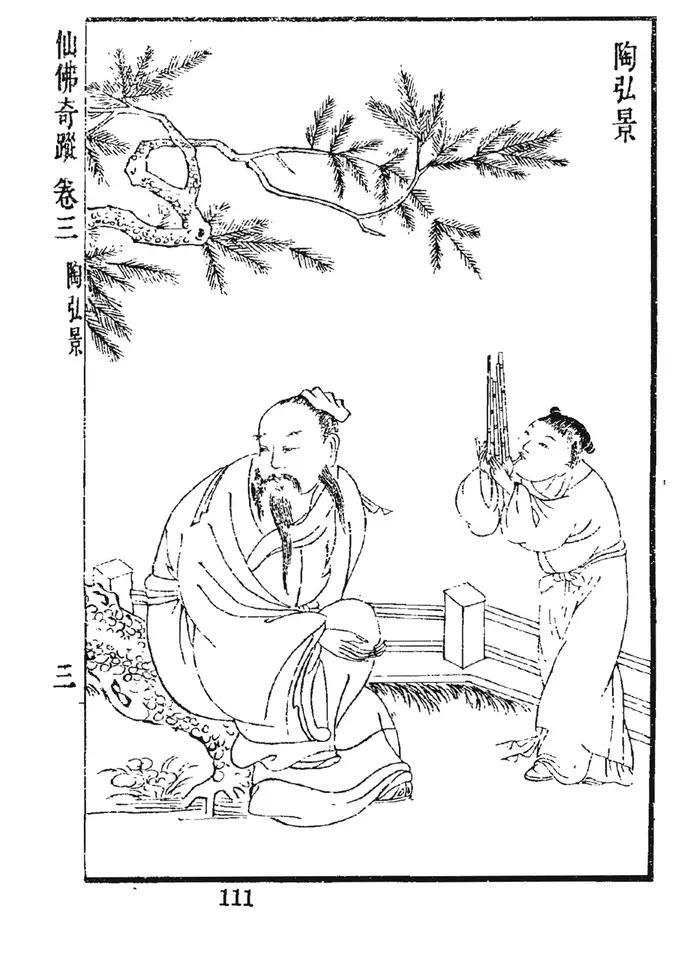
456 CE–536 CE
陶弘景
Tao Hongjing (陶弘景, 456–536), courtesy name Tongming and self-styled Huayangyinju ("Recluse of Huayang"), a native of Moling County in Danyang Commandery (modern Nanjing, Jiangsu Province), was the founder of the Maoshan lineage of Shangqing Daoism, a pioneering pharmacologist and alchemist, and an accomplished calligrapher and writer during the Southern Qi and Liang dynasties, celebrated in his time as the "Prime Minister in…
Tao Hongjing (陶弘景, 456–536), courtesy name Tongming and self-styled Huayangyinju ("Recluse of Huayang"), a native of Moling County in Danyang Commandery (modern Nanjing, Jiangsu Province), was the founder of the Maoshan lineage of Shangqing Daoism, a pioneering pharmacologist and alchemist, and an accomplished calligrapher and writer during the Southern Qi and Liang dynasties, celebrated in his time as the "Prime Minister in the Mountains (Grand Councilor in the Mountains)." Inspired at age ten by reading Ge Hong's Biographies of Divine Transcendents (Shenxian Zhuan), he was appointed Reader-in-Waiting to the Princes at age twenty by Xiao Daocheng (Emperor Gao of Qi), rose to Palace General of the Left Guard, and studied Shangqing scriptures under Sun Youyue. In 492, he hung his court robes at the Shenwu Gate and retired to Mount Juqu (Mount Mao) in Jurong, where he collected the autograph manuscripts of Yang Xi and Xu Mi, founded the Maoshan lineage of Daoism, compiled the Declarations of the Perfected (Zhengao) and the Chart of the Ranks and Functions of the Perfected and Numinous (Zhenling Weiye Tu), and advocated the synthesis of Daoism, Confucianism, and Buddhism. After Emperor Wu of Liang (Xiao Yan) ascended the throne in 502, Tao Hongjing declined repeated summonses to court, yet the emperor consulted him by letter several times a month on all major state sacrifices and military campaigns, earning him the sobriquet "Prime Minister in the Mountains (Grand Councilor in the Mountains)." In pharmacology and alchemy, he compiled the seven-scroll Collected Commentaries on the Classic of Materia Medica (Bencaojing Jizhu), classifying 730 medicinal substances by their natural properties and recording the earliest known flame test for potassium nitrate in the history of world chemistry. He died in 536 at age eighty-one and received the posthumous title Master Zhenbai.
Born into a scholarly gentry family in Moling, Danyang Commandery.
Read Ge Hong's Biographies of Divine Transcendents at age ten and resolved to pursue Daoist longevity; composed "Treatise on Seeking the Mountains" at age fifteen.
Appointed Reader-in-Waiting to the Princes by Xiao Daocheng at age twenty, later serving under Southern Qi as Attendant at Court Audiences and Palace General of the Left Guard.
Around age thirty, became a disciple of Sun Youyue, master of Xingshi Abbey and disciple of Lu Xiujing, receiving Shangqing talismans and scriptures.
Obtained the autograph Shangqing manuscripts of Yang Xi and Xu Mi on Mount Mao; traveled across eastern Zhejiang in 490 to visit recluses and Dharma masters.
Submitted a memorial resigning his post, hung his court robes at Shenwu Gate, and retired to Huayang Cavern on Mount Juqu (Mount Mao) in Jurong as "Huayangyinju," founding the Maoshan lineage.
Declined office upon Emperor Wu of Liang's accession, but was consulted several times each month on major state and military affairs, becoming known as the "Prime Minister in the Mountains (Grand Councilor in the Mountains)."
Received gold, cinnabar, azurite, and realgar from Emperor Wu of Liang for alchemical experiments; Zhuyang Abbey (514) and Taiqing Altar (516) were built for him by imperial order.
Died on Mount Mao at age eighty-one after forty-five years in seclusion; posthumously appointed Grand Master of Palace Leisure and titled Master Zhenbai.
Tao Hongjing, courtesy name Tongming, was born into a Southern Dynasties gentry family in Moling County, Danyang Commandery. At the age of ten he read Ge Hong's Biographies of Divine Transcendents (Shenxian Zhuan) and conceived a lifelong ambition to cultivate longevity; at fifteen he composed his "Treatise on Seeking the Mountains" (Xunshan Zhi), expressing his yearning for a life of seclusion. When he was twenty, Xiao Daocheng (later Emperor Gao of Southern Qi) appointed him Reader-in-Waiting to the Princes, and he subsequently served as Attendant at Court Audiences and Palace General of the Left Guard. Around age thirty, he became a disciple of the Daoist master Sun Youyue—a leading disciple of Lu Xiujing and head of Xingshi Abbey—from whom he received talismanic charts, Shangqing scriptures, and oral instructions, embarking on journeys to famous mountains in search of elixirs and authentic scriptural manuscripts.
In 488 (6th year of the Yongming era of Southern Qi), Tao Hongjing discovered on Mount Mao the original calligraphic manuscripts of the Shangqing scriptures written by the Eastern Jin visionaries Yang Xi and Xu Mi, and in 490 he traveled east through Zhejiang to visit Daoist masters and Buddhist monks. In 492 (10th year of the Yongming era), at the age of thirty-seven, he submitted a memorial resigning his official stipend, hung his court robes at the Shenwu Gate of the palace city in Jiankang, and withdrew to Huayang Cavern on Mount Juqu (Mount Mao) in Jurong, Jiangsu, styling himself "Huayangyinju" and breaking off ordinary worldly intercourse.
When Xiao Yan founded the Liang Dynasty as Emperor Wu in 502 (1st year of the Tianjian era), he repeatedly sent envoys to invite his old friend Tao Hongjing back to court. Although Tao Hongjing steadfastly refused to leave the mountains, the emperor treated him with extraordinary veneration and corresponded with him constantly. In 514 (13th year of the Tianjian era), Emperor Wu ordered the construction of Zhuyang Abbey on Mount Mao for Tao's residence, and in 516 built the Taiqing Numinous Altar for him. Whenever the court faced major auspicious or inauspicious ceremonies or military expeditions, Emperor Wu sent envoys beforehand to consult Tao Hongjing on Mount Mao, exchanging several letters a month, so that contemporaries called Tao the "Prime Minister in the Mountains (Grand Councilor in the Mountains)" (Shanzhong Zaixiang).
During his forty-five years on Mount Mao, Tao Hongjing inherited the philosophical teachings of Laozi and Zhuangzi and the immortality lore of Ge Hong while integrating Buddhist concepts, advocating the synthesis of Daoism, Confucianism, and Buddhism with the dictum that "though the hundred teachings converge in profusion, none transcends the realm of the Three Teachings." Continuing Lu Xiujing's work of scriptural collation, he compiled the Declarations of the Perfected (Zhengao) and Secret Instructions for Ascending to Perfection (Dengzhen Yinjue), systematically tracing the transmission history of the Shangqing revelations. He also compiled the first comprehensive Daoist pantheon, the Chart of the Ranks and Functions of the Perfected and Numinous (Zhenling Weiye Tu), arranging some 3,000 celestial deities, earthly spirits, ghosts, and immortals into a strict seven-tier hierarchy. Through his prestige and numerous disciples, Mount Mao became the center of Shangqing Daoism, known thereafter as the Maoshan lineage with Tao Hongjing as its founder.
Tao Hongjing was one of the greatest early contributors to Chinese pharmacology (bencaoxue). In his time, more than ten materia medica texts circulated without a unified standard, and the ancient Shennong's Classic of Materia Medica (Shennong Bencaojing) had become disordered over the centuries, confusing herbs with minerals and insects with beasts. Undertaking a comprehensive synthesis, Tao Hongjing collated the 365 entries of Shennong's Classic of Materia Medica with 365 additional drugs used by Han and Wei-Jin physicians in the Supplementary Records of Eminent Physicians (Mingyi Bielu), adding his own clinical observations to produce the seven-scroll Collected Commentaries on the Classic of Materia Medica (Bencaojing Jizhu), covering 730 medicinal substances. Crucially, he replaced the traditional three-grade scheme with a natural classification system dividing substances into jades and stones, herbs and trees, insects and beasts, fruits, vegetables, grains, and named substances not yet in use—a classification method that became a milestone in the history of Chinese pharmacology (preserved today in Dunhuang manuscripts and later reconstructions).
Tao Hongjing also conducted extensive alchemical experiments. In 504 (3rd year of the Tianjian era), Emperor Wu of Liang supplied him with gold, cinnabar, azurite, and realgar to compound elixirs. Through these experiments, Tao mastered the properties of mercury amalgams used for gilding and recorded in Collected Commentaries on the Classic of Materia Medica the flame test for distinguishing potassium nitrate (xiaoshi, saltpeter) from sodium sulfate (puxiao, Glauber's salt): "Previously someone obtained a substance similar in color and texture to puxiao, glistening like snow held in the hand that does not freeze. When burned strongly, purple-blue smoke rises and it turns to ash without ceasing to bubble, like puxiao; this is said to be true xiaoshi." Because the "purple-blue smoke" describes the characteristic violet flame coloration of potassium salts, Tao Hongjing's observation stands as the earliest record of potassium salt identification by flame analysis in the history of world chemistry.
An accomplished polymath, Tao Hongjing also wrote on astronomy and chronology, excelled in qin music, weiqi, cursive and clerical calligraphy, and landscape painting (Two Oxen, Mountain Dwelling), and left literary works collected in Collected Works of Recluse Tao of Huayang (Huayang Tao Yinju Ji). He died on Mount Mao in 536 (2nd year of the Datong era) at the age of eighty-one, and Emperor Wu of Liang posthumously appointed him Grand Master of Palace Leisure with the posthumous title Master Zhenbai.
FIGURES ASSOCIATED WITH THIS DYNASTY