Birth
Born in Xiangyang while his father was mobilizing against Southern Qi
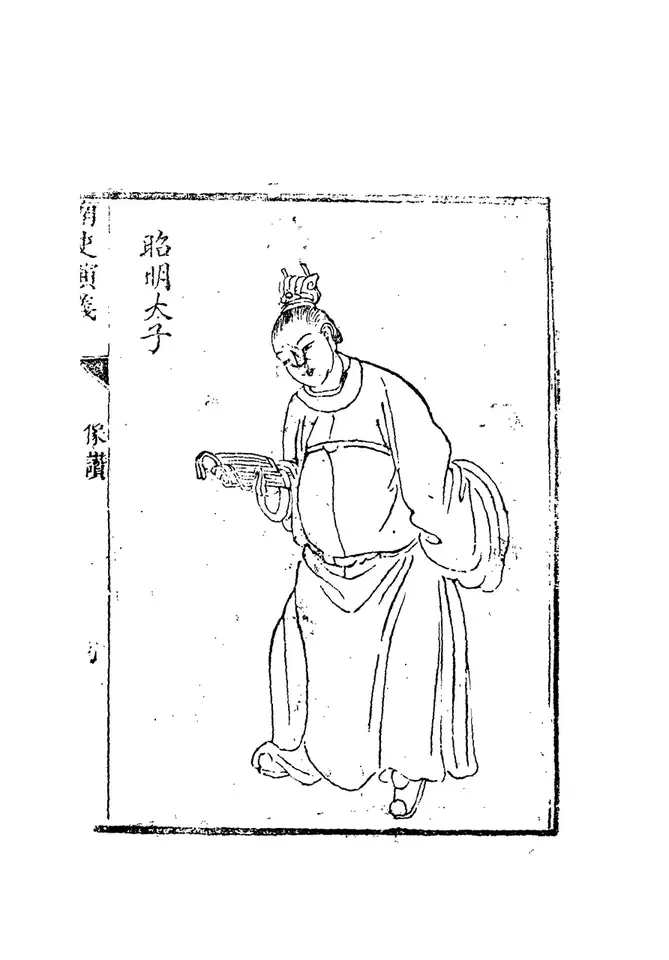
501 CE–531 CE
萧统
Xiao Tong (萧统, 501 – May 30, 531), courtesy name Deshi (德施) and posthumously honored as Crown Prince Zhaoming (昭明太子), was the eldest son and Crown Prince of Emperor Wu of Liang (Xiao Yan) during the Southern Dynasties period. Born in Xiangyang on the eve of his father's dynastic founding, he was invested as Crown Prince in 502 at the age of two. Renowned as a child prodigy, he possessed encyclopedic classical erudition,…
Xiao Tong (萧统, 501 – May 30, 531), courtesy name Deshi (德施) and posthumously honored as Crown Prince Zhaoming (昭明太子), was the eldest son and Crown Prince of Emperor Wu of Liang (Xiao Yan) during the Southern Dynasties period. Born in Xiangyang on the eve of his father's dynastic founding, he was invested as Crown Prince in 502 at the age of two. Renowned as a child prodigy, he possessed encyclopedic classical erudition, extraordinary memory, and profound Confucian-Buddhist compassion. Throughout his thirty-year tenure as heir apparent, Xiao Tong presided over the Eastern Palace as the cultural epicenter of southern China, gathering thousands of distinguished scholars, poets, and philosophers. His enduring monumental legacy is the compilation of the Wen Xuan (Selections of Refined Literature, commonly known as Zhaoming Wen Xuan), the earliest surviving comprehensive anthology of Chinese poetry and prose. Comprising over seven hundred masterpieces by one hundred and thirty prominent writers spanning from the late Zhou through the Han, Wei, Jin, and Southern Dynasties, the Wen Xuan established the definitive aesthetic criteria and genre taxonomy of classical Chinese literature, profoundly influencing the civil service examinations and poetic traditions of the Tang and Song dynasties. Despite his immense popularity and exemplary filial devotion, Xiao Tong's final years were shadowed by political estrangement from Emperor Wu following the infamous "Wax Goose Incident" (La'e Shijian) concerning his mother's burial site. He died prematurely in 531 at the age of thirty-one from complications following a boating accident on a palace lotus pond.
Born in Xiangyang while his father was mobilizing against Southern Qi
Formally invested as Crown Prince of the newly founded Liang Dynasty
Underwent the imperial capping ceremony (Guanli) marking his intellectual maturity
Began participating in court administration, reviewing judicial cases and showing clemency
Directed leading scholars in the Eastern Palace to select and classify Chinese literary masterpieces
Mourned the passing of Noble Consort Ding Lingguang with extreme physical grief and later suffered estrangement over the wax goose incident
Submitted a memorial persuading Emperor Wu to suspend the three-commandery canal excavation project
Died of infected wounds and fever at age thirty-one; conferred title Crown Prince Zhaoming
Xiao Tong displayed astonishing intellectual precocity from infancy. Official annals record that he recognized characters at age three, recited the Classic of Poetry and Book of Documents at age five, and was capable of delivering sophisticated commentaries on Confucian classics by his eighth year.
As he matured, Xiao Tong established a vast private library in the Eastern Palace comprising more than thirty thousand scrolls, matching the holdings of the imperial imperial archives. He established salons where leading literati of the age—including Liu Xiaochuo, Wang Yun, Shen Yue, and Zhou Xingsi—debated literary aesthetics, Buddhist theology, and governance. Unlike the courtly, hedonistic poetic trends of the contemporary "Palace Style" (Gongti Shi) championed by his younger brother Xiao Gang, Xiao Tong advocated a refined, morally grounded literary aesthetic that synthesized elegance of form with emotional and moral substance.
Xiao Tong was celebrated across the Liang empire for his profound empathy toward commoners. During bitter winter freezes, he would send palace attendants through the alleys of Jiankang to deliver silk waddings and blankets to impoverished families, quietly covering the expenses of funerals for penniless vagrants.
When prolonged droughts or torrential floods brought famine to the lower Yangtze valley, Xiao Tong voluntarily reduced his personal meals to plain vegetables and discontinued all musical performances in his palace. When tasked by Emperor Wu with reviewing capital criminal convictions, he systematically commuted harsh death sentences, earning the enduring reverence of the southern populace.
*The Compilation of the Wen Xuan***
Xiao Tong's most monumental historical achievement was his direction and editing of the thirty-volume (later expanded to sixty volumes by Tang commentator Li Shan) Wen Xuan (Selections of Refined Literature).
In his famous Preface to the Wen Xuan (Wen Xuan Xu), Xiao Tong articulated a groundbreaking distinction between purely utilitarian administrative, historical, and philosophical prose on the one hand, and imaginative, aesthetic literature (Wen) on the other. He established the golden rule that true literature required the harmonious union of refined rhetorical pattern (Wencai) and authentic emotional resonance (Qingzhi). Consequently, he excluded standard Confucian classics and historical treatises, admitting only those rare prefaces, memorials, and eulogies that displayed supreme artistic perfection.
The Wen Xuan anthologized thirty-eight distinct literary genres, including rhapsodies (Fu), ancient and regulated poetry (Shi), songs (Yuefu), elegies (Sao), letters (Shu), memorials (Biao), and monumental inscriptions (Bei).
By preserving masterpieces from Qu Yuan, Song Yu, Sima Xiangru, Cao Zhi, Ruan Ji, Tao Yuanming, and Xie Lingyun, Xiao Tong created the foundational textbook of Chinese literary education. During the Tang and Song dynasties, mastery of the Wen Xuan was considered mandatory for success in the imperial Jinshi examinations, giving rise to the popular Chinese adage: "When the Wen Xuan is thoroughly mastered, half the imperial degree is already won" (Wenxuan shu, xiucai chu). The anthology remains the premier primary source for the study of pre-Tang Chinese poetry and rhetoric.
In November 526, Xiao Tong's beloved mother, Noble Consort Ding Lingguang, passed away. Consumed by inconsolable grief, Xiao Tong wept blood and fasted for days, collapsing repeatedly beside her bier. His physical constitution, previously robust, was permanently damaged by his extreme mourning rituals.
While seeking an auspicious burial site for his mother, Xiao Tong dispatched agents to purchase land. A corrupt eunuch, Yu Sanfu, secretly conspired with a wealthy landowner to inflate the price, promising to split the profit. When Xiao Tong selected an alternative site on the advice of an independent geomancer, Yu Sanfu was infuriated.
Yu Sanfu took advantage of Emperor Wu's superstitious nature by secretly informing the emperor that Xiao Tong was burying sympathetic magic charms in his mother's tomb to prolong his own life at the expense of his father's longevity. Emperor Wu dispatched investigators to excavate the burial mound, discovering a wax goose and Daoist talismans that had been secretly planted by the geomancer at the instigation of conspirators.
Emperor Wu was shocked and enraged, preparing to launch a severe treason trial against the Eastern Palace. Prime Minister Xu Mian intervened forcefully, explaining Xiao Tong's pristine filial nature and exposing the fabrications of the eunuch. Although Emperor Wu halted the investigation, a deep psychological estrangement arose between the suspicious father and the heartbroken crown prince. Xiao Tong fell into profound depression, unable to clear his name without casting blame upon imperial attendants.
In April 531, while taking a boat excursion with scholars on the imperial lotus pond at the Houyuan garden, an attendant accidentally tipped the vessel. Xiao Tong fell into the water, severely bruising his leg against the boat's hull.
Though rescued immediately, his leg became acutely infected. Terrified of alarming his elderly father, Xiao Tong concealed the gravity of his illness, continuing to draft official correspondence while feverish. The infection worsened rapidly, and on May 30, 531, Xiao Tong passed away at the age of thirty-one.
Emperor Wu was devastated by grief upon learning of his eldest son's demise. The aged emperor rushed in person to the Eastern Palace, weeping uncontrollably as he caressed his son's cold face. Xiao Tong was buried with supreme imperial honors at Anling, and conferred the posthumous title Crown Prince Zhaoming. Decades later, when his third son Xiao Cha established the Western Liang Dynasty in Jiangling, Xiao Tong was posthumously honored as Emperor Zhaoming (Zhaoming Huangdi).
In 509, at the age of nine, Xiao Tong lectured on the Classic of Filial Piety at Shou'an Hall before court scholars and personally officiated at the sacrificial rites in the Imperial Academy.
Devoted to Buddhist philosophy, Xiao Tong established Huiyi Hall inside the palace to host eminent monks, composed treatises on the Threefold Truth, and divided the Diamond Sutra into its standard thirty-two sections.
In the spring of 530, when former governor Wang Yi proposed conscripting laborers from three eastern commanderies to dig flood channels, Xiao Tong submitted a memorial warning of high grain prices and peasant exhaustion, persuading Emperor Wu to suspend the project.
Recognizing the moral purity and natural style of the Eastern Jin recluse poet Tao Yuanming, Xiao Tong compiled and prefaced the Collected Works of Tao Yuanming, elevating Tao's standing in Chinese literary history.
Throughout his twenty-nine years as Crown Prince, Xiao Tong gathered Liu Xiaochuo, Wang Yun, Lu Chui, Yin Yun, and Dao Qia in the Eastern Palace, creating the most celebrated literary salon of the Southern Dynasties.
Following Xiao Tong's death in 531, Emperor Wu bypassed Xiao Tong's eldest son Xiao Huan to install Xiao Gang as Crown Prince, while enfeoffing Xiao Huan as Prince of Yuzhang and Xiao Cha as Prince of Yueyang.
Beginning with Cao Xian and Li Shan in the Sui and Tang dynasties and continuing through the Five Officials' commentary, scholarship on Xiao Tong's anthology developed into the specialized discipline of Wen Xuan Studies (Xuanxue).
When Hou Jing briefly installed Xiao Tong's grandson Xiao Dong on the throne in 551, Xiao Tong was posthumously honored as Emperor Zhaoming, and in 555 his third son Xiao Cha conferred upon him the temple name Gaozong after founding Western Liang.
FIGURES ASSOCIATED WITH THIS DYNASTY