Age one | Born in Xiapi (present-day Pizhou, Jiangsu), where his father Sun Jian was serving as magistrate of Xiapi County
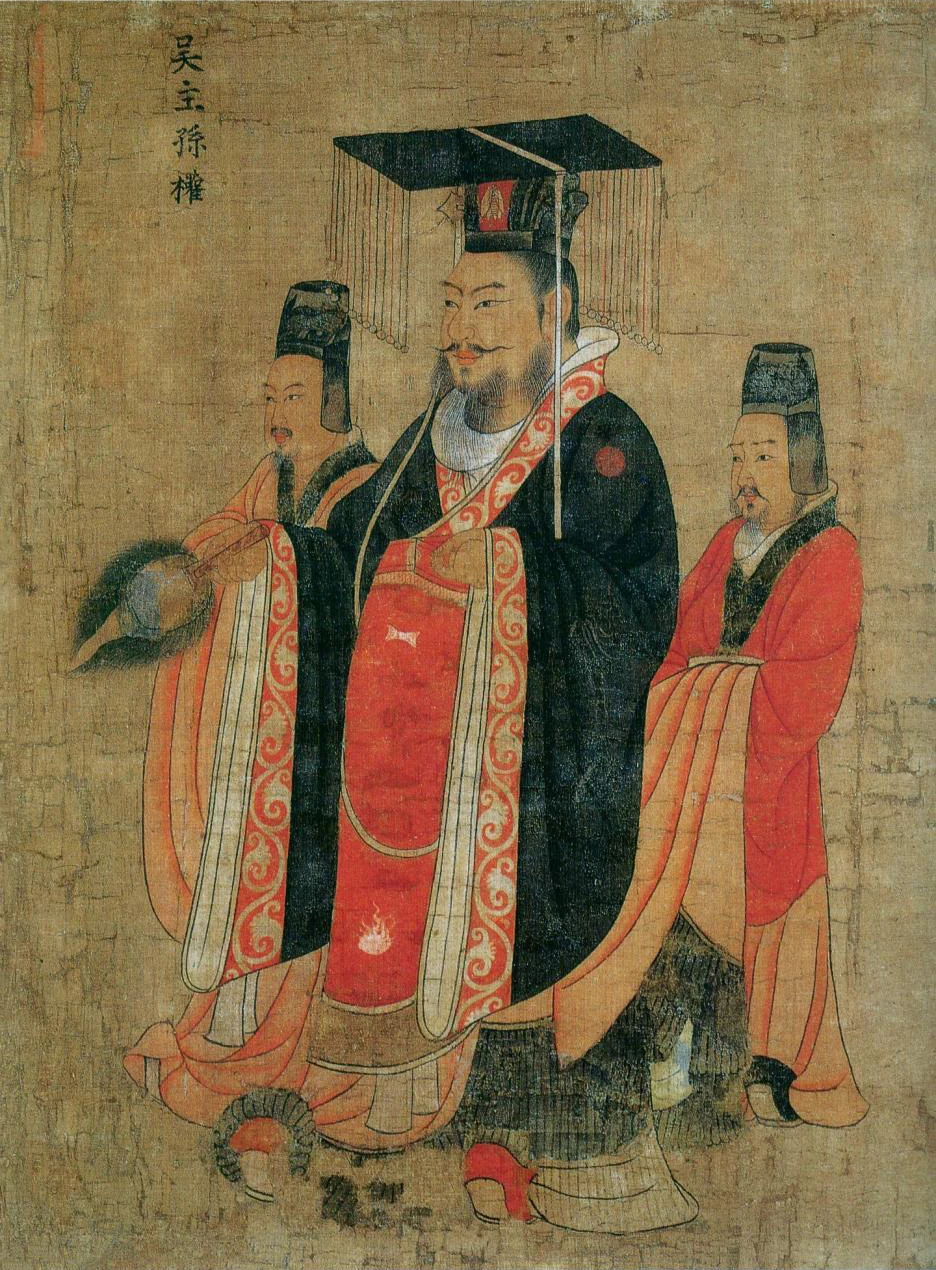
182 CE–252 CE
Emperor
Sun Quan
孙权
Sun Quan (182 – May 21, 252), courtesy name Zhongmou, was a native of Fuchun in Wu Commandery (present-day Fuyang District, Hangzhou, Zhejiang) and was born in Xiapi (present-day Pizhou, Jiangsu). He was the founding emperor of Sun Wu during the Three Kingdoms period, reigning from May 23, 229 to May 21, 252, and was a statesman and military commander. Sun Quan inherited the foundations laid by his father and elder brother.…
182 CE–252 CESun Wu
PROFILE
Sun Quan (182 – May 21, 252), courtesy name Zhongmou, was a native of Fuchun in Wu Commandery (present-day Fuyang District, Hangzhou, Zhejiang) and was born in Xiapi (present-day Pizhou, Jiangsu). He was the founding emperor of Sun Wu during the Three Kingdoms period, reigning from May 23, 229 to May 21, 252, and was a statesman and military commander. Sun Quan inherited the foundations laid by his father and elder brother. With the assistance of Zhang Zhao, Zhou Yu, Lu Su, and others, he stabilized Jiangdong, allied with Liu Bei to defeat Cao Cao at the Battle of Red Cliffs, later seized Jing Province, defeated Liu Bei at the Battle of Yiling, and ultimately proclaimed himself emperor at Wuchang, establishing the Sun Wu regime. During his reign he promoted the Tuntian system, developed the Jiangnan region, and pacified the Shanyue, laying foundations for the later Jiangdong regimes of the Six Dynasties. In his later years, disputes over the succession triggered the Southern Lu factional struggle and destabilized politics. His posthumous title was Great Emperor and his temple name was Taizu. He was buried at Jiangling in what is now Xuanwu District, Nanjing.
- Other names
- Emperor Da of Eastern Wu; courtesy name Zhongmou
- Courtesy name
- Zhongmou
- Period
- Sun Wu
- Dynasty/Regime
- Wu
- Identity
- Emperor
- Ethnicity/Ethnic affiliation
- Not recorded in historical sources
- Ancestral home
- Fuchun, Wu Commandery (present-day Fuyang District, Hangzhou, Zhejiang)
- Date of birth
- 182
- Place of birth
- Not recorded in historical sources
- Date of death
- May 21, 252
- Reign
- May 23, 229 – May 21, 252
- Predecessor
- Sun Ce (founder of the Jiangdong base, never emperor)
- Successor
- Emperor Fei of Wu (Sun Liang)
- Era names
- Not recorded in historical sources
- Temple name
- Taizu
- Posthumous title
- Great Emperor
- Major achievements
- Emperor Da of Eastern Wu, founding emperor of Wu in the tripartite Three Kingdoms order; proclaimed himself emperor at Weiting and, during his reign, consolidated the Jiangdong regime and promoted regional development.
LIFE TIMELINE
Age three | Remained with his family in Shouchun County, Jiujiang Commandery
Age eight | Moved with his elder brother Sun Ce to Shu County in Lujiang Commandery
Age eleven | After his father Sun Jian was killed in battle, moved with his mother to Jiangdu County in Guangling Commandery
Age twelve | Escorted by Lü Fan to Qu'e, where his maternal uncle Wu Jing lived
Age thirteen | Zhu Zhi brought Sun Quan and his mother to Qu'e and supported them
Age fourteen | After Sun Ce crossed the Yangzi, Sun Quan was brought back to Qu'e and studied with Zhu Ran and Hu Zong
Age fifteen | Appointed magistrate of Yangxian County, recommended as xiaolian and maocai, and made acting Commandant of Upholding Righteousness
Age eighteen | Followed Sun Ce in campaigns against Liu Xun and Huang Zu, taking Lujiang and Yuzhang commanderies
Age nineteen | After Sun Ce died from an assassination, succeeded to control of Jiangdong and became General Who Attacks the Caitiffs and Administrator of Kuaiji
Age twenty-two | Launched his first western campaign against Huang Zu and defeated his navy
Age twenty-six | Accepted Gan Ning's advice and again campaigned against Huang Zu, returning after taking captives
Age twenty-seven | Campaigned against Huang Zu for the third time, killed him, and annexed most of Jiangxia Commandery; later that year defeated Cao Cao at the Battle of Red Cliffs
Age twenty-eight | Met Liu Bei at Jingkou and lent Nan Commandery to him, strengthening the Sun–Liu alliance
Age thirty-eight | Sent Lü Meng to seize Jing Province, captured and killed Guan Yu, and greatly expanded his territory
Age forty | Submitted to Cao Wei and was enfeoffed as King of Wu
Age forty-one | Defeated Liu Bei at the Battle of Yiling
Age forty-eight | Proclaimed himself emperor at Wuchang under the state name “Wu,” and soon moved the capital to Jianye
Age fifty-one | Sent troops against Gongsun Yuan in Liaodong, without success
Age fifty-seven | Pacified Jiao Province and established Guangzhou and Jiaozhou
Age sixty-one | Crown Prince Sun Deng died; Sun He was made crown prince
Age sixty-nine | Deposed Crown Prince Sun He, ordered Prince Lu Sun Ba to die, and made Sun Liang crown prince
Age seventy-one | Died of illness at Jianye, was buried at Jiangling, and received the posthumous title Great Emperor
BIOGRAPHY
Biography
Family Background and Early Years
Sun Quan was the second son of Sun Jian and the younger brother of Sun Ce. His mother was Lady Wu, later honored as Empress Wulie. According to the Records of the Three Kingdoms, the Sun family claimed descent from the Spring and Autumn military strategist Sun Wu. Sun Wu's second son Sun Ming was said to have received a fief at Fuchun, after which the family remained there for generations. In 182, the fifth year of the Guanghe era, Sun Quan was born in Xiapi while Sun Jian was serving as magistrate of Xiapi County. The Biographies from South of the Yangzi records that Sun Quan had a “square jaw and a large mouth, with a bright gleam in his eyes,” which Sun Jian regarded as a sign of future eminence. When Lady Wu was pregnant with Sun Quan, she was said to have dreamed that the sun entered her bosom, and Sun Jian interpreted this as an omen that their descendants would flourish.
In 184, the first year of the Zhongping era, Sun Jian followed Zhu Jun in campaigning against the Yellow Turban Rebellion, while Sun Quan remained with his family in Shouchun County, Jiujiang Commandery. In 189, the sixth year of Zhongping, Sun Jian raised troops in response to the coalition against Dong Zhuo, and Sun Quan moved with his elder brother Sun Ce to Shu County in Lujiang Commandery. While there, Sun Ce became close to Zhou Yu, and the two families maintained close relations. In 192, the third year of Chuping, Sun Jian attacked Liu Biao of Jing Province on Yuan Shu's orders and was killed at Xianshan. Sun Quan thus lost his father while still young and was raised and educated by Lady Wu. After the funeral, the family moved to Jiangdu County in Guangling Commandery. In 193, after Sun Ce joined Yuan Shu, he sent Lü Fan to bring Sun Quan and the others to their maternal uncle Wu Jing at Qu'e. In 194, tensions arose between Liu Yao, Inspector of Yang Province, and Yuan Shu and Sun Ce. Zhu Zhi sent men to Qu'e to bring Sun Quan and his mother under his protection. Sun Quan later moved with his mother to Liyang County and Fuling County. In 195, after Sun Ce crossed the Yangzi and defeated Liu Yao, he sent Chen Bao to Fuling to escort the family back to Qu'e.
Sun Quan was described as broad-minded in temperament, benevolent yet decisive, fond of chivalric conduct, and eager to gather talented men. He often accompanied Sun Ce and took part in deliberations, and his ability caused Sun Ce himself to acknowledge his younger brother's strengths. Whenever Sun Ce held banquets for his guests, he would turn to Sun Quan and say, “These men will all become your subordinates in the future.” At this time Sun Quan studied in Wu Commandery with Hu Zong and Zhu Ran, forming close friendships with them.
Succeeding to Jiangdong
In 196, the first year of the Jian'an era, the fifteen-year-old Sun Quan was appointed magistrate of Yangxian County. Zhu Zhi, Administrator of Wu Commandery, recommended him as xiaolian, while Yan Xiang, Inspector of Yang Province, recommended him as maocai. He was later made acting Commandant of Upholding Righteousness. In 199, Sun Quan followed Sun Ce in attacking Liu Xun, Administrator of Lujiang. After Liu Xun fled, the army advanced on Shaxian against Huang Zu and took Lujiang and Yuzhang commanderies.
In 200, the fifth year of Jian'an, Sun Ce was assassinated by retainers of Xu Gong. On his deathbed he summoned Sun Quan, invested him with the seals, ribbons, and military tallies, and designated him as his successor. Sun Quan was nineteen and overwhelmed by grief. Zhang Zhao admonished him: “Xiaolian, is this really the time for weeping? The Duke of Zhou established rites, yet Boqin did not follow them—not because he opposed his father, but because circumstances made it impossible. Now traitors contend on every side and wolves fill the roads. If you would mourn your kin and attend to ritual restraints, it would be like opening the gate and inviting in thieves; that cannot be called benevolence.” Sun Quan therefore removed his mourning clothes, and Zhang Zhao helped him onto a horse so that he could inspect the military camps.
At the time the Sun regime faced crises both within and without. Li Shu, Administrator of Lujiang, openly rebelled; Sun Fu of Luling secretly communicated with Cao Cao; the clansman Sun Gao attempted to seize power; the Administrator of Danyang, Sun Yi, and the senior clansman Sun He were murdered; and tens of thousands of Shanyue in Yuzhang, Kuaiji, and elsewhere waited for an opportunity to rebel. Zhang Zhao, Zhou Yu, and others judged that Sun Quan was a man with whom great affairs could be accomplished and devoted themselves to his service. Sun Quan treated Zhang Zhao with the respect due a teacher, Zhou Yu as an elder brother, and Cheng Pu, Lü Fan, and others as trusted commanders. He first destroyed Li Shu, incorporating more than 30,000 of his followers; then prevented disturbances among the imperial clan, suppressed six thousand Shanyue, and incorporated more than ten thousand people. At the same time he broadly recruited talent. Zhuge Jin, Lu Su, Yan Jun, Bu Zhi, Lu Xun, Xu Sheng, Gu Yong, and others entered his service one after another, helping reassure both the established local clans and immigrant scholars and thereby stabilizing Jiangnan.
The Battle of Red Cliffs and the Tripartite Balance
From the eighth through the thirteenth year of Jian'an (203–208), Sun Quan attacked Jiangxia Commandery three times, ultimately killing Huang Zu and annexing most of Jiangxia. In 208, Cao Cao advanced south, defeated Liu Bei, occupied Jiangling, and wrote Sun Quan claiming that he would “hunt together in Jiangdong” with an army of eight hundred thousand. Sun Quan's camp divided between advocates of resistance and surrender: Lu Su and Zhou Yu favored war, while Zhang Zhao favored submission. Sun Quan intended to fight Cao Cao. Lu Su brought Zhuge Liang back from Jiangxia, demonstrating Liu Bei's determination to ally with Sun Quan against Cao Cao, while Zhou Yu returned in time to analyze the weaknesses of Cao Cao's expedition. Sun Quan decisively appointed Zhou Yu and Cheng Pu as the left and right commanders and joined forces with Liu Bei, defeating Cao Cao's army at the Battle of Red Cliffs. After the battle, Sun Quan personally led an army to besiege Hefei but failed to take the city and withdrew.
In 209, after Zhou Yu had confronted Cao Ren for more than a year, Cao Ren abandoned the city and retreated. Sun Quan acquired Nan Commandery and appointed Zhou Yu as its administrator. That same year, Liu Bei memorialized that Sun Quan should serve in an acting capacity as General of Chariots and Cavalry and concurrently as Governor of Xu Province. Sun Quan met Liu Bei at Jingkou and agreed to lend Nan Commandery to him, consolidating the Sun–Liu alliance. Zhou Yu had proposed detaining Liu Bei and separating him from Guan Yu and Zhang Fei, but Sun Quan rejected the plan because Cao Cao remained powerful in the north and it was necessary to gather heroic men widely.
In 210, Zhou Yu died, to Sun Quan's great sorrow. Lu Su succeeded him as commander and continued to maintain the Sun–Liu alliance. Sun Quan then moved his administrative headquarters from Wu to Jingkou, and later to Gong'an. In 211, accepting Zhang Hong's advice, he transferred his headquarters to Moling. The following year he built Stone City and renamed Moling Jianye.
Seizing Jing Province and the Battle of Yiling
In 215, the twentieth year of Jian'an, Sun Quan sent Zhuge Jin to demand the return of the commanderies of Jing Province from Liu Bei, but Liu Bei delayed. Sun Quan therefore ordered Lü Meng to take Changsha, Lingling, and Guiyang commanderies, bringing the two sides close to open war. When Cao Cao attacked Hanzhong, Liu Bei was forced to reach an accommodation with Sun Quan, and the two divided Jing Province along the Xiang River.
In 219, the twenty-fourth year of Jian'an, Guan Yu campaigned north against Xiangyang and Fancheng and flooded the Seven Armies, shaking the realm. Sun Quan adopted the plans of Lü Meng and Lu Xun. Taking advantage of the weakness of Guan Yu's rear, he sent Lü Meng to cross the river in disguise and seize Jing Province, ultimately capturing and killing Guan Yu. This greatly expanded Sun Quan's territory but completely destroyed the Sun–Liu alliance.
In 221, the second year of Huangchu, Liu Bei personally led a large army against Wu to avenge Guan Yu. Sun Quan submitted to Cao Wei and was enfeoffed as King of Wu. In 222, the first year of Huangwu, Lu Xun inflicted a major defeat on Liu Bei at the Battle of Yiling, forcing Liu Bei to retreat to Baidi. In 223, after Liu Bei died, Zhuge Liang sent Deng Zhi as envoy to Wu. Sun Quan restored the alliance with Shu Han so that the two states could jointly counter Cao Wei.
Proclaiming Himself Emperor and Founding Wu
In the spring of 229, the first year of Huanglong, officials throughout the government urged Sun Quan to assume the imperial title. In the fourth month, reports from Xiakou and Wuchang claimed that yellow dragons and phoenixes had appeared. On the day bing-shen, Sun Quan ascended the imperial throne at the southern suburban altar of Wuchang, named the state “Wu,” proclaimed a general amnesty, and adopted Huanglong as the era name. He posthumously honored his father Sun Jian as Emperor Wulie, his mother Lady Wu as Empress Wulie, and his elder brother Sun Ce as Prince Huan of Changsha, and he made Sun Deng crown prince. In the sixth month, Shu Han sent Chamberlain for Dependencies Chen Zhen to congratulate Sun Quan on his accession. The two states agreed on a theoretical partition of the realm: Yu, Qing, Xu, and You provinces were assigned to Wu; Yan, Ji, Bing, and Liang provinces to Shu, with Hangu Pass as the boundary. They erected an altar, sacrificed animals, invoked the spirits, and concluded an alliance. In the ninth month, Sun Quan moved the capital to Jianye. Because the former headquarters at Wuchang was retained, he summoned Senior General Lu Xun to assist Crown Prince Sun Deng and manage affairs left at Wuchang.
After becoming emperor, Sun Quan continued to promote the Tuntian system, establish commanderies and counties, pacify the Shanyue, and strengthen administration in Jiangnan and the southern regions. In 232, the first year of Jiahe, he sent troops against Gongsun Yuan in Liaodong, without success. In 238, the first year of Chiwu, he pacified Jiao Province and established Guangzhou and Jiaozhou. During his reign, Sun Quan repeatedly dispatched fleets overseas, strengthening contacts with Yizhou, identified in the source as present-day Taiwan, and with Southeast Asia.
Later Years and Death
In his later years, Sun Quan repeatedly changed course over the succession. In 242, the fifth year of Chiwu, Crown Prince Sun Deng died. Sun Quan made Sun He crown prince but at the same time favored Prince Lu Sun Ba, producing the Southern Lu factional struggle between supporters of the crown prince and the Prince of Lu. Court officials divided into two camps: Lu Xun and Gu Tan supported Crown Prince Sun He, while Bu Zhi and Quan Cong supported Prince Lu Sun Ba. In 245, the eighth year of Chiwu, Lu Xun was reprimanded by Sun Quan for his involvement in the dispute and died in grief and anger. In 250, the thirteenth year of Chiwu, Sun Quan deposed Crown Prince Sun He, ordered Prince Lu Sun Ba to die, and made his young son Sun Liang crown prince. The struggle destabilized Sun Wu politics and depleted its pool of talent.
In the fourth month of 252, the first year of Shenfeng, Sun Quan died of illness at Jianye at the age of seventy-one, after a reign of twenty-three years. He received the posthumous title Great Emperor and the temple name Taizu, and was buried at Jiangling in present-day Xuanwu District, Nanjing.
Sun Quan, styled Zhongmou, was born at Xiapi and was a native of Fuchun in Wu commandery, his ancestral home being Le'an. His father Sun Jian and his brother Sun Ce had laid the foundations of power in Jiangdong among the contenders of the late Han. The Tang genealogy of the Sun clan traces them to the Tian family of Qi: Tian Wan, styled Jingzhong, whose fourth-generation descendant was Huanzi Wuyu, had two sons, Heng and Shu; Shu, styled Zizhan, a grandee of Qi, was rewarded for his campaign against Ju by Duke Jing of Qi with the surname Sun and the fief of Le'an, and from him descended generals and governors down to Sun Quan, founder of Wu. Sun Quan was generous and clear in temper, benevolent yet decisive, fond of gallantry and of keeping men of talent, so that he came to be named with his father and brother; he often attended Sun Ce and took part in his councils, and his ability made Sun Ce himself confess his inferiority. At every banquet Sun Ce would turn to Sun Quan and say that these men would be his officers. In 200 Sun Ce was murdered and left the government to Sun Quan, who was still weeping when Zhang Zhao told him that this was no time for tears, that the Duke of Zhou made laws which Boqin did not follow not from disobedience but because the times forbade it, and that to mourn and keep the rules while wolves filled the roads was to open the gate to robbers; and he changed Sun Quan's dress, set him on horseback and sent him to review the troops. Sun Quan then held only Kuaiji, Wu, Danyang, Yuzhang and Luling, with the fastnesses not wholly subdued, and the great men of the realm scattered among the provinces and the wandering gentry ready to leave at any change, so that there was no firm bond of ruler and subject; but Zhang Zhao and Zhou Yu, judging that he could accomplish great things, gave themselves to him. Cao Cao made him general who subdues the caitiffs and governor of Kuaiji, stationed at Wu, and he treated Zhang Zhao with the rites of a teacher, made Zhou Yu, Cheng Pu and Lü Fan his generals, gathered men of talent and invited the famous, so that Lu Su and Zhuge Jin became his guests, and he divided commands among his officers to pacify the mountain Yue and chastise the disobedient. The record has it that when Sun Ce died young with his grace not yet spread, the people were in confusion; and that when Zhang Zhao assisted Sun Quan and comforted the people, the wandering gentry were able to settle. Sun Quan left Zhang Zhao to hold the capital whenever he marched, and afterwards Zhang Zhao put down the Yellow Turbans and took the bandit Zhou Feng at Nancheng, being thereafter less a general than a counsellor at Sun Quan's side. In 208, when Cao Cao, holding Jingzhou, marched south and wrote demanding the surrender of Wu, the court divided between the war party under Lu Su and Zhou Yu and the peace party under Zhang Zhao, but Sun Quan meant to fight, and Lu Su brought Zhuge Liang from Jiangxia, so that the alliance was made and Cao Cao was broken at the Red Cliff. Zhou Yu afterwards memorialised that Liu Bei, a hero with tiger generals in Guan Yu and Zhang Fei, would not long serve another, and advised bringing him to Wu with palaces, women and playthings to charm him and separating the other two; but Sun Quan, needing to gather heroes with Cao Cao in the north and doubting his power to control Liu Bei, declined. In the same period Cao Cao tried to move the people of Huainan; Jiang Ji warned that the people loved their land and would not go, and when Cao Cao would not listen a hundred thousand of them fled to Wu. In 210 Sun Quan sent Bu Zhi as inspector of Jiaozhou, and when Shi Xie submitted and Wu Ju proved disloyal Bu Zhi killed him, Sun Quan making Shi Xie general of the left. After the Red Cliff he fixed his capital at Moling on Zhang Hong's advice: Zhang Hong said that Moling had been founded by King Wu of Chu and named Jinling, that its hills ran to Shitou, and that the old men said qin Shihuang on his eastern tour had been told by a diviner that the ground had the air of a royal capital and had cut the ridge and renamed it Moling, and that the place remained and the air was Heaven's decree, so that it should be made the capital. Sun Quan approved but did not act; later when Liu Bei came east and lodged at Moling he too urged it, and Sun Quan, saying that wise men think alike, made it his capital. When Liu Bei came to Gong'an and sent Guan Yu with thirty thousand men to Yiyang, Sun Quan recalled Lü Meng to help Lu Su; Lü Meng induced Hao Pu to surrender and took all the officers of the three commanderies, and Guan Yu was held at Yiyang until, with Cao Cao entering Hanzhong and Liu Bei fearing to lose Yizhou, envoys were sent to make peace. In 219 Sun Quan attacked Hefei, while Guan Yu besieged Fancheng, took Yu Jin and shook the north; Sun Quan sent envoys offering help but ordered them not to go quickly, at which Guan Yu, angered by the delay and elated by his victory, cursed them; and in that year Sun Quan had Lü Meng seize Jingzhou, greatly enlarging his territory. On the death of Cao Cao in 220, and the usurpation of his son Cao Pi, and Liu Bei's assumption of the imperial title in 221, Sun Quan moved his capital from Gong'an to E, renaming it Wuchang, and made six counties into Wuchang commandery. In the ninth month of 222 the Wei sent Cao Xiu, Zhang Liao and Zang Ba out of Dongkou, Cao Ren out of Ruxu, and Cao Zhen, Xiahou Shang, Zhang He and Xu Huang against Nanjun, and Sun Quan sent Lü Fan with five armies by water against Cao Xiu, Zhuge Jin and others to relieve Nanjun, and Zhu Huan as commander at Ruxu against Cao Ren. Zhu Huan lowered his banners and feigned weakness, drawing Cao Ren, who sent his son Cao Tai against Ruxu and the general Chang Diao by oil-boat against Zhongzhou, where the families of the troops lived; Zhu Huan took the boats, killed Chang Diao, took Wang Shuang alive and drove Cao Tai off with fire and slaughter. At Jiangling the Wei sent Cao Zhen, Xiahou Shang and Zhang He against Zhu Ran with the emperor himself at Wan, and Sun Quan sent Sun Sheng with ten thousand men to build a fortified camp as a relief; when Zhang He drove Sun Sheng back and held the heights, Zhu Ran was cut off, and though the garrison was reduced by disease to five thousand, Zhu Ran was calm, encouraged his officers and broke two camps. The siege lasted six months; the magistrate of Jiangling, Yao Tai, plotting to betray the north gate, was found out and executed, and Xiahou Shang, unable to take the city, withdrew. Zhuge Jin, being of a slow and reasonable temper with no gift for sudden shifts, failed to raise the siege, and Sun Quan was displeased; but when the spring floods came and Pan Zhang built a water fortress upstream, Zhuge Jin attacked the pontoon bridge and Cao Zhen retired, keeping his army whole and the frontier safe. In 223 the defector Jin Zong was taken by He Qi at Qichun, and the Shu envoy Deng Zhi came on a mission. In the spring of 229 the ministers urged Sun Quan to take the imperial title. In the fourth month the yellow dragon and phoenix were reported at Hankou and Wuchang, and on the bing-shen day he took the throne in the southern suburb, proclaiming an amnesty and a new era. He honoured his father as Emperor Wulie, his mother as Empress Wulie, and his brother Sun Ce as Prince Huan of Changsha, made his heir Sun Deng crown prince, and advanced and rewarded his officers. In the sixth month the Shu sent Chen Zhen to congratulate him, and Sun Quan divided the empire with Shu, giving Yu, Qing, Xu and You to Wu and Yan, Ji, Bing and Liang to Shu, with the Sili region divided at the Hangu pass, and made a covenant calling on Han and Wu to join in destroying Wei, to succour each other in danger and share in disaster and rejoicing, and to keep their borders inviolate for ever, sacrificing victims and invoking the gods. In the ninth month he moved his capital to Jianye, and sent the grand general Lu Xun to assist the crown prince and hold Wuchang. In the south, after the death of Shi Xie, Sun Quan made his son Shi Hui general and governor of Jiuzhen under the supervision of Chen Shi; Lü Dai proposed dividing the southern three commanderies as Jiaozhou under Dai Liang and the four eastern as Guangzhou under himself, and when Shi Hui refused to obey and held the coast, Lü Dai, arguing that a swift secret move would catch him unprepared while delay would let him fortify and raise the seven commanderies and a hundred tribes, sailed with three thousand men, took Shi Hui's submission and beheaded him with his brothers, defeating his generals and being made Marquis of Panyu, after which Guangzhou was abolished and Jiaozhou restored. In 230 Sun Quan sent Wei Wen and Zhuge Zhi with ten thousand men by sea to seek the islands of Yizhou and Danzhou, of which the elders said that Qin Shihuang had sent Xu Fu with thousands of boys and girls to seek the immortal isles and drugs of Penglai and that they had stayed there with several tens of thousands of families, some of whom came to Kuaiji to trade cloth; but the island being too distant, they could not reach it and brought back only several thousand people from Yizhou. In the third month of 232 Sun Quan sent Zhou He and Pei Qian by sea to Liaodong, and in the ninth month the Wei general Tian Yu ambushed and killed Zhou He at Chengshan. In the tenth month the Wei governor of Liaodong, Gongsun Yuan, sent envoys to submit to Sun Quan and offer sables and horses, and Sun Quan greatly rejoiced and raised his rank. In the first month of 233 he issued an edict of his own unworthiness and his tireless search for able men, proclaiming the submission of the Prince of Yan, lord of Liaodong, and declaring that the empire was now to be unified, with a general amnesty; in the third month he sent the envoys home and despatched Zhang Mi, Xu Yan and He Da with ten thousand troops and treasure by sea to invest Gongsun Yuan, though all the ministers from the chancellor down warned that he could not be trusted and that the honour was excessive, asking that only a few hundred men escort the envoys; Sun Quan would not listen, and Gongsun Yuan killed the envoys and sent their heads to Wei, keeping the troops and treasure. Sun Quan in fury would have marched against him, and desisted only at the remonstrance of the vice director Xue Zong. The record tells that of the four hundred followers who reached Xiangping, Gongsun Yuan divided them among the counties of Liaodong and lodged sixty officers and men with Qin Dan at Xuantu; that Qin Dan fled to Koguryo and proclaimed the edict there, at which the king of Koguryo joyfully submitted, sending twenty-five men to escort him back with a memorial of homage and gifts of a thousand sable skins and ten pheasant skins, so that Sun Quan, admiring them, made them all commandants; and that a year later he sent envoys to invest the king of Koguryo as Shanyu with robes and treasures, the king having first been incited by Wei to seize the envoys, so that the envoy seized thirty of his men as hostages and the king sent an apology and several hundred horses, of which but eighty could be carried home in the small ship. Sun Quan marched north many times, twice against Hefei, without in the end achieving his aim. In 226 he attacked Jiangxia on Cao Pi's death and retired without success. In the fifth month of 234 he sent Lu Xun and Zhuge Jin to Jiangxia and Miankou, Sun Shao and Zhang Cheng towards Guangling and Huaiyang, and led a great force himself against the new city of Hefei; thinking that the Wei emperor could not leave his capital, he found instead that the emperor, having sent troops against Zhuge Liang, led his fleet east and came as far as Shouchun before Sun Quan withdrew. In the fourth month of 241 he sent Quan Cong into Huainan, where he broke the Shaobei dikes, burned the Ancheng granaries and took the people, while Zhuge Ke attacked Liu'an; Quan Cong fought the Wei general Wang Ling at Shaobei, losing a dozen officers, and Zhu Ran besieged Xiangyang while Zhuge Jin took Juzhong. At Hefei in 215, Zhang Liao with eight hundred picked men fell upon Sun Quan's camp at dawn, killing dozens and two generals and coming to Sun Quan's standard, so that Sun Quan, alarmed, fled to a high mound and held it with his halberd; Zhang Liao called him down to fight and he dared not move, and only when Zhang Liao's force was seen to be small did he surround him, but Zhang Liao broke out twice and brought his men off, the Wu troops giving way before him, and the spirit went out of them from morning to midday. Toward the mountain Yue, Lu Xun advised Sun Quan that no conquest was possible without troops and that the old grievance of the mountain bandits in their fastnesses must first be settled, so that the able might be taken into the army; and when Fei Zhan rebelled in Danyang, Lu Xun was sent against him and then enrolled the three commanderies of the east, the strong as soldiers and the weak as taxable households, gaining tens of thousands of good troops, the long-standing evil being swept away. In 216, when You Tu of Poyang received Cao Cao's seal and led the people into revolt with three counties, He Qi and Lu Xun broke him, killing thousands, and eight thousand picked troops were taken. The leaders of the mountain Yue were captured one by one, the young and strong drafted into the army and the old and the women set to farming, so that the rear was secured. Lu Xun, entering service at twenty-one, became an agricultural commandant at Haichang, where in years of drought he opened the granaries to the poor and encouraged farming and sericulture, to the people's relief. In the eighth month of 245 Sun Quan sent Chen Xun to cut a canal through Jurong and build granaries; in 250 he made the Tangyi dyke, and several canals besides, serving both as waterways and for irrigation. In his later years Sun Quan trusted the inspector Lü Yi, a harsh man, against whom the crown prince Sun Deng remonstrated in vain until the ministers dared not speak; when Lü Yi's crimes were exposed and he was executed, Sun Quan took the blame on himself, sending Yuan Li to apologise to the generals and ask what should be reformed. In the first month of 240 he decreed that without the people no ruler stood and without grain no people lived, that the levies had been heavy and the harvests poor and wicked officers stole the farming seasons, and that the commanders and governors must report all who disturbed the people in the seasons of husbandry; he ordered the walls, watchtowers, ditches and canals of the prefectures and counties repaired against bandits, and in the eleventh month, the people starving, opened the granaries to the poor. In the matter of the succession, having made Sun He crown prince and enfeoffed Sun Ba as Prince of Lu, and the two having first shared a palace and equal honours, the ministers held that prince and king should be distinguished, so that separate palaces and staff were given and the breach opened. Lu Xun, Zhuge Ke, Gu Tan, Zhu Ju, Teng Yin, Shi Ji and Ding Mi held to the rites and served the crown prince, while Bu Zhi, Lü Dai, Quan Cong, Lü Ju and Sun Hong adhered to the Prince of Lu, and the whole court divided. Sun Quan, troubled, told Sun Jun that the princes' discord and the officers' factions would bring the ruin of the Yuans and the laughter of the world, and resolved to change the succession. In the eighth month of 250 he deposed Sun He to Guzhang and put Sun Ba to death, in the eleventh month making his son Sun Liang crown prince; in the twelfth month he repelled the Wei attacks on Nanjun and Xiling. Many remonstrated and were killed or exiled, Chen Zheng and Chen Xiang being destroyed with their families and Zhu Ju and Qu Huan beaten a hundred strokes each. In the fifth month of 251 he made the consort Pan empress with an amnesty and a new era; in the eleventh month, after sacrificing in the southern suburb, he fell ill, the record saying that he was stricken with a wind disease, and summoned Zhuge Ke by post-horse as tutor to the crown prince, remitting corvée and reducing taxes. In the first month of 252 he enfeoffed the deposed Sun He as Prince of Nanyang at Changsha, Sun Fen as Prince of Qi at Wuchang and Sun Xiu as Prince of Langya at Hulin; in the second month he proclaimed an amnesty and the era Shenfeng, and the empress Pan died. In the fourth month he died at seventy-one with the posthumous name Great Emperor, and was buried in the seventh month at the Jiangling, which the records place on the southern slope of Mount Zhong, the burial place being called Sunlinggang, or the imperial tomb of Wu, the earliest of the Six Dynasties tombs at Nanjing. Of his daily conduct much is recorded. He hunted tigers on horseback, and when a tiger sprang at his saddle Zhang Zhao remonstrated that a ruler should master heroes and command the worthy, not chase game and wrestle beasts, since a moment's mishap would make the world laugh; Sun Quan thanked him, saying that youth foresees little and that he was ashamed before him, yet he could not refrain, and built a tiger-shooting carriage with open sides from which he shot, taking pleasure in striking the beasts with his own hand while Zhang Zhao argued and he laughed without answer. When Lü Fan managed the accounts, Sun Quan in his youth asked him privately for money, and Lü Fan always reported it and would not consent of himself, at which Sun Quan resented him; and when Sun Quan as acting magistrate of Yangxian spent privately. Zhou Gu falsified the register to save him from questioning, and Sun Quan was then pleased with him; but when he took the government he trusted Lü Fan for his loyalty and dismissed Zhou Gu for his falsified books. Zheng Quan, learned and eccentric and fond of wine, whom Sun Quan made a palace gentleman, being asked whether he feared the dragon's scales when he remonstrated openly, answered that with a clear ruler and upright ministers, and no taboos in the court, he relied on great favour and feared no scales; and when Sun Quan in jest had him led out to punishment, he kept looking back, and Sun Quan, calling him back, asked laughing why he who feared no scales looked back at the door, and he answered that relying on favour he knew no danger of death, but that at the door he was moved by the majesty and could not but look. Zhu Huan, on setting out on campaign with the emperor's farewell, raised his cup and said that Heaven had given the emperor a sage's countenance and universal rule, and that if he might but stroke the imperial beard he would die content; Sun Quan leaned on his couch and thrust out his head, and Zhu Huan stroking it cried that at last he had stroked the tiger's whiskers, at which Sun Quan laughed. Ling Tong at Hefei broke the ring with three hundred men and brought Sun Quan out, all his men dying and he himself wounded; grieving that none returned, he was comforted by Sun Quan, who wiped his tears with his own sleeve and told him that since he lived there was no want of men, and after his early death adopted his two young sons in the palace, calling them his tiger cubs, having Ge Guang teach them letters and horseback ten days in ten, and rewarding Ling Tong's service by making Ling Lie a marquis of a pavilion and restoring his father's troops. When Pan Jun alone refused to appear after the conquest of Jingzhou, Sun Quan had him carried in on a couch and, when he lay weeping with his face to the mat, addressed him by his style as Chengming, citing Guan Dingfu and Peng Zhongshuang, captives of Chu who became its generals and its prime minister, and asking whether he held the emperor's measure less than the ancients', wiping his tears with a napkin, so that Pan Jun rose and bowed, was made supervisor and consulted on all the military affairs of Jingzhou. Shen You, learned and eloquent, annotator of the Art of War, was invited with honour and spoke to Sun Quan of the arts of kingship and hegemony, and his plan to annex Jingzhou was adopted; but upright and severe in court he was slandered as a rebel, and Sun Quan, because he would never serve him, had him killed at twenty-nine. Hao Zhou, taken with Yu Jin's army and sent by Sun Quan with a memorial to the Wei king, pledged his whole household as surety for Sun Quan's good faith, at which Sun Quan wept and swore to Heaven, yet never sent his son, so that Cao Pi published Sun Quan's guilt and set Hao Zhou aside for life. When Cao Cao crossed at Ruxu by night with oil-boats, Sun Quan took three thousand of his men and thousands more were drowned; and when Sun Quan himself came up the inlet in a light boat, Cao Cao, seeing the order of his ships and troops, sighed that a man should have a son like Sun Zhongmou and that the sons of Liu Jingsheng were no better than pigs and dogs; and Sun Quan, writing to him that the spring floods were coming and he should go, and adding in a separate note that while he lived Sun Quan could not be at ease, Cao Cao told his officers that Sun Quan did not deceive him, and withdrew. The Song history of portents describes him as square-jawed and large-mouthed, with a purple beard, long above and short below, and Liu Wan the physiognomist said of the brothers that though all were intelligent their fortunes would not last, but that the middle brother had a noble countenance, a frame not of the common sort, the signs of great honour, and the longest life. His calligraphy too was prized, a work of the Great Emperor of Wu being among those presented by Wang Sengqian in the Southern Qi.
Major Activities
Political Achievements
After inheriting the foundations laid by his father and brother, Sun Quan faced severe internal and external problems. He adopted a series of measures to consolidate his rule: he destroyed Li Shu's rebellion, prevented disorders within the imperial clan, pacified the Shanyue, and broadly recruited talented men. He treated Zhang Zhao with the respect due a teacher and Zhou Yu as an elder brother, thereby uniting the Sun family's old followers with the indigenous elite of Jiangdong. Sun Quan was adept at employing men, and Zhuge Jin, Lu Su, Lu Xun, Gu Yong, and others all served under him. He promoted the Tuntian system and agricultural production, established commanderies and counties to strengthen local administration, and pacified the Shanyue to stabilize the social order of Jiangnan. After becoming emperor, he further strengthened administration in Jiangnan and the southern regions and sent fleets overseas to increase contacts with Yizhou and Southeast Asia.
Military Activities
Sun Quan took part in many major campaigns. Between the eighth and thirteenth years of Jian'an (203–208), he attacked Jiangxia Commandery three times and eventually killed Huang Zu. In 208, he allied with Liu Bei and defeated Cao Cao at the Battle of Red Cliffs, helping establish the tripartite balance of the realm. In 215, he sent Lü Meng to seize Changsha, Lingling, and Guiyang commanderies. In 219, he sent Lü Meng to take Jing Province and capture and kill Guan Yu. In 222, Lu Xun defeated Liu Bei at the Battle of Yiling. Sun Quan also personally campaigned against Hefei several times. Although he never captured it, these campaigns demonstrated his military ability. In his later years he sent troops against Gongsun Yuan in Liaodong. The expedition failed, but it reflected his strategic ambitions for expansion.
Diplomatic Strategy
Sun Quan's diplomacy was highly flexible. After succeeding to power in 200, he submitted a memorial seeking good relations with Cao Cao and was appointed by the Han court as General Who Attacks the Caitiffs and Administrator of Kuaiji. In 208, he allied with Liu Bei to defeat Cao Cao at Red Cliffs. After seizing Jing Province in 219, the Sun–Liu alliance collapsed. In 221, he submitted to Cao Wei and was enfeoffed as King of Wu, thereby avoiding a war on two fronts. In 223, he restored the alliance with Shu Han to jointly resist Cao Wei. After proclaiming himself emperor in 229, he concluded an alliance with Shu Han and agreed on a theoretical division of the realm. This diplomatic flexibility secured room for Sun Wu to survive within the tripartite order.
Development of Jiangnan
During Sun Quan's rule, the Jiangnan region was developed on a large scale. He promoted the Tuntian system, organizing soldiers and commoners to reclaim wasteland and increase agricultural production. He established commanderies and counties and strengthened local administration, including Xindu, Poyang, and Linhai commanderies. He pacified the Shanyue and incorporated Shanyue populations into household registers, increasing both labor and military manpower. He also dispatched fleets overseas, strengthening contacts with Yizhou and Southeast Asia and promoting exchanges between Jiangnan and overseas regions. These measures laid foundations for the subsequent development of the Jiangdong regimes of the Six Dynasties.
Relations with Contemporaries
Sun Quan maintained close relations with civil and military officials including Zhang Zhao, Zhou Yu, Lu Su, Lu Xun, and Gu Yong. Zhang Zhao was the leading civil official and was treated by Sun Quan with the respect due a teacher; Zhou Yu was the foremost commander and was treated like an elder brother. Lu Su proposed the “Couch Strategy,” outlining a plan for Sun Quan's imperial ambitions. Lu Xun defeated Liu Bei at the Battle of Yiling and later became Grand Councilor. Sun Quan exchanged letters with Zhuge Liang, and the two maintained good relations while their states were allied. His relationship with Liu Bei combined alliance and conflict and ultimately ended in war over Jing Province.
Sun Quan founded his state in Jiangdong, opening the south to Jiaozhou and Guangzhou, the seas to the east and Liaodong to the north. In 210 he sent Bu Zhi as inspector of Jiaozhou, and afterwards Lü Dai by sea put down the rebellion of Shi Hui and abolished Guangzhou, restoring Jiaozhou. In 230 he sent Wei Wen and Zhuge Zhi with ten thousand men by sea for the islands of Yizhou and Danzhou, and though the latter was too distant he brought back several thousand people from Yizhou. He also gave the merchants of Daqin ten short men of Yi and She taken in the Danyang campaign and sent them home. In the northern sea route he sent envoys frequently to Liaodong, opening the direct passage between Jiangdong and Liaodong, which became an important line of communication in the Six Dynasties between the south-east and the north-east, allowing the Southern Dynasties to reach the peoples of the north-east beyond the barbarian dynasties, so that the textiles of the south reached the northern lands and the sables and horses of the north came to Wu. He invested the king of Koguryo as Shanyu with gifts, and brought back eighty horses of the several hundred he sent in tribute. At home he pacified the mountain Yue, taking the strong for his armies and the weak for the registers, so securing his rear; he made Lu Xun an agricultural commandant at Haichang, where he relieved the poor and encouraged farming; and in the Chiwu years he had Chen Xun cut a canal through Jurong and build granaries, made the Tangyi dyke, and cut several canals serving both as waterways and for irrigation. His dealings with his servants are also recorded - the reception of Pan Jun as supervisor, the adoption of Ling Tong's two sons in the palace and the wiping away of his tears. He died with the posthumous name Great Emperor and was buried at the Jiangling on the southern slope of Mount Zhong, the site called Sunlinggang or the imperial tomb of Wu, the earliest Six Dynasties tomb at Nanjing.
Personal Relations
- Father: Sun Jian (Emperor Wulie)
- Mother: Lady Wu (Empress Wulie)
- Elder brother: Sun Ce (Prince Huan of Changsha)
- Younger brothers: Sun Yi, Sun Kuang, Sun Lang
- Wives and consorts: Lady Xie, Lady Xu, Lady Bu (Bu Lianshi), Lady Wang, Empress Pan
- Sons: Sun Deng (crown prince), Sun Lü, Sun He (crown prince), Sun Ba (Prince Lu), Sun Liang (young emperor), Sun Xiu (Emperor Jing)
- Daughters: Sun Luban (Princess Quan), Sun Luyu (Princess Zhu)
- Nephews: Sun Chuo, Sun Jun
- Zhang Zhao: entrusted by Sun Ce with assisting Sun Quan; Sun Quan treated him with the respect due a teacher
- Zhou Yu: close friend of Sun Ce; Sun Quan treated him as an elder brother; principal commander at the Battle of Red Cliffs
- Lu Su: proposed the “Couch Strategy” and was an important adviser to Sun Quan
- Zhang Hong: adviser to Sun Quan who recommended moving the seat of government to Moling
- Zhuge Jin: adviser to Sun Quan and elder brother of the Shu Han Grand Councilor Zhuge Liang
- Lu Xun: commander at the Battle of Yiling and later Grand Councilor; reprimanded in his later years over the Southern Lu factional struggle
- Lü Meng: principal commander in the seizure of Jing Province and the capture of Guan Yu
- Gu Yong: Grand Councilor under Sun Quan, noted for effective administration
- Cheng Pu: veteran commander of the Sun family who held a succession of important posts
- Huang Gai: proposed the fire-attack plan at the Battle of Red Cliffs
- Gan Ning: surrendered commander who advised Sun Quan on campaigning against Huang Zu
- Taishi Ci: former subordinate of Sun Ce who guarded Jianchang for Sun Quan
- Cao Cao: opponent at the Battle of Red Cliffs and later Emperor Wu of Wei
- Liu Bei: ally who later became an enemy over the Jing Province dispute
- Guan Yu: commander defending Jing Province who was captured and killed by Lü Meng
- Huang Zu: Administrator of Jiangxia, killed by Sun Quan
- Li Shu: Administrator of Lujiang who openly rebelled and was destroyed by Sun Quan
Historical Assessment
Three Kingdoms / Contemporary
- Cao Cao: “A son should be like Sun Zhongmou.” (Records of the Three Kingdoms, Biography of the Lord of Wu, Pei Songzhi's annotation citing Wu Li)
- Liu Bei: “Sun, the General of Chariots and Cavalry, is long above and short below; it is difficult to serve under him. I should not meet him again.” (Records of the Three Kingdoms, Biography of the Lord of Wu, Pei Songzhi's annotation citing Shanyang Gong Zaiji)
- Zhuge Liang: “Sun Quan has held Jiangdong for three generations. The state is protected by difficult terrain, the people are attached to him, and worthy and able men serve him. He can be taken as an ally but cannot be plotted against.” (Records of the Three Kingdoms, Biography of Zhuge Liang)
- Zhou Yu: “General, with your extraordinary martial ability and heroic talent, and relying on the achievements of your father and elder brother, you have established yourself in Jiangdong over several thousand li. Your troops are elite and sufficient for use, and men of ability gladly serve.” (Records of the Three Kingdoms, Biography of Zhou Yu)
Jin and Northern and Southern Dynasties
- Chen Shou: “Sun Quan could bend himself and endure humiliation, employ talent and value stratagem, possessing the singular qualities of Goujian and the stature of a hero. Thus he was able to dominate the region beyond the Yangzi and accomplish the work of a tripartite balance. Yet by nature he was suspicious and prone to killing, and as he reached his final years these tendencies only increased.” (Records of the Three Kingdoms, Biography of the Lord of Wu)
- Lu Ji: “Emperor Wulie of Wu rose vigorously in the lower country and burst forth like lightning south of Jing. His strategies were manifold, and his loyalty and courage dominated the age.” (Bian Wang Lun)
- Pei Songzhi: “As a man, Sun Quan was intelligent, benevolent, wise, and a ruler of heroic strategy.” (Annotations to the Records of the Three Kingdoms)
Tang and Song Periods
- Su Shi: “Sun Quan was brave and possessed strategy; he was not someone who could be taken by intimidation and displays of force.” (On Emperor Wu of Wei)
- Su Zhe: “Sun Quan's serving Wei as a subject did not reflect his true intention; he had no choice. Observe that although he submitted himself to Wei, he ultimately refused to attend court, and his mind can thus be known.” (On the Three Kingdoms)
- Sima Guang: “Sun Quan inherited the achievements of his father and elder brother, held Jiangdong, employed the worthy and capable, defended his territory, and allowed the people respite; he may be called worthy.” (Comprehensive Mirror in Aid of Governance)
- Hong Mai: “With only the corner of Jiangdong, Sun Quan stood in a tripartite balance with Wei and Shu, and his state continued for more than fifty years. Although one may speak of Heaven's Mandate, human planning also played its part.” (Rongzhai Suibi)
Ming and Qing Periods
- Wang Fuzhi: “Sun Quan's usurpation of the imperial title was not his original intention. He did so because Shu Han could not possess the realm and Wu likewise could not survive alone.” (Du Tongjian Lun)
- Li Zhi: “Sun Quan was skilled at employing men. Zhou Yu, Lu Su, Lü Meng, and Lu Xun were all outstanding men of their age, and Quan was able to entrust responsibility to all of them.” (Cangshu)
- Mao Zonggang: “Sun Quan had discernment in knowing men, tolerance in accommodating men, and the ability to make decisions, but in his later years he did not maintain these virtues to the end.” (commentary on Romance of the Three Kingdoms)
Modern Period
- Lü Simian: “Although Sun Quan's rule of Wu did not match Cao Cao's heroic talent and grand strategy, he was able to preserve Jiangdong against powerful enemies and was also a hero of his age.” (Stories of the Three Kingdoms)
- Tian Yuqing: “Sun Quan was the founder of the Jiangdong regimes of the Six Dynasties, and his approach to governance had a profound influence on later generations.” (Aristocratic Politics of the Eastern Jin)
- Yi Zhongtian: “Sun Quan was a statesman with strategy, courage, and breadth of mind, but he made some mistakes in his later years.” (Pin Sanguo)
FIGURES ASSOCIATED WITH THIS DYNASTY
Bibliography
- Chen Shou, Records of the Three Kingdoms, juan 47, "Biography of the Ruler of Wu," annotated by Pei Songzhi.
- Chen Shou, Records of the Three Kingdoms, juan 46, "Biographies of Sun Po-lu and Sun Tao-ni," annotated by Pei Songzhi.
- Xu Song, Veritable Records of Jiankang, juan 1.
- Ouyang Xiu, New Book of Tang, juan 73, "Table of Chancellors' Lineages."