Birth | Born at Maoling in Youfufeng, present-day Xingping in Shaanxi.
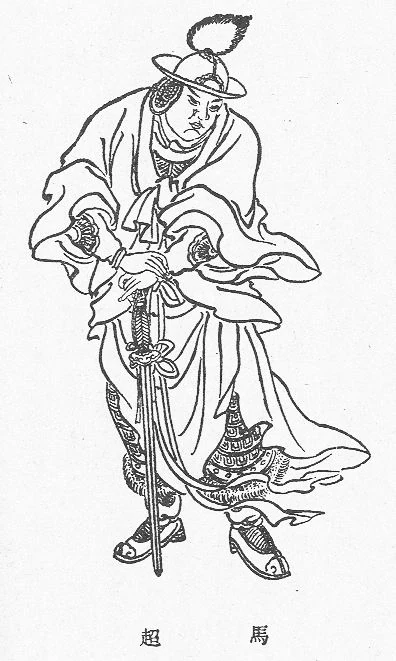
176 CE–222 CE
Military commander
Ma Chao
马超
Ma Chao (176–222), courtesy name Mengqi, was a native of Maoling in Fufeng (northeast of present-day Xingping, Shaanxi) and a descendant of the Han general Ma Yuan, General Fubo. He was a prominent military commander of Shu Han during the late Han and Three Kingdoms period. Known from youth for his physical prowess and courage, Ma Chao joined Han Sui and other Guanzhong commanders in rising against Cao Cao and for a time…
176 CE–222 CEEastern Han
PROFILE
Ma Chao (176–222), courtesy name Mengqi, was a native of Maoling in Fufeng (northeast of present-day Xingping, Shaanxi) and a descendant of the Han general Ma Yuan, General Fubo. He was a prominent military commander of Shu Han during the late Han and Three Kingdoms period. Known from youth for his physical prowess and courage, Ma Chao joined Han Sui and other Guanzhong commanders in rising against Cao Cao and for a time posed a serious threat to him during the Battle of Tong Pass. After defeat he moved between several bases, entered the service of Zhang Lu in Hanzhong, and eventually submitted to Liu Bei, becoming an important Shu Han commander. After Liu Bei proclaimed himself emperor, Ma Chao rose to General of Agile Cavalry, concurrently Governor of Liang Province, and was promoted to Marquis of Lixiang. He died of illness in 222, the second year of the Zhangwu era, at the age of forty-seven by traditional reckoning, and was posthumously titled Marquis Wei during Liu Shan's reign.
- Alternate Names
- Ma Mengqi; "Brocade Ma Chao"
- Courtesy Name
- Mengqi
- Period
- Shu Han
- Date of Birth
- 176
- Date of Death
- 222
- Dynasty/Regime
- Shu Han
- Identity
- Military commander
- Ethnicity/Ethnic Affiliation
- Not reliably confirmed by existing sources
- Native Place
- Maoling, Fufeng (northeast of present-day Xingping, Shaanxi)
- Place of Birth
- Unknown
- Major Achievements
- A Liang Province warlord in the late Han and later a prominent Shu Han commander; allied with Han Sui against Cao Cao and later joined Liu Bei, serving on the northern frontier.
- Courtesy / Art Name
- Mengqi
- Era
- Shu Han
- Dynasty
- The late Eastern Han and Shu Han of the Three Kingdoms
- Ethnicity
- Han
- Ancestral Home
- Maoling of the Right Fufeng
- Place of Death
- Unknown
- Lifespan
- 47 years
- Major Offices
- Aide of the capital commandant's army, prefect of Xuzhou, grand master of remonstrance, lieutenant general, general who pacifies the west, commandant of Linju, general of the left, general of agile cavalry, concurrently governor of Liangzhou
- Peerage
- Marquis of the Pavilion of the Capital, marquis of Taixiang
- Posthumous Name
- Marquis Wei
LIFE TIMELINE
Age 20 | Accompanied his father Ma Teng during fighting with Han Sui; fought Han Sui's subordinate Yan Xing and was nearly killed with a broken spear.
Age 26 | Fought Guo Yuan and Gao Gan under Zhong Yao. Although shot in the foot, he bound the wound and continued fighting; his subordinate Pang De killed Guo Yuan.
Age 32 | Ma Teng entered court service as Minister of the Guards. Ma Chao remained in Liang Province, inherited command of his father's troops, and was appointed General of a Separate Command and Marquis of Duting.
Age 35 | Joined Han Sui and other Guanzhong commanders in rebelling against Cao Cao, confronted him at Tong Pass, and was later defeated after Cao Cao sowed dissension among the allies.
Age 36 | His father Ma Teng and more than two hundred relatives and household members were executed by Cao Cao.
Age 37 | Captured Ji City and styled himself General Who Conquers the West; after Yang Fu and others rebelled against him, he fled to Hanzhong and joined Zhang Lu.
Age 38 | Submitted to Liu Bei and assisted in the seizure of Chengdu.
Age 43 | After Liu Bei became King of Hanzhong, Ma Chao was appointed General of the Left and granted a tally of authority.
Age 45 | After Liu Bei proclaimed himself emperor, Ma Chao was promoted to General of Agile Cavalry, concurrently Governor of Liang Province, and advanced to Marquis of Lixiang.
Age 46 | Died of illness; shortly before death he submitted a memorial entrusting his younger clansman Ma Dai to Liu Bei.
Posthumous honor | Received the posthumous title Marquis Wei.
He died of illness in 222 | He died of illness in 222, the second year o Shortly before his death he memorialized Liu Bei that more than two hundred members of his clan had been almost completely exterminated by Cao Cao, leaving only his younger clansman Ma Dai to continue the ancestral sacrifices, and entrusted Ma Dai to the emperor.
Chengdu | Liu Shan, the Later Ruler of Shu Han, posthumously honoured Ma Chao as Marquis Wei in recognition of his bravery and service.
Marquis Wei conferred | He was posthumously honoured as Marquis Wei.
BIOGRAPHY
Biography
Family Background and Early Life Ma Chao was born in 176, the fifth year of the Xiping era under Emperor Ling of Han, at Maoling in Fufeng. He was a descendant of the Eastern Han general Ma Yuan. His father Ma Teng came from poverty, made a living cutting and selling firewood, and later entered military service because of his physical courage, gradually becoming a regional military power in Liang Province. Ma Chao was Ma Teng's eldest son by a concubine. Raised around soldiers, he developed martial skills from an early age and became known for his strength and bravery. In 196, the first year of Jian'an, Ma Teng and the northwestern warlord Han Sui turned against each other over clashes between their followers. The two men, once sworn brothers, fought repeatedly. The young Ma Chao accompanied his father and fought Han Sui's subordinate Yan Xing. Yan Xing attacked fiercely with a spear; after Ma Chao broke the spear, Yan Xing used the broken shaft to strike Ma Chao's neck and nearly killed him. The encounter exposed Ma Chao to the dangers of battle and hardened his courage. During disturbances in the Three Capital Commanderies, Ma Chao led troops in attacking the Su clan's fortified settlement. According to Fu Xuan's Rhapsody on the Imperial Carriage Horse, the fort contained more than a hundred fine horses, and Ma Chao's soldiers competed to seize the strongest animals. The account suggests that discipline among his troops was not strict, but also shows that Ma Chao was already capable of independent command. ### Rise to Prominence In 202, the seventh year of Jian'an, Yuan Shang's commanders Gao Gan and Guo Yuan allied with Huchuquan, the Southern Xiongnu chanyu, to attack Hedong in an effort to seize Guanzhong. Zhong Yao, Colonel Director of Retainers, wrote to Ma Teng and Han Sui explaining the stakes and sent Zhang Ji and Fu Gan to urge them to provide troops. Ma Teng dispatched Ma Chao with more than ten thousand men to assist in Guanzhong, and the court appointed Ma Chao as Supervising Military Officer under the Colonel Director of Retainers. When Guo Yuan led his army across the Fen River, Ma Chao struck while only part of the force had crossed. He was shot in the foot during the fighting, but bound the wound with cloth and continued to lead his troops, inflicting a major defeat. His subordinate Pang De personally killed Guo Yuan. For this achievement the court appointed Ma Chao Inspector of Xu Province and later Advisory Grandee. Ma Chao did not take up the Xu Province post and instead remained in Liang Province. After Cao Cao became chancellor, he repeatedly summoned Ma Chao to the capital, but Ma Chao declined. In 208, the thirteenth year of Jian'an, Zhang Ji persuaded Ma Teng to enter court service, and Ma Teng was appointed Minister of the Guards. Ma Chao's younger brothers Ma Xiu and Ma Tie were appointed Commandant of the Imperial Carriages and Commandant of Cavalry, and the family moved to Ye. Ma Chao alone remained in Liang Province. He was appointed General of a Separate Command and Marquis of Duting, took command of Ma Teng's troops, and was stationed at Huaili, where he controlled part of the Three Capital Commanderies. ### Rising Against Cao Cao In the third month of 211, the sixteenth year of Jian'an, Cao Cao sent Zhong Yao westward and ordered Xiahou Yuan to march from Hedong to join him. The stated objective was a campaign against Zhang Lu in Hanzhong, but the armies would have to pass through the territories of Ma Chao and the other Guanzhong commanders. They suspected that Cao Cao intended to use the passage as a pretext to attack them. Ma Chao therefore joined Han Sui, Yang Qiu, Li Kan, Cheng Yi, and other leaders of ten Guanzhong forces, together numbering about one hundred thousand troops, in rising against Cao Cao. The episode became known as the rebellion of Han Sui and Ma Chao. To secure Han Sui's support, Ma Chao told him that Zhong Yao had once instructed him to take Han Sui's head and that the men east of the passes could no longer be trusted. He declared that he would abandon his own father and regard Han Sui as his father, and urged Han Sui likewise to abandon his son and regard Ma Chao as a son. Yan Xing advised Han Sui not to ally with Ma Chao, but Han Sui believed that the commanders had reached the same conclusion without prior consultation and chose to join them. He was made commander of the coalition, which advanced toward Huayin and concentrated along the Wei River and Tong Pass. Cao Cao sent Cao Ren and others to hold the area and ordered his generals to remain behind fortified positions until the main army arrived. In the seventh month, Cao Cao personally led his forces west and faced Ma Chao's coalition at Tong Pass. Ma Chao advised Han Sui to hold the northern bank of the Wei River, arguing that within twenty days Cao Cao's supplies from Hedong would be exhausted and his army would withdraw. Han Sui instead favored attacking during a river crossing, and Ma Chao's proposal was not adopted. Cao Cao later heard of Ma Chao's plan and remarked that if Ma Chao remained alive, he feared he would have nowhere to be buried. In the eighth month, Cao Cao crossed the Yellow River north of Tong Pass. Ma Chao sent Liang Xing with five thousand troops against Xu Huang, but Xu Huang repelled him. When Cao Cao himself began crossing, Ma Chao suddenly attacked with more than ten thousand infantry and cavalry, and arrows fell like rain. Cao Cao had only Xu Chu and roughly a hundred elite guards to cover the retreat. Xu Chu raised a saddle with one hand to shield Cao Cao from arrows and propelled the boat with the other, fighting desperately to save him. Commandant Ding Fei released large numbers of cattle and horses on the bank; Ma Chao's soldiers broke formation to seize them, allowing Cao Cao to escape. Cao Cao later laughed that he had nearly been trapped by the "young bandit." In the ninth month, Cao Cao used Jia Xu's stratagem. He spoke and laughed with Han Sui before the armies and sent Han Sui a deliberately altered letter of supposed reconciliation, provoking suspicion within the coalition. Ma Chao and the others indeed began to distrust Han Sui. Cao Cao attacked as the alliance fractured, decisively defeating it south of the Wei River. Cheng Yi, Li Kan, and others were killed, while Ma Chao and Han Sui fled back toward Liang Province. ### Defeat in Liang Province After the Battle of Tong Pass, Ma Chao withdrew into Liang Province. In 212, the seventeenth year of Jian'an, Cao Cao executed Ma Teng and more than two hundred of Ma Chao's relatives and household members who were at Ye, leaving most of Ma Chao's family dead. In 213, the eighteenth year of Jian'an, Ma Chao rose again, took several commanderies in the Long region, and besieged Liang Province Inspector Wei Kang in Ji City. The siege lasted eight months before Wei Kang surrendered. Ma Chao occupied Ji City, styled himself General Who Conquers the West, assumed the office of Governor of Bing Province, and took command of military affairs in Liang Province. The Di king Yang Qianwan allied with him. Ma Chao, however, killed the surrendered Wei Kang and detained the scholar Jia Hong, actions that cost him support. Yang Fu, Jiang Xu, Liang Kuan, Zhao Qu, and others conspired against him. Zhao Qu lured Ma Chao outside the city and then shut the gates, killing Ma Chao's wife and children. With no base left, Ma Chao attacked Licheng, killed Jiang Xu's mother and son, burned the city, and fled with his younger clansman Ma Dai and subordinate Pang De to Zhang Lu in Hanzhong. Zhang Lu appointed Ma Chao as Dujiang Jijiu and initially intended to marry a daughter to him. An adviser objected that a man who had failed to preserve the lives of his father and brothers could not be expected to cherish Zhang Lu's daughter, and the marriage did not proceed. Ma Chao repeatedly asked Zhang Lu for troops to attack Liang Province, but each expedition failed. Zhang Lu's subordinate Yang Bai and others became jealous of Ma Chao's favor and plotted against him, causing Ma Chao to flee from Wudu into Di territory. ### Submission to Liu Bei In 214, the nineteenth year of Jian'an, Ma Chao concluded that he could not accomplish great things with Zhang Lu. At the time, Liu Bei had Liu Zhang surrounded in Chengdu and secretly sent Li Hui to Hanzhong to make contact with Ma Chao. Ma Chao then sent a private letter offering submission, which greatly pleased Liu Bei. News of Ma Chao's defection reached Chengdu and shook morale in the city; Liu Zhang soon opened the gates and surrendered. After taking Yi Province, Liu Bei appointed Ma Chao General Who Pacifies the West, stationed him at Linju, and granted him the title Marquis of Duting. In 219, the twenty-fourth year of Jian'an, after Liu Bei became King of Hanzhong, Ma Chao was appointed General of the Left and granted a tally of authority. Ma Chao served on Shu Han's western frontier, where his reputation among the Qiang and other pastoral peoples contributed to deterring unrest. On one occasion, Peng Yang, an official who resented being distanced by Liu Bei, approached Ma Chao and complained of Liu Bei in reckless terms, then suggested that Ma Chao act outside while he acted within, claiming the realm could then be settled. Having only recently joined Liu Bei, and with most of his relatives already dead because of his earlier rebellions, Ma Chao feared suspicion and reported Peng Yang's words to Liu Bei. Peng Yang was imprisoned and executed. In 221, the first year of Zhangwu, Liu Bei proclaimed himself emperor and founded Shu Han. Ma Chao was promoted to General of Agile Cavalry, concurrently Governor of Liang Province, and advanced to Marquis of Lixiang. He died of illness in 222, the second year o Shortly before his death he memorialized Liu Bei that more than two hundred members of his clan had been almost completely exterminated by Cao Cao, leaving only his younger clansman Ma Dai to continue the ancestral sacrifices, and entrusted Ma Dai to the emperor. Liu Bei accepted the request, and Ma Dai later became an important Shu Han commander.
Major Activities
Military Activity Ma Chao's best-known military campaign was his confrontation with Cao Cao at the Battle of Tong Pass. Leading a coalition of ten Guanzhong forces said to number one hundred thousand, he fought Cao Cao for several months along the Wei River and Tong Pass and at one point nearly trapped him. During Cao Cao's crossing of the Yellow River, Ma Chao attacked with more than ten thousand cavalry and infantry under a rain of arrows, and Cao Cao escaped only through Xu Chu's desperate protection. Cao Cao's later remark that if "the Ma boy" did not die he would have nowhere to be buried reflected the scale of the threat Ma Chao posed. At the Battle of Pingyang in 202, the seventh year of Jian'an, Ma Chao struck Guo Yuan's army while it was crossing the river. Though wounded in the foot by an arrow, he bound the injury and continued fighting. Guo Yuan's forces were routed and Pang De killed Guo Yuan, bringing Ma Chao wider fame. In 213, the eighteenth year of Jian'an, Ma Chao captured Ji City after an eight-month siege, forced Liang Province Inspector Wei Kang to surrender, and later defeated Xiahou Yuan's relief force two hundred li from the city. Although his position collapsed after he lost political support, the campaign demonstrated his military ability. ### Political Activity Ma Chao's political career was highly unstable. He initially refused Cao Cao's summons and remained in Liang Province commanding his father's troops. In 211 he joined the Guanzhong commanders in rising against Cao Cao. After defeat he eventually entered Zhang Lu's service and then submitted to Liu Bei. Under Shu Han he rose to General of Agile Cavalry, concurrently Governor of Liang Province, and Marquis of Lixiang, placing him among the highest-ranking Shu Han military figures. ### Travels and Movements Ma Chao's career took him across Guanzhong, Liang Province, Hanzhong, and Yi Province. In his early years he campaigned with Ma Teng in Liang Province and later occupied Huaili while controlling part of the Three Capital Commanderies. After rising against Cao Cao, he fought at Tong Pass and south of the Wei River, withdrew into Liang Province, and captured Ji City. Following his defeat he fled through Wudu into Di territory and then joined Zhang Lu in Hanzhong. He ultimately submitted to Liu Bei, entered Chengdu, and was later stationed at Linju and associated with operations on Shu Han's northern frontier. ### Relations with Contemporaries Ma Chao's relationship with Han Sui was especially complex. Their fathers' forces had fought each other in Ma Chao's youth; later Ma Chao and Han Sui allied against Cao Cao, only to become suspicious of each other after Cao Cao's stratagem and suffer defeat. His relationship with Zhang Lu was also uneasy: Zhang Lu at one point considered marrying a daughter to him, but abandoned the plan after being advised against it, and jealousy among Zhang Lu's followers eventually drove Ma Chao away. After submitting to Liu Bei, Ma Chao was grouped with Guan Yu, Zhang Fei, Huang Zhong, and Zhao Yun as a leading Shu Han commander; Chen Shou placed all five in a single collective biography in the Records of the Three Kingdoms.
Personal Relations
- Ma Teng: Father, a Liang Province warlord of the late Eastern Han who later entered court service as Minister of the Guards and was executed by Cao Cao because of Ma Chao's uprising.
- Ma Xiu: Younger brother, Commandant of the Imperial Carriages, executed by Cao Cao because of Ma Chao's uprising.
- Ma Tie: Younger brother, Commandant of Cavalry, executed by Cao Cao because of Ma Chao's uprising.
- Ma Dai: Younger clansman who followed Ma Chao and later became an important Shu Han commander.
- Lady Yang: Principal wife, killed at Ji City.
- Lady Dong: Concubine left in Hanzhong when Ma Chao joined Liu Bei; later captured by Cao Cao and given to Yan Pu.
- Ma Qiu: Son by Lady Dong, killed by Zhang Lu.
- Ma Cheng: Son who inherited the marquisate of Lixiang.
- Lady Ma: Daughter who married Liu Li, Prince of Anping and son of Liu Bei. ### Associates - Zhong Yao: Colonel Director of Retainers who persuaded Ma Teng to provide troops; Ma Chao served under his overall command in the campaign against Guo Yuan.
- Zhang Ji: Persuaded Ma Teng to enter court service and later urged Ma Chao to submit to Liu Bei. ### Rulers - Cao Cao: Principal enemy at Tong Pass; later ordered the execution of Ma Chao's family.
- Liu Bei: Ruler whom Ma Chao joined and who appointed him General of Agile Cavalry and Marquis of Lixiang.
- Zhang Lu: Former patron whom Ma Chao later left because of jealousy among Zhang Lu's followers. ### Conflicts - Han Sui: Allied with Ma Chao against Cao Cao but became mutually suspicious after Cao Cao's stratagem.
- Yan Xing: Han Sui's subordinate who once nearly killed Ma Chao.
- Yang Fu: A principal organizer of the rebellion against Ma Chao at Ji City; Ma Chao's wife and children were killed during the uprising.
- Peng Yang: Reported by Ma Chao after making seditious remarks and subsequently imprisoned and executed.
Historical Assessment
Three Kingdoms Period - Cao Cao was recorded as saying that if "the Ma boy" did not die, he would have nowhere to be buried, and also that he had nearly been trapped or deceived by the enemy, reflecting his concern about Ma Chao's military power.
- Yang Fu stated that Ma Chao had the courage of Han Xin and Ying Bu and enjoyed strong support among the Qiang and Hu, while also criticizing him as powerful but lacking righteousness and for turning against his father and ruler and killing provincial officials.
- Chen Shou wrote in the Records of the Three Kingdoms that Ma Chao relied on the Rong peoples and his own courage only to bring ruin upon his clan, while observing that his eventual escape from extremity into security was at least preferable to complete destruction.
- Liu Bei described Ma Chao as one of his "claws and teeth," placing him alongside Guan Yu and Zhang Fei as an important military servant. ### Jin and Northern and Southern Dynasties - Fu Xuan of Western Jin recorded Ma Chao's attack on the Su clan's fortified settlement in the Rhapsody on the Imperial Carriage Horse, describing his martial activity.
- Pei Songzhi's annotations to the Records of the Three Kingdoms, citing the Dianlüe, Weilüe, and other works, add many details about Ma Chao and question the account in the Shanyang Gong Zaiji that Ma Chao addressed Liu Bei by his personal style name.
- Xi Zuochi of Eastern Jin discussed Ma Chao's uprising against Cao Cao in the Han-Jin Chunqiu and commented on the fate of his family. ### Song, Yuan, Ming, and Qing Periods - Sima Guang's Comprehensive Mirror in Aid of Governance provides a detailed account of Ma Chao and the Battle of Tong Pass in a comparatively restrained narrative.
- Chen Liang of the Southern Song described Ma Chao in his Chronology of the Three Kingdoms as a "hero of his time," regarding him as exceptionally brave but deficient in strategy.
- Luo Guanzhong's Romance of the Three Kingdoms popularized the image of "Brocade Ma Chao" and grouped him with Guan Yu, Zhang Fei, Huang Zhong, and Zhao Yun among the Five Tiger Generals.
- The Qing scholar He Zhuo, in Yimen Dushu Ji, described Ma Chao as brave but lacking strategy and unable to build a great enterprise despite his support among Qiang and Hu groups. ### Modern Period - Lü Simian's Informal History of the Three Kingdoms regards Ma Chao as a significant regional power among the late Han contenders and attributes his failure in part to a lack of political foresight.
- Fang Beichen, in Famous Generals of the Three Kingdoms, describes Ma Chao as a formidable battlefield commander while also emphasizing that his political immaturity contributed to the destruction of his family.
- Modern screen portrayals often present Ma Chao as a young, imposing, and exceptionally brave commander, and the epithet "Brocade Ma Chao" remains widely known.
FIGURES ASSOCIATED WITH THIS DYNASTY
Bibliography
- Chen Shou, Records of the Three Kingdoms, Book of Shu, "Biographies of Guan Yu, Zhang Fei, Ma Chao, Huang Zhong, and Zhao Yun," Zhonghua Book Company collated edition.
- Pei Songzhi, annotations to the Records of the Three Kingdoms, citing the Dianlüe, Weilüe, Shanyang Gong Zaiji, and other works.
- Fang Beichen, Famous Generals of the Three Kingdoms, Peking University Press.
- Lü Simian, Informal History of the Three Kingdoms, Zhonghua Book Company.