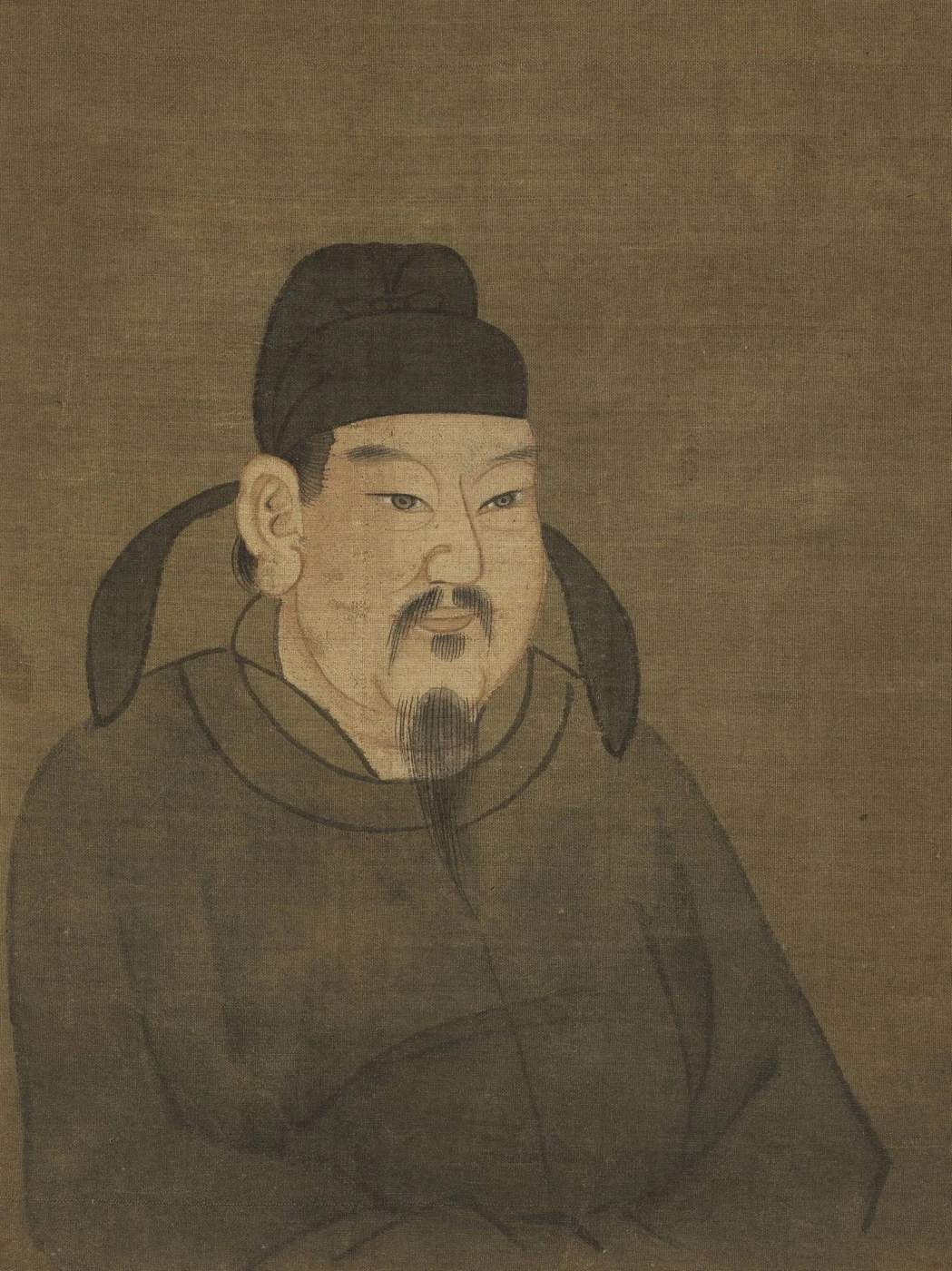
Biography
Family Background and Early Life
Li Chun was born in 778, the thirteenth year of the Dali era. He was the eldest son of Emperor Shunzong of Tang, Li Song, and Lady Wang, later Empress Zhuangxian. When Li Chun was born, his father was still crown prince, and Li Chun grew up in the Eastern Palace at Chang'an. He was intelligent from childhood and was much favored by his grandfather, Emperor Dezong of Tang. In 788, the fourth year of Zhenyuan, Li Chun was created Prince of Guangling Commandery. Historical accounts state that even as a youth he showed a decisive and resolute temperament and was deeply concerned by the arrogance of the military governorships and the deterioration of court government.
In 805, the twenty-first year of Zhenyuan, Emperor Dezong died and Crown Prince Li Song succeeded as Emperor Shunzong. After taking the throne, Shunzong employed Wang Shuwen and others to carry out reforms known as the Yongzhen Reform, but they met strong opposition from eunuchs and military governors. Shunzong reigned for only a few months before illness led him to abdicate in favor of Crown Prince Li Chun. In the eighth month of the same year, Li Chun ascended the throne as Emperor Xianzong and adopted the era name Yuanhe.
Accession and Campaigns against the Military Governorships
When Emperor Xianzong took the throne, the Tang dynasty had long suffered from the separatism of military governorships after the An Lushan Rebellion. Central authority had weakened, regional military governors commanded their own armies, controlled tax revenues, and in some cases passed offices hereditarily. Xianzong was determined to bring about a restoration, making the reduction of military-governor power and the revival of central authority his primary goals. He worked diligently at government, accepted remonstrance, employed capable chief ministers such as Du Huangshang, Pei Du, and Li Jiang, rectified administration, reformed fiscal affairs, and strengthened central military power.
In 806, the first year of Yuanhe, Liu Pi, military governor of Xichuan, rebelled. Xianzong decisively dispatched troops and quickly suppressed the revolt, winning an early success. He subsequently defeated rebellions led by Li Qi in Zhenhai, Wu Yuanji in Huaixi, Li Shidao in Ziqing, and others. Military governorships in Hebei, Henan, Shandong, and elsewhere successively submitted to the central government, producing what became known as the Yuanhe Restoration.
Later Years and Death
In the later part of his reign, Xianzong gradually became more extravagant and arrogant. He trusted practitioners of immortality, pursued longevity, consumed alchemical elixirs, and became irritable and quick to punish attendants. In 820, the fifteenth year of Yuanhe, Xianzong died suddenly in Zhonghe Hall at Daming Palace at only forty-three years of age. Historical works commonly record that he was killed by the eunuch Chen Hongzhi, though there are also accounts linking his death to his late reliance on eunuchs and neglect of government. After Xianzong's death, Crown Prince Li Heng succeeded as Emperor Muzong of Tang. Xianzong received the temple name Xianzong, the posthumous name Emperor Zhaowenzhangwu Dasheng Zhishen Xiao, and was buried at Jingling Mausoleum in present-day Pucheng, Shaanxi.
Emperor Xianzong, originally named Li Chun, was born on the fourteenth day of the second month of 778 in the eastern palace, the Daming Palace, at Chang'an. The reigning emperor was his great-grandfather Daizong, his grandfather Dezong was heir apparent, and his father Shunzong was still a commandery prince, his mother, the Empress Zhuangxian, being a concubine. When Dezong's campaign against the provinces failed and the Jingyuan mutiny broke out in Chang'an, the six-year-old Li Chun fled with him; afterward Dezong took him on his knee and asked whose child he was, and he answered, "I am the third Son of Heaven of the Tang," startling and impressing the emperor with his cleverness. Grown, he loved the *Essentials of Government of the Zhenguan Era* and took Taizong and the young Xuanzong as his models, resolving to curb the provinces and restore Tang prestige. He was made Prince of Guangling in 788 and in 793 took the Lady Guo as consort; his eldest son Li Ning was born that year.
Early in 805 Shunzong took the throne and employed Wang Shuwen, Wei Zhiyi, Liu Zongyuan and Liu Yuxi, whose group sought reforms to check the eunuchs. But the emperor had already been paralyzed by a stroke, and the eunuchs Wenzhen and Liu Guangqi, opposed to reform, joined the provincial governors Wei Gao of Jiannan, Pei Jun of Jingnan and Yan Shou of Hedong in forcing him to name Li Chun heir, changing his name to Li Chun, to have him supervise the government in the seventh month and to abdicate in the eighth in favor of his son — the "abdication of Yongzhen" — after which the members of Wang Shuwen's group, the two Wangs and eight simas, were all demoted. In the first month of 806 the retired emperor died, officially of illness, though unofficial accounts hinted at murder by the eunuchs, as the Tang romance *Xin Gongping Ascends to Heaven* is thought to suggest.
Xianzong resolved "to bring the provinces to order by law" and attacked Liu Pi, deputy governor of Xichuan, in his second year, winning; that same year Yang Huilin of the Xiazhou army refused to give up his troops and was defeated and killed, and in 807 the emperor campaigned against Li Qi, governor of Zhenhai. In 812 Tian Xing, governor of Weibo, submitted to the court, while a campaign against Wang Chengzong of Chengde, who resisted, failed. From 815 to 817 Li Su, governor of Tangdeng, took Caizhou by a night march through snow and put down the rebellion of Wu Yuanji in Huaixi, Han Yu, then secretary of the army, taking part and composing the victory inscription. In 818 the emperor sent five columns against Li Shidao of Ziqing; with Wu Yuanji destroyed, every province at least nominally submitted to the Tang — "and from this time all observed the court's restraints" — a brief reunification known as the Yuanhe restoration.
Alongside this, his devotion to Buddhism left a controversy. In the first month of 819 he sent envoys to Fengxiang to bring the Buddha's relic bone into the palace, and when the vice minister of justice Han Yu memorialized against it in language the emperor found disrespectful, he nearly had him executed and finally banished him as prefect of Chaozhou. Thereafter he came to trust alchemists and take their elixirs and grew ever more violent in temper; he died suddenly in the Daming Palace on the twenty-seventh day of the first month of 820 at forty-three, with the temple name Xianzong, first styled "Holy, Divine, Illustrious and Martial Filial Emperor" and later "Glorious in Letters, Martial in Arms, Great Sage, Most Divine, Filial Emperor," and was buried at Jingling. As to his death the official histories mostly record the elixirs, while others held that the eunuch Chen Hongzhi and his fellows murdered him; the two accounts stand side by side without resolution.
The Yuanhe restoration rested on financial and personnel measures as much as on arms. Xianzong made Li Jiang, Wu Yuanheng and Pei Du chancellors and relied on such commanders as Li Su, Li Guangyan and Wu Chongyin in separate theaters; campaigns against Huaixi and Ziqing lasted years, and the supply of grain and men required long-term financial support, so that the court attended closely to the two-tax revenue and the salt monopoly, the northward transport of Jianghuai wealth becoming the material basis of the campaigns. Pei Du's going to the front in person during the Huaixi campaign is reckoned a chief reason the reign could claim success.
Xianzong's death changed the situation. His successor Muzong adopted a conciliatory policy toward the Hebei provinces, and Chengde, Weibo and Lulong returned to autonomy one after another, so that the gains of the Yuanhe restoration were not maintained; under Jingzong and Wenzong the conflicts among court, eunuchs and provinces deepened, ending in the Ganlu incident under Wenzong. Historians of the middle and late Tang often treat Yuanhe as a turning point: Xianzong's resolve to curb the provinces restored the court's authority, and after his death the central government never again had the will or the occasion, so that eunuchs making emperors and provinces governing themselves became the norm.
Xianzong's reign was also a time when the men who shaped Tang letters and thought were gathered at court. Han Yu promoted the ancient prose movement and was banished for his memorial against the Buddha's relic; Bai Juyi and Yuan Zhen were writing new yuefu and satirical verse; Liu Zongyuan and Liu Yuxi, on the losing side of the Yongzhen reforms, were posted away as adjutants and prefects in distant provinces. Politics and letters answered each other: the brief revival brought by curbing the provinces rekindled the hope of "making the ruler a Yao or Shun," and that hope turned to disappointment after Xianzong's death and the renewed autonomy of Hebei, deepening the note of "protest against injustice" in mid-Tang writing.
Abroad, Xianzong's reign saw alternation of war and peace with the Tibetans and repeated marriage embassies with the Uighurs; in the western regions Tang influence was much reduced, though contact with Central Asia continued through the Hexi and Longyou corridors. These conditions at home and abroad are the setting in which the Yuanhe restoration could appear and could not last.
The Yuanhe restoration came closer than any period since the An Lushan rebellion to restoring the Tang court's authority, and its rise and failure are often cited in later discussions of the dynasty's fortunes.
Youth, Investiture and Accession
Li Chun, whose original name was Li Chun, was a great-grandson of Emperor Daizong of Tang and the eldest son of Emperor Shunzong, born at Chang'an on the fourteenth day of the second month of the thirteenth year of Dali, 17 March 778. When he was six or seven, Emperor Dezong took him on his knee and asked whose child he was and how he came to be in his arms, and Li Chun answered that he was the third Son of Heaven. Dezong was astonished and delighted; for as the emperor's eldest grandson, numbering grandfather, father and son, the answer was both unheard of and exactly right, and Li Shi could not but feel a new fondness for the grandson on his knee. In the sixth month of the fourth year of Zhenyuan, 788, at eleven, Li Chun was enfeoffed as Prince of Guangling; and in the ninth year of Zhenyuan, 793, while still Prince of Guangling, he took as wife the lady Guo, of a great family, a marriage of pure politics, the lady being by generation his father's cousin. In the eleventh year of Zhenyuan, 795, two years after the marriage, the lady Guo bore a son, Li Heng, afterwards Emperor Muzong. On the sixth day of the fourth month of the twenty-first year of Zhenyuan, 805, Li Chun was made heir apparent; on the twenty-eighth day of the seventh month he was given charge of military and state business, acting as regent; on the fourth day of the eighth month the succession passed to him from Shunzong; and on the ninth day of the eighth month he formally ascended the throne in the Xuanzheng hall, changing the era name to Yuanhe in the following year.
Early Zeal and the Reduction of the Provinces
At the outset of his reign Li Chun issued an edict stopping the tribute of rare birds and beasts, took care to set a good tone in government, encouraged his ministers to remonstrate frankly, and himself received counsel with an open mind; and he took the founding of the enterprise by Taizong and the good government of Xuanzong as models to follow, reading the veritable records of the earlier reigns and being stirred by the diligence of sovereign and minister. In the first year of Yongzhen, 805, Liu Pi, military commissioner of Xichuan, held his troops and demanded also the three Sichuan commands, which Li Chun would not allow, and Liu Pi thereupon sent troops to besiege the commissioner of Dongchuan at Zizhou. Li Chun at once ordered Gao Chongwen, commissioner of the left Shence field army, and others to attack him, and in the same year Gao Chongwen took Chengdu, took Liu Pi and sent him to Chang'an, where he was executed with his clan and party. In the summer of the second year of Yuanhe, 807, after Yang Huilin of Xiazhou and Liu Pi of Shu had been put down, the military commissioners were greatly afraid and most of them asked leave to come to court. Li Qi, commissioner of Zhenhai, trusting in his imperial descent, first memorialised that he was ill and asked to postpone his coming; and when the chancellor Wu Yuanheng urged the reduction of the provinces and held that he should not be indulged, Li Chun agreed that authority must be exercised, and on the fifth day of the tenth month issued an edict summoning Li Qi to be left vice director of the department of state affairs. Li Qi refused, and Li Chun stripped him of office and of his place in the imperial register and ordered the troops of the several circuits to attack him together. As the government forces closed in, the command of Zhenhai divided, the commander Zhang Ziliang and others turned to the government and led their troops into the seat at Jingkou, taking Li Qi alive and sending him to Chang'an, where he was cut in two at the waist in the marketplace; and the court gave Li Qi's confiscated property to the people of Zhexi in place of their tax for the year.
The Recovery of Weibo and the Campaign in Huaixi
In the eighth month of the seventh year of Yuanhe, 812, Tian Ji'an, commissioner of Weibo, died, and the army set up his son Tian Huaijian as deputy commissioner in charge of military affairs; but Tian Huaijian was only eleven and could not command, and military and civil matters were all decided by the household servant Jiang Shize and others. Li Chun deliberated on Weibo with his chancellors, and Li Jifu asked to send troops against Tian Huaijian, but Li Jiang held that Tian Huaijian was a child in swaddling clothes who could not possibly hold the situation, that no military action was needed, and that the court should sharpen its weapons and wait for Weibo to come over of itself; and that when disorder broke out within the Weibo army, the court should not begrudge ranks and salaries to the victor, so that the other circuits, seeing it, would come over of themselves and the enemy be subdued without battle. Li Chun heard him and changed to agree. Soon after, mutiny indeed broke out in the Weibo army and the soldiers set up Tian Xing in place of Tian Huaijian, and Tian Xing of himself brought the six prefectures of Weibo over to the Tang court. In the tenth month Li Chun appointed Tian Xing commissioner of Weibo; and in the eleventh month he sent Pei Du, then a drafter of edicts, with a million and a half strings of cash to reward the soldiers of Weibo and remitted the taxes and labour service of the people of the six prefectures for a year, whereupon it was said that the soldiers of Weibo received the gifts with joy like thunder.
Huaixi, since the time of Wu Shaoyang, had remained half independent, and Li Chun had wished to take it since he put down Shu, while the chancellor Li Jifu also insisted on it. In the ninth month of the ninth year of Yuanhe, 814, Wu Shaoyang, commissioner of Zhangyi, that is of Huaixi, died, and his son Wu Yuanji did not receive the imperial envoy but sent out troops on every side, slaughtered Shunyang, burned Ye and plundered Lushan and Xiangcheng, so that the east of the passes was shaken; and Li Chun, following Zhang Hongjing's advice to be courteous first and use force after, sent Li Junhe, vice director of the ministry of works, to offer condolences, but Li Junhe could not enter and returned, and Li Chun resolved to attack Huaixi. As the war went long without success, in the fifth month of the tenth year of Yuanhe, 815, Li Chun sent Pei Du, assistant censor-in-chief, to the field headquarters to comfort the troops and observe the situation; and Pei Du, returning, set out the certainty of victory in Huaixi and recommended Li Guangyan as commander, and soon Li Guangyan defeated the Huaixi troops at Shiqu. In the meantime the chancellor Wu Yuanheng was murdered by assassins and the court was shaken. After four years the attack on Huaixi was still unsuccessful, and the expense of supply was past bearing, so that the generals and such ministers as Li Fengji wished to stop on the ground of the strain on the armies and the drain on the treasury; only Pei Du declared that Wu Yuanji could not be pardoned and asked leave to go himself to direct the fighting. Li Chun appointed him, with the offices of vice director of the chancellery, joint manager of government affairs and prefect of Caizhou, commissioner for consolation and suppression, and Pei Du hastened to the front and became the real commander, enforcing strict military law and uniform orders, and asking that the supervising eunuchs be removed so that the generals might be free to command. In the winter of the twelfth year of Yuanhe, 817, Li Su, commissioner of Tangdeng, led his troops through great wind and snow, marching day and night, and at the fourth watch of the fifteenth day fell suddenly upon the city of Caizhou with no one knowing of it, and took Wu Yuanji, who was sent to Chang'an and beheaded in the eleventh month, so that the thirty years and more of division in Huaixi came to an end.
The Pacification of Ziqing, the Settling of Hebei, and the End
Huaixi being pacified, Li Shidao, commissioner of Ziqing, first begged to submit and then rebelled again. In the seventh month of the thirteenth year of Yuanhe, 818, Li Chun sent the troops of Xuanwu, Weibo, Yicheng, Wuning and Henghai against him, and under the weight of the government armies the command of Ziqing divided, the commander Liu Wu killing Li Shidao, so that Ziqing and eleven other prefectures were pacified. Wang Chengzong of Chengde first offered land in atonement, and when he died the army set up his younger brother Wang Chengyuan as deputy, who dared not make the office hereditary but asked the court to name another commissioner and was made commissioner of Yicheng; Liu Zong of Lulong gave up all his land and troops, sent his officers to the capital and became a monk; Tian Hongzheng was moved to Chengde and Zhang Hongjing sent out to command Lulong. In his later years Li Chun came to believe in arts of longevity: in the thirteenth year of Yuanhe he issued an edict seeking magicians, and a favourite recommended Liu Mi as able to compound the elixir of long life, whom Li Chun made prefect of Taizhou; and the next year he began to take the elixir and his temper became violent and irascible, so that he often reproved or put to death the eunuchs about him. In the fourteenth year of Yuanhe, 819, he had the Buddha's bone brought from Fengxiang to Chang'an, raising a great fervour of almsgiving among princes, nobles and common people alike; and when the vice minister of justice Han Yu sent up a memorial of earnest remonstrance, Li Chun was enraged and would have had him put to death, but on the pleas of Pei Du and others that Han Yu was loyal and upright he was banished to be prefect of Chaozhou. At the end of the fourteenth year of Yuanhe, worn down by the golden elixir, Li Chun lay weak; and in the first month of the fifteenth year of Yuanhe, 820, he was murdered by the eunuch Chen Hongzhi and others at the age of forty-three. Chen Hongzhi and Wang Shoucheng gave it out that he had died of the elixir of long life, and with the eunuch generals Ma Jintan, Liang Shouqian, Liu Chengxie and Wei Yuansu conspired to set up Li Heng, that is Emperor Muzong. In the sixth month of the fifteenth year of Yuanhe Li Chun was buried at Jingling, and afterwards was given the posthumous title of the emperor who was brilliant in letters, martial in arms, great in holiness and perfection of filial piety.
The Vacant Throne of the Empress and the Question of the Heir
Li Chun had many women in his inner palace. Considering that the lady Guo came of a great family, he feared that if she became empress she would not allow him the favours of the inner palace, and so for long would not appoint an empress; and scholars have held that what he feared was not an empress meddling in government but rather the usurpation of the consort's kin. From Li Chun onward the emperors Muzong, Jingzong, Wenzong, Wuzong and Xuanzong followed him in turn and likewise named no empress, so that the empresses spoken of in the histories of that time were in fact mothers of emperors, ennobled after their sons came to the throne. Between him and the lady Guo there was respectful accord, like the manners of one household, and family life was harmonious. In the fourth year of Yuanhe, 809, Li Chun decided to set up an heir: his eldest son Li Ning was of lower birth than his second son Li You and but two years older, yet Li Chun set aside the noble for the elder and made Li Ning heir apparent; and when Li Ning died young, Li Chun agreed to make Li You, afterwards Emperor Muzong, heir, but still would not make the lady Guo empress. Thereafter, over the choice of the new heir, the court and beyond divided into two parties, one headed by the eunuch Tuoba Chengcui, whom Li Chun favoured, planning to set up the Prince of Li, while another group of ministers, leaning on the great house of Guo, urged the setting up of Li Heng, Prince of Sui, son of the lady Guo. Those who presented the address of the emperor of Yuanhe said that in the government of Yuanhe the bows and arrows were laid aside, that the plans were settled beforehand and all yielded before them, that the two rivers were cleared and the great stair made level, and that men said they had not thought to see again the good government of Zhenguan and Kaiyuan in their own day.
His Last Years and After
At the end of the fourteenth year of Yuanhe, 819, Li Chun lay weak from taking the golden elixir. In the first month of the fifteenth year of Yuanhe, 820, he was murdered in the palace by the eunuch Chen Hongzhi and others, and both the Old and New Books of Tang state fairly clearly that he met his death at the hands of Chen Hongzhi and his fellows. After his death Emperor Muzong did not punish Chen Hongzhi, the murderer of the emperor, but soon sent him out to be supervising commissioner at Huainan, a great southern post; and within days of his accession Muzong ordered the magician Liu Mi and the monk Datong beaten to death, banished the magicians of the palace and sent far away the officials connected with them, to show that his father had died of the elixir. Li Chun was buried in the sixth month of the fifteenth year of Yuanhe at Jingling in Shaanxi, which was declared a provincial monument of the first rank on 6 August 1956 and a national key monument of the fifth rank by the State Council on 25 June 2001.