Palace Birth
Born on July 22 in Daming Palace as the eldest son of Emperor Muzong and Lady Wang.
809 CE–827 CE
李湛
Li Zhan (李湛, July 22, 809 – January 9, 827), reigning from 824 to 827 as Emperor Jingzong of Tang (唐敬宗), was the fourteenth monarch of the Tang Dynasty, the eldest son of Emperor Muzong (Li Heng), and born to Empress Gongxi. Ascending the imperial throne before his father's bier in January 824 at the age of sixteen, his short reign was marked by ministerial delegacy to eunuch commander Wang Shoucheng and chancellor Li Fengji,…
Li Zhan (李湛, July 22, 809 – January 9, 827), reigning from 824 to 827 as Emperor Jingzong of Tang (唐敬宗), was the fourteenth monarch of the Tang Dynasty, the eldest son of Emperor Muzong (Li Heng), and born to Empress Gongxi. Ascending the imperial throne before his father's bier in January 824 at the age of sixteen, his short reign was marked by ministerial delegacy to eunuch commander Wang Shoucheng and chancellor Li Fengji, under whom factional struggles between the Niu and Li cliques escalated severely. Emperor Jingzong was notoriously infatuated with equestrian polo, wrestling bouts, and nocturnal fox hunting, frequently neglecting morning audiences and expending substantial state revenues on constructing lavish halls such as the Qingsi Palace. In April 824, dyer Zhang Shao led a desperate rebel band into the imperial apartments, forcing the sovereign to seek refuge in the Shence Army camp. Volatile and cruel, Jingzong frequently beat palace attendants and athletes for minor errors. In January 827, following a late-night banquet, he was assassinated by aggrieved eunuchs Liu Keming and Su Zuoming at eighteen, interred in Zhuangling Mausoleum as a tragic emblem of royal degradation under eunuch dominance.
Born on July 22 in Daming Palace as the eldest son of Emperor Muzong and Lady Wang.
Created Prince of Jing following Muzong's accession; indulged in polo and horsemanship.
Officially designated Crown Prince in December, residing in the Eastern Palace without rigorous tutoring.
Succeeded before Muzong's bier in January at sixteen; neglected morning audiences to play polo.
Dyer Zhang Shao stormed Qingsi Palace in April; Jingzong fled to Shence camp before the mutiny was crushed.
Changed era to Baoli; Li Deyu submitted admonitory verses, which the emperor praised but failed to follow.
Visited the hot springs of Mount Li in November despite weeping remonstrances from censors.
Addicted to midnight fox hunts, lavish construction, and brutal flogging of attendants.
Murdered in the bedchamber by eunuchs Liu Keming and Su Zuoming on January 9, 827, interred in Zhuangling.
Li Zhan was born on July 22, 809 (the seventh day of the sixth month of the fourth year of Yuanhe) in a private chamber of Daming Palace in Chang'an, as the eldest son of Emperor Muzong (Li Heng) and born to Empress Gongxi (Lady Wang). Following Muzong's accession in 820, the youthful Li Zhan was enfeoffed as Prince of Jing. In December 822, upon ministerial petitions and the consent of the inner court, the fourteen-year-old Li Zhan was formally invested as Crown Prince of the Great Tang. Naturally handsome and physically robust, he displayed an avid passion for horsemanship, archery, and acrobatic games, spoiled by Muzong's indulgent affection without receiving rigorous Confucian ethical statecraft education.
In January 824, Emperor Muzong passed away abruptly in his bedchamber following prolonged debauchery and chronic mercury poisoning from alchemical elixirs. The sixteen-year-old Crown Prince Li Zhan hastily ascended the imperial throne before his father's bier as the fourteenth monarch of Tang, proclaiming that the following year would adopt the era Baoli. Emotionally immature and intellectually frivolous, the young sovereign confronted entrenched warlord separatism and rampant eunuch dominance without the slightest ambition to reform the administration or maintain fiscal frugality, leaving supreme state power in the hands of eunuch Wang Shoucheng and bureaucratic factionalists.
Immediately upon accession, Li Zhan transformed the inner court of Daming Palace into a riotous playground for physical amusements. Disregarding filial mourning decorum, he hosted lavish nocturnal drinking banquets and polo tournaments in the Qingsi Palace and Feilong Courtyard within weeks of his enthronement. Impetuous and restless, his pursuit of pleasure degenerated into missing dawn court audiences for consecutive days. Civil and military ministers assembled outside the Zichen Gate before daybreak were forced to wait until midday in scorching sun or freezing cold, with several elderly statesmen collapsing from physical exhaustion, completely eroding dynastic discipline.
Confronted with the young sovereign's unbridled neglect of statecraft, conscientious remonstrators launched vehement petitions. Policy Critic Li Jingjian remonstrated vigorously in court without regard for personal safety, while Rectifier of Omissions Li Han battered his head against the palace pillars until blood flowed across his face, weeping as he recalled the tragic lessons of the An Lushan Rebellion and beseeched Jingzong to distance himself from sycophants. Outwardly moved by these dramatic appeals, Li Zhan offered soothing words and issued decrees commending Li Han's loyalty; however, once back within the inner palace, he resumed polo tournaments without changing his behavior.
In addition to capital censors, distinguished statesman Li Deyu, serving as Surveillance Commissioner of Zhexian, submitted six admonitory poems entitled Dan'yi Zhen, drawing upon ancient maxims to counsel the emperor on self-cultivation, vigilance, heeding advice, shunning lust, relieving subjects, and practicing frugality. Li Zhan expressed genuine admiration for the literary brilliance of the submission, commanding Hanlin academicians to draft an edict honoring Li Deyu with lavish gifts; nevertheless, the insightful counsel remained a mere literary ornament on the imperial desk, failing to exert any meaningful restraint over the sovereign's hedonistic lifestyle.
As time progressed, Li Zhan's recreational pursuits became increasingly eccentric. In addition to daily polo matches on the palace grounds, he developed a hazardous fascination with midnight fox hunting. He frequently led retinues of armed eunuchs and stable boys carrying torches and blades through the palace courtyards and along rooftops, hunting wild foxes with deafening clamor that echoed across the inner precinct. He established dedicated fox-hunting squads and mounted huntsmen to accompany his nocturnal excursions, reducing the imperial residence to chaotic bedlam and stripping away imperial dignity.
The emperor's reckless abandonment of court vigilance degraded palace security to an unprecedented degree, culminating in April 824 in the astonishing palace mutiny led by dyer Zhang Shao. Zhang Shao, an impoverished artisan in the imperial textile workshops, conspired with fortune-teller Su Xuanming, capitalizing on the chaos of Jingzong's polo games to lead a mob of hundreds of armed dyers through the Right Yintai Gate into the palace. The mutineers stormed the Qingsi Palace, feasting upon imperial dishes on the throne, while the terrified emperor was carried on a eunuch's back through back alleys to seek refuge in the Left Shence Army headquarters.
Trembling in terror within the military garrison, Li Zhan wept uncontrollably until Left Shence Army Commander Kang Yiquan mobilized elite armored cavalry to launch an assault on the inner precinct. Heavy cavalry surrounded the Qingsi Palace, slaughtering Zhang Shao, Su Xuanming, and hundreds of mutineers in vicious close-quarters combat. Following the suppression of the bizarre insurrection, Jingzong returned to the throne under military escort; however, this humiliating ordeal failed to awaken his political conscience, serving only to make him completely dependent upon the praetorian eunuchs who held armed military power.
Shortly thereafter, palace defenses suffered another shocking security failure. In August of that year, religious fanatic Ma Wenzhong conspired with minor official Ji Wende and nearly fourteen hundred plotters to stage a nocturnal raid on Daming Palace, an insurrection narrowly thwarted by routine night patrols before the plotters were beaten to death. These consecutive crises underscored the utter paralysis of central authority and the profound weakness of the crown. Yet having escaped danger, Li Zhan immediately dismissed the terrors from memory, conscripting thousands of laborers to build even more extravagant pleasure pavilions.
Beyond reckless hedonism, Li Zhan possessed an erratic and tyrannical temper. Expending tens of thousands of strings of cash, he recruited physically powerful ruffians as wrestling companions and polo players; whenever matches were lost or protocol breached, he flew into violent rages, subjecting eunuchs, attendants, and athletes to savage floggings, occasionally beating servants to death. Prominent eunuchs including Liu Keming and Su Zuoming, who had attended him for years, were repeatedly subjected to humiliating beatings and demotions, cultivating deep, murderous grievances throughout the inner court.
On the night of January 9, 827 (the eighth day of the twelfth month of the second year of Baoli), the eighteen-year-old emperor returned from a massive fox-hunting expedition in the southern hills. In the western wing of Qingsi Palace, Li Zhan gathered twenty-eight intimate attendants, including Liu Keming, Su Zuoming, and Shi Shenying, for an evening of heavy drinking. After several rounds of wine, the intoxicated monarch stumbled unsteadily toward an inner chamber to change his garments. Having endured endless beatings and dreading future execution, Liu Keming and Su Zuoming exchanged glances and resolved to assassinate their tormentor.
As Li Zhan entered the bedchamber, Su Zuoming and Liu Keming abruptly extinguished every candle in the hall, plunging the room into pitch-black darkness. Liu Keming and his accomplices rushed the inner chamber, smothering and strangling the defenseless eighteen-year-old emperor with heavy brocade quilts. The brief, chaotic reign of Emperor Jingzong ended abruptly in a pool of blood within the palace at eighteen. Liu Keming attempted to enthrone Prince of Jiang Li Wu by forging imperial decrees, but was quickly executed by rival eunuch Wang Shoucheng, who enthroned Emperor Wenzong Li Ang. Jingzong was interred in Zhuangling Mausoleum.
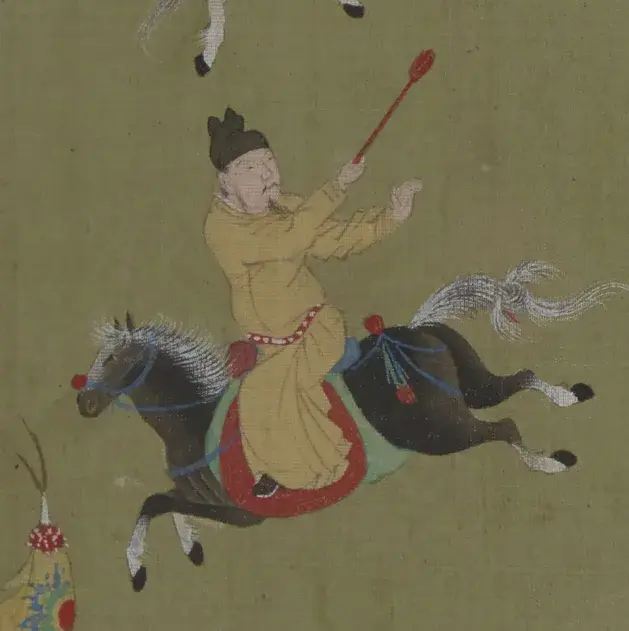
In recreational amusements and martial athletics, Emperor Jingzong was the most obsessive polo player and spectacle enthusiast in imperial Chinese history. Endowed with natural equestrian skill and physical strength, he treated horse polo as the paramount endeavor of his life. He excavated and leveled dozens of expansive polo fields within Daming and Xingqing palaces, establishing the Feilong Courtyard to stable thousands of prized western steeds while recruiting hundreds of commoner equestrians with lavish salaries to compete daily. Disregarding imperial decorum, he personally donned leather armor and wielded mallets in violent matches, suffering repeated falls without dampening his enthusiasm.
In addition to polo, Jingzong displayed unbridled enthusiasm for wrestling bouts, tug-of-war contests, and cockfighting spectacles. He established the Hall of Strongmen within the palace, granting privileged stipends to muscular wrestlers who performed daily in the courtyards for his amusement. He maintained a relentless passion for nocturnal fox hunts and wild fowl stalking, repeatedly defying ancestral regulations to make clandestine journeys to Mount Li and the southern mountains in freezing weather to hunt beasts on horseback. This unchecked indulgence degraded imperial majesty and left an infamous legacy in Tang dynastic records.
Regarding court power dynamics, the reign of Emperor Jingzong marked the decisive phase in which palace eunuchs consolidated complete control over praetorian military commands and imperial succession. Because the young sovereign completely abdicated governmental duties, supreme privy council authority was delegated to Shence Army Commander Wang Shoucheng. Utilizing his command over the imperial guards, Wang Shoucheng exercised absolute dominance over the bureaucracy, colluding with unscrupulous chancellor Li Fengji to purge upright scholar-officials, which exacerbated factional struggles between the Niu and Li cliques and led to the exile of honorable statesmen.
Jingzong's uncritical reliance upon Wang Shoucheng reduced the imperial monarchy to a helpless captive of praetorian eunuchs. The eunuch faction controlled imperial decrees and private treasuries, establishing private tribunals within the military camps to try civil magistrates, while provincial military governors were compelled to bribe Wang Shoucheng before presenting gifts to the emperor. This toxic administrative model established during Jingzong's reign paved the way for the sovereign's assassination by his own servants and the eventual catastrophe of the Sweet Dew Incident under Emperor Wenzong.
In external governance, Jingzong's chronic absenteeism caused administrative paralysis and the severe decay of central institutions. Chancellor Li Fengji and cabinet ministers concealed frontier crises and urgent state business to pander to the emperor's playful temperament. Seeing the sovereign neglect state affairs for months on end, ministerial officials abandoned their posts while public security in the capital deteriorated under rising banditry. Within three years, the hard-won achievements of central imperial authority secured under Emperor Xianzong during the Yuanhe Restoration were completely squandered amid hedonistic indulgence.
Regarding palace construction and fiscal expenditure, Emperor Jingzong inherited an unquenchable penchant for luxury, conscripting immense labor forces to build private pleasure pavilions. Disregarding state insolvency and popular misery, he conscripted tens of thousands of civilian laborers across Guanzhong to build the Qingsi Palace, Xuanqing Hall, and Longshou Lake aquatic pavilions. He dispatched eunuch commissioners nationwide to extort rare beasts and precious timber, with southern tributary convoys bearing silks, ivory, and jade crowding the highways day and night, exhausting the depleted imperial treasury.
To fund this ceaseless extravagance, Jingzong's court levied emergency commercial surcharges and increased salt taxes across Guanzhong, driving commoners into flight and destitution. Yet while squandering immense fortunes on palaces, the emperor showed absolute indifference to drought and flood victims, refusing to disburse palace reserves for humanitarian relief. Straining under the dual burdens of excessive corvée labor and crushing taxes, the populace groaned in misery while the capital palace resounded with music, sharpening social contradictions that directly triggered Zhang Shao's desperate assault on the palace.
Despite his frivolous temperament, Jingzong retained an innate intellectual curiosity and treated scholars with courtesy throughout his reign. Endowed with natural talent for calligraphy, verse, and musical composition, he frequently spent leisure hours composing poetry with Hanlin academicians such as Bai Juyi and Wei Chuhou. Whenever fearless censors like Li Han and Zhang Quanyu delivered stinging remonstrances in court, Jingzong rarely reacted with murderous fury like a tyrant, preferring to bestow silk brocades to comfort them, exhibiting a degree of gracious forbearance toward the scholar-gentry.
In cultural administration, Jingzong ordered the collation of ancient texts in the Department of the Imperial Library, patronized students in the National Academy, and conducted regular imperial civil examinations to recruit scholars into ministerial offices. Upon receiving Li Deyu's Dan'yi Zhen, he demonstrated refined aesthetic judgment by warmly praising its literary composition, proving that his artistic sensibilities were not entirely uncultivated. However, these literary tastes could never offset the fatal damage inflicted upon the empire by his unbridled hedonism, leaving him a tragic juvenile ruler overwhelmed by the currents of power.
From the perspective of institutional history, the brief reign of Emperor Jingzong provided a profound and chilling warning in Tang political development. Ascending the throne at sixteen and murdered at eighteen, his reckless rule permanently shattered the psychological and moral boundaries that had previously governed relations between monarchs and palace servants. The unpunished regicide committed by eunuchs emboldened the praetorian faction to manipulate imperial succession at will throughout the reigns of Wenzong, Wuzong, and Xuanzong, shattering the sacred inviolability of the imperial throne.
FIGURES ASSOCIATED WITH THIS DYNASTY