Birth | Local records place his birth in the second lunar month; his native place was Xiangcheng, Suzhou, while the exact birthplace is disputed. His family later moved to Hengjian village, Yingzhou, after Yellow River flooding
1325 CE
General
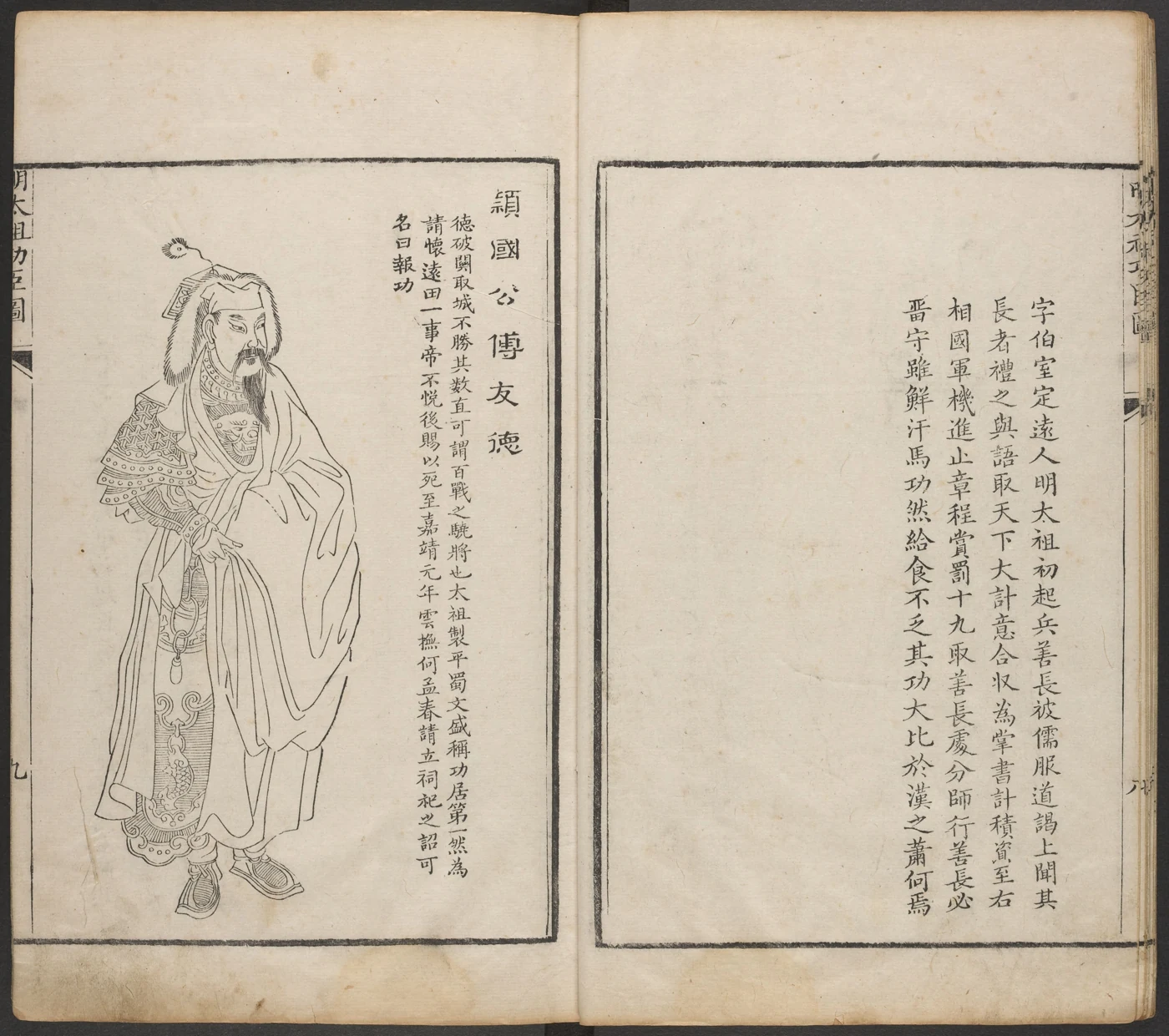
Fu Youde
傅友德
Fu Youde (1325–1394), courtesy name Weixue, was a native of Xiangcheng in Suzhou and a general active from the late Yuan into the early Ming. In the late Yuan he successively served under Li Xixi, Ming Yuzhen, and Chen Youliang. In 1361 he led his men in surrendering to Zhu Yuanzhang and thereafter participated in the Battle of Lake Poyang and the wars of unification in the early Ming. After the establishment of the Ming…
1325 CEMing Dynasty
PROFILE
Fu Youde (1325–1394), courtesy name Weixue, was a native of Xiangcheng in Suzhou and a general active from the late Yuan into the early Ming. In the late Yuan he successively served under Li Xixi, Ming Yuzhen, and Chen Youliang. In 1361 he led his men in surrendering to Zhu Yuanzhang and thereafter participated in the Battle of Lake Poyang and the wars of unification in the early Ming. After the establishment of the Ming Dynasty, he took part in the Northern Campaign into the Central Plains, the conquest of Sichuan, and, in 1381, the campaign to pacify Yunnan as General Who Conquers the South. For his military achievements he was successively made Marquis of Yingchuan and Duke of Ying and at one point held the title Grand Preceptor of the Heir Apparent. His military career spanned Zhu Yuanzhang's expansion from the Jiang-Huai region to rule over most of the country. Fu died in 1394(27th year of Hongwu).
- Noble titles
- Marquis of Yingchuan; Duke of Ying
- Courtesy name
- Weixue
- Period
- Ming Dynasty
- Date of Birth
- 1325
- Date of Death
- 1394
- Dynasty/Regime
- Ming Dynasty
- Identity
- General
- Ethnicity/ethnic affiliation
- Han Chinese
- Native place
- Xiangcheng, Suzhou (present-day Huaibei, Anhui)
- Place of birth
- Unknown
- Major achievements
- Participated in the Battle of Lake Poyang and the wars of unification in the early Ming; took part in the northern campaigns, the conquest of Sichuan, and the pacification of Yunnan; was made Duke of Ying for military merit.
- Lifespan
- Unknown
LIFE TIMELINE
Early military service | Served successively under Sesame Li (Li Er), Li Xixi, Ming Yuzhen, and Chen Youliang; the surviving sources do not securely date each transfer
Military service | Li Xixi was defeated and entered Sichuan; Fu followed and later joined Ming Yuzhen
Submission | When Zhu Yuanzhang attacked Jiangzhou, led his men in surrendering and was placed under Chang Yuchun
Battle | Fought in the Battle of Lake Poyang and continued after receiving several wounds; Chen Youliang was killed by a stray arrow during the campaign
Wuchang campaign | Captured Gaoguanshan at Wuchang and was appointed Commander of the Xiongwu Guard
Defense of Xuzhou | Defeated a Yuan general named Li Er (also written Li Er/Er; the sources do not establish whether he was the same person as Sesame Li) and was promoted to Assistant Grand Councilor in the Jiang-Huai Branch Secretariat
Northern Campaign | Served with Xu Da in the northern campaigns, including operations at Dadu and Taiyuan; the biographical sources group several campaigns across adjacent years
Enfeoffment | Made Marquis of Yingchuan and granted the merit title Kaiguo Fuyun Tuicheng Xuanli Wuchen
Sichuan campaign | Served as Vanguard General Who Conquers the Enemy and, advancing separately from General Who Conquers the West Tang He, helped destroy the Ming Xia regime in Sichuan
Northern campaign | Joined Feng Sheng's northern expedition into the steppe; the source records seven victories in seven engagements and describes his force as the only one of the three columns to achieve complete success
Yunnan campaign | Served as General Who Conquers the South and led a force stated to number 300,000 in the campaign to pacify Yunnan
Enfeoffment | Advanced to Duke of Ying with an annual stipend of three thousand shi
Later years | Concurrently held Grand Preceptor of the Heir Apparent; was rebuked by Zhu Yuanzhang over a request for land
Later years | Guoque records that Fu killed his two sons and then died by suicide after a winter banquet; the History of Ming only briefly records that he was later put to death by imperial order
In the autumn of 1381(14th year of Hongwu) | In the autumn of 1381(14th year of Hongwu), Zhu Yuanzhang decided to conquer Yunnan.
In 1384(17th year of Hongwu) | In 1384(17th year of Hongwu), Fu was advanced to Duke of Ying with a stipend of three thousand shi and a hereditary certificate.
In 1392(25th year of Hongwu) | In 1392(25th year of Hongwu), Fu requested one thousand mu of commoners' land in Huaiyuan.
It says Zhu learned of the conversation and | It says Zhu learned of the conversation and, at a winter banquet in 1394(27th year of Hongwu), rebuked Fu and ordered him to summon his two sons.
BIOGRAPHY
Biography
Family Background and Early Years Local materials record Fu Youde’s birth as the eighth day of the second lunar month in 1325(2nd year of Taiding). his native place as Xiangcheng, Suzhou, while His family later moved to Hengjian village in Yingzhou after Yellow River flooding. The surviving sources provide little information about his family. The Zuiwei Lu says that he later lived as a hired guard in Dangshan. Liu Futong launched an uprising in Yingzhou in 1351(11th year of Zhizheng), but the surviving biographical sources do not establish that Fu joined it that year. The Zuiwei Lu says only that he later served under Sesame Li, so the date of Fu’s entry into the rebel forces is left unspecified here. The Accounts of Rival Powers at the Founding of the Dynasty dates Sesame Li’s Xuzhou uprising to 1351 and describes how the group entered the city disguised as river workers. This account of the uprising is distinct from the uncertain date when Fu joined Sesame Li’s forces. The Zuiwei Lu states that Fu’s skill in striking, fencing, riding, and archery was outstanding for his time. In 1352(12th year of Zhizheng), Yuan forces captured Xuzhou and Sesame Li escaped. The Zuiwei Lu says Fu later reached Dangshan, worked as a hired guard, married into a Cheng family in Zaozhuang, and then left after encouragement from an elderly neighbor surnamed Gao to join Li Xixi. It does not date each of these events separately. ### Service under Rival Powers Fu followed Li Xixi in campaigns through Shandong and took part in an attack on the palaces at Shangdu. In the sixth month of 1357(3rd year of Longfeng), Liu Futong attacked Bianliang and divided his forces into three northern columns. Li Xixi's column moved toward Guanzhong, and Fu followed him west. In the fourth month of 1358(4th year of Longfeng), Chaghan Temür concentrated forces against Li Xixi at Gongchang Prefecture. Li was defeated and entered Sichuan, with Fu following him. In Sichuan, Li Xixi's followers used blue headscarves and were known as the Blue Turban army, but they were defeated by Ming Yuzhen. Fu then joined Ming Yuzhen but was not given important responsibilities. Dissatisfied, he took his own men to Wuchang, transferred to Chen Youliang, and served together with Ding Pulang in defending Xiaogushan. ### Submission to Zhu Yuanzhang In the eighth month of 1361(21st year of Zhizheng), Zhu Yuanzhang personally led a naval force against Chen Youliang. Zhu had learned from the captive Li Mingdao that Chen had killed Xu Shouhui, that his officers were divided, and that orders were inconsistent, and decided to advance. On the thirteenth day of the eighth month he reached Caishi and moved upstream. Fu, then one of the defenders of Xiaogushan, led his men in surrendering. Zhu judged him to be exceptional and appointed him as a commander under Chang Yuchun. In 1363(23rd year of Zhizheng), Fu followed Chang Yuchun in relieving Anfeng and taking Luzhou. He then fought in the Battle of Lake Poyang, where he used light boats against Chen Youliang’s vanguard. Fu suffered several wounds but continued fighting and later joined the engagement at Jingjiangkou. Chen was killed by a stray arrow during the campaign; the sources do not attribute the fatal wound to Fu. The next year Fu took part in the campaign against Wuchang. Gaoguanshan overlooked the city from the southeast but was held by the defenders and the other generals hesitated to attack. Fu led ten thousand men in taking it. An arrow struck his cheek and passed through, and another wound pierced his side, but he continued fighting. After Wuchang was pacified, he was appointed Commander of the Xiongwu Guard. Fu later followed Xu Da in taking Luzhou and separately captured Yiling, Hengzhou, and Xiangyang. At Anlu he suffered nine wounds but ultimately took the city and captured the Yuan commander Ren Liang. He also joined operations in eastern Huai, defeated Zhang Shicheng's reinforcements at Maluogang, captured one thousand vessels according to the source, and later defeated the Yuan commander Zhu Zhen at Anfeng. ### Defense of Xuzhou and the Northern Campaign In 1367(1st year of Wu), while Zhu Yuanzhang concentrated on western Zhejiang, Fu was assigned to defend Pengcheng, or Xuzhou. The Yuan commander Köke-Temür (Wang Baobao) sent a general named Li Er (also written Li Er/Er) to attack and encamped at Lingzi village. The sources do not establish whether this general was the same person as the earlier rebel Sesame Li. Fu judged himself outnumbered and refused battle at first. After learning that Yuan troops had dispersed to plunder, he took two thousand men upstream to Lülianghong and attacked after landing. Fu personally charged the Yuan officer Han Yi with a lance and killed him. Expecting reinforcements, Fu quickly returned, opened the city gates, formed his troops outside, and ordered them to lie behind their spears until the drum signal. Li Er arrived with a larger force but hesitated before the orderly formation. Fu then had the drums sounded and attacked, defeating the Yuan army and capturing Li Er. He was summoned to the capital and promoted to Assistant Grand Councilor in the Jiang-Huai Branch Secretariat. Zhu Yuanzhang removed the canopy from before his own position and had drums and wind instruments accompany Fu back to his residence as an exceptional honor. That year Zhu Yuanzhang ordered Xu Da to conduct the Northern Campaign. He praised Fu and Xue Xian for courage and strategic ability and judged them suitable to command vanguards independently. Fu followed the army in taking Yizhou, killing Wang Xuan, capturing Qingzhou, and advancing through Shandong and Henan to Dadu (Beijing). He then reconnoitered the passes near Gubeikou with picked cavalry and later joined the main army from Zhending toward Taiyuan. Köke-Temür came from Bao'an with ten thousand cavalry and formed up against the camp. Fu led fifty cavalry in driving them back and then participated in a night attack. Köke-Temür fled, and Fu pursued to Tumen Pass. The source records forty thousand armored soldiers captured and very large numbers of horses. Fu later defeated He Zongzhe at Shizhou and Tuoliebo at Xuanfu, then moved west to join Xu Da at Qingyang. He stationed a force at Lingzhou to block reinforcements, and after Qingyang fell the Guanzhong-Shaanxi region was brought under Ming control. ### Enfeoffment and the Conquest of Sichuan In 1370(3rd year of Hongwu), Fu followed Xu Da to Dingxi and defeated Köke-Temür. He then took part in operations toward Sichuan, leading the vanguard through Yibaidu, taking Lüeyang, and entering Mianzhou before moving through Lianyun plank roads toward Hanzhong. When supplies failed he withdrew to Xi'an. When the Ming Xia commander Wu Youren attacked Hanzhong, Fu led three thousand cavalry to the relief. At Doushan stockade, he ordered each soldier to carry ten torches up the mountain at night. The defenders believed a large reinforcement force had arrived and fled. That winter, in a broad distribution of honors, Fu received the merit titles Kaiguo Fuyun Tuicheng Xuanli Wuchen, Grand Master for Glorious Happiness, Pillar of State, and co-director in the Chief Military Commission; he was made Marquis of Yingchuan with a stipend of 1,500 shi and received a hereditary certificate. In 1371(4th year of Hongwu), Fu served as Vanguard General Who Conquers the Enemy and advanced on Sichuan separately from General Who Conquers the West Tang He. Tang He and Liao Yongzhong attacked Qutang Gorge by water, while Fu and Gu Shi led infantry and cavalry through the Qin-Long region. Zhu Yuanzhang instructed Fu that the Ming Xia forces would likely concentrate in the east at Qutang and in the north at Jinniu and urged him to strike unexpectedly at Jiezhou and Wenzhou with speed. Fu publicly announced that he would move through Jinniu but instead rushed to Chencang and traversed difficult mountain routes day and night. Reaching Jiezhou, he defeated the Ming Xia commander Ding Shizhen and took the city. When the defenders destroyed the bridge over the Bailong River, Fu's army rebuilt it, crossed, took Wuliguan, and captured Wenzhou. He then crossed the Baishui River and moved directly toward Mianzhou. The Han River was in flood, preventing a crossing, so his army felled timber to build vessels. To send news of his progress downstream toward Qutang, Fu had thousands of wooden tablets cut with the dates on which Jie, Wen, and Mian had fallen and cast them into the river. The defenders who saw them reportedly lost heart. The Ming Xia chancellor Dai Shou and others had concentrated their best troops at Qutang. On learning that Fu had taken Jie and Wen and was advancing toward Jiangyou, they detached forces toward Hanzhou to protect Chengdu. Before the reinforcements arrived, Fu defeated the local defender Xiang Daheng outside the city. He told his troops that the relief force, after a long march and hearing of Xiang's defeat, would already be demoralized. Fu then intercepted and defeated it, took Hanzhou, and advanced on Chengdu. Dai Shou used war elephants in battle. Fu ordered strong crossbows and firearms against them and continued fighting after being hit by an arrow. The elephants turned and trampled many Ming Xia troops. After learning that Ming Sheng had surrendered, Dai Shou and others registered the treasuries and granaries and surrendered with their hands bound. Chengdu was pacified. Fu then sent forces against remaining prefectures, took Baoning, and captured Wu Youren. The source states that Sichuan was thereby pacified. By the time Tang He's river force advanced after receiving the wooden tablets, the defenders at Qutang had already sent their elite troops west to Hanzhou, leaving weaker forces behind. Liao Yongzhong was therefore able to press on to Chongqing and receive Ming Sheng's surrender. Zhu Yuanzhang's Proclamation on Pacifying Western Sichuan later praised Fu's achievement as first and Liao Yongzhong's as second. ### Northern Steppe Campaign and Pacification of Yunnan In 1372(5th year of Hongwu), Fu assisted Feng Sheng on a campaign into the northern steppe. At Xiliang he defeated a Northern Yuan commander named Shilahan, and at Yongchang defeated the Grand Commandant Duo'erjiba. He captured large numbers of horses, cattle, and sheep. At Gansu he killed the pingzhang official Buhua and received the surrender of the Grand Commandant Suona'er and others. At Gua and Sha prefectures the source records the capture of gold and silver seals and twenty thousand head of livestock. Of the three campaign columns, the source describes Fu's as the only one to achieve complete success, with seven victories in seven engagements. Because the overall commander Feng Sheng was punished, Fu received no additional reward. In the autumn of 1381(14th year of Hongwu), Zhu Yuanzhang decided to conquer Yunnan. Fu served as Regional Commander, bore the seal of General Who Conquers the South, and commanded Left Deputy General Lan Yu and Right Deputy General Mu Ying, leading an army stated to number 300,000. Reaching Huguang, Fu detached commander Hu Hai and others with fifty thousand troops to move from Yongning toward Wusa, while he led the main army through Chen and Yuan toward Guizhou. He took Puding and Pu'an and received the submission of local groups. At Qujing he fought the Battle of Baishijiang and captured a Yuan pingzhang official whose name is named Dalima. He then advanced on Wusa, moved south along Gegushan to link with the Yongning forces, and sent the two deputy generals directly toward Yunnan. Basalawarmi, the Yuan Prince of Liang, died by suicide while fleeing. Fu built fortifications at Wusa. When local groups attacked, his forces defeated them, took Qixing Pass, and opened communication with Bijie. He also captured the Kedu River positions and received the submission of groups in Dongchuan, Wumeng, and Mangbu. When the Wusa groups rebelled again, Fu campaigned against them. The source records more than thirty thousand enemies killed and more than one hundred thousand cattle and horses seized, after which the Shuixi groups all submitted. In 1384(17th year of Hongwu), Fu was advanced to Duke of Ying with a stipend of three thousand shi and a hereditary certificate. In 1386(19th year of Hongwu), he campaigned against local resistance in Yunnan. In the 20th year of Hongwu, he assisted General-in-Chief Feng Sheng against Naghachu at Jinshan. In the 21st year, when groups in Dongchuan rebelled, Fu again served as General Who Conquers the South and suppressed them. He then moved against the Yuezhou leader Azi and defeated him at Pu'an the following year. In 1390(23rd year of Hongwu), Fu accompanied Prince of Jin Zhu Gang and Prince of Yan Zhu Di on a campaign into the steppe and captured the Mongol Nair Buhua. After returning he garrisoned Kaiping and later campaigned again in Ningxia. The next year he served as General Who Conquers the Enemy and guarded the Beiping frontier. He then accompanied Prince of Yan against the Mongol Hazhesheli and pursued a Yuan Prince of Liao. Shortly after the force departed, it unexpectedly received orders to return. Because the Yuan troops were unprepared, the Ming force instead penetrated secretly to Heiling, defeated them, and returned. ### Later Years and Death Fu Youde rose through accumulated merit to Duke of Ying and Grand Preceptor of the Heir Apparent. His son Fu Zhong married Princess Shouchun, while Fu's daughter married Zhu Jixi, heir to the Prince of Jin, placing the family in close marital connection with the imperial house. In 1392(25th year of Hongwu), Fu requested one thousand mu of commoners' land in Huaiyuan. Zhu Yuanzhang rebuked him, saying that his stipend and rewards were already generous and asking why he wished to encroach on the people's interests, invoking the example of Gong Yixiu. Soon afterward Fu assisted Duke of Song Feng Sheng in dividing forces through Shanxi, organizing military agriculture around Datong and Dongsheng and establishing sixteen guards. The Guoque (vol. 10) records that after the Lan Yu case Wang Bi told Fu that Zhu Yuanzhang’s advanced age placed the meritorious officials in danger. It says Zhu learned of the conversation and, at a winter banquet in 1394(27th year of Hongwu), rebuked Fu and ordered him to summon his two sons. According to the Guoque, Fu soon returned with their heads, stated that the emperor wanted the heads of father and sons, and killed himself; his surviving family was relocated and Wang Bi also died by suicide. The History of Ming, by contrast, does not recount the banquet and only says that Fu was summoned back and was put to death the following year. The banquet narrative is therefore attributed specifically to the Guoque. In the ninth month of 1493(6th year of Hongzhi), Prince of Jin Zhu Zhongxuan cited a precedent involving the descendants of Duke of E Chang Yuchun and requested a one-rank promotion for Fu Youde's fifth-generation descendant Fu Ying so that he could maintain ancestral sacrifices; the Ministry of Rites rejected the request. In 1644(17th year of Chongzhen), the Hongguang Emperor of Southern Ming posthumously made Fu Prince of Lijiang with the posthumous name Wujing.
The Red Turbans and the Rising of Sesame Li
The army to which Fu Youde first attached himself had its origins in the Red Turban upheaval at the end of the Yuan. The Gengshen waishi records that in the fifth month of the eleventh year of Zhizheng a Red Turban force rose at Yingshang in Yingzhou and took the style of the Incense Army, so named because its members burned incense in worship of the Maitreya Buddha. It began in the household of a scholar named Han at Luancheng in Zhaozhou, and before long the people of the Yellow River, the Huai, Xiang and Shaanxi regions followed it as one, so that the Red Turbans of Jing and Han, Xu and Ru, Shandong, Feng and Pei and the two Huai all rose in response. The force at Yingshang, under Du Zundao, took Chenggao, seized the granaries and grew to several hundred thousand, then took Runing, Guangxi and Xinyang; the force of Qi and Huang, led by the monk Peng Yingyu and Xu Zhenyi, took Deyang, Mianyang, Anlu, Wuchang, Jiangling and the commanderies of Jiangxi; those who rose in Xiang and Han, led by Bu Wangsan and Meng Haima, took Tang, Deng, Nanyang, Song, Ru and Henanfu under the former and Jun, Fang, Xiangyang, Jingmen, Gui and Xia under the latter; and those who rose at Feng and Pei were led by Sesame Li. Sesame Li was a man of Pizhou who, in a year of famine, had possessed only one granary of sesame which he gave away entirely to relieve others, and so came by his name. At that time Jia Lu was cutting a new channel for the Yellow River, destroying the livelihood of the people wherever he went, and men's minds were unsettled. Sesame Li plotted to rise with his neighbour Zhao Junyong, saying that the court had rashly undertaken great works, that the common people were poor and had nowhere to appeal, and that since the Yingshang Incense Army had risen and the government troops could do nothing against it, this was the season for true men to seize wealth and honour. Zhao Junyong went to the house of Peng Er south of the Yan city wall and found him sharpening an axe; he urged wealth and honour upon him, and Peng Er at once understood, asking whether Sesame Li was among them, and on being told that he was, followed him. Eight men having come together, they smeared blood in oath. On the tenth day of the eighth month of that year the eight pretended to be labourers on the river works and hurried into the city of Xuzhou; when the gate guards turned them back at night they said they were river labourers who only wanted a night's lodging, and what harm was that. At the fourth watch four men inside the city lit four fires and four outside answered with four more, and then combined into one. A shout went up within the city, those outside responded, and in an instant all was disorder; the four within seized weapons and began killing while the four without entered, and all cried out to kill. The people had long been strangers to war and, seeing the killing, submitted with folded hands. At dawn a great banner was set up to recruit soldiers, and more than a million followed, so that they held the counties near Xuzhou together with Suzhou, Wuhe, Hongxian, Feng, Pei and Lingbi, and, westward, Anfeng, Hao and Si.
Surrender at Xiaogu and the Battle of Jiangzhou
Chapter 9 of the Veritable Records of Taizu records that on the gengyin day of the eighth month of the xinchou year Zhu Yuanzhang in person led the fleet against Chen Youliang. Earlier Zhu Wenzhong had sent Li Mingdao to Jiankang, and when Zhu Yuanzhang asked how matters stood with the Chen, Li Mingdao said plainly that Chen Youliang had murdered Xu Shouhui, that his officers were estranged from him, that his orders were inconsistent and many held power on their own authority, and that such a brave commander as Zhao Pusheng had been killed out of jealousy, so that though he had many men they were of no use. When Anqing fell, Zhu Yuanzhang resolved to attack, and summoned his generals to say that Chen Youliang had murdered Xu Shouhui and usurped the great title, which neither heaven's principle nor human feeling could tolerate, and that they should each encourage their soldiers to follow. Xu Da said that an army with justice on its side is strong, and that since they were upright and the enemy crooked there could be no failure; Liu Ji also reported that in the sky the evening before Venus had gone before and Mars behind, a sign of victory for the army. Thereupon he led Xu Da, Chang Yuchun and the others out from Longwan with the fleet, himself aboard a great ship named Dragon Courser, with a large banner set before him inscribed "To relieve the people and punish the guilty, to receive the submissive and summon those who submit". The armies went up with wind and current, and ten thousand crows flew alongside the flagship while a snake came floating from the northwest to coil about the rudder, so that all took it for a portent of divine favour. The next day they reached Caishi and anchored at Niuzhuji; on the wuxu day they reached Anqing, where the enemy held fast and would not fight; they held him in check with land forces, and when the enemy moved, ordered Liao Yongzhong and Zhang Zhixiong to attack his water fort with the fleet, breaking more than eighty enemy boats and taking twenty-seven warships, and so Anqing was taken. Advancing without pause to Xiaogu, Chen Youliang's commander Fu Youde and Ding Pulang came out and surrendered. On the renyin day the army halted at Hukou and met Chen Youliang's boats on patrol; Chang Yuchun was ordered to attack, the enemy withdrew, and pursuing to Jiangzhou they found Chen Youliang in person directing the fighting; the fleet was divided into two wings and fell upon him from both sides, breaking him again and taking more than a hundred boats. Chen Youliang, at his wits' end, abandoned the city at midnight with his wife and children and fled to Wuchang. On the guimao day the army entered Jiangzhou, taking more than two thousand horses and grain in the quantity of several hundred thousand, and Xu Da was sent in pursuit; hearing that Chen Youliang meant to bring out warships from Mianyang to resist, he camped at Dunkou in Hanyang to block him.
The Wuchang Campaign and the Capture of Zhang Bixian
Chapter 14 of the Veritable Records records that on the xinhai day of the second month of the jiachen year Zhu Yuanzhang came to Wuchang and directed the assault. Earlier Zhang Dingbian, grand commandant under Chen Li, seeing matters come to a crisis, secretly sent soldiers by night down the wall by the Guanyin Pavilion to Yuezhou to tell the chancellor Zhang Bixian to come to the rescue. Zhang Bixian brought his troops to within twenty li of the city and camped at Hongshan, whereupon Chang Yuchun was ordered to attack with five thousand picked men before the enemy could concentrate; the enemy was heavily defeated and Zhang Bixian taken. Zhang Bixian was brave and skilled in war, known to men as "Splashing Zhang", and the defenders relied on him greatly; he was now bound and shown below the wall, with the words that the man in whom they trusted had been taken and there was nothing left to rely on. Zhang Bixian also called to Zhang Dingbian, saying that he had come to this pass and the affair could not be saved, and that his brother should look to himself and surrender quickly, which was the best course. Zhang Dingbian was choked and could not speak. Southeast of the wall of Wuchang there was a hill called Gaoguan, overlooking the city, and when Zhu Yuanzhang asked which of the generals could take it, Fu Youde asked leave to go and carried it at the first drumming with several hundred men, so that the defenders lost heart further still. Some days later Luo Furen, an old minister of Chen Youliang, was sent into the city to tell Chen Li and Zhang Dingbian that if Chen Li came he would not lose his wealth and honour. Luo Furen asked leave to say that his sovereign extended the benevolence that loves life and would spare this region, that the orphan of the Chen house might keep his head and that he himself would not break his word, and that he would die without regret. Zhu Yuanzhang said that his forces were not insufficient but that he had stayed so long only to await a voluntary submission and spare the people, and that Luo Furen should go and not be misled. Luo Furen wept below the wall; Chen Li, startled, called him in, and the two wept together; when the weeping stopped and the reason was asked, Luo Furen conveyed the imperial meaning in earnest and moving words, and Chen Li and Zhang Dingbian and the rest asked to surrender. In this campaign Fu Youde was first to scale the hill and took an arrow without flinching, so that the other generals were won over to him, and on his return he was promoted to commandant of the Xiongwu Guard.
Rewards in the Second Year of Hongwu and a Marquisate in the Third
Chapter 47 of the Veritable Records records that on the jichou day of the twelfth month of the second year of Hongwu Zhu Yuanzhang held court at the Fengtian Gate and greatly rewarded the merits of the officers who had pacified the central plain and campaigned in the south. Xu Da, general-in-chief, right chancellor and Duke of Xin, who had taken the prefectures of Shandong, Henan, Yan and Ji, Qin and Jin, defeating the enemy, spreading the state's prestige and pacifying soldiers and people like a great general, received five hundred taels of silver and fifty bolts of patterned silk; Chang Yuchun, Prince of Kaiping, who had died of illness in the army, was rewarded according to his merits while alive on the same scale as the general-in-chief. Feng Zongyi, because at Zezhou he and the chancellor Yang Jing had each gone their own way and lost soldiers, and because when he took command of the whole army in the bitter cold he withdrew without orders and left the soldiers frozen and hungry, was excluded from the rewards; but in consideration of his earlier part with the general-in-chief in pacifying Shandong, Henan and Shaanxi, he was given two hundred taels of silver and fifteen bolts. Tang He, commanding in the south, was too lenient and let the remnants of Chen Youding's mountain camps disperse, so that eight commanderies rebelled again and the army was greatly wearied; his merits and faults balancing, he was given two hundred and fifty taels and fifteen bolts. Liao Yongzhong, who had pacified Fujian, Guangdong and Hainan and summoned the mountain valleys of the two rivers, deserved full reward, but in Fujian he had not supported Tang He, and so, merits and faults balancing, he received two hundred and fifty taels and twenty bolts. Wu Zhen, whose army was orderly, who hunted down the remnants of the Lanxiushan rebels and brought his whole force home, received two hundred and fifty taels and twenty bolts. Zhao Yong, who followed the general-in-chief in pacifying Shandong, Henan, Yan and Ji, Qin and Jin, and afterwards went with Chang Yuchun from Shaanxi to retake Shangdu, and later as deputy general with Li Wenzhong commanded in Shanxi and took Tuoliebo alive, received two hundred taels and nineteen bolts. Cao Liangchen and others, who had many victories, received two hundred and fifty taels and twenty bolts. The right vice minister Xue Xian and the assistant administrator Fu Youde each received two hundred taels of silver and nineteen bolts of patterned silk; the chancellor Han Zheng two hundred and fifty taels and seventeen bolts; the chancellor Yu Tongyuan, the right vice ministers Mei Sizu and Lu Ju and the deputy commissioner Gu Shi each one hundred and fifty taels and fifteen bolts. Below these, from seven bolts for each guard commander and six for each chiliarch and guard judge down to three piculs of rice and three taels three mace of silver for a company commander, three piculs and three taels two mace for a squad leader and three piculs and three taels for a common soldier, all had their grades. In that year's rewards Fu Youde stood with Xue Xian, his merit already among the foremost of the generals.
The Plan for the Southern Campaign and the Farewell at Longjiang
In the fourteenth year of Hongwu Zhu Yuanzhang resolved to pacify Yunnan and appointed Fu Youde general of the southern campaign, with Lan Yu as left deputy and Mu Ying as right deputy, commanding three hundred thousand horse and foot; he escorted them in person to Longjiang and gave them his plan before they set out. He told Fu Youde that Yunnan lay far off in a desolate region, and that in conducting a campaign one must know the shape of its mountains and rivers in order to plan the advance; that he had studied the maps and consulted many men to learn its defiles, and that the plan should begin from Yongning, sending first a bold commander with a force toward Wusaz, while the great army entered Puding by way of Chen and Yuan, occupying the vital points before advancing; that Qujing was the throat of Yunnan and that the enemy would surely concentrate there to resist, and that the opportunity for seeing the ground and winning by surprise lay precisely there; that after Qujing was taken one of the three generals should take picked troops to Wusaz to join the force from Yongning while the great army drove straight at Yunnan, so that the enemy, pulled this way and that, would wear himself out and be certainly broken; and that once Yunnan was taken they should at once send a force to take Dali first, when their reputation would be established and the rest would crumble, the remaining tribes being summoned to submit without need of arms. Fu Youde, receiving the command, reached Huguang and detached the associate commissioners Hu Hai, Guo Ying and Chen Huan with fifty thousand men to go from Yongning in Sichuan toward Wusaz and divide the enemy's strength, while he himself led the great army from Chen and Yuan into Guizhou by way of Puding, which he took; the Miao of the Luogui and Gelao tribes submitted at the news, Puan was taken, and the army advanced to Qujing.
The Battle of the Baishi River
When the Liang prince Bazalawarmi heard that the imperial army had taken Puding, he sent his minister of state Dalima with more than a hundred thousand picked troops to camp at Qujing and resist. Mu Ying, the right deputy, told Fu Youde that the enemy did not expect the imperial army to penetrate so far, and that if they marched double stages at speed and struck where they were not expected they must break them, and that this was what was meant by winning by surprise. Fu Youde agreed and advanced; a few li short of Qujing a great fog closed in on every side, and pushing through the fog they came up against a river and halted, to find themselves already at the Baishi River. Presently the fog cleared, and Dalima, seeing them, was greatly startled and lost his head. Fu Youde wished to cross at once, but Mu Ying said that the army had come far and its disposition was now exposed, so that a quick battle was indeed to be desired, but a hasty crossing might be checked. They therefore drew up their forces along the stream as though about to cross, and Dalima duly massed his picked troops to hold the water; Mu Ying then sent several thousand men secretly across downstream to appear behind his array with drums, gongs and banners. Dalima, seeing them, hastily withdrew troops to meet them and his ranks fell into disorder, whereupon Mu Ying drew his sword and urged the army across. Dalima retired several li and formed up; the whole imperial army had crossed, and Fu Youde waved them forward to the attack, arrows and stones flying together and the shouts shaking heaven and earth. After several encounters Mu Ying loosed his armoured cavalry at the centre and the enemy broke and was utterly defeated; Dalima was taken alive and his men captured by the ten thousand. Fu Youde comforted them all and released them to return to their trades, and the tribesmen, seeing those who came back, were glad and reassured, while the reputation of the army grew greater still, and Qujing was pacified. Fu Youde left troops to hold the place, led several tens of thousands himself against Wusaz, and detached Lan Yu and Mu Ying toward Yunnan; the Yuan Liang prince Bazalawarmi died in flight and the city of Yunnan fell.
The Duan Family of Dali and the Completion of the Pacification
When the Ming army entered Yunnan and advanced to Dali, the Yuan pacification commissioner Duan Shi submitted a letter asking that, in the manner of the Tang and Song, he be granted a princely seal, a copy of the calendar and a copy of the code of laws, with a small tribute each year and a great tribute every third year. Fu Youde refused, and Duan Shi wrote a second time that Shanchan was as perilous as climbing a mountain and Dali twice as perilous as leaping into the sea; that the Han emperor Wu, practised in war, had established only Yizhou there, and that the founder of the Yuan had come in person and given the Liang prince a share of the land; and that from of old it was easy to pacify the empire and hard to pacify Yunnan. Fu Youde was greatly angered, and with Mu Ying broke through the passes and destroyed his army, taking Duan Shi; detaching forces he took Heqing, occupied Lijiang, broke Shimen, and reduced Jinchi, Cheli, Moxie and Hene, with Pingmian submitting entirely, and sent the household of the Liang prince with the son of the Prince of Weishun, more than three hundred persons in all, to the capital. Shortly afterwards the various tribes of Wusaz rebelled again; Mu Ying attacked them while the commander Gu Cheng was sent to break the western stockade, cutting off more than thirty thousand heads and taking more than a hundred thousand horses, cattle and sheep, searching the valleys with troops so that none escaped, and the strongest of the western tribes, Aicui, also submitted, so that Yunnan was completely pacified.
The Government of the Sixteenth Year and the Return of the Army
With Yunnan settled, in the sixteenth year of Hongwu the Yuan leader Puyandu Xianbuhua, holding Dengzhou, rebelled again; Fu Youde turned his army back from Qiliguan to Dali and pacified it, then attacked Beisheng and Lijiang, cutting off more than thirteen thousand heads in all. Following local custom he fixed the land tax, established schools, buried the bones of the dead, extended military farming and set up the various offices, and the matter was greatly settled. Fu Youde and the others were ordered back to the capital, Mu Ying alone being left to hold Yunnan. On his return Fu Youde was advanced to Duke of Ying with a stipend of three thousand piculs a year, granted a patent and hereditary warrant, given fifteen hundred piculs of rice in addition, and had three generations of his ancestors posthumously ennobled as dukes. In the twentieth year of Hongwu he again went with the Prince of Yan out of Gubeikou against the Yuan grand commandant Nair Buhua; the chancellor Jia Zhu and others surrendered and all their tribes were taken, and crossing the Black Mountains to Lianzihai and to the Bearskin Mountains he returned; recalled and given leave to visit his home district, he asked for a thousand mu of fields at Huaiyuan, and Zhu Yuanzhang stopped him and Fu Youde withdrew in shame. In the twenty-first year the tribes of Dongchuan rebelled and Fu Youde was again made general of the southern campaign against them, and against Azi, the rebellious chief of Yuezhou, and all the Miao were settled; he continued to go out as a general to drill troops, guard the frontier and manage military farms, the dukes and marquises on such service being all under his command, and was advanced to be concurrently grand tutor to the crown prince.
Frontier Service from the Twentieth to the Twenty-Fourth Year
In the twentieth year of Hongwu, Feng Sheng as general-in-chief campaigned against Naha Chu at Jinshan with Fu Youde as his deputy. That year he also went out beyond the frontier with the general-in-chief Xu Da as far as the northern Yellow River, and in the night destroyed his camp at Huishan. He then went with the Prince of Yan out of Gubeikou against the Yuan grand commandant Nair Buhua, whose chancellor Jia Zhu and others surrendered, and all their tribes were taken; crossing the Black Mountains to Lianzihai and as far as the Bearskin Mountains he returned. In the twenty-first year the tribes of Dongchuan rebelled and he was again made general of the southern campaign against them, and against Azi, the rebellious chief of Yuezhou, whom he broke at Puan in the twenty-second year. In the twenty-third year he went with the Prince of Jin, Zhu Gang, and the Prince of Yan, Zhu Di, against the desert, took Nair Buhua, brought the army back to Kaipling and campaigned again in Ningxia. In the twenty-fourth year he was made general for the suppression of the enemy and guarded the frontier of Beiping; he also went with the Prince of Yan against Hazhesheli and pursued the Yuan prince of Liao, but the army had no sooner set out than it was suddenly ordered to return, and the Yuan troops, taken unprepared, allowed him to slip deep into their country as far as the Black Ridge, where he heavily defeated them and returned. Through these years Fu Youde passed back and forth between Yan, Jin, Shaanxi and Ningxia, drilling troops and guarding the frontier without a single day's rest, the dukes and marquises on such service all being under his command, so that his prestige stood highest among the generals.
The Order of the Twenty-Third Year Ennobling Three Generations
In the ninth month of the twenty-third year of Hongwu Zhu Yuanzhang, reflecting on the merits of the founding ministers, judged that the award of titles alone was not enough to fulfil the statutes of requital, and ordered Ge Jun, expositor of the Hanlin Academy, and others to examine the ancient regulations and report. Ge Jun and the others reported that under the Song the meritorious Han Qi had been made Duke of Wei in life and posthumously Prince of Wei, and Han Shizhong had been made Commandery Prince of Xian'an in life and posthumously Prince of Qi, and that since their descendants held only dukedoms there was no settled rule for princes and three generations; that in the present dynasty the three generations of Chang Yuchun, Prince of Kaiping, had all been made princes by special grace and could not be a precedent; and that the posthumous grants for Xu Da and the others should follow the Song rule. Zhu Yuanzhang said that the Princes of Zhongshan and Qiyang were both great founders of the state and should be treated as the Prince of Kaiping, with three generations made princes, and that from that time all founders of the state should have three generations posthumously ennobled, while the heirs to their titles should, unless they won extraordinary merit, hold in life and death only their own rank, and this was made law. The great-grandfather, grandfather and father of Xu Da, Prince of Zhongshan, were accordingly made Princes of Zhongshan, and the corresponding female ancestors Princesses of Zhongshan; the three generations of Li Wenzhong, Prince of Qiyang, were made Princes of Qiyang. The three generations of Fu Youde, Duke of Ying, of Wu Liang, Duke of Jiang, of Wu Zhen, Duke of Hai, of Han Zheng, Duke of Yun, of Wu Fu, Duke of Qian, of Qiu Cheng, Duke of Wan, of Pu Ying, Duke of Yuelang and of Yu Tonghai, Duke of Guo, were all made dukes; and those of Sun Ke, Marquis of Quanning, Cao Zhen, Marquis of Jingchuan, Zhang Wen, Marquis of Huining, Li Xin, Marquis of Chongshan, and Geng Bingwen, Marquis of Changxing, were all made marquises. It was by this grant that the three generations of Fu Youde received dukedoms and the names of his forebears first became known to the history of the state.
Military Farming and Drill in the Twenty-Fifth Year
In the twenty-fifth year of Hongwu Fu Youde asked for a thousand mu of the people's land at Huaiyuan. Zhu Yuanzhang was displeased, saying that his annual stipend and gifts were not small, and asking why he should encroach upon the interests of the common people, and whether he had never heard of Gongyi Xiu; Fu Youde withdrew in shame. In the winter of the same year he assisted Feng Sheng, Duke of Song, in dividing the troops in Shanxi and establishing military farms about Datong and Dongsheng, with sixteen guards, thereby sparing the labour of transport and strengthening the defence of the north. The following year he drilled troops in Shanxi and Henan, reviewing the soldiers and repairing their equipment against alarms on the frontier. Though in his later years he stood at the very top of the ministerial ranks and was concurrently grand tutor to the crown prince, Fu Youde gave particular attention to military farming, drill and frontier defence, and his arrangements were mostly followed by later men. His son Fu Zhong married the Princess of Shouchun, and his daughter became the consort of Zhu Jixi, heir of the Prince of Jin, so that he was allied to the imperial house and his honour and favour were at their height; yet great merit overshadows the sovereign, and the seeds of suspicion were already sown in this.
The Death in the Twenty-Seventh Year and the Differing Accounts
Chapter 10 of the Guoque records that after the Lan Yu case Wang Bi, Marquis of Dingyuan, said to Fu Youde that the emperor was advanced in years and would before long make an end of them all. When Zhu Yuanzhang heard of it, it happened that at the celebration banquet Fu Youde's second son Fu Rang, then a guard judge of the Imperial Bodyguard, attended without wearing his pouch, which the emperor took for disrespect, and he sealed a sword and sent it to Fu Youde. Fu Youde received the command, went out and cut down the messenger before the envoy; when the envoy reported it, Zhu Yuanzhang asked in astonishment whether he had not planted a son of his own, and Fu Youde, in fear, cut his own throat outside the palace gate in the eleventh month of the twenty-seventh year of Hongwu. Wang Bi was afterwards also put to death on a charge, being posthumously created Duke of Hao with the name Wuwei in the Hongguang period. Zhu Yuanzhang's anger was not yet appeased, and he moved Fu Youde's family to the frontier. His eldest son Fu Rang was a guard judge, his second son Fu Xiao served in the Imperial Bodyguard, and his third son Fu Zhong married the Princess of Shouchun. The Ming shi's life of Fu Youde does not describe the banquet, saying only that the following year he was summoned back with the others and the year after that put to death; the Zuiwei lu doubted whether asking for fields could by law deserve death, and cited the censor Li Qing's Refutation of the Idle Biography of Fu Youde, which held that the account of a residence granted and a door shut until he starved to death came close to the Veritable Records, and that the account of suicide might also be true. The records differ, and the death of Fu Youde became one of the great doubtful cases of the early Ming; yet the height of his fame and the misery of his end made him the very type of the meritorious minister of the Hongwu reign.
The Three Armies of the Northern Campaign in the Fifth Year
In the fifth year of Hongwu Zhu Yuanzhang launched a great campaign into the desert, making Xu Da general-in-chief of the expedition by the central route, Li Wenzhong by the eastern route and Feng Sheng general of the western expedition by the western route, with Fu Youde as Feng Sheng's deputy. Fu Youde went out from Jinlan and led five thousand armoured cavalry ahead to Xiliang, where he met and defeated the Yuan commander Shilahan; at Yongchang he defeated the Yuan general Duo'erjiba and took more than a hundred thousand horses, cattle and sheep; attacking Gansu he shot dead the Yuan pingzhang Buhua and received the surrender of the grand commandant Suona'er and others, taking ten thousand horses; and at Gua and Sha he defeated their commander and took three gold and silver seals with twenty thousand horses, cattle and sheep. In that campaign all three routes went out, and the central and eastern armies both returned for want of provisions or after reverses, while the force under Fu Youde alone won complete success, victorious in seven battles out of seven, the only one of the three armies never defeated. Yet the commanding general Feng Sheng, having been charged with a minor fault, received no reward, and Fu Youde likewise received no special grant, so that his merit was little marked at the time, though later ages, in speaking of the frontier achievements of the early Ming, always name it first.
The Campaign at Jinshan in the Twentieth Year
In the twentieth year of Hongwu Zhu Yuanzhang made Feng Sheng, Duke of Song, general-in-chief of the expedition against the Yuan grand commandant Naha Chu at Jinshan, with Fu Youde and Lan Yu as his deputies. Naha Chu had several hundred thousand men and held the defiles of Jinshan, the last strong remnant of the Yuan house in Liaodong. The Ming armies advanced by three routes, and Naha Chu, at his wits' end, asked to surrender; his troops came over one after another, Liaodong was settled, and the remnants of the Yuan house could never again raise an army. Fu Youde had great merit in the Jinshan campaign, and after the army returned he was relied on the more, having a hand in every matter of drill, frontier defence and military farming. That year he also went out beyond the frontier with Xu Da as far as the northern Yellow River, destroyed the camp at Huishan by night, and then went with the Prince of Yan out of Gubeikou against Nair Buhua, taking all his tribes and returning.
A Supplement on His Early Years
In the last years of the Yuan the Yellow River burst its banks again and again, and Jia Lu's cutting of the channel destroyed the livelihood of the people wherever he went, so that the people of Su and Ying moved away in great numbers, and the rise of the Red Turbans had its roots in this. Fu Youde's family, originally of Xiangcheng in Suzhou, moved to Hengjian village in Yingzhou because of the floods, and afterwards fled the disorders to Dangshan, where he worked as a hired labourer and married into the Cheng family of Zaozhuang, leaving them at the persuasion of an old neighbour woman, née Gao, to join Li Xixi. It is recorded of him that in thrusting with the spear and shooting from horseback he was without equal in his time, and he was already known in the army for his martial skill. It was for this that he afterwards followed Li Xixi in the campaigns in Shandong, in the storming of Shangdu's palaces, and further into Shu and to Wuchang, passing among the rival contenders without ever accepting a subordinate place. Such was the hardship of his early years, and it was for this that after he came over to Zhu Yuanzhang his desire for achievement was the keener, so that in every battle he was first to scale the wall and press into the ranks, again and again gravely wounded without ever losing spirit; among the generals of the early Ming, Fu Youde was one of those who combined courage with strategy and whose lot was hardest.
The Sequence of His Offices and the Residence Granted at Fengyang
From his submission to his death Fu Youde held office for more than thirty years, and the order of his promotions can be traced. On coming over to Zhu Yuanzhang he was at once employed for his ability and given troops under Chang Yuchun; after Wuchang was pacified he was promoted to commandant of the Xiongwu Guard for his merit; with Xu Da he took Luzhou and the commanderies of Yiling, captured Ren Liang, pressed on Huai'an, broke the relieving force at Malügang and defeated Zhu Zhen at Anfeng; in the first year of Wu he held Pengcheng and broke Li Er, was advanced to assistant administrator of the Jianghuai province, and was summoned to the court and escorted home with drums and trumpets; at the great ennoblement in the third year of Hongwu he received the patent of an inaugurating, assisting, loyal and zealous minister of the founding, grand master for splendid happiness, pillar of state and associate director of the Chief Military Commission, was enfeoffed as Marquis of Yingchuan with a stipend of fifteen hundred piculs, and was granted a hereditary patent; in the seventeenth year he was advanced to Duke of Ying with three thousand piculs a year, granted a patent and hereditary warrant, given fifteen hundred piculs of rice in addition, and three generations of his ancestors were posthumously ennobled as dukes; and in the twenty-fifth year he was made concurrently grand tutor to the crown prince. The residence granted to him was at Fengyang, and the Veritable Records of Taizu first records the grant of a residence to Fu Youde at Fengyang and then records his death, honour and grief only a few years apart. The hereditary patent said that except for treason, which would not be pardoned, if he committed a capital offence he should be spared death twice and his son once, in requital of his merit. The iron patent stood, yet could not in the end preserve him, and the fate of the founding ministers of the early Ming is here exemplified.
The Honours After the Victory at Pengcheng
The Guochao xianzheng lu records that after Fu Youde had held Pengcheng, broken Li Er and presented his captives in the capital, Zhu Yuanzhang rewarded him and ordered him escorted home with drums and trumpets; the secretariat advisers Li Yinbing and Yang Xisheng brought a troupe of musicians and singers to celebrate with him, and when Li Yinbing and the others drank naked and to excess and it came to the emperor's ears, Zhu Yuanzhang quietly reprimanded Li Yinbing and the others and consoled Fu Youde, saying that he had worn armour and risked death a hundred times over, and that it did no harm if he drank himself drunk. At that time Fu Youde, fresh from the prestige of breaking the Yuan army, received extraordinary courtesy from the court, the chief ministers treating him as an honoured guest, to the envy of his colleagues. Afterwards, when the great army went north, of those whom Zhu Yuanzhang praised and encouraged there were no more than four or five, and Fu Youde was among them; his deep understanding by Zhu Yuanzhang was rare among the founding generals. Yet as favour grew great suspicion followed, and the catastrophe of the twenty-seventh year had long been latent.
His Cooperation with His Fellow Generals
Those with whom Fu Youde served through his life were all famous commanders of the early Ming. In his early years he was under Chang Yuchun, following him to relieve Anfeng and attack Luzhou, and at Poyang Lake he went in and out with Chang Yuchun's fleet; in the northern campaign he followed the general-in-chief Xu Da from Yizhou, Qingzhou, Bianliang and Henan as far as Taiyuan and Qingyang, his troops being present wherever Xu Da went; in the western campaign he was deputy to Feng Sheng, going out from Jinlan, through Xiliang and as far as Gua and Sha; in the pacification of Shu he and Tang He advanced by separate routes, one through Qin and Long, the other through Qutang; and in the pacification of Yunnan he was one of the three generals with Lan Yu and Mu Ying, after which Mu Ying alone was left to hold Yunnan. His joint operations with Xu Da, Chang Yuchun, Feng Sheng, Tang He, Lan Yu and Mu Ying are all recorded in the Veritable Records, and it is said of him that he carried out the plans of the court and never failed in what was entrusted to him, meaning that he received the settled plans of the court and executed them without omission, so that he could share merit with the other generals without friction.
Fu Youde and Mu Ying in the Government of Yunnan
With Yunnan pacified, Fu Youde returned to the capital and Mu Ying was left in command, so that the government of Yunnan fell into two stages: the work of opening the frontier belonged to Fu Youde and the duty of holding it to Mu Ying. In Yunnan Fu Youde fixed the land tax according to local custom, established schools, buried the bones of the dead, extended military farming and set up the various offices, and he built the wall of Wusaz and opened the road through Qixingguan; afterwards the Mu family held Yunnan hereditarily for more than two hundred years, and their dispositions of guards and battalions, rules of military farming and policies of loose rein mostly followed his. The people of Yunnan sacrificed to Fu Youde, Jin Chaoxing and Mei Sizu in one shrine, while Mu Ying had a temple of his own, and the two are named together, which shows the weight of each in the affairs of Yunnan. Fu Youde, an outsider in command, achieved the first merit of opening Yunnan, and Mu Ying, holding it hereditarily, preserved its soil for a century; the two together made the situation of the southwest in the Ming.
With Li Xixi into Shu and the Campaign at Shangdu
After joining Li Xixi, Fu Youde followed him in the campaigns in Shandong and in the storming of the palaces at Shangdu. In the sixth month of the third year of Longfeng, that is 1357, Liu Futong attacked Bianliang and divided his forces for the northern campaign by three routes: Guan Xiansheng and Potou Pan against Shanxi and Hebei, Bai Buxin, Da Dao'ao and Li Xixi toward the Pass, and Mao Gui to hold Shandong. Fu Youde went west with Li Xixi and that year the palace at Shangdu was stormed and burned, to the consternation of the Yuan court in the north. In the fourth month of the following year Chaghan Temur gathered a great army and attacked Li Xixi at Gongchangfu; Li Xixi was defeated and went into Shu, and Fu Youde went with him.
Between Ming Yuzhen and Chen Youliang
In Shu, Li Xixi took the blue turban as his sign and called his men the Blue Turban Army, and was defeated by Ming Yuzhen. Fu Youde then submitted to Ming Yuzhen, but Ming Yuzhen could not make use of him. Finding himself without prospect under Ming Yuzhen, he led his troops to Wuchang and went over to Chen Youliang, holding Xiaogu together with Ding Pulang. From his first enlistment to his submission to the Ming, Fu Youde followed Sesame Li, Li Xixi, Ming Yuzhen and Chen Youliang in turn, and found no satisfaction with any of them; his care in choosing a master and his decision in leaving one are visible in this. In the eighth month of the twenty-first year of Zhizheng, when Zhu Yuanzhang came to Xiaogu in person with his fleet, Fu Youde brought his followers over; Zhu Yuanzhang spoke with him, found him out of the common, and made him a general under Chang Yuchun, and from this time Fu Youde's career found its place.
His Employment at the Beginning of His Submission
Fu Youde submitted as commander of Xiaogu, and this was the first merit of Zhu Yuanzhang's eastern campaign against Chen Youliang. He submitted without waiting for battle, and Zhu Yuanzhang therefore thought him useful and at once made him a general, giving him troops under Chang Yuchun, with whom he relieved Anfeng and attacked Luzhou. He then followed in the attack on Chen Youliang at Poyang Lake, where he attacked the enemy van with a tower ship and, though wounded several times, fought the harder; and in the Wuchang campaign he was first to scale Gaoguan Hill, taking an arrow in the face that came out behind his skull and another under his ribs without losing heart, so that all admired his courage, and for his merit he was promoted to commandant of the Xiongwu Guard. From his submission to that command no more than two or three years passed, an advance as swift as any among the generals who came over.
An Outline of His Life
Fu Youde, whose courtesy name was Weixue, was a man of Xiangcheng in Suzhou. In the last years of the Yuan he moved to Yingzhou because of the flooding of the Yellow River, and in the troubles took refuge at Dangshan, where he worked as a hired labourer; he afterwards passed among the forces of Sesame Li, Li Xixi, Ming Yuzhen and Chen Youliang without finding his place, and in the seventh year of Longfeng brought his troops over to Zhu Yuanzhang from Xiaogu Hill, serving under Chang Yuchun. Thereafter he fought at Poyang Lake, at Wuchang and in the eastern Huai; in the first year of Wu he held Pengcheng and broke the Yuan general Li Er; in the first year of Hongwu he followed Xu Da north, took the Yuan capital and Taiyuan and settled the passes and Shaanxi; he was enfeoffed as Marquis of Yingchuan in the third year, led the campaign in Shu as general of the van in the fourth, went north as Feng Sheng's deputy in the fifth, and in the fourteenth year, as general of the southern campaign, led three hundred thousand men into Yunnan; in the seventeenth year he was advanced to Duke of Ying and made concurrently grand tutor to the crown prince, and in the twenty-seventh year he was ordered to die, being posthumously created Prince of Lijiang in the Hongguang period of the Southern Ming.
Major Activities
Military Contributions Fu Youde's military career ran from the competing powers of the late Yuan through the wars of unification in the early Ming. His major military activities included: - Battle of Lake Poyang: In 1363(23rd year of Zhizheng), he used light boats against Chen Youliang's vanguard, continued fighting after several wounds, and later joined the interception at Jingjiangkou; Chen was killed after the defeat, and Fu was ranked first in merit.
- Capture of Wuchang: Led ten thousand men in taking Gaoguanshan; an arrow struck his cheek and passed through, and he was also wounded in the side, but he continued the attack.
- Battle of Xuzhou: With two thousand infantry and cavalry, defeated the larger Yuan force under Li Er and captured Li Er, demonstrating effective use of surprise and discipline.
- Northern Campaign into the Central Plains: Followed Xu Da in the capture of Dadu (Beijing) and Taiyuan, joined a night attack on Köke-Temür's camp, and pursued to Tumen Pass; the source records forty thousand armored captives.
- Pacification of Sichuan: In 1371(4th year of Hongwu), served as Vanguard General Who Conquers the Enemy, struck unexpectedly through Jie and Wen, took Chengdu, and helped destroy the Ming Xia regime. Zhu Yuanzhang's Proclamation on Pacifying Western Sichuan praised his contribution as first.
- Northern Steppe Campaign: In 1372(5th year of Hongwu), accompanied Feng Sheng and, according to the source, won seven engagements in succession, making his the only completely successful one of the three campaign columns.
- Pacification of Yunnan: In 1381(14th year of Hongwu), served as General Who Conquers the South and led an army stated to number 300,000, captured the Yuan official Dalima, and drove Basalawarmi, the Yuan Prince of Liang, to suicide while fleeing. ### Political and Administrative Activities Fu also participated in frontier defense and military agriculture. In 1373(6th year of Hongwu), he presented five proposals concerning state affairs, all accepted by Zhu Yuanzhang. In 1376(9th year of Hongwu), he defeated and captured Boyan Temür at Yan’an. In the winter of 1392(25th year of Hongwu), he assisted Feng Sheng in organizing military farms around Datong and Dongsheng and establishing sixteen guards; the following year he trained troops in Shanxi and Henan. ### Relations with Contemporaries In his early career Fu served under Sesame Li (Li Er), Li Xixi, Ming Yuzhen, and Chen Youliang. After joining the Ming side, he served under Chang Yuchun and campaigned alongside Xu Da, Feng Sheng, Tang He, Lan Yu, Mu Ying, and other leading early Ming generals. His son Fu Zhong married Princess Shouchun, linking the family by marriage to the imperial house. Marquis of Dingyuan Wang Bi was another Ming general. The Guoque records a private conversation between him and Fu after the Lan Yu case; both later died.
The Great Ennoblement and the Oath of the Iron Patent
Chapter 58 of the Veritable Records of Taizu records that on the bingshen day of the eleventh month of the third year of Hongwu, at the great ennoblement of meritorious ministers, Zhu Yuanzhang held court in the Fengtian Hall with the crown prince and the princes in attendance, the left chancellor Li Shanchang and the right chancellor Xu Da leading the civil and military officials in ranks to left and right of the vermilion steps. Summoning the generals and ministers, Zhu Yuanzhang said that he had received the Mandate and that his awards that day were not out of private favour but followed the statutes of the ancient sage kings, and had been weighed for two years, being delayed only by the campaigns; that at the beginning of the enterprise the empire had been in disorder and the contenders had risen together, and that those who wished to build merit and found a house had often had no means to govern their subordinates and so all came to nothing. He then set out the faults of his generals in fixing their rank: Tang He, he said, was of the same village as himself and had followed him from youth, with many merits, yet loved drink and killed without cause and did not keep to law; Zhao Yong had taken Yingchang with Li Wenzhong, no small merit, yet had privately kept slaves and broken the law of the state; Liao Yongzhong had fought bravely at Poyang against the enemy's ships, a marvellous man, yet had caused a scholar in his confidence to sound the imperial intention in order to obtain a title; Guo Zixing had disobeyed his commanding general and kept no discipline, and his merits did not cover his faults. These four were made marquises only. Li Wenzhong, commanding at Yingchang, had driven the former Yuan crown prince far beyond the desert and taken his grandson, consorts and concubines, all his treasures going to the court, and this was the greatest merit of all; Deng Yu had followed from boyhood, served in many posts, and though checked and thwarted never complained, so that these two should be dukes. Li Shanchang, though without the toil of the saddle, had served him longest and never failed in supplying the army's food; Xu Da was of the same country as himself and had followed him in campaigns in all directions from the moment he raised troops, overcoming the strong and comforting the obedient, with the greatest labour among all, and these two, already dukes, should be advanced to great principalities in token of praise; the rest were enfeoffed according to merit. In that same year Fu Youde received the patent as an inaugurating, assisting, loyal and zealous minister of the founding, grand master for splendid happiness, pillar of state, and associate director of the Chief Military Commission, was enfeoffed as Marquis of Yingchuan with a stipend of fifteen hundred piculs, and was granted a hereditary patent. On the fifteenth day of the fourth month of the seventeenth year of Hongwu Zhu Yuanzhang again issued an edict advancing his rank and stipend, recounting that Fu Youde, with a valiant and resolute nature, had met the season when the cauldron boiled, and among the many contenders had chosen to come over to him; that he had served for years as guard of the capital, been transferred to guard Anji, fought at Poyang Lake, recovered the Wuchang region, campaigned in Jiangyou and in the east of the Huai with many merits; that when he was charged with the peace of Pengcheng his vanguard had won a great victory and his prestige had spread far; that as assistant administrator in a province and afterwards in the campaigns in Qi, Lu, Yan, Ji, the Pass and Shaanxi his achievements were especially marked. He swore with him that except for treason, which would not be pardoned, if he committed a capital offence he should be spared death twice and his son once, in requital of his merits, and said that as Ma Yuan had come over to the Han, so he had followed that example and his merit exceeded it, and that he should look to the end as to the beginning, extend his diligence, and instruct his sons and grandsons that the family might endure forever. In that year Fu Youde was advanced to Duke of Ying with a stipend of three thousand piculs, and was granted a patent of hereditary privilege, three generations of his ancestors being posthumously ennobled, his great-grandfather Zongshan, grandfather An and father Rong all becoming dukes.
The Rewards for the Pacification of Shu and the Defence of Wenzhou
Chapter 70 of the Veritable Records records that on the xinmao day of the twelfth month of the fourth year of Hongwu rewards were given to the officers who had pacified Shu, with an edict declaring that the Marquis of Yingchuan, Fu Youde, commanding the great army, had crossed perils and obstacles, been first to take Jie and Wen, broken Mian, Han, Chengdu and the other commanderies of Baoning; and that the Marquis of Deqing, Liao Yongzhong, had broken Qutang, taken Chongqing and brought about the surrender of Ming Sheng, so that these two had the greatest merit and each received two hundred and fifty taels of silver and twenty bolts of patterned silk. The Marquis of Jining, Gu Shi, who had advanced together with the Marquis of Yingchuan, received one hundred and fifty taels and fifteen bolts; the Marquis of Linjiang, Chen De, who had taken Hanzhou and Chengdu, one hundred taels and twelve bolts; the Marquis of Gongchang, Guo Zixing, who had also taken Hanzhou and Chengdu but who had been sent on the campaign as a punishment for a fault, twelve bolts only. Wang Xingzu, associate commissioner, who died in the service of the state at Wenzhou, should by rule have received double, but having also been on the campaign as a punishment his son received one hundred taels and twelve bolts. Below these, from the associate commissioners He Wenhui, Wang Jian, Lan Yu, Zhang Wen and Jin Chaoxing at fifty taels and ten bolts each, down to the Marquis of Zhongshan, Tang He, and the officers and soldiers of the several guards, the rewards diminished in order. In the sixth month of the same year Ding Shizhen, chancellor of the false Xia, led a force that took and destroyed Wenzhou, and the assistant commander Zhu Xianzhong died there. Zhu Xianzhong was a man of Rugao in Taizhou who had first served Zhang Shicheng with his elder brother Zhu Zhen; when the army took Songjiang the brothers brought their troops over, and in the first year of Wu he was given the post of assistant commander of the Haoliang Guard, afterwards going with Deng Yu down to Hezhou and as far as Tibet and returning to guard Hezhou; when he had taken Wenzhou with Fu Youde he was left to hold it. When Ding Shizhen drew in several tens of thousands of Tibetan raiders to attack, Zhu Xianzhong beat them off; then the false Xia commander Zhao joined Ding Shizhen and attacked the city again, and with the grain in the city nearly gone and no relief coming, his subordinates said that rather than die in a doomed place it would be better to leave the city and seek a way to live. Zhu Xianzhong cried out that a general guarding a city lives while the city lives and dies when the city dies, and that there was no such thing as a general who sought to live. At dawn, when the attack grew fiercer, he sent all his troops out of the east gate to fight while Ding Shizhen attacked the west gate; as evening came he was wounded, bound up his wound and fought on, but his strength failed, the city was broken and he was killed by the soldiers of the disorder; the chiliarch Wang Junliang was taken and, refusing to submit, was torn to pieces by the men of Shu at the east gate of Wenzhou. Zhu Xianzhong had begun with more than seven hundred men and had only two hundred left when the city fell; then Fu Youde sent troops to relieve it and Ding Shizhen abandoned the city and fled. When this was reported, sacrifices were ordered for Zhu Xianzhong and Wang Junliang and their families generously provided for. In that month Yu Sizhong, chancellor of the false Xia commanding the Jiulongshan camp at Jinzhou, came with his officials, soldiers and people, two thousand three hundred and more in all, to surrender to Fu Youde, offering ten fine horses; Fu Youde sent him to the capital, where Zhu Yuanzhang ordered the horses returned to him and gave him a residence in the capital, with five piculs of rice and six thousand cash for Yu Sizhong himself, and rice, cash and clothing in descending grades for his right vice minister Yuan Bin and two others, for the assistant administrator Li Wende and four others, and for the seven of Tongqian Zhou Rengui, the assistant commissioner Li Cheng, the court judge Zhong Xing and the rest.
The Memorial of Five Articles in the Sixth Year and the Defence of Yan'an in the Ninth
Chapter 161 of the Veritable Records of Taizu records that in the sixth year of Hongwu the great army again went out northwest of the Yanmen Pass and patrolled beyond the Great Wall, Fu Youde leading the vanguard; the enemy, hearing of it, crossed into the far desert and fled, and the former Yuan chancellor Deng Boluo Temur was pursued and taken. When the army returned Fu Youde was left to guard Beiping; in a year of drought he prayed for rain in person. He also submitted a memorial with five articles. First, on transport: the Hejian troops should carry grain from Changlu to Tongzhou and the Beiping troops from Tongzhou into the city, so that the people would not be wearied and the work would be done; the people of Yongpingfu who relayed military stores from the Yahong Bridge to Beiping had a long road to travel, and the old channels of the Qinghe and Laishui should be opened for water transport, which would cost less labour and achieve more. Second, on refugees crossing the frontier, a great danger to the border: they should be summoned, pacified and settled, their taxes and labour service relaxed and remitted for three years, so that the people's strength would revive of itself and they would have rest. Third, at Gubeikou and elsewhere, where for every man guarding the pass two more supplied transport, the arrangement was nominal rather than real; the civilian labourers should be released to work the fields and a thousand government soldiers appointed instead to guard the passes, so that with undivided responsibility the frontier would be at peace. Fourth, the newly submitted people beyond the pass were mostly poor and without means of living, and should be given clothing and food and generously provided for, so that the population would daily increase. Fifth, the prefectures and counties of Beiping had for years supplied the great army and should have their burden somewhat eased, so that the people might grow daily more prosperous and would gladly undertake their duties. Zhu Yuanzhang praised his words. He was soon recalled to accompany the crown prince and the princes on a hunt at Jingshan to practise military matters. In the ninth year of Hongwu he was ordered to assist Tang He in guarding against Boyan Temur at Yan'an; when Boyan Temur sued for peace and all the generals were recalled, Fu Youde alone was left with troops in readiness, and when Boyan Temur duly raided the frontier Fu Youde laid an ambush, broke him utterly, took countless soldiers, horses and baggage, and the Tibetan troops brought Boyan Temur bound to surrender. When Zhu Yuanzhang was about to pacify Yunnan he again sent Fu Youde on a tour of the Sichuan region and of Yongning and Yabo to repair the city walls, passes and bridges, whereupon the chiefs of the camps of Jinzhu, Puding, Zhongping and Qianxi came over one after another; returning to the capital he presented five hundred horses, and Zhu Yuanzhang gave him fifteen fine horses from the imperial stables.
The Edict of the Second Month of the Fifteenth Year: Learning from Antiquity
After Yunnan was pacified, on the sixteenth day of the second month of the fifteenth year of Hongwu, Zhu Yuanzhang issued an edict to Fu Youde, general of the southern campaign, Lan Yu, left deputy, and Mu Ying, right deputy, saying that since the general had gone south the great army had advanced like a splitting bamboo and the lands of the southern tribes had been brought to peace one after another. He added that he had observed that from of old the tribes of Yunnan had been irregular in their rebellion and submission, because their land was perilous and remote and their people rich and fierce, and that the way to tame them lay in a proper mixture of leniency and severity; that the details of the matter would not need to trouble him, but that he could not refrain from setting before the general the doings of the ancients. In the time of Emperor Wu of Han the southwestern tribes were first obtained, and through the two Han dynasties they rebelled ten times; in the time of Guangwu the general Liu Shang attacked the Yi of Yizhou and, passing by Yuexi, found that the chiefs had brewed much poisoned wine to feast his army and fall upon it; Liu Shang, learning of the plot, at once divided his troops, seized and executed them and moved their families to Chengdu; in the time of Shu Han Zhuge Liang pacified the region, gathered its braves, and took out its gold, silver, horses and cattle to supply his army, so that in Liang's lifetime the Yi did not rebel again, but after his death they rebelled four times, and though Zhang Yi once attacked them, when he turned back at Xinggu the Lao rebelled again and he had to attack once more before the land was pacified; in the time of Emperor Taizong of Tang Yunnan kept to itself, and it was under Gaozong that it first sent tribute, and though the court treated it with the greatest weight it grew insolent, and the Tang sent armies against it nine times in all, were repeatedly defeated, and never could control it; Kublai came down into Yunnan in person and set an imperial prince to guard it, yet in the hundred years of Yuan there were seven rebellions. He concluded that the general should weigh these things well and deal with them carefully, and that in present circumstances it was not enough merely to keep them from rebelling but important to make them have no rebellion in them.
The Rebellion of the Yunnan Tribes and the Defence of the Provincial City
In the ninth month of the fifteenth year of Hongwu the tribes of Yunnan rebelled again. After pacifying Yunnan, Fu Youde and the others had divided their forces in all directions against camps that had not submitted, so that few were left to hold the city of Yunnan and the tribes took the occasion to stir up a plot of rebellion. A local official named Yang Ju, particularly crafty, deceived his followers by saying that the commanding general had already returned with the whole army and that the city of Yunnan could be taken, and gathered more than two hundred thousand tribesmen to attack it. The city's grain was low and its soldiers mostly sick, and when the enemy came upon them suddenly there was much anxiety; the associate commissioners Xie Xiong and Feng Cheng and others held the walls firmly, set up towers and engines of defence, and placed many strong bows and crossbows on the parapets, so that the enemy, coming up, were shot and fell at the twang of the string; when they relaxed a little, picked troops were sent out to attack them. The enemy could not take the city and so formed a continuous line of camps to blockade it. Mu Ying, then at Wusaz, chose ten thousand armoured cavalry to return to its relief; reaching Qujing he sent a soldier secretly to report into the city, but the man was taken by the enemy and questioned, and answered deceitfully that the commanding general had arrived with three hundred thousand troops; the enemy were astonished and broke camp in the night, fleeing to Anning, Luoci, Shaodian, Fumin, Jinning, Daqi and Jiangchuan, where they again fortified the passes with palisades in hope of raiding once more; Mu Ying sent officers in various directions who destroyed or drove them out, taking more than four thousand alive, and the tribes were settled and Yunnan pacified again. In the eighth month of the same year Zhu Yuanzhang sent envoys to tell Fu Youde and Mu Ying that the soldiers in Yunnan were short of food, and that military arrangements must be well judged, or the tribes would rebel again once the great army withdrew and could not be mastered; that soldiers who fled into the tribal lands could not come out again, for if the tribesmen did not kill them they would be imprisoned in the deep mountains and made to plough, and that this should be explained at every garrison; that since the troops were short of food they should not be divided, and that one guard should be established each at Chishui, Bijie and Qixingguan, with another between Heizhang to the south and Wadian to the north, and that with such dispositions the roads of Yunnan would be open to travel; and that the land of Aicui would need a hundred thousand men before it could be settled.
The Edict of the Twenty-First Year on Dongchuan and Mangbu
In the seventh month of the twenty-first year of Hongwu envoys were sent with an edict to Fu Youde, Duke of Ying and general of the southern campaign, saying that the tribes of Dongchuan and Mangbu, though of different kinds, all descended at first from the Luoluo, whose descendants multiplied, each established a domain, and took the different names of Dongchuan, Wusaz, Wumeng, Mangbu, Luzhao and Shuixi, so that in peace they quarrelled among themselves and in trouble came to each other's aid. He added that when, in Tang times, Geluofeng fled to Dali and the Tang troops pursued him through the lands of Mangbu, the tribes professed submission while plotting treachery, gathered their ruffians, seized the passes and laid ambushes, and the Tang general, unprepared, fell into the trap and lost nearly two hundred thousand men, all because the commander trusted too readily and had no plan; that those who now said the tribes of Dongchuan did not rebel, calling them orderly, should not be gainsaid, but that precautions must be taken beforehand and the army kept in strict order so that they could not work their wicked schemes, and then the rebels could be broken. He concluded that to subdue them now, in a land of steep mountains, rough roads and deep forests, whose people were no different from apes, would be hard indeed, for at the approach of a great army they slipped into the woods and could not be caught, and that the best course was to station troops and farm the land and wait upon time before attempting it.
The Return of the Army in the Twenty-Second Year and the Control of the Southwest
On the first day of the third month of the twenty-second year of Hongwu envoys were sent to order Fu Youde, general of the southern campaign and Duke of Ying, and the others to bring their armies back and station them in the guards of Huguang and Sichuan for drill: Fu Youde at Yuanzhou, Duke of Shen Deng Zhen at Dayong, Duke of Wei Xu Yungong at Changde, Duke of Cao Li Jinglong at Anlu, Duke of Kai Chang Sheng at Chenzhou, Marquis of Jingning Ye Sheng at Xiangyang, Marquis of Puding Chen Huan at Yuezhou, Marquis of Xiongwu Zhou Wu at Wuchang, Marquis of Ji'an Lu Zhongheng at Qizhou, Marquis of Anlu Wu Jie at Chaling, Marquis of Dongping Han Xun at Huangzhou, Marquis of Dongchuan Hu Hai at Baoqing, Marquis of Nanxiong Zhao Yong at Changsha, Marquis of Xuanning Cao Tai at Qutang, Marquis of Xuande Jin Zhen at Shizhou, Marquis of Jinghai Wu Zhen at Hengzhou, Marquis of Jiangyin Wu Gao at Yongzhou, Marquis of Quanning Sun Ke at Mianyang, Marquis of Yan'an Tang Shengzong at Huangping, and the associate commissioners Zhang Quan, Wang Cheng and Sun Yan at Guiyang, Zhongzhou and Daozhou, with Tang Ding, son of the Duke of Xin, and Wang Wei, son of the Marquis of Lu'an, at Changning and Yiling. Fu Youde and the others were told that the southwestern tribes had from of old been called hard to subdue, because their high mountains and deep forests, their dense grass and trees, their summer fogs and rains and steaming vapours, and the venom of snakes and insects everywhere, made men who entered the region sicken for want of adaptation, so that campaigns mostly failed of their object; that from their report Dongchuan was now pacified and Azi had submitted and the general situation was settled, but that the tribes were apt to change and rebel, and he feared that once the great army withdrew they would again run wild and gather, which would weary his officers and men again; and that for the present the army should return and be stationed at the vital points, both to rest the soldiers and to control the tribes.
The Separate Sacrifices to Mountains, Rivers and Seas in the Tenth Year
In the sixth month of the tenth year of Hongwu eighteen ministers were appointed to sacrifice separately to the sacred mountains, the great rivers and the seas: Li Shanchang, Duke of Han, to the central sacred mountain; Xu Da, Duke of Wei, to the northern; Li Wenzhong, Duke of Cao, to the eastern; Feng Sheng, Duke of Song, to the western; Zhou Dexing, Marquis of Jiangxia, to the southern; Lu Zhongheng, Marquis of Ji'an, to the eastern guardian mountain; Tang Shengzong, Marquis of Yan'an, to the western; Wu Liang, Marquis of Jiangyin, to the southern; Gu Shi, Marquis of Jinan, to the northern; Fei Ju, Marquis of Pingliang, to the central; Wang Zhi, Marquis of Lu'an, to the eastern sea; Yang Jing, Marquis of Yingyang, to the western sea; Zhu Liangzu, Marquis of Yongjia, to the southern sea; Fu Youde, Marquis of Yingchuan, to the northern sea; Huang Bin, Marquis of Yichun, to the Jiang River; Yu Tongyuan, Marquis of Nan'an, to the Yellow River; Tang He, Marquis of Zhongshan, to the Huai River; and Cao Tai, Marquis of Xuanning, to the Ji River. The edict said that Heaven gave birth to the people and set up rulers, and the ruler establishes the mandate for the people, so that the sacrifices to the hundred spirits are the first business of the state; that when he and his ministers had been contending among the contenders and winning by battle, it was only by the manifest regard of Heaven and Earth and the effective power of the mountains, rivers and seas that they had come to this; that the first month of autumn being at hand, the sacrifices to the mountains, rivers and seas called for a thanksgiving; that in antiquity the ruler on his progresses sacrificed to the famous mountains and great rivers at the foot of each quarter's sacred mountain; and that since the state was newly founded and the people had only just found rest, he could not go in person and therefore appointed them to go in his stead. That a founding marquis should be included in this rite and sent to sacrifice to the northern sea was a signal honour of the time.
The Rites After Death and the Building of Shrines
After the death of Fu Youde no one cleared his name throughout the Hongwu reign. After the twenty-seventh year his family was moved to the frontier and his sons and household were not permitted to live in the capital. In the ninth month of the sixth year of Hongzhi the Prince of Jin, Zhu Zhongxuan, citing the precedent of the grace shown to the descendants of Chang Yuchun, Duke of E, asked that Fu Ying, Fu Youde's descendant of the fifth generation, be advanced one grade to carry on the ancestral sacrifices; the Ministry of Rites rejected the request and no edict was granted. In the first year of Jiajing the grand coordinator of Yunnan memorialised that Fu Youde, Duke of Ying, Jin Chaoxing, Marquis of Xuande, and Mei Sizu, Marquis of Ru'nan, had all been ministers who opened up the territory of Yunnan, and asked that a shrine be built for joint sacrifice to them; the edict permitted it, and so a shrine was established in Yunnan to honour their work of opening the frontier. In the seventeenth year of Chongzhen the Hongguang emperor of the Southern Ming posthumously granted Fu Youde the titles of grand master for special advancement, left pillar of state, and Prince of Lijiang, with the name Wujing, and his tablet was placed among the meritorious ministers. Two hundred and fifty years after the end of the Hongwu reign his name was at last cleared, and when men of Yunnan speak of the opening of the province they always name first Fu, Duke of Ying, and Mu, Marquis of Xiping.
His Descendants and His Legacy in Yunnan
Fu Youde had three sons, Fu Rang the eldest, Fu Xiao the second and Fu Zhong the third. Besides the line of Fu Zhong there was a son Fu Mao, styled Weichun, who at the time of his father's death was thirty-three and serving as assistant commander of Kunming; he married Tong and afterwards Zhang, and on hearing of his father's death consulted his fourth brother Fu Jing, who held office at the same place in Kunming, and it was agreed that Fu Jing should stay in Yunnan to answer to the court while Fu Mao returned to Dangshan. Fu Mao led his whole household out of Yunnan into Huguang, and passing through Wugangzhou, where he saw a place called Yanshan with fine hills and waters and fertile soil, he decided to settle there, teaching his sons to farm and to study, so that his descendants gradually rose in the world. His posterity spread in turn to Zhijiang in Hunan and Tianzhu, Huaihua, Changde and Xinning in Guizhou, and some went to Zhaotong and Qujing in Yunnan and to Guiyang and Anshun in Guizhou. Where Fu Youde had stationed troops to pacify the tribes his descendants often settled, so that the flourishing of the Fu clan between Yunnan and Guizhou began from the single line of the Duke of Ying.
The Plan for the Pacification of Shu and the Message of the Wooden Tallies
In the fourth year of Hongwu Fu Youde was made general of the van for the suppression of the enemy and advanced against Shu by a separate route from Tang He, general of the western expedition. Zhu Yuanzhang gave him his instructions in secret, saying that when the men of Shu heard of the western campaign they would certainly send all their picked troops east to guard Qutang and block Jinniu to the north against the imperial army; that if he struck where they did not expect, straight at Jie and Wen, their gates would be thrown down and their heart would collapse of itself; and that in war speed was precious and only want of daring was to be feared. Receiving the command, Fu Youde hurried to Shaanxi, assembled the troops of the several circuits and proclaimed that he would go out by Jinniu, while secretly reconnoitring the weak defences of Jie and Wen; he then led his army out through Chencang, climbing the cliffs and valleys and marching day and night until he reached Jiezhou, where the commander Ding Shizhen came out with his troops to resist and was driven off, and Jiezhou was taken. The men of Shu broke the bridge over the White Dragon River to stop the imperial army, and Fu Youde had the bridge repaired for a crossing, broke through the Wuli Pass, took Wenzhou, crossed the Qingzhou, Guoyang and Baishui rivers, and the men of Shu fled at the news, being summoned to submit by envoys. Advancing toward Mianzhou, he found the Han River unfordable and ordered the army to build more than a hundred warships to ferry them across; wishing to send word of his army to Tang He, but with mountains and rivers between them, and the river being then in flood, he had several thousand wooden tallies cut with the dates on which he had taken Jie, Wen and Mianzhou, and threw them into the Han to float downstream, so that the defenders of Shu saw them and lost heart altogether. He then took Hanzhou. At first the men of Xia, hearing of the campaign, had ordered the chancellor Dai Shou and the grand commandant Wu Youren with all their troops to guard Qutang, but hearing that Fu Youde had broken Jie and Wen they divided their forces to relieve Hanzhou and save Chengdu; before they arrived Fu Youde had pressed Hanzhou, where the commander Xiang Daheng came out with all his troops to fight below the wall and was defeated. When Dai Shou and the others arrived, Fu Youde gave the order that they had come far and were weary, and hearing of the defeat of Xiang Daheng their men must be in confusion, so that they could be taken in a single battle, and leading his troops in person against Dai Shou he defeated him utterly and took the city. At that time Tang He lay at Daxikou without advancing, and Zhu Yuanzhang cited the merit of Fu Youde in crossing the dangers and beating the enemy to reproach him; and Tang He, finding the wooden tallies in the river, advanced to Kui Prefecture. Fu Youde then besieged Chengdu, where Dai Shou and Xiang Daheng came out to fight, drawing up elephants in place of armoured soldiers in front of their array; Fu Youde ordered arrows and firearms against them, the elephants, struck, turned and fled, and many of Dai Shou's men were trampled to death, while Fu Youde himself took a stray arrow. When Tang He sent word of the victory at Chongqing, Dai Shou and the others lost all will to fight and surrendered the treasuries and granaries, with thirty thousand soldiers and horses. Forces were detached to reduce the prefectures and counties that had not submitted, Baoning was taken and Wu Youren bound and sent to the capital in fetters, and Shu was pacified. On the return of the army and the reckoning of merits, the edict declared that Fu Youde had crossed perils and obstacles, been first to take Jie and Wen and broken the commanderies of Mian, Han, Chengdu and Baoning, and that his merit was greatest; he received two hundred and fifty taels of silver and twenty bolts of patterned silk, and Zhu Yuanzhang composed the Pacification of Western Shu in his honour.
Military Farming in Yunnan and Guizhou and the Establishment of Guards
With Yunnan pacified, Fu Youde fixed the land tax according to local custom, established schools, buried the bones of the dead, extended military farming and set up the various offices. When the army was brought back in the twenty-second year of Hongwu it was stationed by guards in Huguang and Sichuan, from Yuanzhou, Dayong, Changde and Anlu as far as Qutang, Shizhou, Baoqing and Changsha, some twenty places being garrisoned and drilled, while in Yunnan one guard each was established at Chishui, Bijie and Qixingguan to keep the roads open. The system of guards and battalions in Yunnan and Guizhou in the Ming was largely fixed by his hand, and the regulations followed afterwards by the Mu family in their hereditary command of Yunnan were mostly based on those of Fu Youde. To open territory by force and hold it by garrison farming was the essential art of the early Ming in managing the southwest, and Fu Youde was its pioneer.
His Place Among the Founders and the Order of Ennoblement
At the great ennoblement in the eleventh month of the third year of Hongwu six men were made dukes: Li Shanchang, Duke of Han; Xu Da, Duke of Wei; Chang Mao, Duke of Zheng; Li Wenzhong, Duke of Cao; Feng Sheng, Duke of Song; and Deng Yu, Duke of Wei. Twenty-eight were made marquises, Tang He, Marquis of Zhongshan, at their head, and Fu Youde, as associate director of the Chief Military Commission, was enfeoffed as Marquis of Yingchuan among them, his merit ranking between those of Cao Liangchen, Xue Xian and Han Zheng. In the seventeenth year of Hongwu only a few of the dukes and marquises were advanced again, and Fu Youde passed from marquis to duke, his stipend rising from fifteen hundred to three thousand piculs, and that year three generations of his ancestors were ennobled, so that the names of his forebears entered the history of the state. The Zuiwei lu records that Zhu Yuanzhang himself wrote out the roll of meritorious ministers and set out beneath Fu Youde's name his achievements one after another, calling him resourceful and valiant in war, saying that in taking Jing and Chu, Wu and Yue and reducing the central plain his ability had been seen, and saying that in reducing Yunnan and Shu and campaigning at Jinshan his merit placed him among fifteen men; so that his place among the founders of the early Ming was already of the first rank. Of the several dozen dukes and marquises famous for arms in the early Ming, those who took part in the campaigns of Zhexi, the eastern Huai, the central plain, the Pass and Shaanxi, Ba and Shu, the desert and Yunnan almost without exception were only Fu Youde and a few others such as Xu Da and Feng Sheng.
Fu Youde in the Gazettes and Stele Biographies of the Ming
The deeds of Fu Youde appear in several dozen entries of the Veritable Records of Taizu, in a life of his own in the Guochao xianzheng lu, in the lives of the founding ministers in the Zuiwei lu, and in the Guoque, which details the events of his last years, while the life in the Ming shi is by contrast brief. The gazettes of Yunnan and Guizhou and the genealogies of the Fu clan further record his opening of Yunnan and his stationing of troops to pacify the tribes, and it was on the ground of his opening of the frontier that the grand coordinator of Yunnan asked for a shrine of joint sacrifice, the edict permitting it being granted in the first year of Jiajing. That one man's merit should span the rise and decline of a whole reign, with shrines, posthumous grants and genealogical records after his death, is a true record of the early Ming management of the southwest.
An Outline of His Deeds
Fu Youde's merit appears chiefly in the great campaigns of the early Ming: at Wuchang he was first to scale Gaoguan Hill and took an arrow without flinching, being promoted to commandant of the Xiongwu Guard; at Pengcheng he broke the Yuan general Li Er with two thousand horse and foot and took him alive; in the northern campaign he attacked Koke Temur's camp by night and pursued him to the Tumen Pass, taking forty thousand armoured soldiers; in the pacification of Shu in the fourth year of Hongwu he was first to take Jie and Wen and to break Mian, Han and Chengdu, and Zhu Yuanzhang's Pacification of Western Shu reckoned his merit first; in the fifth year his contingent in the northern campaign won seven victories in seven battles, the only force of the three to be wholly victorious; and in the fourteenth year, in Yunnan, he took Dalima alive at the Baishi River, drove the Yuan Liang prince to his death and reduced Dali and Wusa, establishing guards and farms which were the beginning of the Ming garrison system in Yunnan and Guizhou. His military merit ran through the campaigns of Zhexi, the eastern Huai, the central plain, the passes and Shaanxi, Ba and Shu, the desert and Yunnan, and the iron patent of the seventeenth year granted that he should be spared death twice and his son once.
Personal Relations
- Fu Zhong: eldest son; married Princess Shouchun.
- Fu Youde's daughter: wife of Zhu Jixi, heir to the Prince of Jin.
- Fu Yan: grandson, born to Princess Shouchun; exempted from exile.
- Fu Ying: fifth-generation descendant; a petition was made on his behalf in the Hongzhi era for rank connected with ancestral sacrifices. ### Associates
- Chang Yuchun: Fu served under him after joining Zhu Yuanzhang.
- Xu Da: Fu campaigned under him for many years.
- Feng Sheng: Fu served as his subordinate in the northern steppe campaign.
- Tang He: advanced on Sichuan on a separate route from Fu.
- Lan Yu: Left Deputy General under Fu in the Yunnan campaign.
- Mu Ying: Right Deputy General under Fu in the Yunnan campaign.
- Wang Bi: Marquis of Dingyuan; the Guoque records his private conversation with Fu after the Lan Yu case. ### Rulers
- Zhu Yuanzhang: ruler whom Fu served; the History of Ming records that Fu was later put to death by imperial order.
- Zhu Biao: Crown Prince, whom Fu accompanied during military exercises at Jingshan.
- Zhu Gang: Prince of Jin; Fu campaigned with him in the steppe.
- Zhu Di: Prince of Yan; Fu campaigned with him in the steppe. ### Conflicts
- Chen Youliang: Fu served him early in his career and later fought against him after joining Zhu Yuanzhang.
- Köke-Temür (Wang Baobao): major opponent in the northern campaigns.
- Yuan general Li Er (also written Li Er/Er): captured by Fu during the defense of Xuzhou; the sources do not establish whether he was the same person as Sesame Li.
- Dai Shou: chancellor of Ming Xia; surrendered during the Chengdu campaign.
- Wu Youren: Ming Xia commander; captured in the Baoning campaign.
Historical Assessment
Ming and Contemporary Assessments - Zhu Yuanzhang praised Fu and Xue Xian as foremost in courage and strategy among the armies and judged them capable of commanding independent fronts, according to the Veritable Records of the Ming Taizu Emperor.
- Zhu Yuanzhang's Proclamation on Pacifying Western Sichuan praised Fu's contribution to the conquest of Sichuan as first and Liao Yongzhong's as second.
- The History of Ming describes Fu as repeatedly exposing himself to mortal danger, always leading from the front from junior command through senior generalship, and fighting even harder when wounded.
- The Zuiwei Lu describes his skill in striking, fencing, riding, and archery as outstanding for his time. ### Later Historical Accounts and Assessments - The History of Ming praises Fu for repeatedly facing mortal danger and leading from the front, and records his campaigns, titles, and eventual death by imperial order.
- The Record of Eminent Officials of the Present Dynasty recounts his campaigns; Yuan Zhi compares his reputation for courage with that of Chang Yuchun.
- The Guoque adds the report of Wang Bi’s conversation with Fu after the Lan Yu case and a detailed account of the winter banquet. These details are attributed to that later historical account; the History of Ming gives only a brief note that Fu was put to death.
- Liu Yazhong published a chronological study of Fu Youde’s life in 2004.
FIGURES ASSOCIATED WITH THIS DYNASTY
Bibliography
- History of Ming*, vol. 129, "Biography of Fu Youde."
- Veritable Records of the Ming Taizu Emperor*.
- History of Yuan*, vols. 138 and 142.