Birth in Suizhou
Born on October 2 into an agrarian family in Meiqiuli; distinguished by double pupils.
1331 CE–1366 CE
明玉珍
Ming Yuzhen (1329–1366), original name Ming Rui and courtesy name Yuzhen, was an outstanding military leader of the late Yuan Red Turban rebellions and the founding emperor of the Great Xia dynasty (明夏). Born into a peasant household in Suizhou with rare double pupils in one eye, he studied at local government academies in his youth, acquiring solid literacy in classical texts. In 1351, amidst nationwide peasant uprisings…
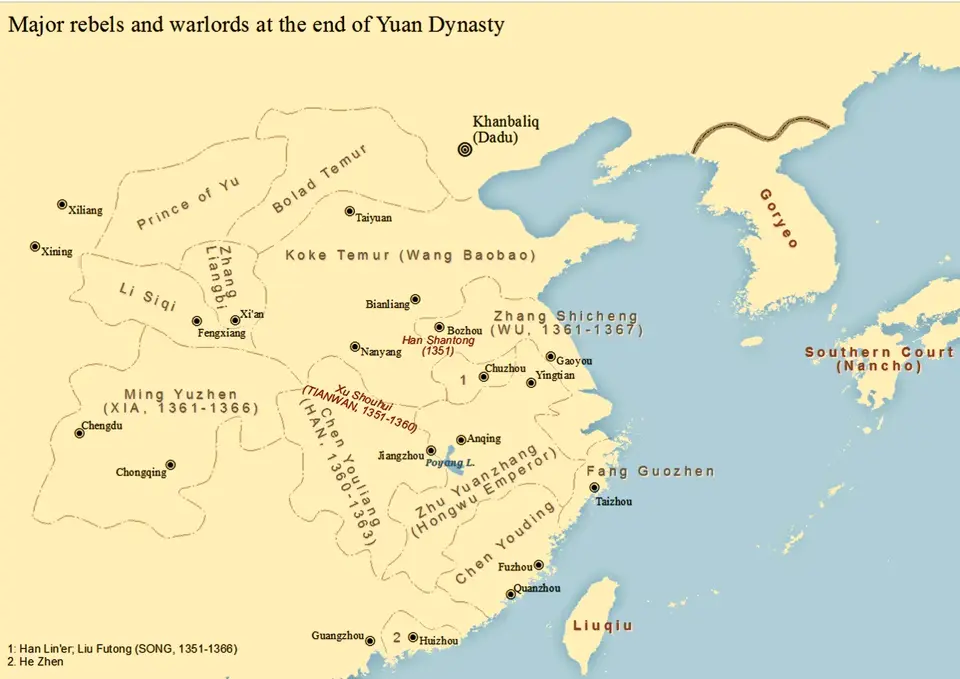
Ming Yuzhen (1329–1366), original name Ming Rui and courtesy name Yuzhen, was an outstanding military leader of the late Yuan Red Turban rebellions and the founding emperor of the Great Xia dynasty (明夏). Born into a peasant household in Suizhou with rare double pupils in one eye, he studied at local government academies in his youth, acquiring solid literacy in classical texts. In 1351, amidst nationwide peasant uprisings against Mongol rule, he was chosen by his community to organize local militias and fortify Mount Qinglin. In 1353, he submitted to Xu Shouhui's Tianwan Red Turban regime, receiving appointment as Grand Marshal to garrison Mianyang. During naval clashes on Lake Mianyang, he repelled Yuan general Hamatu but lost sight in his right eye from an arrow wound, earning the popular moniker "Commander Bright Eyes." Beginning in 1355, Ming Yuzhen commanded transport fleets up the Yangtze gorges to procure grain in Sichuan. Finding widespread disaffection with local Mongol authorities, he coordinated with rebel leader Yang Han to launch a campaign into the interior. In 1358, his forces captured Chongqing, subsequently pacifying Jiading and Chengdu to establish total control over Sichuan. When rival warlord Chen Youliang assassinated Xu Shouhui in 1360, Ming Yuzhen severed relations and proclaimed himself King of Longshu. On January 16, 1363, he ascended the imperial throne in Chongqing, proclaiming the Great Xia dynasty and adopting the era name Tiantong. He reformed the administration into Central Secretariat and Bureau of Military Affairs, instituted a light agricultural tax of ten percent, minted Tiantong Tongbao coinage, re-established imperial examinations, and maintained an alliance with Zhu Yuanzhang. In 1366, he passed away from illness at age thirty-eight, buried at the Ruiling Mausoleum.
Born on October 2 into an agrarian family in Meiqiuli; distinguished by double pupils.
Completed studies at the Suizhou prefecture academy, growing to eight feet in height.
Mobilized village defense forces at Mount Qinglin, chosen by refugees as militia head.
Submitted to Emperor Xu Shouhui, appointed Grand Marshal to defend Mianyang.
Defeated Yuan forces; struck in the right eye by an arrow, earning the name "Bright Eyes."
Commanded fifty river transports up the Yangtze to acquire grain for famine relief.
Met Yang Han in Wu Gorge and launched an amphibious expedition against Chongqing.
Took Chaotian Gate without prolonged siege; appointed Right Vice Chancellor of Longshu.
Captured Dafo Mount at Jiading and took Chengdu, securing all Sichuan territories.
Executed Chen Youliang's emissaries over Xu Shouhui's murder; took title King of Longshu.
Enthroned as Emperor of Great Xia in Chongqing on New Year's Day; adopted Tiantong era.
Dispatched Wan Sheng to capture Zhongqing (Kunming); established defensive border policy.
Exchanged ambassadors and treaties with Zhu Yuanzhang to wage unified resistance against Mongols.
Passed away on March 17 at age thirty-eight; buried at the Ruiling Mausoleum in Jiangbei.
Ming Yuzhen was born on October 2, 1329, in Meiqiuli, Suixian, under the jurisdiction of Huangzhou Route in Huguang Province. His ancestral line had farmed the river valleys of Suizhou for generations, descending through agriculturalists Ming Lang, Ming Zicheng, and Ming Ruhai. Born as the eldest son, Ming Yuzhen possessed striking physical features, growing to a stature of eight feet and bearing a distinctive double pupil in one eye. From early childhood, he showed deep intellectual seriousness and an innate aptitude for community mediation.
In 1333, at the age of five, Ming Yuzhen began formal primary instruction in Chinese characters. In 1338, he entered the district academy alongside local youths Zhang Wenbing, Dai Shou, and Zou Xing. Over six rigorous academic years, he mastered the Confucian classics, imperial statutes, and historical treatises, passing annual assessments to attain the status of student licentiate. By 1346, when he returned home upon graduating, he combined broad scholastic knowledge with outstanding physical vigor, archery prowess, and martial skill, commanding immense respect among the village clans of Suizhou.
In 1351, massive dyke breaches along the Yellow River ignited the nationwide Red Turban insurrections, bringing rural governance across the central plains to total collapse. Bands of rogue Yuan soldiers and marauding outlaws terrorized the Han River valley. Observing the widespread devastation of neighboring communities, the twenty-two-year-old Ming Yuzhen convened elderly clan leaders to deliberate on communal survival. He argued that disorganized households would be slaughtered piecemeal unless they unified under disciplined leadership.
Local elders enthusiastically acclaimed Ming Yuzhen as commander. He mobilized several thousand local youths, establishing a fortified redoubt in the rugged heights of Mount Qinglin. He directed the felling of timber to construct stockades and perimeter towers, cleared parade grounds for horse archers, and enforced strict codes of mutual defense. Over the following months, tens of thousands of displaced refugees sought protection within his camp. Under his equitable governance, agricultural work continued unhindered, creating a rare haven of stability that earned him election as tribal marshal.
In the winter of 1353, Emperor Xu Shouhui, leader of the southern Tianwan Red Turban regime, sent emissaries to Suizhou to recruit Ming Yuzhen's militia into the anti-Yuan coalition. Recognizing that isolated hill forts could not permanently withstand royal Mongol pacification, Ming Yuzhen led his disciplined troops to swear allegiance to Xu Shouhui. The emperor welcomed him warmly, granting him the title of Grand Marshal of the Expeditionary Vanguard and assigning him under Prime Minister Ni Wenjun to garrison the pivotal river outpost of Mianyang.
Shortly thereafter, Yuan provincial chancellor Hamatu marshaled elite Mongol cavalry alongside provincial auxiliaries to assault Mianyang. Ming Yuzhen commanded river fleets to intercept the enemy on Lake Mianyang. During a ferocious naval clash, a stray enemy arrow pierced Ming Yuzhen's right eye. Disregarding agonizing pain, he snapped the arrow shaft and continued directing the attack from the deck until the Mongol fleet was routed. The injury permanently blinded his right eye, earning him the honorific title "Commander Bright Eyes" throughout the southern theater.
In the autumn of 1354, catastrophic flooding devastated the crops around Mianyang, reducing the population to foraging weeds and water grasses. In 1355, Ni Wenjun ordered Ming Yuzhen to take ten thousand troops and fifty heavy river vessels up the Yangtze to procure food supplies in the upper gorges. Passing safely through the Three Gorges due to friendly ties with Tianwan governor Jiang Jue at Yiling, Ming Yuzhen reached Kui Prefecture, purchasing substantial grain reserves from local river communities through fair barter.
His troops maintained impeccable discipline, refraining entirely from the plunder characteristic of other insurgent groups. The mission returned safely to Mianyang laden with foodstuffs, alleviating the famine and providing vital supply lines for Tianwan operations. In late 1356, Ming Yuzhen undertook a second commercial grain run. By March 1357, as his transport fleet sailed through Wu Gorge, he encountered five thousand rebel troops under Yang Han, a former Yuan militia leader who had revolted against provincial governor Wanzhedu in Chongqing.
Yang Han revealed to Ming Yuzhen that Chongqing's defense garrison was depleted and that Mongol commanders Wanzhedu and Hamatu were locked in bitter personal enmity. He urged Ming Yuzhen to seize the strategic city. While Ming Yuzhen initially hesitated out of deference to central orders, commander Dai Shou advised that securing Sichuan would provide an impregnable base of operations for the entire anti-Yuan cause. Convinced, Ming Yuzhen split his flotilla, sending half the grain to famine victims in Hubei while leading the remainder directly toward Chongqing.
In the autumn of 1357, his fleet arrived before Chaotian Gate. Accustomed to years of peace, the defending troops disintegrated in panic; Wanzhedu fled overnight to Guozhou while Hamatu was captured. Ming Yuzhen prohibited all pillage, pacified the populace, and appointed local scholar Liu Zhen as chief political adviser after an interview at Luzhou. In 1358, Xu Shouhui formally confirmed Ming Yuzhen as Right Vice Chancellor of the Longshu Branch Secretariat, cementing his regional authority across eastern Sichuan.
In early 1359, Ming Yuzhen led an offensive westward along the Fu River to dislodge northern Red Turban forces under Li Xixi (the Green Turbans) occupying Chengdu. In June, he crushed Li Xixi at Puzhou, forcing him to abandon central Sichuan. He subsequently laid siege to the fortress of Dafo Mount at Jiading, where Yuan commander Zhao Zi held out stubbornly. After a ten-day coordinated assault, Ming Yuzhen overran the defensive fortifications, forcing Zhao Zi to flee into the mountains.
Throughout the pacification campaigns, Ming Yuzhen emphasized generous treatment toward surrendered personnel while relentlessly eliminating irreconcilable enemies. In 1360, when local resistance led by Dong Xiaowen fortified Hezhou, Ming Yuzhen personally invested the stronghold, breaking defensive lines while sparing civilian inhabitants. In April 1360, imperial scouts captured Zhao Zi, Wanzhedu, and Langgedai as they conspired in Longzhou; Ming Yuzhen ordered their execution, permanently ending Mongol resistance and bringing the entirety of Sichuan under unified control.
In June 1360, ambitious general Chen Youliang murdered Emperor Xu Shouhui at Caishiji, establishing the rival state of Dahan and dispatching emissaries to demand Ming Yuzhen's vassalage. Deeply attached to Xu Shouhui's memory, Ming Yuzhen wept bitterly upon receiving the news. He executed Chen Youliang's messengers, burned the diplomatic letters, and commanded his soldiers to don mourning garments for the dead emperor, permanently severing all ties with Dahan and fortifying the Three Gorges against invasion.
In the winter of 1360, local notables and military commanders acclaimed Ming Yuzhen as King of Longshu in Chongqing. Over the next two years, under Liu Zhen's guidance, he built an autonomous state machinery. On January 16, 1363 (the Lunar New Year of the Guimao year), Ming Yuzhen conducted solemn sacrifices to heaven and earth in Chongqing, formally acceding to the imperial dignity. He named his dynasty Great Xia to symbolize the restoration of ancient Chinese heritage, establishing the reign era Tiantong and elevating his consort Lady Peng to empress.
In the winter of 1363, Great Xia armies probed the northern passes toward Hanzhong, defeating Yuan forces at Latakan. In March 1364, Ming Yuzhen directed an expansive southwestern offensive, sending Wan Sheng, Zou Xing, and Zhima Li with an expeditionary force through Sichuan into Yunnan. Advancing through tribal highlands, the Xia forces enlisted the support of indigenous Wuman and Wulong chieftains, capturing the regional capital Zhongqing (Kunming) in December 1364 and pushing deep toward Dali.
However, remote lines of supply and the mobilization of thousands of tribal auxiliaries under Dali ruler Duan Gong made permanent occupation unsustainable. Realizing that distant adventurism would squander state resources, Ming Yuzhen ordered Wan Sheng to withdraw cleanly to Sichuan, treating all indigenous tribes with strict respect. Following an inconclusive siege of Hanzhong in early 1365, Ming Yuzhen decisively halted foreign expansion, establishing a resolute grand strategy of regional defense and domestic consolidation.
Years of uninterrupted military campaigning and unremitting administrative labor took a severe physical toll on the emperor. By the winter of 1365, chronic ailments flared up severely, resisting all medical remedies. On March 17, 1366, realizing that death was near, Ming Yuzhen summoned his senior civil ministers and his ten-year-old heir, Crown Prince Ming Sheng, to his bedside in the Chongqing palace.
In a poignant testament, Ming Yuzhen instructed his ministers: "The Central Plains remain unpacified and the northern barbarians unexpelled; that I must leave this ambition unfulfilled is the will of Heaven. The mountains of Western Shu are naturally impregnable. After my passing, you must unite wholeheartedly to preserve the realm, caring for the livelihood of our people. Never entertain frivolous ambitions toward the Central Plains, and avoid provoking military strife on our frontiers!" He died peacefully shortly after at thirty-eight. He was entombed with honors at the Ruiling Mausoleum on Mount Baogai.
Upon founding Great Xia, Ming Yuzhen initially adopted the classical Six Ministers model from the Rites of Zhou, appointing Dai Shou as Grand Minister of State and Wan Sheng as Minister of War. Recognizing by 1365 that archaic titles hindered efficient governance, he modernized the bureaucracy by instituting the Central Secretariat and Bureau of Military Affairs on the Song-Yuan model. Provincially, he divided Sichuan into eight administrative circuits with three tiers of local magistrates, while creating Pacification Commissions to govern southwestern ethnic minority regions effectively.
To restore an agrarian economy ravaged by warfare, Ming Yuzhen enacted a sweeping tax reform in 1363, setting agricultural grain dues at a fixed ten percent of the harvest. He permanently banned corvée labor obligations, confiscated abandoned Yuan military pastures to redistribute to landless peasants, and mandated that military garrisons practice agricultural colony farming. These benevolent policies made Sichuan the lowest-taxed territory in late Yuan China, enabling rapid population recovery and economic prosperity.
To counter rampant inflation driven by depreciated Yuan paper currency, Ming Yuzhen instituted comprehensive currency reform in 1363. He cast copper coins inscribed with "Tiantong Tongbao" in regular script and "Tiantong Yuanbao" in seal script. These high-purity copper coins effectively replaced worthless paper money, stabilized consumer prices, and revitalized commercial exchanges throughout the upper Yangtze valley. He additionally experimented with woodblock-printed paper currency on mulberry paper to facilitate wholesale trade.
Believing firmly that intellectual culture was indispensable to enduring statehood, Ming Yuzhen instituted an extensive public school network. He founded the Hanlin Academy and National Directorate of Education in Chongqing, employing distinguished scholars Mou Tunan and Shi Tianzhang to educate the crown prince and sons of nobility, while creating local schools across all prefectures. In the autumn of 1363, he reinstated the imperial civil examinations, selecting Dong Bi and other scholars through palace examinations to serve in government.
In foreign relations, Ming Yuzhen displayed visionary pragmatism by cultivating an enduring alliance with Zhu Yuanzhang, the future founder of the Ming dynasty. In 1364, he dispatched ambassadors to Jiankang, initiating an active correspondence that emphasized mutual respect, trade, and coordinated resistance against the Yuan empire. By securing his eastern border through formal pacts of non-aggression, Ming Yuzhen shielded Sichuan from civil strife and contributed substantially to the collective overthrow of Mongol dominion.
Throughout his reign, Ming Yuzhen maintained the unpretentious habits of his agrarian upbringing. He shunned palace luxuries, wore plain robes, and refused to expend treasury funds on concubines or ostentatious monuments. Archaeological excavations of his Ruiling Mausoleum in 1982 confirmed that his funerary goods consisted merely of practical weapons, simple textiles, and the solitary gold cup bestowed upon him by Xu Shouhui. His frugal governance ensured that state resources remained focused on popular welfare, earning him historical renown as a virtuous sovereign.
| Relationship Type | Name | Identity and Historical Interaction |
|---|---|---|
| Consort | Empress Peng | Primary empress of Great Xia, served as regent following Ming Yuzhen's death. |
| Military Comrade | Wan Sheng | Great Xia Right Chancellor, commanded southwestern campaigns; later murdered in political intrigue. |
| Chief Strategist | Liu Zhen | Former Yuan scholar who served as grand counselor and designed the Great Xia political system. |
| Former Sovereign | Xu Shouhui | Tianwan Red Turban emperor who appointed Ming Yuzhen; mourned deeply by Ming Yuzhen after his murder. |
| Rival | Chen Youliang | Founder of Dahan who murdered Xu Shouhui; Ming Yuzhen executed his envoys and severed ties. |
| Strategic Ally | Zhu Yuanzhang | Founder of the Ming dynasty (then King of Wu), maintained close diplomatic and commercial ties with Great Xia. |
FIGURES ASSOCIATED WITH THIS DYNASTY