Born | Born
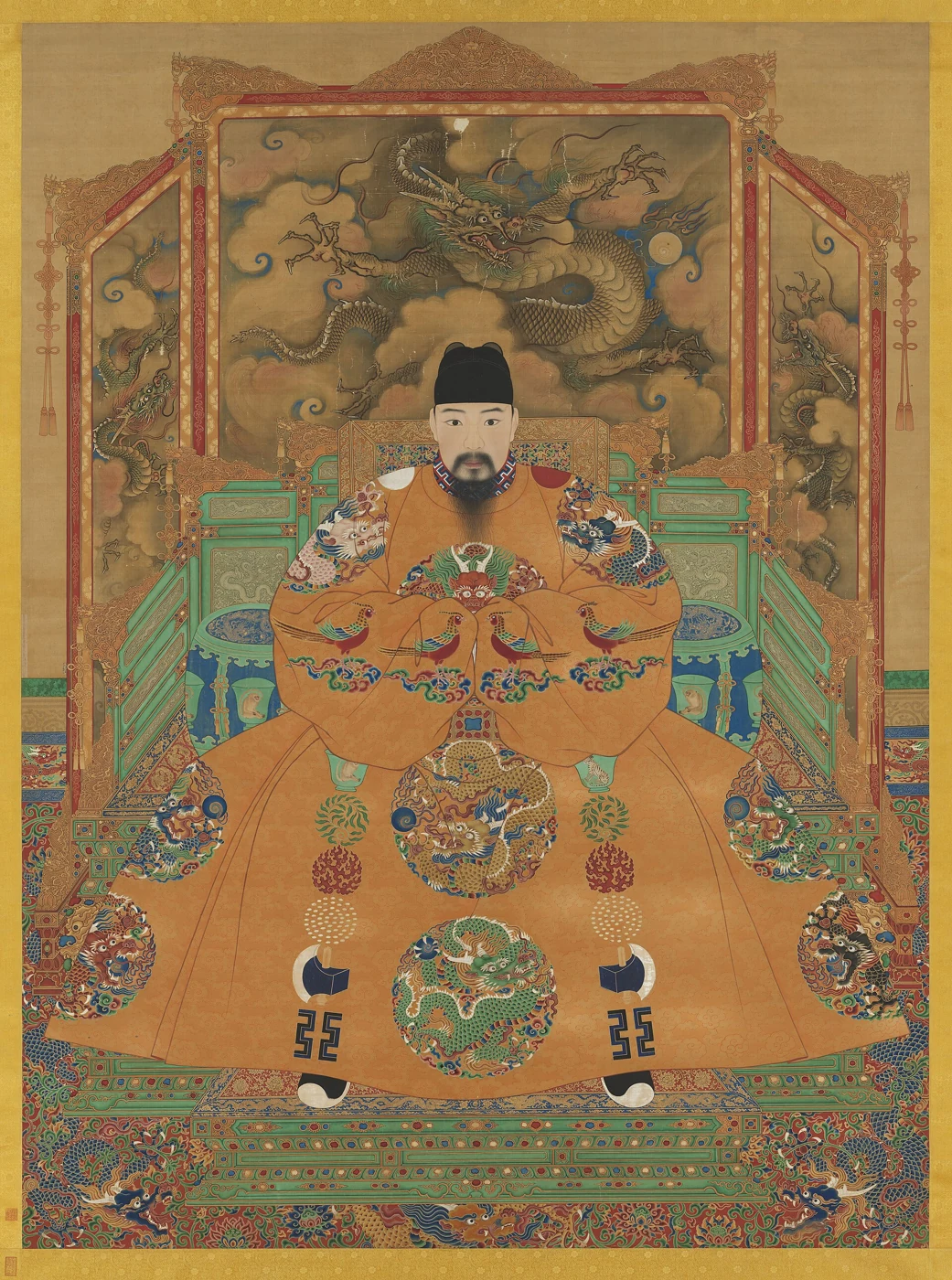
Ninth emperor of the Ming Dynasty (Emperor Xiaozong)
Hongzhi Emperor of Ming (Zhu Youtang)
朱祐樘
Zhu Youtang (30 July 1470 – 8 June 1505), ninth emperor of the Ming with the era name Hongzhi and the temple name Xiaozong, reigned for eighteen years from 1487 to 1505. Third son of Emperor Xianzong, he was made crown prince in 1475 and educated by his lecturers and by the eunuch Qin Ji; on coming to the throne he reversed the abuses of the late Chenghua years, dismissing favourites and employing the worthy, so that order…
Ming Dynasty
PROFILE
Zhu Youtang (30 July 1470 – 8 June 1505), ninth emperor of the Ming with the era name Hongzhi and the temple name Xiaozong, reigned for eighteen years from 1487 to 1505. Third son of Emperor Xianzong, he was made crown prince in 1475 and educated by his lecturers and by the eunuch Qin Ji; on coming to the throne he reversed the abuses of the late Chenghua years, dismissing favourites and employing the worthy, so that order was gradually restored in what is known as the Hongzhi restoration. He trusted his grand secretaries and senior ministers, Xu Pu, Liu Jian, Li Dongyang and Xie Qian among the former and Wang Shu, Ma Wensheng, Liu Daxia and Dai Shan among the latter, and several times summoned his grand secretaries to decide business in his presence; his reign saw the harnessing of the Yellow River and the repair of the Songjiang and Suzhou waterworks, the remission of taxes in disaster areas, the reform of the salt administration, regular assessment of officials and restrictions on princely and consort requests for land. In his later years he held court less often and favoured the eunuch Li Guang and Daoist rites, and after Li Guang's suicide he reformed again; he died at thirty-six and was generally praised by historians as a worthy ruler.
- Period
- Ming Dynasty
- Date of Birth
- July 30, 1470 CE(6th year of the Chenghua era, Ming, 7th month, 3rd day)
- Date of Death
- June 8, 1505 CE(18th year of the Hongzhi era, Ming; the Yueriliangbaikejizaibutong era)
- Ethnicity
- Han
- Role
- Ninth emperor of the Ming Dynasty (Emperor Xiaozong)
- Reign
- September 22, 1487 – June 8, 1505
- Era name
- Hongzhi
- Temple name
- Xiaozong
- Burial place
- Tailing Mausoleum
- Predecessor
- Zhu Jianshen (Emperor Xianzong)
- Successor
- Zhu Houzhao (Emperor Wuzong)
- Father
- Zhu Jianshen (Emperor Xianzong)
- Mother
- Consort Ji (posthumously Empress Xiaomu Ji)
- Major achievements
- Hongzhi Restoration; diligent and benevolent governance; appointed capable ministers; practiced monogamy
LIFE TIMELINE
Named crown prince | Named crown prince
September 22, 1487 CE(23rd year of the Chenghua era, Ming, 9th month, 6th day) | Ascended the throne | Ascended the throne, era name Hongzhi
Dismissed alchemist Li Zisheng | Dismissed alchemist Li Zisheng, eunuch Liang Fang, and imperial in-law Wan Xi
Employed capable ministers in the Grand Secretariat and Six Ministries | Employed capable ministers in the Grand Secretariat and Six Ministries
Died | Died
Grand Secretariat appointments | Xie Qian and Li Dongyang entered the Grand Secretariat; thereafter Li Guang's favour and the Daoist rites drew increasing criticism from officials.
Li Guang's fall | Li Guang lost power and killed himself, and after Xu Pu retired Liu Jian led the Grand Secretariat.
Codification | The Wenxing Tiaoli (Regulations on the Questioning of Punishments) was completed, consolidating criminal provisions.
Compilation completed | The Collected Statutes of the Ming was completed, and the Ministry of Revenue simultaneously memorialised on shortfalls in revenue and expenditure.
Death | Zhu Youtang died and Zhu Houzhao succeeded him.
BIOGRAPHY
Biography
Youth as Crown Prince
Zhu Youtang was the third son of Emperor Xianzong, born in 1470. His mother is recorded as a palace woman of the Ji clan, and the accounts in the History of Ming and later works describe a childhood spent hidden in the palace until he was made crown prince in 1475; the Chenghua years, when Consort Wan dominated the inner palace, gave rise to much dispute over palace affairs. What the sources agree on is that he was an intelligent and studious pupil, "of sage-like intelligence", reciting without error what he had been taught and listening with fixed attention; he was also punctilious in courtesy, and when a lecturer misread a character he did not reprove him but simply did not follow the reading until the lecturer corrected it. After each lecture he would say to the lecturer, "Sir, take tea", and though those about him said that as crown prince he need not do so, he continued as before. In the twelfth month of 1482 Xianzong commissioned the Wenhua daxun, to be read to the crown prince, and whenever it was lectured on Zhu Youtang would have the table removed, leave his seat and stand to listen, sitting again only afterwards.
In his upbringing the eunuch Qin Ji of the Directorate of Ceremonial, a man of gentle and sincere character, of broad understanding and well read in history, had considerable influence, discussing with him the institutions of past and present, the condition of the people and matters of agriculture, soldiery and taxation; when Xianzong granted him an estate Qin Ji advised him not to accept it, saying that the empire would one day be his and he had no need of estates; and when he was once reciting Buddhist scriptures with the eunuchs and heard Qin Ji coming, he quickly put them aside and took up a Confucian book. Such details show that his early education was chiefly in the Confucian classics and histories and that his character and habits were formed in these years.
The First Years of the Reign
In the later Chenghua years Xianzong neglected government and eunuchs and favourites held power, so that "for a time the conduct of government was disordered and full of abuses"; when the seventeen-year-old Zhu Youtang came to the throne he quickly made men look at him with new eyes, and his early measures, dismissing the flatterers and employing the worthy, gradually restored the order lost since the later Chenghua years. He was also extraordinarily mild and good-natured, showing great forbearance even towards the family of Consort Wan, who had persecuted his own mother; later writers held that all this came from filial piety, since to be filial to the emperor his father was to maintain tradition, a principle around which the politics of the Hongzhi court turned.
His early measures against the abuses inherited from Chenghua were aimed also at the social tensions that threatened the dynasty. At first his energies went chiefly into appointments at court, and once these were settled he turned to internal and external problems. In appointments he made Xu Pu chief grand secretary and in 1495 brought Xie Qian and Li Dongyang into the Grand Secretariat at the same time, Qiu Jun dying that year; these were the only men in the Grand Secretariat throughout the reign; in 1498 Xu Pu retired with an eye ailment and Liu Jian became chief grand secretary, working with Xie Qian and Li Dongyang. The six ministries and the censorate were likewise held by experienced and upright men such as Wang Shu, Ma Wensheng, Peng Shao, He Qiaoxin, Liu Daxia and Dai Shan. The precedence of grand secretaries was also raised: when Qiu Jun entered the Grand Secretariat as minister of rites in 1491, Wang Shu as minister of personnel and head of the six ministries stood above him, but at the inner banquet in the second month of 1493 Zhu Youtang had Qiu Jun placed above Wang Shu, and thereafter those entering the Grand Secretariat from vice ministerships or the household of the heir apparent took precedence over the six ministers, a practice suited to the growth of Grand Secretariat power since the Xuande years; he was himself an emperor who trusted his Grand Secretariat, and when something could not be carried out its members often contended for it together, Liu Jian, Li Dongyang and Xie Qian being known to the realm as worthy chief councillors.
Audience and Decision in Person
One practice of his reign was long remembered: the summoning of grand secretaries to discuss and endorse documents in the emperor's presence. The audience of 1497 followed Xu Pu's memorial asking the emperor to meet his ministers, in which Xu Pu observed that the emperors of the dynasty from Hongwu to Tianshun had often met their scholar-officials to consult on affairs, whereas now, apart from court attendance, the emperor's face was never seen, so that the only channel for the feelings of the lower orders was memorials, and these were not decided in time, which hindered the conduct of government; Zhu Youtang accepted the criticism. On the twenty-second day of the third month, after the imperial lecture, he summoned the grand secretaries Xu Pu, Liu Jian, Li Dongyang and Xie Qian to the Wenhua Hall and had the eunuchs bring the memorials to be dealt with, saying that he would settle them with them; when the four entered they found the eunuchs of the Directorate of Ceremonial kneeling round the table in a row, with a thick pile of documents on it. He called them to the couch, had the eunuchs bring the memorials and provided brushes, inkstones and slips of paper. After reading, they agreed on the endorsements and submitted them; he read them and wrote the decisions himself, "sometimes changing two or three characters, sometimes deleting two or three sentences, writing rapidly and without hesitation, the imperial hand clear and flowing". When Liu Jian, on a memorial involving many matters, wished to take it away to read closely, Zhu Youtang preferred to deal with it there, saying that there were many documents and all should be looked at, and that going away would be no more leisurely, so they might as well settle them on the spot; after working through the main ones over most of a day he pointed to the remaining documents and said that these were routine matters, requiring only that the department concerned be informed, whereupon the grand secretaries bowed and withdrew. This was a rare proceeding in any dynasty, by which he sought to restore the habit of diligent government, and it won the approval of upright ministers. In the fifth month of 1500 he summoned Liu Jian, Li Dongyang and Xie Qian to the Pingtai and produced the ministry of war's memorial recommending commanders of the capital camp, going through the names one by one to decide in their presence and having the Directorate of Ceremonial prepare brush and paper so that he could write the edict himself and hand it to the ministry for immediate execution. The advantage of deciding business in this way was that it removed the intermediary stages between Grand Secretariat and emperor, so that the secretaries' draft endorsements became administrative orders at once, and the emperor could question his ministers on the spot rather than through the eunuchs, which best prevented embezzlement and the sharing of power in the middle; for the grand secretaries it was an ideal method, and his audiences became a weapon later secretaries used in seeking access, with considerable influence on later history.
The Earlier Years: Salt, Money and Local Government
Several measures of the earlier reign may be noted. In the salt administration, after the case of 1488 Zhu Youtang ordered Peng Shao and Li Si to straighten out the salt administration of Zhejiang and the Huai regions, and the two dealt strictly with the localities and changed the salt laws, steadying order, so that the effect of his reform of official discipline was fully shown. Some years later a great famine in Sichuan gave the local minority chiefs and the mountain bandits of the Chenghua years their opportunity, and he appointed a grand coordinator for Sichuan to deal with it. As to the salt law, the Ming supplied the frontier by the "open exchange", merchants delivering grain at the frontier and drawing salt at the works for sale in allotted areas; but from the middle Chenghua years the rich colluded with the powerful to corner the stored salt, the law was broken and the profits taken by favourites and eunuchs, forming a great official-merchant group against which ordinary merchants could not contend. The abuse was discussed in the Hongzhi reign, and opinions differ on the effects of its reform, scholars being divided over the authenticity of the relevant accounts.
The Yellow River and the Waterworks
The largest undertakings of the reign were the river and waterworks. In 1492, with the Songjiang and Suzhou channels silted and causing floods, Zhu Youtang sent a vice minister of works and the right deputy censor-in-chief Liu Daxia to deal with the Yellow River; Liu Daxia took up the work that spring, and in summer, with grain boats massed on the canal and unable to go north at Zhangqiu so that the grain route was blocked, he followed the advice of water experts and first cut a diversion channel on the west bank of the breach to keep the canal open, then over two years closed the Zhangqiu breach, dredged several channels to divide the flow and built three hundred and sixty li of long dike from Zuocheng through Dongming and Changyuan to Xuzhou, largely checking the floods so that for more than twenty years the canal had no great trouble; after this work the Yellow River no longer ran northeast into Shandong from Kaifeng. As the river work finished, the waterworks of Songjiang and Suzhou were completed: also a great undertaking with more than two hundred thousand labourers, repairing and dredging a hundred and thirty-five canals, channels, lakes, sluices and dikes, largely settling the water problems of that rich grain region. In all, from 1489 to 1492 the work was chiefly on the Yellow River with the Songjiang and Suzhou waterworks besides, employing nearly six hundred thousand labourers over six or seven years; the force mobilised was great, and it also in part relieved the unemployment and distress of the disaster areas, so that the period showed stable prosperity in production and population: after the completion of the waterworks in 1495 the grain and wheat revenue of the following year rose to more than 28,840,000 piculs, an increase of over a million, approaching the average of the early Hongwu reign.
Tax Remission and Relief
His reign repeatedly remitted the summer and autumn taxes of districts and sometimes distributed government property in relief, the records being very numerous; among the larger instances: in the second month of 1490 the autumn grain of disaster-stricken Henan was remitted, and on the twelfth day of the same month the ministry of revenue asked for the remission of the taxes of Nanjing and Huguang, to which he agreed entirely; in the eighth month of 1491, on account of floods, the weaving workshops of Suzhou and Zhejiang were stopped for the year; in 1493 the remissions on account of disaster included the summer taxes of the Taiyuan and Pingyang prefectures in Shanxi beyond the two capitals, half the summer tax of the Kaifeng prefectures in Henan and the autumn grain of Xiangfu and other counties, while 64,000 piculs of the Shenyang guard's military farm grain were remitted; with Shandong in famine the grand coordinator and others asked for more than five hundred thousand taels of treasury silver and more than two million piculs of grain, distributed by competent officials after inspection of households, so that "more than two million six hundred thousand famine victims were kept alive"; in 1498 the taxes of the disaster areas of the southern metropolitan region, Shanxi, Shaanxi, Guangdong and Guangxi were remitted; in 1501 relief and remission were given to the two metropolitan regions and the disaster areas of Jiangxi, Shandong and Henan; and in the ninth month of 1503 relief was given to soldiers and people in the two metropolitan regions, Zhejiang, Shandong, Henan and Huguang. He also forbade princes and consorts to petition for land or to receive land handed over by others, and forbade powerful families to encroach on the people's livelihood, all of which greatly eased social tension. Historians praised him as "frugal and self-restrained, diligent in government and caring for the people", which may be partly flattery, but compared with the Chenghua and Zhengde reigns before and after, the government of the Hongzhi period was indeed comparatively clean; before and after it there were many peasant risings, forming the two peaks of mid-Ming revolt, while in this period they were very few, a time of relative political stability.
Assessment of Officials and the Selection of Hanlin Bachelors
In institutions, several changes of the reign were lasting. The first concerned the assessment of officials: since the assessment of remonstrating officials had had no fixed term, some being reassessed on the completion of mourning and most unable to fulfil the ten-year term, the Hongzhi period fixed a six-year cycle for remonstrating officials, and Zhu Youtang also required provincial officials to attend court once in three years, the annual assessment falling in the chen, xu, chou and wei years, giving some assurance in point of time. The second concerned the selection of Hanlin bachelors: since in earlier reigns there had been no rule as to the time, the department, the method or the number, with selection in alternate examinations, in successive ones, or omitted for several, sometimes by the Grand Secretariat, sometimes by the ministry of rites, sometimes by both, and sometimes limited by age or by region, or by reputation, or taken from the palace examination papers, or tested by a separate examination, Zhu Youtang fixed one selection for each examination, conducted by the Grand Secretariat and the ministries of personnel and rites, with a prescribed method of examination, which thereafter became the established rule. The third was the raising of the priority of grand secretaries, already noted.
Eunuchs, Li Guang and the Later Conduct of Government
Eunuchs enjoyed favour in his reign too. Li Guang was a palace eunuch in favour who deluded Zhu Youtang with Daoist arts; the histories say little explicitly, but from the circumstances he probably led the emperor to feasts and gardens and to the study of Daoist techniques of nourishing life. Once in favour he copied the practice of the Chenghua years, forging decrees to grant offices at request, extorting bribes from the provinces and cornering the salt trade; officials memorialised against him repeatedly and Zhu Youtang never inquired. From about 1495 his court attendance grew rare, especially about 1497; satisfied with these results, he had begun to think that he might be a monarch of peace and relaxed his attention to government, holding court little and no longer regularly meeting the grand secretaries and the six ministries after 1495.
Li Guang's death had a direct effect on the politics of the reign. After his suicide, registers found in his house bore the names of many civil and military officials with figures in hundreds and thousands of piculs of "yellow and white rice"; Zhu Youtang wondered aloud how much Li Guang could eat that he should receive so much, and was told by his attendants that these were riddles, yellow rice meaning gold and white rice silver, whereupon he was furious and ordered the judicial authorities to prosecute, while the officials who had dealt with Li Guang went to the Marquis of Shouning to plead. Thereafter he again dismissed the flatterers and honoured the worthy, seeking earnestly to govern well. Two other cases concerned eunuchs: one who murdered an acrobat boy, whose guilt was exposed, was ordered by Zhu Youtang to be executed at once, and when the eunuchs pleaded for him and asked that he be spared, the emperor refused and had them attend the execution in full dress as a warning; and another favoured eunuch was punished for similar conduct. These dealings show that in the matter of eunuchs he was both favouring and at times severe.
In the later years of the reign Liu Daxia, who had taken no part in the factional disputes of the earlier years and had merit in the river works, became the minister most relied on. In 1502 he succeeded Ma Wensheng as minister of war, after which Zhu Youtang could hardly do anything without him. In their conversations Liu Daxia described the abuses of society in such detail that Zhu Youtang sighed that he had reigned long without knowing them and did not deserve the name of a ruler, and decided to begin a movement to expose abuses and consider remedies, including measures against corruption and proposals to cut the offices granted at request and to control sale of rank. In short, his revival in the later years owed much to Liu Daxia, whose conversation he made a pleasure, summoning him privately again and again, and whose frank answers often met his mind, so that it was said of ruler and minister that they "discussed at leisure". When Liu Daxia answered that the desire for good government could not be too urgent and that each matter should be discussed with the grand secretaries and acted on once it was right, Zhu Youtang always believed him, and believed too that upright officials like him were the key to good government. In the first month of 1505, when Dai Shan asked to retire through illness, Zhu Youtang would not permit it, and when Liu Daxia pleaded for him, said with feeling that when a host presses a guest to stay the guest will stay, and could he not stay for the emperor's sake, the realm not yet being at peace; and Dai Shan did not raise the matter again.
The Army and the Frontiers
The military situation of the reign was marked by an empty frontier establishment: more than three tenths of the soldiers of the Shaanxi guards had deserted, and apart from the guards on duty and the military farms each guard had only two hundred, a hundred or even fifty or sixty men for defence, mostly old and weak and unfit to fight. To revive the forces Zhu Youtang relied on ministers such as Ma Wensheng, making various efforts to reorganise the capital army and defend the frontier, somewhat improving its fighting quality and changing the weakness of the frontier, winning a relatively quiet external environment for the Hongzhi restoration; but with abuses long accumulated the army and frontier remained full of problems, and such patching could hardly reverse the decline of Ming military power.
In the north the campaigns against the Mongols exposed the problems of commanders and discipline: the court sent Zhu Hui and others to relieve Yansui and Ningxia, but by the time the army reached Ningxia the Mongols had plundered and gone; Zhu Hui led five columns into the Ordos and took only fifteen hundred horses, camels, cattle and sheep. Soon afterwards the Mongols attacked Guyuan, Pingliang and Qingyang, shaking the Guanzhong region, and Zhu Hui, afraid to advance, "took only fifteen heads" and recovered four thousand head of livestock. At this victory of great loss the censors and ministers impeached him on all sides, yet Zhu Youtang did not question Zhu Hui but rewarded some as having "destroyed the nests", sent eunuchs with sheep and wine to welcome him and left him in command of the capital camp. This manner of dealing suited his mild temper but was criticised by later writers.
The Hami Crisis and the Western Regions
In the western regions the Hami crisis was the chief frontier problem of the reign. The ruler of Turfan, Ahmad, murdered Hanzhen and occupied Hami, sending envoys to the Ming with tribute; the Ming maintained its earlier refusal to intervene by force, demanding only verbally that the Turfan envoys tell their master to return the seized land. One difference was that Zhu Youtang adopted the proposal to "reduce their tribute and make the various peoples resent Ahmad", that is to reduce trade with Turfan in order to set it at odds with the western states; the result was not to make the peoples resent Ahmad but to anger the western states friendly to the Ming, so that they turned to him, and Ahmad entered Hami, styled himself khan and raided widely. In 1496 he again occupied Hami; because the Ming closure of tribute had caused great economic loss to the western tribes, those who had once submitted to Ahmad turned against him, forcing him in 1497 to return Shaba and the gold seal, and two years later Shaba entered Hami. Though Hami was recovered, the problems of the Hami guard could not be rooted out, and the crisis grew worse in the Zhengde and Jiajing periods, ending with the Ming acknowledging Turfan's position in the west and resuming mutual tribute.
Yunnan Chieftains and the Struggle over Mangui
In the Yunnan borderlands the ownership of Mangui ran through the Chenghua and Hongzhi reigns: Mengmi and Mengyang successively gained the advantage in the struggles of the chieftains, which had much to do with the control of Mangui, and from the Chenghua years to 1503 Mangui changed hands twice, becoming a key area of contention. The grand coordinator of Yunnan proposed establishing the four pacification commissions of Longchuan, Ganya, Nanjian and ... and opening offices with troops from Tengchong to hold them, but the court under Zhu Youtang, on the grounds that the country was remote and the miasma hard to hold, returned the area to Mubang, greatly displeasing Mengmi and destroying the temporary accord between Mengmi and Mubang; weakened as it was by Mengyang's incursions, Mengmi still contended for Mangui, and the old enmity was rekindled, so that the border could not be truly settled. Some writers hold that the mishandling of Mangui was the key factor in renewing the dispute between the chieftains.
Jurchen Tribute and Champa and Annam
In the northeast, the court had rules on the tribute and promotion of the Jurchen guards, but tribute bearers still sought office against the rules: in the seventh month of 1501 the commander Shanggu of the Wuzhe Front Guard in the Haixi region presented camels, returned seized border people and asked for promotion to commissioner, receiving only the rank of assistant commissioner; enraged, he ceased to send tribute and raided the frontier, even blocking the entry of the Haixi tribes to tribute, so that other guards could not send theirs. Zhu Youtang also strictly limited the numbers of Jurchen tribute envoys: when in the first month of 1501 the Jurchen chief Wuyinzhu and others asked to raise each guard's quota to ten men and the Jianzhou guards asked that each commander bring one attendant, the ministry of rites held that precedent should be followed and no increase allowed, and he accepted this. In the south, Champa several times sought Ming protection against Annam: in 1490, in view of Champa's repeated complaints and Annam's raids on the Ming frontier, Zhu Youtang issued a decree telling the king of Annam not to talk so much but to keep to his borders and enjoy peace, and warning that if the court were once enraged and the heavenly troops came, as in the Yongle reign, there would be no room for regret; this was the severest warning since the Zhengtong period. In 1495 Champa's envoys complained again of Annam's invasion and asked for a minister to mediate, and the Ming dealt with these requests repeatedly by decree, without assisting Champa; apart from the strong warning of 1490, its handling was mostly peaceful adjustment, tolerating Annam's aggression.
Tibetan Monks and Daoist Rites
In religious matters the reign continued practices of earlier times. The Tibetan monks in the capital being numerous, it was only after the censors memorialised against them that Zhu Youtang ordered a hundred and eighty-two to be kept and the rest sent home; he also granted new titles to monks in the capital such as Zhaba Jiancan and Shijia Yarta as "Western Buddhas' Sons", and his favour extended to deceased monks, as when the monk Runubandan died in the eleventh month of 1492 and received further honours. In his later years he was also fond of holding Daoist fasts and offering prayers, a tendency connected with Li Guang's favour through Daoist arts. On the whole his reign both repatriated and restrained, and honoured and favoured, in religious matters, consistent with the swing of the mid-Ming court between Tibetan Buddhism and Daoist practices.
Succession, Death and Appraisal
The succession became a concern in the later years: his son Zhu Houzhao (later Emperor Wuzong) was born in 1492 and began his studies in 1498. In 1505, gravely ill, Zhu Youtang summoned the grand secretary Liu Jian and others, saying that he knew how hard they had worked since his accession, that the heir apparent was intelligent but young, and that they should often bring him out to study and guide him to be a good man; Liu Jian and the others wept and begged him to be less anxious, and the conversation lasted some time, running to several hundred words in the record of the Veritable Records of Emperor Xiaozong. He died in the sixth month of that year at thirty-six, was buried at the Tai Mausoleum with the temple name Xiaozong and the posthumous title Jian Tianmingdao Chengchun Zhongzheng Shengwen Shenwu Zhiren Dade Jing Huangdi, and was succeeded by his son Zhu Houzhao as Emperor Wuzong.
Appraisals fall into several groups. The official appraisal in the Veritable Records of Emperor Xiaozong calls him sincere by nature, sparing of speech and careful in action, full of cultivation yet never displaying it, and holds that in maintaining the succession he might be compared to Emperor Wen of Han and Emperor Renzong of Song, or to the age of Cheng and Kang of the three dynasties; the posthumous title praises him for penetrating the three ultimates, fulfilling the five relations, cultivating himself in silence, honouring the suburban and ancestral sacrifices, revering the inner palace, never lightly discarding men of talent, earnestly enquiring into the people's condition, diligent in the lectures on the classics and histories and free of any taste for hunting. Ming historians said that of the sixteen reigns of the dynasty, apart from Taizu and Chengzu only Renzong, Xuanzong and Xiaozong deserved praise; that "among those after the three dynasties who may be called worthy rulers are Emperor Wen of Han, Emperor Renzong of Song and our Xiaozong"; and that his eighteen years of deep kindness came near to the ideal of a generation, though they admitted the excessive favour to consorts' families, the excessive grants and the excessive numbers of supernumerary officials and eunuchs. Contemporary observers abroad, the Korean envoys Li Feng, Cai Shou and Jin Zizhen, reported to their king that "the government is strict and clear, and all within and without is orderly", that "the emperor's laws are strict and the Chinese all call him sage-like, the old eunuchs of the former reign being moved to the side of the late emperor's tomb, and all business of the court entrusted to worthy scholar-officials", but also that "the imperial countenance is not glowing, he often rises late for court", that he "loves the empress and often comes late to court", that "the emperor holds court daily without interruption, but does not attend to business", and yet that "the emperor holds court every day without a break, and the ceremonial of the court has been renewed, the ranks orderly, the steps measured ... and the emperor does not treasure pearls and jade, the treasury being emptied of them, so that there is no trade in them in the markets", reports that show how mixed contemporary views were. Modern research is divided: some hold that in his early years he corrected the neglect of Chenghua to a limited degree, that he could take advice, was frugal and conventional and employed and trusted upright ministers, yet "was not a ruler of great achievement", relaxing in his later years, ruled by his wife and shielding the Zhang family and favouring eunuchs, so that he was "a middling ruler a little above the average in whom virtues and faults are both visible, the virtues somewhat outweighing"; others stress that his measures were neither forceful nor long-lasting, that the social problems were not solved and the downward drift of the dynasty not halted, so that the appearance of peace concealed a serious social crisis.
Major Activities
Two Aspects of the Hongzhi Restoration
The restoration had two aspects. One was the recovery of political order: with Xianzong's neglect and the dominance of eunuchs and favourites in the later Chenghua years, Zhu Youtang dismissed the flatterers, employed the worthy, cut the offices granted at request and reformed the salt administration and official discipline, so that the court had many gentlemen and "all within and without looked to the government with hope", historians describing his reign as one of clear order and prosperous people and comparing his early measures to the time of Renzong of Song, when favourites existed but did not injure the body of good government and petty men could not overcome the spirit of the worthy. The other was the repair of livelihood and finance: the harnessing of the Yellow River and the Songjiang and Suzhou waterworks kept the canal open and raised the revenue to more than 28,840,000 piculs, approaching the Hongwu average; taxes were repeatedly remitted and treasury funds distributed in the disaster areas, and princes and consorts were forbidden to petition for or receive land, so that the period saw very few peasant risings in the middle Ming. Together they form the factual basis of his image as frugal, self-restrained, diligent and caring for the people, while the limits of his achievement lay in the abuses not removed and the limited force and duration of his measures.
Filial Continuity and Institutional Innovation
Two threads run through the politics of the reign. The first is continuity on the principle of filial piety: to be filial to the emperor his father and to maintain tradition was taken as fundamental, and the politics of the reign began from that principle; it made it hard for him to settle the abuses of the previous reign, since that would have advertised his father's faults, and hard to break through the encirclement of consorts' families and princes, whom he treated with generosity. The second is the completion and reform of the ancestral institutions: under the banner of continuity he abolished abuses of the preceding reigns and carried out new measures, such as the periodic assessment of officials, the rules for selecting Hanlin bachelors, the raising of the priority of the grand secretaries, the reform of the salt administration and of the army. Historians therefore rate him highly as a worthy ruler, and the two threads together, one conservative and one reforming, explain how the notion of a restoration could arise.
Appointments and the Group of Worthy Ministers
His appointments had their own character: the grand secretaries were mostly experienced and steady men, Xu Pu, Liu Jian, Li Dongyang and Xie Qian entering the Grand Secretariat in turn and contending together when something could not be carried out; the six ministries and the censorate were largely held by upright men such as Wang Shu, He Qiaoxin, Peng Shao, Ma Wensheng, Liu Daxia, Dai Shan and Min Gui, so that it was said that "the court had many gentlemen, almost matching the flourishing times of Kaiyuan and Qingli"; and he did not lightly discard men of talent, being especially considerate to military officers and frontier commanders and reluctant to dismiss even minor officials on assessment. Later writers held that his reign could be compared to the time of Renzong of Song precisely because Liu Jian, Xie Qian and the other worthies held the Grand Secretariat while Wang Shu, He Qiaoxin and Peng Shao headed the six ministries, maintaining and correcting the government. At the same time eunuchs such as Li Guang and Guo Yong and consorts' relatives such as the two Zhangs obtained advancement, so that it was also said that "in the months of high summer there must be hidden shade" and that the ruler's choice between advancing the worthy and retiring the unworthy was of the greatest consequence.
The Assessment and Relief Measures
Among the institutional measures of the reign the assessment of officials was fixed at a six-year cycle for remonstrating officials and a three-yearly attendance at court with annual assessment in the chen, xu, chou and wei years; the selection of Hanlin bachelors was fixed at one selection for each examination by the Grand Secretariat with the ministries of personnel and rites, with a prescribed examination, thereafter established practice; and the priority of grand secretaries over the six ministers was fixed, suiting the growth of Grand Secretariat power since the Xuande years. In relief and finance the reign saw repeated remission of summer and autumn taxes and distribution of treasury silver and grain, with the larger instances of 1490, 1491, 1493, 1498, 1501 and 1503 covering Henan, Huguang, Shanxi, Shandong, the two metropolitan regions, Jiangxi, Shaanxi, Guangdong, Guangxi, Zhejiang and Huguang, more than two million six hundred thousand famine victims being kept alive in the great Shandong famine alone; princes, consorts and powerful families were forbidden to petition for or receive land or to encroach on the people, measures that greatly eased social tension and made the period one of the few in the middle Ming with almost no peasant risings.
The Army, the Frontier and Foreign Relations
The military situation was one of empty frontier establishments, with more than three tenths of the Shaanxi guards' soldiers deserted and each guard reduced to a few dozen or a couple of hundred men, mostly old and unfit, so that Zhu Youtang relied on Ma Wensheng and others to reorganise the capital army and defend the frontier, somewhat improving the forces and winning a comparatively quiet external environment, though the deeper decline could not be reversed. In the north the campaigns against the Mongols were marked by the failure of commanders: Zhu Hui's relief of Yansui and Ningxia came too late, his Ordos campaign took only fifteen hundred head of livestock, and after the Mongol attack on Guyuan and Pingliang he took only fifteen heads and recovered four thousand animals, yet the emperor did not question him and even rewarded and welcomed him, a handling that suited his mild temper but drew later criticism. In the west the Hami crisis saw Ahmad of Turfan murder Hanzhen and occupy Hami; the Ming refused to intervene by force, and the attempt to reduce Turfan's tribute and set the western peoples against him only angered the western states, so that Ahmad entered Hami as khan, and though the closure of tribute later forced him to restore Shaba and the gold seal in 1497, the crisis deepened in the Zhengde and Jiajing periods and ended with the Ming acknowledging Turfan's position. In Yunnan the dispute over Mangui ran from the Chenghua years to 1503, the court's decision to return the area to Mubang against the advice of the grand coordinator destroying the accord between Mengmi and Mubang and renewing the chieftains' war, some writers holding this the key factor in the renewed border troubles. In the northeast the Jurchen chief Shanggu, denied promotion, ceased tribute and blocked other guards' missions, while the court refused to increase Jurchen tribute quotas; and in the south the court dealt with Champa's complaints against Annam by decrees, warning Annam severely once in 1490 but otherwise mediating peacefully and tolerating its aggression.
Tibetan Monks, Daoist Rites and the Succession
In religion the reign both restrained and favoured: the Tibetan monks in the capital were reduced to a hundred and eighty-two after the censors' protests, yet new titles were granted to monks such as Zhaba Jiancan and Shijia Yarta and honours extended to deceased ones; and in his later years he was fond of Daoist fasts and prayers, a tendency connected with Li Guang's favour. The succession became a concern in the later years, his son Zhu Houzhao being born in 1492 and beginning his studies in 1498; in 1505, gravely ill, he summoned Liu Jian and others, told them that he knew their toil, and asked them to bring the heir apparent often to study and guide him to be a good man, the conversation running to several hundred words in the record; he died in the sixth month at thirty-six, was buried at the Tai Mausoleum and succeeded by his son.
Appraisal and Sources
The official appraisal in the Veritable Records calls him sincere by nature, sparing of speech and careful in action, cultivated yet never displaying it, and compares his maintenance of the succession to Emperor Wen of Han and Renzong of Song; Ming historians held that of the sixteen reigns only Renzong, Xuanzong and Xiaozong deserved praise, that "among those after the three dynasties who may be called worthy rulers are Emperor Wen of Han, Emperor Renzong of Song and our Xiaozong", and that his eighteen years of deep kindness came near to a generation, while admitting the excessive favour to consorts' families and the excessive grants and supernumerary officials; Korean envoys reported both that the government was strict and clear and all business entrusted to worthy officials, and that the emperor often rose late, loved the empress, and held court without attending to business, though they also noted the renewal of court ceremonial and that he did not treasure pearls and jade. Modern research is divided between those who see a limited correction of Chenghua's neglect by a frugal and conventional ruler who was nevertheless "a middling ruler a little above the average", and those who hold that his measures were neither forceful nor lasting, that the social problems were unsolved and the dynasty's decline unhalted, the appearance of peace concealing a serious crisis. The sources for the reign are chiefly the Veritable Records of Emperor Xiaozong and the annals of Xiaozong in the History of Ming, with the treatises on finance and waterways and the collected writings and notes of the time preserving the details of the river works, the salt law and the assessments, while the Korean records offer an outside view; the differing appraisals rest on different materials and standpoints and are here set side by side.
Specific Aspects of Government
Later historians summarised the reign in the formula that in nineteen [sic] years "wealth consisted in enriching the people, military strength in light punishment of the enemy, punishment in the remission of death, and ritual in suiting the times", so that "the people were given rest and the vital force cultivated, all within and without was at peace and punishments were nearly unused". The four clauses correspond to finance, the army, justice and ritual: in finance he was sparing, recording even the miscellaneous expenses of the palace and repeatedly remitting weaving quotas and taxes and forbidding princely and consort petitions for land; in the army the north held to the defence of the Ordos and Yansui lines and the west to closure of tribute and diplomatic pressure, avoiding large expeditions; in justice he was slow to punish and remitted death, reluctant even to dismiss minor officials; and in ritual he honoured the suburban and ancestral sacrifices and attended to the lectures and the education of the heir. The reign also proposed cutting the offices granted at request and controlling the sale of rank, seeking to limit entry to office through favour and purchase, which is not inconsistent with his reluctance to discard men of talent, since what he cut were mostly the irregular posts rather than the regular paths of examination and assessment.
Compared with the Preceding and Following Reigns
The Hongzhi reign lies in the middle Ming, and the reigns before and after it form a contrast: before it the neglect and favouritism of the later Chenghua years, after it the abuses of the Zhengde reign, while in his eighteen years "all within the seas was at peace, households were numerous, arms were at rest and robbers did not arise", peasant risings being fewer than before or after. Institutionally the six-year assessment, the rules for Hanlin bachelors and the priority of grand secretaries gave later administration a comparatively stable framework; financially the river and water works restored the canal and the revenue to near the Hongwu average; and in personnel the group of worthy ministers was cited again and again in later politics. Yet the problems of the reign appear precisely in this comparison: what he changed was mostly local, leaving the fundamental questions of taxation, the imperial clan and the military system untouched, so that the abuses and frontier troubles of the Zhengde and Jiajing reigns followed and the dynasty's decline was not halted by the restoration.
His Place among the Ming Emperors
Ming historical opinion is fairly consistent about his place: of the sixteen reigns of the dynasty, apart from Taizu and Chengzu only Renzong, Xuanzong and Xiaozong deserve praise; "among those after the three dynasties who may be called worthy rulers are Emperor Wen of Han, Emperor Renzong of Song and our Xiaozong", whose eighteen years of deep kindness "came near to a generation and far exceeded Han and Song"; and the writers of his own dynasty praised his government for giving the people rest, cultivating the vital force, and for clear order and a prosperous people. At the same time both Ming and modern writers point to his limits: the dynasty was still declining, only more slowly, and "the appearance of peace concealed a serious social crisis". His reputation as a worthy ruler thus rests chiefly on comparison with the other emperors of the middle Ming rather than on any founding institutional achievement.
Personal Relations
- Zhu Jianshen**: Father, Emperor Xianzong
- Lady Ji**: Birth mother, posthumously Empress Xiaomu Ji
- Empress Zhang**: Empress, China's only monogamous empress
- Zhu Houzhao**: Eldest son, successor as Emperor Wuzong
- Liu Jian, Xie Qian, Li Dongyang**: Grand Secretariat ministers
Historical Assessment
Zhu Youtang is regarded as one of the most virtuous emperors of the Ming Dynasty. His reign was characterized by political clarity, economic prosperity, and cultural flourishing. The "Hongzhi Restoration" became a model of good governance in mid-Ming Dynasty. His personal virtues — benevolence, diligence, frugality, and monogamy — were exceptionally rare among Chinese emperors.
FIGURES ASSOCIATED WITH THIS DYNASTY
Bibliography
- History of Ming* (History of Ming), vol. 15, "Annals of Xiaozong"
- Veritable Records of Emperor Xiaozong* (Veritable Records of Emperor Xiaozong of Ming)
- Record of Events in Ming History* (Record of Events in Ming History)