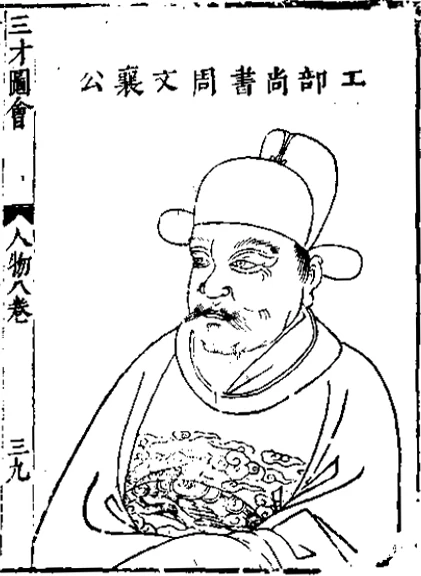
Historical painting or book illustration depicting 周忱; a later artistic interpretation.

1381 CE–1453 CE

Ming fiscal official

Zhou Chen

周忱

Zhou Chen (7 December 1381–3 November 1453), courtesy name Xunru and art name Shuangya, was a native of Jishui County, Ji'an Prefecture, Jiangxi, with ancestral roots in Wuning County, Nanchang Prefecture. He was a prominent mid-Ming official and fiscal administrator. He passed the metropolitan examination in 1404, the second year of the Yongle era, and was selected as a Hanlin bachelor trainee. The following year he…

1381 CE–1453 CEMing Dynasty

PROFILE

Zhou Chen (7 December 1381–3 November 1453), courtesy name Xunru and art name Shuangya, was a native of Jishui County, Ji'an Prefecture, Jiangxi, with ancestral roots in Wuning County, Nanchang Prefecture. He was a prominent mid-Ming official and fiscal administrator. He passed the metropolitan examination in 1404, the second year of the Yongle era, and was selected as a Hanlin bachelor trainee. The following year he continued study in the Wenyuan Pavilion and took part in compiling the *Yongle Encyclopedia* and the *Compendium of the Principles of the Five Classics and Four Books*. He later served as secretary and vice director in the Ministry of Justice and as chief secretary of the Prince of Yue's establishment. For roughly twenty years he remained in relatively low offices. In 1430, the fifth year of Xuande, he became Right Vice Minister of Works, grand coordinator of the Jiangnan prefectures, and superintendent of tax grain. He introduced the “equalized-rice method,” designed so that transport and handling surcharges would be distributed evenly. In the early Zhengtong era, after disasters in Huai'an and Yangzhou disrupted the salt levy, he was sent to inspect the region. In 1441 he was also placed in charge of tax grain in Huzhou and Jiaxing and reviewed judicial cases in Nanjing. In 1450 he was attacked by accusers. The Jingtai Emperor, knowing his diligence, concern for the people, and personal integrity, did not punish him but ordered him to retire. His family later moved to Shanqian Village in Luling. Zhou died at home in 1453, aged seventy-two, and received the posthumous title Wenxiang.

Other names
Xunru; Zhou Wenxiang
Courtesy name
Xunru
Art name
Shuangya
Period
Ming
Dynasty/Polity
Ming
Identity
Ming fiscal official
Ethnicity/People
Not reliably established in historical sources
Native place
Jishui County, Ji'an Prefecture, Jiangxi (present-day Jishui County, Ji'an, Jiangxi)
Date of birth
1380
Place of birth
Yuegang, Jishui County, Ji'an Prefecture, Jiangxi
Date of death
1453
Place of death
Unknown
Highest office
See Biography and Major Deeds

LIFE TIMELINE

Age one | Born at Yuegang, Jishui County, Ji'an Prefecture, Jiangxi.Open

Age one | Born at Yuegang, Jishui County, Ji'an Prefecture, Jiangxi.

Age eight | Began study and was said to remember what he read after a Open

Age eight | Began study and was said to remember what he read after a single viewing.

Age twelve | Studied with the prominent Wang family of Jintang; his faOpen

Age twelve | Studied with the prominent Wang family of Jintang; his father Zhou Sen personally trained him for the examinations.

Age seventeen | Entered the Ji'an Prefectural School as a student.Open

Age seventeen | Entered the Ji'an Prefectural School as a student.

Age eighteen | Studied the *Book of Documents* under Liu Ziqin.Open

Age eighteen | Studied the *Book of Documents* under Liu Ziqin.

Age twenty-one | On his grandfather's advice, gave up plans to sit theOpen

Age twenty-one | On his grandfather's advice, gave up plans to sit the Jiangxi provincial examination that year.

Age twenty-two | Took the Jiangxi provincial examination and ranked siOpen

Age twenty-two | Took the Jiangxi provincial examination and ranked sixty-fourth.

Age twenty-three | Earned the *jinshi* degree and was selected as a HaOpen

Age twenty-three | Earned the *jinshi* degree and was selected as a Hanlin bachelor trainee.

Age twenty-four | Entered the Wenyuan Pavilion as the twenty-ninth stuOpen

Age twenty-four | Entered the Wenyuan Pavilion as the twenty-ninth student; returned home to mourn his mother Long in the eighth month.

Age twenty-seven | Recalled to service in the Hanlin Academy while conOpen

Age twenty-seven | Recalled to service in the Hanlin Academy while continuing at the Wenyuan Pavilion; participated in compiling the *Yongle Encyclopedia*.

Age thirty-one | Appointed secretary in the Guangxi Bureau of the MiniOpen

Age thirty-one | Appointed secretary in the Guangxi Bureau of the Ministry of Justice.

Age thirty-two | Followed the Yongle Emperor back to the Beijing imperOpen

Age thirty-two | Followed the Yongle Emperor back to the Beijing imperial residence; assigned work involving prisoners tried by the Nanjing judicial offices and helped compile the *Compendium of the Principles of the Five Classics and Four Books*.

Age thirty-five | Sent ahead to clear the route and post prohibitions;Open

Age thirty-five | Sent ahead to clear the route and post prohibitions; also handled criminal matters.

Age thirty-six | Promoted to vice director in the Fujian Bureau of theOpen

Age thirty-six | Promoted to vice director in the Fujian Bureau of the Ministry of Justice.

Age thirty-eight | Ordered to press the transport of grain reserves frOpen

Age thirty-eight | Ordered to press the transport of grain reserves from the Northern and Southern Metropolitan Regions.

Age forty-four | Promoted to chief secretary of the Prince of Yue's esOpen

Age forty-four | Promoted to chief secretary of the Prince of Yue's establishment.

Age forty-nine | Promoted to Right Vice Minister of Works, grand coordOpen

Age forty-nine | Promoted to Right Vice Minister of Works, grand coordinator of Jiangnan, and superintendent of tax grain; introduced the equalized-rice method.

Age fifty-one | After a major Jiangnan harvest, proposed establishing Open

Age fifty-one | After a major Jiangnan harvest, proposed establishing the “Aid-the-Farmers Granaries.”

Age fifty-five | Inspected the Huai'an-Yangzhou salt levy.Open

Age fifty-five | Inspected the Huai'an-Yangzhou salt levy.

Age sixty | Given additional responsibility for tax grain in Huzhou anOpen

Age sixty | Given additional responsibility for tax grain in Huzhou and Jiaxing and for reviewing Nanjing judicial cases.

Age sixty-three | At the end of his term, transferred as Minister of WOpen

Age sixty-three | At the end of his term, transferred as Minister of Works while remaining grand coordinator.

Age sixty-nine | Impeached and retired to his home region.Open

Age sixty-nine | Impeached and retired to his home region.

Age seventy-two | Died at home and received the posthumous title WenxiOpen

Age seventy-two | Died at home and received the posthumous title Wenxiang.

BIOGRAPHY

Biography

Family Background and Early Life

Zhou Chen was born on the twenty-first day of the eleventh lunar month of Hongwu 14 (7 December 1381) at Yuegang in Jishui County, Ji'an Prefecture. The Zhou family was not prominent. His father Zhou Sen, a scholar living at home, personally educated his son, while his mother, Lady Long, came from an ordinary family but imposed strict discipline. Zhou began reading at eight and was said to have an exceptional memory. At twelve he studied with the locally prominent Wang family of Jintang, and his father copied model essays by earlier masters for him. When his father was away on official labor, his mother supervised his studies. Unable to afford a set of the *Four Books*, Lady Long wove cotton cloth for a merchant for fifteen days and nights and exchanged the resulting bolt of cloth for the books. She told him that persistent labor prevented poverty of knowledge and that alertness led to achievement, asking him to make his learning as continuous as the cloth she had woven. Zhou remembered the lesson and studied more diligently.

In 1398 Liu Junfu, assistant prefect of Ji'an, ordered Zhou admitted as a student of the prefectural school. In 1399 he studied the *Book of Documents* under Liu Ziqin and progressed rapidly. In 1402 Prefect Zhu Zhongzhi recommended that he enter the Jiangxi provincial examination. His grandfather Zhou Run warned him that men of old did not take office too early and that a young scholar without mature learning or settled judgment might succeed by borrowing others' opinions yet fail in public service. Zhou accepted the advice and devoted himself to further study instead of sitting the examination that year.

Examination Career and Study in the Wenyuan Pavilion

In 1403, urged by Ji'an prefect Lin Fang, Zhou took the Jiangxi provincial examination and placed sixty-fourth. In 1404 he earned the *jinshi* degree and was selected as a Hanlin bachelor trainee. In the first month of 1405 the Yongle Emperor instructed Xie Jin and others to choose twenty-eight gifted new degree-holders for advanced study in the Wenyuan Pavilion. Zhou personally asked to continue his studies because he was still young. The emperor praised his ambition and added him as the twenty-ninth. He studied alongside Zeng Qi, Wang Ying, Wang Zhi, Li Shimian, and others. In the eighth month his mother died and he returned home for mourning.

In 1408 Zhou was recalled and assigned to the Hanlin Academy while continuing at the Wenyuan Pavilion, where he participated in the compilation of the *Yongle Encyclopedia*. In 1412 he became secretary of the Guangxi Bureau of the Ministry of Justice. In 1413 he followed the Yongle Emperor to the Beijing imperial residence, was given duties involving prisoners handled by Nanjing judicial offices, and worked on the *Compendium of the Principles of the Five Classics and Four Books*. In 1416, before the emperor's planned return to Nanjing, Zhou was sent ahead to clear the route, post prohibitions, and handle criminal matters. In 1417 he became vice director of the Fujian Bureau of the Ministry of Justice. In 1419 he was charged with pressing grain shipments from the Northern and Southern Metropolitan Regions.

Although Zhou had considerable practical ability, he spent about twenty years in middle and lower offices and was little known. Xia Yuanji alone recognized his unusual talent. In 1425 Zhou was eventually promoted to chief secretary of the Prince of Yue's establishment. In the early Xuande years someone proposed making Zhou a prefect, but Xia Yuanji argued that an ordinary promotion would not fully use his ability.

Grand Coordinator of Jiangnan and Tax Reform

In the ninth month of 1430, the Xuande Emperor, concerned that tax revenues across the empire were badly administered and that Jiangnan was especially troubled—Suzhou Prefecture alone reportedly owed eight million *shi* of grain—sought a capable senior official. On the recommendation of Grand Secretary Yang Rong, Zhou Chen was promoted to Right Vice Minister of Works and sent as grand coordinator of the Jiangnan prefectures with overall responsibility for tax grain.

On arrival, Zhou summoned local elders and asked why arrears were so large. They explained that wealthy households refused to pay additional transport-loss grain, forcing the surcharge onto small taxpayers, who then fled because of poverty. Zhou introduced the equalized-rice method so that such surcharges would be distributed evenly. He also asked the emperor to have the Ministry of Works issue standard iron measuring vessels to the counties, ending abuses by grain chiefs who took in grain with larger measures and paid it out with smaller ones. Under the old system, each grain chief had two deputies, and all three went to the Nanjing Ministry of Revenue every seventh month to receive official credentials, financing the journeys by levies on taxpayers. Zhou reduced the positions to one chief and one deputy, who alternated in making the trip, while local officials collected the completed documents for return to the ministry. This significantly reduced local burdens.

Zhou found that counties lacked public collection depots and that grain chiefs stored tax grain at home, which he identified as a major source of arrears. He therefore ordered the establishment of waterside granaries. Each unit had a grain head and a depot household in a system called “jurisdictional collection”; only when six or seven ten-thousand *shi* had accumulated was a grain chief appointed over the whole, called “general collection.” Taxpayers delivered grain to the depot under official supervision while the grain chief merely consolidated the accounts by date. Zhou also introduced separate transport-allocation and convoy-transport registers. The first recorded grain assigned for shipment and anticipated losses en route to granaries at the capital and Tongzhou; the second recorded expenses such as transshipment through shallow reaches and provided reimbursement after return. Surplus grain owed to the provincial treasury remained stored locally as “surplus rice.” Collection rates in subsequent years were adjusted according to the size of the reserve.

After the Ming conquest of the Wu region, estates of meritorious families and later confiscated lands of wealthy households had become “official fields.” Their tax grain continued to be assessed at former rent-book levels, making Suzhou's burden exceptionally heavy. Of a total annual rental assessment of 2.77 million *shi* from official and private fields, official fields accounted for 2.62 million. The Xuande Emperor repeatedly ordered reductions. After months of calculation, Zhou Chen and Suzhou prefect Kuang Zhong reduced the official-field rental assessment to just over 720,000 *shi*, with reductions elsewhere as well, giving substantial relief to the population.

Aid-the-Farmers Granaries and Transport Reform

In 1432, after an abundant Jiangnan harvest, the Xuande Emperor ordered local administrations to purchase grain at fair prices with government paper money for relief and loans. Suzhou acquired 290,000 *shi*. At the time stipends for nobles, soldiers, and officials were paid from the Nanjing Ministry of Revenue. Suzhou and Songjiang taxpayers transporting grain to Nanjing paid six additional *dou* of expenses for every *shi*. Zhou proposed paying stipends locally, granting one *dou* as boat compensation, and collecting the remaining five *dou* as a reserve. Together with state purchases, this produced more than 700,000 *shi* of grain, stored in granaries called “Aid-the-Farmers Granaries.”

The reserves were used for disaster relief and agricultural loans. Surplus grain could cover convoy expenses, storm losses, theft, or robbery, with loans repaid after the autumn harvest. Rations for repairing polders and dikes, opening rivers, and dredging lakes did not have to be repaid. Farmers seeking loans were investigated according to household circumstances and landholding and repaid together with the tax grain after harvest; in bad years the reserves were again used for relief. Habitual defaulters were denied later loans. Zhou submitted these procedures as regulations and received imperial commendation. During his tenure, the source states, common people in the major Jiangnan prefectures scarcely experienced famine and the summer and autumn taxes did not fall into arrears.

At the time grain transport was divided equally between military and civilian carriers. The state provided military transport boats, while civilians hired vessels and paid substantial additional losses; roughly one extra *shi* might be required for every three *shi* delivered, and the round trip consumed a year and interfered with farming. Zhou and Chen Xuan, Earl of Pingjiang, agreed that civilian carriers would deliver to Huai'an or Guazhou and transfer the grain to military transport for shipment to Tongzhou. Surcharges varied by transfer point, with additional grain for crossing the river and even reed matting converted into grain. If military carriers were delayed by weather, prefectures and counties supplied compensation grain. A granary was also established at the Guazhou waterfront, with surplus grain supporting its keepers. Transport costs fell substantially.

Continuing Administration in the Zhengtong Era

In the early Zhengtong era, Huai'an and Yangzhou suffered disaster and salt revenues collapsed. The Yingzong Emperor sent Zhou to inspect. He proposed sending ten or twenty thousand *shi* of surplus rice from Suzhou and other prefectures to the Yangzhou salt fields, crediting it against the following year's land tax, while salt workers exchanged salt for grain. Because grain was expensive and salt cheap, the government accumulated salt while the population obtained food, benefiting both public and private interests. Zhou was later given responsibility for the Songjiang salt levy. When Huating and Shanghai owed more than 630,000 units of salt levy and many salt households had fled, Zhou submitted four measures to reduce transport losses, obtained more than 30,000 *shi* of grain, and established Salt-Support Granaries modeled on the Aid-the-Farmers system to cover missing households.

In 1441 he received additional responsibility for tax grain in Huzhou and Jiaxing and, together with Supervising Secretary Guo Jin, for reviewing judicial cases in Nanjing. Zhou was open and approachable. Hu Gai, Minister of the Court of Judicial Review, had previously governed harshly as grand coordinator, while Zhou preferred simple and convenient procedures. After many years in Jiangnan, he knew officials and people almost like family. He often traveled through villages without attendants, spoke directly with farmers about hardships, and sought practical remedies. He consulted even low-ranking clerks and freely adopted useful suggestions. Capable officials such as Kuang Zhong, Songjiang prefect Zhao Yu, Changzhou prefect Mo Yu, and assistant prefect Zhao Tai were trusted to use their strengths.

In 1444 Supervising Secretary Li Su and others accused Zhou of altering established rules and taxes. Zhou defended himself, and the Yingzong Emperor declined to pursue the matter because the surplus grain had been used for public purposes. Yin Chongli then claimed that Zhou improperly collected too much surcharge grain. Zhou's reforms were repealed, but the public complained of hardship. Zhou petitioned for Yin's punishment and his system was restored. The same year, when his term ended, he should have become Minister of Revenue. Because people from Zhejiang, Jiangxi, Suzhou, and Songjiang were said not to be eligible for that ministry, he instead became Minister of Works while remaining grand coordinator.

Jingtai Difficulties and Final Years

In 1450, Peng Shouxue of Liyang repeatedly submitted accusations against Zhou, and the Ministry of Revenue sent Censor Li Jian and others to investigate the counties. In the following year Supervising Secretary Jin Da and others also memorialized against him, and Zhou was recalled. Censors then repeatedly sought punishment. The Jingtai Emperor knew Zhou's merit and most senior ministers supported him, yet still ordered him to retire. Contemporary opinion nevertheless held that no one surpassed Zhou in fiscal administration. His governance centered on relief of the people: surplus grain collected each year was returned to local use, and his rules were adjusted flexibly according to circumstances. Some prefectures accumulated enormous reserves, supporting both government and people and even aiding neighboring regions.

After Zhou's retirement, Li Min replaced him. The Ministry of Revenue began treating his accumulated grain as ordinary state revenue, and reserves gradually declined. When famine later struck Jiangnan, deaths from hunger appeared along the roads while taxes remained unchanged. People increasingly remembered Zhou and erected living shrines to him in many places. After leaving office his family moved to Shanqian Village in Luling. He died in the tenth lunar month of Jingtai 4 (3 November 1453), aged seventy-two, and received the posthumous title Wenxiang.

Major Activities

Political Activity

Zhou Chen's political career centered on twenty years as grand coordinator of Jiangnan from 1430 to 1450, one of the longest such tenures in the Ming. He successively held the offices of Right Vice Minister, Left Vice Minister, and Minister of Works while supervising tax grain and the Jiangnan prefectures. His authority extended beyond fiscal reform to salt administration, judicial matters, and canal transport, making him in practice one of the region's most powerful administrators. During the Zhengtong era he was ordered to inspect the salt taxes of Huai'an and Yangzhou, concurrently oversee the Songjiang salt administration, take charge of tax grain in Huzhou and Jiaxing, and review judicial cases in Nanjing.

Economic Reform

His best-known work lay in fiscal reform. The equalized-rice method distributed surcharge grain more evenly and reduced the burden on poorer households. He simplified the grain-chief system by reducing the principal and deputy grain chiefs from three each to one each and having them take turns going to the Ministry of Revenue in Nanjing to receive official verification tallies, thereby cutting travel costs. He established a two-stage system of subordinate collection and general collection, with grain stored at waterside depots rather than in the grain chiefs' homes, helping prevent arrears. He also created separate registers for allocated transport and convoy transport to regularize canal-grain administration.

His Aid-the-Farmers Granaries stored more than 700,000 *shi* of grain for famine relief, loans to farmers, and rations for hydraulic works. The Chinese source credits these measures with making famine scarcely felt among common households in several major prefectures and with preventing arrears in the two regular taxes. With Earl Chen Xuan of Pingjiang he reorganized canal-grain transport so that civilian carriers delivered grain to transfer points at Huai'an or Guazhou, from which military transport carried it onward to Tongzhou, greatly reducing costs. The source also credits him with reforms to fodder payments and commutation of the “gold-flower silver” levy.

Water-Control Projects

Zhou repeatedly inspected water systems in Jiangnan, especially around Songjiang. Finding heavy silting in waterways between Jiading and Shanghai, he ordered upstream channels cleared so water from Kunshan and Gupu could scour sediment. He often rode along the river in plain fashion so that observers did not recognize the grand coordinator. Repairs to polders and embankments, opening of rivers, and dredging of lakes were supported with grain from the Aid-the-Farmers Granaries and did not require repayment.

Livelihood and Local Development

Zhou's policies stressed livelihood. He supported schools, shrines and graves of worthies, bridges, roads, and religious buildings. He proposed recruiting people to reclaim 150 *qing* of sandy wasteland and brushland beside the Wusong River, increasing revenue while removing insect breeding grounds. He also advocated cancellation of taxes on fields already lost to the Yangtze and heavier assessment of powerful landholders. Early in the Jingtai era, during severe famine north of the Yangtze, Censor-in-Chief Wang Hong borrowed 30,000 *shi* of grain from Zhou's system; after the next harvest the stock reportedly grew to 100,000 *shi*.

Relations with Contemporaries

Zhou worked closely with local officials. With Suzhou prefect Kuang Zhong he spent several months recalculating the rents and taxes on official fields, reducing the total in Suzhou to more than 720,000 *shi* and thereby easing the burden on the population. He likewise consulted closely with Songjiang prefect Zhao Yu, Changzhou prefect Mo Yu, and assistant prefect Zhao Tai, making use of their respective abilities. With Earl Chen Xuan of Pingjiang he reformed canal transport and greatly reduced transport expenses. Xia Yuanji was the first senior minister to recognize his ability, and Grand Secretary Yang Rong recommended him for Jiangnan. Even when censors attacked him under the Jingtai Emperor, most senior ministers reportedly supported him.

Personal Relations

Family

  • Father: Zhou Sen, who personally prepared him for the examinations and copied model prose for his study
  • Mother: Lady Long, who wove cloth for fifteen days and nights to obtain a set of the *Four Books* for him
  • Grandfather: Zhou Run, who advised him not to enter the examinations too early and to deepen his learning

Teachers and Associates

  • Liu Ziqin: teacher of the *Book of Documents* from 1399
  • Xia Yuanji: senior official who recognized Zhou's talent early
  • Yang Rong: Grand Secretary who recommended Zhou as grand coordinator of Jiangnan
  • Kuang Zhong: prefect of Suzhou and Zhou's partner in reducing official-field rents
  • Chen Xuan: Earl of Pingjiang, who worked with Zhou on transport reform
  • Zhao Yu: prefect of Songjiang and trusted collaborator
  • Mo Yu: prefect of Changzhou and trusted collaborator
  • Zhao Tai: assistant prefect of Changzhou and trusted collaborator

Rulers

  • Zhu Di, Yongle Emperor: praised Zhou's ambition in 1405 and added him as the twenty-ninth Wenyuan Pavilion student
  • Zhu Zhanji, Xuande Emperor: promoted Zhou in 1430 and repeatedly commended his reforms
  • Zhu Qizhen, Yingzong Emperor: trusted Zhou during the Zhengtong era and did not pursue accusations over surplus grain used for public purposes
  • Zhu Qiyu, Jingtai Emperor: ordered Zhou to retire but recognized his diligence, concern for the people, and integrity

Conflicts

  • Hu Gai: Minister of the Court of Judicial Review and former grand coordinator, whose harsh style differed from Zhou's
  • Li Su: Supervising Secretary who accused Zhou in 1444 of altering established institutions and taxes
  • Yin Chongli: memorialized that Zhou improperly collected surcharge grain
  • Peng Shouxue: resident of Liyang who repeatedly submitted accusations in 1450
  • Jin Da: Supervising Secretary who impeached Zhou in 1451

Historical Assessment

Ming and Contemporary Assessments

  • The *Veritable Records of Emperor Yingzong* praised Zhou's broad-mindedness, quick intelligence, diligence, easy manner with the people, openness to suggestions even from humble officials, and extraordinary numerical ability, while also criticizing his use of surplus funds to cultivate powerful connections and his trust in lesser men.
  • The *History of Ming* states that during Zhou's tenure the common people of the major Jiangnan prefectures scarcely knew famine and the two annual taxes were never in arrears, and adds that later fiscal administrators generally could not match him.
  • The Jingtai Emperor ordered his retirement but, according to the Chinese source, recognized his diligence, care for the people, and personal integrity.
  • After Zhou left office, people across Jiangnan built living shrines in memory of his service.

Early and Mid-Qing

  • The Qing-compiled *History of Ming* rated Zhou highly, calling him a man of practical statecraft and saying that later fiscal administrators rarely matched him.
  • Zhao Yi, in *Notes on the Twenty-Two Histories*, discussed Zhou's long tenure when examining the Ming grand-coordinator system and treated his results favorably.
  • Qing scholars often held the partnership between Zhou and Kuang Zhong in Suzhou as a model of Ming local administration.

Late Qing and Republican Period

  • Meng Sen's *Lectures on Ming History* lists Zhou among the notable Ming fiscal administrators and credits the equalized-rice method and Aid-the-Farmers Granaries with stabilizing Jiangnan's economy and society.
  • Republican-era economic historians increasingly examined Zhou's tax and labor-service reforms as an important episode in Chinese fiscal history.

Modern Period

  • Chen Ziming's *A Study of Zhou Chen and His Jiangnan Tax and Corvée Reforms in the Ming* systematically analyzes the reforms and argues that they had lasting effects on Jiangnan's social economy.
  • Yu Weiming's *Zhou Chen's Economic and Social Reforms in Jiangnan during the Ming* regards him as one of the Ming's most accomplished fiscal administrators and emphasizes the practical and people-centered character of his measures.
  • Contemporary Ming historians generally regard the equalized-rice method, Aid-the-Farmers Granaries, and related innovations as important milestones in Ming tax reform and as measures with later relevance to Zhang Juzheng's reforms.

LOCAL NETWORK

Xia Yuanji↗Related entry

Original note (Chinese): 最早赏识周忱才能的大臣,认为他有奇才,曾言“此常调也,安足尽周君?”

Zhu Di↗Related entry

Original note (Chinese): 永乐三年(1405年)嘉奖周忱有志,命增为文渊阁第二十九人

Zhu Qiyu↗Related entry

Original note (Chinese): 景泰年间虽令周忱致仕,但知其勤政爱民,廉洁自律

Yu Qian↗Related entry

Original note (Chinese): 土木之变后采纳周忱建议,以通州粮仓之米作为京军兵饷

周森 · No matching entry available

周忱之父,亲自教授周忱举子业,抄录前辈名家文章供其学习

龙氏 · No matching entry available

周忱之母,连续十五昼夜织布为周忱换取《四书》,教子极严

周润 · No matching entry available

周忱祖父,曾告诫周忱不要急于参加科举,应专心致力于学问

刘子钦 · No matching entry available

建文元年(1399年)周忱授业于其门下学习《书经》

杨荣 · No matching entry available

大学士杨荣推荐周忱为工部右侍郎巡抚江南诸府

况钟 · No matching entry available

苏州知府,与周忱搭档治理苏州,共同计算减苏州官田租税至七十二万余石

陈瑄 · No matching entry available

平江伯,与周忱商议改革漕运,实行民运至淮安或瓜洲水次交兑

赵豫 · No matching entry available

松江府知府,周忱推心置腹商议策划的官员

莫愚 · No matching entry available

常州府知府,周忱推心置腹商议策划的官员

赵泰 · No matching entry available

常州府同知,周忱推心置腹商议策划的官员

明宣宗 · No matching entry available

宣德五年(1430年)升周忱为工部右侍郎巡抚江南,多次嘉奖其改革

明英宗 · No matching entry available

正统年间信任周忱,虽有人弹劾,但以余米既为公用,不予追问

胡槩 · No matching entry available

大理寺卿,曾任巡抚,用法严,与周忱的管理风格不同

李素 · No matching entry available

给事中,正统九年(1444年)弹劾周忱擅自改变定制与赋税

尹崇礼 · No matching entry available

上奏妄称周忱不当多征耗米,周忱请治其罪

彭守学 · No matching entry available

溧阳民,景泰元年(1450年)屡次上奏攻击周忱

金达 · No matching entry available

给事中,景泰二年(1451年)上奏弹劾周忱

李敏 · No matching entry available

周忱致仕后代任其职,户部自此把积余米作为公赋

王竑 · No matching entry available

都御史,景泰初年江北饥荒时跟从周忱贷米三万石

CONTEMPORARIES

Bibliography

  • *History of Ming*, juan 153, Biography 41
  • *Veritable Records of Emperor Yingzong*, juan 234
  • *Veritable Records of Emperor Taizong Wen*, juan 28
  • Yu Weiming, *Zhou Chen's Economic and Social Reforms in Jiangnan during the Ming*, Taipei: Taiwan Commercial Press, 1990