Birth | Born in an official residence in Chongde Ward, Junyi County, Kaifeng Prefecture.
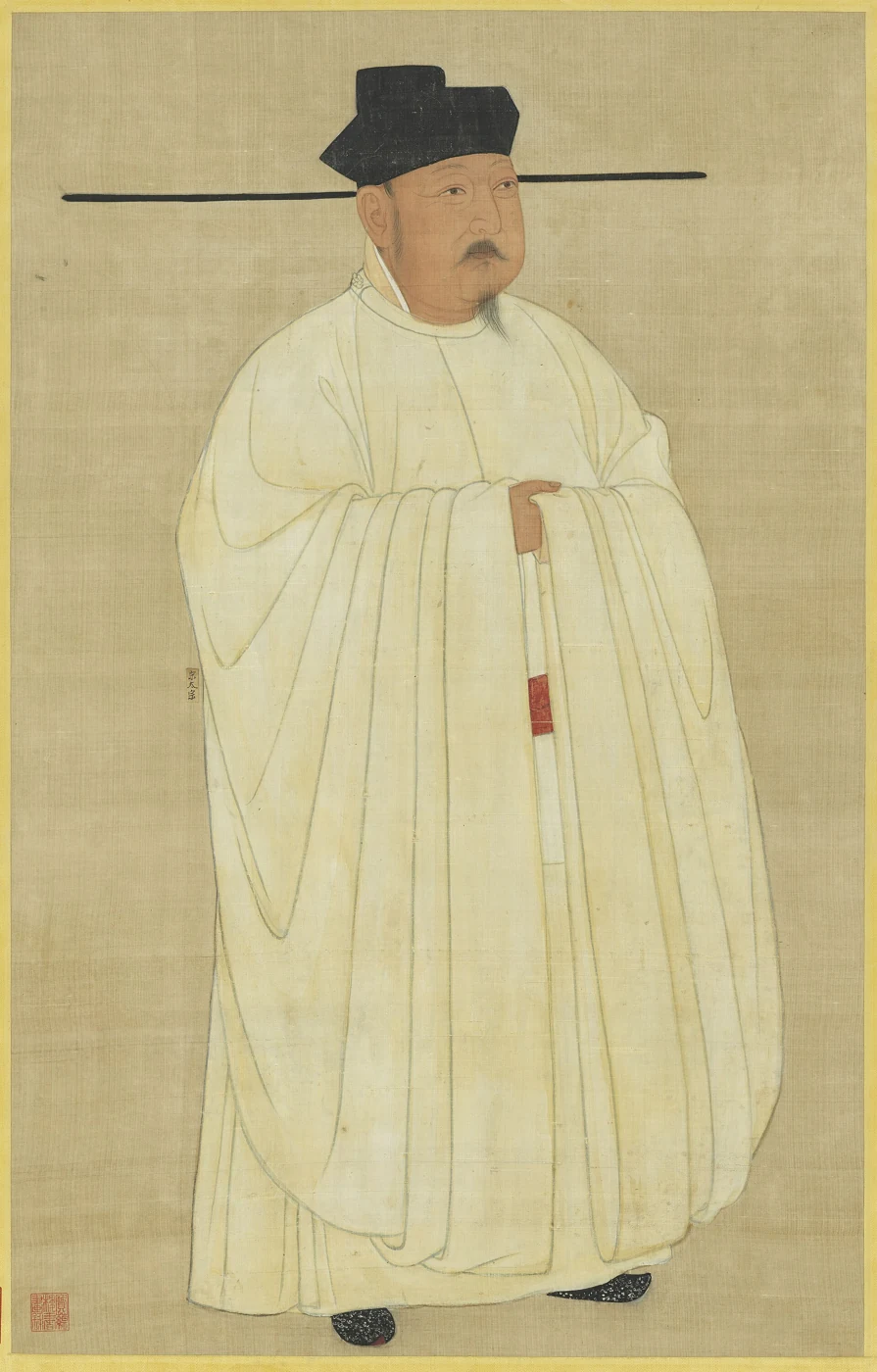
939 CE–997 CE
Emperor
Zhao Guangyi
赵光义
Zhao Jiong (November 20, 939 – May 8, 997), Emperor Taizong of Song, was originally named Zhao Kuangyi. He changed his name to Zhao Guangyi to avoid the personal name of his elder brother Zhao Kuangyin, Emperor Taizu of Song, and after taking the throne changed it again to Zhao Jiong. He was the third son of Zhao Hongyin, posthumously Emperor Xuanzu of Song, and Empress Dowager Zhaoxian, Lady Du, and the younger brother of…
939 CE–997 CENorthern Song
PROFILE
Zhao Jiong (November 20, 939 – May 8, 997), Emperor Taizong of Song, was originally named Zhao Kuangyi. He changed his name to Zhao Guangyi to avoid the personal name of his elder brother Zhao Kuangyin, Emperor Taizu of Song, and after taking the throne changed it again to Zhao Jiong. He was the third son of Zhao Hongyin, posthumously Emperor Xuanzu of Song, and Empress Dowager Zhaoxian, Lady Du, and the younger brother of Zhao Kuangyin. He was the second emperor of the Northern Song, reigning from 976 to 997. During Later Zhou he entered official service through family privilege and rose to Dianqian Zhihou and Gongfengguan Duzhi. After the founding of Song he became Dianqian Duyuhou, was appointed prefect of Kaifeng in 961, and became Prince of Jin in 973 with rank above the chancellors. After Zhao Kuangyin died suddenly in the tenth month of 976, Zhao Guangyi quickly ascended the throne as Emperor Taizong. During his reign Chen Hongjin and Qian Chu surrendered their territories to Song, and Northern Han was conquered, largely ending the division of the Five Dynasties and Ten Kingdoms period. His two major northern expeditions against the Liao dynasty both failed, after which Song adopted a more defensive posture toward Liao. Internally he strengthened central control, expanded recruitment through the civil examinations, and consolidated a policy favoring civil officials over military commanders. His reign was later called the "Taizong era of good government." He died in 997, the third year of Zhidao, aged fifty-nine, and was buried at Yongxi Mausoleum.
- Other names
- Emperor Taizong of Song; Zhao Jiong
- Courtesy name
- Tingyi (recorded only in later popular genealogies)
- Period
- Northern Song
- Date of Birth
- November 20 939
- Date of Death
- May 8 997
- Dynasty / polity
- Northern Song
- Identity
- Emperor
- Ethnicity / people
- Not recorded in historical sources
- Native place
- Not recorded in historical sources
- Place of birth
- Not recorded in historical sources
- Reign
- 976–997
- Predecessor
- Emperor Taizu of Song (Zhao Kuangyin)
- Successor
- Emperor Zhenzong of Song (Zhao Heng)
- Era names
- Not recorded in historical sources
- Temple name
- Taizong
- Posthumous title
- Not recorded in historical sources
- Major achievements
- Younger brother of Emperor Taizu; succeeded after the disputed "Candle Shadow and Axe Sound" episode; conquered Northern Han but was defeated at the Battle of Gaoliang River; helped establish the policy of favoring civil officials over military commanders.
LIFE TIMELINE
Age sixteen | Appointed Youban Dianzhi and later promoted to a palace service office.
Age twenty | Appointed Dianqian Zhihou and Gongfengguan Duzhi.
Age twenty-two | Song was founded; given the name Guangyi, appointed Dianqian Duyuhou, and given the defense commission of Mu Prefecture.
Age twenty-three | In the seventh month, appointed prefect of Kaifeng and Participant in Determining Government Matters.
Age twenty-six | Concurrently appointed Secretariat Director.
Age thirty-five | In the seventh month, enfeoffed as Prince of Jin with precedence above the chancellors.
Age thirty-eight | On the night of the nineteenth day of the tenth month Zhao Kuangyin died; Zhao Guangyi took the throne and in the twelfth month changed the era name to Taiping Xingguo.
Age thirty-nine | Changed his personal name to Jiong in the second month.
Age forty | Chen Hongjin surrendered his territory in the fourth month; Qian Chu surrendered Wuyue in the fifth month, completing Song control of the south.
Age forty-one | Personally campaigned against Northern Han in the first month; Northern Han surrendered in the fifth month; in the seventh month the Song army suffered a major defeat at the Battle of Gaoliang River and Zhao Jiong was wounded by an arrow.
Age forty-two | Sent troops against Jiaozhi, in present-day northern Vietnam; the following year Song forces won initially but were ultimately defeated at the Battle of Bạch Đằng River.
Age forty-four | Zhao Pu returned as chancellor; Zhao Tingmei was demoted and Lu Duoxun exiled.
Age forty-five | Zhao Pu left the chancellorship in the tenth month.
Age forty-eight | Launched the Yongxi Northern Expedition against Liao in three columns; the main force suffered a major defeat at the Battle of Qigouguan in the seventh month and Yang Ye died, after which Song shifted to a defensive posture toward Liao.
Age fifty | Zhao Pu became chancellor for a third time.
Age fifty-two | Lü Mengzheng became chancellor.
Age fifty-seven | In the eighth month, Zhao Heng was made crown prince.
Age fifty-nine | Died on the twenty-ninth day of the third month in Wansui Hall; buried at Yongxi Mausoleum in the tenth month.
BIOGRAPHY
Biography
Family Background and Early Life
Zhao Jiong was originally named Zhao Kuangyi. He was the third son of Zhao Hongyin, posthumously Emperor Xuanzu of Song, and Empress Dowager Zhaoxian, Lady Du, and the younger brother of Zhao Kuangyin. He was born on November 20, 939, the seventh day of the tenth month of the fourth year of Tianfu under Later Jin, in an official residence in Chongde Ward, Junyi County, Kaifeng Prefecture. The History of Song records auspicious stories surrounding his birth, including a dream by Lady Du and a red glow and unusual fragrance on the night he was born. The Chinese source cautions that such accounts are conventional imperial-birth legends and should not be accepted uncritically.
Zhao Jiong was described as intelligent and fond of learning from childhood. His father Zhao Hongyin served as a Later Zhou general. During a campaign in Huainan, when other officers competed for captives and valuables, Zhao Hongyin instead searched for old books and brought them home for Zhao Jiong, telling him that literary and martial skills were the foundations of a person's career. The source connects this upbringing with Zhao Jiong's later interest in literature, calligraphy, and multiple arts. He was also described as physically imposing and dignified.
In 954, the first year of Xiande, as Zhao Kuangyin was rising in the Later Zhou army, Zhao Jiong received appointment as Youban Dianzhi and was soon promoted to a palace service post. In 958 he became Dianqian Zhihou and Gongfengguan Duzhi, serving as a junior military officer. Zhao Jiong later claimed that he had participated in campaigns in Huainan and killed many Southern Tang soldiers and that he had also joined the Later Zhou campaign against Liao in Hebei. These claims lack independent corroboration, and the Chinese source notes that some scholars regard them as unreliable.
Founding of Song and the Kaifeng Prefecture Period
On the third day of the first month of 960, the seventh year of Xiande, Zhao Kuangyin, then Palace Command commander-in-chief, was ordered north to resist the Khitan. The Chenqiao Mutiny occurred the following day, and Zhao Kuangyin returned to Kaifeng and founded the Song dynasty. Zhao Jiong's role at the time is disputed. One account says that he accompanied his brother, participated in the mutiny, stopped Zhao Kuangyin's horse after the coup, and urged him to restrain the troops from looting, helping inspire an intention to transmit the throne to him. This version comes from Zeng Gong's Longping Ji and has been doubted by later scholars. Another account, from Wang Yucheng's Jianlong Yishi, says Zhao Jiong remained in the capital with his mother Lady Du and came out to meet Zhao Kuangyin only after hearing the news. The Chinese source states that the two versions cannot now be decisively reconciled.
After the Song founding, Zhao Jiong was appointed Dianqian Duyuhou, given the defense commission of Mu Prefecture, and granted the name Guangyi. In the fifth month of 960, when Zhao Kuangyin campaigned at Luzhou against Li Yun, Zhao Guangyi was placed in charge of the imperial palace and remained at Kaifeng. In the tenth month, when Zhao Kuangyin marched south against Li Chongjin at Yangzhou, Zhao Guangyi again remained behind with responsibility for the palace. His successful handling of both assignments increased his elder brother's confidence in him.
Empress Dowager Zhaoxian died in the sixth month of 961. The following month Zhao Kuangyin appointed Zhao Guangyi prefect of Kaifeng and Participant in Determining Government Matters. Zhao remained prefect of the capital for about fifteen years until his accession. During this period, according to the source, he relied on his brother's trust, maintained a conspicuously grand household, and cultivated a wide network of talented men and military figures, building a major political power base.
From the beginning of Song, Zhao Guangyi is portrayed in the Chinese source as aspiring to the throne and entering a protracted struggle with Secretariat Director Zhao Pu. In 963 Zhao Kuangyin considered giving Fu Yanqing, father-in-law of both Emperor Shizong of Later Zhou and Zhao Guangyi, command of the imperial army, but Zhao Pu strongly blocked the appointment. In 966 Zhao Pu discovered that the palace academic Feng Zan had given Zhao Guangyi bribes including a gold belt, and Feng was imprisoned. Zhao Guangyi retaliated by forcing Zhao Pu's fellow townsman and friend Song Qi out of the Kaifeng government. Zhao Pu later played key roles in the killing of Yao Shu, the demotion of Shi Xizai, and preventing Dou Yi from taking high office; all three were members of Zhao Guangyi's staff or political circle. Only after Zhao Pu was dismissed as chancellor in the eighth month of 973 did Zhao Guangyi's faction begin to dominate the central government.
Accession and the "Candle Shadow and Axe Sound" Controversy
On the night of the nineteenth day of the tenth month of 976, Zhao Kuangyin suddenly summoned Zhao Guangyi and spoke privately with him about matters after his death. Those outside could not hear the conversation. They could only see Zhao Guangyi's shadow in the candlelight occasionally leaving his seat as though declining or withdrawing. Zhao Kuangyin then used a ceremonial axe to strike or mark the ground and loudly told his brother to handle matters well. Before dawn the next day Zhao Kuangyin died in Wansui Hall. Empress Song sent the eunuch Wang Jien to summon Zhao Defang, but Wang instead went to the Kaifeng government office to find Zhao Guangyi, who immediately entered the palace and took the throne. This became the famous "Candle Shadow and Axe Sound" controversy, one of the most disputed questions surrounding the early Song succession.
At his accession Zhao Jiong announced that the state would continue along the course established by Emperor Taizu. The Chinese source summarizes his stated governing principle as taking precautions in every matter and imposing detailed institutional restraints. In the second month of 977, the second year of Taiping Xingguo, he changed his personal name to Jiong.
To support the legitimacy of the succession, Zhao Pu later produced the story of Empress Dowager Du's dying command, known as the Jinkui zhi Meng. According to the claim, in 961 Lady Du had warned Zhao Kuangyin that Later Zhou had fallen because its ruler was too young, and that preserving Song required brother-to-brother succession: after Taizu, the throne should pass to Guangyi, then to Tingmei, and only later return to Taizu's sons after they had matured. Zhao Pu was said to have recorded the instruction and sealed it in a golden coffer. The Chinese source notes numerous difficulties in this account and states that many later scholars have regarded it as a fabrication by Zhao Pu intended to strengthen Zhao Jiong's legitimacy.
Unification of the South and Conquest of Northern Han
When Zhao Kuangyin died, political unification was incomplete. In addition to Wuyue and the Quanzhou-Zhangzhou region, which acknowledged Song authority, Northern Han still ruled around Taiyuan and relied on Liao against Song. Zhao Jiong completed the major unification campaigns left unfinished by his brother.
In the fourth month of 978, Chen Hongjin, military governor of Qingyuan, was compelled to surrender Zhang and Quan prefectures. In the fifth month, Qian Chu, king of Wuyue, also surrendered his territory. Wuyue's one military command, thirteen prefectures, and eighty-eight counties were incorporated into Song, bringing the south under Song rule.
Zhao Jiong then turned to Northern Han. Zhao Kuangyin had campaigned against it three times without destroying it but had greatly weakened its resources. In the first month of 979 Zhao Jiong decided to lead a personal campaign. Chancellor Xue Juzheng opposed the decision, arguing that Northern Han could rely on Liao support and hold strong fortifications. Zhao Jiong replied that circumstances had changed, that Song was now stronger and Northern Han weaker, and that the earlier emperor's campaigns had prepared the ground for the present moment. He refused further opposition. In the second month he led the campaign in person, deploying more than 100,000 troops. In the third month Guo Jin defeated a Liao relief force south of Shiling Pass, cutting Northern Han off from aid. In the fourth month Zhao Jiong reached Taiyuan and personally directed the siege. On the sixth day of the fifth month, Liu Jiyuan surrendered. Northern Han fell, bringing the major division of the Five Dynasties and Ten Kingdoms period to an end.
Defeat at Gaoliang River and the Yongxi Northern Expedition
After the conquest of Northern Han, Zhao Jiong ignored the objections of his ministers and immediately turned north against Liao in an attempt to recover the Sixteen Prefectures of Yan and Yun. In the seventh month of 979, Song forces besieged Youzhou, present-day Beijing, and fought the Liao army along the Gaoliang River, outside modern Xizhimen. The Song army suffered a major defeat. Zhao Jiong himself was wounded by an arrow and escaped in haste in a donkey cart. The battle reversed the strategic momentum between Song and Liao and caused heavy losses among Song elite troops.
In 986 Zhao Jiong launched the Yongxi Northern Expedition, sending Cao Bin, Pan Mei, Tian Chongjin, and Cui Yanjin along eastern, central, and western routes. The western and central forces initially advanced well, but the main eastern army was badly defeated at the Battle of Qigouguan and its supply line was cut. It failed to coordinate with the other columns. Western commander Yang Ye was captured by Liao while covering the withdrawal of soldiers and civilians and died after refusing food for three days. After the expedition failed, Zhao Jiong adopted a defensive posture toward Liao, and the source states that Song no longer possessed the strength to recover the Sixteen Prefectures of Yan and Yun.
Later Reign and Succession
After the northern campaigns failed, Zhao Jiong concentrated more heavily on domestic government. He expanded recruitment through the civil examinations, refined the palace examination, promoted large numbers of civil officials, and consolidated the policy of favoring civil administration over military power. He personally enjoyed reading, and the saying "reading is always beneficial" is associated with him. Zhao Jiong also practiced calligraphy and was said to be skilled in cursive, clerical, running, seal, and "flying-white" scripts, with particular skill in flying-white. The Chunhua Yuanbao coinage is said in the source to have borne his own calligraphy.
Late in life he faced a difficult succession. His eldest son Zhao Yuanzuo was removed after becoming mentally unstable while sympathizing with the demoted Zhao Tingmei. His second son Zhao Yuanxi died suddenly. Finally Zhao Yuankan, Prince of Xiang, was made crown prince and renamed Zhao Heng. On the twenty-ninth day of the third month of 997, Zhao Jiong died in Wansui Hall in the eastern capital, aged fifty-nine, after twenty-two years on the throne. Empress Li and the eunuch Wang Jien attempted to place Zhao Yuanzuo on the throne, but Chancellor Lü Duan handled the crisis and Zhao Heng succeeded smoothly as Emperor Zhenzong of Song. Zhao Jiong was buried at Yongxi Mausoleum in the tenth month.
Zhao Guangyi, originally named Kuangyi and renamed Guangyi, taking the personal name Jiong on the throne, was the third son of Zhao Hongyin, the Song "declared ancestor", and of the empress dowager Zhaoxian, née Du, and a full brother of the founding emperor Taizu, Zhao Kuangyin. The histories relate that his mother dreamed of a spirit offering her the sun, conceived and bore him on the seventh day of the tenth month of 939 in the official lodging at Chongde North Lane in Junyi county, Kaifeng prefecture, with red light filling the room and a strange fragrance in the lanes. As a child he stood apart from his fellows, who submitted to him at play; grown, he had a high nose and a dragon face, so that men knew him for a person of consequence, and he loved learning and was skilled in many arts. When his father commanded troops in Huainan and took cities and prefectures, he took no property of any kind but sought out old books for his son and urged him on, saying that letters and arms were the root of a man's standing — a habit that shaped his later taste for books. Under the Later Zhou he began as a guard officer and rose to be a court attendant; he claimed himself to have fought in the Huainan campaign and shot many of the enemy, though later scholars distrust both the record and the claim.
At the beginning of 960 the Later Zhou sent the inspector of the palace guard, Zhao Kuangyin, north against the Khitan, and the mutiny at Chenqiao followed. Of Zhao Guangyi's movements the sources tell two contrary stories: one that he went with his brother, took part in the mutiny and afterward seized the bridle of Zhao Kuangyin's horse to beg that the soldiers be restrained from plundering Kaifeng, whereupon his brother swore an oath before the army and the city was spared — and that from this the idea of leaving him the throne first came; the other that he stayed in the capital with their mother and came out in amazement when the news arrived. Which is true has never been settled, but both show his position in the politics of the new dynasty.
After the founding he was made a palace guard commander and commandant of Muzhou and was renamed Guangyi from Kuangyi. In 960, when Zhao Kuangyin campaigned in person against Li Yun in Luzhou in the fifth month and against Li Chongjin at Yangzhou in the tenth, Zhao Guangyi was twice left in charge of Kaifeng as commander of the palace guard or of the capital. These two occasions deepened his brother's trust and gave him a measure of military authority, while the empress dowager Du required that he never go out without the secretary Zhao, to train him in handling business. She died in the sixth month of 961, and in the seventh month Zhao Kuangyin appointed Zhao Guangyi prefect of Kaifeng and joint manager of state affairs, an office he held for sixteen years. In that time he accompanied his brother on campaigns and shared in confidential business, rising steadily: on the Taiyuan campaign he was made keeper of the eastern capital with a grant of gate halberds, and was enfeoffed prince of Jin with precedence above the chancellors, the most powerful man of the imperial house in the early Song.
In the tenth month of 976 the founding emperor died suddenly and Zhao Guangyi took the throne in the same month as the Taizong emperor, changing the era name to Taiping Xingguo. The manner of his succession is obscure: the emperor had been drinking with his brother the night before his death, and only the "shadow of the candle and the sound of the axe" were heard from the palace; the next day Taizong was emperor, while Taizu's own sons Dezhao and Defang were passed over. With the further story of the empress dowager's testament in a golden casket, urging that the throne pass from brother to brother, the legitimacy of the succession has been debated ever since. Whatever the truth, Taizong steadied the situation at once, changing the era name, proclaiming an amnesty and treating Taizu's old ministers well, and in the following years disposed of the kinsmen who might threaten the throne, so that his rule was secured.
From the seventh month of 961, when he was made prefect of Kaifeng and joint manager of state affairs, Zhao Guangyi held the prefecture — known as "judging the southern yamen" — until he took the throne. In those years, relying on his brother's trust, he lived high and moved in great state, so that the people of Kaifeng marveled at the splendid procession; and he cultivated heroes and men of talent far and wide, building up a following of real political weight. From the founding of the Song he coveted the throne, and the obstacle he had to cross was the chancellor Zhao Pu, with whom he began a long duel in the dark. In the second month of 963, when Zhao Kuangyin suddenly wished to give Fu Yanqing — the father-in-law both of the Later Zhou emperor Shizong and of Zhao Guangyi — command of the guards, Zhao Pu blocked it strenuously, and the affair is taken as the first round of their struggle; in 965, when the emperor let it be known that he meant to employ the privy academician Feng Zan, Zhao Pu established in the following year that Feng had sent Zhao Guangyi gold belts and other treasures as bribes, and had him imprisoned; the same year Zhao Guangyi drove Song Qi, a judge of the Kaifeng prefecture in his own household staff, out of his service — and Song Qi was Zhao Pu's fellow provincial and friend, so that the move was read as revenge. Zhao Pu also took a hand in the killing of Yao Shu and the demotion of other of Zhao Guangyi's men, until in the eighth month of 973, having grown too prominent and offended the emperor, he lost the chancellorship; with Zhao Pu's fall Zhao Guangyi reached the position of heir apparent in all but name, was enfeoffed prince of Jin within a month with precedence above the chancellors, and had his confidants raised to the privy council, his faction now reaching into the center of government.
Brother and brother were not, however, without friction. In the last years of the Kaibao era the emperor learned that Zhao Guangyi had forced the purchase of a girl from Qingzhou and had his close servant An Xi hunted down with great severity, a warning to Zhao Guangyi himself; and when a eunuch of the prince of Jin's household asked for timber from the yards to make furniture, the emperor was furious and wrote on the memorial that to cut great beams into small was a matter for which a man might better lose his head. On the snowy night of the nineteenth day of the tenth month of 976, Zhao Kuangyin suddenly summoned his brother and charged him with his last affairs, no one else hearing what passed; through the candlelight Zhao Guangyi was seen to leave his seat from time to time, as if declining something out of modesty, and then the emperor struck the ground with his axe and said loudly, "Do it well." At dawn the emperor was dead in the Wansui hall.
It is recorded that the empress Song sent a eunuch to bring in Taizu's fourth son, Zhao Defang, but that the eunuch Wang Ji'en went instead to the prefecture office to find Zhao Guangyi, and with Cheng Dexuan, who arrived at the same moment, urged him into the palace. Zhao Guangyi, much shocked, said he must consult his family and stayed long in an inner room, until Wang Ji'en pressed him that delay would give the prize to another; he then entered with them. Wang Ji'en would have had him wait in the duty room while he announced him, but Cheng Dexuan insisted that he go straight in, which he did; the empress Song, accepting what was before her, called him "sovereign" and begged him to spare her and her son, and Zhao Guangyi, weeping, promised that they would share wealth and honor and that she need not fear. On the twenty-first he took the throne, and contrary to the practice of changing the era name the following year, declared the twelfth month of 976 the first of Taiping Xingguo; on the ninth day of the second month of the next year he took the name Jiong. At his accession he announced that the great policies of the state would run on the tracks of Taizu's time, presented himself as the true heir of his brother's work, and summed up Taizu's principle of government in the eight words "guard against every contingency and provide for every circumstance" — a formula of much importance in steadying the politics of the early Song.
At Zhao Kuangyin's death the Central Plains were not yet unified: besides the southern states that had submitted and the Quanzhang region, there remained the Northern Han at Taiyuan, allied with the Liao against the Song. Zhao Guangyi completed his brother's work of unification: in 978 he brought pressure to bear until Chen Hongjin, military commissioner of Qingyuan, surrendered Quan and Zhang prefectures, and then compelled Qian Chu, king of Wuyue, to hand over his territory, so that the last two pieces of the southern Ten Kingdoms passed to the Song; in 979 he took the field in person against the Northern Han, first beating back the Liao relief force and then storming Taiyuan, whereupon Liu Jiyuan surrendered, and a regime that had held Hedong for nearly thirty years since the Five Dynasties came to an end, the Central Plains and Hedong being one again.
In unifying the south he relied largely on political pressure and on summoning the rulers to court and not letting them go home. In the fourth month of 977 Chen Hongjin, military commissioner of Qingyuan, came north to Kaifeng to have audience; he was received with great honor in the eighth month and given ten million cash, ten thousand ounces of silver and ten thousand bolts of silk, but was not allowed to return to Quanzhou and Zhangzhou, and in the fourth month of the next year was forced to memorialize the surrender of his two prefectures. In the second month of that year Qian Chu, king of Wuyue, had also come to court, was treated with the highest favor and likewise not allowed home, and in the fifth month handed over his territory, the army of Wuyue and its thirteen prefectures and eighty-eight counties passing to the Song, and the south was unified.
He then turned to the Northern Han in the north. Zhao Kuangyin had campaigned against it three times and had moved its captive population away and raided its farming, greatly draining its strength without destroying it. At the start of his reign Zhao Guangyi told his younger brother, the prince of Qi, Zhao Tingmei, that Taiyuan he would certainly take. In the first month of 979 he asked the privy commissioner Cao Bin about a personal campaign; Cao Bin approved and he resolved on it. The chancellor Xue Juzheng and others held that the Northern Han were worn out and needed no imperial campaign, citing the failure of the Later Zhou before Taiyuan and noting that with Liao support and strong walls the state would not fight, so that a personal campaign might not succeed. Zhao Guangyi answered that the case was the same but the situation different, that they were weak and he strong, and that the late emperor had broken them, moved their people away and emptied their land precisely for this day; the decision was made and there was no more to say. He made Pan Mei commissioner of the northern expedition, with Cui Yanjin, Li Hanqiong, Cao Han and Liu Yu attacking the east, south, west and north faces of Taiyuan, first reducing Fen, Qin and Lan prefectures and then closing on the city; in the second month he took the field in person with more than a hundred thousand men in all. In the third month his general Guo Jin broke the Liao relief force of tens of thousands south of Shiling pass, cutting the Northern Han off from aid, and captured the envoy carrying their appeal to the Khitan, displaying him below the walls until the city's spirit broke.
Through the spring and summer the Song armies attacked day and night under a rain of arrows and stones. In the fourth month Zhao Guangyi came to the walls to direct the assault in person, wearing his own armor and braving the missiles, and when those about him urged him not to expose himself he answered that his soldiers were staking their lives under the weapons and he could not sit and watch; the troops, hearing it, pressed forward the more. On the first day of the fifth month Liu Jiyuan sent an envoy to offer surrender, and that night memorialized it; the emperor, delighted, sent an official into the city with the edict of reassurance, and on the morning of the sixth Liu Jiyuan with his officials stood in plain robes and gauze caps below the wall awaiting sentence. Zhao Guangyi had them released and summoned up to be comforted: one army of Hedong, ten prefectures and forty-one counties passed to the Song, and the division of the Five Dynasties and Ten Kingdoms was wholly ended. Because Taiyuan had stood for a century as the fortress resisting Kaifeng, he ordered the old city destroyed.
With the central provinces' separatist states subdued, he turned to the frontier, aiming at the extent of territory held in the late Tang: above all the sixteen prefectures of You and Yun held by the Liao, and also the northwest and Jiaozhi, but his frontier enterprises all ended in failure. In the fifth month of 979, having pacified the Northern Han, he wished to use the momentum of victory to strike straight at Youzhou and take the You-Yun region at one blow. His troops had been months before Taiyuan and were exhausted, and most of his generals opposed an immediate campaign; only the palace guard commander Cui Han approved, memorializing alone that this matter could not be attempted twice, that with the momentum of splitting bamboo it would be easy and the moment must not be lost. Taking his advice, Zhao Guangyi had Cao Bin move the troops; he left Taiyuan on the twenty-second day of the fifth month, rested briefly, and on the thirteenth day of the sixth month began the northern march from Zhenzhou. On the twentieth he entered Liao territory, where the prefect of Yizhou, Liu Yu, surrendered; his vanguard beat the Liao commander Xidi on the Sha river, and on the twenty-first a Liao judge, Liu Yuande, also surrendered.
The northern campaign against Youzhou ended in the disaster at the Gaoliang river. At dawn on the twenty-third day of the sixth month of 979 Zhao Guangyi reached the south of Youzhou, drove off in person the ten thousand Liao troops camped north of the city, and sat down to besiege it; on the twenty-fifth he set his generals to assault it. Under the defense of the Liao commander Han Derang and others the assaults failed, and when the Liao relief force arrived it met the Song at the Gaoliang river northwest of the city on the sixth day of the seventh month, with Zhao Guangyi himself directing from the front. At dusk one part of the Liao army fell back and the Song had just breathed again when the Liao generals Yelü Xiuge and Yelü Xiezhen fell on them from both wings in a pincer; the besieging troops were hurriedly turned about, the siege was raised and the Song ranks broke into chaos. They were chased more than thirty li with ten thousand heads taken and weapons, armor, tallies, grain and money beyond counting. At dawn on the seventh Zhao Guangyi, wounded by two arrows in the thigh, fled the field alone; his own equipage, treasures and palace women fell to the Liao, and unable to ride for his wound he took to a donkey cart and galloped south. Yelü Xiuge, himself wounded three times and unable to ride, followed in a light carriage as far as Zhuozhou without taking him and returned to Youzhou. On the ninth Zhao Guangyi reached the Jintai post station in Yizhou, learned that the whole army had scattered, sent the palace guard commander Cui Han to gather the fugitives and went on south, leaving Dingzhou on the thirteenth and reaching Kaifeng on the twenty-eighth of the seventh month. So ended the campaign, a heavy defeat for the Song, and he afterward reflected that having taken Bing and Fen and reviewed his troops north of Ji in the confidence of youth, he had pressed forward first and covered the rear last, and that in quiet thought it was a warning to him.
In the following year the Liao came south repeatedly, fighting the Song at Mancheng, at the Yanmen pass and at Xiongzhou with mixed results; after the battle at the Wa bridge Zhao Guangyi wished to campaign again in person against Youzhou, but was dissuaded by his civil ministers and returned from Damingfu. Thereafter he both defended against the Liao and sought alliances with the Tatars, the Ding'an, the Jurchen and Korea to contain them. When through these channels he learned that the Liao throne was held by a child amid internal uncertainty, he resolved on a second northern campaign: disregarding his ministers' objections, he discussed it in secret only with the privy council, where his confidants sat, receiving them as often as six times in a day and excluding the chancellery. Learning from the isolated advance that had ruined him at the Gaoliang river, he planned a feint: Cao Bin was to make a show of force to draw the Liao while Pan Mei and Yang Ye advanced where the enemy was weak. In execution it went wrong — Cao Bin, his supplies failing, was forced to withdraw, then pressed north again as his officers hungered for credit, and in his wavering the Liao seized the moment and broke him; the western column was caught in a hard fight as it fell back, and the famous general Yang Ye, taken after fighting to the last, starved himself to death. The second northern campaign failed as the first had.
In the third month of 986 the second northern campaign opened, called the Yongxi expedition. At first it went well: on the western route Pan Mei quickly took the four prefectures of Huan, Shuo, Ying and Yun behind the mountains, in the center Tian Chongjin took Lingqiu and other places through the Feihu pass, and in the east Cao Bin advanced from Xiong and Ba prefectures into the Shanqian region, taking Xincheng and Gu'an and then Zhuozhou. The Liao reinforcements came quickly, however, and Cao Bin, his supplies failing, withdrew from Zhuozhou after ten days to revictual at Xiongzhou. Zhao Guangyi, who had disapproved from the start of his advancing so fast, rebuked him sharply for the withdrawal and sent orders that he should advance no further but move toward the central column, husband his strength and lend weight to the western army, joining Tian Chongjin once the west had taken all the territory behind the mountains, and then meet at Youzhou to fight the Liao in a decisive battle. But Cao Bin's officers, hearing that the center and west had taken prefecture after prefecture, thought it a disgrace that the eastern column, the main force of the expedition, should hold great strength and achieve nothing, and demanded battle; he could not restrain them and complied, took fifty days' supplies, joined Mi Xin and crossed the Bai ditch to attack Zhuozhou again, only to find his provisions again insufficient and withdraw. On the third day of the fifth month the retreating army met the main Liao force under the empress dowager Xiao and Yelü Xiuge at Qigou pass and was routed. On the news Zhao Guangyi ordered Tian Chongjin and Pan Mei to withdraw as well; on the western route the column escorting the civil population was surrounded by the Liao, and Yang Ye was killed. The Yongxi expedition failed, and after it the Song passed from the offensive to the defensive against the Liao.
Besides the failure of the You-Yun plan, his enterprises in Jiaozhi and Dingnan failed in their turn. In 991 he told his ministers that a state without external troubles must have internal ones: external troubles were no more than frontier matters and could be guarded against, but wicked men within were to be dreaded in the extreme. In 993 he told his chancellor that government lay in cultivating virtue and that the four barbarians should be put out of mind. The Song accordingly gave up the extension of territory by force and turned to guarding the interior while leaving the outer world alone; and the sharpest internal tension was in Sichuan, where the rising of Wang Xiaobo and Li Shun broke out in 993 and was put down only in 995.
In the succession he began by conciliating: he made his brother Zhao Tingmei prefect of Kaifeng and joint manager of state affairs and prince of Qi, continuing the old practice of a brother of the emperor governing the capital, made Zhao Dezhao a military commissioner and prince of Wugong and Zhao Defang a commissioner with the rank of joint manager, and set Tingmei and Dezhao above the chancellors. At the Gaoliang river in 979, when the wounded Zhao Guangyi lost contact with the army, the troops thought of raising the accompanying Zhao Dezhao as their leader, and only made it up when contact was restored; soon after the return Zhao Dezhao killed himself, and it is recorded that Zhao Guangyi on hearing it went in shock and remorse to hold the body, crying out that the foolish boy had no need to come to this. Two years later Zhao Defang also died young and suddenly, and later writers have suspected him in both deaths. In 982, with Zhao Pu's support, he charged Zhao Tingmei with treasonable designs, demoted him to keeper of the western capital, then to duke of Fuling and exiled him to Fangzhou, where he died two years later. The three men who threatened his throne were thus all removed.
He had nine sons, and though he enfeoffed Tingmei, Dezhao and Defang at his accession, he gave his own sons no princedoms and named no heir. After Zhao Tingmei was settled at Fangzhou in the fifth month of 982, he made his eldest son Zhao Yuanzuo prince of Wei and his second Zhao Yuanxi prince of Guangping in the seventh month and had them attend the chancellery on alternate days; but Yuanzuo had spoken up alone for Tingmei and, when the news of Tingmei's death came two years later, fell into a mental illness and madness, lost his father's favor and was reduced to commoner status in 985 for burning part of the palace, being confined in the southern palace. In the tenth month of 986 he made Zhao Yuanxi, prince of Chen, prefect of Kaifeng and attendant gentleman, apparently the heir, yet he steadily refused to name him formally, punishing those who asked for his appointment as crown prince and the chancellor Lü Mengzheng, suspected of backing them; when Yuanxi died suddenly in the eleventh month of 992 he grieved long and would not hear of the succession. Only in the ninth month of 994, his health failing, did he ask Kou Zhun's opinion; Kou Zhun would not answer, and when he named his third son, Zhao Yuankan, prince of Xiang, Kou Zhun approved, so that Yuankan was made prefect of Kaifeng and styled prince of Shou. On the eighteenth day of the eighth month of 995 he formally made Zhao Yuankan crown prince with the name Heng. Since the middle of the Tang few crown princes had been named, and none in the Five Dynasties, so that the act was taken for a great occasion: as Zhao Heng returned from the ancestral temple the people of Kaifeng cheered him and called him the young son of heaven. Hearing of it from the empress Li, Zhao Guangyi felt that the people knew only a crown prince and not himself, and was angry with Kou Zhun until the chancellor explained that a crown prince was the heir to ten thousand generations and that the empire rejoicing in a worthy one was a thing to congratulate.
After the conquest of the Northern Han he fought a series of wars with the Liao, with Jiaozhi and with the Tangut, the result being that the Song never recovered the old frontiers of Han and Tang but held only the base of the Five Dynasties and Ten Kingdoms. At his accession he had kept friendly relations with the Liao and exchanged envoys, even sending Taizu's relics to show goodwill; the Liao envoy who returned in 978 had perceived his military preparations and that he must attack the Northern Han, but the Liao emperor Jingzong took the advice of Han Kuangsi and made no preparations, so that when the Song attacked in the following year the Liao relief force was hastily assembled and broken by Guo Jin at Shiling pass. Zhao Guangyi, pressing his advantage, marched to Youzhou and was beaten at the Gaoliang river and withdrew in confusion; the two states then broke off relations and twenty years of war began.
Defeat at the Gaoliang river did not turn him from recovering You and Yun: he defended against Liao incursions and sought alliances with the Tatars, Ding'an, Jurchen and Korea to contain the Liao, with little result, while Zhao Pu, Li Fang, Zhang Qixian and other civil ministers argued for laying down arms and opposed the war. In 986 he launched the second northern campaign, which also failed, and at the end of that year suffered a worse rout at Junzi lodge. Thereafter he came gradually to accept their view, turned to guarding the interior and leaving the outer world aside, shelved the recovery of You-Yun and strengthened the defenses of Hebei and Hedong with more troops and fortifications, so that Liao incursions were beaten off from behind strong walls by rested troops. In the tenth month of 990 he said that if the northern enemy invaded he would campaign in person, and was dissuaded by Li Jilong. In these years Kou Zhun, Zhao Pu and others memorialized in turn, differing in emphasis but agreeing in urging simple defense and peace with the Liao: some drew lessons from the failures and argued that with no capable generals and strained finances the thing was to reform the army and attend to internal government; some painted the misery the war had brought to Hebei and asked that the people be given peace; and Wang Yucheng reminded him that the frontier people of Hebei did not support the war and blamed the emperor for the disasters of the Liao counterattacks, criticizing in sharp terms those who "lightly used bold generals and drove deep into enemy country" to "exhaust the strength of the common people for an empty name in the histories". Anti-war and pro-peace sentiment was the prevailing opinion of the whole court, and only in 993 did he publicly admit that his Liao war had been the error of youthful ardor and say that the four barbarians should be put out of mind; in 995 he twice sent envoys to the Liao seeking peace, and was refused.
In the northwest, the Tangut Li house of Dingnan had been nominal subjects of the Song while keeping their own territory. When Li Jiyun, acting military commissioner, died in 980, Zhao Guangyi made his younger brother Li Jipeng acting commissioner; Jipeng's senior kinsmen opposed the succession and Dingnan fell into disorder. In 982 one of them memorialized that Jipeng should not succeed but be brought to court, and Zhao Guangyi, agreeing, sent an envoy to Xiazhou requiring his attendance, received him in the Chongde hall, rewarded him richly, gave him the nominal commissionership of Zhangwu and kept him at Kaifeng; he then sent troops to Xiazhou to compel the others to court, bringing the prefectures of Yin, Xia, Sui and You under the central government and conciliating the other Tangut tribes. But Li Jiqian, a cousin, refused to move inward: under the pretext of burying his wet nurse in the countryside he fled with several dozen followers to the Dijin marsh three hundred li northeast of Xiazhou. The emperor's summons was refused, and Li Jiqian, raiding the old Dingnan lands year after year, defeated and rose again until in the second month of 985 he killed the inspecting commissioner Cao Guangshi by a pretended surrender, after which his reputation grew and he allied with the Liao against the Song, keeping the Song armies busy. On Zhao Pu's advice Zhao Guangyi in 988 sent Li Jipeng, renamed Zhao Baozhong, back to Xiazhou as military commissioner to win Li Jiqian over; he submitted for a time, was made commissioner of Yinzhou and renamed Zhao Baoji, but the two plotted to restore their independence and raided continually. The emperor, on the advice of the Shaanxi transport deputy, banned the import of the white salt of Xiazhou and substituted the salt of Xiezhou to cut off Li Jiqian's revenues, and in 994 sent Li Jilong against Xiazhou, taking Li Jipeng and driving Li Jiqian off. He revoked the surname and name granted to Li Jiqian, destroyed the walls of Xiazhou and moved its people to Sui and Yin; Li Jiqian then memorialized an apology and asked for the Dingnan commission, was refused, and was offered theFuzhou commission instead to keep him under control, which he would not accept, aiming at Lingzhou. Though the court was full of talk of laying down arms and most ministers wished to abandon Lingzhou, Zhao Guangyi resolved to hold it and in the ninth month of 996 sent a hundred thousand men in five columns; all but one either would not engage the enemy or failed to advance on time, and the armies came back one after another with the generals out of step and the troops exhausted. The commander's stubborn defense kept Lingzhou from falling before the emperor's death.
Beyond the foreign wars, his reign also saw upheaval in the southwest and in Sichuan. In 993 the rising of Wang Xiaobo and Li Shun broke out there under the slogan of equalizing wealth; the rebels took Chengdu and Li Shun styled himself king of Great Shu, shaking the southwest until Zhao Guangyi sent the eunuch Wang Ji'en to suppress it, which was completed only in 995. Combined with the long drain of the wars with the Liao and the Tangut, this left his later years strained in both finance and military strength. In the first month of 997 his illness worsened until he could not hold court and transacted business in a side hall; he died in the Wansui hall on the twenty-ninth day of the third month, aged fifty-nine, and was given the posthumous name and temple name Taizong, buried in the tenth month at the Yongxi tomb, with further titles added later.
Taking his life as a whole, he left a deep mark in two undertakings. The first was the completion of the unification of the central provinces: compelling Chen Hongjin to surrender Quan and Zhang and Qian Chu to hand over Wuyue, and then conquering the Northern Han in person, ending the division of the Five Dynasties and Ten Kingdoms. The second was the establishment of civil rule: by abolishing the attachment of prefectures to the military commands, dividing the chancellery's powers, adding the bureaus of personnel, assessment and judicial review, widening the examinations, readjusting the routes and appointing overseers, he fixed centralization and government by scholar-officials in institutions, and his preference for letters over arms became an important part of the Song "ancestral rules", so that the three-hundred-year foundation of civil government in the two Songs may be said to have been laid by him. Yet his wars with the Liao and the Tangut failed, both northern campaigns ending in rout, and the Song turned thereafter to guarding the interior and neglecting the outer world; his habit of directing generals from the court also limited what commanders in the field could do, and has often been cited since as an institutional cause of the Song army's weakness.
Zhao Guangyi reigned twenty-one years, and what he did falls broadly into three threads: inheriting and interpreting his father's and brother's work, drawing power inward through institutions, and the fortunes of his wars against the Liao and the Tangut. The principle he set at his accession, to guard against every contingency and provide for every circumstance, was at once an answer to the military politics of the Five Dynasties and the general program of his government: abolishing the attachment of prefectures to the commands, dividing the chancellery's authority, adding the bureaus of personnel, assessment and judicial review, widening the examinations, and turning the circuits into routes with overseers were all concrete means of gathering power from the provinces and from officials into the center. At the same time he issued three edicts for Buddhist ordination, built Daoist temples on a large scale, had the great encyclopedias compiled, and enlarged the examinations and the academies, so that the civil character of the Song took shape in his reign.
Major Activities
Wars of Unification
After taking the throne, Zhao Jiong successively compelled Chen Hongjin, in the fourth month of the third year of Taiping Xingguo, and Qian Chu, in the fifth month, to surrender their territories to Song, completing the political unification of the south. In 979 he personally conquered Northern Han, bringing the principal political divisions of the Five Dynasties and Ten Kingdoms period to an end. In 980 he sent troops against Jiaozhi, now northern Vietnam. Song forces initially won but were defeated the following year at the Battle of Bạch Đằng River, ending the attempt to bring Jiaozhi under Song control.
Northern Expeditions against Liao
At the Battle of Gaoliang River in 979, Song suffered a major defeat and Zhao Jiong was wounded by an arrow. In 986 he launched the Yongxi Northern Expedition in three routes against Liao, but the main eastern column was defeated at the Battle of Qigouguan and Yang Ye died. After these two failures, Song shifted to a defensive policy toward Liao.
Civil Government and Culture
Zhao Jiong expanded the scale of the civil examinations and refined the palace examination, making examination recruitment a central route into official service. He valued literary and cultural activity and personally enjoyed reading. The idiom reading is always beneficial is associated with him. He practiced several forms of calligraphy and was especially known for flying-white script; the source states that he personally wrote the inscription used on the Chunhua Yuanbao coinage. He also sponsored compilation of large reference works including Taiping Yulan, Taiping Guangji, and Wenyuan Yinghua, contributing to the preservation of earlier literature.
Strengthening Central Authority
Zhao Jiong continued Zhao Kuangyin's policy of Strengthening the Center and Weakening the Regions, reducing the power of military governors and increasing central supervision over local administration. He strictly prohibited officials from engaging privately in overseas trade, prescribing punishment for transactions above one hundred cash and penal exile to islands for transactions above fifteen strings of cash. He also consolidated a system in which civil officials exercised authority over military affairs, with long-term influence on Song military institutions.
Religious Policy
Zhao Jiong generally supported Buddhism. During the Taiping Xingguo era he sponsored translation of Buddhist scriptures and temple construction. He also showed respect for Daoism, summoning the Daoist Chen Tuan and granting him the title "Master Xiyi."
The arrangement of the succession at the beginning of the Song is the key thread in understanding Zhao Guangyi's life. Both the Song History and the Long Draft of the Continuation of the Comprehensive Mirror record that in the sixth month of 961, as the empress dowager Du lay dying, she summoned Zhao Pu to receive her testament and asked Taizu whether he knew how he had won the empire. He answered that it was by the accumulated merit of his ancestors and of her; she said it was because the Later Zhou had put a child on the throne — had the Zhou had an elder ruler, the empire would not have gone to the Zhao. She therefore required that on his death the throne pass to his brother, an elder ruler being established first for the safety of the state. Taizu agreed with tears, and Zhao Pu wrote the oath at her bedside, sealed it in a golden casket and committed it to a trustworthy palace woman — the "oath in the golden casket" of later ages. After Taizong took the throne, Zhao Pu presented it in 981, and it became the chief warrant of the legitimacy of his succession.
Whether the oath was genuine has long been argued. Some scholars hold that it was "discovered" at the moment when Taizong needed a warrant for his accession and Zhao Pu needed to recover his standing, and that both its content and its form bear the marks of serving present politics; others hold that the empress dowager, taught by the destruction of the Later Zhou through a child ruler, would plausibly have urged an elder successor, so that the story need not be wholly invented. Related questions are the enfeoffment of Zhao Guangyi as prince of Jin with precedence above the chancellors, and the abnormal deaths of Taizu's two sons, Dezhao and Defang, during Taizong's reign. Institutionally, the arrangement continued the Five Dynasties logic of preferring an elder ruler and opened the long series of disputed successions in the Northern Song; thereafter the throne passed within Taizong's line, while the oath in the golden casket remained in the histories as the official account.
In his reign Zhao Guangyi reorganized central and local administration systematically, the aim being to strengthen the center and divide the chancellor's authority. First, he abolished the attachment of subordinate prefectures to the military commands: since the late Tang a military commissioner might hold "branch prefectures" whose magistrates obeyed him as a subject obeys his lord, to the prejudice of central power. Taizu, after taking Hunan, had made Tan and Lang prefectures directly subject to the capital, with their officials memorializing the court directly, and after the conquests of the Later Shu and Southern Han the newly won prefectures were treated the same, but the old system survived in the former Later Zhou territories. Soon after his accession the magistrate of Huai prefecture, unwilling to be subject to the commissioner Zhao Pu, asked that the attachment be abolished, and Zhao Guangyi granted it, making Huai directly subject to the capital; in the eighth month of 977 he adopted the proposal of Li Han and ordered thirty-nine prefectures of the former Later Zhou lands, Bin, Ning, Tang, Deng, Song and Bo among them, made directly subject to the capital, so that all the prefectures of the empire were thenceforth under the court and the old practice disappeared.
Second, he divided the chancellery's powers. In 981 he set up the bureau of capital and court appointments, leaving the chancellery to appoint only officials above a certain grade, while the examination and selection of lesser capital officials passed to the new bureau; in 992 he created the bureaus for reviewing capital and court officials and for reviewing staff and prefectural officials, the former becoming the bureau of personnel in the following year, when the appointments bureau was abolished, and the latter becoming the bureau of assessment. In 991 he set up a bureau for reviewing sentences within the palace, to which all criminal cases submitted were first sent, with the grand court of revision's findings thereafter going to it rather than to the board of justice. These bureaus took from the chancellery the business of its personnel and judicial sections, reducing the chancellor's authority and strengthening the throne. He also reorganized the privy council, pushing Cao Bin out and appointing his own men as commissioner and deputy.
Third, he readjusted the local divisions. To govern more than three hundred prefectures, commands and offices, he concentrated in the transport commissioners of the thirteen circuits the duties of frontier defense, bandit suppression, justice, revenue and inspection; in 997 the circuits were changed into fifteen "routes", which became a level of administration in the Song state. He also established the office of overseer to tighten the court's control over local government.
Fourth, he promoted civil institutions. To encourage learning and preserve books he added offices to the three academies, collectively called the academies and pavilions, and in 990 appointed staff to the Zhaowen and Jixian academies, completing the system that underlay Song scholarly institutions. He also widened the examinations: there were eight examinations in his reign, with more places and more generous appointments and quicker promotion, so that where formerly a successful candidate could not take up office until appointed he allowed immediate appointment; in 977 the highest graduates were given posts as assistant directors and prefectural supervisors, an honor the chancellors called unmatched in earlier dynasties. Xue Juzheng and others criticized him for taking too many men and employing them too fast, and he ignored it. Under Taizu no successful candidate had reached the highest offices, whereas under him at least eighteen of his graduates became chancellors or privy councillors in his lifetime, Lü Mengzheng among the most famous.
Legislation and the law were among the more original sides of his government. He tightened supervision over the grand court of revision and the board of justice and created offices in the provinces charged with investigating judicial cases, forming a network of oversight from center to locality; he expanded the compilation of supplementary edicts from four rolls under Taizu to more than thirty, turning the lessons of individual cases into generally applicable rules and giving edicts real weight in judicial practice. In punishment he shifted the places of exile from the northwestern frontier to the south, suiting the changed extent of the empire and reducing escapes and frontier trouble. He attended to the selection and training of judicial officials, improved the rank and qualifications required, introduced an examination in criminal law, encouraged officials to study the statutes and drew men into the judicial service with good pay, and punished severely those who used torture or perverted judgments. Outside criminal law he had regulations and forms compiled, mourning dress defined and contracts standardized, improving civil and procedural law; his legislative adjustment of the relation of stepmother and stepson changed the principles of traditional status law, marking a shift from status toward the offense itself. For newly attached southern regions he combined conciliation with instruction, respecting local custom while extending uniform law, and using severity when rebellion required it. In practice he judged cases himself and attended to detail, often finding injustice from small clues and using a single case to drive institutional change.
His legal work faced difficulties too: open channels of advice produced frequent changes and unstable rules; raising individual cases into rules was flexible but left legislation unsystematic; overlapping supervision impaired efficiency and bred evasion and waste; and the arbitrariness of imperial power repeatedly challenged the authority of law, judicial fairness wavering with the sovereign's likes and dislikes.
In agriculture there were three debates and undertakings. The first concerned paddy land: in 993 the magistrate of Linjin in Cangzhou proposed making water fields in Hebei, and Zhao Guangyi sent He Chengju to inspect; he approved the plan and was made commissioner for colonization along the Hebei frontier on the twenty-fourth day of the third month, with eighteen thousand garrison troops set to farm, six hundred li of dikes built at Xiong, Mo and Ba prefectures and the Pingrong, Polu and Shun'an commands, and sluice gates opened to irrigate from the ponds. Many opposed it, officers thought farming beneath them, and when the rice was nipped by frost the outcry nearly stopped the work; the proposer argued that in Jiangdong the frost came late and the rice ripened in the ninth month, while in Hebei frost came early and the soil was a month behind, so that early Jiangdong seed sown in Hebei would ripen in the seventh month. In the eighth month the rice ripened, He Chengju sent cartloads of ears to Kaifeng and the argument ended, and the agriculture of the Hebei prefectures thereafter developed greatly, the people profiting from reeds, rushes and shellfish. The second concerned waterworks and land: in the first month of 995 the revenue officials Chen Yaosou and Liang Ding asked for state fields to be opened and water brought, using discharged soldiers from the Huai and Yangtze regions and hired laborers, with an ox to every thousand men and fifty thousand mu worked; the emperor approved and sent two officials to inspect, who after a year produced practical proposals, so that land in seven prefectures was opened to settlers, beginning at Dengzhou with exemption from tax. The third concerned land reclamation: since the Song encouraged the breaking of new ground with title to the reclaimer, in the seventh month of 996 Chen Jing memorialized for a land system granting unowned land to the landless. Zhao Guangyi was inclined to it and appointed him commissioner for agriculture in the western capital region for eight prefectures, with the two inspectors as his deputies; they thought the scheme impracticable and asked to halt it, and he refused. Soon after the finance commission objected that it would cost much public money which might be lost in drought or flood, and the plan was dropped.
In foreign trade he strengthened official monopoly. After Taizu's customs house at Guangzhou he established one at Hangzhou, once moved to Dinghai in 985 and moved back the next year; he put it under three salaried officers — a capital official, a guard officer and a eunuch — concentrating authority in the court, and although the form of local concurrent management was later restored, the powers were divided among a nominal shipping commissioner held by the prefect, an executive commissioner sent from the court, a supervisory commissioner drawn from the assistant prefect and an inspecting commissioner drawn from the transport commissioner, with overlapping and undefined responsibilities so that each checked the others; the prefecture and the transport office could not monopolize the trade, and the guard officers and eunuchs dared not neglect their duties. Toward private overseas trade he was at once permissive and restrictive: a prohibition of sea trade in 985 was aimed at the Liao, and he generally encouraged the ocean trade. In the third month of 977 he established a monopoly bureau on the advice of the incense official, selling at a small advance the aromatics and treasures of Annam and elsewhere that lay in the treasury, taking three hundred thousand strings the first year and five hundred thousand a year afterward; in the intercalary twelfth month of 982 he partly lifted the monopoly, reserving eight goods — tortoiseshell, ivory, rhinoceros horn, steel, turtle skin, coral, agate and frankincense, with a ninth added later — for official sale while allowing merchants to handle thirty-seven others including costus and betel on condition of official sale.
His restrictions on private sea trade were quite specific. In the fifth month of 989 he required merchants going abroad to apply first at the Liangzhe shipping office for an official warrant, confiscating the goods of any who sailed without one; and to keep the profits of the trade out of private hands he renewed in the second month of 994 Taizu's prohibition on dealing with foreign merchants, with heavier penalties — a year's penal servitude for transactions worth four strings and branding with service as a local garrison soldier for twenty. In 995 he sent two officials to Liangzhe to look into the trade and consider banning the "private routes", and they reported that those using them were only small traders with dried fish, while the great merchants went by sea from Suzhou and Hangzhou with the wind to the Huai and Chu regions, their cargo rich and their tax several times greater, so that banning the small traders would drive off the great ones too; he dropped the ban. The bias toward favoring the large merchant and restraining the small was of a piece with his monopoly policy.
Overland trade to the north was disrupted by war. At his accession he set up markets at Zhen, Yi, Xiong, Ba and Cangzhou on the Liao frontier; in his later years, when the fighting at Lingzhou blocked the route to the western regions and northern frontier trade declined, he shifted the emphasis to the southeast sea route and decreed that envoys from the western regions and the Arabs might come by sea. In 987 he sent eight eunuchs with edicts, gold and silk in four parties to the southern seas to invite tribute and buy aromatics, ivory, pearls and borneol, each party carrying three blank edicts to bestow where it went; but because the customs officials extorted and embezzled and even forced purchases from foreign merchants at low prices, the foreigners feared their rapacity and held back, so that in his last years it was observed that the sea ships had long ceased to come.
In culture he encouraged the presentation of books and sought out texts, and on the basis of the palace collection had his ministers compile the great encyclopedias the Taiping Yulan, the Taiping Guangji and the Wenyuan Yinghua, which with the Cefu Yuangui of his son's reign are known as the four great books of the Song, a considerable service to the preservation of Chinese culture; other works were compiled as well, some since lost. One account holds that a real purpose was to occupy the minds of the old ministers of the conquered southern states, who were resentful: according to a Southern Song writer, when the deposed rulers died their servants murmured, and Taizong took them all into the academies to compile books, expanding the volumes and paying them well to keep them busy, so that many grew old among texts.
In religion he favored Daoism more than Taizu, building many temples, collecting more than seven thousand rolls of Daoist texts, reduced to three thousand seven hundred and thirty-seven, and reading the Laozi himself. Yet he did not neglect Buddhism, which he treated with honor, issuing three edicts for ordination — in 976, 982 and 986 — by which some two hundred thousand men became monks, building and repairing temples, establishing a translation bureau at Kaifeng, and even requiring his chancellors to read Buddhist texts, so that he is reckoned the most Buddhist-minded of the Song emperors.
In military practice, after the battle at Mancheng in 979 he followed the policy of directing commanders from the court, issuing strategies, instructions and even formation diagrams and controlling every movement of his generals in the field, which to some degree tied their hands and limited their initiative, inventiveness and capacity to meet what the enemy did; because of conditions he could not control, the policy worked less well than he had hoped.
His relation to Taizu and his claims of legitimacy form another important side of any judgment of him. After taking the throne he emphasized guarding against every contingency and providing for every circumstance, presenting the arrangements of Taizu's reign as the track his own government would follow, while using the oath in the golden casket to warrant his accession; and over the following years he removed or rendered ineligible for the succession Taizu's sons Dezhao and Defang and his own brother Tingmei. This combination of inheriting Taizu's system while excluding Taizu's heirs left the new dynasty with an anxiety about the succession from its first years, and has made him among the most debated of Song emperors. Institutionally, the framework of centralization and civil government he established was broadly followed by later reigns, while the tendency to direct generals from the court and to guard the interior at the cost of the frontier shaped, to a considerable degree, the long standoff of the Song with the Liao, the Tangut and later the Jin.
Personal Relations
- Zhao Hongyin: father, posthumously Emperor Xuanzu of Song.
- Lady Du: mother, Empress Dowager Zhaoxian.
- Zhao Kuangji: eldest brother.
- Zhao Kuangyin: elder brother, Emperor Taizu of Song.
- Zhao Tingmei: younger brother.
- Zhao Kuangzan: younger brother.
- Lady Yin: first wife, posthumously Empress Shude.
- Lady Fu: later wife, posthumously Empress Yide.
- Lady Li: later wife, Empress Mingde.
- Lady Li: consort, posthumously Empress Yuande.
- Zhao Yuanzuo: eldest son.
- Zhao Yuanxi: second son.
- Zhao Heng: third son, Emperor Zhenzong of Song.
- Zhao Yuanfen, Zhao Yuanjie, Zhao Yuanwo, Zhao Yuancheng, Zhao Yuanyan, Zhao Yuanyi: sons.
- Zhao Pu: political rival, later restored as chancellor.
- Lu Duoxun: trusted ally and Assistant Grand Councilor.
- Song Qi: staff member, later chancellor.
- Shi Xizai: staff member.
- Dou Yi: staff member.
- Feng Zan: staff member.
- Chu Zhaofu: deputy commissioner in the military-affairs administration.
- Cheng Dexuan: supporter in the accession.
- Wang Jien: eunuch and supporter in the accession.
- Xue Juzheng: chancellor.
- Shen Yilun: chancellor.
- Cao Bin: senior military official and commander in the northern expedition.
- Pan Mei: northern-expedition commander.
- Yang Ye: general in the northern expedition who died after capture.
- Guo Jin: commander at Shiling Pass.
- Tian Chongjin: northern-expedition commander.
- Cui Yanjin: northern-expedition commander.
- Li Fang: chancellor.
- Lü Mengzheng: chancellor.
- Zhang Qixian: chancellor.
- Lü Duan: chancellor who secured Zhao Heng's succession.
- Yelü Xian, Emperor Jingzong of Liao.
- Yelü Longxu, Emperor Shengzong of Liao.
- Yelü Xiuge: senior Liao commander.
- Yelü Xiezhen: senior Liao commander who captured Yang Ye.
- Liu Jiyuan: last ruler of Northern Han.
- Li Jiqian: founder of the political base that later became Western Xia.
Historical Assessment
Song and Contemporary Assessments
- The History of Song, in its annals of Emperor Taizong, praised Zhao Jiong's strategic resolve and ambition to unify the realm, noting the surrender of Chen Hongjin and Qian Chu, the conquest of Taiyuan, and campaigns against Liao, Jiaozhi, and Western Xia. It also emphasized his frugality, concern for agriculture, receptiveness to remonstrance, study, and diligence despite war and natural disasters.
- The same work nevertheless noted later controversy over the timing of his era-name change after Emperor Taizu's death, the demotion and death of Zhao Tingmei, the suicide of Zhao Dezhao, and irregularities surrounding Empress Song's mourning, stating that later generations could not avoid questioning these matters.
- Wang Cheng's Dongdu Shilüe described him as intelligent from youth, fond of reading, accomplished in writing, and skilled in multiple arts.
Song and Yuan Periods
- Southern Song historian Li Tao's Long Draft of the Continuation of the Comprehensive Mirror in Aid of Governance recorded the "Candle Shadow and Axe Sound" episode in detail. Although it did not explicitly accuse Zhao Jiong of killing his elder brother, later readers often saw the narrative as casting suspicion on the accession.
- Yuan commentator Hu Sanxing, in his annotations to the Comprehensive Mirror in Aid of Governance, criticized Zhao Jiong's treatment of Zhao Tingmei and of the sons of Emperor Taizu.
Ming and Qing Periods
- Wang Fuzhi in Song Lun harshly argued that Emperor Taizong had not obtained the empire through a fully legitimate succession and criticized his treatment of his brother and nephews. Wang nevertheless acknowledged his diligence in government and concern for the burden on the people and regarded him as a capable ruler of consolidation.
- Zhao Yi in Notes on the Twenty-Two Histories discussed the "Candle Shadow and Axe Sound" controversy and judged that, although the facts were obscure, suspicion of usurpation had a plausible basis.
Modern Assessments
- Modern historians including Deng Guangming and Wang Zengyu have questioned the authenticity of the Jinkui zhi Meng and argued that it may have been constructed by Zhao Pu to strengthen the legitimacy of Zhao Jiong's government.
- The Chinese source summarizes a common modern view that, although serious doubts remain about Zhao Jiong's accession, his reign completed unification, strengthened central authority, expanded cultural and educational institutions, and decisively shaped the Song policy of favoring civil officials over military power. At the same time, the failure of his two northern expeditions ended the best early-Song opportunity to recover the Sixteen Prefectures of Yan and Yun and had lasting strategic consequences.
FIGURES ASSOCIATED WITH THIS DYNASTY
Bibliography
- Toqto'a et al., History of Song, vol. 4, "Annals of Emperor Taizong"