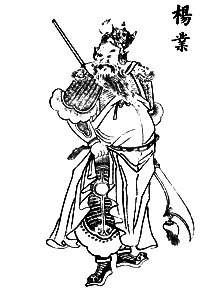
Later artistic depiction of Yang Ye in a historical novel illustration.

?–986 CE

Historical figure

Yang Ye

杨业

Yang Ye (c. 932 – 986), originally named Yang Chonggui, later named Liu Jiye under the Northern Han and restoring his ancestral surname Yang in Song, was a native of Taiyuan, Bingzhou (or Xinqin, Linzhou). He was an illustrious military commander and national martyr of the Five Dynasties and early Northern Song period, celebrated in folklore as "Lord Yang" and "Yang the Invincible." In his youth, he served Emperor Shizu of…

?–986 CENorthern Song

PROFILE

Yang Ye (c. 932 – 986), originally named Yang Chonggui, later named Liu Jiye under the Northern Han and restoring his ancestral surname Yang in Song, was a native of Taiyuan, Bingzhou (or Xinqin, Linzhou). He was an illustrious military commander and national martyr of the Five Dynasties and early Northern Song period, celebrated in folklore as "Lord Yang" and "Yang the Invincible." In his youth, he served Emperor Shizu of Northern Han (Liu Chong), rising to Military Governor of the Jianxiong Army through martial valor and earning the epithet "The Invincible." In 979, he submitted to Emperor Taizong of Song, being appointed Senior General of the Right Wing Militant Guard, Prefect of Daizhou, and Garrison Commander. In 980, he achieved the historic victory at Yanmen Pass, ambushing the Liao rear and slaying consort Xiao Duoli, striking terror throughout the northern frontier. During the Yongxi Northern Expedition of 986, serving as Vice Commander of the Western Army, he recaptured Yun, Ying, Huan, and Shuo prefectures. Following the collapse of the eastern army, he was ordered to evacuate the four prefectures' civilian populace. Compelled into a reckless advance by Commander Pan Mei and army monitor Wang Shen, he was surrounded at Chenjiagu, fighting until wounded and captured, subsequently starving himself to death over three days. He was posthumously created Grand Commandant.

Era
Ancient times
Dynasty
Ancient times
Identity
Historical figure
Date of Birth
Not recorded in historical sources
Date of Death
986
Ethnicity
Han
Ancestral Home
Bingzhou and Taiyuan (present-day Taiyuan, Shanxi; one account says Xin Qin of Linzhou)
Place of Birth
Bingzhou and Taiyuan (present-day Taiyuan, Shanxi; one account says Xin Qin of Linzhou)
Place of Death
Unknown
Lifespan
Unknown
Posthumous Honors
Yang Ye as grand commandant

LIFE TIMELINE

Birth on the Frontier | Born into the lineage of Yang Xin, Prefect of Open

Birth on the Frontier | Born into the lineage of Yang Xin, Prefect of Linzhou; displayed martial boldness and prowess in mounted archery from youth

Service to Northern Han | Entered the service of Liu Chong (Emperor ShOpen

Service to Northern Han | Entered the service of Liu Chong (Emperor Shizu of Northern Han), received the imperial surname Liu, and became Guard Commander

Martyrdom at Chenjiagu | Wang Shen abandoned the ambush site; Yang fouOpen

Martyrdom at Chenjiagu | Wang Shen abandoned the ambush site; Yang fought from noon to dusk to find an empty valley, sustained dozens of wounds, and starved to death over three days

He famously remarked to his followers: "When I command armies in the fOpen

He famously remarked to his followers: "When I command armies in the field in the future | He famously remarked to his followers: "When I command armies in the field in the future, my deployments will be just like unleashing hunting falcons and hounds upon wild pheasants and hares!" In 951, Liu Chong founded the Northern Han dynasty in Taiyuan.

CE(12th year of the Tianhui era, Emperor Bei of Han; 1st year of tOpen

968 CE(12th year of the Tianhui era, Emperor Bei of Han; 1st year of the Kaibao era, Song) | Defence of the Tuanbo Valley | Liu Jiyuan ordered Yang Ye and Feng Jinke to guard the Tuanbo Valley against the Song armies.

Hailed as "The Invincible" | Campaigned against Later Zhou, Song, and Open

Hailed as "The Invincible" | Campaigned against Later Zhou, Song, and Liao forces, elevated to Military Governor of Jianxiong Army; hailed by citizens as "The Invincible"

CE(13th year of the Tianhui era, Emperor Bei of Han; 2nd year of tOpen

969 CE(13th year of the Tianhui era, Emperor Bei of Han; 2nd year of the Kaibao era, Song) | In 969 | In 969, Emperor Taizu of Song besieged Taiyuan.

Siege of Taiyuan | Led cavalry sorties against Emperor Taizu's invadinOpen

Siege of Taiyuan | Led cavalry sorties against Emperor Taizu's invading Song army; urged Northern Han ruler Liu Jiyuan to raid Liao and submit to Song, but was ignored

CE(6th year of the Guangyun era, Emperor Bei of Han; 4th year of tOpen

979 CE(6th year of the Guangyun era, Emperor Bei of Han; 4th year of the Taipingxingguo era, Song) | ### Submission to Song and Sovereign Favor In the spring of 979 | ### Submission to Song and Sovereign Favor In the spring of 979, Emperor Taizong of Song mobilized massive forces for the final conquest of Northern Han.

Surrender to Song | Resisted to the last bastion during Emperor TaizonOpen

Surrender to Song | Resisted to the last bastion during Emperor Taizong's conquest; wept bitterly and surrendered only upon receiving orders from captured ruler Liu Jiyuan

The Ambush Victory at Yanmen Pass In March 980 | The Ambush Victory atOpen

The Ambush Victory at Yanmen Pass In March 980 | The Ambush Victory at Yanmen Pass In March 980, confronting a 100,000-strong Liao invasion, Yang Ye executed a brilliant long-range mountain flanking maneuver through Xixing to emerge north of Yanmen Pass.

Defense of the Northern Border | Appointed Defense Commissioner of ZheOpen

Defense of the Northern Border | Appointed Defense Commissioner of Zhengzhou, soon transferred to Prefect of Daizhou and Garrison Commander, receiving confidential royal directives

Battle of Yanmen Pass | Liao invaded with 100,000 cavalry; Yang led thOpen

Battle of Yanmen Pass | Liao invaded with 100,000 cavalry; Yang led thousands of horsemen through northern mountain tracks to strike the Liao rear, killing consort Xiao Duoli

Frontier Deterrence | Liao forces withdrew upon spotting his banners; Open

Frontier Deterrence | Liao forces withdrew upon spotting his banners; Emperor Taizong dismissed jealous courtiers' letters of slander, handing them to Yang Ye sealed

The Yongxi Expedition | Appointed Vice Commander of the Western Army uOpen

The Yongxi Expedition | Appointed Vice Commander of the Western Army under Pan Mei, spearheading the reconquest of Huan, Shuo, Ying, and Yun prefectures

Evacuation Directive | Following Cao Bin's defeat at Qigou Pass, EmpreOpen

Evacuation Directive | Following Cao Bin's defeat at Qigou Pass, Empress Dowager Xiao recaptured Huanzhou; Song court ordered Western Army to evacuate civilians

BIOGRAPHY

Biography

Early Life and "Yang the Invincible" in Northern Han

Yang Ye was born in the border garrison of Linzhou (modern Shenmu, Shaanxi Province). His father, Yang Xin (originally Yang Hongxin), served as the regional Prefect of Linzhou, leading powerful frontier militias. From childhood, Yang Ye exhibited magnanimous bravery, mastery of equestrian archery, and a passion for hunting, routinely taking several times more game than his companions. He famously remarked to his followers: "When I command armies in the field in the future, my deployments will be just like unleashing hunting falcons and hounds upon wild pheasants and hares!" In 951, Liu Chong founded the Northern Han dynasty in Taiyuan. In his twentieth year, Yang Ye enlisted under Liu Chong. Deeply impressed by his extraordinary courage and integrity, Liu Chong bestowed upon him the imperial Liu surname and the given name Jiye, treating him as a royal kinsman and appointing him Commander of the Palace Guards. Over the ensuing decades, Yang Ye served as Northern Han's premier shock commander against the Later Zhou, Northern Song, and northern Khitans. Promoted to Military Governor of the Jianxiong Army, he triumphed in nearly every engagement. Throughout the realm, citizens and soldiers celebrated his exploits, christening him "Yang the Invincible" . In 969, Emperor Taizu of Song besieged Taiyuan. Yang Ye led hundreds of elite shock cavalry in night sorties against the besieging Song camps, fighting fiercely to preserve the fortress. Following the intervention of allied Liao armies that forced a Song withdrawal, Yang Ye urgently counseled Emperor Liu Jiyuan: "The Khitans are treacherous wolves driven solely by plunder; one day they will devour our state! Their relief columns are undisciplined and negligent; if Your Majesty launches a surprise cavalry attack, we can capture tens of thousands of horses and surrender our territory to the Song Emperor, sparing Shanxi's people while preserving royal honors!" Blinded by obstinacy, Liu Jiyuan rejected the proposal. ### Submission to Song and Sovereign Favor In the spring of 979, Emperor Taizong of Song mobilized massive forces for the final conquest of Northern Han. As Taiyuan was encircled by earthworks and artillery, peripheral garrisons surrendered, and Liu Jiyuan opened the gates in capitulation. Yet amidst universal surrender, Yang Ye alone barricaded the southern fortifications, fighting on tenaciously. Emperor Taizong, who had long admired his legendary valor, ordered his commanders: "Capture Yang Ye alive at all costs; let no harm come to him!" To avert needless slaughter, Emperor Taizong compelled the captured ruler Liu Jiyuan to send his personal confidant into the redoubt to order a cease-fire. Seeing his sovereign's emissary, Yang Ye wept in grief, bowed toward the north, and discarded his armor. Brought before the Emperor, Taizong was overjoyed, presenting him with imperial robes, restoring his ancestral surname Yang with the single name Ye, and naming him Senior General of the Right Wing Militant Guard. Recognizing Yang's consummate knowledge of frontier defense, Emperor Taizong appointed him Prefect of Daizhou and Garrison Commander of the Sanjiao Frontier. The Emperor conferred upon him secret tactical ciphers and vast gifts of gold and silk, entrusting him with the defense of the Yanmen mountain passes. ### The Triumph of Yanmen Pass In March 980, Emperor Jingzong of Liao mobilized an army of 100,000 elite nomadic cavalry to storm Yanmen Pass, seeking to shatter Song's northern bastion. Pan Mei held Daizhou, but the pass fortifications were on the brink of being overwhelmed. Yang Ye orchestrated an audacious operational maneuver. Hand-picking several thousand shock cavalry, he covertly marched out through the rugged trails of the Western Gorge (Xixing), navigating precipitous mountain defiles to emerge undetected north of Yanmen Pass directly behind the advancing Liao formations. As the Liao army assaulted the southern ramparts, Yang Ye's cavalry struck their rear like thunder from the north. Pan Mei coordinated a frontal sortie from the pass, crushing the Liao legions in an inescapable vice. In hand-to-hand combat, Yang Ye personally decapitated the Liao imperial son-in-law, Chief Minister Xiao Duoli, capturing Deputy Commander Li Chonghui. Promoted to Surveillance Commissioner of Yunzhou, Yang Ye's fame spread across the northern steppe. Khitan soldiers fled upon sighting his white banners. Envious frontier commanders dispatched confidential letters to Emperor Taizong slandering Yang Ye. Demonstrating supreme trust, Emperor Taizong declined to inspect the accusations, sealing the documents and sending them directly to Yang Ye, cementing his unshakeable fidelity. ### The Yongxi Expedition and Reconquest of the Four Prefectures In the spring of 986, Emperor Taizong launched the grand Yongxi Northern Expedition to recover the Sixteen Prefectures. The campaign deployed three massive field armies:

  • Eastern Army under Cao Bin advancing toward Youzhou;
  • Central Army under Tian Chongjin through Feihu Pass;
  • Western Army under Pan Mei with Yang Ye as Vice Commander, accompanied by Army Monitor Wang Shen and Liu Wenyu. Advancing through Yanmen Pass, Yang Ye's western forces achieved rapid victories, storming Huanzhou, capturing Shuozhou, forcing Yingzhou to capitulate, and advancing to Yunzhou (modern Datong) along the Sanggan River. However, in May, the eastern army under Cao Bin suffered a catastrophic collapse at the Battle of Qigou Pass against Khitan commander Yelü Xiuge. Emperor Taizong ordered a general retreat, instructing the Western Army to evacuate hundreds of thousands of civilians from the four prefectures back into Shanxi. ### Factional Provocation and the Trap at Chenjiagu

Khitan Empress Dowager Xiao mobilized over 100,000 elite troops, swiftly recapturing Huanzhou. In the council of war, Yang Ye proposed an indirect strategy: "The Liao armies possess overwhelming numbers and momentum; frontal engagement invites disaster! Our mandate is solely to evacuate civilians. Let us march via the Dashi mountain corridors, alerting the garrisons of Yunzhou and Shuozhou to evacuate first. We can deploy our main forces toward Yingzhou to feign an advance; the Liao will divert to meet us, allowing the populace of Shuozhou to slip through the Shijie Valley. Stationing 1,000 heavy crossbowmen at the gorge entrance, our cavalry can cover the rear, securing complete safety for all four prefectures!" Army Monitor Wang Shen, an incompetent courtier hungry for military glory, sneered: "Commanding tens of thousands of imperial troops, why does the general display such shameful cowardice? We should march boldly along the main valley of Yanmen!" Army Inspector Liu Wenyu concurred. Yang Ye argued fiercely: "To advance directly into their vanguard is the certain road to annihilation!" Wang Shen sneered with toxic malice: "Your Lordship has always been hailed as 'The Invincible'; seeing the enemy today, you dally and refuse battle. Do you harbor treasonous intentions?" This mortal insult broke the veteran commander's patience. Weeping, Yang Ye addressed Pan Mei: "I was a captured general of Taiyuan who deserved death! His Majesty showered me with honors and entrusted me with armies. Today you accuse me of treasonous cowardice; I shall be the first to die before the enemy!" Turning toward the narrow defile of Chenjiagu, Yang Ye implored Pan Mei: "Position your heavy infantry and crossbow corps at both flanks of this gorge! When I fight my way back here, unleash your volleys to crush the pursuit; otherwise, not a soul will survive!" Pan Mei and Wang Shen swore to hold the position. ### Final Stand and Martyrdom Leading a few thousand cavalry, Yang Ye engaged the Liao vanguard. Khitan commander Yelü Xiezhen executed a feigned retreat, luring Yang Ye into an ambush prepared by Xiao Talin at Langyacun. Surrounded by superior forces, Yang Ye fought tenaciously from noon until dusk, retreating toward Chenjiagu. At the gorge, however, cowardice and treachery reigned. Observing the distant sounds of combat fade, Wang Shen climbed an observation tower and, assuming the battle was won, abandoned the pass to pursue spoils. Pan Mei failed to restrain him and retreated twenty li south. Upon learning of Yang's retreat, both commanders fled in panic, abandoning the ambush position. Arriving at Chenjiagu at dusk, Yang Ye found an empty gorge. Realizing he had been betrayed, he struck his breast and wept bitterly. Turning to his remaining hundred bodyguards, he urged them to escape and report to the Emperor. Every soldier refused, choosing to fight to the death. Officer Wang Gui slew dozens of enemies before falling, and every guardsman perished without a single surrender. Surrounded by thousands of Khitan horsemen under orders to take him alive, Yang Ye fought with sword and spear, sustaining scores of wounds and cutting down hundreds of foes. His second son, Yang Yanyu, was killed at his side. When his wounded mount collapsed, Yang Ye was captured. Imprisoned in the Liao camp, Yang Ye sighed: "His Majesty treated me with boundless grace; I sought to destroy the enemy to repay the state, yet was trapped by wicked traitors! How can I face the world alive?" He closed his mouth, refusing food and water for three days, dying a martyr's death on August 20, 986, at approximately age fifty-five. Emperor Taizong wept upon hearing the tragedy, severely punishing the commanders: Pan Mei was demoted three ranks, Wang Shen stripped of all titles and exiled to Jinzhou, and Liu Wenyu banished to Dengzhou. Yang Ye was posthumously created Grand Commandant and Military Governor of Datong Army, his surviving sons enrolled in imperial military office. His unyielding sacrifice birthed the immortal legend of the "Generals of the Yang Family" across Chinese history.

Major Activities

1. Renowned as "The Invincible" in Northern Han

Throughout decades of war under the Northern Han dynasty, Yang Ye commanded the frontline armies, defeating the forces of Later Zhou, Northern Song, and Khitan raiders across dozens of engagements, earning the legendary title "Yang the Invincible." ### 2. The Ambush Victory at Yanmen Pass In March 980, confronting a 100,000-strong Liao invasion, Yang Ye executed a brilliant long-range mountain flanking maneuver through Xixing to emerge north of Yanmen Pass. Striking the Liao rear while coordinated with Pan Mei's frontal assault, he decimated the invasion force, killing consort Xiao Duoli. ### 3. Rapid Recapture of the Four Prefectures During the Yongxi Expedition of 986, serving as Vice Commander of the Western Army, he spearheaded the capture of Huan, Shuo, Ying, and Yun prefectures, dismantling Liao's northwestern perimeter before eastern setbacks forced an evacuation. ### 4. Heroic Martyrdom at Chenjiagu Compelled into battle by corrupt monitors, Yang Ye fought through encirclement to find Chenjiagu abandoned by his commanders. Leading his guards to the last breath, he sustained dozens of wounds and starved himself to death over three days, exemplifying supreme martial devotion.

Personal Relations

  • Father: Yang Xin (Prefect of Linzhou under Later Han)
  • Wife: Lady Zhe (daughter of frontier commander Zhe Deyi; celebrated in legend as She Taijun)
  • Sovereigns: Liu Chong (Emperor Shizu of Northern Han), Liu Jiyuan (Northern Han ruler), Emperor Taizu of Song, Emperor Taizong of Song (patron who granted him the imperial cipher)
  • Sons: Yang Yanzhao (Yang Yanlang; renowned frontier general, "Sixth Son"), Yang Yanyu (died at Chenjiagu), Yang Yanpu, Yang Yanxun, Yang Yangui, Yang Yangui, Yang Yanbin
  • Expedition Commanders: Pan Mei (Commander-in-Chief, demoted for abandonment), Wang Shen (Army Monitor who coerced Yang into battle, exiled), Liu Wenyu (Inspector, banished)
  • Liao Opponents: Emperor Jingzong, Empress Dowager Xiao, Yelü Xiezhen, Xiao Talin, Xiao Duoli (killed by Yang)

Historical Assessment

Imperial Edicts and Official Chronicles

  • Emperor Taizong of Song: "Defending the state with shield and lance, we recall our commanders at the sound of the war drums... The late Surveillance Commissioner Yang Ye possessed loyalty firm as stone and metal, with a spirit that stirred wind and clouds... Abandoned by his commanders, he plunged alone into the desert with unwavering fortitude; what ancient exemplar could surpass this!"
  • **Zeng Gong (*Longping Ji*)**: "Yang Ye was valiant and wise, sharing hardships with his troops. In the bitter cold of Daibei, he never used coal fires for himself alone. His governance was simple, earning the love of the border populace; when news of his death arrived, all grieved in outrage."
  • Ouyang Xiu: "Father and son were both renowned commanders whose wisdom and valor were hailed as invincible throughout the realm, known to scholars and common folk alike."
  • **Tuo Tuo (*History of Song*)**: "Yang Ye was an elite warrior of Taiyuan who was moved by Emperor Taizong's favor... His troops could not bear to abandon him, dying by his side in a testament to the heights of martial righteousness." ### Later Commentaries and Cultural Legacy
  • **Wang Fuzhi (*On the Comprehensive Mirror for Aid in Governance*)**: "Yang Ye was a surrendered commander from Taiyuan, yet father and son held military command with devoted soldiers, striking terror into the Khitans."
  • **Cai Dongfan (*Song History Romance*)**: "Yang Ye was a peerless general whose foresight matched his martial courage; Pan Mei failed to trust his wisdom and believed the vindictive Wang Shen, bringing about the ruin of a great hero."

LOCAL NETWORK

Zhao Guangyi↗Linked from this entry

Original note (Chinese): 北汉降将,雍熙三年西路军副将,因掩护军民南撤被辽军俘虏,绝食三日而死

Xiao Chuo↗Linked from this entry

Original note (Chinese): 北宋名将,统和四年(986年)被辽军俘获,绝食三日而死

Yang Yanzhao↗Linked from this entry

Original note (Chinese): 杨延昭为杨业长子,杨业曾评价‘此儿类我’,每出征必带其随军。雍熙三年(986年)杨业殉国后,杨延昭录为崇仪副使。

Pan Mei↗Linked from this entry

Original note (Chinese): 太平兴国五年(980年)雁门关之捷中与杨业合击辽军。雍熙三年(986年)北伐撤军时,潘美未能坚持正确意见,未在陈家谷口接应,导致杨业兵败殉国。

Yang Yanzhao↗Related entry

Original note (Chinese): 杨业六子,北宋名将,即杨六郎

Liu Min↗Related entry

Original note (Chinese): 北汉世祖,赐杨业姓名为刘继业

Liu Jiyuan↗Related entry

Original note (Chinese): 北汉末主,杨业在其麾下为将

Zhao Guangyi↗Related entry

Original note (Chinese): 宋太宗,招降杨业,委以边任,杨业殉国后追赠太尉

Pan Mei↗Related entry

Original note (Chinese): 西路军主将,与杨业有雁门关之战合作,后因嫉恨密奏诽谤,陈家谷口之战中违约撤兵

杨信 · No matching entry available

杨业之父,后汉麟州刺史

杨重勋 · No matching entry available

杨业之弟,归附后周

折氏 · No matching entry available

杨业之妻,后世佘太君原型

杨延玉 · No matching entry available

杨业长子,随父战死于陈家谷口

杨文广 · No matching entry available

杨业之孙,杨延昭之子,北宋名将

王侁 · No matching entry available

监军,讥讽杨业有异志,强令出战,擅自撤离谷口,对杨业之死负直接责任

刘文裕 · No matching entry available

监军,赞成王侁主张,反对杨业作战方案

耶律斜轸 · No matching entry available

辽军主将,设伏击败杨业

萧挞凛 · No matching entry available

辽将,设伏参与者

耶律奚低 · No matching entry available

辽将,射中杨业致其被俘

CONTEMPORARIES

Bibliography

  • Tuo Tuo et al., *History of Song* (*History of Song*), Volume 272: "Biographies 31: Yang Ye"
  • Li Tao, *Long Comprehensive Mirror for Aid in Governance* (*Extended Continuation of the Zizhi Tongjian*), Volume 27
  • Zeng Gong, *Longping Ji* , Volume 17: "Biography of Yang Ye"
  • Ye Longli, *Records of the Khitan State* (*Record of the Khitan State*), Volume 6