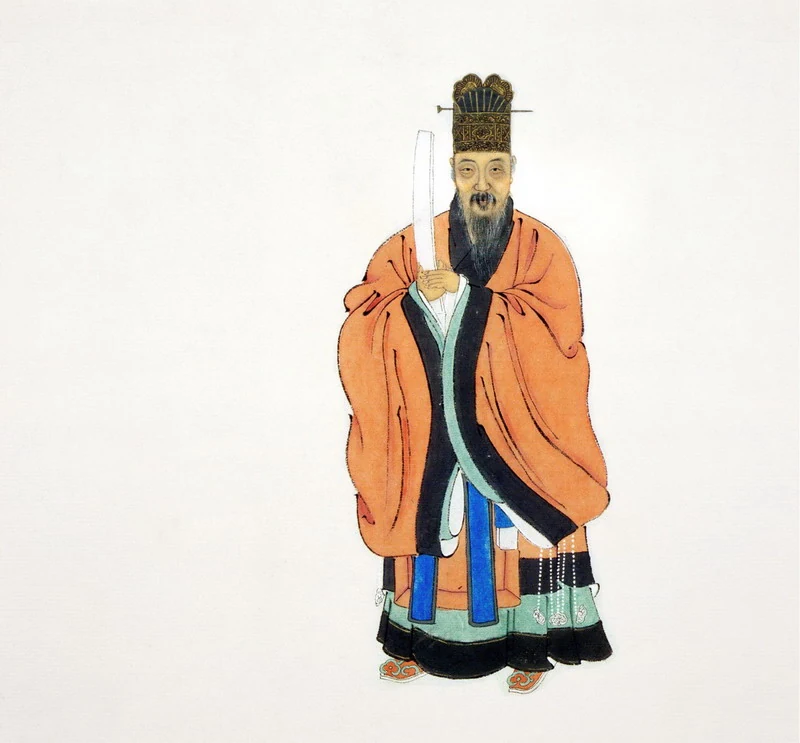
Biography
Family Background and Early Years
In 1501, the fourteenth year of Hongzhi, Xu Jie's father Xu Fu became assistant magistrate of Xuanping County in Zhejiang. Xu Jie was born on the twentieth day of the ninth lunar month of 1503 at the county government office. His mother was Lady Gu, Xu Fu's third wife. Xu survived two near-fatal accidents in childhood. At about one year old, a servant accidentally dropped him into a well; after being rescued he remained unconscious for three days before recovering. In 1507, at age five, he fell from a cliff while traveling with his father through the Kuocang Mountains, but his clothes caught on a tree and saved him, astonishing contemporaries.
Xu was considered exceptionally intelligent from childhood. While he studied at an old monastery that was rumored to be haunted, nothing happened to him, and Xu Fu took this as further evidence that his son was unusual. Xu later studied under accomplished teachers, reading the Elementary Learning and the Four Books, and was able to memorize them quickly. In 1511 Xu Fu was transferred to serve as assistant magistrate of Ningdu in Jiangxi, and Xu Jie accompanied him. On one occasion Xu Fu proposed a matching couplet: “The father returns from afar and the son goes afar to welcome him—the affection between father and son is Heaven-given.” Xu immediately answered: “The ruler dwells above and the minister below—the duty between ruler and minister belongs to human relations.” Xu Fu thereafter began training him systematically in composition.
In 1513 Xu returned with his father to Huating and studied beside Shaohu Lake west of the city, taking Shaohu as his art name. In 1517, at age fifteen, he passed the licentiate examination and entered the Huating county school. Two years later he participated in the Yingtian provincial examination with excellent preliminary results but failed to obtain the degree.
In 1520, the fifteenth year of Zhengde, Nie Bao, a disciple of Wang Yangming, became magistrate of Huating. Among the students he recognized Xu Jie as “material for the state” and, outside official duties, instructed him in the learning of the sages, that is, the School of Mind associated with Wang Yangming. Xu thereafter applied himself with renewed determination and resolved to place in the first class of the palace examination. In 1522, the first year of Jiajing, he placed seventh in the Yingtian provincial examination and became a provincial graduate.
Entering Office and Early Setbacks
In the third month of 1523, the second year of Jiajing, Xu passed the metropolitan examination and ranked third in the first class of the palace examination, receiving the distinction of tanhua and the jinshi degree. When he paid respects to the grand secretaries, Senior Grand Secretary Yang Tinghe was impressed and predicted, “This young man's name and rank will not be below those of men like us.” Xu was then appointed compiler in the Hanlin Academy according to precedent and requested leave to return home and marry Lady Shen.
In the eighth month of 1524, Xu traveled north to take up office. Near Xuzhou he dreamed that his father called to him; while returning, he learned at Pengcheng that his father had died and went home to observe mourning. In 1527, after completing mourning, he returned to his Hanlin post. He later participated in revising works including the Collected Statutes of the Great Ming and the Established Ceremonial Rites. While at the Hanlin Academy, Xu was assigned to teach eunuchs in the Inner Study Hall. Unlike earlier officials who had treated the assignment perfunctorily, Xu arrived each day at the hour of the tiger and did not leave until the hour of the monkey. He strictly supervised the eunuch students, teaching not only literacy but warning them not to violate ancestral regulations by interfering in politics. His conduct was well regarded. When he was later demoted, more than ten eunuchs were said to have clung to the hall pillars and wept.
In 1530, Senior Grand Secretary Zhang Cong proposed replacing statues of Confucius in the temples with wooden spirit tablets and changing Confucius's title from “Great Accomplished, Most Sage, King Who Propagates Culture” to titles appropriate to ancient worthies and scholars. On the twenty-ninth day of the tenth month Xu submitted a memorial presenting three reasons the title need not be removed and five reasons it must not be removed. At a court session on the first day of the eleventh month, Zhang Cong rebuked Xu face to face. Xu argued back sternly and forcefully. Zhang angrily said, “You have betrayed me.” Xu replied, “Betrayal arises only from prior attachment. I have never attached myself to Your Excellency; how then can you speak of betrayal?” Emperor Shizong supported Zhang Cong and demoted Xu to judicial official in Yanping Prefecture, Fujian. According to one story, the emperor even wrote the words “Xu Jie is a petty man; never employ him again” on a column at the Nanjing Imperial University.
This episode became an important turning point in Xu's career. In later years he repeatedly recalled it as a lesson against impetuosity and rashness and as a reason to cultivate a more cautious political style.
Local Office and Return to Favor
Xu arrived in Yanping in the fourth month of 1531 and by the seventh month was acting as prefect. He carefully adjudicated lawsuits, sought to educate the people through ritual and moral principle, destroyed illicit shrines, founded community schools, and personally wrote maxims from Song Confucian scholars for elementary instruction. He also reformed procedures for remitting silver taxes in order to reduce abuse by clerks. In the twelfth month, he personally led local militia against bandits in Youxi and captured 120 people within half a month. During his Yanping tenure he formed close friendships with Zheng Qingyun and Huang Zhuo through shared hardship.
In the third month of 1534, Xu was transferred to serve as assistant prefect of Huangzhou in Huguang. Elders in Yanping erected a stone inscription praising his achievements, and students escorted him as far as Jianning. When he reached Yanling he was reassigned as assistant surveillance commissioner of Zhejiang in charge of educational administration. In the tenth month of 1536 he was transferred to Jiangxi as vice surveillance commissioner, still supervising education. During his time in Jiangxi, relatives of Grand Secretary Xia Yan sought advancement through Xu; Xu refused them directly, angering Xia.
In the second month of 1539 Zhang Cong died. In the fifth month Emperor Shizong was selecting attendants for Crown Prince Zhu Zairui as the latter began formal residence outside the inner palace. Minister of Personnel Xu Zan ensured that Xu Jie was selected, and Xu was recalled to the capital as Director of Studies in the Directorate of the Heir Apparent and concurrently Hanlin reader. In the sixth month of 1540 his mother, Lady Gu, died, and he again returned home for mourning. In the twelfth month of 1542 he was promoted to Chancellor of the Imperial University.
Central Office and Entry into the Grand Secretariat
In the eleventh month of 1543 Xu was promoted to Right Vice Minister of Rites. In an intercalary first month of 1545 he was transferred to Right Vice Minister of Personnel. On taking up the post he wrote a warning to himself in the main hall of the Ministry of Personnel: “Take heed, Xu Jie! You gained the jinshi degree at twenty-one and at forty-three assist the celestial officials. The state's favor is profound—how will you repay it? If you do not exhaust your loyalty and labor, but instead form factions to exclude the worthy, accept bribes and sell the law, betray public duty to seek favor, or cling to office for private gain, may the spirits strike you down and extend the punishment to your descendants. Ah—this is to be feared!” In the twelfth month he was promoted to Left Vice Minister of Personnel. His diligence won him a reputation for competence, and Minister of Personnel Xiong Xia especially valued him.
In 1552, the thirty-first year of Jiajing, Xu entered the Grand Secretariat. He gained Emperor Shizong's favor through skill in composing qingci, the Daoist-style petitions used at court, and by exposing the crimes of Qiu Luan. Thereafter he outwardly served Senior Grand Secretary Yan Song with great caution while secretly helping remonstrating officials persecuted by Yan. After ten years of restraint, Yan Song fell from power in 1561, and Xu succeeded him as Senior Grand Secretary.
As Senior Grand Secretary
After becoming Senior Grand Secretary, Xu declared that he would “return awe and favor to the sovereign, return administrative affairs to the offices, and return appointments, punishments, and rewards to public judgment.” When Emperor Shizong died in 1566, Xu drafted the “Jiajing Testamentary Edict,” reversing many of Yan Song's policies, redressing wrongful cases, and ending costly Daoist rites and other abuses. Officials at court and throughout the country reportedly raised their hands in celebration, comparing the document with the “Edict on the Jiajing Accession” drafted by Yang Tinghe and calling the two “the foremost policies for correcting the beginning and correcting the end.”
During the Longqing reign, Xu continued as Senior Grand Secretary. He repeatedly mediated conflicts between Emperor Muzong and the outer court and prevented eunuchs from gaining greater authority. In 1568, the second year of Longqing, Xu retired and returned home.
Later Years
After Xu's retirement, younger members of his household abused the family's influence and committed numerous offenses. Xu was implicated and on several occasions came close to imprisonment, forcing him to write to friends for assistance. Gao Gong and others also reopened old cases to attack him. Xu died at his home in Huating in 1583, the eleventh year of Wanli, at the age of eighty-one. He was posthumously granted the title Grand Preceptor and given the posthumous name Wenzhen.