Birth | Born into a farming family in Yongfeng Township, Zhongli, Hao Prefecture, northeast of present-day Fengyang, Anhui
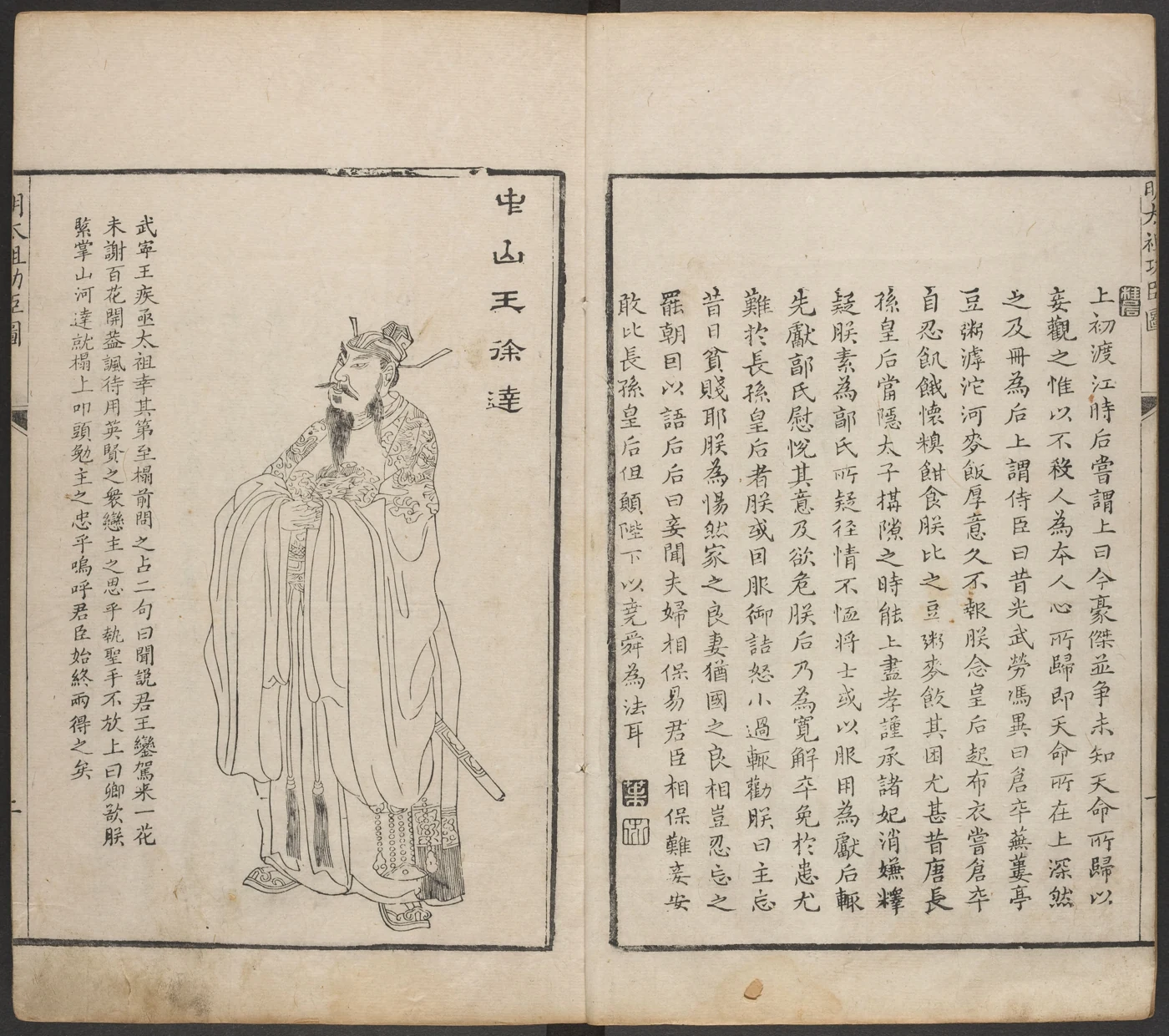
1332 CE–1385 CE
General
Xu Da
徐达
Xu Da (1332–April 7, 1385), courtesy name Tiande, was a native of Zhongli County, Hao Prefecture, in what is now northeastern Fengyang County, Anhui. A celebrated general of the late Yuan and early Ming and a founding meritorious official of the Ming dynasty, he ranked first among the six founding princes and was praised by Zhu Yuanzhang as the “first meritorious founder.” Born into a farming family, Xu joined the rebel army…
1332 CE–1385 CEMing Dynasty
PROFILE
Xu Da (1332–April 7, 1385), courtesy name Tiande, was a native of Zhongli County, Hao Prefecture, in what is now northeastern Fengyang County, Anhui. A celebrated general of the late Yuan and early Ming and a founding meritorious official of the Ming dynasty, he ranked first among the six founding princes and was praised by Zhu Yuanzhang as the “first meritorious founder.” Born into a farming family, Xu joined the rebel army led by Zhu Yuanzhang in 1353, the thirteenth year of the Zhizheng era, and became one of the Twenty-Four Generals of Huaiyou. He subsequently followed Zhu across the Yangtze, defeated Chen Youliang’s forces in the Battle of Lake Poyang, captured Pingjiang, and destroyed Zhang Shicheng’s regime. In 1367 he was appointed General-in-Chief for the Punitive Expedition against the Captives and, with Chang Yuchun as his deputy, led the northern campaign. In 1368, the first year of the Hongwu reign, he entered Dadu and overthrew Yuan rule. Thereafter he repeatedly campaigned against the remnants of the Yuan court, took Shanxi, Gansu, and Shaanxi, and inflicted a major defeat on Köke-Temür. After 1373 he remained for long periods in Beiping, training troops, promoting military farming, repairing and dredging defensive works, and consolidating the northern frontier. He rose to the offices of Grand Tutor, Right Chancellor, participant in state military affairs, and Junior Guardian of the Heir Apparent, and was enfeoffed as Duke of Wei. Xu died of illness in Nanjing in 1385, the eighteenth year of Hongwu, aged fifty-four. Zhu Yuanzhang posthumously created him Prince of Zhongshan, bestowed the posthumous name Wuning, granted burial north of Zhongshan, personally composed his spirit-road stele inscription, enshrined him in the Imperial Ancestral Temple, and placed his portrait first in the Meritorious Officials Temple.
- Other names
- Prince of Zhongshan; “First Meritorious Founder”
- Courtesy name
- Tiande
- Period
- Ming
- Date of Birth
- 1332
- Date of Death
- April 7 1385
- Dynasty / Regime
- Ming
- Identity
- General
- Ethnicity / Affiliation
- Not recorded in historical sources
- Native place
- Zhongli County, Hao Prefecture (northeast of present-day Fengyang County, Anhui)
- Place of birth
- Not recorded in historical sources
- Major achievements
- Zhu Yuanzhang’s foremost general and close friend; led the northern campaigns that overthrew the Yuan and fought across the realm, with achievements ranked above the other generals
LIFE TIMELINE
Age 22 | Answered Zhu Yuanzhang’s call and joined the rebel army, becoming one of the Twenty-Four Generals of Huaiyou
Age 24 | Crossed the Yangtze with Zhu Yuanzhang and captured Caishi and Taiping; offered himself in exchange for the detained Zhu Yuanzhang, further strengthening their relationship
Age 25 | Appointed General-in-Chief; captured Jingkou (Zhenjiang) and was promoted to commander-in-chief of the Huaixing Wing; in the seventh lunar month appointed assistant administrator of the Bureau of Military Affairs
Age 26 | Captured Changzhou; promoted within the Bureau of Military Affairs; captured Zhang Shide, younger brother of Zhang Shicheng, alive
Age 28 | Captured Chizhou; appointed Senior General Supporting the State and deputy administrator of the Bureau of Military Affairs; used a stratagem of alienation that caused Chen Youliang to kill his general Zhao Pusheng
Age 29 | Defeated Chen Youliang outside Yingtian, then recovered Taiping, took Xinzhou, and seized Anqing by surprise
Age 30 | Fought a major battle against Chen Youliang at Jiangzhou and was promoted to Right Chancellor of the Jiangnan Branch Secretariat
Age 32 | Took part in the Battle of Lake Poyang, first blunting the enemy’s attack; later ordered back to defend Yingtian
Age 33 | After Zhu Yuanzhang assumed the title Prince of Wu, Xu Da was appointed Left Chancellor; led troops through Jing and Xiang and eliminated the remaining forces of Chen Youliang
Age 34 | Led forces into eastern Huai, pacifying both Huainan and Huaibei
Age 35 | Appointed General-in-Chief and led 200,000 troops east against Zhang Shicheng
Age 36 | Captured Pingjiang and destroyed Zhang Shicheng; in the eleventh lunar month appointed General-in-Chief for the Punitive Expedition against the Captives and led the northern campaign
Age 37 | Entered Dadu and overthrew Yuan rule; after Zhu Yuanzhang proclaimed himself emperor, Xu received high honorary ranks, was made Supreme Pillar of State, Right Chancellor, and concurrently Junior Guardian of the Heir Apparent
Age 38 | Captured Shanxi and Shaanxi and pacified the northwest
Age 39 | Crushed Köke-Temür at Shenyuer Valley near Dingxi; after returning to the capital received extensive honors, including Grand Tutor and Right Chancellor, was ordered to participate in state military affairs, and was redesignated Duke of Wei
Age 40 | Went to Beiping to drill troops and repair and dredge the city defenses
Age 42 | Defeated Köke-Temür at Huairou; thereafter remained for long periods in Beiping
Age 50 | Led Tang He and Fu Youde on a campaign against Naghachu
Age 54 | Died of illness in Nanjing; posthumously created Prince of Zhongshan and given the posthumous name Wuning
BIOGRAPHY
Biography
Family Background and Early Life
Xu Da was born in 1332, the third year of the Yuan Zhishun era, in Yongfeng Township, Zhongli, Hao Prefecture, in present-day northeastern Fengyang, Anhui. His great-grandfather was Xu Wusi, his great-grandmother was Lady He, his grandfather Xu Siqi, his grandmother Lady Zhou, his father Xu Liusi, and his mother Lady Cai. The family had farmed for generations. Xu was lean-faced, with slightly prominent cheekbones and a powerful build. He trained in martial skills from childhood and became highly proficient. Resolute by temperament and resourceful in difficult situations, he was born to a farming household but harbored large ambitions.
As the Yuan empire fell into disorder, Guo Zixing of Dingyuan raised a rebellion in 1352 and seized Haozhou. Tang He, a native of Haozhou, joined with more than ten strongmen, and at Tang’s invitation Zhu Yuanzhang also entered Guo Zixing’s forces. In the sixth lunar month of 1353, Zhu returned home on Guo’s orders to recruit troops. Xu Da, then only twenty-two, eagerly answered the call and began his military career. Zhu came to believe that Xu “surpassed the heroes in every movement, silence, word, and action” and entrusted him with major responsibilities and campaigning. Zhu later recalled that Xu “was ordinarily sparing in speech and precise in thought; when leading troops, his orders were never issued twice,” indicating the qualities of a great commander.
Crossing the Yangtze and Establishing a Base in Jiangnan
After joining the rebel army in 1353, Xu followed Zhu Yuanzhang in taking Xintang in Hezhou, Sanchahe, and Yangquan, securing a darughachi encampment and capturing Xuguancang stockade. Zhu’s forces grew rapidly in prestige. Guo Zixing meanwhile fell into conflict with Sun Deya and other fellow rebels. Zhao Junyong and Peng Da, who had occupied Xuzhou, fled in defeat to Haozhou and soon assumed princely titles, leaving Guo constrained and nearly killed. Zhu concluded that Haozhou offered little room for expansion. In the autumn of 1354 he led Xu Da, Tang He, and twenty-two others away from Haozhou, moved south toward Dingyuan, and took Chuzhou. Xu’s bravery in direct combat began to stand out.
In the second lunar month of 1355, with supplies at Chuzhou running short, Zhu decided to take Hezhou. Xu led the advance, captured Hezhou together with Zhang Tianyou and Tang He, and was promoted for merit. A consequential incident followed. Sun Deya came to Hezhou because his troops lacked grain, and Zhu, considering the broader situation, accepted them. Guo Zixing hurried to Hezhou and rebuked Zhu. Fearing for his safety, Sun secretly tried to leave. As Zhu escorted him out, news arrived that Guo’s men had clashed with Sun’s troops and that Guo had detained Sun. Sun’s men mistakenly believed Zhu had orchestrated the affair, seized him, and threatened to kill him. When Xu Da learned inside the city that Zhu had been detained and his fate was uncertain, he resolutely offered to take Zhu’s place as hostage. After mediation from several sides, both Sun and Zhu were released. Xu’s willingness to risk himself won Zhu’s high praise and brought the two men even closer.
Soon afterward Guo Zixing died of illness, and Zhu became the effective leader of the rebel force. In the sixth lunar month of 1355, naval leaders of Chaohu—including Zhao Pusheng, Yu Tingyu, Yu Tonghai, Liao Yongan, and Liao Yongzhong—submitted with their forces. Delighted, Zhu ordered an immediate strike at Niuzhu. Xu and the other generals obeyed, seizing Niuzhu and Caishi. Yuan troops along the Yangtze surrendered on hearing of their advance. The army then took Taiping in one assault. Its Yuan defenders fled, and Yuan commander Naghachu and others were captured.
In the third lunar month of 1356, Zhu personally led a major attack on Jiqing Circuit, present-day Nanjing. Xu was ordered to serve as vanguard and advanced with both land and naval forces. He broke the camp of Yuan general Chen Zhaoxian, who surrendered with more than 36,000 troops. Xu then attacked Jiqing, defeated Yuan forces at Jiangshan, where Yuan Censor-in-Chief Fushou died in battle, and induced naval commander Kang Maocai to surrender with more than 500,000 soldiers and civilians. After occupying Jiqing, Zhu renamed it Yingtian Prefecture. Xu’s courage and achievements in crossing the river, taking Caishi and Taiping, and attacking Jiqing made him one of Zhu’s most effective commanders.
Consolidating Jiangnan and Fighting Chen Youliang
After occupying Yingtian, Zhu possessed a firm base but faced a dangerous military situation. In the same month, he appointed Xu Da General-in-Chief and sent him east against Jingkou, the gateway on the eastern front. Xu and his troops captured Jingkou in less than two days, defeating its Yuan defenders and killing commanders Dingding and Duan Wu. Entering through Renhe Gate, Xu kept strict discipline and firm order; the markets were undisturbed and residents welcomed the troops. For his merit at Jingkou he was promoted to commander-in-chief of the Huaixing Wing and stationed there. He both reassured the population and supervised agriculture, while also dispatching troops to take Jintan, Danyang, and other places, thereby consolidating Jingkou as the easternmost outpost.
In the seventh lunar month of 1356, Zhu assumed the title Duke of Wu, established the Jiangnan Branch Bureau of Military Affairs, and appointed Xu assistant administrator. Zhang Shicheng then held Changzhou and sent the defected Jiangdong commander Chen Bao’er with a fleet against Zhenjiang. Xu defeated Chen decisively at Longtan and then besieged Changzhou. In the ninth lunar month, Zhang sent reinforcements. Xu set separate infantry and cavalry ambushes eighteen li from the city and personally engaged Zhang’s army frontally. Shortly after fighting began, Xu’s subordinate Wang Junyong led cavalry into the enemy flank, throwing Zhang’s army into disorder. As it fled, Xu’s ambushes intercepted it and inflicted heavy casualties. In the eleventh lunar month, Zhang induced 7,000 newly attached Wu troops to act as an internal force and surrounded Xu at Niutang. Xu immediately sent men through the encirclement and ordered his deputy Chang Yuchun, together with Liao Yongan and Hu Dahai, to hurry to his aid. Attacked from inside and outside, Zhang’s army was routed and its general Zhang De captured. Changzhou fell in the third lunar month of 1357. In the fourth lunar month Xu advanced on Ningguo; its Yuan defender surrendered the city, yielding more than 100,000 soldiers and 2,000 horses. Xu then attacked Yixing and, through an ambush, captured Zhang Shide, younger brother of Zhang Shicheng. Zhang Shide was an able strategist and fighter who enjoyed the confidence of his troops, and his capture damaged Zhang Shicheng’s morale. In the tenth lunar month Xu sent Ding Dexing to block the mouth of Lake Tai, cutting Yixing’s grain route; the city soon fell.
In the ninth lunar month of 1357, Chen Youliang killed Ni Wenjun and took control of Xu Shouhui’s army, rapidly expanding his power. In the fourth lunar month of 1358, Zhao Pusheng, who had joined Chen, captured Chizhou, bringing the two sides into open conflict. In 1359 Xu Da and Yu Tonghai’s fleet attacked Chizhou, destroyed the river stockades, captured the city, took its commander Hong Jun and others prisoner, and seized all of their warships. For this merit Xu was appointed Senior General Supporting the State and deputy administrator of the Bureau of Military Affairs. He next attacked Anqing, raided Fushan Stockade at night, defeated Zhao Pusheng’s subordinate at Qingshan, and took Qianshan in a single assault. Zhao Pusheng, an intelligent and courageous general, held Anqing so effectively that repeated attacks failed. Xu used a stratagem of alienation that caused Chen Youliang to kill Zhao. With Zhao gone, no one could hold the Zongyang naval stockade, which Xu promptly seized. Chen then sent a large force to retake Chizhou. Xu left old, weak, and disabled troops to hold the city and concealed his elite soldiers below Jiuhua Mountain. When Chen’s army arrived, Xu struck from within and without, beheading more than 10,000.
In the fifth lunar month of 1360, Chen Youliang’s powerful fleet passed Chizhou and moved east to take Taiping, while he also contacted Zhang Shicheng in preparation for a joint attack on Yingtian. In the intercalary fifth month Chen reached the outskirts of Yingtian and was attacked from multiple directions by Xu and others. More than 10,000 of his men were killed, 3,000 captured, and Chen fled back to Jiangzhou. Xu exploited the victory, recovered Taiping, took Xinzhou, and in the sixth lunar month seized Anqing by surprise while Chen was unprepared. Acting as vanguard, Xu moved upstream, captured Jiangzhou, then took Nankang, Longxing, Raozhou, Guangji, and the prefectures of Qi and Huang, forcing Chen to flee west to Wuchang. Xu stationed at Dunkou in Hanyang, blocking Chen’s counterattack. In the third lunar month of 1361 he was promoted to Right Chancellor of the Jiangnan Branch Secretariat. In the eighth lunar month he fought Chen at Jiangzhou, captured 2,000 horses and hundreds of thousands of shi of fine grain, and then advanced west toward Wuchang.
In the third lunar month of 1363, Zhu Zong and Kang Tai, former Chen commanders stationed at Hongdu, rebelled. Xu transferred his Hanyang army and suppressed them. In the fourth lunar month Chen Youliang built giant multi-story ships and assembled a force said to number 600,000. Taking advantage of Xu’s relief expedition to Anfeng, Chen seized Ji’an and Wuwei and concentrated on Hongdu. Zhu Wenzheng and the Wu defenders held out for eighty-five days, buying time for Zhu Yuanzhang to prepare for a decisive battle. In the sixth lunar month, after Hongdu had been besieged for more than two months, Zhu urgently summoned Xu from Luzhou. On the sixth day of the seventh lunar month Xu returned as ordered to relieve Hongdu. Zhu swore the army at Longjiang and stationed 200,000 naval troops at Hujiang, the mouth of the Jiu River, and Nanhuzui to block Chen’s retreat. Hearing that Zhu had personally arrived with a large army, Chen lifted the siege and moved east into Lake Poyang to fight. Xu, commanding a principal assault force, advanced first and met Chen at Kanglang Mountain. Although Chen’s army was larger and its ships towering, Xu showed no fear, personally leading his generals into the enemy formation. His soldiers fought with exceptional ferocity and defeated Chen’s vanguard in one stroke, killing more than 1,500 and capturing a giant ship. The two sides fought all day around Kanglang Mountain until the lake water was said to be stained red with blood. Xu’s first success blunted the enemy’s attack, raised Wu morale, and helped prepare Zhu’s final victory. That evening, fearing Zhang Shicheng might invade from the east, Zhu ordered Xu out of the battle and back to Yingtian. After Xu departed, Zhu continued the fierce fighting on Lake Poyang, ultimately killing Chen Youliang and destroying his main force.
Eastern Campaign against Zhang Shicheng and Pacification of Hunan and Hubei
After returning to Yingtian, Xu strictly trained his troops, strengthened eastern defenses, searched for spies, and repaired the city walls. Zhang Shicheng found no opening and did not dare attack. Zhu later praised Xu: “I was most at ease when I sent Xu Da back to guard Yingtian; whatever problem arose, he could handle it properly.” This reflected Zhu’s high trust in him.
After the Battle of Lake Poyang, Xu and other generals took Luzhou. He was then ordered back to the Huguang front. In the eighth lunar month of 1364, together with administrator Yang Jing and others, Xu swept through the Jing and Xiang regions, successively taking Jiangling, Yiling, Xiangtan, Chenzhou, Hengzhou, Baoqing, Jingzhou, and other places. This eliminated Chen Youliang’s remaining forces and brought Hunan and Hubei under control. In recognition of Xu’s achievements, after Zhu assumed the title Prince of Wu in the first lunar month of 1364 he appointed Xu Left Chancellor, placing him above the other generals.
In 1365 Xu was ordered to command Chang Yuchun and others against eastern Huai, capturing Taizhou. When Zhang Shicheng’s troops took Yixing, Xu recaptured it, then again crossed the Yangtze, took Gaoyou, and captured more than 1,000 men. He advanced on Anfeng, took the Yuan commander Xindu prisoner, forced Zuo Junbi to flee, and captured all of his ships. When Yuan troops attacked Xuzhou, Xu met them in battle and killed or captured tens of thousands, completely pacifying Huainan and Huaibei. He then advised pressing the advantage against Zhang Shicheng.
In 1366 Zhu appointed Xu General-in-Chief and Chang Yuchun deputy general, giving them 200,000 troops against Zhang Shicheng. Zhang attacked in three columns; Xu likewise divided his army into three and sent an additional force to cut off the enemy’s retreat. Zhang was defeated and fled, but could not reenter his city and had to turn back and fight. Xu routed his army, captured 200 officers, and besieged Huzhou. Zhang sent Lü Zhen and others with 60,000 men to relieve the city; they fortified five camps at Jiuguan. Xu ordered Chang and others to build ten forts to contain them. Zhang then personally led elite troops to the relief, but Xu defeated him decisively at Zaolin. Zhang fled, the land and water fortifications at Shengshan were taken, and the Fifth Prince, Zhu Xian, Lü Zhen, and others surrendered. Huzhou capitulated. Xu then took Wujiang and advanced through Lake Tai to besiege Pingjiang.
In 1367 Pingjiang was captured and Zhang Shicheng taken alive. As the city was about to fall, Xu agreed with Chang Yuchun: “My army will camp on the left of the city and yours on the right.” He ordered: “Anyone who plunders the people’s property shall die; anyone who destroys the people’s houses shall die; anyone who leaves camp without authorization for twenty li shall die.” After the troops entered the city, the people of Wu remained secure as before. For his merit in the campaign, Xu was enfeoffed as Duke of Xin.
Northern Campaign against the Yuan and Pacification of the Northwest
In the eleventh lunar month of 1367, Zhu Yuanzhang appointed Xu Da General-in-Chief for the Punitive Expedition against the Captives, with Chang Yuchun as deputy, and sent 250,000 troops north. Zhu personally performed a sacrificial ceremony at Longjiang and gave Xu the campaign strategy. Xu took Yizhou and induced its defender Wang Xuan to surrender. He then captured Yizhou; when Wang Xuan rebelled again, Xu killed him. He took Ju, Mi, Hai, and other prefectures and sent Han Zheng to block the Yellow River. Zhang Xingzu took Dongping and Jining, while Xu’s main army captured Yidu and then Huai, Jiao, and other prefectures and counties. Jinan surrendered. Xu divided his forces to take Dengzhou and Laizhou, completing the pacification of Shandong.
In 1368 Zhu Yuanzhang proclaimed himself emperor and granted Xu high honorary ranks, making him Supreme Pillar of State, Right Chancellor, and concurrently Junior Guardian of the Heir Apparent. Chang Yuchun took Dongchang and joined Xu at Jinan. Xu then returned to Jining, moved his fleet upstream along the Yellow River, and advanced directly on Bianliang. Its defender Li Keyi fled, while Zuo Junbi, Zhu Zhen, and others surrendered. Xu entered Luoyang through Hulao Pass and fought the Yuan general Tuoyin Temür north of the Luo River, defeating him. Prince of Liang Aluwen surrendered Henan. Xu pacified Song, Shan, Chen, Ru, and other prefectures and then advanced on Tong Pass. Li Siqi fled toward Fengxiang and Zhang Sidao toward Fucheng. Xu entered the pass and reached Huazhou. On receiving the victory report, Zhu traveled to Bianliang, summoned Xu, hosted a banquet, and discussed the northern campaign with him. Xu said: “Our great army has pacified Qi and Lu and swept clear the He and Luo regions. Wang Baobao hesitates and watches; Tong Pass has already fallen, and Li Siqi and his kind have fled west in disorder. The Yuan court’s support has been cut off. If we now press the advantage and strike directly at the Yuan capital, we can take it without a battle.”
In the intercalary seventh month, Xu and Chang joined at Heyin and sent deputy commanders on separate routes through Hebei, successively taking Weihui, Zhangde, and Guangping. The army temporarily camped at Linqing. Xu sent Fu Youde to open an overland route for infantry and cavalry and Gu Shi to clear the waterway for the fleet, then moved north. Chang had already taken Dezhou and joined Xu to capture Changlu, seize Zhigu, and construct a pontoon bridge for the army. Advancing by land and water, they defeated Yuan forces at Hexiwu and then took Tongzhou. The Yuan emperor fled north with his empresses and crown prince. The next day Xu deployed before Qihua Gate, filled the moat, and scaled the walls. The regent Prince of Huai Temür Buqa and Left Chancellor Qingtong refused to surrender and were executed, but no one else was killed. Xu had government treasuries sealed, books and valuables registered, ordered commander Zhang Sheng to station 1,000 soldiers at the palace gates, and instructed eunuchs to safeguard palace women, consorts, and princesses. Troops were strictly forbidden to harass or abuse them. Officials and residents continued to live peacefully and shops remained open.
After Dadu fell, Zhu ordered Xu and Chang to move on Shanxi. Wang Baobao, or Köke-Temür, had taken troops through Yanmen Pass and intended to attack Beiping by way of Juyong Pass. Xu discussed the situation with his generals: “Köke-Temür has led his army far away, so Taiyuan must be empty. Governor Sun is in Beiping and can defend it. If we now exploit the enemy’s lack of preparation and strike Taiyuan directly, he will be unable to fight forward and have nowhere to defend in retreat. If he turns west to save it, we can capture him.” Xu therefore marched on Taiyuan. Wang Baobao had reached Bao’an but indeed turned back. Xu selected elite troops for a night attack on his camp, forcing Wang to flee with only eighteen horsemen. Xu accepted the surrender of the remaining troops and captured Taiyuan. He then took Datong and dispatched forces through places not yet subdued, completing the pacification of Shanxi.
In 1369 Xu crossed the river westward and reached Lutai. Zhang Sidao fled, and Xu took Fengyuan. Chang Yuchun had meanwhile captured Fengxiang, while Li Siqi fled to Lintao. Xu assembled the generals to decide the next objective and advocated attacking Lintao. He crossed Longshan, took Qinzhou, captured Fuqiang and Ningyuan, entered Gongchang, and sent Right Deputy General Feng Sheng toward Lintao. Li Siqi surrendered without battle. Xu then detached troops to take Lanzhou, drove off the Prince of Yu, and seized all his baggage and supplies. Turning back through Xiao Pass, Xu took Pingliang. Zhang Sidao fled to Ningxia but was captured by Wang Baobao. Zhang’s younger brother Zhang Liangchen surrendered Qingyang, and Xu sent Xue Xian to receive his surrender. Zhang Liangchen then rebelled, launching a night attack that wounded Xue. Xu personally supervised the siege. Wang Baobao sent a general to relieve Zhang, but Xu defeated the relief army, took Qingyang, and had Zhang Liangchen and his father pulled from the well into which they had thrown themselves and executed. Shaanxi was thereby pacified. Zhu ordered Xu back to court and rewarded him with large quantities of silver and silk.
In the spring of 1370, Zhu again appointed Xu General-in-Chief, with Li Wenzhong as deputy, and sent separate armies against the Northern Yuan. Xu marched west from Tong Pass directly toward Dingxi and Wang Baobao. Li Wenzhong went east from Juyong across the steppe in pursuit of the Yuan emperor. When Xu reached Dingxi, Wang Baobao withdrew to Shenyuer Valley. The two armies camped on opposite sides of a ravine and fought several times in one day. Wang sent elite troops along a small route to attack the southeastern camp. Left Chancellor Hu Deji panicked and the Ming ranks were thrown into confusion, but Xu led troops to repel Wang. The next day he reorganized the army, seized the ravine, and fought desperately, inflicting a crushing defeat. He captured the Prince of Tan, the Prince of Wenji, and more than 1,860 civil and military officials of various ranks, as well as more than 84,500 soldiers and tens of thousands of horses, camels, and other animals. Wang escaped toward Karakorum with only his wife, children, and a few others. After defeating Wang, Xu immediately led his army south from Huizhou by the Hundred-and-Eight Crossings to Lüeyang, took Mianzhou, entered the Lianyun plank road, and captured Xingyuan. Li Wenzhong also took Yingchang and captured the Yuan emperor’s legitimate grandson, consorts, princesses, generals, and ministers. When the victory reports reached court in succession, Zhu ordered the elite troops back to the capital and personally welcomed and rewarded them at Longjiang.
Guarding Beiping and Final Years
In the eleventh lunar month of 1370, Zhu conducted a great enfeoffment of meritorious officials. Xu received a series of high military and civil honors, including Grand Tutor and Right Chancellor, was ordered to participate in state military affairs, and was redesignated Duke of Wei with an annual stipend of 5,000 shi and a hereditary patent. The following year Xu led Sheng Xi and others to Beiping to drill troops and repair the city walls, while relocating military and civilian households from beyond the mountains into various guards and prefectures. In 1372 Xu campaigned again and fought Köke-Temür north of the steppe frontier. Because his force advanced too deeply in isolation, it suffered defeat, with tens of thousands killed. Zhu did not punish him severely, and Xu became even more cautious thereafter.
In 1373 Xu led the generals on another expedition, defeated Köke-Temür at Huairou, and captured members of his tribal population and horses. For more than a decade thereafter Xu remained for long periods in Beiping, campaigning in spring and returning in winter, drilling soldiers, promoting military farming, and repairing and dredging defensive works. He remained cautious, never recklessly sought merit, combined authority with benevolence toward his troops, and enjoyed strong military loyalty. In 1381 he led Tang He and Fu Youde against Naghachu and returned victorious.
In the second lunar month of 1385, Xu died of illness in Nanjing, aged fifty-four. Zhu Yuanzhang posthumously created him Prince of Zhongshan, granted the posthumous name Wuning, and buried him north of Zhongshan. Zhu personally composed his spirit-road stele inscription, praising him: “When commanded, he went forth; when success was achieved, he returned. He never boasted or claimed merit, loved no women, took no treasure, and was upright and without blemish, shining as clearly as the sun and moon. There was but one General-in-Chief.” Zhu also posthumously made Xu’s great-grandfather Xu Wusi, grandfather Xu Siqi, and father Xu Liusi all Princes of Zhongshan. Xu Da was enshrined in the Imperial Ancestral Temple, and his portrait ranked first in the Meritorious Officials Temple.
His Family, His Enlistment, and His Offer to Be a Hostage at Hezhou
Xu Da's family farmed for generations: his great-grandfather Xu Wusi and great-grandmother Lady He, his grandfather Xu Siqi and grandmother Lady Zhou, and his father Xu Liuse and mother Lady Cai. He was spare of face with slightly high cheekbones and a tall, powerful frame, trained in arms from boyhood, firm by nature and shrewd in dealing with affairs. In the sixth month of 1353, when Zhu Yuanzhang was sent home by Guo Zixing to raise troops, Xu Da, then only twenty-two, gladly answered the call; and Zhu Yuanzhang, finding that "in movement and rest, in speech and silence, he surpassed the heroes about him," gave him heavy charges and let him campaign in his own place, recalling afterwards that Xu Da "was ever terse of speech and precise of thought, and when he led troops his orders were never twice given." That year he took part in the taking of Hezhou Xintang, Sancha river and Yangquan, in the holding of the darughachi's camp and the capture of the Xu Guancang stockade. Because Guo Zixing was at odds with his fellow rebel Sun Deya, Zhu Yuanzhang, seeing that nothing great could be done at Haozhou, left it in the autumn of 1354 with Xu Da, Tang He and twenty-two others for Dingyuan in the south. In the Hezhou affair of 1355, when Sun Deya came to Hezhou with his troops short of food and Zhu Yuanzhang, for the sake of the whole, took them in, Guo Zixing came to reprove him, and Sun Deya, fearing for himself, tried to slip away; and as Zhu Yuanzhang was seeing him off news came that Guo Zixing's men and Sun Deya's had clashed and that Sun Deya had been seized, whereupon Sun Deya's men, taking it for a plot by Zhu Yuanzhang, bound him and threatened to kill him. Xu Da, hearing in the city that Zhu Yuanzhang was held and his life uncertain, at once asked to be given as hostage in his place; and after much mediation both Sun Deya and Zhu Yuanzhang were released. The self-sacrifice of that request was much praised by Zhu Yuanzhang, and the two were the closer for it.
Crossing the River, the Taking of Jiqing, Jingkou and Changzhou
In the sixth month of 1355 the Chaohu fleet commanders Zhao Pusheng, Yu Tingyu, Yu Tonghai, Liao Yongan and Liao Yongzhong brought their forces over, and Zhu Yuanzhang sent troops straight for Niuzhu; Xu Da and the other generals took Niuzhu and Caishi, the Yuan troops along the river surrendering at the rumour of them, and the whole army then took Taiping in one rush, its Yuan myriarch Nahacu being captured. In the third month of 1356, when Zhu Yuanzhang led the great army against Jiqing circuit, Xu Da was made vanguard with both fleet and army, broke the camp of the Yuan general Chen Zhaoxian, who surrendered with his troops, more than thirty-six thousand men; and attacking Jiqing again he heavily defeated the Yuan at Jiangshan, where the Yuan censor-in-chief Fu Shou died in battle and the fleet commander Kang Maocai came over with more than five hundred thousand soldiers and civilians, Jiqing circuit being renamed Yingtian prefecture. In the same month that Yingtian was taken Zhu Yuanzhang made Xu Da general-in-chief and sent him east against Jingkou, the gate of the eastern front; and he beat the Yuan defenders in less than two days, killing their commanders Ding Ding and Duan Wu, and entered by the Renhe gate with his troops in strict order and discipline, so that the markets were undisturbed and the people welcomed him, and he was made marshal of the Huaiyang wing and given the charge of the place, where he comforted the people and encouraged farming while sending detachments to take Jintan and Danyang. In the seventh month of the same year Zhu Yuanzhang took the title duke of Wu and set up the Jiangnan branch bureau of military affairs, making Xu Da an associate of the bureau; and when Zhang Shicheng, holding Changzhou, used the turncoat Chen Bao'er with a fleet against Zhenjiang, Xu Da heavily defeated Chen Bao'er at Longtan and pressed the siege of Changzhou. In the ninth month, when Zhang Shicheng sent relief, Xu Da set an ambush of foot and a troop of horse eighteen li from the city and led the front himself; and soon after the fighting began his officer Wang Junyong led the cavalry into the enemy's flank, so that Zhang Shicheng's army broke and fled and was cut down by the ambush. In the eleventh month Zhang Shicheng lured seven thousand of the newly submitted Wu troops into betraying them and enclosed Xu Da at Niutang; and Xu Da at once sent out to break through, ordering the deputy commander Chang Yuchun with Liao Yongan and Hu Dahai to his relief, so that attacking within and without they broke Zhang Shicheng's army and took the enemy general Zhang De alive. In the third month of 1357 Changzhou fell at last; in the fourth month he moved on Ningguo and its Yuan commander surrendered the city, giving more than a hundred thousand soldiers and two thousand warhorses; and attacking Yixing he took Zhang Shicheng's brother Zhang Shide alive by ambush — a man of courage and resource who held his men's hearts, whose capture was a heavy blow to Zhang Shicheng's army's spirit. In the tenth month he sent his officer Ding Dexing to hold the mouth of lake Tai, cutting Yixing's grain road, and it was soon taken.
Chizhou, Jiangzhou, and the First Blow on Lake Poyang
In 1359 Xu Da with Yu Tonghai's fleet attacked Chizhou, broke the Zha river camp, took the city, captured its commander Hong Jun and the rest and seized all their ships, being made general of the state's support and associate of the bureau of military affairs for it; and attacking Anqing he raided the Fushan stockade by night, broke Zhao Pusheng's officer at Qingshan and took Qianshan at one rush. Zhao Pusheng was a great general of Chen Youliang, of courage and resource, holding Anqing, which all the generals had failed to take; and Xu Da by a stratagem of slander made Chen Youliang kill him, after which the Zongyang water camp had no one to hold it and Xu Da took it in course. When Chen Youliang sent a great force back against Chizhou, Xu Da left the old and weak in the city and himself with picked troops lay in ambush below the Jiuhua hills, and when the enemy came, attacking within and without, took more than ten thousand heads. In the intercalary fifth month of 1360 Chen Youliang brought his army to the walls of Yingtian and was taken between Xu Da and the rest, more than ten thousand being killed and three thousand taken, so that he fled back to hold Jiangzhou; and Xu Da pressed the victory to recover Taiping and take Xinzhou, and in the sixth month, taking Chen Youliang unprepared, seized Anqing, then went up the river against the current to seize Jiangzhou and in turn to take Nankang, Longxing, Raozhou, Guangji and the two prefectures of Qi and Huang, driving Chen Youliang west to Wuchang, and stationed himself at Zhuankou in Hanyang, checking any counter-attack. In the third month of 1361 he was promoted president of the right of the Jiangnan branch secretariat, and in the eighth month fought Chen Youliang at Jiangzhou, taking two thousand warhorses and several hundred thousand piculs of fine grain and pressing west against Wuchang. In the third month of 1363, when Zhu Zong and Kang Tai, former Chen Youliang commanders holding Hongdu, rose in revolt, Xu Da moved his Hanyang troops to reduce them. In the seventh month of the same year Zhu Yuanzhang swore his oath at Longjiang and with a fleet of two hundred thousand blocked Chen Youliang's retreat, so that Chen Youliang raised the siege of Hongdu and came east out of lake Poyang to fight; and Xu Da, commanding the main attacking force, led the van and first met Chen Youliang at Kanglang mountain. Chen Youliang's men were many and his ships tall, yet Xu Da showed no fear, going before his officers into the ranks at the risk of his life, and his men fought each as ten, so that he beat Chen Youliang's vanguard at one stroke, taking more than fifteen hundred heads and one great ship — a first victory; and the two sides fought the whole day at Kanglang mountain, so that the water of the lake was dyed red with blood. Xu Da's first blow raised the spirit of the whole army and laid the ground for the final victory; and that night Zhu Yuanzhang, to guard against Zhang Shicheng on the eastern front, ordered him out of the battle and back to hold Yingtian, after which Zhu Yuanzhang directed the rest of the fighting until Chen Youliang was killed and his main force destroyed.
The Eastern Campaign against Zhang Shicheng and the Northern Expedition that Ended the Yuan
Back at Yingtian, Xu Da trained his troops strictly, strengthened the eastern defences, hunted down spies and repaired the walls, so that Zhang Shicheng had no opening and did not dare attack; and Zhu Yuanzhang afterwards praised him, saying that he was easiest in mind leaving Xu Da to hold Yingtian, since whatever problem arose he would settle it properly. In the tenth month of 1365 Zhu Yuanzhang issued a proclamation against Zhang Shicheng, deciding first to take Tong and Tai in Huaidong to cut his support north of the river; and Xu Da with Chang Yuchun and the rest advanced by land and water, reaching the new town of Taizhou in the latter part of the month while detachments took the counties of Xinghua, and after more than a month of hard fighting took Taizhou in the first part of the eleventh month, capturing its commander Yan Zaixing with five thousand men and pressing the siege of Gaoyou. Zhang Shicheng, seeing his plan, launched a great offensive south of the river and put Yixing in difficulties, whereupon Xu Da crossed the river and beat him; in the second month of 1366 he returned to Gaoyou, and leaving Chang Yuchun at Taizhou took Huai'an himself, breaking Zhang Shicheng's fleet at Maluo port in the fourth month, so that Huai'an's commander surrendered the city; and returning by way of Huzijiao to Xinghua he attacked the three prefectures of Hao, Si and Xu, and all Huaidong was taken. He then laid siege to Pingjiang: Zhang Shicheng's old lair, long held and very strong, which the Wu army could not take for months, and though Zhang Shicheng several times broke out he never succeeded; and in the ninth month, when the grain in Pingjiang was gone and soldiers and people ate dry grass and rats while Zhang Shicheng still would not surrender, Xu Da ordered a general assault. In the eleventh month of 1367 Zhu Yuanzhang made him general for the conquest of the north, and at parting Xu Da, in accordance with his wishes, published a proclamation to Qi, Lu, He, Luo, Yan, Ji, Qin and Jin declaring that the Yuan court was corrupt and dissolute and its mandate exhausted; he marched on Yizhou, where Wang Xuan was killed and Wang Xin fled to Shanxi, then held the Yellow river while himself leading the great army against Yidu, taking Shouguang, Linzi, Changle and Gaoyuan in course, and in the early twelfth month went on east against the two prefectures of Deng and Lai, the last Yuan emperor ordering his generals into Shandong and none of them obeying. In the first month of the following year Zhu Yuanzhang took the imperial title at Yingtian; and in the fourth month, coming to Bianliang, he took counsel with Xu Da on the continuation of the campaign, and Xu Da said that with Qi and Lu pacified and the He and Luo swept, with Wang Baobao hesitating and watching, and with Tongguan taken so that Li Siqi and the rest had fled west in confusion, Yuan's support was cut off and they might now go straight for the Yuan capital and have it without fighting; and the emperor said it was well. Xu Da then asked whether, when the capital fell and its lord fled north, he should pursue him to the end, and the emperor answered that Yuan's fortune was spent and it would crumble of itself, and that there was no need to exhaust his troops, but that after going beyond the passes he should hold the frontier firmly and guard against raids; and Xu Da bowed and received the charge. In the middle of the intercalary seventh month he reached Linqing, left Han Zheng there and led the armies north, breaking Dezhou and Changlu and reaching Zhigu, where the Yuan chancellor Yisu fled at the rumour of him; and in the early eighth month he came to the Yuan capital and camped at the Qihua gate, his men filling the moat and mounting the wall, so that Temür Buqa and Qingtong fell one after the other and the capital passed into Ming hands. Entering it, he took up the maps and registers stored by the Yuan and sent them to Yingtian, sent news of the victory, and ordered Xue Xian, Fu Youde and Cao Liangchen to hold the strategic points in force; and Zhu Yuanzhang renamed the capital Beiping, leaving Sun Xingzu and Hua Yunlong to hold it while Xu Da led the great army west into Shanxi. At Taiyuan he judged that with Kökö Temür far away on campaign Taiyuan must be empty, and that if Kökö Temür turned back to save it he would be held and could neither advance nor retire and must be taken; and so the Ming army moved west at speed and rushed Taiyuan from Jingxing, and Kökö Temür, hearing of it, for fear his retreat would be cut, galloped back with picked horse, and the two sides faced each other west of the city, where Xu Da by a stratagem broke him heavily and entered Taiyuan, Kökö Temür escaping with a few remnant troops; and in the first month of the next year he took Datong and all Shanxi was settled.
The Pacification of Shaanxi in 1369, the Victory at Shen'eryu in 1370, and the Defence of Beiping
In the third month of 1369 Xu Da crossed the Yellow river at Mianzhong and turned against Shaanxi, receiving the surrender of the Yuan commander of Fucheng, Shi Cheng; and reaching Lutai, where the Yuan general Zhang Sidao had fled three days before, he took Fengyuan circuit and renamed it Xi'an prefecture. In the fourth month the armies met at Fengxiang and Xu Da decided to attack Li Siqi at Lintao first and then deal with Zhang Sidao at Qingyang, on the ground that Qingyang was strong by nature with good troops and could not be reduced in haste, whereas Lintao bordered the He and Huang on the north and commanded the Qiang and Rong on the west, so that taken, its men would suffice for fighting and its produce for the army's stores; to press it with a great force, and Li Siqi must either flee or be taken bound — and with Lintao taken, what would the neighbouring commanderies be? So he crossed the Long, took Qinzhou, reduced Fuqiang and Ningyuan, entered Gongchang, and sent the assistant general of the right, Feng Sheng, against Lintao, where Li Siqi indeed surrendered without fighting; and dividing his forces he took Lanzhou, drove out the prince of Yu and took all his tribes and baggage, then came out by the Xiao pass and reduced Pingliang. Zhang Sidao fled to Ningxia and was taken by Kökö Temür, and his brother Zhang Liangchen surrendered Qingyang to Xu Da, who sent Xue Xian to receive it; but Zhang Liangchen rebelled again and came out by night, wounding Xue Xian, and Xu Da besieged him on all sides, so that when Kökö Temür's relief was beaten off Qingyang was stormed, and Zhang Liangchen and his son threw themselves into a well and were drawn out and beheaded, and all Shaanxi was settled. In the spring of 1370 Xu Da was again general-in-chief with two columns against the Yuan remnant in the north: he led the western column out by Tongguan and in the fourth month reached Anding. Kökö Temür, then besieging Lanzhou, hearing that Xu Da had come, raised the siege and moved to meet him at Anding, camping north of it at Chedaoxian; and Xu Da sent Feng Guosheng to Shen'eryu to form up, the two "walling in on either side of the gully," and a day's hard fighting was indecisive, whereupon Kökö Temür sent more than a thousand men by side paths to raid the Ming camp, and the president of the left, Hu Deji, lost his head and threw the army into confusion, so that Xu Da met the enemy in person and drove them back, sending Hu Deji to the capital in irons and beheading his commandants and others as an example; and the next day he formed his troops, carried the gully by desperate fighting, and broke the Yuan army utterly, taking the prince of Tan, the prince of Wenji and civil and military officers from dukes and grand councillors down to the number of one thousand eight hundred and sixty, with eighty-four thousand five hundred officers and men and countless horses, camels and other beasts, Kökö Temür escaping to Karakorum with his wife and a few men. He then went from Huizhou south by the Hundred-Degree Crossing to Lüeyang, took Mianzhou and entered by the Lianyun plank road to take Xingyuan. In the eleventh month the army returned, and Zhu Yuanzhang came in person to Longjiang to receive it and reward the troops, and decreed the great enfeoffment, making Xu Da the founding auxiliary and sincere servant, special advance to the glorious and happy grand master, left pillar of state, grand tutor and president of the right of the Secretariat participating in the military affairs of state, and changing his title to duke of Wei with five thousand piculs of revenue and a deed of inheritance. The next year he went with Sheng Xi and others to Beiping to drill troops and horses and repair the walls, moving the soldiers and people behind the mountains to fill out the garrisons and setting up two hundred and fifty-four military farms with more than thirteen hundred qing brought under cultivation. In the first month of 1371, because Ayushiridara and Kökö Temür had gathered at Karakorum and were resting and recruiting beyond the passes in preparation for a return, Xu Da was sent to Beiping to train troops and move thirty-two thousand households of desert people to farm there as a stronger defence, and in the seventh month he was ordered to Shanxi to drill troops.
Major Activities
Military Achievements
Xu Da was Zhu Yuanzhang’s most trusted commander. Over more than thirty years of campaigning, he made exceptional contributions to the establishment and consolidation of the Ming dynasty. His principal military achievements included:
Crossing the Yangtze: In 1355 he followed Zhu across the river and helped take Caishi, Taiping, and Jiqing, establishing Zhu’s base in Jiangnan.
Wars against Chen Youliang: Xu repeatedly defeated Chen’s forces at Chizhou, in the defense of Yingtian, and at Jiangzhou. In the Battle of Lake Poyang he first blunted the enemy’s attack and helped lay the groundwork for the decisive victory. He later eliminated Chen’s remaining forces and occupied Hunan and Hubei.
Eastern campaign against Zhang Shicheng: In 1366 Xu was appointed General-in-Chief and led 200,000 troops against Zhang, ultimately taking Pingjiang and capturing Zhang alive.
Northern campaign and overthrow of the Yuan: In 1367 Xu became General-in-Chief for the Punitive Expedition against the Captives and led 250,000 troops north. In 1368 he entered Dadu and overthrew Yuan rule. In subsequent years he took Shanxi, Gansu, and Shaanxi and decisively defeated Köke-Temür.
Guarding Beiping: After 1373 Xu remained for long periods in Beiping, training troops, promoting military farming, repairing defenses, and strengthening the frontier so that the Northern Yuan could not easily move south.
Political Activity
Xu Da was not only a military commander but also a political figure deeply trusted by Zhu Yuanzhang. After Zhu assumed the title Prince of Wu in 1364, Xu was appointed Left Chancellor and placed above the other generals. After Zhu became emperor in 1368, Xu received high honorary ranks and was appointed Right Chancellor and Junior Guardian of the Heir Apparent. During the great enfeoffment of 1370, he received further honors, was appointed Grand Tutor and Right Chancellor, ordered to participate in state military affairs, and redesignated Duke of Wei. Despite his high position, Xu remained humble and cautious and did not boast of his achievements. Aware of Zhu’s suspicion of powerful officials, he was careful in speech and conduct at court and was described as “deferential and cautious as though unable to speak.” Zhu praised him as one who “went forth when commanded and returned after achieving success, without boasting or claiming merit.”
Strict Military Discipline
Xu was renowned for strict discipline. When he captured Jingkou, his troops maintained order so thoroughly that the markets were undisturbed and residents welcomed them. Before entering Pingjiang, he agreed with Chang Yuchun that “whoever plunders the people’s property shall die; whoever damages the people’s houses shall die; whoever leaves camp without authorization for twenty li shall die.” After entry, the people of Wu remained secure. After taking Dadu, he sealed government treasuries, registered books and valuables, had palace gates guarded, ordered eunuchs to protect palace women, consorts, and princesses, and strictly prohibited harassment. Officials and residents remained secure and shops stayed open. In the army, Xu’s orders were firm, rewards and punishments clear, and his soldiers strongly supported him.
Relationship with Zhu Yuanzhang
Xu Da and Zhu Yuanzhang were both ruler and minister and fellow townsmen who became close friends. During the Hezhou crisis of 1355, Xu resolutely offered to replace the detained Zhu as hostage, risking his life to save him and further strengthening their bond. Zhu trusted Xu deeply and said: “I was most at ease when I sent Xu Da back to guard Yingtian; whatever problem arose, he could handle it properly.” After Xu’s death, Zhu posthumously created him Prince of Zhongshan, granted the posthumous name Wuning, and personally wrote his spirit-road stele, praising him as “upright and without blemish, shining as clearly as the sun and moon; there was but one General-in-Chief.” Zhu also married Xu’s daughter to the Prince of Yan, Zhu Di, who later became the Yongle Emperor, further binding the Xu family to the imperial house.
His Discipline, His Stratagems, and the Northern Frontier of the Early Ming
Xu Da's military talent was not mere ferocity. At Chizhou he used a stratagem of slander to make Chen Youliang kill his own great general Zhao Pusheng, and then took the leaderless Zongyang camp in course; when Chen Youliang came back against Chizhou with a great force he left the old and weak in the city and hid picked troops below the Jiuhua hills to take the enemy between two fires; at Changzhou he set an ambush of foot and a troop of horse and then broke the enemy's ranks with a flank charge; at Niutang, enclosed, he first broke out and then had Chang Yuchun come up to take the enemy between two fires; and at Pingjiang he first cut the grain road and only then, with the city's food gone, ordered the general assault. These show a man ready to use stratagem when the odds were against him and patient when they favoured him. Before the taking of the capital he memorialized that "Yuan's support is cut off, and we may now go straight for the Yuan capital and have it without fighting," which shows his decision resting on a whole reading of the position of the several powers; and at Taiyuan he judged that "with Kökö Temür far away on campaign Taiyuan must be empty," forcing him to turn back and breaking him in the field west of the city — in both cases reckoning first the enemy's advance and retreat and then his own attack and defence.
In discipline Xu Da was strict. At Jingkou his troops were orderly and his orders firm, so that "the markets were undisturbed"; before Pingjiang he agreed with Chang Yuchun that "whoever robs the people of goods shall die, whoever damages their houses shall die, and whoever leaves camp more than twenty li without orders shall die," and after the entry the men of Wu were as before; and after taking the capital he sealed the treasuries, registered the books and treasures, set guards at the palace gates, had the eunuchs look after the palace women, consorts and princesses, and forbade the soldiers to molest anyone, so that officials and people dwelt in peace and shops traded as usual. As to the northern frontier, from 1373 he held Beiping for long periods, training troops, promoting military farming and repairing the defences: after 1370 he moved the soldiers and people behind the mountains to fill the garrisons and set up two hundred and fifty-four farms with more than thirteen hundred qing cultivated, and in 1371 he moved thirty-two thousand households of desert people to farm at Beiping, measures which kept the northern Yuan from coming south. With Zhu Yuanzhang his relation was that of ruler and subject and of fellow provincials and close friends: he had asked to be hostage in Zhu Yuanzhang's place at Hezhou, and Zhu Yuanzhang trusted him ever after, saying that he was easiest in mind leaving Xu Da to hold Yingtian; and though he stood high he was "respectful and cautious as if he could not speak," so that Zhu Yuanzhang judged that he "went out at command and returned at success, neither boasting nor vaunting." After his death he was posthumously made prince of Zhongshan with the posthumous name Wuning, and the spirit-path inscription written by the emperor's own hand called him "central and correct without flaw, bright as the sun and moon, the one general-in-chief and no other"; and his daughter was made princess of Yan, afterwards empress of the Yongle emperor.
Personal Relations
- Father: Xu Liusi, posthumously created Prince of Zhongshan
- Mother: Lady Cai, posthumously made Princess Consort of Zhongshan
- Wife: Lady Xie, daughter of Xie Zaixing
- Eldest son: Xu Huizu, succeeded as Duke of Wei
- Second son: Xu Tianfu
- Third son: Xu Zengshou, posthumously created Duke of Dingguo
- Fourth son: Xu Yingxu
- Eldest daughter: Empress Xu, married Zhu Di, Prince of Yan, and later became Empress Renxiao of the Yongle Emperor
- Second daughter: Lady Xu, married Zhu Gui, Prince of Dai
- Third daughter: Lady Xu, married Zhu Ying, Prince of An
- Zhu Yuanzhang: ruler and close fellow-townsman friend; Xu was unwaveringly loyal and Zhu trusted him deeply
- Zhu Di: son-in-law, the Yongle Emperor; Xu’s eldest daughter was Princess of Yan
- Zhu Gaochi: grandson through his daughter, the future Emperor Renzong of Ming
- Chang Yuchun: long-serving deputy and fellow commander, especially in the northern campaigns
- Tang He: fellow townsman who introduced Xu to the rebel army; also a founding meritorious official
- Li Wenzhong: nephew of Zhu Yuanzhang and deputy general who campaigned on a separate route during the northern expeditions
- Feng Sheng: Right Deputy General who assisted Xu in pacifying Shaanxi
- Chen Youliang: one of Xu’s principal opponents, defeated in the wars culminating in the Battle of Lake Poyang
- Zhang Shicheng: principal opponent whose regime was destroyed by Xu’s campaign
- Köke-Temür (Wang Baobao): leading Northern Yuan general who fought Xu repeatedly, with victories and defeats on both sides
Historical Assessment
Ming / Contemporary Assessments
Zhu Yuanzhang: “When commanded, he went forth; when success was achieved, he returned. He never boasted or claimed merit, loved no women, took no treasure, and was upright and without blemish, shining as clearly as the sun and moon. There was but one General-in-Chief.” (Veritable Records of the Ming Taizu Emperor)
Zhu Yuanzhang: “He was ordinarily sparing in speech and precise in thought; when leading troops, his orders were never issued twice.” (Veritable Records of the Ming Taizu Emperor)
The History of Ming, “Biography of Xu Da”: “He was steady, resourceful, and ranked first among the generals in achievement; sparing in speech and precise in thought, his orders were never issued twice.”
Early to Mid-Qing
Tan Qian, Guoque: “Duke of Wei Xu’s achievements covered all under Heaven, yet he was humble and did not boast. Even the famous generals of antiquity could not surpass him.”
Zha Jizuo, Zuiwei lu: “The Prince of Zhongshan was a founding meritorious official whose achievements ranked above all the generals, yet he was so deferential and cautious as though unable to speak. This is why he came to a good end.”
The History of Ming praised him: “Among the generals who rose with the Ming, the six princes were the greatest. Xu Da was steady and resourceful, and his achievements ranked above all the generals; he may indeed be called a minister who upheld the state.”
Late Qing and Republican Period
Cai Dongfan, Popular Romance of the History of Ming: “Xu Da used troops with marvelous skill, was steady and seasoned, and was the foremost good general of the early Ming.”
Meng Sen, Lectures on Ming History: “Xu Da’s achievements lay not only in founding the dynasty but especially in guarding Beiping, preventing the Northern Yuan from moving south and establishing the basis of Ming northern frontier defense.”
Modern Assessments
Wu Han, Biography of Zhu Yuanzhang: “Xu Da was Zhu Yuanzhang’s foremost general and the only commander he truly trusted. Not only were his military achievements outstanding, but he was cautious, did not covet wealth, avoided women, and did not form cliques—qualities exceptionally rare among the early Ming meritorious officials.”
Gu Cheng, History of the Peasant War in the Late Ming (in a discussion of early Ming military institutions): “Xu Da’s long defense of Beiping, promotion of military farming, and repair of fortifications made major contributions to the establishment of the Ming northern frontier defense system.”
Chen Wutong, A Comprehensive Biography of the Hongwu Emperor: “Xu Da was Zhu Yuanzhang’s most capable military assistant. His achievements ranked above the other generals in the founding wars, and after the dynasty’s establishment he played an irreplaceable role in frontier defense.”
FIGURES ASSOCIATED WITH THIS DYNASTY
Bibliography
- History of Ming*, “Biography of Xu Da”
- Veritable Records of the Ming Taizu Emperor*
- Shao Lei, “A Study of the Tomb of Xu Da, Prince of Zhongshan and Founding Meritorious Official of the Ming Dynasty,” proceedings of the 17th International Symposium on Ming History, 2016