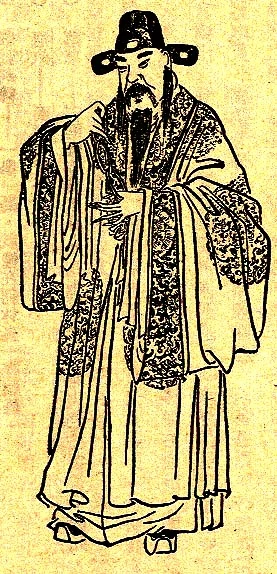
Biography
Family Background and Early Life
Wang Yun came from the Taiyuan Wang clan, a prominent family of Shanxi whose members had long held important provincial and commandery offices and enjoyed considerable local influence. According to the “Genealogical Tables of Chancellors” in the New Book of Tang, the Taiyuan Wang lineage traced itself to Prince Jin, son of King Ling of Zhou, and through Wang Wei, second son of Wang Li, the grandson of the Qin general Wang Jian. Wang Wei served as Inspector of Yang Province under the Han. Nine generations later, Wang Ba, courtesy name Ruzhong, lived at Jinyang in Taiyuan and repeatedly declined office in the Eastern Han. Wang Ba's eldest son Wang Yin later became Administrator of Zhongshan and held an estate in Qi County. Four generations later, Wang Shi had three sons: Wang Yun, Wang Wei, and Wang Mao. Wang Yun belonged to this branch, later called the Wuwan Wang lineage.
From youth, Wang Yun had large ambitions and valued great principles. He studied the classics and commentaries and also practiced riding and archery, cultivating both literary and martial skills. Guo Tai, a celebrated man from the same commandery whose courtesy name was Linzong, was struck by Wang Yun and said that “Wang advances a thousand li in a day; he has the talent to assist a ruler.” Guo Tai became his friend, and such praise from a leading judge of character significantly strengthened Wang Yun's reputation.
Service as a Commandery Clerk
At nineteen Wang Yun was appointed a commandery clerk. Zhao Jin, a palace eunuch in the Jinyang area, was arrogant and oppressive and caused great suffering among local people. Wang Yun ordered his arrest and execution. Zhao Jin's brothers cultivated influence among the eunuchs and used it to accuse Wang Yun. Emperor Huan became enraged and summoned the Taiyuan administrator Liu Zan to the capital, where Liu was imprisoned and executed. Wang Yun escorted Liu Zan's coffin back to Pingyuan and observed mourning for three full years before returning home and resuming official service.
After returning to office, Wang Yun clashed with Administrator Wang Qiu, who wished to employ a local man named Lu Fo despite his poor reputation and lack of virtue. Wang Yun argued openly against the appointment and angered Wang Qiu. The administrator had him arrested and imprisoned, intending to kill him. Inspector Deng Sheng of Bing Province, who had long heard of Wang Yun, immediately sent an urgent order appointing him as an assistant in the provincial administration and thereby saved him. Deng Sheng's patronage and public recognition further increased Wang Yun's fame.
The Chronicle of the Later Han preserves another version. It states that while Wang Yun was commandery registrar, Administrator Liu Wei, acting at eunuch Zhao Jin's request, appointed Lu Fu of Zhongdu as an assistant officer. Wang Yun judged Lu Fu deceitful and repeatedly returned the administrator's orders without execution. He was flogged dozens of times but would not yield. Lu Fu ultimately lost the appointment, while Wang Yun's name spread widely. Lu Fu was immensely wealthy, with hundreds of retainers, and often wished to harm Wang Yun. Wang Yun himself had only a few men, yet whenever he met Lu Fu he sat upright in his carriage, hand on sword, and denounced him; Lu Fu did not dare resist.
Wang Yun was later simultaneously summoned by the Three Excellencies and, after receiving a high evaluation in the office of the Minister of Education, became a Attendant Censor. His move from local administration to the central court was a major turning point in his career and gave him a broader political arena in which to pursue his ideals of service.
Inspector of Yu Province and Eunuch Retaliation
In 184 the Yellow Turban Rebellion erupted on a large scale. To suppress it quickly, the Eastern Han court specially selected Wang Yun as Inspector of Yu Province. He recruited such eminent men as Xun Shuang and Kong Rong to his staff and memorialized the throne asking for the lifting of the partisan prohibitions. In the fighting, he defeated a separate Yellow Turban commander and later joined Left General of the Household Huangfu Song and Right General of the Household Zhu Jun in accepting the surrender of hundreds of thousands of rebels.
During the surrender process, Wang Yun discovered among the rebels a letter written by a retainer of Central Regular Attendant Zhang Rang that referred to contacts with the Yellow Turbans. Zhang Rang was one of the most powerful eunuchs at court and enjoyed extraordinary imperial favor. Ignoring the danger, Wang Yun exposed the matter in detail in a memorial. Emperor Ling rebuked Zhang Rang, who kowtowed and apologized, but was never punished.
Zhang Rang therefore bore a grudge. The following year, the court ordered Wang Yun's arrest. A general amnesty soon restored him to his post, but shortly afterward he was summoned again and arrested. Minister of Education Yang Ci, who knew Wang Yun's character, realized that Zhang Rang intended to kill him. Hoping to spare him torture and humiliation, Yang Ci sent a subordinate to warn him that two summonses in one month over the Zhang Rang affair meant that disaster was imminent and that he should carefully consider his course. One of Wang Yun's own subordinates, weeping, offered him poison so that he could die without humiliation. Wang Yun angrily replied that, as a subject, if the emperor condemned him he should accept the supreme penalty before all under heaven; how could he take poison to escape death? He poured the medicine onto the ground and entered the prison cart.
At the Court of Judicial Review, officials pressed for the case to be decided, while the court generally lamented his fate. General-in-Chief He Jin, Defender-in-chief Yuan Wei, and Minister of Education Yang Ci jointly petitioned the emperor in his defense. They argued that rulers who listened inwardly and reflected would inspire loyal ministers to serve wholeheartedly; that leniency toward the worthy and recognition of ability would strengthen the resolve of righteous men; and that Wang Yun had been specially selected, had punished rebels, comforted those who submitted, and had pacified Yu Province in less than a month. To execute him for mishandling one matter, they argued, would impose a punishment far heavier than the offense and disappoint public expectations. Wang Yun's sentence was therefore reduced by one degree. That winter another general amnesty was issued, but Wang Yun alone remained excluded. Senior ministers continued to petition for him, and only in the following year was he released. Because the eunuchs then dominated court politics and their partisans used even minor grievances to destroy opponents, Wang Yun changed his name, left Luoyang, and moved between Henei and Chenliu to avoid persecution.
Return to Court and Dong Zhuo's Domination
When Emperor Ling died in 189, Wang Yun hurried to Luoyang to attend the mourning. The political situation was chaotic. The relatives of the imperial house, led by General-in-Chief He Jin, had grown stronger, while Zhang Rang and the eunuch faction faced destruction. He Jin summoned Wang Yun to plan the elimination of the eunuchs, made him Gentleman Consultant on his staff, and later transferred him to Intendant of Henan.
After He Jin was killed, Yuan Shu and others led troops into the palace against Zhang Rang. Zhang Rang, Duan Gui, and their associates seized the young emperor Liu Bian and the Prince of Chenliu, Liu Xie, and fled at night. Court nobles and senior officials were frightened by the sudden crisis and did not dare escort the emperor. Wang Yun immediately sent Min Gong, a Henan assistant official, with troops to accompany Secretariat official Lu Zhi in protecting the young emperor. Min Gong later escorted him back to the palace.
In 189 Dong Zhuo deposed the young emperor and placed Liu Xie, Emperor Xian, on the throne. Wang Yun was appointed Grand Coachman and soon Prefect of the Masters of Writing. In 190 he replaced Yang Biao as Minister of Education while retaining control of the Secretariat.
After Dong Zhuo entered Luoyang, he used the emperor to command the realm, deposed and enthroned rulers, poisoned the empress dowager, planted partisans, cultivated personal followers, and gathered military authority into his own hands. Wang Yun recognized that Dong Zhuo had become the gravest threat to the Eastern Han government and had to be restrained and removed. Yet Dong Zhuo controlled strong armed forces, had many adherents, and was personally violent and ruthless. Wang Yun therefore outwardly complied and even deferred to him in order to lower his suspicions, while privately making careful plans.
Dong Zhuo attempted to draw influential court officials into his camp. Wang Yun quietly cooperated and, when necessary, bent his own preferences to win Dong Zhuo's trust. When Dong Zhuo moved the capital to Chang'an, Wang Yun collected the books and esoteric writings of the Lantai and Stone Chamber and carried them to Guanzhong. In Chang'an he sorted and catalogued them and also assembled precedents from earlier Han government for presentation to the throne. These efforts helped preserve important texts. While Dong Zhuo remained in Luoyang, he entrusted much daily government to Wang Yun, who outwardly followed his orders closely. Dong Zhuo therefore trusted him without suspicion. Wang Yun used the opportunity to preside over measures aimed at restoring royal authority and economic order, and both the emperor and officials inside and outside the court came to rely heavily on him.
Secret Plot Against Dong Zhuo
While outwardly accommodating Dong Zhuo, Wang Yun secretly organized opposition. He first consulted with Huang Wan, Colonel Director of Retainers, and Secretariat official Zheng Tai. They proposed appointing Yang Zan, Colonel Protecting the Qiang, to act as Left General, and Shi Sunrui, Bearer of the Gilded Mace, as Administrator of Nanyang, then sending troops through the Wuguan route under the pretext of attacking Yuan Shu. Their real purpose was to divide their forces against Dong Zhuo and eventually escort the emperor back to Luoyang. Dong Zhuo became suspicious and detained them. Wang Yun therefore brought Shi Sunrui into court as Director and Yang Zan as Secretariat official.
Gai Xun was regarded as a righteous court official who had long opposed Dong Zhuo. When Dong Zhuo once asked Wang Yun who was best suited to serve as Colonel Director of Retainers, Wang Yun answered that only Gai Xun was qualified. Though he knew Dong Zhuo and Gai Xun were bitterly opposed, Wang Yun recommended him out of principle. Dong Zhuo replied that Gai Xun was intelligent but could not be entrusted with such a sensitive post. He instead made him Colonel of the Yue Cavalry, and later, fearing that Gai Xun might use capital troops against him, sent him out as Administrator of Yingchuan.
In 191 Dong Zhuo reached Chang'an, assumed the title Grand Preceptor, and granted Wang Yun a fief of two thousand households. In 192 Wang Yun again plotted with Shi Sunrui and Yang Zan. They exploited two sources of tension between Lü Bu and Dong Zhuo: Dong Zhuo had once thrown a hand halberd at Lü Bu in anger over a minor matter, and Lü Bu had had illicit relations with a maid in Dong Zhuo's household and feared discovery. Wang Yun revealed the plot to Lü Bu and finally persuaded him to participate as the insider.
When Emperor Xian recovered from illness and Dong Zhuo entered court to offer congratulations, Wang Yun arranged for Lü Bu to kill him. Dong Zhuo's three clans were exterminated, and his registrar Tian Yi was also killed. The people of Chang'an celebrated openly.
Failed Government and Death
After Dong Zhuo's death, Wang Yun supervised the Imperial Secretariat and governed jointly with Lü Bu. Yet he looked down on Lü Bu, treating him as little more than a swordsman. He rejected Lü Bu's proposals to eliminate all remaining Dong Zhuo partisans and distribute Dong Zhuo's property among their followers, and relations between them deteriorated.
Wang Yun's insistence on executing the scholar Cai Yong further damaged his standing. After Dong Zhuo's death, Cai Yong sighed during a gathering at Wang Yun's residence. Wang Yun became furious, interpreted the gesture as nostalgia for Dong Zhuo's private favor, and handed Cai Yong over to the judicial authorities. Cai Yong begged to be spared, offering to accept mutilating punishment and continue the history of the Han. Many scholars pleaded for him. Defender-in-chief Ma Midi warned Wang Yun that Cai Yong was an exceptional talent who knew Han affairs and should be allowed to complete the later history as a great work of the age. Cai Yong, he noted, had long been known for loyalty and filial conduct; killing him on a vague charge would alienate public opinion. Wang Yun replied that Emperor Wu of Han had once spared Sima Qian, allowing him to write a defamatory work that circulated to later generations. With the state now weakened and the dynasty insecure, Wang Yun said, the court could not allow a flattering minister to wield the historiographer's brush beside a young ruler and attack their reputations. Cai Yong ultimately died in prison. Ma Midi later remarked that Wang Yun probably would not last long: good men were the guiding bonds of the state and institutions were its canonical standards; after destroying the bonds and abandoning the standards, how could he endure?
At the same time, most of Dong Zhuo's remaining troops were from Liangzhou. Wang Yun considered stripping them of military office. Some advisers warned that these men already feared Yuan Shao and the eastern armies and would feel desperate if disarmed. They recommended placing them under Huangfu Song to reassure them and then coordinating with the eastern armies. Wang Yun rejected the proposal, fearing it would make the eastern forces suspicious. He also failed to settle the question of a general pardon for Dong Zhuo's troops. Rumors therefore spread that he intended to exterminate all Liangzhou men, leaving the soldiers frightened and armed in Guanzhong.
Li Jue and Guo Si, officers whom Dong Zhuo had sent east and who had plundered Chenliu and Yingchuan, returned after their commander Niu Fu died. With no one to rely on and no pardon from the court, they followed Jia Xu's advice, gathered troops, and marched west, recruiting along the way. Wang Yun sent Dong Zhuo's former generals Hu Zhen and Xu Rong against them, but Xu Rong was killed and Hu Zhen surrendered. By the time the army reached Chang'an it numbered more than one hundred thousand and joined Dong Zhuo's former subordinates Fan Chou, Li Meng, Wang Fang, and others in besieging the capital.
Ten days later Chang'an fell. Lü Bu fought Li Jue and the others in the city but was defeated and fled. Outside the Qingsuo Gate he urged Wang Yun to leave with him. Wang Yun chose to die for the state and refused. Li Jue had him killed, his corpse exposed in the marketplace, and his three clans exterminated. He was fifty-six.
After Emperor Xian later moved the court to Xu County, he remembered Wang Yun's loyal service, had him reburied, sent a Tiger Guards General with an official message of condolence, restored the insignia of his office, and enfeoffed Wang Yun's grandson Wang Hei as Marquis of Anle Village with three hundred households.