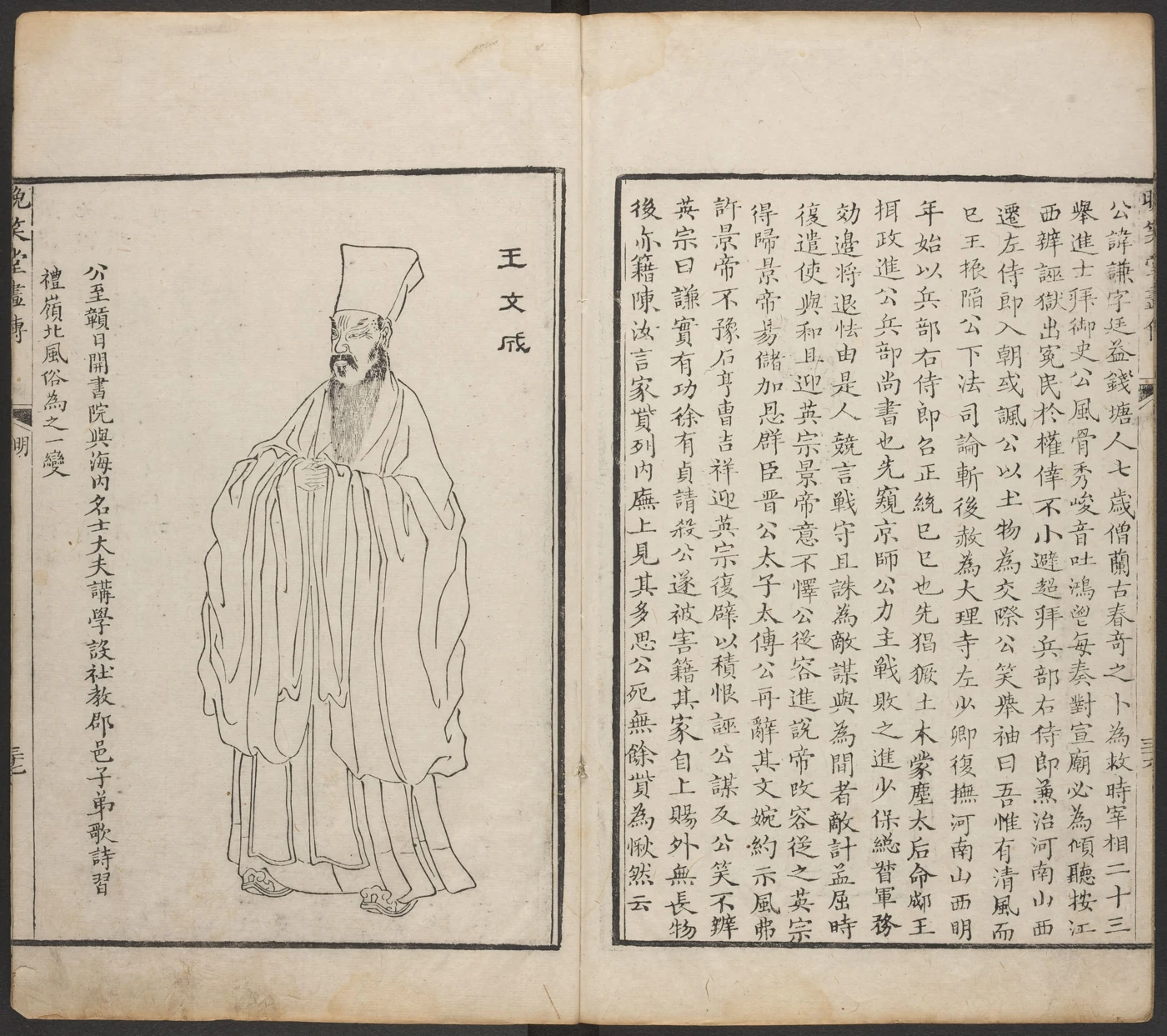
Biography
Family Background and Early Years
Wang Shouren was born in northern Yuyao, Zhejiang, into a scholarly official family. His father Wang Hua placed first in the metropolitan examination in 1481 and eventually became Minister of Personnel in Nanjing. He was upright in office and highly regarded by the Hongzhi Emperor. According to the *Chronological Biography of Master Yangming*, before Wang's birth his grandmother dreamed that a celestial figure dressed in red and jade descended through clouds with music while carrying an infant. His grandfather therefore named the child Yun, “cloud,” and called the family residence Ruiyun Lou, “Auspicious Cloud Tower.” His mother was said to have carried him for fourteen months. He did not speak until age five but could silently remember books read by his grandfather. A passing monk reportedly touched his head and said that he was a fine child but that “the Way had unfortunately been spoken out.” Interpreting the remark through a passage in the *Analects*, his grandfather changed the child's name to Shouren, after which he began to speak.
Wang entered a village school at twelve and lost his mother at thirteen. Although this was a serious childhood loss, the source portrays him as unusually ambitious. When a teacher asked what mattered most under Heaven, Wang answered that success in the civil examinations was not the highest concern; the most important task was to study and become a sage. At fifteen he heard of uprisings led by Shi Ying, Wang Yong, Shi Long, Liu Tong, and others and repeatedly wanted to memorialize the emperor with plans for suppression, which his father dismissed as rash. That same year he traveled for a month around Juyong Pass and Shanhai Pass, surveying the northern frontier and developing ambitions for wider statecraft.
Youthful Intellectual Search and the Examination Path
In 1488, at seventeen, Wang went to Nanchang to marry a daughter of Zhu Yanghe. On the wedding day the family could not find the bridegroom: while wandering, Wang encountered a Daoist meditating at Tiezhugong and began asking about techniques of nourishing life. He sat with the Daoist so long that his father-in-law did not find him until the next day.
In 1489 Wang and his wife returned toward Yuyao. Passing Guangxin, he visited Lou Liang, who explained the doctrine of “investigating things and extending knowledge.” Wang was delighted and thereafter read Zhu Xi extensively, pondering the Song Confucian claim that every object, down to grass and trees, possessed principle. To put the method into practice he tried to exhaust the principle of bamboo, “investigating” it for seven days and nights without success until he fell ill. He consequently became deeply doubtful of the received theory. The episode is remembered as the famous “Shouren investigates bamboo” story.
In 1492 Wang passed the Zhejiang provincial examination on the same list as Hu Shining and Sun Sui. His studies advanced, but he increasingly enjoyed discussing military affairs and became skilled at archery. He failed the metropolitan examination in 1493. Chief Grand Secretary Li Dongyang jokingly told him that although he had not become top graduate that year, he would surely do so next time and invited him to compose an essay for his future success. Wang wrote it immediately, astonishing senior officials, though some became jealous. In 1496 he failed again. When his father consoled him, Wang replied that others were ashamed of not passing, whereas he was ashamed of letting failure disturb his mind.
Early Official Career and the Longchang Awakening
In 1499 Wang took the metropolitan examination, ranked second in the southern examination hall, and received seventh place in the second class of jinshi at the palace examination. He observed administration in the Ministry of Works, handled the funeral arrangements of the former Earl of Weining Wang Yue, and after returning to court submitted a memorial on eight matters including northwestern defense. He was then appointed a bureau secretary in the Ministry of Justice, adjudicating prisoners in areas north of the Yangzi, and later requested leave because of illness. In 1504 he returned to service as bureau secretary in the Military Selection Bureau of the Ministry of War.
In the winter of 1506, when the eunuch Liu Jin dominated government and arrested more than twenty officials including Dai Xian of the Nanjing censorial establishment, Wang memorialized in their defense. Liu Jin was angered; Wang received forty strokes in a court beating and was banished to serve as postal station officer at Longchang in Guizhou, in present-day Xiuwen northwest of Guiyang. His father Wang Hua was also forced out of Beijing and transferred to Nanjing. On the road to exile, agents sent by Liu Jin allegedly pursued Wang, who escaped by staging a drowning. He secretly visited his father in Nanjing. Wang Hua told him that because the court had given him an appointment, he carried an official responsibility and should still go to his post.
Longchang lay amid mountains and dense vegetation and was inhabited by Miao, Liao, and other communities. Wang did not give in to despair. He taught according to local customs and became well liked. There he reached a new understanding of the *Great Learning*, realizing that “the Way of the sages is fully present in my own nature; my former attempt to seek principle in external things was mistaken.” This became known as the Longchang awakening. He wrote *Instructions for the Students of Longchang* to explain principles of the School of Mind. When disciples questioned the claim that there is no principle or thing outside the mind and asked what a flower in the southern mountains had to do with their minds, Wang replied that before one sees the flower, flower and mind alike remain in quiet obscurity, but when one looks at it, its colors suddenly become clear, showing that the flower is not outside the mind.
Grand Coordinator of Southern Jiangxi and Suppression of Revolts
In the intercalary ninth month of 1509, Wang's period of banishment ended and he became magistrate of Luling, present-day Ji'an in Jiangxi, where the source credits him with effective administration. The following year Liu Jin was removed through a plan involving Yang Yiqing and the eunuch Zhang Yong, and Wang was promoted to bureau secretary in the Nanjing Ministry of Justice. In 1511 he was recalled to Beijing and successively served in bureaus of the Ministry of Personnel. In 1512 he became director of its Bureau of Evaluations and vice minister of the Nanjing Court of the Imperial Stud. In 1514 he was promoted to minister of the Nanjing Court of State Ceremonial.
In the eighth month of 1516, Minister of War Wang Qiong recommended Wang's abilities and secured his promotion to Assistant Censor-in-chief and grand coordinator over Nan'an, Ganzhou, Tingzhou, Zhangzhou, and surrounding areas. At the time armed groups were widespread across central and southern Jiangxi. Xie Zhishan held Hengshui, Zuoxi, and Tonggang; Chi Zhongrong controlled Litou and styled himself a king; they coordinated at a distance with Chen Yueneng at Dayu, Gao Kuaima at Lechang, Gong Fuquan at Chenzhou, and others. Zhan Shifu and others at Damao Mountain in Fujian had also risen. The previous grand coordinator Wen Sen had resigned on grounds of illness, leaving a serious situation.
On taking office, Wang learned that government offices contained informants for the rebels. He questioned an elderly, experienced servant, who confessed. Wang pardoned him and used him to gather intelligence, thereby learning the movements of the armed groups. In the first month of 1517 Wang personally led elite troops to camp at Shanghang, pretended to withdraw, then launched a surprise attack, taking more than forty strongholds and killing or capturing over 7,000 people. In the seventh month he moved on Dayu; in the tenth month he captured Zuoxi and Hengshui, destroyed eighty-four strongholds, and killed or captured more than 6,000. After the campaign he established Chongyi County at Hengshui. He then returned to Ganzhou and attacked Chi Zhongrong at Litou, killing more than 2,000. local people marveled that a scholar could lead troops and destroy armed groups that had troubled the region for decades.
After the campaigns, Wang established schools at Ganzhou, introduced the Ten-Household Placard System and the Southern Jiangxi Community Compact, printed Confucian classics, improved teachers' support, and restored Lianxi Academy, later renamed Yangming Academy. Academies proliferated and the source credits these measures with altering a local culture of violent feuding. It especially emphasizes his efforts to transform She communities through a combination of military suppression and pacification, baojia-style supervision, and community compacts, saying that many became integrated with Hoklo or Hakka populations. After suppressing disorders in western Fujian, southern Jiangxi, and eastern Guangdong, Wang left behind three new counties—Pinghe, Chongyi, and Heping—and local people honored him as a “father of counties.”
Suppression of the Prince of Ning Rebellion
In 1519 Zhu Chenhao, Prince of Ning, rebelled in Nanchang. News shocked court officials in Beijing, but Wang Qiong reportedly said with confidence that Wang Bo'an was in Jiangxi and would surely capture the rebel.
Wang was then traveling toward Fujian to deal with another disturbance. At Fengcheng he learned of the rebellion and immediately hurried to Ji'an, recruited local forces, and issued a proclamation against Zhu. He understood that if the prince moved east down the Yangzi, Nanjing would probably fall, and loss of Nanjing would give the rebellion the political initiative. Wang no longer held military tallies, which had been returned to the Ministry of War after earlier campaigns, and had no standing army. Officials throughout Jiangxi came to assist him. Troops from the prefectures and counties were assembled at Yuanzhou, grain was requisitioned, and weapons and boats were prepared.
Wang used deception. He circulated false proclamations claiming that eight thousand—presented in the source as eighty thousand—border and capital troops, together with southern Jiangxi, Huguang, Guangdong, and Guangxi forces, would form an army said to number 160,000 and attack Nanchang. He also wrote sealed messages designed to make Zhu Chenhao's chief councillors Li Shishi and Liu Yangzheng advise an advance on Nanjing, deliberately allowing the messages to reach Zhu. Li and Liu indeed urged the move. Zhu became suspicious and remained in place, losing more than ten days before learning the truth. He then moved east along the river, captured Jiujiang and Nankang, and approached Anqing.
By then Wang had assembled a hastily organized force of 80,000 and marched directly on Nanchang. When some proposed relieving Anqing, he argued that doing so would lead to a prolonged confrontation with Zhu's main force on the river while enemy forces from Nankang and Jiujiang attacked his rear; Nanchang itself was lightly defended, while his own newly assembled force had high morale. Capturing it would force Zhu to return and allow Wang to meet him directly. Nanchang quickly fell. Zhu turned back, and the two sides fought a decisive three-day battle on Poyang Lake. Zhu was defeated and captured, bringing the thirty-five-day rebellion to an end.
Wang's achievement did not initially win recognition from the Zhengde Emperor. Favorites around the emperor who had had dealings with Zhu Chenhao wanted Wang to release the prince so that the emperor, then traveling south, could ceremonially “capture” him in person. Wang withdrew from the political danger, handed Zhu over to the more upright eunuch Zhang Yong, and claimed illness. He received no reward for the campaign during the remainder of the Zhengde reign and was promoted and enfeoffed only after the Jiajing Emperor took the throne.
Enfeoffment as Earl of Xinjian and Later Teaching
In 1521 the Jiajing Emperor came to the throne. Wang requested retirement because his father was elderly, but the emperor replied that Wang's achievements in capturing rebels and suppressing disorder still required reward and refused the request. Wang was promoted to Minister of War in Nanjing and soon made hereditary Earl of Xinjian. After Wang Hua died in 1522, Wang returned home to observe mourning.
In 1524 he was invited to lecture at Jishan Academy. In 1525 he founded Yangming Academy in Shaoxing, while his disciples also began lecturing and spreading what became known as the Wang school. His first wife Lady Zhu died the same year; he married Lady Zhang and had a son the following year.
On the eve of departing for Guangxi in the ninth month of 1527, Wang left his Four-Sentence Teaching at Tianquan Bridge: “The substance of the mind is neither good nor evil; the movement of intention has good and evil. Knowing good and knowing evil is innate knowing; doing good and removing evil is the investigation of things.”
Commander-in-Chief in Guangdong and Guangxi and Death
In 1527 the ethnic leaders Lu Su and Wang Shou rebelled in Si'en and Tianzhou. Governor-general Yao Mo was unable to suppress them, and the court ordered Wang to resume his former office while concurrently serving as Censor-in-chief, commander-in-chief of military affairs in Guangdong and Guangxi, and grand coordinator. Huang Wan memorialized in defense of Wang's earlier merits, requesting an iron certificate and annual stipend and recognition of men who had contributed to suppressing the Prince of Ning rebellion. The Jiajing Emperor approved these requests. In the twelfth month Wang reached Si'en. Lu Su and Wang Shou, already fearful because of Wang's reputation for suppressing armed groups and rebellions, surrendered.
In the second month of 1528 Wang led Huguang troops to Nanning. Lu Su and Wang Shou offered to earn pardon through service. Wang ordered Wang Zhen, assistant commissioner of Huguang, Weng Su, deputy commissioner of Guangxi, Wu Tianting, assistant commissioner, regional commander Zhang Jing, commander Xie Pei, and others to supervise Huguang indigenous troops in a surprise attack on rebels at Duanteng Gorge. Hearing that Huguang troops had arrived, the rebels withdrew into difficult mountain terrain. They then heard that Lu Su and Wang Shou had surrendered and assumed Wang had dispersed his forces, so their defenses relaxed. The Huguang troops approached with banners lowered and drums silent and joined Ming forces in attacks from several directions. The rebels were heavily defeated and withdrew to fortified positions on Xiannü Mountain. Government forces climbed trees and cliffs to attack uphill, successively taking Youzha, Shibi, Dabi, and other positions before striking Duanteng Gorge and suppressing the revolt.
Wang died of illness on 9 January 1529 at Nan'an in Jiangxi, present-day Dayu County, at the age of fifty-seven. Under the Longqing Emperor he was posthumously elevated to Marquis of Xinjian and given the posthumous name Wencheng. In 1584 he was included among the figures receiving sacrifice in the Confucian Temple.
The turning point of Wang Shouren's life came with the beating and banishment of 1506. With the eunuch Liu Jin in power, Dai Xian and more than twenty other supervising secretaries of Nanjing were imprisoned for speaking out; Wang Shouren memorialized in their defense, provoked Liu Jin, was given forty strokes and reduced to keeper of the Longchang post station in Guizhou, while his father Wang Hua was driven from Beijing. On the way to his exile he learned that Liu Jin had sent men after him, feigned a suicide by drowning to escape, and went secretly to Nanjing to see his father, who told him that since the court had given him a charge he should go and take it up. Longchang, a tangle of mountains where Miao and Liao lived intermixed, was then uncivilized country; Wang Shouren was not disheartened, and taught the people according to their customs, winning their affection. It was there that he came to a new understanding of the central teaching of the Great Learning, recognizing that "the way of the sage lies complete in my own nature, and to have sought principle in things was a mistake", and wrote his "Articles of Instruction for the Students of Longchang" — the "enlightenment at Longchang" of the histories.
His term of exile served, he was restored as magistrate of Luling and thereafter held posts in the boards of personnel and elsewhere. In 1516, on the recommendation of the war minister Wang Qiong, he was made a vice censor-in-chief in the censorate and given the grand coordinatorship of Nan'an, Ganzhou, Tingzhou and Zhangzhou. Banditry then swarmed over southern Jiangxi: Xie Zhishan held Hengshui, Zuoxi and Tonggang, Chi Zhongrong held the Liutou hills, each styling himself a king, in concert with Chen Yuening of Dayu, the Gaokuaima of Lechang and Gong Fuquan of Chenzhou, plundering the prefectures, while Zhan Shifu and others rose at the Damao hills in Fujian and the previous coordinator pleaded illness and retired. On arrival Wang Shouren first found that many in the government offices were the bandits' eyes and ears; he interrogated an old and cunning servant, who confessed without concealment, pardoned him and used him to gather intelligence, and so learned the bandits' movements. He then ordered the forces of Fujian and Guangdong to concentrate, and struck first at the Damao hills: in the first month of 1517 he led picked troops to camp at Shanghang, feigned withdrawal and attacked where least expected, carrying more than forty stockades in succession and killing or capturing over seven thousand. Finding his authority too small to command the officers, he memorialized for powers, and Wang Qiong had the court give him the flag and warrant to act at discretion. In the seventh month he advanced on Dayu; in the tenth he took Zuoxi and Hengshui, broke eighty-four nests and killed or took more than six thousand, setting up the county of Chongyi afterwards. Returning to Ganzhou he attacked the Liutou bandits and killed over two thousand. With scholars and subordinate officers he cleared banditry that had troubled the region for decades, and the people around cried out that he was a god.
Beyond war, Wang Shouren's government in southern Jiangxi had deeper effects. He introduced the ten-household plaque system and the Nan'an-Jiangxi community compact, rebuilt the old grass-roots fighting force of elders and sons, founded community schools among the She people, printed Confucian classics, raised teachers' pay and repaired the Lianxi academy, renamed the Yangming academy in the late Qing; for a time academies stood everywhere in southern Jiangxi and the violent temper of the customs changed. Those who fought the government there were mostly She; by combining suppression and conciliation with the mutual-surveillance system and the compact, he turned the "stubborn" into "new subjects" who looked toward civilization, and large numbers of She became sinicized and absorbed into the local population, while those unwilling to do so withdrew deeper into the mountains or moved to eastern Fujian and southern Zhejiang, greatly altering the ethnic map of the Fujian-Guangdong-Jiangxi border. After the counties were set up the people lived in peace and the local economy developed considerably, and he came to be honored as the "father of the county".
In 1519 the prince of Ning, Zhu Chenhao, rebelled. When the news reached Beijing the ministers were shocked, and only Wang Qiong said confidently that with Wang Bo'an in Jiangxi the rebel would surely be taken. Wang Shouren on hearing of it raised troops at once, first using stratagems to make the rebel hesitate and gain time to gather his forces, then striking directly at Nanchang, Zhu Chenhao's base, forcing him to turn back, and burning his fleet on Lake Poyang to take him alive — all within a little over a month, a classic in Ming warfare. He continued to teach, discussing with his disciples the unity of knowledge and action and the extension of innate conscience, and set out the four-sentence teaching: that the substance of mind is neither good nor evil, that the movement of intention may be good or evil, that knowing good and evil is conscience itself, and that doing good and removing evil is the investigation of things — the "testimony at the Tianquan bridge" by which the Yangming school attained its full system. In 1527 he campaigned as governor against Sin'en and Tianzhou, and after settling them broke the Yao and Zhuang of the Wast Vine Gorge and the Eight Stockades; the next year, returning from the campaign, he died in his boat at Nan'an, and to his disciple's question about last words he answered that his mind was luminous and there was nothing more to say. He was given the posthumous name Wencheng in the Longqing reign and was admitted to sacrifice in the Confucian temple in 1584. His lectures and letters were collected by his pupils as the Records of Instruction, together with the Great Learning Question and other works, forming the Complete Works of the Duke of Wencheng, whose influence reached to the end of the Ming and to modern East Asian thought.
The later reception of Wang Yangming's teaching deserves a note of its own. Centered on the extension of innate conscience, it held that knowledge and action are not to be divided and rejected a investigation of principle that stopped at the outward appearance of things; the four sentences gave his pupils a point of entry and, by their talk of a substance beyond good and evil, provoked argument for generations. In the middle and late Ming his followers split into the Jiangyou, Zhezhong and Taizhou branches, and lecture meetings spread across the southeast, the Taizhou school carrying the doctrine of conscience into the daily life of ordinary people. Critics, on the other hand, held that the school degenerated into empty talk of mind and nature, slighting books and practical affairs, and scholars at the turn of the Ming and Qing — Gu Yanwu and Wang Fuzhi among them — had much to say against it. In modern times the doctrine of the unity of knowledge and action has been invoked again and again in discussing the relation of thought to conduct, and the Yangming school has become one of the most widely influential bodies of thought in East Asian intellectual history.
The circumstances of his exile at Longchang are preserved in detail in the chronologies and collected works made by his pupils. Having no house, he first built a thatched hut and then moved into a stone cave on the eastern peak, which he called the Yangming Grotto of Heaven, adding a "Mean Dwelling", a "Gentleman's Pavilion" and a "Retreat for Pondering the Changes"; he lived among the local Miao and Liao, teaching them farming and drinking with them. In that utter isolation he asked himself what a sage would do in such a place, and even made a stone coffin for himself and sat in it day and night to test his thoughts of life and death, until at last his mind grew clear and in the middle of the night he understood the meaning of investigating things and extending knowledge, learning that the way of the sage lies complete in one's own nature and is not to be sought outside. In 1509 the deputy education commissioner of Guizhou, Xi Shu, invited him to lecture at the Wenming academy in Guiyang, where he first set out systematically the unity of knowledge and action, holding that to know and not to act is not yet to know, that knowledge is the beginning of action and action the completion of knowledge. His lecture halls afterward ranged from Chuzhou and Nanjing to Ganzhou and Shaoxing, and his pupils Xu Ai, Lu Cheng, Xue Kan, Qian Dehong and Wang Ji recorded his sayings in the Records of Instruction, so that his teaching grew from an insight in a far corner into the leading school of an age.
The divisions among his followers produced differing readings of the four sentences as well. Qian Dehong held that they were the settled text of the school and that the doing of good and removal of evil was where the work must be grounded; Wang Ji thought that if the substance of mind is beyond good and evil then one is already there and need not lay another foundation — the dispute of the "four having" and the "four nothing", which ran from the late Ming into the early Qing and became a central question in judging the Yangming school.