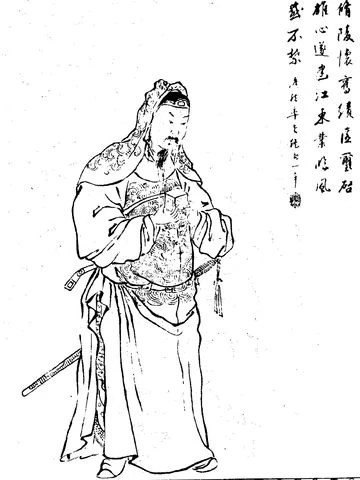
Biography
Family Background and Early Years
Sun Jian was born in 155, the first year of the Yongshou era, and was from Fuchun in Wu Commandery. According to the Records of the Three Kingdoms, he claimed descent from Sun Wu, the ancient military strategist. Wei Zhao’s Book of Wu states that his family “served in Wu for generations and made their home at Fuchun,” suggesting that the Sun clan had established roots in the area. From childhood Sun Jian displayed an unusual bearing; historical accounts describe him as “extraordinary in appearance, open and magnanimous in character, and fond of extraordinary acts.”
At the age of seventeen, Sun Jian traveled by boat with his father Sun Zhong toward Qiantang. On the way they encountered pirates led by Hu Yu dividing goods they had robbed from merchants on the shore. Travelers were too frightened to move and passing boats would not approach. Sun Jian told his father, “These bandits can be attacked. Let me strike them.” Sun Zhong replied that this was not his concern, but Sun Jian had already taken up a blade and rushed ashore. Waving and signaling as though he were directing government troops to encircle the pirates, he caused them to believe soldiers were coming. They abandoned the loot and fled in panic. Sun Jian chased them, killed one, and returned carrying the man’s head. The episode made him widely known, and the commandery recruited him as a county clerk. Thereafter he was “valued by the province and commandery for sudden courage and daring,” and served in posts including local army offices and assistant county magistracies.
In 172, the first year of the Xiping era, Xu Chang, a religious rebel in Kuaiji Commandery, rose at Juzhang and styled himself the Yangming Emperor. Together with his son Xu Shao, he stirred several counties into rebellion and gathered more than ten thousand followers. Serving as an Army Major, Sun Jian recruited more than one thousand strong men and joined provincial and commandery troops in suppressing the uprising. Inspector Zang Min reported Sun Jian’s achievements to the court. Sun Jian was formally appointed assistant magistrate of Yandu, later transferred to Xuji, and then to Xiapi. While at Xiapi, he associated widely with local men of talent and with young men of the district, building personal ties that later aided his military career.
Campaign against the Yellow Turbans
In 184, the first year of the Zhongping era, the Yellow Turban Rebellion broke out and shook the empire. Left General of the Household Huangfu Song and Right General of the Household Zhu Jun each led armies against Yellow Turban forces around Yingchuan. Sun Jian was then at Xiapi. Zhu Jun memorialized the court requesting Sun Jian as an auxiliary army major. Sun Jian recruited more than one thousand young men from Xiapi and elite troops from the Huai and Si river regions and fought alongside Zhu Jun with great determination.
In the sixth month, Yellow Turban forces under Zhao Hong occupied Wancheng with more than one hundred thousand men. Sun Jian led from the front, braved arrows and stones, scaled the wall ahead of the others, and was followed by soldiers swarming up behind him, resulting in a major victory. During one battle he advanced too far alone, was wounded, fell from his horse, and lay in tall grass while the scattered troops failed to notice him. His horse later returned to camp by itself; the soldiers followed it and found Sun Jian in the grass, bringing him back to recover. After a little more than ten days his wounds had improved enough for him to return to battle. Zhu Jun reported his service to the court, and Sun Jian was appointed a detached-unit major.
The Liangzhou Mutiny and Advice to Zhang Wen
In 185, the second year of the Zhongping era, Bian Zhang and Han Sui rebelled in Liangzhou. The court sent Dong Zhuo, then a General of the Household, to campaign under Left General of Chariots and Cavalry Huangfu Song, but the rebellion was not suppressed. The court then appointed Zhang Wen Minister of Works and General of Chariots and Cavalry. Zhang Wen invited Sun Jian to serve on his staff, and the army encamped at Chang'an.
Zhang Wen summoned Dong Zhuo by imperial order, but Dong delayed for a long time before appearing, and Zhang Wen rebuked him. Sun Jian, who was present, privately advised Zhang Wen: “Dong Zhuo is arrogant toward you and does not fear punishment. He should be executed under military law for failing to answer the summons.” Zhang Wen hesitated, saying, “Dong Zhuo has long possessed prestige in Long and Shu. If I kill him today, I fear it will harm our campaign against Bian Zhang.” Sun Jian then listed three major offenses: insulting his superior, failing in the campaign and harming morale, and arriving arrogantly despite having achieved neither merit nor service. He cited the ancient precedents of Rangju executing Zhuang Jia and Wei Jiang executing Yang Gan, urging Zhang Wen to establish authority. Zhang Wen nevertheless did not dare act and instead sent Sun Jian away so Dong Zhuo would not become suspicious. Dong Zhuo later entered the capital and monopolized power, and Zhang Wen was eventually killed by him. The episode was remembered as evidence of Sun Jian’s judgment and decisiveness.
Administrator of Changsha and Ou Xing’s Rebellion
In 187, the fourth year of the Zhongping era, the rebel leader Ou Xing in Changsha styled himself a general and gathered more than ten thousand followers to attack towns and cities. The court appointed Sun Jian Administrator of Changsha. After arriving, he personally led the troops, arranged strategy and defenses, and defeated Ou Xing in less than a month. Zhou Chao and Guo Shi in Lingling and Guiyang rose in response; Sun Jian crossed jurisdictional boundaries to attack them, and the three commanderies were pacified. The Han court enfeoffed him as Marquis of Wucheng for suppressing the unrest. While serving as administrator, Sun Jian recommended the local scholar Huan Jie as a Filial and Incorrupt candidate.
At this time Yichun County came under rebel attack. The county magistrate, a nephew of Lu Kang, Administrator of Lujiang, sent an envoy to ask Sun Jian for help. Sun Jian’s registrar advised him not to cross commandery boundaries. Sun Jian replied: “I have no literary virtue; my merit lies in punitive campaigns. Crossing a boundary to give aid is also to preserve another commandery and state. Even if I am punished, I would have nothing to be ashamed of before the empire!” He then advanced, and the rebels dispersed at the news.
The Coalition against Dong Zhuo
In 190, the first year of the Chuping era, Qiao Mao, Administrator of Dong Commandery, issued a proclamation to the regional lords calling for a campaign against Dong Zhuo. The lords raised armies in response, and Sun Jian marched north from Changsha to join the coalition. Passing through Jing Province, he encountered Inspector Wang Rui, who had long treated him discourteously and had announced that he would first attack Cao Yin, Administrator of Wuling, with whom he was at odds. Fearing death, Cao Yin forged an official proclamation in the name of the circuit commissioner Wen Yi and handed it to Sun Jian, ordering him to execute Wang Rui. Sun Jian immediately led troops to him. Wang Rui asked, “What crime have I committed?” Sun Jian replied, “The crime of knowing nothing.” Wang Rui then swallowed gold and killed himself.
Sun Jian continued north to Nanyang, where Administrator Zhang Zi failed to provide supplies as his army passed through. Sun Jian invited Zhang Zi to a banquet. While the feast was under way, Sun Jian’s registrar entered and reported: “The advance to Nanyang has been delayed, the roads are not repaired, and military supplies have not been prepared. Please arrest the registrar and investigate the reason.” Zhang Zi became terrified but could not leave because troops surrounded the area. Soon the registrar returned and said: “The Administrator of Nanyang has delayed the righteous army and prevented the bandits from being attacked in time. Please arrest him and proceed under military law.” Zhang Zi was immediately beheaded. Thereafter no one dared refuse the army’s demands.
Sun Jian reached Luyang and allied with Yuan Shu. Yuan Shu memorialized the court to appoint him General Who Breaks the Caitiffs and acting Inspector of Yu Province. Sun Jian therefore also became known as “Sun Polu,” after his military title.
Escape at Luyang and Defeat at Liangdong
In the winter of 190, Sun Jian sent his chief clerk Gongchou Cheng back to the province to press for military supplies. He set up tents outside the city gate and invited officials to a farewell banquet. Several tens of thousands of Dong Zhuo’s infantry and cavalry suddenly appeared. Sun Jian continued the drinking ritual and talked and laughed calmly while ordering his units not to move recklessly. Only after the enemy cavalry drew near did he rise unhurriedly and lead the army slowly into the city. He explained: “I did not rise and flee immediately because I feared the soldiers would rush against one another to get in, and then none would be able to enter.” Seeing the discipline of Sun Jian’s army, Dong Zhuo’s forces withdrew without attacking.
Sun Jian later moved his camp to Liangdong. Dong Zhuo sent Xu Rong and Li Meng out to plunder, and they encountered Sun Jian in Liang County. Sun’s army was badly defeated. Sun Jian escaped with only several dozen horsemen. Because the red scarf on his head made him easy to recognize, he removed it and gave it to his close officer Zu Mao to wear, drawing the pursuers away while Sun Jian escaped by a side road. Hard pressed, Zu Mao placed the scarf on a charred pillar and hid in tall grass. The pursuers surrounded the scarf, thinking it marked Sun Jian, only to discover the pillar and leave. Sun Jian’s army suffered severe losses. Li Min, Administrator of Yingchuan, was captured and boiled alive, while other soldiers were wrapped in cloth, hung upside down, and killed with hot oil.
Battle of Yangren and the Death of Hua Xiong
In the second month of 191, the second year of the Chuping era, Sun Jian gathered his scattered troops and encamped at Yangren. Dong Zhuo sent Hu Zhen as chief commander and Lü Bu as cavalry commander with five thousand infantry and cavalry to attack him. Lü Bu and Hu Zhen were at odds, and disorder spread through the force. Hu Zhen had declared that he would behead one high-ranking officer to impose discipline, which caused the other commanders to resent him. When the army reached Guangcheng, several tens of li from Yangren, it was already dusk and the men and horses were exhausted. They camped, planning to attack the next day. To frustrate Hu Zhen’s plan, Lü Bu and others spread the claim that Yangren’s defenders had already fled and should be pursued immediately. Hu Zhen believed it and advanced at once, only to find Sun Jian’s army ready. Hungry and exhausted, Dong Zhuo’s troops had to rest in place. Lü Bu then shouted that the enemy was making a surprise attack. The entire army panicked and fled, abandoning armor. After running more than ten li they realized no enemy was present. At dawn they attempted another attack, but the fortifications had been strengthened and Hu Zhen withdrew. Sun Jian pursued and heavily defeated the forces of Hu Zhen, Lü Bu, Li Jue, and others, killing the commander Hua Xiong and others.
After Sun Jian’s victory, someone warned Yuan Shu: “If Sun Jian obtains Luoyang, he will no longer be controllable. We will drive away the wolf Dong Zhuo only to welcome the tiger Sun Jian.” Yuan Shu became suspicious and withheld supplies. Sun Jian rode through the night back to Luyang and sternly rebuked Yuan Shu: “I risked my life in this campaign above to serve the state by attacking the rebel and below to avenge your family. Dong Zhuo has not killed any of my own relatives, yet you listen to slander and actually suspect me.” Ashamed, Yuan Shu immediately released provisions and equipment, and Sun Jian returned to Yangren.
Recovery of Luoyang and Dissolution of the Coalition
Knowing Sun Jian’s strength, Dong Zhuo sent Li Jue to propose a marriage alliance, promising offices as inspectors and administrators to Sun Jian’s sons and younger relatives. Sun Jian firmly rejected the offer, angrily denounced Dong Zhuo, declared that he would exterminate Dong’s three clans, and immediately advanced toward Dagu. Dong Zhuo personally fought Sun Jian among the mausoleums of earlier emperors, was defeated, and withdrew to Mianchi while gathering troops at Shaan County. Sun Jian entered Luoyang through Xuanyang Gate and defeated Lü Bu’s rear guard. After entering the city, he cleaned the ancestral temples and offered the full sacrificial animals to Heaven and Earth. Dong Zhuo told his chief clerk Liu Ai: “The generals east of the passes have been repeatedly defeated and are not worth worrying about. Only this man Sun Jian is someone you must all guard against.”
The coalition lords, however, were by then pursuing their own interests, remaining inactive and attacking one another. Yuan Shao and Yuan Shu were in conflict, and Yuan Shao appointed Zhou Yu as Inspector of Yu Province and had him seize Sun Jian’s base at Yangcheng. On hearing this, Sun Jian sighed: “We raised righteous troops together to save the state. Dong Zhuo has not yet been destroyed, yet we have begun fighting among ourselves.” After repairing the Han imperial tombs, he returned with his army to Luyang.
Death at Mount Xian
In 191, the second year of the Chuping era, Yuan Shu ordered Sun Jian to attack Liu Biao, Inspector of Jing Province. Liu Biao sent his subordinate Huang Zu to resist. Sun Jian defeated Huang Zu, pursued him, crossed the Han River, and besieged Xiangyang. Huang Zu fled to Mount Xian. Sun Jian pursued him and was shot and killed by Huang Zu’s troops, at the age of thirty-seven. His career thus came to an end.