Birth | Born in the imperial palace as the eldest legitimate son of Emperor Xiaozong and Empress Zhang
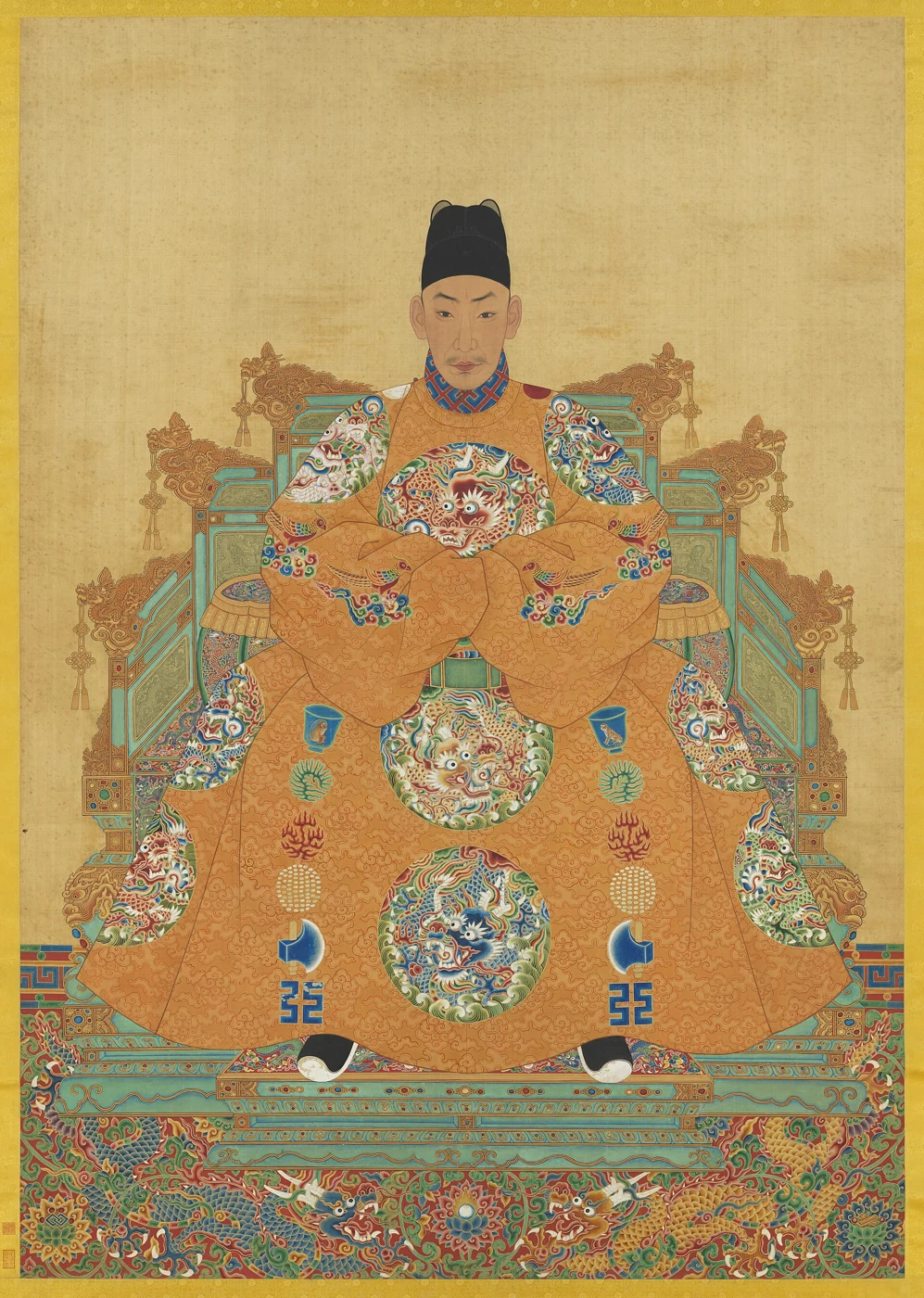
1491 CE–1521 CE
Emperor of the Ming dynasty
Zhu Houzhao
朱厚照
Zhu Houzhao (26 October 1491–20 April 1521), Emperor Wuzong of Ming, was the tenth emperor of the Ming dynasty and the eldest legitimate son of Emperor Xiaozong Zhu Youcheng and Empress Zhang. His era name was Zhengde, and the Chinese source states here that he “reigned in 1505.” Naturally intelligent and fond of riding and archery, Zhu Houzhao favored eunuchs after ascending the throne, established the Leopard Quarter,…
1491 CE–1521 CEMing Dynasty
PROFILE
Zhu Houzhao (26 October 1491–20 April 1521), Emperor Wuzong of Ming, was the tenth emperor of the Ming dynasty and the eldest legitimate son of Emperor Xiaozong Zhu Youcheng and Empress Zhang. His era name was Zhengde, and the Chinese source states here that he “reigned in 1505.” Naturally intelligent and fond of riding and archery, Zhu Houzhao favored eunuchs after ascending the throne, established the Leopard Quarter, assumed the self-created title “Commander-in-Chief and Mighty General for the Supervision of Military Affairs,” and personally went to Yingzhou, where Ming forces repelled the Mongol forces of Dayan Khan. His reign was marked by eunuch domination and repeated popular rebellions, but also by military victories under his personal direction and by foreign cultural contacts. His full posthumous title was Chengtian Dadao Yingsu Ruizhe Zhaode Xiangong Hongwen Sixiao Yi Emperor, and his temple name was Wuzong.
- Alternative names
- Zhengde Emperor; Zhu Houzhao, Emperor Wuzong of Ming
- Sobriquet
- Jintanglaoren
- Period
- Ming Dynasty
- Date of Birth
- October 26 1491
- Date of Death
- April 20 1521
- Dynasty/Polity
- Ming Dynasty
- Identity
- Emperor of the Ming dynasty
- Ethnicity/Ethnic affiliation
- Not recorded in historical sources
- Native place
- Not recorded in historical sources
- Place of birth
- Imperial palace
- Place of death
- Not recorded in historical sources
- Reign
- 1505–1521
- Predecessor
- Emperor Xiaozong of Ming (Zhu Youtang)
- Successor
- Emperor Shizong of Ming (Zhu Houcong)
- Era name
- Zhengde
- Temple name
- Wuzong
- Posthumous title
- Chengtian Dadao Yingsu Ruizhe Zhaode Xiangong Hongwen Sixiao Yi Emperor
- Highest office
- See Biography and Major Deeds
- Major achievements
- Famous for pleasure-seeking excursions; established the Leopard Quarter, toured the northern frontier, and styled himself Duke Who Pacifies the State; Liu Jin dominated politics during his reign
LIFE TIMELINE
Age 1 | Given the personal name Houzhao and invested as crown prince the following day
Age 8 | Began formal lectures outside the palace apartments under Cheng Minzheng, Liang Chu, Jiao Fang, Wang Ao, Yang Tinghe, and other instructors
Age 15 | The gravely ill Emperor Xiaozong entrusted the crown prince to Liu Jian, Li Dongyang, and Xie Qian
Age 15 | Ascended the throne in Fengtian Hall and announced the Zhengde era
Age 16 | Officials demanded the execution of the “Eight Tigers”; Zhu Houzhao ultimately retained Liu Jin and the others, while Liu Jian and Xie Qian retired
Age 17 | Built the Leopard Quarter offices on the southwest shore of Taiye Lake, moved there, and called it his “new residence”
Age 18 | The anonymous document incident at Fengtian Gate enabled Liu Jin to purge opponents; Liu was promoted to chief eunuch of the Directorate of Ceremonial
Age 20 | Zhu Zhifan, Prince of Anhua, rebelled under the slogan of eliminating Liu Jin; the revolt was quickly suppressed
Age 20 | Zhang Yong denounced Liu Jin for treason; Zhu Houzhao personally inspected Liu's residence and ordered his execution by slow slicing
Ages 21–22 | The Liu Six and Liu Seven uprising erupted around the capital; frontier troops were brought in to suppress it
Age 22 | Jiang Bin gained imperial favor through military service and proposed rotating frontier and capital troops
Age 24 | Qianqing Palace burned; Zhu Houzhao continued his recreations
Ages 27–29 | Made four excursions and, under the name “Zhu Shou,” styled himself Commander-in-Chief and Mighty General for the Supervision of Military Affairs
Age 27 | Personally went to the Yingzhou front and directed Ming forces against Dayan Khan's Mongols
Age 29 | Zhu Chenhao, Prince of Ning, rebelled at Nanchang; Wang Shouren rapidly suppressed the revolt
Age 29 | Traveled south under the pretext of personally campaigning against the Prince of Ning, burdening local communities along the route and eventually staying in Nanjing
Age 30 | Traveled and amused himself around Zhenjiang; in the ninth lunar month, while returning north, fell into the water while fishing at Qingjiangpu
Age 31 | Died in the Leopard Quarter; posthumously called Emperor Yi and given the temple name Wuzong
BIOGRAPHY
Biography
Family Background and Early Life
Zhu Houzhao was born on 26 October 1491, the eldest legitimate son of Emperor Xiaozong Zhu Youcheng and Empress Zhang. His birth was associated with an auspicious interpretation of his cyclical birth characters, which were said to form a consecutive sequence when read in reverse. His only full brother, Zhu Houwei, died young, leaving Zhu Houzhao as Emperor Xiaozong's only son to reach adulthood.
On 3 April 1492, Emperor Xiaozong gave him the name Houzhao, drawing on passages from the Book of Documents and the Commentary on the Images of the Book of Changes. He was invested as crown prince the next day.
In 1498 he began formal palace lectures under a group of twenty instructors, including Cheng Minzheng, Liang Chu, Jiao Fang, Wang Ao, Yang Tinghe, Fei Hong, and Jin Gui. The source describes him as having an excellent memory: he could reportedly recite the previous day's lesson without looking at the text and remembered the names of all his instructors. Emperor Xiaozong was very fond of him and took him on excursions, but Zhu Houzhao's formal studies progressed slowly because he preferred riding, archery, and hunting. By the time of his accession he had studied only part of the Analects and the Book of Documents.
Accession as Crown Prince
On 7 June 1505, the dying Emperor Xiaozong summoned Liu Jian, Li Dongyang, and Xie Qian to his inner apartments and entrusted the crown prince to them. He praised Zhu Houzhao as intelligent and martial but expressed concern about his love of pleasure. The following day he summoned Zhu Houzhao and instructed him to observe ancestral institutions, honor the senior palace women, pursue learning and virtue, employ worthy men, and avoid idleness. Xiaozong died later that day.
After the customary rounds of formal urging by officials and senior subjects, Zhu Houzhao ascended the throne on the eighteenth day of the fifth lunar month in Fengtian Hall and announced that the next era would be called Zhengde, a name drawn from the Book of Documents.
Early Reign and Conflict with Officials
At first Zhu Houzhao appeared diligent, often attending court before dawn and continuing daily lectures and classical discussions. Before long, however, he became less regular and sometimes did not emerge from his quarters until the si hour. Chen Hongmo's Jishi Jiwen states that eight eunuchs led by Liu Jin, later called the “Eight Tigers,” encouraged him in daily games and amusements, caused court audiences to begin increasingly late, and accompanied him on visits to palace workshops and offices. He sometimes rode alone out through the palace gates with bow and arrows to shoot birds, and at other times had mock market stalls set up for amusement.
The beginning of the reign was marked by a series of disasters and portentous phenomena. From the sixth through the eighth lunar months of 1505, floods in the capital region inundated crops. In 1506 a comet passed across the Inner Steps and the enclosure of Taiwei; Nanjing was struck by violent winds and thunder that damaged the imperial-city walls; a meteor fell in the capital and a phenomenon described as the “heavenly drum” sounded by itself; and lightning struck ridge ornaments at the suburban altars, the Imperial Ancestral Temple, Fengtian Hall, and other sites. Officials interpreted these events as warnings from Heaven and repeatedly remonstrated against Zhu Houzhao's absorption in riding and archery, military exercises within the palace, excessive amusement, incognito excursions, and delayed audiences. He briefly put away his hunting birds and dogs and suspended riding and archery, but his resentment of bureaucratic restraint increased and he relied more heavily on Liu Jin and other eunuchs. Liu Jin also arranged plays depicting grand secretaries of the Hongzhi era as manipulating court power, further worsening the emperor's view of senior civil officials.
Zhu Houzhao also clashed with officials over concrete administrative matters. Early in 1506, relatives of his maternal uncles Zhang Heling and Zhang Yanling accused commoners of encroaching on imperial estates. The emperor sided with the Zhang household and ordered the Embroidered Uniform Guard to arrest more than two hundred commoners. Officials collectively opposed the action and urged abolition of the estates. Zhu Houzhao refused to abolish them but limited each estate to one eunuch and a little over ten guards. In the ninth lunar month, Minister of Revenue Han Wen approved only half of the 12,000 Changlu salt certificates requested by the emperor's eunuch Cui Gao. Zhu Houzhao angrily told the grand secretaries that wrongdoing was not committed only by eunuchs: among ten men, he said, perhaps only three or four were good while six or seven did wrong, and the senior officials themselves knew this. He nevertheless ultimately compromised.
Dominance of the Eight Tigers and the Death of Liu Jin
In October 1506, Minister of Revenue Han Wen, with a memorial drafted by Li Mengyang, requested the execution of the Eight Tigers. Zhu Houzhao was deeply disturbed, cried, lost his appetite, and sent senior eunuchs including Chen Kuan and Li Rong to the Grand Secretariat in an effort to spare them. Liu Jian and others refused. Minister of Personnel Jiao Fang leaked the plan to the eunuchs, who appealed directly to the emperor and encouraged him to resist the officials. The following day Liu Jian, Li Dongyang, Xie Qian, the Nine Ministers, and remonstrating officials petitioned at the palace gate, but an imperial order pardoned Liu Jin and the others. Liu Jian and Xie Qian resigned; Li Dongyang remained because his position toward the Eight Tigers had been relatively moderate. Wang Yue and Fan Heng, eunuchs who had supported the civil officials, were exiled to Nanjing and were forced by Liu Jin's agents to hang themselves on the journey. Liu Jin was promoted to a senior writing post in the Directorate of Ceremonial and began to dominate court affairs.
In August 1507 Zhu Houzhao built the Leopard Quarter complex on the southwest bank of Taiye Lake and moved there, calling it his “new residence”; according to the source, he thereafter did not again live in the Forbidden City. On 26 June 1508, after the morning audience, a censor on duty found an anonymous document on the imperial way praising Li Rong, the seal-holding eunuch of the Directorate of Ceremonial, while criticizing Liu Jin. Liu detained more than three hundred officials of the fifth rank and below at Fengtian Gate in the blazing sun while investigating the affair, and three died from exhaustion. Zhu Houzhao ordered the officials sent to the Embroidered Uniform Guard prison, then released them the next day, dismissed Li Rong, and promoted Liu Jin to seal-holding eunuch of the Directorate of Ceremonial.
During Liu Jin's ascendancy, important memorials effectively required his red-ink approval before implementation, producing a practice in which memorials were first submitted to him as so-called “red copies” before passing through the Office of Transmission. Liu accumulated enormous wealth, imposed military-supply exactions on frontier officials, sent agents to Fujian and Sichuan to extort money, and even organized illegal sales of salt certificates beyond authorized quotas. A contemporary saying, “fifty taels, one python robe,” mocked the belief that a bribe of fifty taels to Liu could secure an imperially bestowed python robe.
In April 1510, Zhu Zhifan, Prince of Anhua, rebelled in Ningxia under the slogan of “clearing the emperor's side and executing Liu Jin.” Zhu Houzhao appointed Yang Yiqing to command military affairs and the eunuch Zhang Yong as army supervisor. The revolt lasted only a little over ten days before being suppressed. Yang persuaded Zhang Yong to turn against Liu. After returning to the capital, Zhang and his allies accused Liu Jin of treason and of planning to kill the emperor and install his own grandnephew. Zhu Houzhao initially doubted the accusation, but during the search of Liu's residence he found armor and crossbows beyond permitted limits, enormous stores of gold, silver, jade, and valuables, as well as prohibited objects including a dragon robe and jade belt. Liu Jin was then sentenced to death by slow slicing.
Military Favorites, Frontier Threats, and Popular Revolts
After Liu Jin's death, Zhu Houzhao increasingly favored his adopted son Qian Ning and the frontier officer Jiang Bin. Qian Ning, an officer of the Embroidered Uniform Guard, supplied musicians and performers for the Leopard Quarter and introduced Tibetan Buddhist clerics skilled in esoteric rituals. Jiang Bin won favor after fighting despite receiving three arrow wounds and proposed rotating strong frontier troops into the capital while sending capital forces to the frontier.
In 1511–1512, the Liu Six and Liu Seven uprising spread around the capital region and approached Bazhou. Frontier troops from Xuanfu, Datong, and Liaodong were summoned, and the main rebel force was not subdued until the summer of 1512. Other revolts also appeared in Sichuan, Jiangxi, Henan, and Shandong; the Chinese source links these disorders to land concentration and the deterioration of the hereditary military system.
From 1517 to early 1519, Zhu Houzhao made four excursions despite official opposition. Using the name Zhu Shou, he granted himself the title Commander-in-Chief and Mighty General for the Supervision of Military Affairs. In October 1517 he personally went to the Yingzhou front and directed Ming troops against the forces of Dayan Khan. According to the Veritable Records of Emperor Wuzong, fifty-two Ming soldiers were killed and the Mongols also suffered substantial losses. The source states that Mongol forces refrained from deep incursions for several years afterward.
Rebellion of the Prince of Ning and the Southern Tour
In June 1519 Zhu Chenhao, Prince of Ning, rebelled at Nanchang. Wang Shouren, then a regional official in Jiangxi, rapidly assembled troops and suppressed the rebellion in a little over forty days. Zhu Houzhao nevertheless traveled south under the pretext of conducting a personal campaign against the prince. He left Beijing in August and eventually stayed in Nanjing. In the intercalary eighth lunar month of 1520 he traveled around Zhenjiang and other places. While returning north in the ninth lunar month, he fell into the water while fishing at Qingjiangpu. His health deteriorated thereafter.
On 20 April 1521, Zhu Houzhao died in the Leopard Quarter at the age of thirty-one.
The Working of Liu Jin's Dictatorship
After becoming chief of the Directorate of Ceremonial, Liu Jin's power swelled; he took all memorials home, handing them to his niece's husband Sun Cong and to Zhang Wenmian, a dismissed licentiate of Songjiang who had attached himself to him, consulting neither the officials nor, for the most part, the Grand Secretariat. He also arranged entertainments for Zhu Houzhao and, when the emperor's spirits rose, brought in memorials from the ministries for decision; the emperor, impatient, would say "what did I employ you for? Must such trifles trouble me too? Be off", and after several times Liu Jin stopped asking altogether and handled everything himself. Thus the people said that the Great Ming had two emperors, one surnamed Zhu and one surnamed Liu, one seated and one standing. Liu Jin also gathered diviners such as Yu Ming, Yu Lun and Yu Ziren, who read faces and prognosticated that his nephew Liu Erhan would rise greatly; and he befriended the Shaanxi commander Cao Xiong, adding the seal of General Who Tranquillises the West and giving his son a niece in marriage, granting Cao whatever he asked, so that none could fathom his designs. On the twenty-sixth day of the sixth month of 1508, after the morning audience, an anonymous document appeared on the imperial way praising Li Rong and attacking Liu Jin; he held over three hundred officials of the fifth rank and below at the Fengtian Gate to kneel in the blazing sun while the author was sought, many fainting from heat and several, including the bureau secretary He Qian, dying, while the presented scholar Lu Shen, carried into the prison of the Embroidered Uniform Guard, died there that night. The city seethed and the markets closed, and cooks competed to bring free food to the kneeling officials, while the eunuch Li Rong, supervising, pitied them and sent ice and melons. Afterwards Liu Jin still dismissed Li Rong and the others on the ground that "you call men worthy and I will not use them; you call them unworthy and I will". Only in 1510, when Zhu Zhifan, Prince of Anhua, rose under the banner of "clearing the sovereign's side and killing Liu Jin", did the emperor send Yang Yiqing to command and the eunuch Zhang Yong to supervise; the revolt was put down in little more than ten days, and Yang Yiqing turned Zhang Yong against Liu Jin. Returning in triumph on the thirteenth day of the eighth month, Zhang Yong memorialised at night that Liu Jin plotted rebellion and drew from his sleeve an accusation of seventeen crimes; the emperor, furious that "Liu Jin has betrayed me", had him arrested, and though he had no wish to kill him, the search of Liu Jin's house found millions in gold and silver, treasures, illegally kept armour and crossbows, and a folding fan concealing two daggers, whereupon he was sentenced to death by slow slicing.
Fangs of Power: The Leopard Quarters and the Favourites
Under Hongzhi the Grand Secretariat had flourished; on the throne Zhu Houzhao raised the eunuch "Eight Tigers" to suppress it and created his own "Leopard Quarters politics". From 1507 he lived in the Leopard Quarters, using it as his centre of command, relying on three groups: eunuchs, frontier commanders and mere favourites, represented by Liu Jin, Jiang Bin and Qian Ning. The eunuchs grasped power, controlling the capital garrison and the Eastern and Western Depots; the frontier commanders were overbearing, holding troops, urging him to travel and governing from outside while accompanying him; the favourites were greedy, holding posts as hot as the Embroidered Uniform Guard and using them to seize wealth, so that officials and people alike bribed Qian Ning's household. In time Qian Ning, squeezed by the other two groups, plotted with Zhu Chenhao and on arrest had his property confiscated beyond counting. The Leopard Quarters was in effect a second court, its decisions representing the emperor's highest will and surpassing the outer court; on tours, campaigns against the Tatars or journeys south, the Grand Secretariat knew nothing beforehand, learning of decisions only after they were taken. When he travelled for months or years he had important memorials of the Secretariat and Six Ministries sent by fast courier to his camp for the Leopard Quarters circle to decide, and though this delayed business he insisted, both to escape the outer court's interference and to keep it from acting on its own. Yet he was not diligent in government, so many memorials were hidden by favourites and eunuchs: after Emperor Shizong came to the throne more than forty memorials were found in Qian Ning's house, a hundred and thirty-six border reports suppressed by Jiang Bin, and several hundred unforwarded by the Directorate of Ceremonial.
Frontier Troubles and the Battle of Yingzhou
The Zhengde years saw frequent risings, some thirty in all, as the accumulated problems of land concentration and displaced populations combined with Liu Jin's misrule; they were worst in Sichuan, the northern metropolitan region and Jiangxi. In the north, in the earlier years Dayan Khan was busy unifying the Tatars, and though he raided repeatedly the incursions were small; from 1513, with the unification complete, they grew far more serious and the Ming struggled to respond. In 1517 the fifty thousand horse of Dayan Khan entered through Yulin on the twenty-fifth day of the ninth month, meeting the resistance of Wang Xun, the grand commandant of Datong, at the Wulizhai stockade north of Yingzhou on the third day of the tenth month; the next day Zhu Houzhao, hurrying from Yanghe to Yingzhou, joined the battle. After two days' fighting the Tatars, finding no advantage, withdrew beyond the frontier on the fifth; the emperor pursued as far as Pinglu and Shuozhou when a violent wind and black fog came up and he was forced to call off the pursuit, returning in triumph in the first month of the next year. The engagement yielded, it is recorded, sixteen enemy heads and cost several hundred Ming dead and wounded, with the imperial carriage nearly endangered, yet thereafter, though the Tatars raided yearly, they rarely penetrated far. In the fifth month of that year Dayan Khan again sent out nine columns that plundered the Shifosi and Anbian stockades for seven days, killing or seizing more than three thousand soldiers and civilians and carrying off countless livestock, leaving "smoke and fire wiped out for hundreds of li, a calamity unmatched in decades".
The Southern Tour, the Fall into Water and His Death
On the twenty-fifth day of the second month of 1519 Zhu Houzhao granted himself the title of grand preceptor and ordered "Zhu Shou" to convey incense and silk through the two metropolitan regions and Shandong to pray for the people; when news of a southern tour spread there was an outcry, and the chief grand secretary Yang Tinghe and others remonstrated. His favourite Qian Ning, already in league with Zhu Chenhao, informed the prince, who rose on the fourteenth day of the sixth month, claiming a secret decree from the empress dowager and killing the Jiangxi grand coordinator who would not join him. Wang Shouren quickly gathered troops and put the revolt down in little more than forty days. Zhang Zhong, Xu Tai and others, however, claimed that Wang Shouren had once sided with Zhu Chenhao, changed sides only when the prince seemed doomed and embezzled the prince's treasure, so the emperor doubted him, refused his offer to present the captives in person and sent Zhang Yong to Hangzhou to receive Zhu Chenhao; later, when Zhu Chenhao was brought to Nanjing, the emperor did not release him on Lake Poyang but had a great banner set up in a square, the prince placed within it and his fetters struck off, and himself in martial dress amid the assembled troops "seized him to the sound of drums and gongs". In the intercalary eighth month of 1520 he toured Zhenjiang and elsewhere, and in the ninth month, returning north, fell into the water while fishing at Qingjiangpu, after which his health declined steadily. On the fourteenth day of the third month of 1521 he died in the Leopard Quarters, leaving word to the eunuchs Chen Jing and Su Jin that "my illness is past cure; summon the officers of the Directorate of Ceremonial and convey my wishes to the empress dowager; the realm's affairs are weighty and should be deliberated with the grand secretaries. My former errors were mine alone, not any of yours".
Religion, Languages and Anecdotes
Zhu Houzhao could put on monk's robes himself and chant and perform rites with Tibetan monks, personally shaved palace women entering the nunhood and preached to them, built temples at great cost and favoured Tibetan monks such as Xingji Bandan and Lingzhan Zhu. According to Tibetan sources the eighth Karmapa, Mi jue Dorje, was said to know the three times, and on hearing it the emperor sent the eunuch Liu Yun in the eleventh month of 1515 with a gold seal, robes and quantities of gold, tea and salt to U-Tsang, ordering him to bring the lama to the capital within ten years; despite general opposition the mission went, but Mi jue Dorje hid himself, and Liu Yun, resorting to force, provoked bloodshed in which two officers and several hundred soldiers of his escort were killed and half wounded; he fled on a fast horse to Chengdu and misreported the failure, by which time the emperor was dead. He also appears on Zhengde export porcelain as "the Great Ming emperor, King Suleiman", with the Arabic name Shaji Aolan. As to anecdotes, in 1519 he issued a ban on pigs because "pig" sounded like the imperial surname Zhu, ordering pig-keepers to sell or slaughter them on pain of permanent exile to the frontier guards, relenting only when the Court of Sacrifices petitioned, so that pigs might be used in sacrifices; and on his southern tour, when the imperial barge was struck by a boat, he asked who it was, and on learning it was the Shandong administration commissioner Yao Mo, laughed and said "is it the one with the fine beard?", letting it pass. He also wrote poems for Yang Yiqing, one of which declares that "the fame of Zhengde is already spread abroad; in southern campaigns and northern expeditions he takes the lead".
The Eight Tigers and the Officials' Struggle
In the tenth month of 1506 the minister of revenue Han Wen, with a memorial drafted for him by Li Mengyang, asked that the Eight Tigers be beheaded. According to Li Mengyang, Han Wen wept before his subordinates after each audience, and Li told him that "you are a great minister, bound to share the realm's fortunes; tears are useless", advising that since the three elders Liu Jian, Li Dongyang and Xie Qian held the censors' memorial firmly, a desperate joint stand by all the great ministers might succeed. Han Wen then stroked his beard, squared his shoulders, changed countenance and said "good; even if it fails, I am old enough to die — better death than failing to repay the state"; the next morning he secretly questioned the three elders, who agreed, all the ministers eagerly joined, and Li Mengyang drafted the memorial. Reading it, Zhu Houzhao wept and could not eat, three times sending eunuchs of the Directorate of Ceremonial to the Grand Secretariat to beg mercy for the Eight Tigers, but Liu Jian and the others would not withdraw the memorial; at the Zuoshun Gate the eunuch Li Rong held the ministers' memorial and said that "all you gentlemen say is right and springs from loyalty and care for the sovereign, only we have long served him and cannot bear to see the law applied at once; be so good as to relax a little and let the sovereign settle it himself", at which the ministers, shaken, dared not answer and withdrew. When Wang Ao asked Li Rong, "and if the sovereign does not settle it?", Li replied, "do you think my neck is cased in iron, that I should ruin the state's affairs?" That night Liu Jin was summoned into the Directorate of Ceremonial, Wang Yue and Fan Heng were arrested and ordered to Nanjing, and later killed on the road — one account says they were ordered to take their own lives while Xu Zhi was beaten and his arm broken; the eight took key posts, Liu Jin the directorate, Ma Yongcheng and Qiu Ju the Eastern Depot and Gu Dayong the Western. The affair also involved the minister of personnel Jiao Fang, who betrayed the ministers' plan, or, by one account, Li Rong. Liu Jian and Xie Qian were forced to retire, while Li Dongyang, being more moderate, remained.
Court Pleasures and Anecdotes
After moving into the Leopard Quarters Zhu Houzhao left the Qianqing Palace and other halls as storehouses for gunpowder; on the night of the sixteenth day of the first month of 1514 the Qianqing Palace caught fire and burned all night, and he watched the flames skyward from the Leopard Quarters, joking to those about him that "that is a fine display of fireworks". On the second day of the seventh month of 1518, pleading troubles on the frontiers of Liaodong, Xuanfu, Datong, Yansui, Shaanxi, Ningxia and Gansu, he decreed that "Zhu Shou, commander-in-chief and generalissimo supervising military affairs, lead the six armies on campaign" — Zhu Shou being the name he gave himself; three days later another edict reached the Ministry of War, praising Zhu Shou for "leading the six armies in person to destroy the bandits" and granting him the titles of generalissimo and duke with stipend, and though the ministers remonstrated he could not be stopped from going. He sought women among the people and of other peoples: the deputy commander of the Embroidered Uniform Guard, Yu Yong, a Muslim, who had won favour for his skill in secret sexual arts, told him that "Muslim women are fair and glossy, far above those of China", claimed imperial authority to take twelve Muslim dancers from the household of his colleague Lü Zuo into the Leopard Quarters and advised demanding the daughters of Muslim noble houses, to their anger; when the emperor, hearing that Yu Yong's own daughter was a beauty, demanded her, Yu Yong passed off the daughter of his neighbour Bai Huizi as his own and pleaded illness to avoid exposure. He also seized other men's wives: Ma Ang, to recover military command, conspired with the eunuch Zhang Zhong and offered his sister, already married to the commander Bi Chun, through Jiang Bin's advocacy sending the eunuch Xu Quan and Ma Ang's brothers to force their way into Bi Chun's house and carry her off to the Leopard Quarters; in the ninth month, coming in disguise to Ma Ang's house and being refused his concubine, he angrily stripped Ma Ang of his post and dropped his sister. Another, Wang Mantang of Bazhou, who had failed the palace selection as a girl and refused to marry, dreamed that one Zhao Wanxing would marry her and rise greatly; a Daoist named Duan Chang learned of the dream, passed himself off as Zhao, and married her, and when Duan Chang later stirred the people, took the imperial title and a reign name, he and his party were executed and Wang Mantang was brought to the capital and deported.
The Veritable Records on His Early Rule
The Veritable Records of the Ming says that Zhu Houzhao was "by nature intelligent, brave and resolute, diligent in learning while heir apparent", and that after his accession he still sat in the warm chamber of the Wenhua Hall, twice a day reading and discussing the Documents, Analects, the Extended Meaning of the Great Learning and the Digest of the Comprehensive Mirror, lighting candles when the audience ended before dawn and never tiring; that on calamity he was alarmed and had the civil and military ministers examine themselves, and on flood or drought in any quarter at once ordered relief and remission. It records too that he "gave particular attention to military matters, often riding and practising archery", that when rebels rose in Henan, Shandong, Sichuan and Jiangxi he appointed generals and forgot his meals, and that his northern journey to Xuanfu and Datong, western tour to the passes and Shaanxi, and southern journey to the Huai and the Yangtze were all meant to repair neglected defences, while he entrusted the capital to the Grand Secretariat and the ministries without suspicion. It notes likewise that his last words "hinted at the repentance of the Luntai decree" and commended the weighty affairs of the realm to the empress dowager and the Grand Secretariat. These records come from the court's own annals and are inclined to excuse him, and must be read together with contemporary remonstrances and later criticism.
Major Activities
Establishment of the Leopard Quarter
In August 1507 Zhu Houzhao constructed the Leopard Quarter on the southwest shore of Taiye Lake west of the Forbidden City and moved there permanently. The complex housed favored eunuchs, military men, musicians, Tibetan Buddhist clergy, male favorites, and women. Traditional interpretations treated it primarily as a center of personal pleasure, while the Chinese source notes that some modern scholars regard it as an alternative political headquarters from which Zhu Houzhao tried to curb the civil bureaucracy and control access to the throne. Favorites such as Qian Ning and the performer Zang Xian could influence appointments and political decisions through their control of imperial access.
Battle of Yingzhou
In October 1517, Dayan Khan led Mongol forces south. Zhu Houzhao, using the name Zhu Shou and his self-created military title, went to the Yingzhou front and personally supervised the fighting. The Veritable Records of Emperor Wuzong record fifty-two Ming deaths and substantial Mongol losses. The Chinese source describes the engagement as limited in scale but notable as a rare mid-Ming campaign directly commanded by the emperor.
Four Excursions
Between 1517 and early 1519, Zhu Houzhao made four excursions against ministerial opposition, traveling to Xuanfu, Datong, Miyun, Xifengkou, and other places. During these trips he styled himself Commander-in-Chief and Mighty General for the Supervision of Military Affairs and Duke Who Pacifies the State and ordered local officials to obey the commands issued in the name of “Zhu Shou.” The journeys imposed heavy burdens on local communities but also gave him direct exposure to frontier defense.
Cultural Contacts
Zhu Houzhao showed a strong interest in Tibetan, Mongol, Arab, and Portuguese cultures and was said to know several languages. He assumed the title “Great Celebrating Dharma King,” studied Tibetan Buddhist rituals, encountered Islamic and Catholic traditions, and met the Portuguese envoy Tomé Pires. He also promoted innovations in court music and was skilled in composing melodies.
Household Estates and Finance
Before Zhengde the imperial household's estates around the capital had been occasional: Yingzong set up one, Xianzong another, and Xiaozong added only three. Zhu Houzhao within a month of his accession set up seven, and by 1513 had thirty-three in all, covering 37,595 qing and 46 mu, one seventh of the official and private land of the eight metropolitan prefectures, their eunuch and guard stewards commonly abusing the people. In the Zhengde years he created another household enterprise, the imperial shops: those of the Mingyu and Jiqing wards within Beijing, six more in the Rongzhengfu street, and others at the nine gates of the capital. In 1509, moreover, he ordered the manuscript of the Collected Statutes of the Great Ming to be collated and printed with a preface of his own, promulgating it in 1511.
Exchanging Capital and Frontier Troops
The founding regulations forbade sending capital troops to the frontier and frontier troops to the capital, lest "weak frontier troops bring trouble from the barbarians and weak capital troops trouble from the frontier". Zhu Houzhao broke this rule, since the capital army could not even defeat the roving bands of Liu Six and Liu Seven, and he therefore relied on frontier troops. In the eleventh month of 1512 he directed that capital and Xuanfu troops be exchanged for training and garrison duty; Li Dongyang refused to draft the decree as contrary to the regulations, so the emperor bypassed the Grand Secretariat and brought in six thousand five hundred men from Xuanfu, Yansui, Datong and Liaodong, setting up Eastern and Western Offices in the Leopard Quarters under the eunuch Zhang Zhong and the frontier general Xu Tai. Besides these four garrisons' troops there were the palace guards, including the Embroidered Uniform Guard, some ten thousand in all, and the eunuchs' drilling corps of one or two thousand; these three forces were the emperor's own and the strength behind Leopard Quarters politics.
Foreign Trade and Relations
Zhu Houzhao took a relatively open attitude to overseas trade, approving a twenty per cent duty, later briefly thirty, so that the Ming began to levy customs, which both increased revenue and stimulated private trade; the sea ban in practice relaxed, so that any who paid could trade freely with China, until "foreign ships never ceased in the harbours and barbarian traders thronged the cities", and Chinese merchants sailed abroad on a larger scale, though some officials condemned the measure as contrary to the founding rules. In the twelfth month of 1520 he agreed to refuse tribute envoys arriving outside the prescribed periods while still taxing those within them. In the northwest, Turfan in 1513 forced the Ming-appointed loyal and obedient king of Hami; the Gansu commander Peng Ze negotiated through interpreters with Mansur, obtaining the return of Hami and its seal in exchange for increased "rewards", but the next year Mansur, thinking the rewards small, attacked again and besieged Suzhou, while the Hami agent Xieyihuxian, sent to the capital, bribed Qian Ning with jewels and women, was freed, brought into the Leopard Quarters and given the surname Zhu. The minister of war urged conciliation, while Yang Tinghe and the grand secretaries insisted on restoring Hami and closing the frontier to tribute, nor was the matter settled until Jiajing's reign, when Xieyihuxian was executed and the policy of pacification and tribute taken up. By sea, the Portuguese embassy, since Portugal was not among the tribute states listed in the Collected Statutes, was told to obtain prior approval, but through the eunuch garrison commander attached itself to Jiang Bin, and the emperor exceptionally allowed it to audience at Nanjing and thence to the capital; in 1520 the king of Malacca sent urgently for help on learning of the Portuguese attack, but the emperor refused troops on the ground of the Tatar crisis, and only after his death were the Portuguese envoys and the Portuguese at Tuen Mun expelled.
Adopted Sons, Favourites and Tastes
Zhu Houzhao loved to adopt sons and give them the surname Zhu; by the ninth month of 1512 he had a hundred and twenty-seven, headed by Zhu De, the Earl of Yongshou, Zhu Ning, the military governor, and Zhu An, with several dozen more military officers, and he continued to take them in, among them Zhu Bin, that is Jiang Bin. He delighted in roaming among the people: on his northern tours he "rode out each night, and on seeing a great house would gallop in, whether to demand drink or to seize its women", while his attendants gathered respectable women for his bed, sometimes in dozens of carriages, with deaths daily. His favourite was Liu Liangnü, whom he summoned from the female musicians demanded of the Prince of Jin; thereafter she stood at his side, and whoever offended him was forgiven if she pleaded, so that Jiang Bin and others called her their adoptive mother; once, having lost his token, he went by night in person to Zhangjiawan to fetch her. His favourites also procured boys for him: Yang Zhi, a singing boy in Yang Yiqing's household, was given the name "Jade of Sheep's Fat" for his pale skin and taken north with him, and a singer at Xuanfu called "White Head" was castrated because the eunuchs guessed at the meaning of his jest about whether "what is white above is white below". He was also often drunk, since the eunuchs, to idle while he slept, carried flasks and plied him again on waking. He understood music, composing the "Music of Quelling the Frontier", played on sheng, flute and drum with a loud, brisk sound, which became a fixed item of the Nanjing court entertainment office and by the late Ming had become the "Ten Brocades" popular in Wu.
The Complications over Presenting the Captives
After the prince of Ning rose in 1519, Zhang Zhong and Xu Tai memorialised at Nanjing in the emperor's presence that Wang Shouren had rebelled; when asked for proof they proposed summoning Wang to Nanjing, and Wang, on receiving the order, hurried there only to be stopped by them and sent back. Earlier, when Wang would have presented the captives, Zhang Zhong and the others had tried to have him recalled, even proposing to release Zhu Chenhao on Lake Poyang so that the emperor might fight him in person and then report a victory, and pursuing Wang's party as far as Guangxin; Wang refused, passed Yushan and Caoping post by night, and found Zhang Yong waiting at Hangzhou, where he set before him the misery of Jiangxi's people, long poisoned by the prince's revolt and then struck by disorder, drought and the levies for the capital and frontier armies, so that desperation might drive them into rebellion; Zhang Yong agreed, took charge of Zhu Chenhao and Wang Shouren retired on grounds of illness to the Jingci Monastery on West Lake. The episode shows how victory in the suppression was bound up with court intrigue at the end of the Zhengde reign.
Personal Relations
- Emperor Xiaozong Zhu Youcheng (father)
- Empress Zhang (mother)
- Zhu Houwei (younger brother, died young)
- Empress Xia (empress)
- Liu Jian (senior minister entrusted with the succession; later retired)
- Li Dongyang (senior minister entrusted with the succession; remained in the Grand Secretariat)
- Xie Qian (senior minister entrusted with the succession; later retired)
- Yang Tinghe (instructor and later Senior Grand Secretary)
- Jiao Fang (instructor who later aligned himself with Liu Jin)
- Liu Jin (chief eunuch of the Directorate of Ceremonial; later executed by slow slicing)
- Zhang Yong (one of the Eight Tigers who later denounced Liu Jin)
- Qian Ning (officer of the Embroidered Uniform Guard and adopted son)
- Jiang Bin (frontier commander and imperial favorite)
- Wang Shouren (suppressed the rebellion of the Prince of Ning)
- Yang Yiqing (helped suppress the Prince of Anhua's rebellion)
- Liu Jian and Xie Qian (forced into retirement after demanding the execution of the Eight Tigers)
- Han Wen (Minister of Revenue who petitioned against the Eight Tigers and was later dismissed)
- Zhu Zhifan (Prince of Anhua; rebelled and was suppressed)
- Zhu Chenhao (Prince of Ning; rebelled and was suppressed)
Historical Assessment
Ming and Contemporary Assessments
- The Veritable Records of Emperor Wuzong described him as intelligent and martial but devoted to pleasure, criticizing his governance while also recording his military ability.
- Yang Tinghe characterized him as naturally talented and vigorous but unwilling to submit to restraint.
- Korean envoys recorded that the emperor rarely appeared and that Liu Jin exercised imperial business, reflecting contemporary perceptions of eunuch domination.
Early and Mid-Qing Period
- Gu Yingtai's Mingshi Jishi Benmo blamed the emperor's pleasure-seeking for allowing eunuchs to seize power and for repeated political disorder.
- Wan Sitong's draft history of the Ming acknowledged Wuzong's interest in military affairs while criticizing the consequences of that interest.
- The History of Ming treated the reign as a further stage in the weakening of Ming state power after the Zhengtong era.
Late Qing and Republican Periods
- Meng Sen's Ming Qing Shi Jiangyi interpreted Wuzong's extravagant behavior partly as a form of personal self-assertion under Ming autocracy.
- Liang Qichao used the reign as an example of intensified conflict between eunuch power and the civil bureaucracy.
- Xiao Gongquan discussed the political disorder of the reign as an example of problems inherent in Ming autocratic institutions.
Modern Assessments
- Fang Zhiyuan's study of Emperor Wuzong argues that the Leopard Quarter should also be understood as a political center used to check the civil bureaucracy rather than simply as a pleasure palace.
- Shang Chuan emphasizes Zhu Houzhao's personal military activity at Yingzhou and his involvement in suppressing rebellions, while also noting his foreign cultural interests.
- Li Xun's work on Ming fiscal history links the deepening fiscal crisis of the Zhengde era to both imperial expenditure and Liu Jin's extraction of wealth.
FIGURES ASSOCIATED WITH THIS DYNASTY
Bibliography
- History of Ming, Basic Annals of Emperor Wuzong
- Veritable Records of Emperor Wuzong of Ming