Birth | Born in Ji County, Tianshui Commandery.
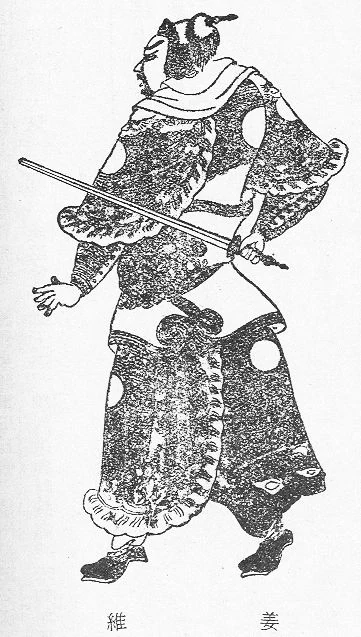
202 CE–264 CE
General
Jiang Wei
姜维
Jiang Wei (202–March 3, 264), courtesy name Boyue, was a native of Ji County in Tianshui Commandery, Liang Province, present-day Gangu County, Tianshui, Gansu. He was a famous Shu Han general of the Three Kingdoms period who rose to General-in-Chief. Originally an officer of Cao Wei in Tianshui Commandery, he surrendered to Shu Han in 228, Jianxing 6, during Zhuge Liang's first expedition through Mount Qi and was highly…
202 CE–264 CECao Wei
PROFILE
Jiang Wei (202–March 3, 264), courtesy name Boyue, was a native of Ji County in Tianshui Commandery, Liang Province, present-day Gangu County, Tianshui, Gansu. He was a famous Shu Han general of the Three Kingdoms period who rose to General-in-Chief. Originally an officer of Cao Wei in Tianshui Commandery, he surrendered to Shu Han in 228, Jianxing 6, during Zhuge Liang's first expedition through Mount Qi and was highly valued by Zhuge Liang. After Zhuge Liang's death, Jiang Wei successively served under Jiang Wan and Fei Yi. Following Fei Yi's assassination, he gained effective control of Shu Han's military and led eleven campaigns against Cao Wei, repeatedly confronting Wei commanders including Deng Ai, Chen Tai, and Guo Huai. After the fall of Shu Han, Jiang Wei feigned submission to Zhong Hui and attempted to exploit Zhong Hui's rebellion to restore Shu Han. The plan failed and Jiang Wei was killed at the age of sixty-two.
- Other name
- Jiang Boyue
- Courtesy name
- Boyue
- Period
- Shu Han
- Date of Birth
- 202 CE(7th year of the Donghanjianan era)
- Date of Death
- March 3, 264 CE(1st year of the Caoweixianxi era)
- Dynasty / polity
- Shu Han
- Identity
- General
- Ethnicity / group
- Han Chinese
- Native place
- Ji County, Tianshui Commandery, Liang Province (present-day Gangu County, Tianshui, Gansu)
- Place of birth
- Not recorded in historical sources
- Major achievements
- General-in-Chief of late Shu Han; carried on Zhuge Liang's ambition through nine campaigns into the Central Plains; after Shu's fall, attempted but failed to restore the state.
LIFE TIMELINE
Age eleven | His father Jiang Jiong died in battle; Jiang Wei received an official appointment as zhonglang and participated in local military affairs.
Age twenty-seven | Surrendered to Zhuge Liang; appointed granary clerk and created Marquis of Dangyang Village.
Age twenty-nine | Promoted to Protector of the Army and General Who Conquers the West.
Age thirty-three | Zhuge Liang died; Jiang Wei returned to Chengdu, became Right Army Supervisor and General Who Assists Han, and was created Marquis of Pingxiang.
Age thirty-seven | Stationed at Hanzhong with General-in-Chief Jiang Wan and later became military aide to the Grand Marshal.
Age forty-two | Promoted to Senior General Who Guards the West and concurrently Inspector of Liang Province.
Age forty-six | Promoted to General of the Guards and jointly recorded affairs of the Masters of Writing with Fei Yi; suppressed unrest among the Pingkang Yi of Wenshan.
Age forty-eight | Received authority as Bearer of Credentials and campaigned at Xiping, returning without success.
Age fifty-two | After Fei Yi was assassinated, Jiang Wei began to dominate military affairs and campaigned toward Shiying and Nan'an.
Age fifty-three | Given command over internal and external military affairs; campaigned in Longxi and killed the Wei general Xu Zhi.
Age fifty-four | Defeated Wang Jing heavily west of the Tao River and advanced to besiege Didao.
November 11, 255 CE(18th year of the Yanxi era, Shu Han, 9th month, 25th day) | Age fifty-five | Appointed General-in-Chief; suffered a major defeat at Duangu and demoted himself to General of the Rear.
Age fifty-seven | Restored as General-in-Chief and changed the defensive strategy for Hanzhong.
Age sixty-one | Defeated by Deng Ai at Houhe and withdrew to Tazhong.
Age sixty-two | Shu Han fell; Jiang Wei surrendered to Zhong Hui, then was killed after the failed rebellion.
Defeat at Houhe | He sent troops to Taoyang and was defeated by Deng Ai at Houhe; fearing exclusion by Huang Hao and Yan Yu, he withdrew to Tazhong to farm military colonies.
Defence of Jiange and surrender | Wei invaded Shu; Jiang Wei escaped Deng Ai's pursuit and withdrew with the other armies to Jiange, and after Liu Shan surrendered to Wei he was ordered to surrender to Zhong Hui.
Death | Zhong Hui's rising in Chengdu failed and Jiang Wei and Zhong Hui were killed by mutinous troops.
BIOGRAPHY
Biography
Family Background and Early Years
Jiang Wei was born in 202, Jian'an 7, in Ji County of Tianshui Commandery in Liang Province. The Jiang clan of Tianshui was a major local lineage and regarded as the foremost of the “four surnames of Tianshui.” His father Jiang Jiong served as an officer of merit in the commandery and died fighting to protect the administrator during a Qiang and Rong uprising. Jiang Wei therefore lost his father at a young age and grew up with his widowed mother. He favored the classical learning of Zheng Xuan, possessed high ambitions, secretly cultivated relations with local brave men, maintained personal retainers willing to die for him, and disdained ordinary civilian labor. Because of his father's service, Jiang Wei received the office of zhonglang and participated in commandery military affairs. He later served as a clerk responsible for annual accounts and was recruited as an assistant in the provincial administration.
Defection to Shu and the Zhuge Liang Period
In 228, Jianxing 6, Shu Han Chancellor Zhuge Liang advanced through Mount Qi. At the time, Jiang Wei was traveling on inspection with Tianshui Administrator Ma Zun, together with Officer of Merit Liang Xu, Registrar Yin Shang, Recording Secretary Liang Qian, and others. Hearing that the Shu army was approaching and that several counties were responding, Ma Zun suspected Jiang Wei and the others of disloyalty and fled overnight to Shanggui. Jiang Wei and his companions could not catch him. When they returned to Ji County, its gates were also shut against them, and they therefore had no choice but to surrender to Zhuge Liang. Zhuge Liang greatly appreciated Jiang Wei, appointed him a granary clerk, gave him a general's title, and created him Marquis of Dangyang Village at the age of twenty-seven. In a letter to Chief Clerk Zhang Yi and Army Adviser Jiang Wan, Zhuge Liang praised Jiang Wei as “diligent in the affairs of the time and meticulous in his deliberations,” judged him superior to figures such as Li Shao and Ma Liang, and called him “Liang Zhou Shang Shi.” He also ordered him to be trained in command of five or six thousand elite central infantry, saying that he “Xin Cun Han Shi,Cai JianYuRen.” Jiang Wei thereafter accompanied Zhuge Liang on several Northern Expeditions and repeatedly won merit. In 234, Jianxing 12, Zhuge Liang died at Wuzhang Plains and instructed that Jiang Wei follow Wei Yan in the rearguard. Wei Yan refused Yang Yi's orders and withdrew first; Jiang Wei advised Yang Yi to reverse the banners and beat the drums, causing Sima Yi to refrain from pursuing. After returning to Chengdu, Jiang Wei was appointed Right Army Supervisor and General Who Assists Han, commanding various units, and was advanced to Marquis of Pingxiang.
Under Jiang Wan and Fei Yi
In 238, Yanxi 1, Jiang Wei accompanied General-in-Chief Jiang Wan to Hanzhong. After Jiang Wan became Grand Marshal, he appointed Jiang Wei his military aide and repeatedly sent him with detached forces westward into Qiang territory. In 240, Jiang Wei campaigned in Longxi and fought Wei general Guo Huai, withdrawing when Guo Huai advanced. In 243, after adopting Jiang Wei's proposal, Jiang Wan memorialized that Jiang Wei should be Inspector of Liang Province and that he himself would support him with the main army. The court approved; Jiang Wei was promoted to Senior General Who Guards the West and concurrently Inspector of Liang Province. In 247 he became General of the Guards and jointly recorded affairs of the Masters of Writing with General-in-Chief Fei Yi. That year, unrest broke out among the Pingkang Yi of Wenshan; Jiang Wei led troops to suppress it. He then campaigned in Longxi, Nan'an, and Jincheng, fought Wei generals Guo Huai and Xiahou Ba west of the Tao River, accepted the surrender of Qiang and other group leaders including Zhi Wudai, and moved their people into Shu territory. Jiang Wei continued Zhuge Liang's policy of conciliating non-Han groups and promoted peaceful relations. In 249 he received authority as Bearer of Credentials, campaigned at Xiping, failed to take it, and returned. Thereafter Jiang Wei repeatedly sought large northern campaigns, but Fei Yi restricted him to fewer than ten thousand troops, preventing major operations.
Control of the Army and the Northern Expeditions
In 253, Fei Yi was assassinated and Jiang Wei began to dominate Shu Han military affairs. In 254, he was given command over internal and external military operations. Taking advantage of turmoil in Wei, he advanced into Longxi; Li Jian, magistrate of Didao, surrendered the city, and Jiang Wei occupied it. In the tenth lunar month he besieged Xiangwu, killed the Wei general Xu Zhi, and pressed the advantage to capture Heqian, Lintao, and other counties. In 255, after the death of Wei General-in-Chief Sima Shi, Jiang Wei launched another campaign with Senior General Who Conquers the West Zhang Yi, General-in-Chief of Chariots and Cavalry Xiahou Ba, and tens of thousands of troops. West of the Tao River, they heavily defeated Wang Jing, Inspector of Yong Province; tens of thousands of Wei soldiers were killed and the survivors withdrew to Didao. Jiang Wei continued the siege, but Wei generals Chen Tai and Deng Ai came to relieve the city and Jiang Wei withdrew to Zhongti. In 256, Jiang Wei became General-in-Chief and arranged to join Senior General Who Guards the West Hu Ji, but Hu Ji failed to arrive as scheduled. Jiang Wei was defeated by Deng Ai at Duangu, his troops scattered, and casualties were heavy. He requested demotion to General of the Rear while continuing to exercise the authority of General-in-Chief. In 258 he was restored as General-in-Chief.
The same year, Jiang Wei changed Hanzhong's defensive strategy by withdrawing troops from a number of forward fortified positions and concentrating defense at key passes, clearing nearby resources and intending to draw the enemy deep into the region before encircling and destroying them. The approach was later shown to carry serious risks. In 262 he campaigned toward Taoyang but was defeated by Deng Ai at Houhe, suffering heavy losses. Jiang Wei resented the eunuch Huang Hao's monopoly of influence and memorialized that Huang Hao should be executed; Liu Shan refused. Huang Hao then sought revenge and tried to replace Jiang Wei with Yan Yu. Fearing for his position, Jiang Wei withdrew to Tazhong under the pretext of establishing military farms.
Fall of Shu Han and Death in a Failed Restoration Plot
In 263, Wei general Zhong Hui trained troops in Guanzhong. Jiang Wei memorialized Liu Shan, recommending that Zhang Yi and Liao Hua be sent to defend Yang'an Pass and the bridgehead at Yinping as a precaution. Huang Hao trusted the words of spirit mediums and Liu Shan did not act. That year Sima Zhao launched a three-pronged invasion of Shu. Zhong Hui led more than one hundred thousand troops against Hanzhong; Deng Ai led thirty thousand troops from Longyou to pin down Jiang Wei; Zhuge Xu led another thirty thousand to the Yinping bridgehead to block Jiang Wei's return. Jiang Wei withdrew south, deceived Zhuge Xu, and retreated to defend Jiange, where he faced Zhong Hui. Zhong Hui could not break the defenses and considered withdrawing, but Deng Ai instead led a surprise force over the mountain route from Yinping and advanced directly toward Chengdu. Zhuge Liang's son Zhuge Zhan died fighting at Mianzhu, and Liu Shan surrendered to Deng Ai, bringing Shu Han to an end. When Jiang Wei and the other generals received the news, they abandoned Jiange and moved toward Chengdu. At Qi County they received Liu Shan's order to surrender and submitted to Zhong Hui.
Zhong Hui treated Jiang Wei generously, “when riding out they shared a carriage, when seated they shared a mat,” and remarked that compared with famous men of the central lands, even Zhuge Dan and Xiahou Xuan were inferior to Jiang Wei. Jiang Wei discovered Zhong Hui's ambition to rebel and believed he could use it to restore Shu Han, so he encouraged Zhong Hui to rise against Sima Zhao. In the first lunar month of 264, the first year of Xianxi, Zhong Hui rebelled at Chengdu. Jiang Wei secretly wrote to Liu Shan: “Let Your Majesty bear a few days’ shame; I mean to make the altars of state, though endangered, secure again, and the sun and moon, though darkened, shine once more.” The rebellion failed. Zhong Hui was killed and Jiang Wei also died amid the mutiny at the age of sixty-two.
Jiang Wei, styled Boyue, was a native of Ji county in Tianshui. Losing his father in boyhood he lived with his mother and studied the learning of the Zheng school. He served as an accounting assistant in the commandery and was called to office by the province. His father Jiong, a commandery officer, had died in battle guarding his commander against a Qiang rebellion, and for that service Jiang Wei was given the rank of palace gentleman and a post in the military affairs of his commandery. In 228, when Zhuge Liang's army moved towards Mount Qi, the governor of Tianshui was away on tour with Jiang Wei, the officer Liang Xu, the registrar Yin Shang and others. Learning that the Shu army was at hand and that the counties were responding to it, the governor suspected them of disaffection and fled by night to Shanggui. Jiang Wei and his companions, finding him gone, followed too late; the gates were shut against them, as were those of Ji, and they were forced to present themselves to Zhuge Liang. Ma Su having been defeated at Jieting, Zhuge Liang withdrew with a thousand households of Xi county and with Jiang Wei, so that he was separated from his mother. Pei Songzhi's commentary from the Weilue records it otherwise: that Ma Zun, after Guo Huai's words, went east to Shanggui, and when Jiang Wei urged him to return to Ji he answered that they could no longer be trusted and were all rebels, whereupon Jiang Wei went back to Ji and the officials and people, delighted, sent him to Zhuge Liang, who was greatly pleased. The Wei armies took Ji and captured his mother and wife and children, but because he had not meant to go, they did not confiscate his household but held them as a lure. Zhuge Liang made him an officer of the granary, gave him the rank of general of righteous service and enfeoffed him as Marquis of Dangyang at the age of twenty-seven. Writing to Zhang Yi and Jiang Wan, Zhuge Liang said that Jiang Wei was diligent and precise, that Yongnan and Jichang were not his equals, and that he was the finest man of Liangzhou; that he should first train five or six thousand of the central guard troops, being quick in military matters, bold and righteous and deeply understanding the art of war, and that his heart was with the Han and his talent above other men, so that when his training was done he should be presented to the sovereign. He was afterwards made inspecting general of the centre and general of the western expedition. At Zhuge Liang's last campaign against the Wei, when Sima Yi repeatedly petitioned for battle and the court sent Xin Pi with the staff to restrain him, Jiang Wei told Zhuge Liang that with Xin Pi's arrival the enemy would not come out; Zhuge Liang answered that Sima Yi had no wish to fight and only petitioned to display his valour to his troops. In the autumn Zhuge Liang, gravely ill, secretly arranged with Yang Yi, Fei Yi and Jiang Wei the withdrawal after his death, with Wei Yan to hold the rear and Jiang Wei next. When the army withdrew, Jiang Wei had Yang Yi reverse the banners and beat the drums as if to attack Sima Yi, who drew back and dared not press, so that Yang Yi formed his ranks and went on, and only in the valley was mourning declared; and the people made the saying that "the dead Zhuge Liang put the living Zhongda to flight." When the grand commander Jiang Wan judged that Zhuge Liang's repeated probes into the Qin valleys had failed through the difficulty of the roads and supplies and proposed to go downstream by the Han and Mian against Weixing and Shangyong, the court sent Fei Yi and Jiang Wei to dissuade him. Jiang Wan memorialised that Liangzhou was the key to the barbarian frontier and that the Qiang and Hu thirsted for the Han, proposing that Jiang Wei be made inspector of Liangzhou, and that if he marched out he, Jiang Wan, would follow with the army; and he was accordingly moved back to Fu. In 243 Jiang Wei took the office of the grand commander's aide and went west into the Qiang country. In 247 he was made general of the guard and shared the secretariat with Fei Yi; that year he put down a rebellion of the Yi of Pingkang in Wenshan, and marching into the borders of Longxi, Nanan and Jincheng, fought Guo Huai and Xiahou Ba west of the Tao, where the Hu king Zhiwudai and others brought their tribes to surrender. In 249 he was given the staff and marched again to Xiping, returning without success. Knowing the western customs and confident of his own ability, he wished to draw in the Qiang and Hu as his wings and thought the country west of Long could be cut off and held; but whenever he wished to raise a great army, Fei Yi restrained him and gave him no more than ten thousand men. When he built two cities by Mount Qu with Ju An and Li Xin to hold them, the Wei general Guo Huai and the provincial inspector Chen Tai discussed how to meet him: Chen Tai judged that the cities, though strong, lay far from Shu and must be supplied by transport, and that the Qiang and Yi, wearied by Jiang Wei's levies, would not adhere to him, so that to besiege them would take the cities without bloodshed; Guo Huai followed his plan and sent him with Xu Zhi and Deng Ai to cut the supply road and the water outside the walls. Jiang Wei came to the relief by way of Mount Niutou, and Chen Tai, holding that the art of war valued subduing the enemy without fighting, ordered his troops to hold their walls and not engage, sending word to Guo Huai to cross the White Water and move east so as to cut Jiang Wei's road of return; Guo Huai approved and moved to the Tao. Jiang Wei, afraid, fled, and Ju An and his fellows, isolated, surrendered. In 249, when Deng Ai and Guo Huai opposed Jiang Wei and he withdrew, Guo Huai went west against the Qiang, and Deng Ai, saying that the enemy had not gone far and might return, was left to camp north of the White Water. Three days later Jiang Wei sent Liao Hua to form camp south of the river facing him, and Deng Ai told his officers that Jiang Wei had come back suddenly and that, his own force being small, he must be using Liao Hua to pin him while he himself struck east at the city of Tao, sixty li from the camp; he marched his troops by night to the city, and when Jiang Wei came to cross he found Deng Ai already there and was unable to prevail. After Fei Yi was assassinated, Jiang Wei held the whole military power of Shu. The Wei court had posthumously enfeoffed Guo Xiu, who had stabbed Fei Yi, as Marquis of Changle; Jiang Wei then besieged Xiangwu, met Xu Zhi and cut him down, the Wei troops retreating, and pursuing his advantage he took Heguan, Didao and Lintao and brought the people of the three counties back to Shu, settling them at Mianzhu and Fan. Returning to Chengdu he proposed another campaign, and Zhang Yi argued at court that the country was small and should not be wearied with war, but Jiang Wei would not listen. In 255 Jiang Wei with the general of chariots and cavalry Xiahou Ba marched out to Didao and broke the Wei inspector Wang Jing west of the Tao, several tens of thousands of his men being killed, so that he fell back on Didao, which Jiang Wei besieged; Chen Tai came to raise the siege and Jiang Wei withdrew to Zhongti. Zhang Yi had told him that he might stop and not press further lest he spoil a great achievement; Jiang Wei, in anger, said it was to draw legs on a snake, and besieged Wang Jing at Didao in vain, thereafter disliking Zhang Yi but always taking him along. In the spring of 256 he was made grand general, and arranging his troops afresh, agreed with Hu Ji to meet at Shanggui; Hu Ji failed to come, and Jiang Wei was broken by Deng Ai at Duangu, his army scattering with heavy losses, so that the people murmured and the country west of Long was unsettled; he acknowledged his fault and asked to be degraded, and was made general of the rear with the duties of grand general. In 257, when Zhuge Dan rebelled in Huainan and drew the Guanzhong troops east, Jiang Wei marched out through the Luo valley to Shenling to take advantage of the emptiness, and the garrisons at Changcheng, with much grain and few men, were alarmed; Sima Wang and Deng Ai both concentrated at Changcheng, and though Jiang Wei, encamped on Mount Mang by the hills, challenged repeatedly, they would not fight. In 258 he returned to Chengdu and was restored to the grand generalship. The eunuch Huang Hao and the director of the Secretariat Chen Zhi now worked together and began to meddle in government; Jiang Wei, though senior, was usually in the field, and his power was less than Chen Zhi's, so that the men of Shu all looked back longingly to Dong Yun. The wars being long and the people weary, Qiao Zhou wrote his essay on rival states. Jiang Wei also proposed a change in the defence of Hanzhong: instead of the old system of holding the outlying stockades, which he held could check the enemy but win no great victory, he would withdraw to the two cities of Han and Yue, store grain and strengthen the walls, let the enemy into the plain, and hold the passes, so that unable to take the passes and with no grain in the field and supplies brought from a thousand li, the enemy must wear himself out - the way to destroy him; and accordingly Hu Ji withdrew to Hanshou, Wang Han held Yue, Jiang Bin held Han, and stockades were set up at Xi'an, Jianwei, Wuwei, Shimen, Wucheng, Jianchang and Linyuan. In 262 he marched out to Han and Houhe, was broken by Deng Ai and withdrew to Tazhong. A stranger in the land where he had taken service, and with little to show for years of fighting, while Huang Hao and his like wielded power within and the general Yan Yu conspired with them to replace him, Jiang Wei feared for himself and would not return to Chengdu. He had earlier asked the sovereign to put Huang Hao to death, and the sovereign had answered that Huang Hao was a mere household servant and that he need not mind him; seeing how widely Huang Hao's branches had spread, Jiang Wei feared to say more and withdrew, and at the sovereign's order that Huang Hao should apologise to him he took the occasion to ask for Tazhong to grow wheat there and escape the pressure at court. In 263, hearing that Zhong Hui was massing troops in Guanzhong, he memorialised the sovereign that Zhang Yi and Liao Hua should be sent to guard Yang'an pass and the Yinping bridgehead against mischance; but Huang Hao, trusting to spirits, told the sovereign the enemy would not come, and the ministers did not know of it. When Zhong Hui moved towards the Luo valley and Deng Ai towards Tazhong, Liao Hua was at last sent to Tazhong and Zhang Yi and Dong Jue towards Yang'an pass. Reaching Yinping and hearing that Zhuge Xu was moving on Jianwei, they halted; and more than a month later Jiang Wei, broken by Deng Ai, fell back on Yinping. Zhong Hui besieged Han and Yue, sent a detachment against the pass, where Jiang Shu opened the city and surrendered and Fu Qian died fighting; unable to take Yue, Zhong Hui learned that the pass had fallen and drove straight on. Zhang Yi and Dong Jue had just reached Hanshou when Jiang Wei and Liao Hua abandoned Yinping, and joining forces they all fell back on Jiange to oppose Zhong Hui. Zhong Hui wrote to Jiang Wei of his civil and military virtue and world-surpassing strategy, and of their former common service to Wei; Jiang Wei made no reply, but arrayed his camps and held the defiles, and Zhong Hui, unable to break him and with his supply line long, spoke of withdrawing. Zhuge Xu's Yongzhou troops blocking the road at the bridgehead, Jiang Wei went north by the Konghan valley to get behind him, and Zhuge Xu, hearing of it, drew back thirty li; Jiang Wei, learning this, passed the bridgehead quickly, and Zhuge Xu, hurrying to intercept him, missed him by a day, so that Jiang Wei went east and held Jiange. Deng Ai then came in by the Jinggu road beside Yinping, broke Zhuge Zhan at Mianzhu, and the sovereign surrendered to him. Jiang Wei and his fellows, hearing of the defeat, and variously that the sovereign would hold Chengdu, go east to Wu or south to Jianning, marched by Guanghan and Qidao to learn the truth; then, at the sovereign's order, they threw down their arms and surrendered to Zhong Hui before Fu, the officers and men, in their fury, striking the rocks with their swords. Zhong Hui asked why he had come so late, and Jiang Wei, with grave face and tears, answered that to come today was very early. Zhong Hui prized him highly, restored his insignia and staff and kept him company, riding in the same carriage and sitting on the same mat, telling Du Yu that Jiang Wei, set beside the gentlemen of the central plain, would not be outdone by Xuande or Taichu. Zhong Hui having framed Deng Ai, who was sent back in a cage-cart, he brought Jiang Wei and the rest to Chengdu, proclaimed himself governor of Yizhou and rebelled, wishing to give Jiang Wei fifty thousand men as his vanguard. Jiang Wei, seeing his secret design, thought that disorder might be turned to the restoration of the Han, and spoke to him of Han Xin and the grandee Zhong, urging him to follow the example of Fan Li and withdraw to the mountains to preserve his merit and his life; Zhong Hui said the words were too lofty for him and that the present situation perhaps did not end there, and Jiang Wei answered that the rest was within his own wit, and so they became fast friends. Jiang Wei had Zhong Hui destroy the northern officers, meaning when they were dead to kill Zhong Hui, bury the Wei troops and restore the house of Han, and secretly wrote to the sovereign that he should bear a few days' shame, for he meant to make the altars of state, though endangered, secure again and the sun and moon, though darkened, shine once more. Zhong Hui reached Chengdu on the fifteenth day of the first month of 264, and the next day summoned all the guards, commandery governors, camp commanders and above, with the former officials of Shu, to mourn for the empress dowager in the Shu hall, forging a testament of the empress dowager bidding him rise and depose Sima Zhao, and shut them all in the offices of Yizhou, closing gates and surrounding them with troops. Qiu Jian, his provost, had once served Hu Lie, who deceived his attendants and wrote to his son that Qiu Jian had disclosed that a great pit had been dug and thousands of clubs prepared to kill the outside troops; the story passed from mouth to mouth all night. At noon on the eighteenth the soldiers of Hu Lie and his son beat the drums and went out, and without any summons the troops of every camp rushed shouting to the city. Zhong Hui, alarmed, asked Jiang Wei what was to be done if the soldiers meant mischief, and Jiang Wei answered that they had only to fight them. Leading Zhong Hui's attendants he killed five or six men with his own hand before the soldiers cut him down, and then turned on Zhong Hui and killed him at forty, several hundred officers and men dying. The Wei troops, enraged by his design, opened his body afterwards and found his gall bladder as large as a peck.
While Zhong Hui was besieging Han and Yue, he wrote to Jiang Bin, the officer holding Han, saying that Shu abounded in able men and that Jiang Bin and Zhuge Zhan were of his own kind, and that on coming west he wished to visit the grave of Jiang Bin's late father, sweep it and do it reverence, asking where it lay; Jiang Bin answered that his father had died of illness at Fu and been buried there as the divination directed, and that he was moved to grief by the courtesy of the request, and Zhong Hui, receiving the reply, admired its purport. The defence of Shu was also undone by the choice of officers: Jiang Shu, who held Yang'an pass, had been an inspector of Wuxing and was sent to assist Fu Qian at the pass precisely because he had done nothing of note in his post; when the Wei detachment attacked, he opened the city and surrendered and Fu Qian died fighting, so that with the pass lost Zhong Hui could drive straight on. The strength of Shu at its fall may be seen from the registers of the time. The Shu ji records Deng Ai's letter urging surrender, with its arguments on the decline of dynasties, and the examples of Wei Xiao and Gongsun Shu as overturned carts, and its maxim that to preserve a state whole is best and to break it second best; the sovereign then sent Zhang Jun and Ru Chao to serve under Deng Ai, Jiang Xian with orders to Jiang Wei, and Li Hu with the register of officials and people, which counted two hundred and eighty thousand households, nine hundred and forty thousand men and women, a hundred and two thousand armed soldiers and forty thousand officials, with more than four hundred thousand bushels of grain, two thousand catties each of gold and silver, and two hundred thousand bolts each of brocade, damask, coloured silk and plain silk. Of what followed his surrender the elders of Shu had much to say. Sun Sheng relates that in the early Yonghe years, serving under the general Anxi in the pacification of Shu, he met the old men and saw the secret memorial Jiang Wei sent to Liu Shan after his surrender, saying that he meant to serve Zhong Hui in seeming and kill him to restore the soil of Shu, and that the affair failing he perished, so that the men of Shu still grieve for him. Before that, when he withdrew to Jiange with Zhang Yi and Dong Jue, Zhong Hui could not break him and spoke of withdrawing for want of supplies; and learning that Zhuge Xu held the bridgehead, Jiang Wei went north by the Konghan valley to get behind him, so that Zhuge Xu drew back thirty li, and after going thirty li up the northern road Jiang Wei turned back and passed the bridgehead at leisure, Zhuge Xu unable to overtake him - a manoeuvre that turned wholly on his knowledge of the ground. Shrines to his memory also survive. In the Han Jiang Hou ci in the southern street of Lushan in Sichuan stands a hall to Jiang Wei, Marquis of Pingxiang, where in the Republican period the local people held their festivals, so that the building is also called the Jiang Qing tower. First built in the Northern Song, the present structure was rebuilt in 1445, the tenth year of Zhengtong of the Ming; a temple-style timber building on a low platform, square in plan, five bays wide and four deep, twenty-four metres high with a floor area of two hundred and two square metres, it has two storeys, a triple-eaved hip-and-gable roof, galleries about it and great bracket sets a quarter of the height of the columns.
Major Activities
Military Contributions
Jiang Wei was the most important military commander of late Shu Han. Continuing Zhuge Liang's ambitions, he launched eleven northern campaigns against Cao Wei. Although he achieved no decisive strategic victory, he repeatedly exerted pressure on Wei's western frontier. His victory west of the Tao River over Wang Jing, where tens of thousands of Wei troops were reportedly destroyed, was one of late Shu Han's few major battlefield successes. The defeats at Duangu and Houhe, however, exposed both Shu Han's exhausted resources and Jiang Wei's tendency toward overextension. Jiang Wei also made extensive use of Qiang and other non-Han groups, repeatedly inducing tribes to surrender and trying to open a strategic route through Longxi. His change to Hanzhong's defensive system was intended to lure an invading army inward for destruction, but the strategy later proved risky during Zhong Hui's invasion and contributed to Hanzhong's rapid loss.
Political Activity
Politically, Jiang Wei continued the broad course associated with Zhuge Liang, Jiang Wan, and Fei Yi. He maintained a policy of conciliation toward non-Han groups and sought peaceful relations on the frontier. In 247, he suppressed unrest among the Pingkang Yi of Wenshan, then campaigned in Longxi and accepted the surrender of Qiang and other groups, resettling them within Shu territory. After Fei Yi's assassination, Jiang Wei controlled the army, but many court officials opposed continued northern campaigns and the eunuch Huang Hao dominated palace politics. Jiang Wei's conflict with Huang Hao became intense. He asked Liu Shan to execute Huang Hao, but the emperor refused. Huang Hao then tried to replace Jiang Wei with Yan Yu, forcing Jiang Wei to withdraw to Tazhong for self-protection.
Travels and Campaign Areas
Jiang Wei's life took him across Longxi, Hanzhong, Chengdu, and neighboring regions. In youth he accompanied Zhuge Liang on northern campaigns and fought around Mount Qi and Wuzhang Plains. After Zhuge Liang's death, he accompanied Jiang Wan at Hanzhong and repeatedly led detached forces west into Qiang territory. As Inspector of Liang Province, he repeatedly campaigned in Longxi, Nan'an, Jincheng, the region west of the Tao River, Didao, and other places. Late in life he withdrew to Tazhong, later defended Jiange, and was ultimately killed in Chengdu. His military activity was concentrated mainly in present-day southern Gansu and southern Shaanxi.
Relations with Contemporaries
Jiang Wei's closest political relationship was with Zhuge Liang, who greatly valued him and called him an outstanding man of Liang Province. Jiang Wei also maintained generally good relations with Jiang Wan and Fei Yi. Jiang Wan memorialized in favor of appointing him Inspector of Liang Province; although Fei Yi restricted the troops available for his campaigns, the two jointly recorded affairs of the Masters of Writing and were able to cooperate. Jiang Wei served with generals including Zhang Yi and Liao Hua, although Zhang Yi opposed repeated Northern Expeditions and disagreed with him. Jiang Wei repeatedly fought Wei generals Deng Ai, Chen Tai, and Guo Huai. His relationship with Zhong Hui was complex: Zhong Hui treated him generously, but Jiang Wei ultimately tried to exploit Zhong Hui's ambition as a means to restore Shu Han.
Jiang Wei carried on Zhuge Liang's policy towards the frontier peoples, promoting peace and concord among the Qiang and Hu of the Longxi region, and after taking Heguan, Didao and Lintao he moved the people of the three counties into Shu at Mianzhu and Fan. In the Jingyao years he changed the defence of Hanzhong from the old system of holding the outlying stockades, proposing withdrawal to the two cities of Han and Yue with grain stored and walls strengthened, the enemy admitted to the plain and the passes held, with stockades set up at Xi'an, Jianwei, Wuwei, Shimen, Wucheng, Jianchang and Linyuan. He was esteemed in his own day for his conduct. Xi Zheng observed that holding the highest military office and standing first among the ministers, he kept a poor house and left no wealth, had no concubines in his side chambers and no music in his courts, took clothing only for use and carriage and horses only for service, and ate with moderation neither lavishly nor stintingly, spending his official allowances as they came; and that this was not austerity for the sake of shaming the covetous, but simply that he thought such sufficed and sought no more, adding that his tireless love of learning and his plain frugality made him the model of his time. When the posthumous title of Zhao Yun was debated in the Yanshi years, Jiang Wei and the other ministers memorialised that Zhao Yun had followed the late sovereign through many campaigns with conspicuous merit and had respected the state's regulations, asking that by the rules of posthumous naming he be entitled Shunping, and the sovereign agreed. Jiang Wei held the title of Marquis of Pingxiang and rose to be grand general. Many traces of him survive in his native place and in Shu: his tomb in Gangu county of Tianshui, on the Xuziping of Mount Jiangjun south of Jiangjiazhuang, five kilometres east of the county town, covering six thousand square metres, was declared a county-level protected site and centre of patriotic education in 1997; his bones were buried in Sichuan, but his fellow countrymen raised a cenotaph and a memorial hall on Mount Jiangjun with a stone inscribed "the native place of Jiang Wei," and sacrifice is offered there on the anniversary of his birth. The tomb on Longwei mountain in Lushan, Sichuan, listed in 2007 among the seventh batch of protected sites of the province, is said to be the resting place of his gall bladder, which his followers carried back from Chengdu at the risk of their lives, whence it is called the gall-bladder tomb; the mound is round, faced with stone, and before it stands a stele of 1835 inscribed to the Han grand general Marquis of Pingxiang. On the cliff above the Jiange pass a wooded plateau open on three sides and approachable by one narrow path, where tens of thousands of men might camp, is called by the local people the camp terrace or the city of Jiang Wei; later commanders holding Jiange camped there, and traces of walls and trenches remain. The plank road at Putou mountain is said to have been opened by Jiang Wei for his advance, and beside it stands a stele of 589 recording that the road was repaired by the provincial inspector Jiang Xiangda.
Personal Relations
- Jiang Jiong (father); Jiang Wei's mother; Jiang Wei's wife; Jiang Wei's son (name unknown).
- Zhuge Liang (mentor); Jiang Wan (superior); Fei Yi (colleague); Zhang Yi (colleague); Liao Hua (colleague); Xiahou Ba (colleague).
- Liu Shan (ruler); Huang Hao (political enemy).
- Deng Ai (enemy commander); Zhong Hui (person Jiang Wei sought to exploit); Sima Zhao (enemy power-holder).
Representative Works
- Ling YouJiZai Quan Wen Yuan Yin《Wei Jin Wen Xue Shi》Cheng Jiang Wei Zhu You《PuYuan Bie Zhuan》,BingTiJi《Quan San Guo Wen》JiLu《BaoMuShu》《JianYiTianDi》《YiShi Zhao Yun》《Biao Hou Zhu》《MiShu Tong Hou Zhu》Deng Pian Ming。Xian Cun Cai Liao Zhu YaoYiShi Shu Yin Wen、Hou Records of the Grand HistorianYiHuo Yan Jiu Zhu Zuo Wei ZaiTi,BuNengJuCiRen Ding Zhe Xie Zuo Pin Jun You Wan ZhengDuLiChuan Ben。
Anecdotes
The Miscellaneous Records of Sun Sheng records that after Jiang Wei was separated from his mother he received a letter from her urging him to seek "danggui" (angelica); Jiang Wei answered that "a hundred qing of good land do not depend on one mu; if one has far-reaching aims, one need not return home". "Danggui" and "yuanzhi" are both names of medicines and both serve as puns. The story is preserved in later histories as a transmitted record, and no exact year or month is inferred for the letters.
Historical Assessment
Shu Han / Contemporary
Zhuge Liang praised Jiang Wei: “diligent in the affairs of the time and meticulous in his deliberations,Judging by what he possessed, Yong and Ji Chang were no match for him. As for the man, he was a gentleman of Liangzhou.” (Records of the Three Kingdoms, “Biography of Jiang Wei”).
Zhong Hui said of Jiang Wei that compared with famous men of the central lands, even Gongxiu (Zhuge Dan) and Taichu (Xiahou Xuan) could not match him. (Records of the Three Kingdoms, annotation citing Shiyu).
After the defeat at Duangu, the people of Shu Han resented Jiang Wei's expeditions, and the region west of Mount Long was also disturbed and unsettled. (Records of the Three Kingdoms, “Biography of Jiang Wei”).
Jin and Tang
Chen Shou wrote: “Jiang Wei was rough in letters and arms, devoted to fame and office, yet he wore himself out with a hundred thousand troops and never judged the day aright, so that in the end he brought himself to ruin。” (Records of the Three Kingdoms, “Biography of Jiang Wei”).
Chang Qu's Huayang Guozhi described Jiang Wei as “a man of both talent and martial skill” but was critical of his repeated northern campaigns.
Tang historian Liu Zhiji mentioned Jiang Wei in Shitong and judged that his “his wisdom and courage were both exhausted.”
Song and Yuan
Sima Guang's Comprehensive Mirror in Aid of Governance recorded Jiang Wei's activities and affirmed his loyalty while judging the repeated campaigns costly to the people and state.
Zhu Xi, in Outline and Details of the Comprehensive Mirror, characterized Jiang Wei as having abundant loyalty but insufficient strategic judgment.
Yuan commentator Hu Sanxing, in his annotations to the Comprehensive Mirror in Aid of Governance, criticized Jiang Wei for exhausting the people of a small state in pursuit of war and regarded defeat as the natural result.
Ming and Qing
Ming thinker Li Zhi wrote in Cangshu: “Jiang Boyue was loyal and could be compared with Zhuge Liang, though his ability fell short of him.”
Qing historian Wang Mingsheng, in Discussions of the Seventeen Histories, regarded Jiang Wei as ambitious beyond his abilities but admired his loyalty to Shu Han.
Qing scholar Zhao Yi wrote in Notes on the Twenty-Two Histories: “Jiang Wei's northern expeditions were Zhuge Liang's northern expeditions; but Zhuge Liang could manage Shu and Jiang Wei could not, and this is the difference between talent and the lack of it.”
Modern
Lü Simian, in Informal Talks on Three Kingdoms History, regarded Jiang Wei as a loyal minister but argued that his strategy of repeated northern campaigns was excessively risky.
Fan Wenlan, in A Concise General History of China, described Jiang Wei as brave and resourceful but constrained by the weakness of the state.
Modern scholar Tian Yuqing, in Studies on Qin-Han and Wei-Jin History, analyzed the gains and losses of Jiang Wei's campaigns and argued that he inherited Zhuge Liang's ambitions but lacked Zhuge Liang's political skill.
FIGURES ASSOCIATED WITH THIS DYNASTY
Bibliography
- Chen Shou, Records of the Three Kingdoms, Book of Shu, Biographies of Jiang Wan, Fei Yi and Jiang Wei
- Chen Shou, Records of the Three Kingdoms, Book of Shu, Biographies of Liu, Peng, Liao, Li, Liu, Wei and Yang, (related)
- Chen Shou, Records of the Three Kingdoms, Book of Wei, Biographies of Wang, Guan, Qiu, Zhuge, Deng and Zhong, (related)