Birth | Born into the Guwalgiya clan of the Manchu Bordered Yellow Banner; third son of Uici
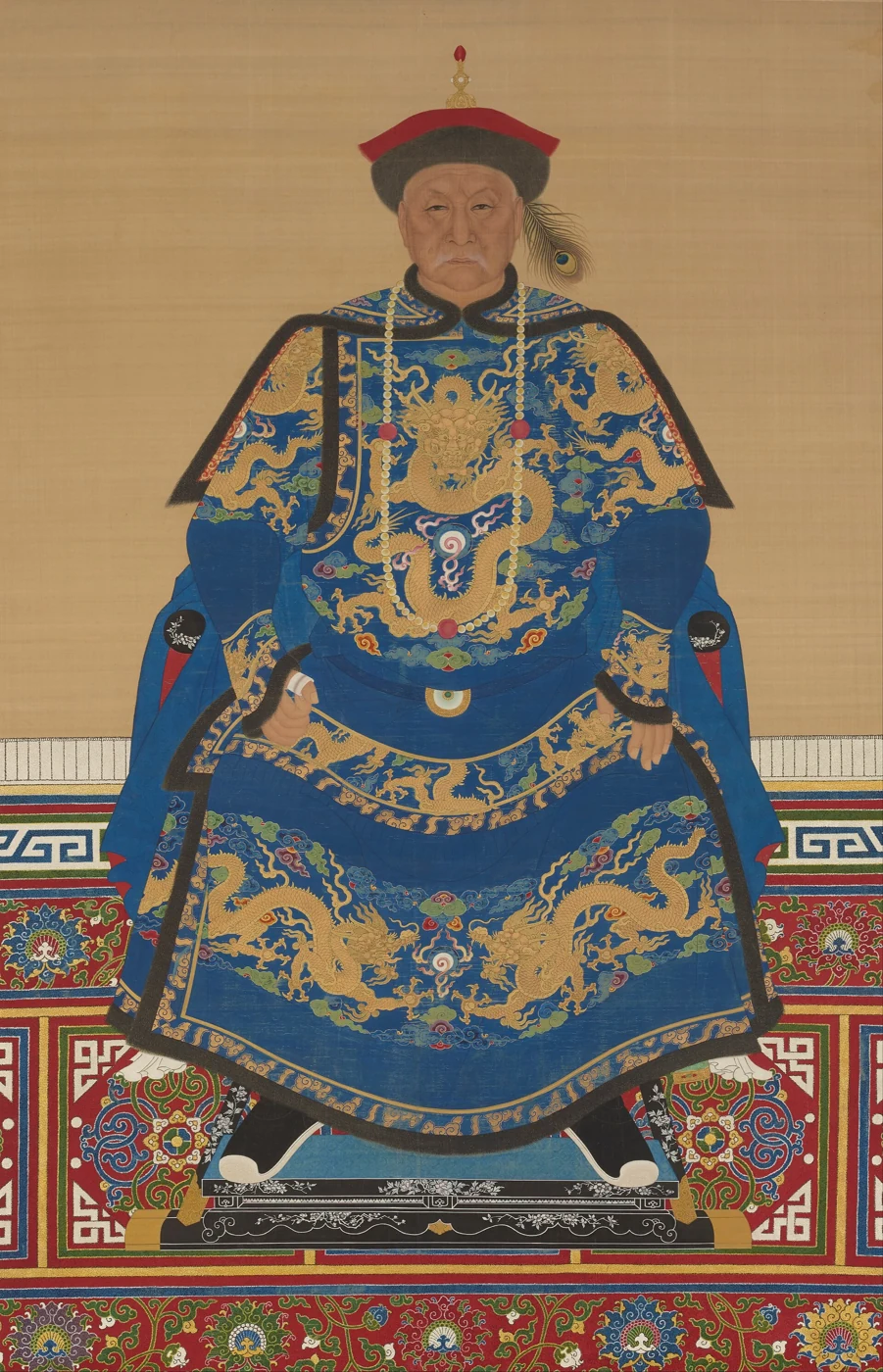
1610 CE–1669 CE
Senior official
Guwalgiya Oboi
瓜尔佳·鳌拜
Guwalgiya Oboi (c. 1610–1669), of the Guwalgiya clan and the Manchu Bordered Yellow Banner, was a veteran of the founding generation of the Qing and a regent. Born into a military family, he was a nephew of the Later Jin founding minister Guwalgiya Feiyingdong. He rose through military service and served through the Tianming, Tiancong, Chongde, Shunzhi, and Kangxi eras, advancing from guard officer to Chamberlain of the…
1610 CE–1669 CEQing Dynasty
PROFILE
Guwalgiya Oboi (c. 1610–1669), of the Guwalgiya clan and the Manchu Bordered Yellow Banner, was a veteran of the founding generation of the Qing and a regent. Born into a military family, he was a nephew of the Later Jin founding minister Guwalgiya Feiyingdong. He rose through military service and served through the Tianming, Tiancong, Chongde, Shunzhi, and Kangxi eras, advancing from guard officer to Chamberlain of the Imperial Bodyguard and member of the deliberative council. In 1661, the eighteenth year of Shunzhi, he was named one of the four regents by the late emperor's testament. During the early Kangxi reign he became increasingly domineering, built a faction, and excluded rivals. The young Kangxi Emperor eventually arranged his arrest. Oboi was stripped of office and confined, and died in detention. Late in the Kangxi reign he was posthumously restored to the rank of first-class baron. Under the Yongzheng Emperor his first-class dukedom was restored and he was granted the honorific Chaowu.
- Also known as
- Guwalgiya clan
- Period
- Qing
- Date of Birth
- Not recorded in historical sources
- Date of Death
- 1669
- Dynasty/State
- Qing
- Identity
- Senior official
- Ethnicity
- Manchus
- Banner affiliation
- Manchu Bordered Yellow Banner
- Native place
- Not recorded in historical sources
- Place of birth
- Not recorded in historical sources
- Place of death
- Not recorded in historical sources
- Highest office
- See “Life” and “Major Deeds”
- Major achievements
- One of the four regents at the beginning of the Kangxi reign; later exercised increasingly autocratic power and was arrested through a plan devised by the young Kangxi Emperor
LIFE TIMELINE
Granted the hereditary rank of Cavalry Commandant and | Granted the hereditary rank of Cavalry Commandant and, holding a company command, accompanied Hong Taiji on campaign against Chahar
Took Pidao | Took Pidao; for first merit promoted to third-class baron and granted the title Baturu
Accompanied Jirgalang in the siege of Jinzhou and defeated forces under Hong Chengchou fiv | Accompanied Jirgalang in the siege of Jinzhou and defeated forces under Hong Chengchou five times; promoted to first-class meiren i janggin
Promoted to commander of the imperial guards | Promoted to commander of the imperial guards, becoming a senior Eight Banners officer
After Hong Taiji's death | After Hong Taiji's death, swore with officials of the two Yellow Banners to support an imperial son and forced Dorgon to compromise in the succession dispute
Entered China proper with Ajige and pursued Li Zicheng's Dashun forces | Entered China proper with Ajige and pursued Li Zicheng's Dashun forces
Accompanied Hooge into Sichuan | Accompanied Hooge into Sichuan, where Zhang Xianzhong was killed; promoted for first merit to second-class duke
Accused in connection with the effort to enthrone Hooge and twice sentenced to death | Accused in connection with the effort to enthrone Hooge and twice sentenced to death; pardoned by imperial order
Persecuted for a third time under Dorgon | Persecuted for a third time under Dorgon; death sentence reduced to monetary punishment and demotion
After the Shunzhi Emperor assumed personal rule | After the Shunzhi Emperor assumed personal rule, appointed to the deliberative council, promoted to first-class marquis, and made Chamberlain of the Imperial Bodyguard
After the Shunzhi Emperor's death | After the Shunzhi Emperor's death, appointed by testament as one of the four regents
Caused the execution of Feiyanggu and his sons through an altered or falsely issued order | Caused the execution of Feiyanggu and his sons through an altered or falsely issued order; his arbitrary exercise of power grew increasingly serious
Forced an exchange of banner lands and caused the execution of Sunahai | Forced an exchange of banner lands and caused the execution of Sunahai, Zhu Changzuo, and Wang Denglian through an unauthorized order
After the Kangxi Emperor assumed personal rule | After the Kangxi Emperor assumed personal rule, Oboi accused Suksaha and had him executed
Arrested through a plan devised by the Kangxi Emperor | Arrested through a plan devised by the Kangxi Emperor; charged with thirty offenses, stripped of office and confined; died in detention
Posthumously rehabilitated and granted the rank of first-class baron | Posthumously rehabilitated and granted the rank of first-class baron
First-class dukedom restored as hereditary | First-class dukedom restored as hereditary; granted the honorific Chaowu
Qianlong Emperor ordered a reassessment of his merits and crimes | Qianlong Emperor ordered a reassessment of his merits and crimes; hereditary dukedom discontinued while the first-class barony remained hereditary
BIOGRAPHY
Biography
Family Background and Early Years
Oboi was born around 1610 into the Guwalgiya clan of the Manchu Bordered Yellow Banner. His family belonged to the prominent Suwan branch. His uncle Guwalgiya Feiyingdong had followed Nurhaci early and became a founding minister of Later Jin, later receiving the hereditary title First-Class Xinyong Duke. Oboi's elder brother Zhuobtai was also a noted early-Qing commander. Raised in a military family, Oboi practiced martial skills and mounted archery from childhood and entered military service as a young man. In 1634, the eighth year of Tiancong, he received a hereditary cavalry rank and, serving with a company command, accompanied Hong Taiji in the campaign against Chahar. He later also campaigned in Korea and gradually became one of Hong Taiji's notable commanders.
Pidao and the Battle of Song-Jin
In 1637, the second year of Chongde, Hong Taiji ordered Beizi Šoto together with Kong Youde, Geng Zhongming, Shang Kexi, and others to attack Pidao. The island, formerly a Ming base under Mao Wenlong, supported the Ningjin defensive system outside the Great Wall and was considered a serious strategic problem by Later Jin. When the first assault failed, Hong Taiji reassigned the operation to Ajige. Ajige and the commanders adopted a two-pronged plan: large vessels would feint from the sea while light craft carrying elite troops struck a weak point in the northwest. Oboi volunteered together with Zhunta, swearing that they would not return until the island was taken. Under Ming artillery and missile fire, Oboi pressed the assault and fought at close range. Qing forces gained the island. Hong Taiji regarded the capture as highly important and rewarded Oboi as a third-class baron with the title Baturu, meaning “brave warrior.”
In 1641 Oboi accompanied Prince Zheng Jirgalang in the siege of Jinzhou. Hong Chengchou, Ming supreme commander of Ji and Liao, brought a force described as 130,000 to relieve the city. During heavy fighting around Songshan, Jirgalang's right wing suffered setbacks and Ajige sent elite guard troops to reinforce it. Oboi led the Bordered Yellow Banner guard standard, defeated Ming cavalry encountered on the road, then pursued them to the infantry line, ordered his men to dismount, and defeated the enemy again. He was credited with five successive victories and promoted to first-class meiren i janggin. When Hong Chengchou's forces later attempted to break out in separate columns, Oboi joined Ajige, Nikan, and others in intercepting them near the coast. The Ming army was badly defeated. In the following year Oboi was promoted to commander of the imperial guards.
Campaigns After the Qing Entry into China Proper
In 1644, the first year of Shunzhi, Oboi's main assignment after the Qing entry into China proper was the pursuit of rebel armies. In the tenth month he accompanied Ajige, then General-in-Chief Who Pacifies Distant Regions, through northern Shaanxi against the Dashun forces of Li Zicheng, who had withdrawn to Xi'an. Qing forces captured four cities and accepted the submission of thirty-eight more before moving south. After Dodo broke through Tong Pass and pressed Xi'an, Li Zicheng abandoned the city and withdrew toward Hubei. Oboi and other commanders advanced by land and water and fought thirteen engagements around Dengzhou in Henan and Chengtian, De'an, and Wuchang in Hubei, badly damaging Dashun forces. In the sixth month of 1645 Li Zicheng was killed at Jiugong Mountain, according to the source, and the Dashun regime collapsed.
In the first month of 1646 Oboi accompanied Prince Su Hooge against Zhang Xianzhong's Daxi forces in Sichuan. Learning that Zhang had withdrawn toward Xichong, Oboi led the vanguard to intercept him. He charged at the front when the armies met; the Daxi force collapsed and Zhang Xianzhong was killed in the battle. The source states that the Qing destroyed more than 130 camps, killed tens of thousands, and seized more than 12,200 horses, mules, and other animals. Oboi was credited with first merit and received a major promotion.
Succession Crisis and Persecution under Dorgon
On the ninth day of the eighth month of 1643, Hong Taiji died and the Manchu elite entered a severe succession dispute. Hooge, Hong Taiji's eldest son, and Hong Taiji's brother Dorgon were rival candidates. The Plain and Bordered Yellow Banners controlled by Hong Taiji supported Hooge, while Dorgon's Plain and Bordered White Banners supported Dorgon. Oboi, as commander of the Bordered Yellow Banner guards and an officer with troops under his control, became a central figure. Together with Soni, Tantai, and other officials of the two Yellow Banners, he met at Hooge's residence, swore to share life and death, and planned to support Hooge, while troops were ordered to guard the approaches.
On the fourteenth day of the eighth month, Daišan convened a council at Chongzheng Hall to decide the succession. That morning Oboi and officials of the two Yellow Banners swore an oath at the Daqing Gate and placed armed guards around the hall, prepared if necessary for violence. As the meeting became deadlocked, Oboi and other commanders loyal to Hong Taiji stepped forward with hands on their swords and declared that they had eaten the late emperor's food and worn his clothing and would rather die and follow him underground than allow anyone other than one of his sons to inherit. Under this pressure Dorgon compromised and proposed enthroning Hong Taiji's six-year-old ninth son Fulin, with Dorgon and Jirgalang serving as regents. The compromise was accepted.
After becoming regent, Dorgon attacked political rivals, including Hooge and those who had supported him. Oboi, a firm supporter of Hooge who refused to attach himself to Dorgon, suffered repeated punishment. In one early case connected with Ajige's insulting reference to the young emperor, Oboi followed Tantai's advice and failed to transmit an order, lost credit for his military service against Li Zicheng, and was fined. Later, amid conflict between Tantai and Soni, Oboi was again punished for protecting Soni and nearly lost office. In 1648 Beizi Tunqi accused Jirgalang, Oboi, and others of having plotted to enthrone Hooge. Oboi was condemned to death but allowed to redeem the sentence with a fine. In the fourth month another guard, Kuobusu, accused him of having mobilized soldiers to guard the gates without authorization after Hong Taiji's death. He was again condemned to death and ordered dismissed to commoner status, but the dismissal was remitted. In 1650, during Dorgon's final illness, Oboi was again implicated in a dispute over imperial attendance, condemned to death, and eventually spared with a fine and demotion. Dorgon died later that year and the Shunzhi Emperor took personal power.
Favor under the Shunzhi Emperor
After assuming personal rule, the Shunzhi Emperor learned that Oboi, Soni, and others had once sworn to be loyal to their ruler through life and death and treated Oboi as a trusted senior official. Oboi served closely at court and participated in a range of government matters, including discussion of procedures for handling memorials, relations with the Khorchin Mongols, relations between the emperor and empress dowager, memorial rites for deceased princes and consorts, joint judicial reviews, and military examinations. He advocated large-scale reviews of troops and personally instructed successful military examinees in riding and archery. In 1656, when an old wound left Oboi bedridden, the Shunzhi Emperor personally visited his residence. In the winter of 1657, while Empress Dowager Xiaozhuang was seriously ill, Oboi attended within the palace day and night and was praised for his devotion.
Regency and Concentration of Power
On the eighth day of the first month of 1661, the Shunzhi Emperor died and designated his third son Xuanye, the future Kangxi Emperor, as heir. Soni, Suksaha, Ebilun, and Oboi were appointed regents. They swore before the late emperor's spirit to assist the young ruler together, but the four did not function as a cohesive group. Soni was an elderly veteran and increasingly avoided conflict. Suksaha, of the Plain White Banner and formerly connected with Dorgon's camp before later denouncing him, was distrusted by Soni and others. Oboi and Suksaha, though related by marriage, frequently clashed over policy. Ebilun, from a prominent family, was described in the source as weak and often followed Oboi. Although Oboi ranked last among the four in formal order, his seniority and military record gave him considerable personal authority, and he increasingly acted on his own.
In the fourth month of 1664 Oboi had the imperial guard Wohe and others executed for riding imperial horses and using imperial bows and arrows to hunt deer. Wohe's father Feiyanggu bitterly resented him, and Oboi then had Feiyanggu and his sons Nikan and Sahalian executed on charges of resentment, with their property confiscated and transferred to Oboi's brother Murma.
In 1666 Oboi forced an exchange of lands between the Bordered Yellow and Plain White Banners in an effort to obtain more favorable territory for his own banner. Minister of Revenue Sunahai, Governor-general of Zhili Zhu Changzuo, and Governor Wang Denglian resisted the exchange. Oboi accused them of disobeying imperial orders and improperly altering established arrangements and demanded death sentences. The Kangxi Emperor believed the three had not committed capital crimes and accepted only corporal punishment and confiscation proposed by judicial officials. Oboi nevertheless caused them to be executed and forced through the land exchange.
Soni died in the sixth month of 1667. Shortly before his death he had memorialized that the Kangxi Emperor should begin personal rule in accordance with the precedent that the Shunzhi Emperor had done so at fourteen. In the seventh month Kangxi assumed personal rule, while the regents were still ordered to assist in government. Suksaha then requested release from his regency and asked to guard the Shunzhi Emperor's mausoleum at Zunhua. This implied that Oboi and Ebilun should also withdraw. Oboi instead brought twenty-four charges against Suksaha, accusing him of long-standing disloyalty and disrespect for the young ruler, and demanded dismemberment and extermination of his family. The Kangxi Emperor knew Suksaha did not deserve death but could not preserve him. After repeated pressure from Oboi, Suksaha was strangled and his family punished. The execution sharply intensified the conflict between Oboi and the emperor.
With Soni dead and Suksaha executed, only the comparatively ineffectual Ebilun remained among the other regents, and Oboi's dominance increased. The French missionary Joachim Bouvet, who later wrote about the Kangxi Emperor, is cited in the source as describing the most powerful regent as having controlled the Deliberative Council and the Six Ministries and exercised imperial authority so freely that no one dared oppose him.
Arrest and Posthumous Treatment
The Kangxi Emperor decided to remove Oboi's faction. Because Oboi's allies were spread throughout the central and provincial governments, the emperor concealed his intentions and selected physically strong young nobles to practice wrestling in the palace as entertainment. Oboi regarded the exercise as the pastime of an immature ruler and did not become suspicious. In the fifth month of 1669 the emperor first sent Oboi's close associates away from the capital and placed trusted men in control of the capital's guards. He then summoned Oboi to an audience. When Oboi arrived unsuspectingly, the young wrestlers rushed him and seized him.
Prince Kang Giyesu and others enumerated thirty charges against Oboi and the court proposed execution. The Kangxi Emperor, considering Oboi's service through three reigns and long record of military merit, did not have him killed but instead stripped him of office, confiscated his property, and confined him. Members of his faction were executed or dismissed. His granddaughter's husband, Prince Jingjin Lanbu, was demoted to Defender Duke. Oboi died in confinement, while his son Namfe was later released.
In 1713 the Kangxi Emperor reconsidered Oboi's earlier services and posthumously granted him the rank of first-class baron. The Yongzheng Emperor restored the first-class dukedom as hereditary and granted the honorific Chaowu. In 1780 the Qianlong Emperor ordered a new reckoning of Oboi's merits and crimes, discontinued hereditary succession to the dukedom while retaining the first-class barony, and ordered the banners to report descendants of officials whose hereditary ranks had been removed because of Oboi's false accusations.
Major Activities
Military Campaigns
Oboi accumulated extensive military service. He took Pidao in 1637 and was promoted to third-class baron with the title Baturu. In the 1641 Battle of Song-Jin he was credited with five victories over Hong Chengchou's forces and promoted to first-class meiren i janggin. After the Qing entry into China proper in 1644 he pursued Li Zicheng and fought thirteen engagements against the Dashun forces in Henan and Huguang. In 1646 he accompanied Hooge into Sichuan, where Zhang Xianzhong was killed, and was promoted to second-class duke for first merit. His military career thus extended across the early-Qing wars of consolidation from Liaodong to Sichuan.
Support for Fulin's Accession
After Hong Taiji's death in 1643, Oboi, as commander of the Bordered Yellow Banner guards, joined Soni and other officials of the two Yellow Banners in swearing to support an imperial son. Armed Yellow Banner guards surrounded Chongzheng Hall, and Oboi and others openly threatened resistance to Dorgon's own claim. The pressure contributed to Dorgon's acceptance of the compromise enthronement of Fulin, which the source presents as important in preventing a split among the Manchu elite.
Regency and Arbitrary Rule
Oboi became one of the four regents by testament in 1661. In the early Kangxi reign he increasingly concentrated power, caused the executions of Sunahai, Zhu Changzuo, and Wang Denglian in connection with the land exchange, brought accusations that resulted in Suksaha's death, excluded rivals, built a political faction, and dominated the Deliberative Council and the Six Ministries, creating a serious challenge to the young Kangxi Emperor's authority.
Banner Land Exchange
In 1666 Oboi forced an exchange of lands between the Bordered Yellow and Plain White Banners. Sunahai, Zhu Changzuo, and Wang Denglian resisted and were executed despite the Kangxi Emperor's refusal to approve capital punishment. The affair became one of the principal examples of Oboi's arbitrary exercise of power and a major cause of his later fall.
His career between the regency and the emperor's personal rule can be set out by year: in 1667 (sixth year of Kangxi), with the emperor ruling in person, Oboi had Saksaha framed and executed; in 1669 (eighth year of Kangxi) he was seized by a ruse of the emperor's, charged on thirty counts, stripped of office and imprisoned, dying in confinement; in 1713 (fifty-second year of Kangxi) the emperor rehabilitated him and granted him posthumously the rank of first-class baron; under Yongzheng his first-class dukedom was restored with hereditary succession and the title Chaowu; and in 1780 (forty-fifth year of Qianlong) Qianlong proclaimed a restoration of his merits and faults, ending the hereditary dukedom but keeping the first-class barony. His passage from regent to overmighty minister, and from seizure to rehabilitation, reflects the adjustment of relations between imperial power and the old Manchu nobility in the early Qing and shows that the assessment of founding ministers was revised several times between Kangxi and Qianlong.
In early Qing politics the Oboi case has three aspects: first, the tension between the old Manchu nobility and imperial power under the regency reached its height around the emperor's assumption of personal rule; second, Kangxi solved the problem of an overmighty minister by a ruse, avoiding a large-scale purge and afterwards gradually rehabilitating him, which reflects the repeated reassessment of founding ministers; and third, Yongzheng and Qianlong restored his rank and proclaimed his merits and faults in turn, showing that the historical placing of the early Qing nobility was not settled once for all. His own military career and his conduct during the regency can be traced in the Draft History of Qing and the official books of the dynasty.
From military merit to the regency, from the regency to conviction and from conviction to rehabilitation, his life runs parallel with the strengthening of imperial power in the early Qing.
His standing was revised again and again under Kangxi, Yongzheng and Qianlong, which is itself material for the political history of the early Qing.
His measures during the regency were bound up with the interests of the Manchu nobility, and after Kangxi took personal rule the conflict between his power and the imperial authority became the core of politics; the thirty charges on which he was seized concerned chiefly the concentration of power, the forming of factions and the handling of Saksaha, while his later rehabilitation and restoration of rank show that the court's assessment of his merits and faults was adjusted at different times.
His offices and military service under Shunzhi and Kangxi are also recorded, forming with his career during the regency the substance of his biography.
His political standing under Kangxi passed repeatedly between convicted minister and honored one.
The military and political business he directed during the regency was interwoven with the politics of the early Kangxi years, and the course of his conviction and rehabilitation became a typical instance of the relation between ruler and minister in the early Qing.
The affair is recorded in the Draft History of Qing and the Veritable Records of the Kangxi Emperor, while the judgement of his merits and faults varies with the age.
The debate over his merits and faults continues in Qing historical scholarship today.
Personal Relations
- Uncle: Guwalgiya Feiyingdong, founding minister of Later Jin and First-Class Xinyong Duke
- Father: Uici, ninth son of Suwan chief Solgo
- Elder brother: Zhuobtai, noted early-Qing military commander
- Younger brother: Murma, banner commander
- Son: Namfe, inherited a second-class dukedom and was stripped of rank in 1669
- Grandson: Dafu, inherited a first-class barony and under Yongzheng again inherited a first-class dukedom
- Hong Taiji: Oboi's early ruler and commander; Oboi served as one of his trusted military officers
- Shunzhi Emperor: favored Oboi and treated him as a trusted senior minister
- Kangxi Emperor: inherited Oboi as a regent and later arranged his arrest after Oboi's concentration of power
- Dorgon: political opponent who repeatedly punished Oboi during the regency
- Soni: fellow regent and veteran of four reigns; had earlier joined Oboi in supporting an imperial son
- Suksaha: fellow regent and relative by marriage; political opponent whom Oboi accused and had executed
- Ebilun: fellow regent who frequently followed Oboi
- Jirgalang: Prince Zheng; Oboi campaigned under him during the Battle of Song-Jin
- Ajige: Prince Ying; Oboi campaigned with him repeatedly
- Hooge: Prince Su; Oboi strongly supported his claim during the succession crisis
Historical Assessment
Qing and Contemporary Assessments
- After Oboi's arrest, the Kangxi Emperor considered his long service and did not execute him, later posthumously restoring a first-class barony in 1713, indicating continued recognition of his earlier merits.
- The Yongzheng Emperor restored Oboi's first-class dukedom as hereditary and granted the title Chaowu in recognition of his founding service.
- In 1780 the Qianlong Emperor ordered a reassessment of Oboi's merits and crimes, discontinued the hereditary dukedom while preserving the first-class barony, and provided for descendants of officials harmed by Oboi's accusations.
- The Draft History of Qing records both his military achievements and his later concentration of power, describing him as trusted by Hong Taiji for loyalty and forthrightness but ultimately failing to preserve that reputation.
Late Qing and Republican Period
- Xiao Yishan, in his General History of the Qing Dynasty, described Oboi as a fierce early-Qing commander, recognizing his military service while criticizing his arbitrary exercise of power during the regency and arguing that his downfall came from failing to know when to withdraw.
- Meng Sen, in his Lectures on Qing History, interpreted Oboi's fall as a case of merit and power becoming threatening to the ruler and argued that, despite courage and loyalty, he lacked sufficient political judgment.
- Writings by some Manchu loyalists in the late Qing and early Republican period treated him as a representative founding minister whose merits and faults were both substantial.
Modern Assessments
- Dai Yi, in a concise history of the Qing, interpreted Oboi as a representative of early-Qing military aristocratic power and his dominance as reflecting tensions between Manchu noble power and centralizing imperial authority; Kangxi's arrest of Oboi is treated as a step in strengthening imperial power.
- Yan Chongnian argued that Oboi “had merits and faults, with the faults greater than the merits”: he was militarily capable but brought about his own downfall through political arrogance.
- Modern scholarship generally treats Oboi as more complex than the simple “treacherous minister” figure of later fiction and drama: courageous and loyal in his early career but autocratic in later years, with his rise and fall reflecting changes in the political structure of the early Qing.
FIGURES ASSOCIATED WITH THIS DYNASTY
Bibliography
- Draft History of Qing, juan 249, biography 36
- Veritable Records of the Kangxi Reign
- Xiao Yishan, General History of the Qing Dynasty
- Meng Sen, Lectures on Qing History
- Dai Yi, Concise History of the Qing