Imperial Birth in Shengjing
Born in the Palace of Eternal Blessing in Shenyang to Hong Taiji and Lady Bumbutai.
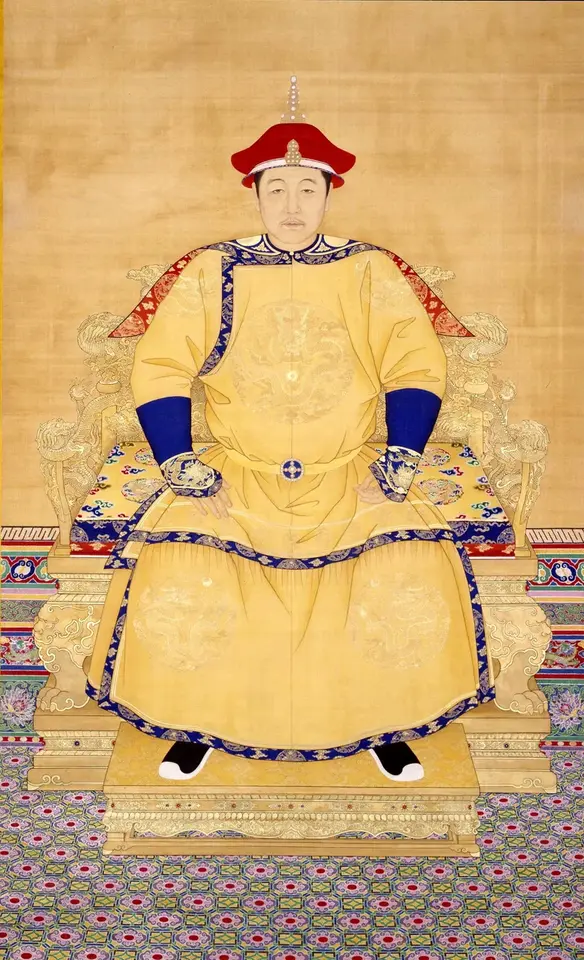
1638 CE–1661 CE
爱新觉罗·福临
Aisin Gioro Fulin (爱新觉罗·福临, March 15, 1638 – February 5, 1661), commonly known by his era name the Shunzhi Emperor, was the third sovereign of the Qing dynasty and the first Qing emperor to rule over China proper following the conquest of Beijing. The ninth son of Hong Taiji (Emperor Taizong) and Empress Dowager Xiaozhuang (Bumbutai), Fulin ascended the imperial throne in Shenyang at the age of six in 1643, chosen as a…
Aisin Gioro Fulin (爱新觉罗·福临, March 15, 1638 – February 5, 1661), commonly known by his era name the Shunzhi Emperor, was the third sovereign of the Qing dynasty and the first Qing emperor to rule over China proper following the conquest of Beijing. The ninth son of Hong Taiji (Emperor Taizong) and Empress Dowager Xiaozhuang (Bumbutai), Fulin ascended the imperial throne in Shenyang at the age of six in 1643, chosen as a compromise candidate to prevent civil war between rival prince factions. In 1644, following the fall of the Ming dynasty to peasant rebels, Qing forces crossed the Shanhai Pass under Prince Regent Dorgon, defeated the rebel forces of Li Zicheng, and occupied Beijing. In October 1644, young Fulin performed imperial sacrifices at the Temple of Heaven, formally proclaiming Beijing as the permanent capital of the Great Qing. During the first seven years of his reign, supreme executive authority was wielded exclusively by Prince Regent Dorgon, who enforced aggressive expansion southward while enacting draconian measures such as the Queue Order and land confiscations that sparked fierce Ming loyalist resistance. Upon Dorgon's sudden death in 1650, the fourteen-year-old Shunzhi Emperor assumed direct personal governance, swiftly orchestrating a comprehensive political purge of Dorgon's faction and recovering the Bordered White and Plain White Banners under direct imperial control. Recognizing that military conquest alone could not sustain foreign rule over China, Shunzhi boldly embraced classical Confucian statecraft, establishing the Grand Secretariat, instituting dual Manchu-Han appointments across central ministries, restoring civil examinations, promulgating the Qing Code, and granting imperial audiences to the Fifth Dalai Lama to secure border alliances. In his personal life, Shunzhi was an intensely passionate, sensitive, and romantic monarch who rebelled against arranged Mongol marriages, bestowing legendary affection upon Lady Donggo (Empress Xiaoxian). The premature death of Lady Donggo in 1660 devastated the young sovereign, plunging him into profound grief and driving him toward Zen Buddhism, where he briefly sought monastic tonsure. In February 1661, Shunzhi succumbed to virulent smallpox in the Yangxin Hall at the age of twenty-four, designating his eight-year-old son Xuanye (the Kangxi Emperor) as his successor in his deathbed edict. Interred in the Xiaoling Mausoleum of the Eastern Qing Tombs, Shunzhi is honored in imperial annals as Emperor Shizu, the founding consolidator who steered the Qing dynasty from a nomadic conquest regime into a legitimate, culturally sophisticated Chinese world empire.
Born in the Palace of Eternal Blessing in Shenyang to Hong Taiji and Lady Bumbutai.
Enthroned in Shenyang following Hong Taiji's death, with Dorgon and Jirgalang appointed regents.
Qing armies occupied Beijing; Fulin performed sacrifices at the Temple of Heaven, proclaiming the Qing capital.
Dorgon decreed mandatory queue hairstyles and suburban land confiscations, provoking widespread revolts.
Dorgon passed away suddenly at Karahot; Shunzhi swiftly neutralized Prince Ajige's coup attempt.
Assumed personal rule at age fourteen; posthumously stripped Dorgon of noble titles and reclaimed royal banners.
Traveled outside Beijing to welcome the Fifth Dalai Lama, granting official golden seals to formalize ties.
Reformed the Three Inner Courts into the Grand Secretariat; instituted the Thirteen Palace Departments.
Welcomed Lady Donggo into the imperial palace, promoting her to Imperial Noble Consort with a general amnesty.
Ming loyalist Zheng Chenggong besieged Nanjing; Shunzhi prepared to lead troops in person before Qing forces prevailed.
Lady Donggo died of illness; Shunzhi observed intense mourning, elevating her posthumously to Empress.
Contracted smallpox and died inside Yangxin Hall at age twenty-four; named Xuanye successor in his final edict.
Aisin Gioro Fulin was born on March 15, 1638, in the Palace of Eternal Blessing within the Shengjing Imperial Palace in modern Shenyang. His father, Hong Taiji, was the energetic founding emperor of the Great Qing who transformed the Jurchen tribal state into an imperial realm, while his mother, Lady Bumbutai of the Mongol Khorchin Borjigin clan, was an exceptionally astute political matriarch known to history as Empress Dowager Xiaozhuang. Dynastic chronicles record that prior to his birth, auspicious crimson lights illuminated the palace pavilions, leading Hong Taiji to name him Fulin, meaning fortunate arrival.
In September 1643, Hong Taiji died suddenly in the Qingning Palace without designating an heir apparent. A violent succession struggle immediately erupted between Prince Hooge (Hong Taiji's eldest son, backed by the Yellow and Blue Banners) and Prince Dorgon (the brilliant commander of the White Banners). As armed banner regiments stood poised for civil war outside the palace gates, Prince Jirgalang proposed a compromise: both senior claimants would step aside in favor of Hong Taiji's six-year-old son Fulin, with Dorgon and Jirgalang serving as co-regents. On October 8, 1643, young Fulin ascended the throne in the Daming Palace, inaugurating the Shunzhi era.
In the spring of 1644, seismic upheavals convulsed central China. The peasant army of Li Zicheng stormed Beijing, driving Emperor Chongzhen of the Ming dynasty to hang himself on Coal Hill. In northern Hebei, Ming general Wu Sangui, who guarded the formidable gateway of Shanhai Pass, found his position caught between approaching rebel columns and northern Manchu armies. Choosing submission to the Manchus, Wu opened the gates to Dorgon. In a cataclysmic battle along the stone beach of the Shanhai Pass, combined Qing and banner forces routed Li Zicheng's army, swiftly occupying Beijing.
Recognizing that regional control in Shenyang could never secure continent-wide dominion, Dorgon dispatched urgent memorials imploring the child emperor and the court to transfer the imperial seat to Beijing. In September 1644, the six-year-old Shunzhi Emperor entered the Forbidden City in an imperial palanquin. On October 30, he mounted the imperial altar at the Temple of Heaven to offer solemn sacrifices, issuing an imperial accession edict declaring Beijing the permanent capital of the Great Qing. Proclaiming that the Qing marched to avenge the fallen Ming sovereign and rescue the civilian multitudes from banditry, Shunzhi established the imperial legitimacy of his house as the rightful heirs to the Chinese empire.
Between 1644 and 1650, actual imperial authority was exercised by Prince Regent Dorgon. Capitalizing on his conquest laurels, Dorgon systematically centralized state power into his private residence. In 1645, he was awarded the title of Imperial Uncle Prince Regent, escalating in 1648 to Imperial Father Prince Regent, requiring cabinet ministers to submit memorials directly to his palace and prostrate themselves before his person as if before the emperor. Dorgon eliminated his aristocratic rivals, starving Prince Hooge to death in prison and stripping Prince Jirgalang of administrative authority.
Simultaneously, Dorgon enacted coercive assimilation decrees that severely aggravated ethnic hostility throughout central and southern China. In the summer of 1645, he issued the infamous Queue Order, commanding all adult Han Chinese males to shave their foreheads and braid their hair in the Manchu queue within ten days on pain of execution. This triggered massive popular resistance across Jiangnan, culminating in the horrific massacres of Jiading and Jiangyin. In northern provinces, the regency enforced large-scale land enclosures, expelling tens of thousands of Chinese peasants from their ancestral fields to allocate estates to banner garrisons. Living in the shadow of this brutal regency, young Shunzhi nurtured a profound revulsion toward tribal autocracy, secretly resolving to govern through Confucian civil benevolence.
On December 31, 1650, Prince Regent Dorgon died unexpectedly while hunting in Karahot near the Great Wall, passing away at the age of thirty-nine. Dorgon's brother, Prince Ajige, immediately mobilized banner cavalry in an attempt to usurp the regency. Acting with remarkable poise, the thirteen-year-old Shunzhi Emperor joined forces with Empress Dowager Xiaozhuang and Prince Jirgalang, ordering imperial guards to surround Ajige's mansion and compelling him to commit suicide.
On January 26, 1651, the fourteen-year-old Shunzhi Emperor formally assumed direct imperial governance in the Hall of Supreme Harmony. One month later, imperial guards and palace retainers submitted extensive dossiers detailing Dorgon's treasonous conspiracies, including the fabrication of imperial yellow robes and plots to usurp the throne. Shunzhi responded with merciless fury, stripping Dorgon of all posthumous imperial honors, exhuming his corpse to be flogged and decapitated in public, and confiscating his colossal personal wealth. Shunzhi transferred the Bordered White and Plain White Banners into direct imperial custody, permanently merging them with the Yellow Banners to establish the supreme Upper Three Banners, thereby dismantling the traditional oligarchic power of the Manchu princes and anchoring absolute monarchical autocracy.
Upon assuming personal power, Shunzhi realized that an empire of over one hundred million people could not be administered by nomadic martial force alone. Overcoming fierce opposition from conservative Manchu grandees, he decisively committed the dynasty to classical Confucian governance. In 1651, he personally conducted grand sacrificial ceremonies at the Imperial Academy (Guozijian) in Beijing, conferring upon Confucius the supreme title of Ultimate Sage and First Teacher, while ordering state restoration of the ancestral temple in Qufu.
Shunzhi instituted daily imperial lectures in classical canons, inviting celebrated Chinese literati such as Fan Jingwen and Jin Zhijun to expound the Four Books, Five Classics, and Zizhi Tongjian. In 1653, he transformed the archaic Three Inner Courts into the Grand Secretariat, institutionalizing civilian cabinet governance. Across the Six Ministries and the Censorate, he introduced a dual administrative system, appointing one Manchu and one Han Chinese president, alongside two Manchu and two Han vice-presidents for each bureau. He relied extensively on experienced Chinese statesmen, including Fan Wencheng, Hong Chengchou, and Chen Mingxia, entrusting them with strategic planning, taxation reform, and legal codification, which successfully integrated Chinese gentry elites into the imperial administration.
Throughout Shunzhi's personal reign, the southern provinces remained engulfed in protracted warfare against Ming loyalist regimes. In the southwestern provinces of Guizhou and Yunnan, the Southern Ming Yongli regime, championed by heroic general Li Dingguo, mounted an extraordinary military resurgence. In 1652, Li Dingguo led allied peasant armies out of Yunnan, capturing Guilin and compelling the Qing Prince of Southern Pacification Kong Youde to commit suicide, subsequently ambuscading and slaying Qing Prince Nikan at Hengzhou. This legendary feat of slaying two imperial princes sent shockwaves through Beijing, prompting Shunzhi to contemplate abandoning southwestern territories.
Rallying his resolve, Shunzhi appointed Grand Academician Hong Chengchou as supreme military commissioner overseeing the armed forces of seven southern provinces. Adopting a methodical defensive strategy of fortress networks and economic conciliation, Hong steadily choked loyalist supply lines. In 1658, Shunzhi launched a three-pronged coordinated offensive commanded by Prince Doni, Prince Wu Sangui, and Prince Shang Kexi, capturing Guiyang and Kunming and forcing the Yongli Emperor to flee across the border into Burma.
Simultaneously, in the summer of 1659, maritime loyalist leader Zheng Chenggong launched a colossal naval expedition up the Yangtze River, seizing Zhenjiang and laying tight siege to Nanjing. Infuriated by the threat to the southern capital, the twenty-one-year-old Shunzhi drew his sword in open court, slashing his imperial throne and vowing to lead an imperial relief expedition in person. Dissuaded by Empress Dowager Xiaozhuang, who warned against reckless imperial exposure, Shunzhi dispatched elite banner cavalry to reinforce the garrison. Exploiting complacency in the besieging fleet, Qing forces launched a coordinated amphibious counter-strike, shattering Zheng's naval armada and permanently securing Qing dominion over the Yangtze delta.
While Shunzhi embraced intellectual discipline in state affairs, his emotional life was marked by fierce independence and tragic romanticism. In 1651, Regent Dorgon arranged for Shunzhi to marry Lady Borjigin, a daughter of Khorchin Prince Ukshan and niece of Empress Dowager Xiaozhuang. Arrogant, extravagant, and intolerant of Chinese culture, the young Mongol empress alienated Shunzhi by demanding solid gold tableware and abusing palace attendants. In 1653, defying his mother and the entire court, the sixteen-year-old emperor demoted her to the status of Consort Jing. Although the court arranged a replacement Mongol consort (Empress Xiaohui), Shunzhi treated her with frigid formality.
In 1656, Shunzhi fell profoundly in love with Lady Donggo, the daughter of Manchu noble Eshuo. Cultured, gentle, and deeply versed in Chinese literature and calligraphy, Lady Donggo became the emperor's soulmate. Within months of her entry into the Forbidden City, Shunzhi elevated her to Imperial Noble Consort, granting an extraordinary nationwide amnesty to celebrate her promotion. The two were inseparable; Lady Donggo sat beside him as he reviewed memorials late into the night, gently urging judicial clemency for political prisoners. In the autumn of 1657, Lady Donggo gave birth to Shunzhi's fourth son, whom the overjoyed monarch proclaimed as his principal heir. However, the infant succumbed to illness before reaching one hundred days, plunging both parents into despair.
The loss of her child permanently shattered Lady Donggo's health. On September 23, 1660, she passed away in the Chengqian Palace at the age of twenty-two. Her death drove the twenty-two-year-old emperor into suicidal despair. Weeping hysterically, Shunzhi attempted self-harm and had to be physically restrained by palace attendants. He decreed unprecedented imperial honors for his late consort, posthumously elevating her to Empress Xiaoxian and personally authoring a four-thousand-character eulogy celebrating her virtue and intelligence. He ordered the court to observe full mourning for several months, compelling princes and ministers to participate in grieving assemblies.
Following her demise, an inconsolable Shunzhi turned to Zen Buddhism for spiritual solace. He had previously established close intellectual ties with celebrated Chan masters, including Hanpu Xingcong, Yulin Tongxiu, and Maoxi Xingsen, receiving the Bodhisattva Precepts under the monastic name Xingchi (Devoted to Folly). In his profound grief, Shunzhi ordered Master Xingsen to shave his head in the Jingshan Palace, preparing to abandon the imperial throne and enter monastic life. Alarmed by this dynastic crisis, Empress Dowager Xiaozhuang summoned Master Yulin, who threatened to burn Xingsen at the stake if he ordained the sovereign. Yielding to his mother's tears and religious admonitions, Shunzhi abandoned formal ordination, though his spirit remained utterly detached from worldly governance.
Depleted by severe grief, sleep deprivation, and relentless fasting, Shunzhi's physical constitution rapidly collapsed. In the winter of 1660, a virulent epidemic of smallpox swept through Beijing. Lacking biological immunity, the Manchu nobility lived in mortal terror of the disease. On February 2, 1661, Shunzhi developed high fevers and cutaneous eruptions, diagnosed with malignant smallpox.
Within days, the emperor's condition turned fatal. On the night of February 4, Shunzhi summoned Grand Academician Wang Xi and Academician Margi to his bedside in the Yangxin Hall, dictating his famous deathbed edict. In this remarkable historical document, known as the Fourteen Self-Reproaches, the dying monarch subjected his reign to searching self-criticism, expressing contrition for adopting Chinese luxuries, neglecting ancestral Manchu martial traditions, and grieving excessively for Consort Donggo.
Consulting with his mother and his trusted European scientific advisor, Jesuit father Johann Adam Schall von Bell, Shunzhi weighed the succession. Father Schall urged the selection of the emperor's third son, eight-year-old Xuanye, because the boy had already survived smallpox and possessed lifelong immunity. Accepting this advice, Shunzhi designated Xuanye as his heir, appointing four conservative Manchu grandees—Sonin, Suksaha, Ebilun, and Oboi—as regents. On February 5, 1661, the Shunzhi Emperor passed away in the Yangxin Hall at the age of twenty-four. He was interred in the Xiaoling Mausoleum of the Eastern Qing Tombs, remembered as a tragic yet transformative sovereign whose embrace of Chinese culture laid the foundations for the golden age of Kangxi.
In his efforts to circumvent the conservative aristocratic hegemony of the Manchu nobility, Shunzhi introduced major administrative innovations within the inner court. In 1653, seeking an executive instrument loyal exclusively to the crown, he abolished the traditional Imperial Household Department (Neiwufu) and established the Thirteen Palace Departments (Shisan Yamen), modeled directly upon the eunuch offices of the Ming dynasty.
Through these departments, trusted eunuchs managed palace logistics, treasury receipts, and imperial manufacturing, providing the emperor with independent administrative machinery to counterbalance the Deliberative Council of Princes and Ministers. Foremost among his retainers was chief eunuch Wu Liangfu, whom the emperor treated as a confidant. Although Shunzhi erected iron steles prohibiting eunuchs from interfering in exterior civil affairs, the system provoked intense resentment among the Manchu banner elite. Immediately following Shunzhi's death, Regent Oboi executed Wu Liangfu and abolished the Thirteen Yamen, restoring the noble-dominated Imperial Household Department.
Inheriting a bankrupt agrarian economy devastated by decades of warfare, Shunzhi prioritized the stabilization of national finances. He permanently abolished the hated Three Surcharges of the late Ming period, ordering regional magistrates to collect only standard land and poll taxes recorded in ancestral Ming registers.
To restore production on millions of acres of abandoned farmland, Shunzhi enacted the Re-registered Lands policy in 1648, transferring confiscated estates of former Ming princes directly to the peasant tenants who tilled them, granting them perpetual ownership rights. Concurrently, the Ministry of Revenue completed the compilation of the Complete Book of Tax and Labor (Da Qing Fuyi Quanshu), standardizing land quotas, grain levies, and labor exemptions across every prefecture in China. In monetary policy, he established the Board of Revenue and Board of Works mints in Beijing, issuing standard Shunzhi Tongbao bronze coins to suppress counterfeit currency and revitalize commercial markets along the Grand Canal.
To replace archaic tribal customs with codified jurisprudence, the regency promulgated the Great Qing Code with Collected Commentaries (Da Qing Lu Jijie Fuli) in 1646. Supervised by seasoned Chinese jurists such as Dang Chongya, this monumental legal code synthesized the classical structure of the Ming Code with specific banner precedents, establishing seven major divisions governing administrative, civil, ritual, military, and penal law.
Upon assuming personal rule, Shunzhi distinguished himself through extraordinary judicial leniency and a commitment to humanitarian jurisprudence. Deeply influenced by Confucian ethics, he issued strict prohibitions against torture, forbidding judicial magistrates from using illegal implements like ankle-crushers and finger-vices to extract confessions. He formalized the Autumn Assizes and established mandatory triple imperial review for all capital sentences, spending long nocturnal hours reviewing execution dockets in the Yangxin Hall to commute hundreds of death sentences to exile or hard labor.
Shunzhi was a dedicated scholar who personally bridged the cultural divide between the northern conquerors and the Sinitic literati elite. He achieved profound mastery of classical Chinese, authoring moral and political treatises including the Imperial Mirror for Ministers (Yuzhi Renchen Jingxin Lu) and Maxims for Exhorting Goodness (Quanshan Yaoyan), which were distributed nationwide as required reading for civilian officials.
Simultaneously, he directed the translation of fundamental Chinese historical classics into the Manchu script, including the Comprehensive Mirror in Aid of Governance (Zizhi Tongjian) and the Essentials of Governance of the Zhenguan Era (Zhenguan Zhengyao). This bilingual policy transformed the Manchu ruling class from illiterate steppe warriors into cultivated aristocrats conversant with historical statecraft, establishing an integrated imperial identity that sustained the dynasty across three centuries.
While promoting civil administration, Shunzhi recognized that the imperial examination system had to remain an incorruptible mechanism for talent selection. In 1657, widespread bribery and nepotism erupted during the provincial examinations in Shuntian and Jiangnan, resulting in incompetent wealthy candidates passing while destitute scholars were eliminated, sparking street protests at the Confucius Temple in Nanjing.
Viewing examination fraud as an existential threat to monarchical legitimacy, Shunzhi intervened with uncompromising severity. He dispatched imperial inquisitors to arrest the chief examiners, hauling hundreds of candidates to Beijing for a personal re-examination conducted under imperial supervision at Yingtai Island. Demonstrating absolute impartiality, he confirmed the bribery charges, executing chief examiners Fang You and Qian Kaizong by public decapitation and exiling their families to the northern wastes of Ningguta. This stern retribution permanently eradicated aristocratic cartels from the examination boards, ensuring fair advancement for talented commoners.
Shunzhi exhibited exceptional diplomatic foresight in managing the complex frontier relations of Inner Asia. Recognizing that Tibetan Buddhism wielded supreme spiritual authority among the nomadic Khalkha and Oirat Mongols, Shunzhi resolved to construct a tripartite imperial alliance between the Qing throne, the Mongol banners, and the Tibetan hierarchy.
In 1652, Shunzhi welcomed the Fifth Dalai Lama, Lobsang Gyatso, to Beijing with unprecedented imperial honors, traveling thirty li outside the city walls to greet him in person. The emperor constructed the grand Western Yellow Temple as the Dalai Lama's official residence and presented him with an imperial golden seal and jade tablets designating him as the Great Good Self-Existent Buddha of the Western Heavens. This historic accord formalized Qing sovereign suzerainty over Tibet, cementing the spiritual and political alliance that neutralized northern nomadic coalitions and stabilized the western frontiers for generations.
Modern and traditional historians agree that the reign of the Shunzhi Emperor was the foundational turning point in early modern Chinese history. Ascending the throne amidst civil war and ethnic polarization, he avoided the catastrophic errors of earlier nomadic dynasties by rejecting tribal isolationism and fully embracing Chinese administrative institutions.
By eliminating Dorgon's personal dictatorship, establishing the Grand Secretariat, enforcing dual Manchu-Han bureaucratic parity, and adopting Confucian statecraft, Shunzhi transformed what could have been a temporary barbarian occupation into an enduring, legitimate imperial dynasty. His courageous defense of Chinese civil institutions against reactionary Manchu nobles and his inspired selection of his son Xuanye laid the indispensable foundation for the high Qing golden age.
Following his death in 1661, widespread urban folklore claimed that the Shunzhi Emperor had not died of smallpox, but had faked his demise out of grief for Consort Donggo to become a Buddhist monk at Mount Wutai in Shanxi. This romantic narrative was subsequently popularized in Qing dynasty historical novels, drama, and twentieth-century martial arts fiction such as Jin Yong's The Deer and the Cauldron.
Modern archival research in Beijing and Taipei has conclusively debunked the Wutai legend as romantic myth. The personal diaries of Grand Academician Wang Xi, who drafted the emperor's final edict at his deathbed, alongside diplomatic dispatches from the Korean court and clinical memoirs written by Jesuit father Johann Adam Schall von Bell, provide undeniable contemporary proof that the emperor contracted malignant smallpox on February 2, 1661, and succumbed five days later in the Yangxin Hall. His body was cremated according to early Manchu custom and his ashes interred in the Xiaoling Mausoleum, demonstrating that the legends of his monastic flight were imaginative literary fictions.
Beyond his statecraft, Shunzhi was an exceptionally gifted painter, calligrapher, and poet whose surviving works are preserved in the Palace Museum in Beijing. He studied the fluid brush techniques of Song and Yuan masters, demonstrating a distinctive talent for landscape painting, finger-painting, and Zen Buddhist portraits.
His celebrated hanging scroll Bodhidharma Crossing the Yangtze on a Reed depicts the Zen patriarch with dynamic, flowing drapery lines and penetrating spiritual intensity. His calligraphic works, executed in bold semi-cursive script, were frequently presented as imperial gifts to senior ministers. His most famous literary work, the philosophical verse In Praise of the Monastic Life (Zan Seng Shi), expressed poignant spiritual weariness: "Across the empire, monastic halls offer food like mountains; the alms bowl provides sustenance wherever one roams... In eighteen years I have known no freedom; when will these southern and northern campaigns cease?" This deeply reflective poem reveals the sensitive human spirit beneath the imperial robes of the young conqueror.
FIGURES ASSOCIATED WITH THIS DYNASTY