Birth | Born in Chang'an; historical sources described him as “handsome in appearance and intelligent from youth”
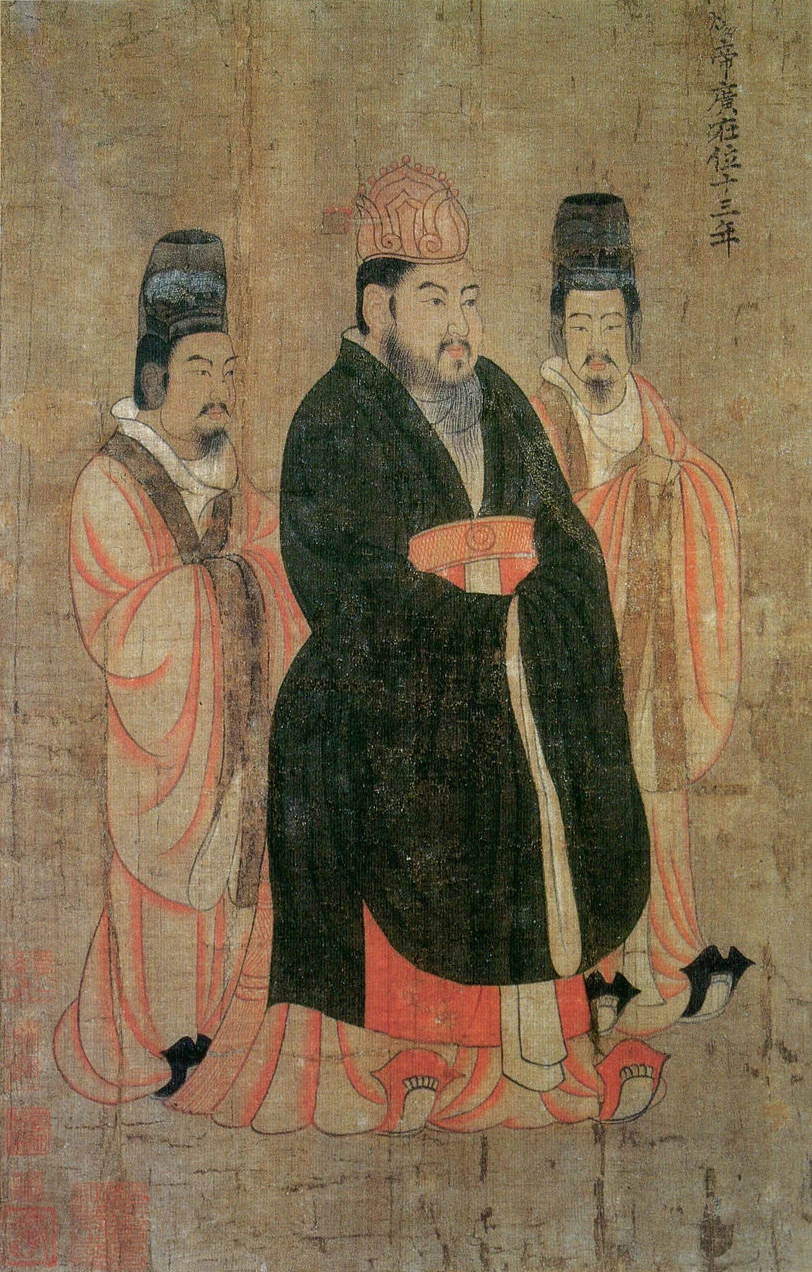
569 CE–618 CE
Emperor
Yang Guang
杨广
Yang Guang (569–April 11, 618), also named Ying and known in childhood as A'mo, was the second legitimate son of Emperor Wen of Sui, Yang Jian, and Empress Wenxian, Dugu Jialuo. He was the second emperor of the Sui dynasty and is known to history as Emperor Yang of Sui, reigning from 604 to 618. Naturally intelligent, handsome, and talented in literature, he was enfeoffed as Prince of Jin at thirteen and nominally commanded…
569 CE–618 CESui Dynasty
PROFILE
Yang Guang (569–April 11, 618), also named Ying and known in childhood as A'mo, was the second legitimate son of Emperor Wen of Sui, Yang Jian, and Empress Wenxian, Dugu Jialuo. He was the second emperor of the Sui dynasty and is known to history as Emperor Yang of Sui, reigning from 604 to 618. Naturally intelligent, handsome, and talented in literature, he was enfeoffed as Prince of Jin at thirteen and nominally commanded the conquest of Chen at twenty. In 600, the twentieth year of the Kaihuang era, he was named heir apparent, and in 604, the fourth year of the Renshou era, he ascended the throne. During his reign he dredged and constructed the Sui Grand Canal, built and shifted the eastern capital to Luoyang, toured west to Zhangye, personally campaigned against Tuyuhun, launched three campaigns against Goguryeo, and established the jinshi examination, helping formalize the imperial examination system. Yet his pursuit of rapid achievement, repeated warfare, and excessive labor conscription provoked large-scale popular uprisings and ultimately ended in his own death and the collapse of the dynasty. Yang Guang was also a gifted poet whose works anticipated aspects of early Tang verse.
- Other name
- Emperor Yang of Sui
- Period
- Sui Dynasty
- Dynasty/Regime
- Sui
- Identity
- Emperor
- Ethnicity
- Not recorded in historical sources
- Native place
- Not recorded in historical sources
- Date of birth
- 569
- Place of birth
- Not recorded in historical sources
- Date of death
- April 11, 618
- Reign
- 604–618
- Predecessor
- Emperor Wen of Sui (Yang Jian)
- Successor
- Emperor Gong of Sui (Yang You)
- Posthumous title
- Emperor Yang of Sui
- Major achievements
- A reigning emperor and gifted poet whose verse anticipated aspects of early Tang poetic style.
LIFE TIMELINE
Childhood | Because of his father Yang Jian’s achievements, enfeoffed as Duke of Yanmen Commandery
Age thirteen | Enfeoffed as Prince of Jin and appointed Pillar of State and governor-general of Bingzhou
Age eighteen | Transferred to Director of the Department of State Affairs for the Huainan Circuit Administration, then summoned as governor of Yongzhou and Director of the Secretariat
Age twenty | Appointed campaign commander for the southern expedition against Chen
Age twenty-one | Chen conquered; entered Jiankang, sealed its storehouses, and was promoted to Grand Commandant
Age twenty-two | Appointed governor-general of Yangzhou and stationed at Jiangdu to pacify Jiangnan
Age thirty-two | Led an expedition from Lingwu against the Turks but returned without encountering them; named heir apparent the same year
Age thirty-six | Ascended the throne; forged a testamentary edict and had the deposed heir Yang Yong strangled
Age thirty-seven | Constructed the eastern capital at Luoyang and opened the Tongji Canal and Han Canal
Age thirty-nine | Toured north to Yulin, opened the Yongji Canal, and executed Gao Jiong and Heruo Bi
Age forty-one | Personally campaigned against Tuyuhun and established the four commanderies of Xihai, Heyuan, Shanshan, and Qiemo
Age forty-two | Opened the Jiangnan River, completing the canal system; made his third journey to Jiangdu
Age forty-three | Mobilized a great army for war against Goguryeo; Wang Bo rebelled and late-Sui uprisings spread
Age forty-four | First campaign against Goguryeo ended in major defeat
Age forty-five | Second campaign against Goguryeo; Yang Xuangan rebelled and the army withdrew in haste
Age forty-six | Third campaign against Goguryeo; withdrew after Goguryeo sought submission
Age forty-seven | During a northern tour of the Great Wall, besieged at Yanmen by Shibi Qaghan
Age forty-eight | Traveled to Jiangdu
Age fifty | Killed by Yuwen Huaji; the Sui dynasty collapsed
BIOGRAPHY
Biography
Family Background and Early Life
Yang Guang was born in Chang'an in 569, the fourth year of Northern Zhou’s Tianhe era. His father Yang Jian was then Duke of Sui under Northern Zhou, while his mother Dugu Jialuo was a daughter of the Northern Zhou Grand Marshal Dugu Xin. Yang Guang was their second legitimate son. Historical sources described him as handsome in appearance and intelligent from youth, and he was greatly favored by his parents. Under Northern Zhou he was enfeoffed as Duke of Yanmen Commandery because of his father’s achievements.
In 581 Yang Jian replaced Northern Zhou and founded the Sui dynasty. Yang Guang, then thirteen, was enfeoffed as Prince of Jin and appointed Pillar of State and governor-general of Bingzhou. He later became General-in-Chief of the Left Martial Guard, Supreme Pillar of State, and Director of the Department of State Affairs for the Hebei Circuit Administration. In 586 he was transferred to the same post for Huainan and later summoned as governor of Yongzhou and Director of the Secretariat. From youth he displayed unusual intelligence and ability and was especially favored among the imperial princes.
Command in the Conquest of Chen and Governorship of Yangzhou
In the winter of 588 Emperor Wen sent more than five hundred thousand troops south against Chen. The twenty-year-old Yang Guang was appointed campaign commander, though actual direction of the army rested with his chief of staff Gao Jiong. Sui forces advanced rapidly. Heruo Bi crossed at Jingkou and Han Qinhu at Caishi, taking Chen by surprise. After Chen fell the following year, Yang entered Jiankang. He wished to take Zhang Lihua, a favored consort of the last Chen ruler, but Gao Jiong cited King Wu’s execution of Daji after defeating Shang and had her killed, greatly displeasing Yang. Yang sealed the treasuries and took no wealth for himself. On returning from the campaign he was promoted to Grand Commandant and won a reputation for virtue.
After the conquest, Sui introduced household registration and village reorganization in Jiangnan, but policy failures provoked fierce resistance among local elites and commoners. In 590 large rebellions broke out throughout former Chen territory, with forces ranging from several thousand to tens of thousands. Emperor Wen sent Yang Su, who fought more than a hundred engagements before pacifying the region. Yang Guang was appointed governor-general of Yangzhou and stationed at Jiangdu with the task of governing the Huai and maritime regions and transforming the customs of Wu and Kuaiji. During his administration of Jiangnan he treated worthy men respectfully, acted with humility and caution, lived simply, and avoided conspicuous indulgence. His record won praise at court and in the provinces and strengthened his position in the later succession struggle.
Succession Struggle and Accession
Yang Guang’s elder brother Yang Yong was heir apparent. He was generous and straightforward and did not conceal his preferences, but he favored the concubine Yun and neglected his principal wife Lady Yuan. After Lady Yuan died suddenly, Empress Dugu suspected Yun’s involvement and became deeply dissatisfied with Yang Yong. Learning of his mother’s attitude, Yang Guang increased his deliberate self-restraint. He kept only a small formal household of concubines, lived only with his principal wife Lady Xiao, maintained simple carriages and retinues, and treated officials with extreme deference. His reputation among the princes rose accordingly. Before Empress Dugu he also displayed conspicuous filial devotion, weeping at partings and accusing Yang Yong of planning to harm him. The empress gradually came to favor replacing the heir.
Yang Guang and his confidant Zhang Heng formed a plan and sent Yuwen Shu to cultivate Yang Yue, younger brother of Yang Su, so that Yang Su would be approached. Seeing that the empress had already made up her mind, Yang Su shifted to Yang Guang’s side. In 600 Yang Guang bribed Ji Wei, a favorite of the heir apparent, to report various alleged offenses by Yang Yong. Yang Su manipulated the accusations and constructed a case. Emperor Wen then deposed Yang Yong and made Yang Guang heir apparent. In the same year the Turks raided the frontier; Yang led troops out from Lingwu but returned without encountering the enemy.
In the seventh month of 604 Emperor Wen died and Yang Guang ascended the throne. He immediately forged what the source describes as Emperor Wen’s testamentary edict and had the deposed heir Yang Yong strangled. The next year his younger brother Yang Liang, Prince of Han, rebelled at Bingzhou in the name of attacking Yang Su. Yang Guang sent Yang Su to suppress him. Yang Liang surrendered and was imprisoned until his death. Soon afterward Yang Guang followed Yun Dingxing’s advice and had Yang Yong’s sons poisoned, removing further threats to the throne.
Achievements and Harsh Rule in the Daye Era
After taking the throne, Yang Guang imposed large labor levies almost every year. In 605 he ordered construction of the eastern capital at Luoyang, employing two million adult men each month; the project was completed in ten months. The new capital was vast, more than fifty li in circumference, divided into palace city, imperial city, and outer city, with over one hundred residential wards and the three large markets Fengdu, Datong, and Tongyuan. He also moved people from across the empire to Luoyang, whose population, according to the source, exceeded one million.
The same year he ordered construction of the Grand Canal. Centered on Luoyang, it consisted of three main sections: the central Tongji Canal and Han Canal, running from Luoyang southeast to the Huai and then to Jiangdu and the Yangtze; the southern Jiangnan River, from Jingkou to Yuhang; and the northern Yongji Canal, from Luoyang to Zhuo Commandery. Construction was carried out in stages over five years, producing a waterway more than 2,700 kilometers long. In 607 and 608 he twice rebuilt the Great Wall east of Yulin, mobilizing 1.2 million men, of whom the source says more than half died in service. Over little more than a decade, the number of peasant labor mobilizations was said to reach at least ten million person-times, creating the image of “the realm dying in labor service.”
In 609 Yang personally campaigned against Tuyuhun and won a major victory, establishing the four commanderies of Xihai, Heyuan, Shanshan, and Qiemo and expanding the frontier by five thousand li. Qu Boya, king of Gaochang, came to Zhangye to pay court. At this point the Sui was described as reaching its height, with 190 commanderies, 1,255 counties, more than 8.9 million registered households, and a population exceeding 46 million.
In 611 Yang began preparations for war against Goguryeo. In 612 he mobilized more than 1.13 million soldiers and two million laborers for the first campaign, concentrating the land army at Zhuo Commandery and the navy at Donglai. Although Sui forces reached the vicinity of Pyongyang, the campaign ended in severe defeat. In 613 he launched a second campaign, but while the armies were locked in fighting, Minister of Rites Yang Xuangan rebelled against Sui and Yang Guang withdrew in haste. In 614 he launched a third campaign. Goguryeo sent an envoy seeking submission, and Yang withdrew. The three campaigns mobilized millions of people. Large numbers of soldiers and laborers died in battle and service, inflicting severe economic damage and becoming a major trigger of the late-Sui uprisings.
Tours and Final Collapse
Yang Guang traveled extensively almost every year of his reign: three times to Jiangdu, twice beyond the northern frontier, once to the Hexi region, and three times to Zhuo Commandery. On journeys to Jiangdu, he was accompanied by princes, officials, consorts, and palace women numbering between one and two hundred thousand, and his flotilla was said to stretch for more than two hundred li. His dragon boat was described as forty-five chi high, fifty chi wide, two hundred chi long, and four stories tall. Prefectures and counties within five hundred li of the route were required to supply food, producing enormous waste. To display the empire’s prosperity, every first month when leaders and merchants of minority peoples and foreign states gathered in Luoyang, Yang ordered spectacular performances outside Duan Gate. The performance grounds extended for eight li, employed nearly thirty thousand singers and performers, and could be heard tens of li away.
In 615, during his customary northern tour of the Great Wall, Shibi Qaghan besieged him at Yanmen. Yang appealed for help to the qaghan’s wife, Princess Yicheng of Sui, while Sui relief armies approached, and Shibi eventually withdrew. In 616 Yang traveled to Jiangdu and never again returned north. By then the realm was in chaos, with the Wagang army, Hebei rebels, Jianghuai rebels, and other anti-Sui forces rising throughout the country. According to the source, Yang nevertheless remained at Jiangdu immersed in drinking and entertainment. In 618, the fourteenth year of the Daye era, imperial guard commander Yuwen Huaji launched a mutiny, and Yang Guang was strangled in the palace at Jiangdu. The Sui dynasty collapsed in the same period.
Yang Guang was the second son of the Sui founder Yang Jian by the empress Dugu, known in childhood as A-chuang. The Sui History calls him handsome in bearing and quick-witted from boyhood, and of all his sons most beloved by his father and mother. Under the Northern Zhou he was enfeoffed duke of Yanmen for his father's services; when the Sui was founded in 581 he was made prince of Jin with the offices of pillar of state and commander-in-chief of Bingzhou at the age of thirteen, and afterward general of the left guard with the rank of senior pillar and president of the Hebei branch secretariat. It is recorded that before his father's rise a physiognomist was made to look over all the sons and declared the prince of Jin too noble for words — the sort of tale later used to illustrate his early ambition.
The conquest of Chen was his first important part. From the beginning of his reign the Sui founder had aimed at the conquest, appointing the generals and building the fleet, and in the winter of 588 the campaign began. Yang Guang was nominally marshal, but the actual command lay with the marshal's chief of staff Gao Jiong, to whom the whole army referred for decisions; the Sui forces went south by several routes and were received everywhere with submission, and the Chen ruler with his empress and consorts was brought back to the capital. On the return Yang Guang sealed the treasuries and took nothing, so that the empire called him worthy, and was advanced to grand commandant with a gift of carriage and horses, robes and crowns and disks of dark jade and white. One incident was much remembered afterward: he wanted Zhang Lihua, the favorite consort of the Chen ruler, and Gao Jiong had her beheaded on the ground that King Wu of Zhou had killed Daji when he destroyed Yin, which much displeased him.
In 590 a great rebellion broke out in Jiangnan, provoked by Su Wei's revival of the Five Teachings for all to recite and by the rumor that the court meant to move the southern population into the passes: Wang Wenjin at Wuzhou, Gao Zhihui at Yuezhou and Shen Xuankui at Suzhou all rose and styled themselves sons of heaven with their own officials, and Cai Daoren, Li Ling, Wu Shihua, Shen Xiaoche, Wang Guoqing, Yang Baoying and Li Chun of Jiaozhou proclaimed themselves grand commanders and seized prefectures, so that the old Chen lands were almost all in revolt, the largest bands numbering tens of thousands and the smallest thousands, and magistrates were seized, their guts drawn or their flesh eaten, with the cry of whether they could still make the people recite the Five Teachings. The emperor sent Yang Su as commander-in-chief; he took Lai Huer's advice to stand in order of battle and send a detached force across the river by stealth, broke Gao Zhihui on the east bank of the Zhe, and sent Shi Wansui over the ridges and across the sea from Wuzhou, who fought more than seven hundred engagements over a thousand li and for a hundred days was thought dead until he floated a letter down the water in a bamboo tube; the risings were put down one after another and Gao Zhihui was at last taken and beheaded at Quanzhou at Wang Guoqing's hands, and Jiangnan was quiet. Afterward the court made the prince of Jin, who had been commander in Bingzhou, president of Yangzhou at Jiangdu, where he spent years among southern scholars and monks and built up the political capital he would later use. In 600, when the Turks raided the frontier, he campaigned again as marshal out of Lingwu and returned without a single captive.
Yang Guang had long coveted the place of his elder brother Yang Yong. To win his father's favor he made a show of frugality: when the emperor was to visit his residence he had the pretty women of his household withdraw and left only the older and plainer to receive him, and had a dusty zither with broken strings set in plain view; the emperor, taken in, concluded that he cared nothing for music and women, praised him, and he put on the disguise the more, so that men called him filial and kind. On another occasion, caught in the rain while watching a hunt, he refused an oiled cloak because his attendants were getting wet, and the emperor, hearing of it, praised his benevolence. He played the dutiful son before the empress Dugu too, parting from her with every show of sorrow, and falsely told her that the heir meant him harm, deepening her dislike of Yang Yong. He courted the attendants of both his parents to speak well of him, and won over the emperor's favorite minister Yang Su, so that a party against the heir formed about the empress and Yang Su and conspired to replace him.
Yang Yong himself was fond of learning and of letters, generous and easy by temper and without dissimulation, with scholars as his friends, and had once incurred his father's displeasure for ornamenting a corselet, the emperor fearing the beginnings of luxury. The decisive matter was the empress's horror of concubines: Yang Yong had many favorites, and his consort of the Yuan family, out of favor, died suddenly of a heart ailment, which the empress suspected to be the work of his favorite Yun. Yang Guang, learning of it, made himself look even better — keeping concubines only for the count and living solely with his consort Xiao, going to court with plain carriages and few attendants, deferential to officials in the extreme, so that his reputation surpassed all the princes. Taking leave of the empress before returning to Yangzhou he wept and could not rise, saying that he was stationed far off and could not serve her, and falsely that he knew not what offense had lost him the heir's love, that the heir nursed wrath against him and sought his destruction, so that he feared slander like the tale of the thrown shuttle and poison in his cup. The empress in anger said she could no longer bear the man, told how the young wife had died suddenly of poison, and asked whether, after her own death, he would not be devoured. Certain now that the empress's mind had changed, Yang Guang fixed his plans with Zhang Heng, sent Yuwen Shu to cultivate Yang Su's brother Yang Yue, and had the empress's words conveyed to Yang Su, who at a banquet praised the prince of Jin's filial piety and frugality to sound her, was confirmed, and spoke freely of the heir's incapacity; the empress sent him gold, and the design of deposition was settled.
Yang Yong, frightened and without a plan, consulted a diviner, made charms of bronze and iron, and built a cottage of a commoner in his garden where he slept on a straw mat in plain clothes, hoping to avert the omen. The emperor had Yang Su look at him; Yang Su stayed outside the gate to provoke him, and reported that the heir was resentful and might be dangerous; the empress had spies about the eastern palace reporting every trifle and blowing it up into a crime. The emperor, misled, grew suspicious and set watchers between the Xuanwu and Zhide gates to report his movements, transferred the palace guards to the regular commands and removed the strong among them. Yang Guang had Duan Da bribe the heir's favorite Ji Wei to spy and report by way of Yang Su, threatening him with the emperor's secret decree of deposition and the great wealth awaiting him if he came over; and Ji Wei memorialized against the heir, declaring that he meant to make a park of the country from Fanchuan to Sanguan, that he had said any who remonstrated should simply be killed, a hundred or so of them sufficing to end the talk, and that a diviner had told him the emperor's term ended in the eighteenth year, which was near. The emperor, weeping, asked whether any man was not born of parents, and said that in reading the Book of Qi he had been angered beyond measure at Gao Huan's indulgence of his sons and would not imitate it. Yang Yong and his sons were confined, his party arrested, and Yang Su, twisting the law, manufactured a case; so the heir fell. On the yichou day of the tenth month of 600 the emperor in armor and with troops drawn up in the Wude hall had the decree read deposing Yang Yong and his sons and daughters to commoner status; Yang Yong bowed twice, saying he deserved to die in the marketplace as a warning to the future but was grateful for his life, wept until his front was wet and danced away, and those about him were silent with pity. On the wuzi day of the eleventh month the prince of Jin was made crown prince. Yang Yong, thinking his deposition unjust, asked again and again to see the emperor and was blocked by the new heir, once climbing a tree and shouting to be heard; Yang Su reported that his mind was deranged and possessed by a mad ghost, and he was never received.
In 604, as the emperor lay ill at Renshou palace, the president of the secretariat Yang Su, the minister of war Liu Shu and the yellow gate attendant Yuan Yan attended him within, and the crown prince took up residence in the Dabao hall. Wishing to prepare against the emperor's death, Yang Guang wrote a letter with his own hand, sealed it and sent it out to Yang Su, who answered with an itemized report; but a palace servant mistakenly brought the reply to the emperor, who was greatly angered. At dawn lady Chen went out to change her dress and was molested by the crown prince, and escaping brought back a face so changed that the emperor asked why; weeping, she said the crown prince had been unseemly. The emperor in fury struck the bed, crying that the beast was unfit to be given the empire and that Dugu had ruined him, and called for Liu Shu and Yuan Yan to summon his son; when they moved to summon the crown prince he said he meant Yang Yong. The two went out to draft the edict, Yang Su heard of it and told the crown prince, who forged an edict arresting them and committing them to the grand court, brought the eastern palace troops to guard the Renshou palace with the gates closed, set Yuwen Shu and Guo Yan to command, and sent the prince's aide Zhang Heng into the emperor's chamber, clearing the palace women into other rooms; in a little while the emperor was dead. Hence the conflicting accounts: the Brief Record tells that the emperor ordered Liu Shu and Yuan Yan to draft an edict restoring Yang Yong, that thirty strong palace slaves were disguised in women's clothes with staves beneath, and that when Yang Su and Zhang Heng entered, the emperor died suddenly; the General Calendar says Zhang Heng was sent in to drag him, and that blood spattered the screen and his cries of grief and pain were heard outside. Lady Chen and the palace women looked at each other trembling; in the afternoon the crown prince sent a small gold box with a slip pasted on it and his own seal, and lady Chen, terrified that it was poison, would not open it until the messenger pressed her, and found inside several love-knots, at which the palace women rejoiced that they were saved, while she sat back in anger and would not give thanks until they forced her to bow to the messenger; and that night the crown prince took her.
Having taken the throne, he forged a testament and compelled Yang Yong to take his own life, and in 607 killed his nephew the prince of Changning and sent Yang Yong's other sons to Lingnan, where all were killed on the road; when Yang Yong was deposed his eldest son had begged in a moving memorial to be allowed to serve as a guard, and the emperor was moved, until Yang Su said that a hand bitten by a snake must be cut off and he should think of it no more. In the eleventh month of 604 Yang Guang, on the ground that he was born under the element wood and that Yongzhou was the breach of wood and he could not long remain there, and because a prophecy said that the repairing of Luoyang would return the realm to the house of Jin — he having been prince of Jin — went to Luoyang and decreed a new eastern capital, his edict setting out that Luoyang was a capital since antiquity, that within the royal domain heaven and earth met and yin and yang were harmonized, that it commanded the three rivers and was secured by four barriers; that the rebellion of the prince of Han had shown how far the passes lay and how slow the troops were to arrive; and that the new capital should be built at the Yi and Luo, with orders that the work be frugal and no carved walls or towering eaves be raised in this age. Tens of thousands of men were set to dig a trench from Longmen east by Changping and Jijun to the Linqing pass, across the river to Junyi and Xiangcheng and on to Shangluo, as a frontier defense. In the third month of 605, by the Comprehensive Mirror, Yang Su with the director of speech Yang Da and the master of works Yuwen Kai were ordered to build the eastern capital, with two million men conscripted each month; and Yuwen Kai, divining that the emperor's heart was set on magnificence, made the capital of the most extreme splendor.
The revolt of the prince of Han, Yang Liang, commander of Bingzhou, was the first crisis of his reign. Uneasy since the prince of Shu, Yang Xiu, had been deposed for crime, Yang Liang refused the summons after the emperor's death and rose, having his marshal Huangfu Dan beaten for remonstrating. Wang Kui told him that since his officers' families were all west of the passes, he should drive deep and seize the capital like a thunderbolt, or if he meant only to hold the old Qi lands he should use easterners; unable to decide, he used both plans and proclaimed that Yang Su had rebelled. Pei Wen'an urged him to strike at the shaken capital within ten days, and he sent four columns to the north and east and a fifth toward the capital; but a hundred li short of the Pujin ford he changed his mind, breaking the bridge and calling Pei Wen'an back, who told him that speed and surprise had been the whole point and that with this he had lost the game. Yang Su with five thousand horse surprised and broke his men at Puzhou and marched on Taiyuan with forty thousand; he beat the guard of Gaobi, and Yang Liang, in panic, wished to withdraw, though Wang Kui urged him to attack the exhausted enemy instead of showing fear. He fell back on Qingyuan, where Yang Su attacked and killed eighteen thousand of his men, then besieged him in Bingzhou until, at the end, he surrendered and was afterward kept in confinement until he died.
The building of the eastern capital, afterward called Dongdu, was the first great work of his reign. In the third month of 605 Yang Su with the director of speech Yang Da and the master of works Yuwen Kai were set to build it with two million men conscripted monthly; it was finished in the first month of 606 after ten months and renamed Dongdu in 609. The Luoyang region then counted two hundred and two thousand households, perhaps a million souls, a city without parallel in scale at the time; notably the Sui capital had no outer wall, only a low parapet, the outer wall being added under Wu Zetian in the Tang. Alongside it came palaces and parks: the Xianren palace was built by the Zao stream, reaching south to the Zao gully and north across the Luo, with rare timbers and stones brought from south of the Yangtze and north of the five ranges and rare plants, birds and beasts to fill the gardens; Wang Hong and others were sent south to build tens of thousands of dragon boats and other vessels, the dragon boat itself four stories high, forty or fifty feet tall and two hundred feet long, with throne rooms, inner halls and eastern and western courts on the top, a hundred and twenty chambers in gold and jade in the middle and the eunuchs below, with phoenix, yellow dragon, red warship and tower ship besides, for his several progresses to Jiangdu. The labor was driven so hard that four or five men in ten died, and the carts carrying the dead lined the roads from Chenggao in the east to Heyang in the north.
In the fifth month of 605 the Western Park was made, two hundred li around, with a lake ten li about, in which were the mountains of Penglai, Fangzhang and Yingzhou rising a hundred feet from the water with halls and palaces scattered over them; the Dragon Scale canal wound into the lake and along it sixteen courts were built, each with its gate on the water and a consort of the fourth rank at its head, the halls and towers of the utmost splendor. When the trees dropped their leaves in autumn the court cut silk into flowers and leaves and tied them to the branches, replacing them as they faded so that it was spring the year round, and cut silk lotus and water chestnut for the pool, removing the ice when the emperor came; the sixteen courts vied in delicacies to win his favor, and he loved to ride by moonlight through the Western Park with several thousand palace women, playing his song of a clear night's excursion on horseback. On his progress to Jiangdu he took with him princes, officials, consorts and palace women to the number of a hundred or two hundred thousand, the fleet stretching over two hundred li, and the prefectures along the route had to furnish food within five hundred li, with prodigious waste. In 612 he secretly ordered the commanderies of the Yangtze and Huai regions to select comely maidens from among the people for annual tribute. For his luxury he built palaces and parks and lodges everywhere, the best known being the Xianren, Jiangdu, Linjiang, Jinyang palaces and the Western Park.
In 607 he gave the Turkish khan Qimin twenty million bolts of silk with gifts to his subordinates besides, and a carriage and horses, drums and banners and the privilege of being announced without name, with precedence above the princes. Gao Jiong thought the khan too well treated, telling the master of the treasury He Chou that the man knew the empire's weakness and the passes and rivers and would be a danger later; the prince of Guan, Yang Xiong, said the court had no discipline; the minister of rites Yuwen Bi said privately that the extravagance of the Tianyuan emperor was nothing to this and that the Great Wall works were no urgent matter; and the grandee He Ruobi likewise criticized the feasting of the khan. Reported as slander of the government, Gao Jiong, Yuwen Bi and He Ruobi were all put to death, Gao Jiong's sons exiled and the wives and children of the other two made slaves, with Su Wei dismissed as an accomplice; and the empress Xiao's brother Xiao Cong, a friend of He Ruobi and the subject of a rhyme that the Xiao would rise again, was deprived of office and soon died. Gao Jiong had been a statesman of great ability, in power nearly twenty years, trusted by court and country and, it was said, the author of the empire's prosperity; his death was mourned by all, and the case has been taken as one of the turning points at which the Sui passed from strength to decline.
In 612 he decreed the levying of troops throughout the empire against Goguryeo: the Sui put a million a hundred and thirty thousand soldiers and more than two million laborers into the field and were beaten before Liaodong city. The next year he attacked Liaodong again, and while Yang Xuangan, overseeing the grain at Liyang, saw that the people were oppressed by labor and the empire ripe for revolt and rose against the dynasty, he was forced to withdraw from Liaodong. After Yang Xuangan's defeat he had the affair prosecuted: telling Pei Yun that one shout of Yang Xuangan's had brought a hundred thousand after him, that the empire's people were too many and would gather as bandits unless thoroughly destroyed, and that without wholesale killing there could be no warning, he let Fan Zigai, cruel by nature, and Pei Yun, armed with that instruction, judge severely, so that more than thirty thousand were killed with their families confiscated, more than half of them innocent, and six thousand exiled; and because Yang Xuangan had opened the granaries for the people of the eastern capital, he had all who had received grain buried alive south of the city. In 614 he attacked Goguryeo a third time; with risings spread over the whole empire and the dynasty in peril, he had at last to make peace and withdraw.
The burdens of the people reached their limit in those years. He went on progress every year, to Yangzhou three times, to the northern frontier twice, to the Hexi once, to Zhuojun three times, and back and forth between Chang'an and Luoyang, building lodges wherever he went; in the eleventh month of 604 he conscripted hundreds of thousands of peasants from Shanxi and Henan for his great trench; in 605 the eastern capital employed two million men a month; from 605 to 610 the canals took more than three million peasants and soldiers from the provinces of Henan, the northern and southern Huai, Hebei and Jiangnan; in 607 and 608 the Great Wall east of Yulin took a million two hundred thousand men twice over, more than half of whom died. In little more than ten years the number of men conscripted came to not less than ten million, and the empire was said to have died of labor service: with a population of forty-six million, half of them men, and only about ten million able-bodied after the old and infirm were excluded, women were taken for the work. Land lay waste, the people could not live, and there were reports of men eating men. In 611 Wang Bo and others rose at Changbai mountain and the risings of the end of the Sui began; by 613 they had spread from Shandong and Hebei over the whole empire, and the bands of Li Mi and Dou Jiande beat the imperial armies again and again. He tried to terrify the people by slaughtering all whom he caught, which only drove more into the rebel ranks, so that risings sprang up everywhere and the armies could not put them down until the dynasty fell. Unwilling to face the fact, he ordered the commanderies and villages to build forts and move the people into them to farm nearby for control, while his favorites told him the rebels were growing fewer.
In 615, on a northern tour of the Great Wall, the Turkish khan Shibi planned to seize him with several hundred thousand horse; the princess Yicheng sent warning, he rode into Yanmen, and the Turks besieged it: in terror the people tore down houses for defense, the fifteen thousand soldiers and civilians had food for twenty days, and of forty-one cities thirty-nine fell, only Yanmen and Guoxian holding. The arrows fell about the emperor's person, and he wept in fear with his son the prince of Zhao in his arms until his eyes were swollen. He sent for help to Shibi's wife, the Sui princess Yicheng, who warned her husband that the north was in danger, and with the Sui relief forces arriving Shibi raised the siege in the ninth month and withdrew. Thereafter matters went from bad to worse: in the fourth month of 616 a fire broke out in the western court of the Daye hall, and believing the rebels had come the emperor fled into the Western Park and hid in the grass until it was out — for since 608, it is recorded, he could not sleep at night without a start, crying that the bandits were there, and needed women to soothe him; in the fifth month he had several measures of fireflies collected at the Jinghua palace and released them by night on the hills, so that the light filled the valleys; while Li Mi invested the eastern capital and published a proclamation listing ten crimes of the emperor, and Li Yuan rose at Taiyuan, the Sui rule was beyond saving amid the fires of revolt.
His progresses and campaigns formed the other two lines of his rule. He toured in 607, 609 and 615 and went repeatedly to Jiangdu. After the siege of Yanmen was raised in 615 he told his ministers that the Turks were mad and could do nothing, blamed Xiao Yu for spreading alarm and sent him out to be governor of Hechi, and blamed the guard general Yang Zichong for frightening the people out of a place among his claws and teeth. On returning to Taiyuan, Su Wei urged him that with the bandits unceasing and his troops and horses worn out he should return at once to the western capital and strengthen the root of the state, and he agreed at first, but Yuwen Shu advised going by the eastern capital, where the wives of the escort mostly were, and entering by the Tong pass, and he changed his mind. The next year he wished to go from the eastern capital to Jiangdu: Zhao Cai remonstrated that the people were exhausted, the treasury empty, the bandits swarming and the prohibitions unenforced, and begged him to return to the capital and settle the people, and was thrown into prison; Ren Zong memorialized against it and was beaten to death in the hall the same day; Cui Minxiang memorialized at the Jianguo gate and had his jaw broken before being killed; at Sishui Wang Airen renewed the plea and was killed; at Liangjun the people of the town blocked his carriage to say that if he went to Jiangdu the empire would no longer be his, and were killed too. Taking leave of the palace women with a poem that he dreamed of the beauty of Jiangdu and that the Korean campaign had been a mere accident, he showed how set he was on going south, whatever the facts.
His dealings with the outer peoples also ended in exhaustion. The Tuyuhun, a state of Qinghai and the Hexi, he destroyed in the year after taking advantage of its internal troubles, opening several thousand li of territory from the eastern shore of Lake Qinghai to the Tarim basin and from the Kuruktag range to the Kunlun, and setting up four commanderies; but the officer sent to govern them never reached his post and returned, and the Tuyuhun came back, attacked the Hexi and could no longer be resisted by the Sui. To support the enterprise the counties about Chang'an and the northwestern commanderies had to send supplies beyond the frontier, in astronomical quantity every year, over perilous roads beset by robbers, and where men and animals died on the way their families were assessed for the loss, so that the people lost their livelihood and the west was ruined first. The campaign in Champa in the south was as costly: the army reached the capital, took the golden image of the temple, defiled the palace and cut a stone to record its merit, but the soldiers died of swollen feet to the number of four or five in ten and the commander Liu Fang died on the way home, and the king afterward restored himself in his old lands. Against the Khitan he had Wei Yunqi lead the Turkish troops to destroy them: pretending to pass through to trade with Goguryeo, he entered their territory unopposed and fell on their camp fifty li away, taking more than forty thousand men and women. Toward Qimin, the eastern Turkish khan, he was lavish, gathering musicians from the whole empire to entertain him at court and feasting him and three thousand five hundred of his tribe under a great tent with banners and guards and a hundred entertainments, with gifts to all; yet in the later years of the Sui the Turks rose and in 615 came the siege of Yanmen.
The western progress to Zhangye was the most theatrical of his displays. In 609 he came in person with a great army from Chang'an to Longxi, up into Qinghai, across the Qilian range and by the Dadou pass to Zhangye. Before the progress he had Pei Ju persuade the king of Gaochang and the Turkish governor of Hami with rich offers to come to court; at Mount Yanzhi those two and envoys of twenty-seven western states met him on the east side of the road, all made to wear gold and jade, brocade and felt, burning incense, playing music and dancing with shouts; and he had the men and women of Wuwei and Zhangye deck themselves to view the sight, with the commanderies and counties compelling those whose dress and equipage were not fine. He then held court in his mobile hall of viewing the customs with full ceremony, feasting the king of Gaochang and the governor of Hami on the dais with more than twenty other envoys below, with the music of nine divisions and dragon and fish shows, rewards in proportion, and a general amnesty. In the progress the governor of Hami offered a thousand li of land and he set up four commanderies; but apart from a brief hold on the smallest and easternmost, they were never really controlled: the officer sent to govern the remnant could not get beyond Xiping and returned, and the neighboring commanderies made no response; soon after, the Tuyuhun returned to their old lands and attacked the Hexi, which the Sui could not defend. To sustain the enterprise the counties about the western capital and the northwestern commanderies had to supply the frontier with astronomical quantities every year, and where men and beasts died on the road their households were assessed for the loss, so that the people lost their livelihood and the west was ruined first.
His personal taste for machinery, and some absurdities, are also recorded. At the spring festival of 616 he feasted his ministers on the water in the Western Park, had the scholar Du Bao compile a record of water diversions culling seventy-two ancient water stories, and had Huang Gun make wooden water figures — puppets worked by hydraulic machinery on the boats, moving as if alive, with bells and zithers playing complete tunes. As heir he had been intimate with the scholar Liu Bian, and on the throne made him director of the library and a marquis, calling him in after court to talk and recite, and when drinking with his consorts would have him at the same mat as a friend; regretting that he could not summon him by night, he had a wooden figure made in Liu Bian's likeness with machinery to sit and rise and bow, and would set it on the mat by moonlight to drink and laugh with. When Liu Bian died at Yangzhou on the progress, he mourned him long, gave him a general's title and the posthumous name Kang. These records, with the automated library, the mobile hall, the six-fold cities and the alarm system, make up his technophile side: wide-ranging in interest and ingenious in device, but employed for display and pleasure rather than for the people's good.
Judgments of him have fallen into two camps since his own day. The Sui History compiled under the Tang records at once that he was handsome and quick from boyhood, that on the conquest of Chen he sealed the treasuries and took nothing so that the empire called him worthy, and that he killed his father and his brother, built without measure and campaigned three times in Korea until the empire died of labor service; and his posthumous name Yang — by the rules of posthumous naming, he who loves pleasure and neglects propriety, who departs from propriety and estranges the people, who defies heaven and oppresses the people, is called Yang — fixed his historical image. Later writers have seen him either as the type of the ruler who loses an empire or as a complex figure whose crimes belonged to his age and whose works outlasted it: the pattern of the canals and Luoyang was inherited by the Tang, the north-south communication and the ordering of the texts were used by later ages, while the exhaustion of the people, the refusal of counsel and the evasion of reality in his last years have been cited again and again as warnings. The scene in which he looked in a mirror at Jiangdu and asked his empress and ministers who would cut off so fine a neck, set beside his poem that he dreamed of the beauty of Jiangdu and that the Korean campaign was a mere accident, marks exactly how a ruler at the height of his power lost his sense of reality.
Major Activities
Political Achievements
During Yang Guang’s reign, the imperial examination system was formally established as state policy. He added the jinshi examination, selecting men through poetry and fu and thereby weakening the monopoly of the Guanzhong aristocratic group over official careers and broadening the social base of government. The examination system continued for more than thirteen centuries and was abolished only in 1905, the thirty-first year of the Guangxu era, profoundly affecting Chinese political and cultural history. He also employed southern officials such as Yu Shiji and Pei Yun in an attempt to weaken the domination of the Guanzhong aristocracy over court politics.
Yang built the eastern capital at Luoyang, making it an eastern political, military, and economic center. He dredged and constructed the Sui Grand Canal, centered on Luoyang and extending north to Zhuo Commandery and south to Yuhang for more than 2,700 kilometers. The source describes it as one of the world’s great engineering projects and credits it with promoting north-south economic and cultural exchange and consolidating political unity. In 609 he personally campaigned against Tuyuhun, established the commanderies of Xihai, Heyuan, Shanshan, and Qiemo, incorporated the Qinghai region into the Sui territorial system, and stationed troops and agricultural colonies in Heyuan.
Military Activities
In his early career Yang participated in operations involving the Turks and Khitan with some success. After becoming emperor, he launched a series of wars against Goguryeo, Tuyuhun, and the Turks. His personal campaign against Tuyuhun in 609 was victorious and expanded Sui-controlled territory by five thousand li. His three campaigns against Goguryeo, however, all failed to secure their objective: the first ended in major defeat in 612; the second was abandoned in 613 because of Yang Xuangan’s rebellion; and the third ended in 614 after Goguryeo sought submission. The three campaigns consumed immense human and material resources and directly fueled the late-Sui uprisings. During his northern tour in 615 he was besieged at Yanmen by Shibi Qaghan and narrowly escaped disaster.
Literary Achievement
Yang Guang was a talented writer and an important figure in Sui literary culture. The source says his poetry anticipated early Tang poetic style. He was especially known for frontier and landscape verse, written in a clear and elegant manner, and is credited with exerting a positive influence on the development of Tang poetry. He also promoted literary activity at Luoyang and gathered a group of writers and scholars there.
Large-Scale Construction
Yang’s reign saw extensive construction: the eastern capital at Luoyang, detached palaces and residences, the Grand Canal, and sections of the Great Wall. Famous palace and garden complexes included Xianren Palace, Jiangdu Palace, Linjiang Palace, Jinyang Palace, and the Western Park. The Western Park west of Luoyang was said to have a circumference of more than two hundred li, with an artificial lake more than ten li around, artificial hills, halls, towers, and elaborate structures. He also ordered tens of thousands of dragon boats and other vessels for imperial travel. These works consumed enormous labor and resources and imposed severe burdens on the population.
Institutions were not wholly neglected under him. In the central administration he divided the chancellery and the imperial stables, took the name of the palace supervision for a new Palace Department, and made five departments with the secretariat, chancellery, inner secretariat and library; added the two courts of reception and of the capital to make three with the censorate; divided the treasury into the lesser treasury, renamed the inner palace service, the national academy and the directorate of works, and with the waterworks made five directorates; turned the guards of the left and right into the guards of the left and right flanks, the personal guards into the mounted guards, and the rest into twelve guards in all; and with four more households of guards made sixteen. In law, finding the code of the late emperor too severe, he ordered a revision, removing the ten abominations, reducing five hundred articles in eighteen sections with more than two hundred offenses punished more lightly, promulgated as the Code of Daye — a real adjustment of Sui law. He moved the capital to Luoyang in 605 and renamed it Dongdu in 609, and during his reign opened the sections of the Grand Canal; costly in human life, the Luoyang and canal arrangements were long used by the Tang. In the examinations too the Sui began the jinshi degree, established in his reign, on which the Tang system was built.
His own code, however, was soon undone by his own tyranny. The treatise on law in the Sui History records that, campaigning abroad and indulging himself at home, with campaigns every year and taxes multiplying, the officials pressed the people and cast the statutes aside while bribery went unpunished and the poor, with nowhere to appeal, gathered as bandits; that he therefore made punishments severer, decreeing that all theft and above, whatever its gravity, be beheaded without waiting for report; that the people gathered in bands to attack the towns and punishment could not stop them; that as the banditry continued he multiplied cruel punishments, and in 613 decreed the confiscation of the families and property of thieves, after which the bands rose in great numbers and the local officials did as they pleased with life and death; and that when Yang Xuangan rebelled he destroyed him to the ninth degree of kinship, with punishments of quartering and exposure of heads, and even had ministers tear and eat the flesh of the condemned, until the people cursed and sighed and the empire collapsed. The passage from the removal of the ten abominations to the decree that thieves be beheaded is the measure of how his early legal reform was effaced by his later terror.
In the third month of 618, seeing the empire in chaos, his heart spent and unwilling to return north, he ordered the palace at Danyang repaired to move there; most of his escort were men of Guanzhong, homesick and deserting. Sima Dekan and other guard commanders conspired, using the soldiers' longing for home, and made Yuwen Huaji their leader; hearing of the rising the emperor changed clothes and fled into a side hall, was caught by the rebels and, refused the poison he asked for, was killed at fifty. His wife the empress Xiao and the palace women made a coffin of bed boards and buried him secretly beneath the Flowing Pearl hall at Jiangdu, after which Yuwen Huaji went into mourning, provided an escort and reburied him at Wugong terrace, and after the Tang pacified Jiangnan he was moved to Leitang and in 631 reburied with imperial rites. When the news reached Luoyang the ministers there set up his grandson, the prince of Yue Yang Tong, as emperor, giving him the posthumous name Ming and the temple name Shizu; Dou Jiande gave him the name Min, and Li Yuan, after compelling the puppet Yang You to abdicate and founding the Tang, gave him the posthumous name Yang, the epithet of a tyrant. That same year Wang Shichong forced Yang Tong to abdicate and the Sui was wholly at an end.
The three campaigns in Korea were the immediate cause of the Sui's decline. In 612, for the first, more than a million a hundred and thirty thousand troops were levied, the army concentrating at Zhuojun and the fleet at Donglai, with two million laborers to carry armor and grain; those building the sea-going ships stood in the water day and night until their skin rotted and worms bred below the waist, and many died. The Korean cities held out and could not be taken; Lai Huer with the Yangtze and Huai fleet went on ahead by sea, took forty thousand picked men to the walls of Pyongyang, and was drawn into the city by a feigned defeat, where, his troops plundering without order, the ambush sprang and he was routed with only a few thousand escaping. Before the campaign the emperor had forbidden his generals to decide anything without reporting first: all advances and halts must be memorialized and answered, and no general might act on his own; and he had also ordered that if the Koreans offered to surrender they were to be received and not attacked. So when Liaodong was about to fall and the defenders cried that they surrendered, the generals, bound by the order, sent off a courier instead of taking the city, and by the time the answer came the defenses were ready again and the garrison came out to fight — three times over, and the emperor never saw it. The three hundred and five thousand troops who crossed the Liao were also destroyed: the Korean minister Eulji Mundeok came to feign surrender and spy out their condition, and Yu Zhongwen, though secretly ordered to seize him, was dissuaded by Liu Shilong and let him go; pursuing across the Yalu, they found the enemy always retiring, since Eulji Mundeok meant to exhaust them, and Yuwen Shu, winning seven engagements in a day, pressed on across the Sa river and camped thirty li from Pyongyang. Eulji Mundeok feigned surrender again, offering to bring the king to the imperial camp if they withdrew, and Yuwen Shu, his men worn out and the city strong, took him at his word and turned back; marching in square formation they were harassed on every side, and when half the army had crossed the Sa river the Koreans fell on the rear and killed the general Xin Shixiong, the whole army broke and could not be restrained, and the men fled four hundred and fifty li in a day and a night to the Yalu, only one commander's force surviving intact — of three hundred and five thousand who crossed the Liao, two thousand seven hundred returned to Liaodong, with immense stores and equipment all lost. In 613 the second campaign was broken off when the minister of rites, Yang Xuangan, rose in rebellion; in 614 the third, with risings sweeping the empire, was ended when the Koreans, worn out too, asked for peace. The campaigns cost millions of men and incalculable goods, with soldiers and laborers dead in the field and on the works, and the countryside so stripped of labor and draft animals that the land lay waste and the society was ruined, bringing on the great risings of the end of the Sui.
Abroad he also campaigned and sent envoys, notably to Liuqiu: in 607 and 608 envoys were sent to reassure that country and were refused, and in 610 the guard commander Chen Leng and the grandee Zhang Zhenzhou were sent with more than ten thousand men of Dongyang across the sea, arriving after a month, breaking the king's forces repeatedly, driving him into his stockade, storming it, killing him and carrying off more than ten thousand of his people — no Sui rule was established there, and during the fighting the islanders came to trade in the Sui camp, since, as the Book of Sui says, taking the ships for merchantmen they came to do business. As for his canals, most of them used natural channels or dredged older cuts of earlier dynasties; but the line bought at such cost in human labor, together with the Luoyang he built, set patterns the Tang would use for centuries.
The Grand Canal was among the most consequential works of his reign. In 605 he conscripted more than a million men of Henan and the northern Huai to open the Tongji canal, leading the Gu and Luo waters from the Western Park to the Yellow River and the river to the Huai from Panzhu; in the same year a hundred thousand men of Huainan dug the old Han straight cut of the Han ditch from Shanyang to Yangzi at the Yangtze, forty paces wide, with level imperial roads on both banks planted with willows; in 608 a million men of Hebei dredged the Han river of Tun and the old bed of the Great River with Cao Cao's White ditch into the Yongji canal; and in 610 the canals of Wu of the Spring and Autumn period, the Qin cut at Dantu and the Southern Dynasties' canals were dredged into the Jiangnan canal. The schedules were brutal: the Tongji canal was begun in the third month and had to be finished by autumn, and two thirds of the laborers are said to have died under the driving. The inspection was as cruel: officials released wooden geese with twelve-foot iron feet into the current, and wherever a goose stopped the work was called too shallow; on one stretch the goose stopped more than a hundred times, and he had fifty thousand officials and laborers of that stretch bound and buried alive on the spot. Thus a north-south artery was opened at the cost of countless lives, joining the Qiantang, the Yangtze, the Huai, the Yellow River and the Hai river systems through four sections and some five thousand li, with Kuaiji, Luoyang and Zhuojun as its three points. It must be said, too, that most of what the Sui "opened" used natural channels or dredged the cuts of earlier dynasties, the founder having already dug along the old Han canal to the Tong pass in 584; later writers have therefore held that the Yang emperor only finished the work more completely, and that the excessive praise of him in this matter comes partly from ignorance of the history of waterworks and partly from the wish to enjoy the fruit of others' labor.
With the canals came progresses on the water without precedent. He went from Luoyang to Jiangdu in a dragon boat forty-five feet high and four stories, with throne and inner halls and eastern and western courts above, a hundred and sixty rooms in luxurious decoration in the middle and the eunuchs below — a floating palace; the empress followed in a slightly smaller boat as richly furnished, and consorts, princes, princesses, officials, monks, nuns, Daoists and foreign envoys followed in more than five thousand vessels, strung out over two hundred li, with eighty thousand trackers and two hundred thousand cavalry on the banks, banners blotting the sun by day and lanterns lighting the boats by night; the prefectures within five hundred li had to furnish delicacies, and what could not be eaten was buried when the boats left. Returning by land the next year he needed vast numbers of carriages and ceremonial robes and equipages, and for feathers and hides drove a hundred thousand people to hunt birds and beasts, almost exterminating them without filling the quota, so that the people had to buy at ruinous prices from the rich — a pheasant's tail costing ten bolts of silk — and many were bankrupted.
As to the examinations, in 606 he added the jinshi degree, when the xiuсai examined on policy, the jinshi on current affairs and the mingjing on the classics, the last being the highest and the jinshi next, the system being still called the xiuсai; in 607 he decreed that officials of the fifth rank and above might recommend candidates under ten heads, and by then ten subjects existed; in 609 he called for candidates in four categories of learning, talent, strength and diligence in office with uprightness under pressure. Whether the Sui created the jinshi degree, or the examination system at all, has been much debated: some infer from a tomb inscription found at Luoyang in 1902 that the jinshi began in 605, while others hold that the essence of the system lay in allowing candidates to present themselves without the special recommendation of ministers or governors and in the practice of failing candidates by examination, which appeared only under the Tang; since the Sui decrees still had men of the fifth rank and above recommend candidates and did not allow commoners to present themselves, the practice remained in substance the old recommendation system, and many scholars conclude that the Sui, though it abolished the nine-rank system, still used recommendation, the jinshi degree and the examinations beginning under the Tang.
In books and libraries his contribution is often hidden under his reputation for tyranny. As president of Yangzhou he gathered scholars to put the texts in order, and in the twenty years about his accession a hundred and thirty works in more than seventeen thousand rolls were produced, including his own four-hundred-roll Mirror of Changzhou jade and a compendium of twelve hundred rolls, a real service to the preservation of the classics. He ordered the commanderies to map their customs and products, producing the Record of the Products and Customs of the Commanderies in a hundred and thirty-one rolls, the Description of the World in a hundred and twenty-nine and the Collection of Prefectural Maps and Gazetteers in a hundred, works of great scale that summed up what had gone before and began the systematic mapping of the empire. Pei Ju, sent to manage the western trade at Zhangye, gathered materials on the mountains, rivers and customs of the west and wrote his Illustrated Account of the Western Regions in three rolls covering forty-four states, with maps, descriptions and colored paintings of the peoples in their own dress. He sought out scattered books and protected them: it is recorded that fifty copies were made in three grades and stored in the eastern and western corridors of the Guanwen hall at the eastern capital; the Sui collections were the largest in Chinese history, with treasuries at both capitals and, at Luoyang, rare editions among a total of more than three hundred and seventy thousand rolls in seventy-seven thousand categories, most of which were destroyed in the wars. In 609 he decreed honors to Confucius, calling him the teacher and father whose virtue resided in himself, and had his descendants sought out and made marquises.
He took a strong interest in engineering, astronomy, calendrical science and medicine, one of the few emperors who could be called a technophile. The Comprehensive Mirror describes fourteen book rooms before the Guanwen hall, their windows, beds, cupboards and curtains of the rarest beauty, each three rooms opening with a door and hanging curtains of brocade on which two flying immortals were mounted over a trigger in the floor; when the emperor visited, a palace woman went before him with incense, and when she stepped on the trigger the immortals descended, the curtains rolled up and the doors of rooms and cupboards opened of themselves, and when he left all closed again — a mechanical contrivance remarkable for the seventh century. He had Yuwen Kai build a great tent to overawe the Turks, seating several thousand beneath it, and a "mobile hall of viewing the customs", holding several hundred guards, made in separable sections on wheels and moved with a swiftness that seemed supernatural, which the Turks beheld with astonishment; modern research considers it the earliest movable building after the coming of agriculture. In military engineering, on his northern tour of 608 his camp included a "six-fold city" of interlocking planks forty-two feet high with towers at the corners, a six-fold hall and a tent for a thousand carried on spear-carts, crossbows triggered by a cord so that whoever touched it was shot, iron caltrops and barbed spikes about, and a warning system of cords, bell posts and gongs called the alarm, which rang when any cord was touched; for the Korean campaign of 612 a "hooked array" of plank panels was made, and a six-fold city eight li around was set up by night opposite the enemy wall, ten fathoms high with armored men, banners and standards on the parapet and watchtowers at the corners, finished in a single night and so lifelike that the Koreans at dawn took it for the work of gods.
Taken as a whole, his reign presents two utterly opposed faces. On one side there were real advances: the five departments, three courts, five directorates, twelve guards and sixteen households of the central administration; the Code of Daye with its removal of the ten abominations; the building of Luoyang and its eastern capital; the sections of the Grand Canal; the compilation of gazetteers for the whole empire; a library of more than three hundred and seventy thousand rolls; the automated book rooms of the Guanwen hall; the mobile hall of viewing the customs, the six-fold cities and halls, and the alarm system; and the establishment of the jinshi degree with the decrees for candidates in ten and in four categories. On the other there is the price, paid in the exhaustion of the people: two million men a month for the eastern capital, two thirds of the laborers dead on the Tongji canal, fifty thousand buried alive at its inspection, more than half dead on the Great Wall, not less than ten million conscripted in a dozen years, millions put into the field and left dead in three campaigns in Korea, until the empire was said to have died of labor service, the population collapsed and the bandits swarmed. In the long view, the Luoyang and the canals he laid down and the north-south communication and the ordering of the texts he promoted were inherited and enjoyed by the Tang; while his tyranny became the standard example invoked ever after in speaking of the rulers who lost an empire.
Personal Relations
- Yang Jian — father, Emperor Wen of Sui; Dugu Jialuo — mother, Empress Wenxian; Yang Yong — elder brother and deposed heir apparent; Yang Liang — younger brother and Prince of Han; Lady Xiao — wife, Empress Xiao; Yang Zhao — eldest son and Crown Prince Yuande; Yang Jian — second son and Prince of Qi; Yang Tong — grandson and Prince of Yue; Yang You — grandson and Prince of Dai.
- Gao Jiong — chief of staff in the Chen campaign, later executed after political criticism; Yang Su — powerful minister crucial to the succession struggle and later suppressor of Yang Liang’s rebellion; Zhang Heng — confidant who helped devise the succession strategy; Yuwen Shu — important participant in the succession struggle; Yu Shiji — southern official and major minister under Emperor Yang; Pei Yun — southern official and major minister; Lai He — physiognomist said to have predicted that Yang Guang was “nobly destined beyond words.”
- Chen Shubao — last ruler of Chen, captured by Sui; Shibi Qaghan — Turkic qaghan who besieged Yang at Yanmen; Go Won — king of Goguryeo and target of the three campaigns; Yuwen Huaji — regicide; Yang Xuangan — rebel minister; Li Yuan — cousin and founder of the Tang dynasty; Dou Jiande — Prince of Xia, who gave Yang Guang the posthumous title Emperor Min; Yang Tong — Prince of Yue, who gave him the posthumous title Emperor Ming and temple name Shizu.
- The conflict between Empress Dugu and Crown Prince Yang Yong created the opportunity for Yang Guang’s succession struggle. Yang Guang’s resentment toward Gao Jiong began over the execution of Zhang Lihua. Yang Xuangan’s rebellion represented an eruption of conflict within the ruling elite. Repeated labor mobilizations and military campaigns provoked nationwide uprisings that ultimately contributed to the collapse of Sui.
Historical Assessment
Tang / Contemporary
Tang founder Li Yuan gave Yang Guang the posthumous title “Emperor Yang,” understood as a condemnatory title associated with indulgence and estrangement from ritual and the people. Emperor Taizong of Tang criticized him for pursuing limitless desires and eliminating remonstrance officials in order to conceal his faults, treating him as an archetypal ruler who lost his state through extravagance and cruelty. Wei Zheng, who led the compilation of the Book of Sui, repeatedly criticized Yang for relying on the dynasty’s wealth and strength to pursue unsatisfied desires, though he also acknowledged that Yang possessed intelligence and strategic ability rather than mere incompetence. Tang historian Wu Jing’s Zhenguan Zhengyao records many statements in which Emperor Taizong used Emperor Yang as a negative example.
Song and Yuan Periods
Sima Guang’s Zizhi Tongjian frequently criticizes Yang for relying on the empire’s wealth and strength to satisfy private desires, while also recording achievements such as the canal and the eastern capital. Song Neo-Confucian scholar Zhu Xi described him as exhausting luxury and desire and poisoning the people, regarding the dynasty’s collapse as self-inflicted. Yuan historian Ma Duanlin, in Wenxian Tongkao, positively assessed the historical role of the examination system and argued that the establishment of the jinshi examination was effective as a method of selecting officials.
Ming and Qing Periods
Ming thinker Li Zhi gave a more complex assessment in Shigang Pingyao: while criticizing Yang for cruelty, he also regarded him as a ruler of considerable talent and ambition rather than a wholly worthless figure. Qing historian Zhao Yi, in Nian'ershi Zhaji, attributed Sui’s collapse to haste for achievement and disregard for popular labor capacity, but also noted that projects such as the canal brought benefits to later ages. Wang Fuzhi’s Du Tongjian Lun harshly criticized Yang for making the realm serve a single person, while acknowledging his unusual quickness and ability.
Modern and Contemporary
Fan Wenlan’s modern history treated Yang as an extreme tyrant while also acknowledging that projects such as the Grand Canal made major contributions to later economic and cultural development. Cen Zhongmian’s history of the Sui and Tang described him as talented but morally unequal to his position, attributing his failure to grandiose ambition and lack of concern for the people. Ray Huang, writing from a macrohistorical perspective, argued that many of Yang’s projects had long-term vision but exceeded the social capacity of the time and thereby helped bring about his death and the dynasty’s collapse. Contemporary scholarship commonly views Yang as a ruler of substantial ability and ambition whose impatience for rapid achievement produced both major accomplishments and severe costs.
FIGURES ASSOCIATED WITH THIS DYNASTY
Bibliography
- Wei Zheng et al., Book of Sui, "Annals, Part Three: Annals of Emperor Yang."
- Fan Wenlan, A Concise General History of China.
- Cen Zhongmian, History of Sui and Tang.
- Ray Huang, Broadening the Horizons of Chinese History.