Birth | Born into an aristocratic family in Luoyang, Western Wei, as the third son of Kai-fu Yitong Sansi Zhangsun Si.
551 CE–609 CE
唐朝追封宗室外戚
Zhangsun Sheng
长孙晟
Zhangsun Sheng (552–609), courtesy name Jisheng or Yide, childhood name Ewang and Anquan, was a native of Luoyang, Henan, and a descendant of the Northern Wei Tuoba imperial clan. He was a distinguished military strategist and diplomatic visionary of the Sui Dynasty, as well as the father of Empress Wende and the esteemed Prime Minister Zhangsun Wuji of the Tang Dynasty. Renowned in his youth for quick intelligence, supreme…
551 CE–609 CEWestern Wei
PROFILE
Zhangsun Sheng (552–609), courtesy name Jisheng or Yide, childhood name Ewang and Anquan, was a native of Luoyang, Henan, and a descendant of the Northern Wei Tuoba imperial clan. He was a distinguished military strategist and diplomatic visionary of the Sui Dynasty, as well as the father of Empress Wende and the esteemed Prime Minister Zhangsun Wuji of the Tang Dynasty. Renowned in his youth for quick intelligence, supreme archery, and profound strategic calculation, Zhangsun Sheng escorted Princess Qianjin to marry the Turkic ruler Ishbara Khagan (Shaboluo) during the Northern Zhou era. Astounded by his prowess, Ishbara detained him for over a year, during which Zhangsun achieved the legendary feat of "shooting two vultures with a single arrow," aweing all northern nomads while covertly mapping steppe topography and tribal divisions. Following the establishment of the Sui Dynasty and massive Turkic invasions, Zhangsun Sheng presented his monumental memorial advocating "befriending the distant while attacking the near, and alienating the strong while rallying the weak." Emperor Wen adopted his blueprint in its entirety, appointing him to orchestrate clandestine diplomacy that successfully fractured the Turkic Khaganate into hostile Eastern and Western divisions mired in continuous civil war. Later, Zhangsun Sheng provided crucial military and diplomatic patronage to the refugee Tuli Khagan (Qimin Khagan), erected Dali City to shelter his followers, and crushed Tardush Khagan's (Datou) 200,000-strong army, enabling Qimin to unify the steppe under Sui suzerainty. Under Emperor Yang, he was elevated to General of the Right Valiant Guard and accompanied the imperial tour to Yulin, where Qimin prostrated in submission. Zhangsun passed away in Luoyang in 609 at age fifty-eight, receiving the posthumous rank of Grand Minister of Works and later the title Duke of Qi under the Tang Dynasty.
- Courtesy / Art Name
- Jisheng, Yide
- Era
- 西魏至隋朝 (552 CE—609 CE)
- Dynasty
- Northern Zhou、Sui dynasty (Sui dynasty)
- Identity
- 唐朝追封宗室外戚
- Ethnicity
- Xianbei (descendant of the Tuoba royal clan of Northern Wei, Sinicized as Baba and Zhangsun clans, integrated into the Huaxia nation)
- Ancestral Home
- Luoyang County, Henan Commandery (present-day Luoyang, Henan Province)
- Date of Birth
- Unknown
- Place of Birth
- 河南郡洛阳县
- Date of Death
- Unknown
- Place of Death
- Unknown
- Lifespan
- 58 years old
- Highest Office
- 司卫上士、宣义将军、奉车都尉、General of Chariots and Cavalry、左勋卫车骑将军、直阁将军、Bearer of the Privilege of Opening a Bureau with the Ceremonial of the Three Excellencies、内史舍人、汉王杨谅府司马、Chief Controller of a Marching Army、宗正少卿、右骁卫将军、General of the Left Palace Guards
- Major Offices
- 司卫上士、宣义将军、奉车都尉、General of Chariots and Cavalry、左勋卫车骑将军、直阁将军、Bearer of the Privilege of Opening a Bureau with the Ceremonial of the Three Excellencies、内史舍人、汉王杨谅府司马、Chief Controller of a Marching Army、宗正少卿、右骁卫将军、General of the Left Palace Guards
- Peerage
- 齐国公
- Posthumous Name
- Xian
- Posthumous Honors
- 长孙晟为司空
- Major Achievements
- 探明突厥漠北地理与部族内情;首创“远交近攻、离强合弱”战略致突厥彻底分裂;扶立启民可汗一统漠北塞外;built at the Jin River、大利诸城经略北疆;平定隋朝北方大患
LIFE TIMELINE
Age 18 | Entered court service as Senior Officer of Palace Guards (Siwei Shangshi); Yang Jian (Duke of Sui) recognized his peerless talents, predicting he would become an extraordinary commander.
Age 29 | Appointed General of Declaring Righteousness and Commandant of Imperial Carriages; served as vice-envoy escorting Princess Qianjin to marry Ishbara Khagan of the Turks, remaining in the steppe for over a year.
Age 29 | Performed the legendary feat of "shooting two vultures with one arrow" during a royal hunt, covertly allied with Chuluohou, and exhaustively surveyed Turkic topography and tribal tensions.
Age 30 | Following Sui's founding and Ishbara's massive invasion, submitted the Memorial on Alienating the Strong and Rallying the Weak; appointed General of Chariots and Cavalry upon full imperial approval.
Age 31 | Dispatched to destabilize Turkic alliances; utilized counter-espionage to induce Rangan to fabricate a Tiele rebellion, prompting Ishbara to hastily withdraw his invasion forces.
Age 32 | Served under General Dou Rongding to defeat Apa Khagan at Gaoyueyuan; persuaded Apa to pledge allegiance to Sui, triggering full-scale internal civil war within the Turkic Khaganate.
Age 32 | Ishbara sacked Apa's northern headquarters and murdered his mother; Apa fled to Tardush Khagan for troops to strike back, finalizing the permanent split into Eastern and Western Turkic Khaganates.
Age 33 | Accompanied Yu Qingze as vice-envoy to the Turks; astutely persuaded Ishbara to perform filial prostrations as imperial son-in-law to receive the Sui edict; promoted to Yitong Sansi.
Age 34 | Hard-pressed by Western Turks, Ishbara formally submitted as a vassal to the Sui court; northern border crises were pacified, freeing Sui to prepare the conquest of the southern Chen dynasty.
Age 36 | Ishbara died and was succeeded by Chuluohou (Mohuo Khagan); Zhangsun Sheng granted imperial banners, advised preserving Apa alongside Mohuo, leading to Apa's capture.
Age 37 | Mohuo died on western campaign and Dulan Khagan succeeded; Zhangsun Sheng delivered condolences and tribute from conquered Chen, ennobled as Duke of Jinshan County.
Age 42 | Han fugitive Yang Qin incited Princess Dayi to conspire against Sui; Zhangsun captured Yang Qin during a nighttime raid at the royal camp, exposing the plot; promoted to Kai-fu Yitong Sansi.
Age 46 | Formulated the policy of aiding the weak against the strong; arranged the marriage of Princess Anyi to Rangan and relocated his tribe to Baidaochuan as a buffer screen.
Age 48 | Dulan and Tardush allied to crush Rangan; Zhangsun rushed to the rescue and escorted Rangan to safety; elevated to General of the Left Capital Guard.
Age 48 | Emperor Wen invested Rangan as Yilizhendou Qimin Khagan; Zhangsun supervised the construction of Dali and Jinhe cities to house his nomadic subjects.
Age 49 | Campaigned alongside Shi Wansui and Yang Su to crush Tardush and Dulan's forces; Dulan was slain by mutineers, and Zhangsun patrolled the northern sands as Expeditionary General.
Age 50 | Tardush proclaimed himself Buka Khagan and surged southward with 200,000 horsemen; Zhangsun assisted Qimin in scorched-earth defense at Dali City.
Age 51 | Campaigned under Yang Su against Tardush; devised the "poisoned springs" stratagem, devastating enemy troops and horses, causing Tardush to flee to Tuyuhun and permanently pacifying the northern steppe.
Age 56 | Appointed General of Right Valiant Guard under Emperor Yang; accompanied imperial tour to Yulin where Qimin knelt with wine chalice; praised by Emperor Yang as worthier than a million troops.
Age 58 | Passed away in Luoyang at age fifty-eight; posthumously honored as Grand Minister of Works (Sikong); later honored under Tang Dynasty as Duke of Qi and Grand Minister of Works (Situ).
BIOGRAPHY
Biography
Aristocratic Heritage and Early Strategic Talents
Zhangsun Sheng was born in 552 (the first year of Emperor Fei of Western Wei) into one of the most prominent noble clans of the Xianbei aristocracy. Originally bearing the Tuoba surname of the Northern Wei imperial house, his lineage was renamed Baba and subsequently Zhangsun during Emperor Xiaowen's Sinicization reforms. His great-grandfather, Zhangsun Zhi, was Grand Tutor, Overseer of the Department of State Affairs, and Prince Wenxuan of Shangdang in late Northern Wei, standing as a titan of the state. His grandfather, Zhangsun Yu, held the noble title Marquis of Pingyuan, while his father, Zhangsun Si, attained the exalted rank of Kai-fu Yitong Sansi (Opening Office Equal to the Three Excellencies), Duke of Xue, serving as governor of Xiong and Jiang commanderies with exemplary governance. Zhangsun Sheng was the third son among his brothers; his eldest brother Zhangsun Chi was renowned for administrative brilliance, ultimately serving as Right Vice Director of the Department of State Affairs under Sui, while his second brother Zhangsun Chang was likewise a celebrated minister.
From childhood, Zhangsun Sheng displayed exceptional mental acuity, strategic discernment, and physical prowess. While well-versed in historical chronicles and military classics, he possessed an extraordinary natural aptitude for mounted archery and missile weapons, being celebrated for his swift agility. During the Northern Zhou era, the ruling Guanlong military aristocracy placed supreme value on martial virtue, and young noble scions frequently boasted of their horsemanship and archery. Yet whenever matching skills with Zhangsun Sheng on the hunting fields, these aristocratic peers invariably found themselves outclassed. Uniquely, Zhangsun Sheng combined this martial supremacy with deep contemplation and foresight, never viewing himself as a mere frontline brawler.
In 569 (the fourth year of Tianhe under Northern Zhou), the eighteen-year-old Zhangsun Sheng entered court service as Senior Officer of Palace Guards (Siwei Shangshi), overseeing imperial palace security and ceremonial guard duties. At this stage, he was young and largely unrecognized among the glittering court nobility. However, Yang Jian, Duke of Sui and future founding emperor, possessed an uncanny eye for human talent. Upon conversing with Zhangsun Sheng, Yang Jian was profoundly astonished by the young officer's strategic acumen and breadth of vision. Taking Zhangsun Sheng's hand before the gathered assembly, Yang Jian remarked with profound admiration: "Young Master Zhangsun possesses peerless martial skills, and in conversing with him, I find he abounds in extraordinary strategic insight. Who else could be our empire's future grand commander if not this youth?" This prescient assessment established a lifelong bond between sovereign and strategist that would later shape the destiny of imperial China.
Embassy to the Steppe and Shooting Two Vultures with One Arrow
In 580 (the second year of Daxiang, Northern Zhou), the First Turkic Khaganate stood at the zenith of its geopolitical power, commanding hundreds of thousands of nomadic horsemen and casting an existential shadow over the fractured Chinese heartland. Ishbara Khagan (Ashina Shetu) dispatched envoys requesting marriage alliance with Northern Zhou. Seeking to avert imminent northern catastrophic raids, Emperor Xuan of Northern Zhou conferred upon the daughter of Prince of Zhao Yuwen Zhao the title Princess Qianjin, granting her in marriage to Ishbara.
In contemporary geopolitics, such dynastic marriages between steppe empires and Chinese dynasties were arenas of intense psychological and diplomatic intimidation. Both courts sought to parade their military might and discover weaknesses in the opposing state. The Turks sent seasoned and ferocious warriors, prompting the Northern Zhou court to meticulously select officers possessing both formidable combat prowess and diplomatic sophistication. Zhangsun Sheng, celebrated for his peerless mounted archery and acute mind, was commissioned as General of Declaring Righteousness and Commandant of Imperial Carriages (Fengche Duwei), serving as vice-envoy alongside chief envoy Yuwen Qing, Duke of Runan, to escort Princess Qianjin to the Turkic royal encampment.
Upon their arrival in the deep steppe, Northern Zhou dispatched dozens of subsequent envoys and deputies to negotiate and present gifts. However, Ishbara Khagan was haughty, fierce, and dismissive of Chinese emissaries, treating literary officials with overt contempt. Yet when confronting Zhangsun Sheng, Ishbara was utterly captivated by his extraordinary martial poise and commanding presence. The Khagan treated him with unparalleled esteem, frequently inviting Zhangsun Sheng to accompany him on imperial hunts and steppe reconnaissance, detaining him as an honored guest for over a full year.
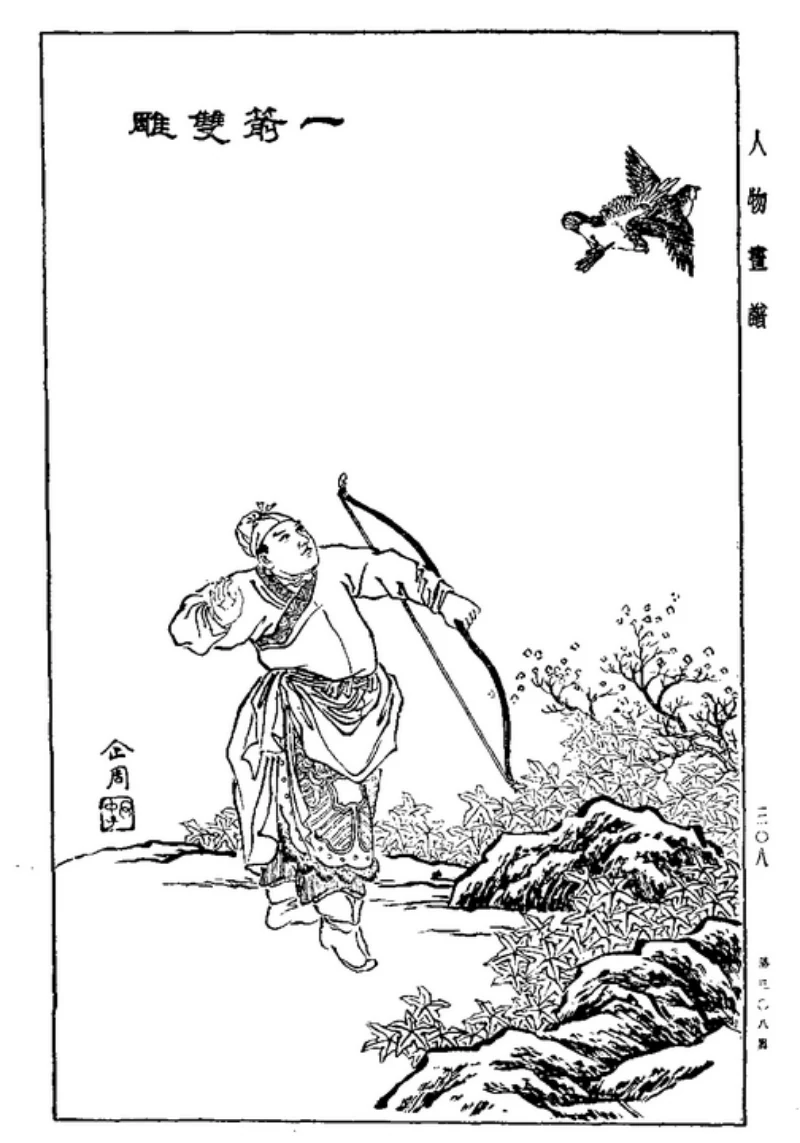
During one such grand expedition, an episode occurred that entered Chinese legend. As Ishbara and Zhangsun Sheng rode across the plateau, two massive steppe vultures were observed soaring in midair, violently clashing and tearing at a piece of flesh. The birds tumbled and wheeled in fierce combat. Seeking to test his guest's legendary marksmanship, Ishbara drew two arrows from his quiver, handed them to Zhangsun Sheng, and said with a challenging grin: "Please, shoot down these two beasts for me!" Zhangsun Sheng calmly took the arrows, spurred his charger forward, and waited for the split-second when the two grappling vultures locked claws and bodies in mid-flight. Drawing his composite bow to a full circle, he loosed a single arrow with thunderous power. With a sharp twang, the arrow pierced through both vultures simultaneously! Screeching in agony, the two massive birds crashed to the earth united by a single shaft.
The Khagan, Turkic princes, and hundreds of mounted warriors stood dumbfounded in awe before erupting into thunderous adulation. Ishbara was overjoyed and immediately issued orders across the royal court, commanding his sons, nephews, and tribal chieftains (erkins and tegins) to befriend Zhangsun Sheng and master his celestial archery techniques. From this historic event arose the enduring Chinese idiom "shooting two vultures with one arrow" (Yi Jian Shuang Diao).
Crucially, Zhangsun Sheng never lost sight of his supreme strategic mission. Ishbara's younger brother, Chuluohou (bearing the title Tuli Shad), was a man of deep calculation who enjoyed immense popularity among the nomadic rank-and-file. Consequently, Ishbara harbored intense jealousy and suspicion toward him. Sensing impending mortal danger from his brother, Chuluohou secretly dispatched trusted agents to form a sworn brotherhood with Zhangsun Sheng, confiding all intimate tribal grievances. Utilizing his extensive hunting expeditions across thousands of miles of plateau, Zhangsun Sheng painstakingly investigated every strategic mountain pass, river crossing, hidden water source, fertile pasture, tribal feud, and troop deployment throughout both eastern and western wings of the Turkic empire, committing this invaluable cartographic and human intelligence indelibly to memory.
In early 581, Zhangsun Sheng returned to the capital. By then, Yang Jian had received the abdication of the Zhou monarch, establishing the Sui Dynasty as Emperor Wen. Zhangsun Sheng immediately requested a private imperial audience, revealing every geographic obstacle, tribal rift, and strategic vulnerability of the steppe. Overjoyed, Emperor Wen promoted him to Commandant of Imperial Carriages, elevating him to the inner circle of northern frontier strategy.
The Grand Memorial: Befriending the Distant and Alienating the Strong
In the winter of 581 (the first year of Kaihuang), news of Sui's founding provoked outrage in the northern wilderness. Citing his duty to avenge his wife Princess Qianjin's Zhou imperial house, Ishbara Khagan declared to his assembled lords: "I am the son-in-law of the House of Zhou. Now Yang Jian usurps the throne. If I cannot exterminate this rebel, with what face can I gaze upon the Empress?" Allied with Gao Baoning, a rebellious former Northern Qi general holding Yingzhou, Ishbara captured Linyu Pass (east of modern Funing, Hebei) and forged an alliance among all steppe khagans, preparing a catastrophic invasion of hundreds of thousands of iron horsemen to storm Chang'an.
The newborn Sui Empire faced an existential military emergency. Emperor Wen mobilized millions of laborers to hastily repair the Great Wall, dispatched grand garrisons under Yin Shou to Youzhou and Yu Qingze to Bingzhou, and deployed tens of thousands of troops across Linyao, Wuwei, and Yifubo. Yet linear static defense along a multi-thousand-mile front was ruinously expensive and strategically untenable against hyper-mobile nomadic cavalry.
At this critical juncture, Zhangsun Sheng submitted his historic Master Memorial on Alienating the Strong and Rallying the Weak (Li Qiang He Ruo Shu). Drawing upon his firsthand intelligence, he demonstrated that the seemingly monolithic Turkic Khaganate was internally fractured into bitter personal and generational feuds. Ishbara (Shetu), though nominally Great Khagan of the east, was militarily surpassed by his western uncle, Tardush Khagan (Dianjue), who ruled the vast Western Regions; Apa Khagan (Daluobian), son of Muqan Khagan, was fierce and resentful over his denial of the supreme throne due to his mother's common birth; and Chuluohou commanded widespread loyalty while living under constant threat of assassination by Ishbara. All four khagans commanded vast armies, feigning external brotherhood while plotting mutual destruction.
Zhangsun Sheng articulated the classic sixteen-character geopolitical formula: "Befriend the distant while attacking the near, alienate the strong while rallying the weak." Specifically, he advised:
- "Befriend the Distant": Cultivate Tardush Khagan in the far west through lavish diplomatic honors and gifts, isolating Ishbara from western reinforcement;
- "Attack the Near": Meet Ishbara's direct border incursions with resolute defensive attrition;
- "Alienate the Strong and Rally the Weak": Stoke the simmering suspicions between Ishbara, Apa, and Chuluohou, extending imperial patronage to the weaker factions to ensure no single nomad leader could command absolute dominance.
Zhangsun Sheng prophesied: "Through this calculated statecraft, within a decade their brotherly bonds will dissolve into internecine slaughter. When their strength is exhausted by internal bloodshed, a single expeditionary stroke by our imperial armies will pacify the northern frontier forever!"
Emperor Wen studied the memorial with rapt astonishment and summoned Zhangsun Sheng to an intimate imperial council. There, Zhangsun vividly recited enemy troop strengths and sketched out mountain passes, river valleys, and tribal borders on paper with consummate precision. Emperor Wen sighed in admiration: "Zhangsun's intellect surpasses an army of one hundred thousand!" The Emperor adopted his blueprint without reservation, appointing him General of Chariots and Cavalry to direct the clandestine fragmentation of the Turkic world.
Emperor Wen dispatched Grand Master of the Imperial Stud Yuan Hui westward along the Yiwu route to present Tardush Khagan with the ultimate nomadic honor: a Wolf-head Golden Banner (Langtou Dao), showering him with imperial flattery. When Tardush sent reciprocal envoys to Chang'an, Emperor Wen deliberately seated them above the ambassadors of Ishbara. News of this diplomatic slight infuriated Ishbara, who immediately suspected Tardush of treasonous collusion with Sui. Simultaneously, Zhangsun Sheng rode eastward along the Huanglong route with vast treasures of gold and silk, securing the allegiance of the Xi, Xi (Shiwei), and Khitan tribes as scouts, covertly contacting Ishbara's brother Chuluohou to forge an anti-Ishbara alliance. The grand diplomatic web was cast.
Fracturing the Khaganate: The Civil War of Ishbara, Tardush, and Apa
In 582 (the second year of Kaihuang), Ishbara gathered the united forces of the steppe, launching hundreds of thousands of cavalry across the Sui frontier. Longxi, Bingzhou, and Youzhou fell into dire peril. Intent on a knockout blow, Ishbara urged Tardush to join him in sweeping across the Great Wall to sack Chang'an. However, deeply swayed by Sui's flattering diplomacy and reluctant to bleed for his eastern rival, Tardush flatly refused to advance further and withdrew his western hosts.
Perceiving Ishbara's vulnerability and rear anxiety, Zhangsun Sheng executed a masterful piece of psychological warfare. He secretly approached Ishbara's nephew Rangan (later Qimin Khagan) with gifts and strategic counsel, inducing Rangan to dispatch couriers galloping to Ishbara's main camp with a fabricated alarm: "The Tiele tribes in our northern rear have revolted in collusion with Northern Zhou remnants, launching a surprise assault on the main royal yurt! If we do not return immediately, our home tribes will be annihilated!" Terrified of losing his base, Ishbara abandoned his southern march and beat a panicked retreat back beyond the northern sands. The existential threat to Sui was averted without pitched battle.
In the fourth month of 583 (the third year of Kaihuang), suffering severe livestock famine from steppe droughts, the Turkic khagans invaded again. Emperor Wen unleashed an eight-pronged counter-offensive commanded by supreme marshals including Yang Shuang (Prince of Wei), Yang Hong, Doulu Ji, and Dou Rongding.
Zhangsun Sheng served as vanguard advisor under Dou Rongding, whose 30,000 foot and horse engaged Apa Khagan at Gaoyueyuan in Liangzhou. Dou Rongding's forces fought with ferocious discipline, repeatedly routing Apa's forces. Shattered and disoriented, Apa's army fell into despair.
Seizing this moment, Zhangsun Sheng unleashed his fatal psychological maneuver. He sent an eloquent emissary into Apa's encampment to deliver a chilling message: "Whenever Shetu (Ishbara) raids the frontier, he returns laden with booty and captives. Yet the moment you, Great Khagan Apa, set foot on Chinese soil, you suffer crushing defeats. This is not merely personal disgrace, but the humiliation of your entire warrior lineage! Furthermore, your forces were once equal to Shetu's. Today, he boasts of triumphs while you return empty-handed and broken. Shetu is notoriously jealous and cruel; he will inevitably pin the blame for the entire war on your head, seize this pretext to exterminate your northern yurts, and massacre your sons! Ask yourself: with your decimated ranks, can you survive Shetu's vengeance?"
Apa trembled in terror and sent a secret courier to Zhangsun Sheng, pleading for salvation. Zhangsun advised: "Tardush has already formed an unbreakable pact with our Great Sui Emperor, and Shetu dares not touch a hair on his head. Why do you not likewise pledge fealty to our August Sovereign? By allying with Tardush in the west and leaning upon Great Sui in the south, you will stand invincible! Why return to suffer execution and butcher at Shetu's hands?"
Apa was thoroughly convinced. He halted all military actions, garrisoned his troops along the frontier, and sent his trusted chieftains following Zhangsun Sheng to Chang'an to prostrate before Emperor Wen.
Meanwhile, Ishbara's main army suffered a catastrophic defeat against Marshal Yang Shuang at Baidaochuan. As Ishbara retreated across the sands, he received reports that Apa had suffered defeat in Liangzhou and had secretly dispatched envoys to submit to Sui! Long harboring deep paranoia toward Apa's martial reputation, Ishbara flew into an uncontrollable rage. Betraying all tribal conventions, Ishbara turned his army northward, launching a treacherous dawn assault upon Apa's ancestral homeland. Ishbara captured Apa's encampment, butchered Apa's elderly mother, and enslaved his wives, children, and herds.
When Apa learned on his march home that his mother had been murdered and his clan enslaved, he wailed in inconsolable anguish. Left with merely a few thousand riders, Apa galloped west to seek refuge with Tardush Khagan. Outraged by Ishbara's barbaric cruelty, Tardush granted Apa an army of over 100,000 western shock cavalry, dispatching him to exact bloody vengeance. Bolstered by Tardush's mighty host, Apa rallied tens of thousands of scattered loyalists, launched counter-offensives against Ishbara, recaptured his lost territories, and inflicted repeated defeats upon Ishbara's forces.
Through Zhangsun Sheng's brilliant orchestration of "alienating the strong and rallying the weak," the formidable First Turkic Khaganate fractured irretrievably into the Eastern Turkic Khaganate (under Ishbara) and Western Turkic Khaganate (under Tardush and Apa). The steppe descended into decades of bloody, fratricidal civil war, completely removing the northern threat from the borders of China.
Vassal Submission of Ishbara and Preserving Apa
Pummeled by the joint onslaught of Apa and Tardush, Ishbara found his domain shrinking and his power broken. Driven to desperation, he turned to the Sui Empire for survival, dispatching ambassadors to Chang'an in 584 (the fourth year of Kaihuang) to plead for vassal status and military assistance.
To formalize this submission, Emperor Wen sent Yu Qingze as chief envoy and Zhangsun Sheng as vice-envoy to Ishbara's royal camp. The Emperor bestowed the imperial Yang surname upon Princess Qianjin, granting her the new title "Princess Dayi," along with massive gifts of silk and gold. At the formal edict-reading ceremony, Ishbara attempted to cling to his imperial pride, standing aloof and refusing to perform prostrations before the Chinese emperor's decree. Yu Qingze's repeated demands were met with stony silence, while Turkic chieftains gripped their scimitars in tense standoff.
Zhangsun Sheng stepped forward with calm authority, addressing Ishbara: "The Great Turkic Khaganate and the Great Sui Empire are both supreme realms under Heaven. If this were purely an affair between two rival emperors, your refusal to kowtow would be understandable, and we would not presume to compel you. However, Princess Dayi is the formally adopted daughter of our August Emperor. In marrying the Princess, Great Khagan, you are the son-in-law of our Sovereign! Where under Heaven does a son-in-law receive the formal commands of his father-in-law while standing upright in arrogance? Does Turkic custom completely disregard filial duty and familial hierarchy?"
Disarmed by Zhangsun's irrefutable logic and sharp wit, Ishbara laughed aloud and remarked to his assembled lords: "The Chinese envoy Zhangsun speaks true! A son-in-law must pay homage to his father-in-law. I shall prostrate!" He promptly straightened his robes, fell to his knees, and performed reverent prostrations toward the south. Through diplomatic brilliance, Zhangsun Sheng secured absolute imperial prestige without shedding a drop of blood. Upon his return, Emperor Wen promoted him to Yitong Sansi and General of Chariots and Cavalry in the Left Meritorious Guard.
In the seventh month of 585, hard-pressed by Western Turks, Ishbara formally submitted as a vassal to Sui, adopting the imperial calendar. The northern frontier was completely secured. With northern peace assured, Emperor Wen mobilized the empire's full military and economic might toward the south, culminating in the triumphant conquest of the Chen dynasty in 589, reunifying China after four centuries of division.
In 587 (the seventh year of Kaihuang), Ishbara died. Acknowledging his younger brother Chuluohou's immense prestige, he bequeathed the throne to him as Mohuo Khagan. The Turks requested imperial confirmation. Emperor Wen dispatched Zhangsun Sheng bearing the imperial tally and ceremonial drums to invest Mohuo Khagan and confer the title of Yabgu upon Ishbara's son Yonglü.
Mohuo Khagan was profoundly grateful. At that time, Apa Khagan had suffered setbacks, hiding with five or six thousand cavalry in deep mountain gorges. Mohuo proposed to Zhangsun Sheng: "Apa is forsaken by Heaven. If the General grants permission, I shall capture him and present him in chains to the Sui Emperor!" Zhangsun Sheng galloped an urgent courier to Chang'an. At court, Duke Le'an Yuan Xie argued for immediate execution, while Duke Wuyang Li Chong urged public decapitation in Chang'an.
Zhangsun Sheng submitted a contrary grand strategy from the frontier: "Barbarians can only be subdued through timing and balance. The present war is a family feud; Apa's crime was never active rebellion against Sui, but self-preservation. To annihilate him in his destitution violates imperial benevolence toward distant peoples, and worse, it will leave Mohuo in sole, absolute dominion over the steppe, recreating a northern menace! It is far wiser to 'preserve both factions,' maintaining an equilibrium of mutual suspicion between Mohuo and Apa." Left Vice Director Gao Jiong enthusiastically endorsed this view. Emperor Wen concurred. Utilizing the imperial flags granted by Sui, Mohuo advanced west; Apa's demoralized troops surrendered without resistance, and Apa was taken captive, leaving the steppe fragmented and reliant upon Sui arbitration.
Exposing Princess Dayi and Neutralizing Espionage
In the eleventh month of 588, Mohuo Khagan fell in battle during a western expedition, and Yonglü succeeded as Dulan Khagan. Zhangsun Sheng was sent bearing treasures captured from the fallen Chen court to offer condolences and display imperial might. He was ennobled as Duke of Jinshan County.
Yet beneath this calm surface, dangerous treason brewed. Princess Dayi, daughter of the Northern Zhou royal house, harbored deep hatred for the Sui dynasty that had deposed her clan. Following the conquest of Chen in 589, Emperor Wen presented her with a magnificent painted screen belonging to the deposed Chen ruler. Overcome by grief and bitter memory, the Princess composed an infamous lament upon the screen, ending with: "Prosperity and decline are like morning and evening, the world drifts like duckweed... Only the ancient grudge of my lost realm endures forever in my weeping heart!"
In 593 (the thirteenth year of Kaihuang), a Chinese fugitive named Yang Qin from Yan'an fled to Dulan Khagan's court. Seeking wealth, Yang Qin falsely informed Princess Dayi: "Duke Peng Liu Chang and loyalists of the Yuwen clan in Chang'an are secretly plotting a rebellion to overthrow Sui. They dispatched me to forge an alliance with the Khagan, pleading for steppe cavalry to strike in coordination to restore the Great Zhou!" Overjoyed, Dayi believed every word, persistently urging Dulan Khagan to cease tribute to Sui and plotting with senior chieftain An Suijia to unleash war.
Dulan Khagan halted all tribute missions, and northern border tensions escalated rapidly. Detecting anomalies, Emperor Wen dispatched Zhangsun Sheng to investigate. Upon arriving at the royal yurt, Zhangsun observed Princess Dayi's insolent language and evasive behavior. Returning to Chang'an, he briefed the Emperor. Furious, Emperor Wen sent Zhangsun Sheng back with an ultimatum demanding the extradition of Yang Qin.
Dulan and Princess Dayi attempted to conceal the fugitive, deceitfully claiming: "We have searched every tent in the royal camp; no such person exists." Zhangsun Sheng feigned belief, but secretly mobilized the vast intelligence network he had established decades earlier. Bribing a close counselor of Dulan with massive sums of gold, Zhangsun discovered Yang Qin's exact hiding yurt.
That night, Zhangsun Sheng led a squad of elite imperial guards in a daring raid, capturing Yang Qin in his bed and hauling him bound into Dulan Khagan's assembly hall! Confronted by undeniable living evidence, Zhangsun unleashed a fierce verbal indictment of Dulan's bad faith. Dulan blushed in profound humiliation, while the entire Turkic nobility viewed the exposure as a supreme disgrace. Broken by Zhangsun's diplomatic siege, Dulan surrendered conspirators including An Suijia to Zhangsun's custody.
Returning to Chang'an in triumph, Zhangsun Sheng was elevated to Kai-fu Yitong Sansi. Princess Dayi was subsequently executed by imperial order. Through peerless intelligence mastery, Zhangsun Sheng extinguished a brewing steppe holocaust in its cradle.
Patronage of Qimin Khagan and Founding of Border Cities
Following Princess Dayi's death, Dulan Khagan grew resentful and, threatened by Western Turks, requested another imperial marriage alliance. While most court ministers favored compliance, Zhangsun Sheng delivered a prophetic dissent.
Zhangsun argued: "Yonglü (Dulan) is treacherous, fickle, and deceitful. He leans upon our Empire today solely because of his blood feud with Tardush. Should we bestow a princess upon him, he will exploit imperial prestige to intimidate Tardush and Rangan, absorbing their tribes. Once his wings are fully grown, he will inevitably rebel, and he will be impossible to control! Conversely, Rangan (son of Mohuo) has demonstrated absolute loyalty for two generations. When I met him previously, he passionately pleaded for marriage. We should grant Rangan an imperial bride, encouraging his tribe to migrate south toward our frontier! His numbers are small and easy to manage; by elevating the weak Rangan against the arrogant Dulan, we create an eternal northern shield for our empire!"
Emperor Wen praised his strategic insight, rejecting Dulan and consenting to marry imperial scion Princess Anyi to Rangan. In 597 (the seventeenth year of Kaihuang), Zhangsun Sheng escorted the Princess to the steppe, successfully guiding Rangan's tribe to settle in Baidaochuan (north of modern Hohhot, Inner Mongolia), creating a loyal buffer screen along the Great Wall.
This masterstroke upended the nomadic balance of power. Infuriated by Sui's open patronage of Rangan, Dulan Khagan allied with his former nemesis Tardush, launching an overwhelming invasion to wipe out Rangan. In 599 (the nineteenth year of Kaihuang), the combined khagan armies shattered Rangan at Baidaochuan. Rangan's brothers were killed, and he fled into the night with only a handful of horsemen.
Anticipating this crisis, Zhangsun Sheng led light cavalry on a forced march of hundreds of miles, intercepting the desperate fugitive along the Yellow River. Rescuing Rangan, Zhangsun escorted him safely across the river to Chang'an.
Emperor Wen welcomed Rangan with grand honors, investing him as Yilizhendou Qimin Khagan, granting him imperial treasures, and settling his people between Xiaozhou and Shengzhou. For his monumental role, Zhangsun Sheng was appointed General of the Left Capital Guard.
To permanently transform the unstable, migratory nature of nomadic populations, Zhangsun Sheng proposed an epochal policy: building fortified cities to settle nomadic tribes. He surveyed the northern frontier and directed the construction of Jinhe and Dali cities (near modern Helinger and Tuoketuo, Inner Mongolia). These formidable walled fortresses were equipped with granaries, administrative offices, and surrounded by fertile pastures. Zhangsun gathered scattered steppe refugees, providing farming tools, livestock, and instruction in Chinese laws and settled agriculture. This provided Qimin with an unassailable bastion and integrated nomadic society with Chinese civilization, pushing Sui's strategic frontier hundreds of miles to the north.
Destruction of Tardush and Unification of the Steppe
In 600 (the twentieth year of Kaihuang), Dulan and Tardush launched another desperate offensive toward Chang'an and Dali City. Emperor Wen ordered a massive counter-strike under Prince Yang Guang, with Zhangsun Sheng serving as Expeditionary General alongside legendary commanders Shi Wansui and Yang Su. At Baidao, Shi Wansui obliterated the enemy vanguard, and Dulan was assassinated by his own mutinous subordinates during the chaotic retreat.
Following Dulan's demise, Tardush proclaimed himself "Buka Khagan," absorbing Dulan's tribes and reaching the height of nomadic arrogance. In 601 (the first year of Renshou), Tardush mobilized 200,000 horsemen in a massive campaign to annihilate Qimin and breach the Sui frontier. Outnumbered, Qimin retreated into Dali City under severe siege.
Zhangsun Sheng maintained calm resolution on the front lines, directing stubborn defensive resistance while requesting reinforcements. In 602 (the second year of Renshou), Emperor Wen dispatched Grand Marshal Yang Su with a relief army, with Zhangsun Sheng leading the vanguard and guiding the operational strategy.
During this decisive campaign, Zhangsun Sheng devised a stratagem of breathtaking ingenuity. Advancing deep into the arid sands, Sui forces faced a hyper-mobile enemy of 200,000 cavalry. Surveying the barren landscape, Zhangsun knew that vast nomadic armies were entirely dependent on a few known desert springs and waterholes to water their mounts.
Zhangsun selected dozens of elite cavalry squads carrying potent indigenous herbal poisons, infiltrating behind enemy lines under cover of night to poison the essential springs and marshlands along Tardush's advance route. When Tardush's thirsty vanguard arrived and drank greedily from the waters, men and horses perished in agony by the thousands, leaving the wilderness strewn with carcasses. Highly superstitious, the nomadic warriors believed that the Chinese Emperor commanded divine spirits that had placed a fatal curse upon their army. Panic and mutiny swept through Tardush's ranks.
Seizing this psychological collapse, Zhangsun Sheng and Yang Su unleashed their heavy cavalry in a devastating assault. The Sui army routed the disorganized masses, beheading thousands and capturing over 100,000 horses and livestock. Tardush was utterly ruined; abandoned by his followers, he fled west to Tuyuhun in Qinghai, disappearing into historical oblivion.
With Tardush destroyed, the vast steppe from the Gobi to the Altai Mountains lay pacified. Chieftains and lords from every corner rushed to submit to the Sui court. Under Zhangsun Sheng's guidance, Qimin Khagan unified the entire Eastern Turkic steppe under absolute Sui suzerainty. Unlike former hostile khagans, Qimin was profoundly grateful to Sui and Zhangsun Sheng, remaining an unwaveringly loyal tributary vassal and securing over two decades of unbroken northern peace.
Imperial Tour to Yulin and Peaceful Demise
In 604, Emperor Wen passed away and Emperor Yang ascended the throne. Revering Zhangsun Sheng's veteran stature, Emperor Yang appointed him General of the Right Valiant Guard (You Xiaowei Jiangjun), entrusting him with palace security and northern frontier diplomacy.
In 607 (the third year of Daye), seeking to project imperial majesty across the northern wilderness, Emperor Yang embarked upon a grand imperial progress across the northern steppe. Zhangsun Sheng oversaw all logistics and diplomatic protocols. When the imperial entourage reached Yulin (modern Inner Mongolia), Qimin Khagan arrived with his queen, princes, and tens of thousands of tribal chieftains to pay homage.
In a magnificent imperial yurt, Qimin knelt before Emperor Yang, holding a golden chalice with both hands and advancing on his knees to offer wine in profound submission. Qimin even petitioned Emperor Yang to permit his people to discard their nomadic dress and adopt Chinese robes and caps, pledging to guard the northern frontier as eternal vassals.
Gazing upon the vast pacified steppe, Emperor Yang turned to his chief counselor Yu Shiji and remarked with heartfelt admiration: "In the days of Northern Zhou, the barbarians were arrogant and insatiable, raiding our heartland despite yearly tributes! Today, the Khagan prostrates in submission and the frontier knows no warfare. This is entirely the fruit of General Zhangsun's two decades of tireless statecraft! General Zhangsun's intellect alone is worth more than an army of one million men!" Emperor Yang rewarded him with ten thousand taels of gold and ten thousand bolts of silk.
Years of harsh frontier campaigns and desert exposure took their toll on Zhangsun Sheng's health. In 609 (the fifth year of Daye), Zhangsun Sheng passed away peacefully at his private residence in Luoyang at the age of fifty-eight.
News of his death brought deep grief to Emperor Yang, who issued an imperial decree honoring his family and posthumously conferring the high office of Grand Minister of Works (Sikong). In the northern steppe, Qimin Khagan wept bitterly facing south and erected a sacrificial shrine in his honor.
Zhangsun Sheng's legacy shone even brighter in subsequent generations. His daughter, Empress Wende (Empress Zhangsun), married Li Shimin (Emperor Taizong of Tang) and became celebrated as one of the most virtuous and influential empresses in Chinese history, fostering the golden "Reign of Zhenguan." His youngest son, Zhangsun Wuji, served as chief architect of the Tang founding, top-ranked hero of the Lingyan Pavilion, Chancellor, and Duke of Zhao.
Upon ascending the throne, Tang Emperor Taizong honored his late father-in-law's historic achievements in pacifying the northern barbarians, posthumously bestowing the titles Grand Pillar of State, Duke of Qi, Grand Tutor (Taiwei), and Grand Minister of Works (Situ), with the honorable posthumous name "Xian" (The Dedicated). Zhangsun Sheng's legacy as the supreme master of steppe grand strategy remains permanently enshrined in the annals of Chinese history.
Major Activities
Strategic Geopolitical Doctrine: Alienating the Strong and Rallying the Weak
Zhangsun Sheng ranks among the foremost grand strategists in Chinese history. His supreme theoretical and practical masterpiece was the formulation of "befriending the distant and attacking the near, alienating the strong and rallying the weak" (Li Qiang He Ruo, Yuan Jiao Jin Gong).
Confronted with the overwhelming military might of the First Turkic Khaganate, Zhangsun rejected crude, symmetric attrition warfare. Instead, he exploited the inherent fragility of nomadic confederacies, treating geographic distance and tribal power balance as strategic variables. Toward the distant but mighty Tardush, he practiced "befriending the distant," elevating his status with imperial banners to provoke eastern jealousy; toward the predatory Ishbara, he practiced "attacking the near" through resolute defense; toward vulnerable factions like Apa, Chuluohou, and Qimin, he practiced "alienating the strong and rallying the weak," binding them to Sui through dynastic marriages and material aid. This strategy permanently bifurcated the Turkic Empire into warring Eastern and Western divisions, neutralizing nomadic aggression for generations.
Steppe Cartography and Military Intelligence Network
Zhangsun Sheng was the earliest Chinese grand strategist to conduct systematic, empirical military cartography across the vast steppe. During his year-long stay in 580, he utilized hunting expeditions to traverse thousands of miles, mapping strategic corridors, mountain passes across the Yin Mountains, and crucial desert waterholes.
This intelligence apparatus proved decisive in every subsequent northern campaign. When eight field marshals counter-attacked in 583, they operated under Zhangsun's cartographic guidance. In 602, his exact knowledge of desert hydrology enabled the fatal "poisoned springs" stratagem that routed Tardush's 200,000 cavalry. Zhangsun's reconnaissance doctrines and use of indigenous scouts established the operational standard for Sui and Tang imperial cavalry expeditions.
Border Fortification and Vassal Governance Systems
Transcending the historical dilemma between ruinous foreign conquest and humiliating appeasement, Zhangsun Sheng pioneered an integrated vassal governance model based on border fortresses and settled pastoralism.
When Qimin Khagan fled south in destitution, Zhangsun directed the construction of Jinhe and Dali cities along the strategic northern loop. He settled nomadic tribes around these fortresses, introducing Chinese agricultural tools, irrigation methods, and legal structures. This transformed volatile migratory horsemen into settled, loyal frontier guardians, advancing Sui's defense line hundreds of miles into the steppe and laying the direct structural foundation for the Tang Dynasty's Jimi (loose-rein) administrative prefecture system.
Personal Relations
| Relationship | Name | Identity / Description |
|---|---|---|
| Great-Grandfather | Zhangsun Zhi | Grand Tutor, Overseer of the Department of State Affairs, and Prince Wenxuan of Shangdang in Northern Wei; titan of the state |
| Grandfather | Zhangsun Yu | Marquis of Pingyuan in Northern Zhou |
| Father | Zhangsun Si | Kai-fu Yitong Sansi, Duke of Xue in Northern Zhou; governor of Xiong and Jiang commanderies |
| Eldest Brother | Zhangsun Chi | Right Vice Director of Department of State Affairs under Sui; renowned scholar and statesman |
| Second Brother | Zhangsun Chang | Senior official in Sui and Tang; attained rank of Kai-fu Yitong Sansi and Duke of Pi |
| Wife | Lady Gao | Primary wife; daughter of Northern Qi Prince of Le'an Gao Mai; mother of Empress Wende and Zhangsun Wuji |
| Eldest Son | Zhangsun Xingbu | Eldest son (by earlier marriage); killed in action during Prince of Han Yang Liang's rebellion against Yang Su |
| Second Son | Zhangsun Hengan | Second son (by earlier marriage); served as Eagle-Shooting Commandant (Yingyang Langjiang) |
| Third Son | Zhangsun Anye | Third son (by earlier marriage); expelled Lady Gao and young Wuji after his father's death; later Tang General of Palace Gate |
| Fourth Son | Zhangsun Wuji | Youngest son (born to Lady Gao); prime minister of Tang, first-ranked hero of Lingyan Pavilion, Duke of Zhao |
| Daughter | Empress Wende | Daughter (born to Lady Gao); empress of Tang Emperor Taizong (Empress Zhangsun); paragon of imperial virtue |
| Sovereign Patron | Emperor Wen of Sui (Yang Jian) | Founding Emperor of Sui; discovered Zhangsun in the palace guard and adopted his steppe grand strategy |
| Sovereign Admirer | Emperor Yang of Sui (Yang Guang) | Second Emperor of Sui; appointed Zhangsun General of Right Valiant Guard; praised him as worthier than a million troops |
| Steppe Ally | Qimin Khagan (Rangan) | Turkic Khagan fostered by Zhangsun Sheng; key nomadic ally who unified the Eastern steppe under Sui suzerainty |
| Diplomatic Adversary | Ishbara Khagan (Shetu) | Great Khagan of Eastern Turks; impressed by Zhangsun's archery, later fatally divided by his diplomatic maneuvers |
| Diplomatic Rival | Tardush Khagan (Dianjue) | Western Turkic Khagan; courted through "befriending the distant" and ultimately crushed by the poison water stratagem |
| Bitter Foe | Princess Dayi | Northern Zhou Princess Qianjin; plotted against Sui and was exposed and executed following Zhangsun's night raid |
Historical Assessment
- Yang Jian (Emperor Wen of Sui): "Young Master Zhangsun possesses peerless martial skills, and in conversing with him, I find he abounds in extraordinary strategic insight. Who else could be our empire's future grand commander if not this youth?"
- Yang Jian (Emperor Wen of Sui): "Zhangsun Sheng orally depicts strategic situations and sketches mountains and rivers with his hand, laying bare every Turkic vulnerability within his palm. In managing the northern wilderness with his plans, how could the four seas fail to be at peace!"
- Yang Guang (Emperor Yang of Sui): "In the days of Northern Zhou, the barbarians were arrogant and insatiable. Today, Qimin prostrates in submission and the frontier knows no warfare. This is entirely the fruit of General Zhangsun's two decades of statecraft. His intellect alone is worth more than an army of one million men!"
- Wei Zheng et al. (Book of Sui): "Zhangsun Sheng excelled in archery and missile marksmanship, possessing swift agility, quick intelligence, and profound strategy. His doctrine of befriending the distant and attacking the near, and alienating the strong while rallying the weak, fractured the Turks into mutual cannibalism, sweeping dust from the frontier and silencing border beacons. Even ancient masters like Tiaohou (Zhou Yafu) and Zhao Chongguo could not surpass him!"
- Li Yanshou (History of Northern Dynasties): "Zhangsun Jisheng wielded extraordinary stratagems with effortless grace. Shooting two vultures with one arrow spread his renown across foreign lands; a single word disarmed fierce barbarians and shook their dragon fortresses. His fostering of Qimin secured the northern marches, standing as a pillar of the realm and the master key to the northern gates!"
- Sima Guang (Zizhi Tongjian): "The Turks were mighty and numerous, commanding hundreds of thousands of bowmen whom China could not withstand. Sui inherited the frontier perils of Zhou. Zhangsun Sheng calculated enemy weaknesses and exploited their rifts, alienating the strong and rallying the weak, until the fierce nomads fractured into civil war and north-south division, leaving the barbarians permanently weakened. Sheng's strategic depth was profound and far-reaching!"
- Li Shimin (Emperor Taizong of Tang): "The Duke of Qi (Zhangsun Sheng) possessed peerless foresight and strategic calculation. Formulating grand strategies early in the Sui era, he crushed the ferocious arrogance of the northern nomads and protected millions of subjects. He was truly a heaven-sent talent of epochal merit!"
FIGURES ASSOCIATED WITH THIS DYNASTY
Bibliography
- Wei Zheng et al. Book of Sui (Sui Shu), Volume 51, Biography 16: Biography of Zhangsun Sheng. Beijing: Zhonghua Book Company, 1973.
- Li Yanshou. History of Northern Dynasties (Bei Shi), Volume 22, Biography 10: Biography of Zhangsun Sheng. Beijing: Zhonghua Book Company, 1974.
- Sima Guang, commentary by Hu Sanxing. Comprehensive Mirror in Aid of Governance (Zizhi Tongjian), Volumes 175–181: Annals of Sui. Beijing: Zhonghua Book Company, 1956.
- Zhou Weizhou. Studies on the History of Ethnic Relations in Northern China during the Han and Tang Dynasties. Xi'an: Sanqin Publishing House, 2003.
- Cen Zhongmian. Collected History of the Turks (Tujue Jishi). Beijing: Zhonghua Book Company, 1958.