Birth | Ögedei was born as a son of Genghis Khan and Börte.
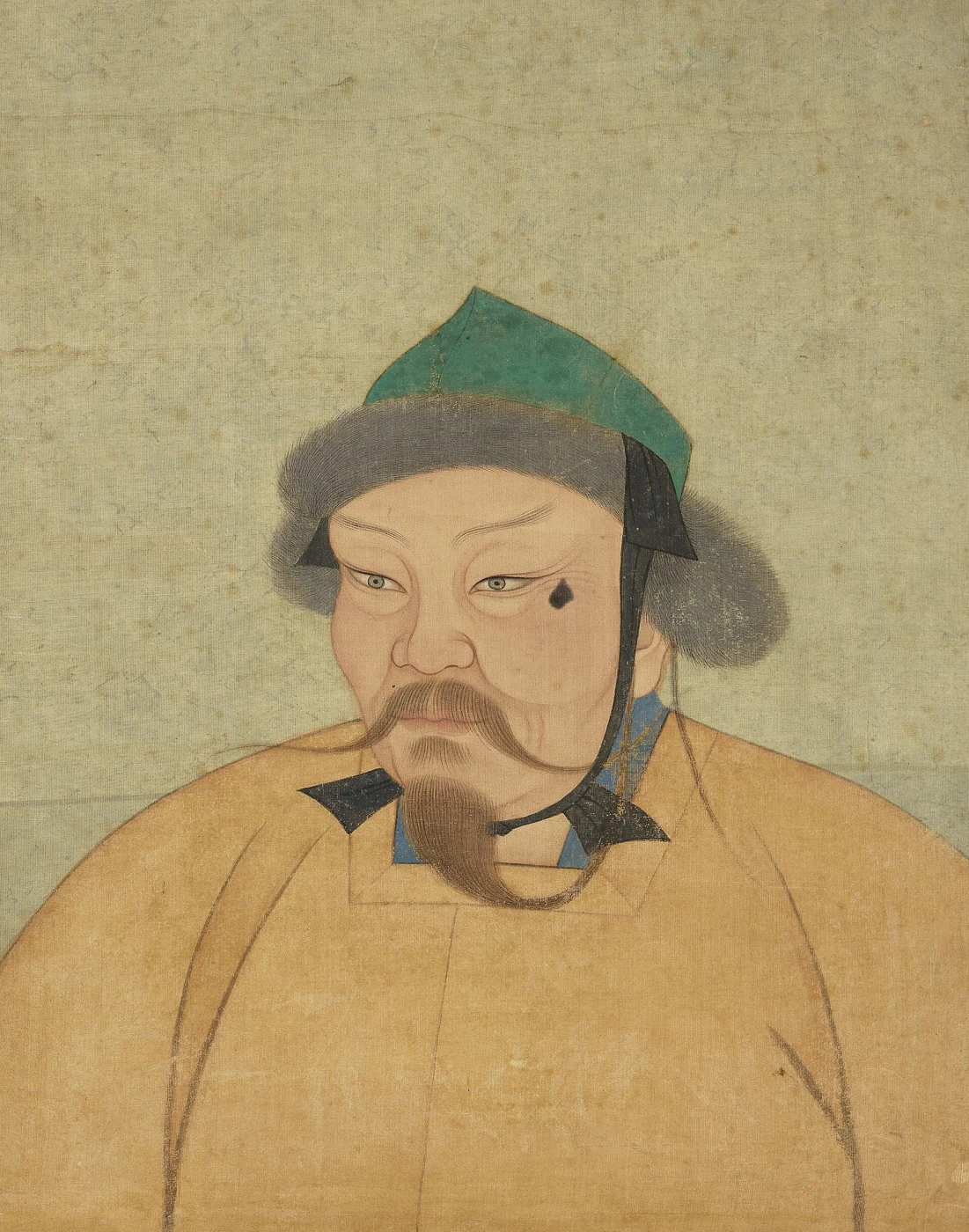
1186 CE–1241 CE
Second Great Khan of the Mongol Empire
Borjigin Ögedei
孛儿只斤·窝阔台
Borjigin Ögedei (November 7, 1186-1241), the third son of Genghis Khan, was the second Great Khan of the Mongol Empire. Before the first western campaign in 1219(14th year of Genghis Khan's reign), Genghis Khan selected him as successor after a dispute among his sons. In 1229(1st year of Ögedei's reign), Ögedei was elected Great Khan at a quriltai of the imperial princes. During his reign, he and his commanders continued the…
1186 CE–1241 CEYuan Dynasty
PROFILE
Borjigin Ögedei (November 7, 1186-1241), the third son of Genghis Khan, was the second Great Khan of the Mongol Empire. Before the first western campaign in 1219(14th year of Genghis Khan's reign), Genghis Khan selected him as successor after a dispute among his sons. In 1229(1st year of Ögedei's reign), Ögedei was elected Great Khan at a quriltai of the imperial princes. During his reign, he and his commanders continued the war against the Jin dynasty. In 1234(6th year of Ögedei's reign), Mongol and Southern Song forces jointly attacked Caizhou, and the Jin dynasty fell. He then ordered wars against the Southern Song and Goryeo and appointed Batu and other princes to lead the Second Mongol Western Campaign. Ögedei also established a Secretariat and taxation offices, reorganized household registration and fiscal levies, developed a postal-relay network, built Karakorum, and used enfeoffment and rewards to maintain relations among the princes. These measures expanded the administrative and transport capacity of the khan's court but also served sustained warfare and resource extraction. After his death in 1241, his wife Töregene Khatun ruled as regent, and his son Güyük became Great Khan in 1246. After the establishment of the Yuan Dynasty, Ögedei was posthumously honored as Emperor Taizong of Yuan and given the posthumous name Emperor Yingwen.
- Other names
- Ögedei; Ögödei; Qa'an (honorific)
- Period
- Mongol Empire
- Date of Birth
- November 7 1186
- Date of Death
- 1241 CE(13th year of the Wokuotaihan era)
- Dynasty/polity
- Mongol Empire; Yuan Dynasty (posthumous honors)
- Identity
- Second Great Khan of the Mongol Empire
- Place of birth
- Not clearly recorded in the available sources
- Place of death
- Mongol traveling camp; sources do not agree on the exact location
- Ethnicity
- Mongol
- Clan/tribe
- Borjigin clan
- Parents
- Father: Borjigin Temüjin (Genghis Khan); mother: Börte
- Reign
- September 13, 1229-1241
- Era name
- Did not use a Chinese-style era name during his lifetime
- Temple name
- Taizong (posthumously conferred by the Yuan Dynasty)
- Posthumous name
- Emperor Yingwen (posthumously conferred by the Yuan Dynasty)
- Predecessor
- Borjigin Temüjin (Genghis Khan)
- Successor
- Borjigin Güyük (after a regency by Töregene Khatun)
- Major achievements
- Completed the conquest of the Jin dynasty and expanded the Mongol Empire; established Karakorum as the khan's political center; reorganized taxation, household registration, postal relays, and local administration; ordered the Second Mongol Western Campaign and wars against the Southern Song and Goryeo
LIFE TIMELINE
Battle at Qalaqaljid Sands | Was wounded while fighting with Genghis Khan and escaped with the help of his commanders.
Campaign against Jin | Joined Jochi, Chagatai, and others in warfare against the Jin dynasty and captured prefectures north of the mountains.
Designated successor | Before the first western campaign, Genghis Khan decided after a dispute among his sons that Ögedei would succeed to the khanship.
CE(6th year of the Jiading era, Song; 1st year of the Zhenyou era
1213 CE(6th year of the Jiading era, Song; 1st year of the Zhenyou era, Jin) | Capture of Gurganj | After Jochi and Chagatai came into conflict, Ögedei was ordered to coordinate the siege; the Mongol army subsequently captured the city.
Death of Genghis Khan | Ögedei became the intended successor under his father's final arrangement, while Tolui temporarily acted as regent according to Mongol custom.
Accession as Great Khan | Elected by a quriltai of the imperial princes and succeeded to the khanship of the Mongol Empire.
CE(1st year of the Baoqing era, Song; 2nd year of the Zhengda era
1225 CE(1st year of the Baoqing era, Song; 2nd year of the Zhengda era, Jin) | Personal campaign against Jin | Mongol forces attacked the Jin by several routes, with Ögedei commanding the central army, and the war entered a new phase.
Siege of Bianjing after the Battle of Sanfengshan | Tolui's army defeated the main Jin forces and joined Ögedei, after which Subutai and others were ordered to besiege Bianjing.
September 13, 1229 CE(1st year of the Wokuotaihan era, 8th month, 24th day) | Establishment of schools and cultural institutions in North China | Ordered a school to be established at the Confucian Temple in Yanjing, with Mongol students studying Chinese and Han students studying Mongolian and archery; the same year, Kong Yuancuo was restored as Duke Yansheng.
CE(3rd year of the Shaoding era, Song; 7th year of the Zhengda er
1230 CE(3rd year of the Shaoding era, Song; 7th year of the Zhengda era, Jin) | Fall of the Jin dynasty | Mongol and Southern Song forces captured Caizhou; Emperor Aizong of Jin committed suicide and the Jin dynasty fell.
New phase of imperial expansion | A council of princes decided on the Second Mongol Western Campaign and military operations against the Southern Song and Goryeo, and construction began at Karakorum.
Household registration and enfeoffment | Completed a census in the former Jin territories, registering more than 1.1 million households, and then granted part of the registered population to princes and meritorious officials.
Wuxu selection examination | The court selected Confucian scholars for service in administration and education.
Adoption of tax farming | Employed Abd al-Rahman and other merchants to farm taxes in the Chinese territories, creating policy conflict with Yelü Chucai and others.
Death | Ögedei died, and Töregene Khatun began a regency while the succession remained unsettled.
Death of Yelü Chucai | Yelü Chucai was unable to maintain his policy program under the regency and died at Karakorum.
Accession of Güyük | Töregene Khatun's regency ended, and Ögedei's son Güyük became Great Khan through a quriltai.
Posthumous honors | Kublai conferred on Ögedei the temple name Taizong and the posthumous name Emperor Yingwen.
Death | In 1241(13th year of his reign), he went hunting again and attended a drinking banquet, then died in his traveling camp.
Yelü Chucai could no longer maintain some of his policy positions at court and died in 124 | Yelü Chucai could no longer maintain some of his policy positions at court and died in 1244 during the regency.
CE(the 1st year of the reign of Emperor Dingzong of the Mongol Em
1246 CE(the 1st year of the reign of Emperor Dingzong of the Mongol Empire) | In 1246(1st year of Güyük's reign) | In 1246(1st year of Güyük's reign), Güyük became Great Khan through a quriltai.
After the Yuan Dynasty was established | After the Yuan Dynasty was established, Kublai posthumously honored Ögedei in 1266(3rd year of Zhiyuan of Yuan) as Emperor Taizong of Yuan with the posthumous name Emperor Yingwen.
CE(3rd year of the Zhiyuan era, the Mongol Empire; 2nd year of th
1266 CE(3rd year of the Zhiyuan era, the Mongol Empire; 2nd year of the Xianchun era, Song) | After the Yuan Dynasty was established | After the Yuan Dynasty was established, Kublai posthumously honored Ögedei in 1266(3rd year of Zhiyuan of Yuan) as Emperor Taizong of Yuan with the posthumous name Emperor Yingwen.
Temple name Taizong conferred | He was posthumously honoured with the temple name Taizong.
BIOGRAPHY
Biography
Early Campaigns and Succession Arrangements Ögedei was the third son of Genghis Khan and Börte. he accompanied his father in warfare from a young age and was wounded in the 1203 battle at Qalaqaljid Sands, escaping under the protection of commanders including Boroqul. He later took part in campaigns against the Jin dynasty. In 1211(6th year of Genghis Khan's reign), he joined Jochi, Chagatai, and others in attacking the regions north of the mountains and subsequently continued campaigning inside Jin territory. These early military experiences made him an important participant in imperial military and political affairs among Genghis Khan's sons. Before the first western campaign in 1219(14th year of Genghis Khan's reign), Genghis Khan discussed the succession in front of his sons. Jochi and Chagatai quarreled over Jochi's parentage, after which Kökö Chos mediated. Chagatai then recommended Ögedei, describing him as steady in temperament and willing to accept instruction. Genghis Khan accepted this proposal and designated Ögedei as his successor. During the western campaign, Ögedei joined Jochi and Chagatai in besieging Gurganj, the capital of Khwarazm. Because his two elder brothers were in conflict, Genghis Khan ordered them to follow Ögedei's coordination. Ögedei restored cooperation among them, and Mongol forces captured the city in 1221(16th year of Genghis Khan's reign). After Genghis Khan died in 1227(22nd year of his reign), Ögedei was the intended successor under his father's arrangement, but the position of Great Khan still required formal election by the imperial princes. Tolui temporarily governed as regent according to Mongol custom. Ögedei returned to his appanage at Emil and waited for two years while princes and senior officials continued to negotiate the transfer of power. ### Accession and the War against Jin On September 13, 1229(24th day of the 8th lunar month, 1st year of Ögedei's reign), princes from the different branches of the imperial family assembled for a quriltai in the region of the Onon and Kherlen rivers and elected Ögedei Great Khan. Chagatai, Tolui, and other princes participated in the enthronement, Tolui offered him a ceremonial drink, and the assembly acclaimed him as Qa'an. Yelü Chucai argued during the ceremony for a more formal ruler-minister order. After his accession, Ögedei continued Genghis Khan's Yasa, pardoned some offenses committed before the assembly, and recognized power arrangements that had emerged during Tolui's regency in order to secure cooperation among the princely houses. Ögedei's principal military objective after taking power was the destruction of the Jin dynasty. In 1230(2nd year of his reign), Jin forces defeated a Mongol army at Dachangyuan, prompting Ögedei to decide on a personal campaign. Mongol armies initially attacked from Shaanxi, Hebei, and other directions, but the advance at Tong Pass was blocked and relief forces reached Weizhou, frustrating plans for a quick victory. Ögedei then adjusted the strategy. In 1231(3rd year of his reign), he again led the central army, captured Hezhong Prefecture, and crossed the Yellow River. Tolui's right-wing army moved through Southern Song territory into the Jin rear, while Anchen Noyan led the left wing in support. In the first lunar month of 1232(4th year of Ögedei's reign), Tolui's army defeated the main Jin force at the Battle of Sanfengshan. Ögedei then joined Tolui, and Subutai and others were ordered to besiege Bianjing. Mongol forces controlled Bianjing in 1233(5th year of Ögedei's reign), but Emperor Aizong of Jin escaped to Caizhou, so the war continued. On February 9, 1234(10th day of the 1st lunar month, 6th year of Ögedei's reign), combined Mongol and Southern Song forces captured Caizhou. Emperor Aizong of Jin committed suicide, and the Jin dynasty fell. During the conquest, Yelü Chucai opposed the massacre of Bianjing and argued that its population, artisans, and tax base should be preserved; Ögedei accepted this advice. That decision coexisted with the subsequent treatment of members of the Jin imperial clan and does not mean that the wider war was free of violence or destruction. After the fall of Jin, Southern Song forces moved north to recover the three former capitals in the operation known as the Duanping northern campaign; Mongol counterattacks then worsened relations, and the Mongol-Song war expanded. ### Expansionary Warfare and Princely Enfeoffment In 1235(7th year of Ögedei's reign), Ögedei convened a council of princes that planned the Second Mongol Western Campaign toward the Kipchak and Rus' lands, ordered his sons Köden and Köchü to attack the Southern Song from different directions, and continued pressure on Goryeo. Batu served as the senior prince commanding the western expedition, while Subutai and other generals directed major military operations. It would therefore be inaccurate to treat all of their battlefield decisions as personal campaigns by Ögedei. The western armies subsequently advanced into Eastern Europe, while Ögedei used princely councils to allocate troops, land, and resources. After the conquest of Jin, Ögedei's court carried out a household survey in the former Jin territories. In 1236(8th year of his reign), more than 1.1 million households were registered. Part of the population and land was then distributed as appanages to princes and meritorious officials. Yelü Chucai opposed arbitrary exactions by the princes and argued that the khan's court should collect revenue through its own officials and then distribute fixed shares. The Five-House Silk levy likewise allocated part of the fiscal burden between the central government and appanage holders. This limited the ability of grantees to control all revenue directly, but the enfeoffment of households still placed commoners within princely resource systems and added fiscal and labor burdens. Militarily, Ögedei expanded tamma troops, reorganized Chinese military units organized by tümen, and used these forces in western and eastern campaigns and local garrisons. Mongol armies continued attacks on Goryeo during his reign, demanding submission and members of the royal family as hostages. After the Goryeo court moved its capital to Ganghwa Island, it continued repeated resistance. Warfare against the Southern Song also persisted after the fall of Jin. Ögedei sent Köden and Köchü along separate routes, while Southern Song forces relied on the Yangtze and Huai defenses; the conflict alternated between Mongol advances and reverses. ### Administrative, Fiscal, and Cultural Development During Ögedei's reign, the khan's court began to develop from a temporary military-political staff into more regular institutions. Yelü Chucai and others participated in establishing the Secretariat and regional taxation offices. Central officials handled decrees, household registration, and taxation, while local cities received officials including darughachis. In Mongolia proper, the court established levies known as alban and qubchur. In the Chinese territories it used land taxes, poll taxes, commercial taxes, and taxes on salt and alcohol, and created taxation offices for ten circuits. Yelü Chucai advocated fixed taxation so as to preserve agricultural production and prevent cultivated Chinese land from being converted into pasture. Ögedei accepted this proposal but also expanded fiscal extraction to finance continuing warfare. In 1239(11th year of Ögedei's reign), despite Yelü Chucai's objections, Ögedei allowed Abd al-Rahman and other ortoq merchants to farm taxes in the Chinese territories. Tax farmers paid the court a fixed sum and then recovered their costs and profits through collection, linking state revenue to potentially high exactions by intermediaries. This policy conflicted with fixed taxation and with Yelü Chucai's preference for easing burdens on the population, showing that the court itself was divided over methods of taxation. Ögedei also granted appanages and annual gifts to princes. Such measures helped maintain the Mongol aristocratic coalition, but continual rewards and military expansion added to the empire's fiscal demands. Ögedei made Karakorum the political center of the khan's court. In 1235(7th year of his reign), he mobilized craftsmen from the Chinese territories and Central Asia to build the city and Wan'an Palace, and the palace was completed in 1236(8th year of his reign). For the postal-relay system, he appointed officials to manage stations and set rules for station households, relay horses, provisions, and travel passes, creating a network centered on Karakorum and linking the Chinese territories, Central Asia, and princely domains. Ögedei regarded the postal network as one of his major achievements. It increased the court's ability to move troops, transmit orders, and requisition supplies. The Ögedei court also supported Confucian education and cultural institutions. In 1233(5th year of his reign), it established a school at Yanjing in which Mongol youths studied Chinese and Chinese youths studied Mongolian, and it brought Kong Yuancuo back to inherit the title Duke Yansheng. In 1236(8th year of Ögedei's reign), the Yanjing Compilation Office and Pingyang Classics Office were established. In 1238(10th year of his reign), the court held the Wuxu selection examination and admitted more than four thousand Confucian scholars, who were then used in administrative and educational work; this examination system did not continue as a permanent regular institution. Ögedei also continued Genghis Khan's protection of multiple religions and used relief and tax reductions in disaster areas. These policies coexisted with continued requisitions, tax farming, and appanage grants. ### Final Years and the Succession after His Death Ögedei drank increasingly heavily in his later years. He once fell ill after a hunt and later temporarily recovered. In 1241(13th year of his reign), he went hunting again and attended a drinking banquet, then died in his traveling camp. Claims that he was poisoned remain unproven. This article follows the date jointly supported by the two sources and does not present any single cause of death as certain. After Ögedei's death, his senior khatun Töregene Khatun governed as regent, and the succession was not immediately resolved. Yelü Chucai could no longer maintain some of his policy positions at court and died in 1244 during the regency. In 1246(1st year of Güyük's reign), Güyük became Great Khan through a quriltai. After the Yuan Dynasty was established, Kublai posthumously honored Ögedei in 1266(3rd year of Zhiyuan of Yuan) as Emperor Taizong of Yuan with the posthumous name Emperor Yingwen.
His Name, His Early Battles, and His Marriage
Ogedei was the third son of Temujin and Borte, born three years before Temujin took the title of khan; his name means "ascent" or "upward" in Mongolian, though one account derives it from Old Turkic with the sense of "wise." He campaigned with his father from boyhood and first appears in the histories at the battle of Halahazhenshata in 1203: separated from Temujin in the fighting, he was wounded and had the clotted blood sucked from his wound by an officer, and at last with Borokhul and others he cut a way out through the encircling enemy and rejoined Temujin, who wept to see Borokhul come back carrying the wounded Ogedei in his arms. In the winter of 1204 Temujin destroyed the Merkit and brought the three clans of the Maigudan, Tuotuoli and Chahun under his rule; and finding among the captives a woman of beauty he asked who she was and learned that she was a chief's daughter of the Merkit, and gave her to Ogedei as a wife, by whom a son was born a year later. In 1206 Temujin was proclaimed Genghis Khan; and five years later, when Genghis Khan attacked the Jin in force, Ogedei with his elder brothers Jochi and Chagatai took Yunnei, Dongsheng, Wu and Shuo and other prefectures in separate commands. Two years later, when Genghis Khan attacked the Jin again in three columns, Ogedei and his two brothers formed the right army, going south along the Taihang mountains and taking the prefectures of Bao, Sui and Ansu in Hebei.
The Discussion of the Succession and the Coordination at Urgench
In 1219, before the western campaign, Yesui Khatun advised Genghis Khan to settle the succession first, and he called his sons to discuss it. Chagatai seized on the question of Jochi's blood and the two quarrelled violently; and after Kokochos had mediated, Chagatai turned to recommend Ogedei on the ground that he was "honest and open to correction." Genghis Khan agreed and assigned the appanages of Ogedei and Jochi; and Ogedei, in fear and trembling, accepted, saying that though he would do his utmost his sons might not be able to inherit. Genghis Khan therefore confirmed him as heir, adding that should Ogedei's sons be unable to inherit, sons of another branch might succeed to the khanate. In the western campaign Genghis Khan made Jochi commander with Chagatai and Ogedei as deputies against Urgench, the capital of Khwarezm; and when Jochi and Chagatai fell out so that the siege dragged on for months, Genghis Khan in anger ordered both to obey Ogedei, the Secret History of the Campaigns recording the order that "the army being assembled, let it be under the third prince's command." Ogedei met his two brothers daily and mediated between them, restoring the army's cohesion, so that the city was taken in the fourth month of 1221; and afterwards he and Chagatai led their commands to join Genghis Khan, who had taken the fortresses of Talikan, and marched on together. In the spring of 1225 he returned with his father to the Mongol homeland, the campaign having lasted seven years. In 1226, when Genghis Khan again campaigned in person against the Western Xia for breach of faith, and after breaking the main Xia army turned against the Jin, crossing the Yellow river, entering the Lintao circuit by Jishizhou and taking Jingzhao in the seventh month, he on his deathbed again affirmed that Ogedei should succeed, required his sons to swear in writing to be loyal to him, and arranged that his youngest son Tolui should inherit the great ordo according to Mongol custom.
His Election, Accession, and First Institutions
The Mongol throne had to be confirmed by an assembly of princes, and so Ogedei, after the destruction of Western Xia, returned to his appanage at Emil and waited two years. In the autumn of 1229, when the horses were fat, the princes of all the branches gathered at the great ordo at the source of the Onon for a quriltai; and they feasted for forty days together, so that "the matter was still undecided." Yelü Chucai told the regent Tolui that this was the great business of dynasty and state and should be settled early, and when Tolui still wished to delay he insisted that "after this there will be no auspicious day"; and so Ogedei, after some demur, went through the Mongol rites of being raised on the felt and the worship of the sun, with Chagatai holding his right hand and Tolui his left raising him to the seat, Tolui offering him the cup, and all present hailing him as "qa'an" — Ogedei being the first Mongol ruler to take the Turkic title of qa'an rather than khan. In the course of it Yelü Chucai told Chagatai that though he was the elder brother, his place was that of a subject and the rites required him to bow; and Chagatai accordingly led the imperial kin and the ministers in kneeling before the tent, which established the court ceremonial of ruler and subject and broke with the old tribal equality. Yelü Chucai was for this service of support among the ministers most valued by Ogedei. After his accession he mourned Genghis Khan for three days, killing forty beautiful women and a number of fine horses as offerings, and proclaimed that he would follow the laws of Genghis Khan in all things, keeping the four shifts of quiver-bearers of Genghis Khan's time and making no change in the core guards; and he proclaimed a general amnesty for all offences committed before the quriltai, which in substance recognized the facts of Tolui's regency and the distribution of power and profit during it, in exchange for the Tolui branch's agreement. He also established the three measures of helping the poor (fixing taxes), establishing granaries, and joining up the post stations. One immediate cause of his personal campaign against the Jin was that a Jin general, flushed with the victory at Dachangyuan, told the Mongol envoy Woguluan that he had his troops ready and they might come and fight; and Woguluan reported it and Ogedei in anger told Chagatai that he had taken the great seat of the emperor's father without any skill of his own, that with the Jin still unpacified he meant to go and attack them himself — that is, to establish his authority by a personal campaign.
The Two Phases of the War against the Jin, and the Dispositions for West and South
In 1230 Ogedei, instead of following Genghis Khan's plan of passing through Song territory, adopted a plan of taking two roads directly: he led the main force into Shanxi, turned into Shaanxi after the nine-day worship of heaven to attack Fengxiang, ordered Subutai against Tongguan and the troops of Hebei south against Weizhou, intending to go straight for Kaifeng without entering Song territory. But in the winter of that year Subutai's attack on Tongguan failed and the siege of Weizhou was raised by Jin relief troops, so that the plan of a quick victory collapsed; Ogedei in anger punished Subutai and was only dissuaded by Tolui's pleading. Though Tongguan held out, Fengxiang fell in the second month of 1231, and Ogedei with his chief generals went north to summer at Guanshan and made a new plan of three columns by way of Song territory. That autumn he led the centre himself, took Hezhong to clear the flank of Tongguan, and crossed the Yellow river southward at Baipo; Tolui with the right column made a wide sweep through Song territory and reached the Jin rear, while Anchun Noyan took the left column out of Jinan in support. In the first month of 1232 Tolui destroyed the Jin main army in one battle at Junzhou with fewer men, and joined Ogedei at Sanfeng mountain, breaking the outer defences of Kaifeng and the counties of northern Huai; in the third month Subutai was sent to besiege Kaifeng, while Ogedei and Tolui went north again to Guanshan, and Tolui died suddenly on the way. During the Jin war Ogedei also sent two detached columns, one west against the remnant of Jalal al-Din of Khwarezm and one east against Koryo; and after 1233 he no longer campaigned in person but left the finishing of the Jin to Subutai, so that in 1234 the Mongols with the Song took Caizhou and the Jin came to an end. After this he held a quriltai to reward merit and to plan a new round of expansion, sending Subutai west, and dividing two columns against the Song — he had meant to campaign against the Song in person and was dissuaded by Tasi, and he probably had no such intention, so he commended Tasi for having him in his heart; and he also repeatedly sent troops against Koryo. As to the west, in 1235 he called a quriltai to plan the campaign against the Kypchaks, the Rus and others, Batu being the commander of the princes with Subutai and others directing the fighting, which cannot be written up as Ogedei's own campaign; his part was to allocate armies, land and resources through the quriltai. At his death the empire stretched east to the Yellow Sea and south to the Yangtze and the Huai, spanning Eurasia. After Tolui's death Ogedei had no rival, and almost all the princes were sent out on campaigns, so that in the latter half of his reign he devoted himself to internal government with the help of Yelü Chucai and the other three chancellors.
The New Jasagh of Dalandaoba, Karakorum, and the Post Stations
In the fifth month of 1234 Ogedei proclaimed eleven new ordinances at a quriltai at Dalandaoba: whoever fails to come to the assembly and feasts privately shall be beheaded; those who come and go in the palace precincts shall each have attendants, with men and women in parties of ten and no mingling; in the army every ten men shall have a file-leader, who shall be obeyed, and any who acts on his own authority shall be punished; when a file-leader comes to the palace on business, a deputy and one outside the file shall be appointed, and the two may not come and go at will on pain of punishment; whoever speaks on public business when it is not for him to speak shall have his ears boxed, and on repetition be caned, and on a third offence be beaten with the rod, and on a fourth be put to death; any chiliarch who advances before the myriad-commander shall be shot at with blunt arrows, and the same applies to centurions, file-leaders and the other troops, and those who do not obey shall be dismissed; at future assemblies, where a file is short of its number it shall be filled from the nearest wing; whether in quarters or in camp no one shall shout; those coming to assemblies shall take fifty good horses as a kuree, with five keepers, three to feed the lean horses and three to guard the kuree, and whoever steals one or two horses shall be put to death; any horses that should not be tethered in the kuree shall be confiscated and given to those who keep tigers and leopards; and women who make the ceremonial robes improperly, and the jealous, shall be paraded through the tribe on a gelded ox and punished, and their property taken to marry another. These new ordinances were meant to regulate Mongol social order, court ceremonial and march discipline so as to strengthen the khan's authority. As to the capital, Ogedei departed from the pastoral tradition of holding court in tents without a city and in 1235 set the craftsmen of China and the Western Regions to build a capital in the Orkhon valley, meaning "black round stone" and known as Karakorum, where the princes set up their residences and where Chinese-style palaces were raised, at once symbolizing the khan's authority and weakening the influence of the great ordo inherited by Tolui. He kept the habit of moving with the seasons: in spring at the Jiajian Chahan palace north-west of Karakorum, in summer at the nearby Yuer Mieqietu, in autumn at the Quxiao'er marsh two hundred li south-west of Karakorum, and in winter at the Wangji camp south of the city. For the post stations he appointed officers to manage them and fixed the station households, horses, provisions and tablets, with Karakorum as the centre linking China, the Western Regions and the princes' domains; he counted the post stations among his chief achievements, since they strengthened the court's power to move armies, transmit orders and exact goods.
Taxation, Appanages, Tax Farming, and the Succession
To secure the resources for expansion Ogedei formally established a system of taxation. In the Mongol homeland he applied the "alban" and "qubchir": the former blended service and tribute as a subject's obligation to his lord, the latter was a capitation or livestock tax, set at his accession at one mare for a hundred horses, one bull for a hundred cattle and one gazelle for a hundred sheep. In China, where courtiers such as Biedie had proposed killing the Chinese and turning their land into pasture, Yelü Chucai argued that the land tax, commercial tax, salt, wine, iron and mountain-and-marsh revenues of China could yield five hundred thousand taels of silver, eighty thousand bolts of silk and more than four hundred thousand piculs of grain a year, enough to supply the army; and Ogedei followed his advice, set up tax offices under Yelü Chucai's sole charge, appointed Chinese and Jurchen officials of the former Jin as tax commissioners and levied according to the old Jin system, with taxes on wine, vinegar, salt and commerce besides the land and capitation taxes. But Yelü Chucai's policy of letting the people rest and taking in measure could not satisfy his needs, and so in 1239 Ogedei, against Yelü Chucai's opposition, farmed out the taxation of China to Ortagh merchants, supplying them with capital and drawing double returns at usury, the proceeds going to the Western Regions for the treasures he wanted; in the Western Regions the alban became the kharaj tax and the qubchir was attached to post-station service, with the tamgha (commercial tax) and the taghar (army supply tax) added. As to appanages, after the conquest of the Jin the Mongols took more than one million one hundred thousand households, of which Ogedei in 1236 and 1238 gave more than seven hundred thousand as appanages to princes and meritorious servants: the distribution of the bing-shen year laid out the appanages of Ogedei and the princes, Chagatai receiving more than forty-seven thousand households in Taiyuan, Batu more than forty thousand in Pingyang, Guyuk sixty-eight thousand in Daming, the Tolui family eighty thousand in Zhending and Köten more than forty-seven thousand in Dongping; and that of the wu-xu year covered thirty-six meritorious servants including Yelü Chucai. On Yelü Chucai's advice Ogedei did not hand over the right to control the appanages but had the court collect the rents and distribute them to the holders, allowing them only to appoint a darughachi, the method being the five-household silk: every two households contributed one catty of silk to the court of the great khan, and every five households one catty to the holder of the appanage. In 1236, when a man asked to issue paper money, Yelü Chucai, mindful of the inflation that paper currency had caused at the end of the Jin, limited the issue to ten thousand ingots, and it never became a currency. The succession troubled Ogedei in his last years: the great khatun Boragchin had no son, Genghis Khan had once proposed the second son Köten, who was chronically ill, while Ogedei's favourite third son was called the "eastern palace" with the standing of heir but died about 1240, and Köten died in 1236 during the campaign against the Song; so Ogedei was obliged to name Shiremun, son of Khochu, as heir, and Shiremun being too young to command respect laid the ground for later disputes over the khanate.
His Drinking, His Last Years, and After
Ogedei was famous for drink, which grew worse in his last years. Yelü Chucai, having remonstrated many times in vain, took an iron wine trough and told him that the iron was eaten away by the wine and so cracked, and that a man's five organs were far weaker than iron and could hardly escape injury; and Ogedei commended him and ordered his attendants to bring him no more than three cups a day, but in the end he ruined his health. On the third day of the second month of 1241 he returned from hunting, drank more than usual and fell ill, and the physicians summoned declared his pulse gone; he revived again, and Yelü Chucai asked for an amnesty for the prisoners of the empire, and Ogedei nodding, he was well the next day. On the fourth day of the eleventh month he went out hunting again, and Yelü Chucai, casting his horoscope, strongly urged him not to, but those about him said that without riding and shooting he had no pleasure; and after five days of riding and shooting he returned to Mount Etiemu'erhulan and watched singing and dancing in his travelling tent, drinking heavily until deep in the night. His attendants, entering the next day, found him struck dumb by a seizure, and he died soon afterwards in the travelling hall. The stories of poison in his illness and death are rumour without evidence to settle them; this article records his death by the date the sources agree on and does not make a single cause of death a certainty. He left a saying about pleasure, that this world is half for enjoyment and half for winning a name, and that "when you relax, your own bonds are loosened, and when you restrain yourself, you bind yourself." After his death the great khatun Töregene ruled as regent and the succession was not settled at once; Yelü Chucai, unable to prevent changes of policy at court, died in 1244. In 1246 Guyuk took the throne by a quriltai. After the founding of the Yuan, Kublai in 1266 honoured Ogedei as Taizong with the posthumous name emperor Yingwen.
Major Activities
Destruction of Jin and Military Planning Ögedei personally took part in the 1230-1232 campaigns against the Jin dynasty and coordinated operations with Tolui, Subutai, Anchen Noyan, and others. The Jin dynasty ultimately fell in 1234(6th year of Ögedei's reign) after Mongol and Southern Song forces jointly captured Caizhou. He then used princely councils to order the Second Mongol Western Campaign, campaigns against the Southern Song, and attacks on Goryeo. His principal role was overall authorization, deployment of forces, and coalition management, while specific battlefield operations were carried out by Batu, Subutai, Köden, Köchü, and other princes and commanders. ### Building Administrative and Tax Networks Ögedei's court established the Secretariat, taxation offices for ten circuits, and local administrative organs and developed systems of household registration, land taxes, commercial taxes, salt and alcohol taxes, and the Five-House Silk levy. Yelü Chucai advocated central collection by the khan's government and restrictions on arbitrary exactions by appanage holders, but Ögedei later allowed Abd al-Rahman and other merchants to farm taxes. The policy was therefore not fully consistent. The administrative network increased the central court's ability to mobilize resources while also drawing the population, land, and taxation of conquered regions more deeply into the empire's military-political system. ### Construction of Karakorum and Reorganization of Postal Relays Ögedei built walls and Wan'an Palace at Karakorum, establishing a fixed political center on the steppe. He appointed officials for the postal-relay network and set rules for station households, relay horses, provisions, and travel passes, linking the Chinese territories, the steppe, and Central Asia. Karakorum and the postal system supported long-distance military orders and resource transport and also served continued expansion and princely rule. ### Educational and Religious Policies Ögedei supported schools at Yanjing, the inheritance of the title Duke Yansheng by descendants of Confucius, compilation offices, and the Wuxu selection examination, bringing some Confucian scholars into imperial administration. He also continued protection and employment of Buddhist, Daoist, and other religious figures. These cultural measures gave Mongol nobles channels for learning about Chinese administrative traditions, but the examination system did not develop into a stable, permanent civil-service examination system during his reign.
The Nature of His Military Authorisation, Two Conflicting Fiscal Logics, and the Limits of His Cultural Measures
Ogedei's military achievement must be divided into overall authorisation and battlefield execution. In the war against the Jin he did go to the front himself: in 1230 he directed the attack on Fengxiang and in 1231 led the centre to take Hezhong and cross the river, dividing the work with Tolui, Subutai and Anchun Noyan; but the destruction of the Jin main army at Sanfeng mountain was Tolui's battle, the finishing of the war after 1233 was left to Subutai and others, and the taking of Caizhou in 1234 with the Song was the work of the combined armies. The same is true of the western and southern campaigns after 1235: Batu was the commander of the princes in the west with Subutai and others directing the fighting, and Köten and Khochu advanced against the Song on two roads, while Ogedei's part was to allocate armies, land and resources through the quriltai and to decide the direction of expansion. To write him as a commander present in every theatre, or on the other hand to ascribe the whole expansion to his generals, would both misstate the record.
In finance the court ran two incompatible logics at once. One was Yelü Chucai's fixed taxation and five-household silk: tax offices set up, levies made on the old Jin model with land and capitation taxes and taxes on wine, vinegar, salt and commerce, the court collecting the rents and distributing them to the holders of appanages, with the aim of letting the people rest and taking in measure and of keeping China as farmland rather than pasture. The other was tax farming after 1239: the farming out of Chinese taxation to Ortagh merchants, with capital supplied by the court and double returns drawn at usury, the proceeds going west for treasures, with the aim of satisfying the khan's immediate needs for army supply and luxury. The result of running both was a marked increase in the centre's power to mobilise resources, and at the same time a deeper entanglement of the conquered population, land and taxes in the imperial military system, with the capitation tax, appanage populations and commercial taxes becoming institutionalised burdens. Correspondingly, his cultural measures — the school at Yanjing in 1233, where Mongol boys learned Chinese and Chinese boys Mongol, with the heir of Confucius confirmed as the holy duke; the compilation offices at Yanjing and the classics bureau at Pingyang in 1236; and the wu-xu examination of 1238, which took in more than four thousand Confucian scholars — did open a channel by which the Mongol nobility could approach Chinese administrative knowledge, but the examination never became a standing institution, so that its effect was confined to opening a channel for employing men rather than establishing a system. On the whole, in thirteen years Ogedei ended the Jin, established taxation and the post stations, built Karakorum and held the wu-xu examination, and at the same time left long-term problems in tax farming, the appanages and the succession.
Personal Relations
- Borjigin Temüjin: father; founder of the Mongol Empire who designated Ögedei as his intended successor.
- Börte: mother; principal wife of Genghis Khan.
- Borjigin Jochi: elder brother; took part in the first western campaign and the capture of Gurganj.
- Borjigin Chagatai: elder brother; participated in recommending Ögedei for the succession and in his enthronement.
- Borjigin Tolui: younger brother; temporarily governed as regent after Genghis Khan's death and later took part in the war against Jin.
- Töregene Khatun: wife; governed as regent after Ögedei's death.
- Borjigin Güyük: son; became Great Khan after Töregene Khatun's regency.
- Borjigin Köden: son; ordered to command forces against the western front of the Southern Song and to administer the former Western Xia region.
- Borjigin Köchü: son; ordered to take part in the war against the Southern Song and later died during campaigning.
- Borjigin Shiremün: grandson; designated by Ögedei late in his reign as an intended successor.
- Yelü Chucai: head of the Secretariat who participated in fiscal, administrative, and cultural institution-building in the Chinese territories.
- Subutai: Mongol general who took part in the conquest of Jin and the Second Mongol Western Campaign.
- Borjigin Batu: prince of the Jochid line who was ordered to command the western princes and was not Ögedei's son.
Historical Assessment
The History of Yuan, “Annals of Emperor Taizong,” describes Ögedei as broad-minded, loyal, and forgiving and summarizes his period as one in which the Chinese territories became prosperous and travelers did not need to carry their own provisions. That evaluation emphasizes order and economic recovery but should not be used to ignore the burdens created by warfare, appanage distribution, and taxation. Ögedei's own account of his “four achievements and four faults” listed the destruction of Jin, establishment of postal stations, creation of tamma troops, and digging of wells as achievements, while identifying his drinking, seizure of followers from an uncle, killing of a meritorious person, and construction of hunting walls as faults, presenting his own assessment of the gains and losses of his rule. Later judgments have also differed. Bi Yuan and other historians praised Ögedei's broad-mindedness, the conquest of Jin, and institutional construction. Wei Yuan acknowledged his continuation of his father's policies while arguing that inadequate succession arrangements contributed to the regency and later succession problem. Tu Ji criticized his transfer of tax collection to ortoq merchants and his distribution of people and land as appanages. Modern scholarship more often analyzes separately the military expansion, taxation and postal system, household registration and enfeoffment, and Confucian policies of the Ögedei reign. Taken together, these records show that Ögedei helped transform the Mongol court from a conquest coalition into a more regular administrative government, but that this system continued to depend heavily on military mobilization and resource extraction and did not achieve a stable succession after his death.
FIGURES ASSOCIATED WITH THIS DYNASTY
Bibliography
- Song Lian et al., History of Yuan, vol. 2, “Annals of Emperor Taizong.” Compared with the locally stored text to check his accession, military planning, government affairs, and succession after death.