Birth in Yanjing
Born in Yanjing, Central Capital of Jin; ninth-generation descendant of Emperor Taizu of Liao; named Chucai by his sixty-year-old father Yelü Lü.
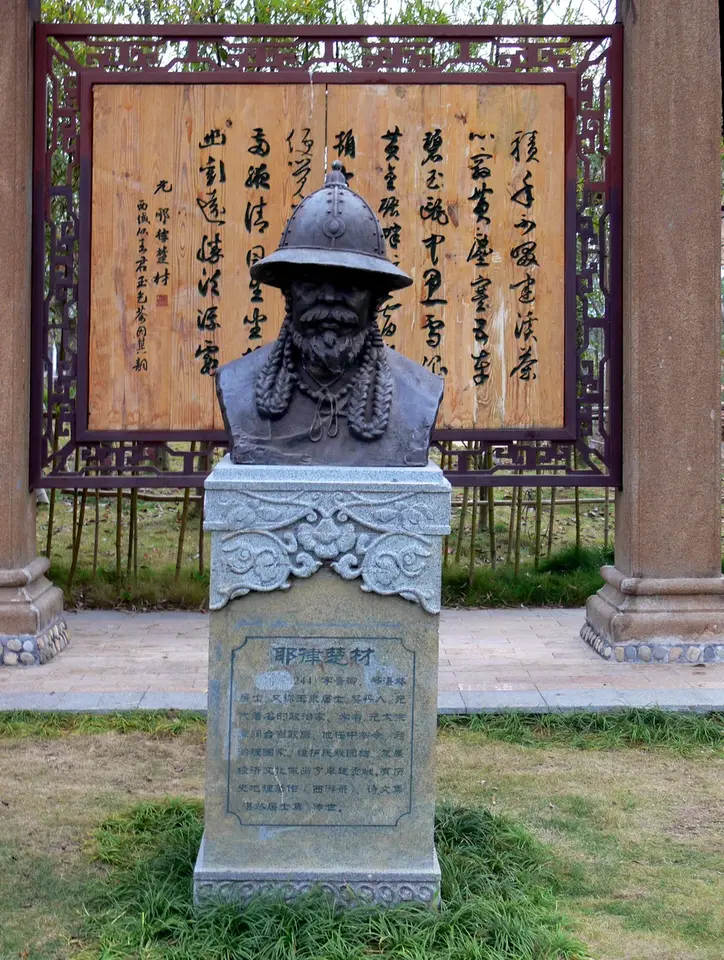
耶律楚材
Yelü Chucai (耶律楚材, 1190–1244), courtesy name Jinqing (晋卿), art name Zhanran Jushi (湛然居士), known respectfully in Mongolian as Urtu Saqal (吾图撒合里, meaning the Long-Bearded Man), was a native of Yanjing (modern Beijing). He was a preeminent statesman, astronomer, scholar, and reformer during the Mongol Empire, as well as a ninth-generation descendant of Emperor Taizu of Liao and the son of Yelü Lü, Vice Grand Councilor of the…
Yelü Chucai (耶律楚材, 1190–1244), courtesy name Jinqing (晋卿), art name Zhanran Jushi (湛然居士), known respectfully in Mongolian as Urtu Saqal (吾图撒合里, meaning the Long-Bearded Man), was a native of Yanjing (modern Beijing). He was a preeminent statesman, astronomer, scholar, and reformer during the Mongol Empire, as well as a ninth-generation descendant of Emperor Taizu of Liao and the son of Yelü Lü, Vice Grand Councilor of the Department of State Affairs under the Jin Dynasty. Endowed with vast erudition, Yelü Chucai mastered Confucianism, Buddhism, and Daoism, and achieved deep expertise in astronomy, mathematics, calendar formulation, geography, and medicine. He initially served the Jin court as Vice Director of the Left and Right Bureaus. In 1215, when Mongol armies took the Jin Central Capital of Yanjing, Genghis Khan heard of his extraordinary scholarship and summoned him into service as an intimate advisor. Accompanying Genghis Khan on the arduous Western Expedition against Khwarazm and Central Asian realms for seven years, Yelü Chucai earned the deep trust of the supreme ruler through his accurate astrological prognostications and far-sighted strategic counsel. Prior to his demise, Genghis Khan solemnly instructed his heir Ögedei that Yelü Chucai was a divine gift to their house, directing that all military and state governance be entrusted to him. Upon Ögedei Khan's ascension to the throne, Yelü Chucai was appointed Secretariat Director, taking supreme charge of imperial civil administration and fiscal management across the conquered northern Chinese domains. When conservative nomadic chieftains proposed to annihilate the entire sedentary Chinese populace and convert fertile croplands into horse pastures, Yelü Chucai bravely intervened. By establishing scientific land and commercial taxation systems, he proved to the court that preserving the farming population would yield an annual revenue of five hundred thousand ounces of silver, eighty thousand bolts of silk, and four hundred thousand piculs of grain, thereby miraculously rescuing millions of Chinese lives and safeguarding the roots of agrarian civilization. Throughout his governance, Yelü Chucai vigorously implemented administrative policies founded on Confucian statecraft. He stripped nomadic military commanders of their arbitrary control over civil governance and taxation, institutionalized the separation of civil and military powers, promulgated structured tax codes to eliminate predatory extortions, reformed criminal jurisprudence by banning summary executions, and established compilation bureaus in key circuits. In 1238, he organized the historic Wuxu Examination, recruiting 4,030 literati and emancipating over one thousand four hundred scholars from hereditary military servitude, ensuring the unbroken preservation of Huaxia cultural heritage under Mongol rule. Following the demise of Ögedei Khan, Töregene Khatun assumed regency and empowered predatory tax-farming merchants such as Abd al-Rahman. Yelü Chucai fought resolutely against systemic extortion until his marginalization and illness. He died in 1244 on the northern steppes at the age of fifty-five. Later, Kublai Khan posthumously honored him as Grand Preceptor and bestowed the prestigious posthumous title Wenzheng, while Emperor Huizong of Yuan subsequently enfeoffed him as Prince of Guangning. Celebrated for both monumental political vision and profound humanitarian compassion, Yelü Chucai remains revered as the supreme protector of Chinese civilization during an era of unprecedented turmoil.
Born in Yanjing, Central Capital of Jin; ninth-generation descendant of Emperor Taizu of Liao; named Chucai by his sixty-year-old father Yelü Lü.
Bereaved of his father at age two; raised strictly by Lady Yang; mastered classics, astronomy, calendars, mathematics, medicine, and Buddhist thought.
Passed the palace examination for noble sons with top honors; appointed Vice Director of the Left and Right Bureaus; remained in Yanjing with Wanyan Fuxing.
Following the capture of Yanjing, Genghis Khan summoned him, admired his imposing bearing and integrity, and enlisted him as a confidential advisor.
Accompanied the imperial forces during the Central Asian campaign against Khwarazm; observed celestial phenomena and composed the travel record Xiyou Lu.
Appointed Secretariat Director by Ögedei Khan; established court rituals, standardized administrative statutes, and launched systemic bureaucratic governance.
Strongly opposed the military faction's demand to depopulate northern farmlands for pasture, securing civilian life by proving the immense revenue of agrarian taxation.
Interceded during the fall of Bianjing, persuading Ögedei Khan to issue strict prohibitions against butchering the city, sparing more than 1.4 million residents.
Orchestrated the first imperial examination under Mongol rule, recruiting over four thousand scholars and redeeming enslaved Confucian literati from military captivity.
Resisted predatory tax-farming policies favored by the regent; fell ill under severe marginalization and passed away on the northern steppes; posthumously honored as Wenzheng.
Yelü Chucai was born on the twentieth day of the sixth lunar month in 1190 in the Central Capital of the Jurchen Jin Dynasty, modern Beijing. The Yelü clan comprised the imperial lineage of the Great Liao Dynasty; Yelü Chucai was a ninth-generation descendant of the dynastic founder Emperor Taizu of Liao (Yelü Abaoji) and an eighth-generation descendant of Yelü Bei, the Prince of Dongdan. His father, Yelü Lü, was an illustrious statesman and Confucian scholar under Jin, rising to the elevated office of Vice Grand Councilor of the Department of State Affairs. Yelü Lü was already past sixty years of age when this son was born. Filled with joy, he declared to his relatives that the child was a thoroughbred who would become an instrument of statecraft capable of serving foreign rulers. Drawing inspiration from the ancient historical passage in the Zuo Zhuan stating that although materials originated in Chu, Jin put them to practical use, he bestowed upon the boy the personal name Chucai and the courtesy name Jinqing.
In 1192, Yelü Lü passed away. The two-year-old child was reared solely by his mother, Lady Yang, a woman of deep moral virtue and classical education from a prominent Jin family. Lady Yang maintained strict discipline and personally supervised his studies. Exhibiting prodigal talent and lofty ambition from infancy, Yelü Chucai read extensively through classical canons, historical chronicles, astronomical treatises, geographical texts, mathematical methods, and the philosophical doctrines of Buddhism and Daoism. In 1213, at twenty-four, he sat for the imperial examination designated for sons of senior officials. Yelü Chucai delivered brilliant and lucid policy responses, placing first in the premier grade. He was immediately appointed Vice Director of the Left and Right Bureaus in the central executive department.
In 1214, as Mongol forces advanced southward, the Jin Emperor Xuanzong hastily transferred the imperial seat to Nanjing, modern Kaifeng, leaving Grand Councilor Wanyan Fuxing and Yelü Chucai behind to defend the Central Capital. In the fifth month of 1215, Mongol armies captured Yanjing. Having long heard of prominent scholars residing in the city, Genghis Khan commanded that gifted literati be sought out. When the great conqueror received Yelü Chucai in his traveling pavilion, he was profoundly struck by his tall, commanding stature, penetrating gaze, and long, graceful beard that reached his chest. Genghis Khan addressed him warmly by the Mongolian moniker Urtu Saqal and remarked that since the Khitan and Jurchen were historic enemies, the Mongol conqueror had now avenged his ancestral grief. Yelü Chucai composedly replied that his father and grandfather had both loyally served the Jin dynasty as ministers, and as an honorable subject, he could never harbor duplicitous malice against his dynastic sovereigns. Greatly impressed by his unwavering integrity and moral rectitude, Genghis Khan incorporated him into his innermost circle of counselors, entrusting him with imperial correspondence and document seals.
In 1219, Genghis Khan embarked upon the monumental Western Expedition against the Khwarazmian Empire and surrounding Central Asian territories. Yelü Chucai accompanied the campaign as head of the imperial secretarial bureau. Crossing rugged mountain chains and treacherous deserts, he utilized his formidable expertise in astronomical mathematics to predict celestial motions, solar and lunar eclipses, and sudden weather shifts, while consistently deploying humanitarian wisdom to curb wanton destruction. According to historical records, while the army was stationed at the Iron Gate Pass along the Indus River valley, soldiers sighted an extraordinary green-hued horned creature capable of human speech, which commanded the host to withdraw. When Genghis Khan sought counsel, Yelü Chucai utilized the auspicious omen of the mythical Luduan to argue that Heaven abhorred needless carnage, persuading the conqueror to spare local populations and commence the eastward march home.
During the seven years of campaigning across the western frontier, Yelü Chucai meticulously surveyed the topographical layout, climatic variations, and ethnic customs of Central Asia. His observations were recorded in the celebrated travelogue Xiyou Lu, creating an indispensable scientific document detailing Eurasian intercultural exchanges in the thirteenth century. Near his death, Genghis Khan solemnly instructed Crown Prince Ögedei that Yelü Chucai was an invaluable gift granted by Heaven to their ruling family, urging him to entrust state governance entirely to his seasoned hands.
Following the demise of Genghis Khan in 1227, Ögedei ascended the throne. Honoring his father's testament, the new ruler appointed Yelü Chucai as Secretariat Director in 1229, conferring upon him plenary executive authority over civil administration and imperial revenues across northern China. At that juncture, Mongol rulers were unaccustomed to the administration of vast agrarian territories, and conservative nomadic factions advocated extreme measures. In 1230, general Biedie and other senior commanders proposed to Ögedei Khan that Chinese agriculturalists were useless to the Mongol realm, arguing that all Chinese inhabitants should be eradicated and their croplands turned into open pastures for cattle and steeds.
Faced with this perilous crisis that threatened the physical survival of Chinese civilization, Yelü Chucai risked his life to offer fierce counterarguments before the throne. He reasoned that conquering an empire on horseback did not mean it could be ruled from horseback, and that the imperial treasury required silver, silk, and grain which nomadic pastures could never supply. He pledged that if allowed to establish tax bureaus across ten major circuits such as Yanjing and regulate levies on land, commerce, salt, iron, and spirits, he could deliver an annual revenue of five hundred thousand taels of silver, eighty thousand bolts of silk, and four hundred thousand piculs of grain.
Ögedei Khan allowed Yelü Chucai to initiate a pilot trial across the ten designated circuits. Yelü Chucai dispatched righteous Confucian scholars such as Chen Shixian and Zhao Fang to oversee taxation, strictly prohibiting military commanders from levying unauthorized exactions. In the winter of 1231, when Ögedei Khan hosted an imperial banquet, Yelü Chucai presented the amassed treasure of silver bars, silk bales, and grain records precisely as promised. Marveling at the immense wealth piled within the imperial tent, Ögedei Khan praised Yelü Chucai before the entire assembly of nomadic nobility, immediately ordering that all proposals to depopulate farmland and convert agrarian soil into grazing lands be abolished forever. Through this monumental administrative achievement, Yelü Chucai safeguarded the lives of tens of millions of northern Chinese farmers.
In 1234, the combined forces of the Mongols and Southern Song breached the walls of Caizhou, bringing about the formal collapse of the Jin Dynasty. During the prior siege of the Jin Southern Capital at Bianjing, Mongol commander Subutai was infuriated by the stubborn defensive resistance that inflicted heavy casualties on his army. In accordance with customary steppe warfare rules, Subutai petitioned the imperial court to butcher and loot every living inhabitant once the fortress fell. Upon learning of this horrific plan, Yelü Chucai hastened without rest to Ögedei Khan's camp, weeping and entreating that military conquest was meant to acquire land and subjects; to seize territory while exterminating its inhabitants rendered the land entirely useless. He added that Bianjing housed the finest artisans, scholars, medical masters, and irreplaceable classical libraries in the realm. Deeply moved by his appeals, Ögedei Khan issued an imperial decree ordering that aside from the imperial clan of Jin, all civilian and military inhabitants in the city must be spared. As a result, over 1.4 million residents of Bianjing survived intact.
To overcome the pastoral disregard for formal governance and restore civil bureaucratic structures, Yelü Chucai actively championed the revival of Confucian institutions. He established compilation institutes in Yanjing and Pingyang to collect and carve woodblocks for hundreds of thousands of volumes of ancient classics and histories. In 1238, overcoming immense political inertia, he persuaded Ögedei Khan to restore state examinations to select talented scholars for administrative service. The court decreed the execution of the famous Wuxu Examination, evaluating candidates on classical interpretation, literary composition, and statecraft essays.
During the prolonged wars, thousands of learned scholars had been captured by Mongol officers and enslaved as domestic herd-keepers and laborers. Yelü Chucai specifically secured an imperial decree providing that any captured scholar who passed the examination must be granted unconditional liberation by their master, warning that anyone concealing scholars or preventing them from taking the examination would be executed under military law. Through this historic examination, 4,030 scholars were recruited into the state service, and over 1,400 prominent intellectuals were freed from enslavement. This pivotal breakthrough created the foundational reservoir of scholar-officials that subsequently enabled Kublai Khan to construct the bureaucratic institutions of the Yuan Dynasty.
In the eleventh month of 1241, Ögedei Khan died suddenly from excessive drinking, plunging the Mongol court into severe instability. His primary wife, Töregene Khatun, assumed regency over the empire. Haughty and avaricious, she sidelined the senior ministers who served the previous rulers, placing reliance upon unscrupulous Central Asian merchants such as Abd al-Rahman. Abd al-Rahman proposed to purchase the exclusive right to farm all taxes across northern China for an exorbitant sum of 1.4 million ounces of silver annually, attempting to impose an unrestrained tax-farming monopoly.
Yelü Chucai recognized that tax-farming would unleash rapacious exploitation upon ordinary subjects, driving the populace into widespread revolt. In the Secretariat, he openly confronted Töregene Khatun, maintaining that ancestral laws fixed tax quotas to preserve social stability, and that placing tax collection into the hands of profit-seeking merchants would oppress the people and undermine the imperial foundation. He declared that as the presiding Secretariat Director, he would rather die than stamp the imperial authorization. Furious at his defiance, Töregene Khatun bypassed the Secretariat to issue seals directly to Abd al-Rahman, stripping Yelü Chucai of all substantive executive and financial control.
Watching corrupt factions plunder the realm while the populace groaned under onerous burdens, Yelü Chucai was consumed by anguish and fell severely ill. On the fourteenth day of the fifth lunar month in 1244, the revered statesman passed away in his camp on the northern steppes at the age of fifty-five.
Upon his death, common people across northern lands mourned as if they had lost a parent, and scholar-gentry across southern China wept openly upon receiving the tidings. Corrupt rivals slanderously asserted that having led the Secretariat for decades, Yelü Chucai must have accumulated immense private riches. Töregene Khatun ordered commissioners to confiscate his residence and belongings. When officials ransacked his lodgings, they discovered nothing but several stringed musical instruments, along with more than one thousand volumes of classical manuscripts, historical archives, calligraphy, paintings, and rubbings of ancient bronzes and stone steles. Deeply moved by his profound incorruptibility, even the confiscating officers bowed in reverence. In 1281, Kublai Khan posthumously awarded him the offices of Grand Preceptor and Pillar of State, along with the posthumous title Wenzheng. In 1352, the Yuan court further enfeoffed him as Prince of Guangning. He was interred at the foot of Yuquan Mountain west of Yanjing, near the current Kunming Lake of the Summer Palace in Beijing, where he continues to be honored through the ages.
During the initial brutal conquests of northern China, Yelü Chucai achieved an unprecedented feat that redirected the trajectory of East Asian civilization. When steppe generals led by Biedie proposed exterminating the entire northern Chinese farming population to convert agricultural lands into vast pasture zones, Yelü Chucai relied on profound fiscal foresight to alter the emperor's perspective. By constructing a tax system across ten circuits, he demonstrated that preserving farmers generated dependable annual revenues of silver, grain, and textile resources far surpassing the utility of grazing grounds. His intervention dismantled the catastrophic depopulation initiative, shielding millions of civilians from eradication and preserving the fundamental roots of Chinese agrarian society.
Yelü Chucai served as the primary architect who transitioned the Mongol regime from an archaic steppe tribal confederation into a centralized bureaucratic empire. During his tenure as Secretariat Director, he eliminated the arbitrary interference of nomadic nobility by instituting formal court protocol, enforced a strict boundary between military commands and civil administration, prohibited garrison generals from intervening in regional judicial cases, standardized weights and measures, unified fiscal coinage, and overhauled the imperial post-relay network to suppress official extortion. His foundational institutions erected the structural blueprint upon which the Yuan administrative system and provincial governance were later consolidated.
During an era when scholar-officials were enslaved and cultural traditions were in jeopardy, Yelü Chucai orchestrated an enduring effort to preserve cultural heritage. He prompted the creation of classical carving institutes in Yanjing and Pingyang to reprint Chinese classics, and in 1238 pioneered the Wuxu Examination to recruit scholars into civil administration. By enforcing imperial mandates that emancipated tested scholars from aristocratic enslavement, he redeemed 4,030 literati from bonded servitude. This decisive measure preserved the continuity of Confucian learning in northern China and furnished the administrative talents essential for the subsequent emergence of the Yuan Dynasty.
Beyond his statesmanship, Yelü Chucai stood out as an accomplished scientific scholar proficient in both Chinese and western astronomic disciplines. During his accompaniment of Genghis Khan's western campaigns, he identified alignments between Islamic celestial computations and Chinese traditional calendars. Applying advanced mathematical principles, he compiled the Gengwu Yuan Calendar and the Xitian Lidu, significantly elevating the precision of imperial calendar calculation. Concurrently, his geographic masterpiece Xiyou Lu chronicled the geography, cultures, and religions of various Central Asian polities, serving as an invaluable thirteenth-century record of cross-continental Eurasian history.
FIGURES ASSOCIATED WITH THIS DYNASTY