Birth at Onon River
Born on the sixteenth day of the fourth month at Delüün Boldog as the eldest son of chieftain Yesügei.
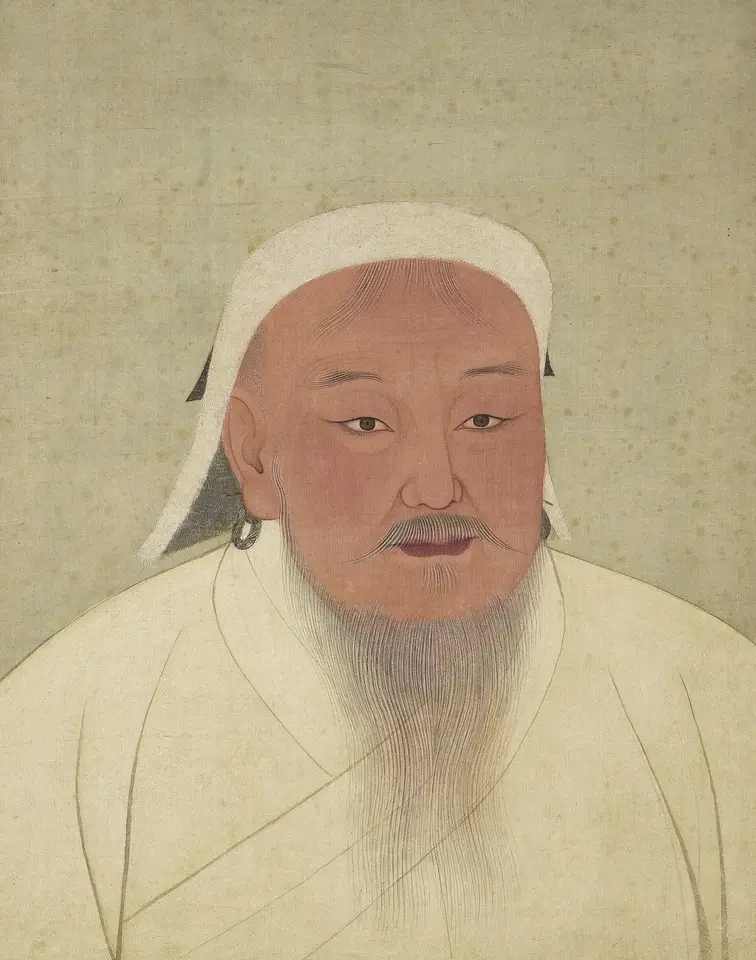
1162 CE–1227 CE
孛儿只斤·铁木真
Borjigin Temüjin (孛儿只斤·铁木真, May 31, 1162 – August 25, 1227), born near the Onon River at Delüün Boldog (present-day Dadal, Khentii Province, Mongolia), was the founding Khagan of the Mongol Empire (reigned 1206–1227), revered by his imperial title Genghis Khan (成吉思汗) and posthumously honored as Emperor Taizu of the Yuan dynasty. Born into the aristocratic Borjigin clan of the Khiyad Mongols as the eldest son of chieftain…
Borjigin Temüjin (孛儿只斤·铁木真, May 31, 1162 – August 25, 1227), born near the Onon River at Delüün Boldog (present-day Dadal, Khentii Province, Mongolia), was the founding Khagan of the Mongol Empire (reigned 1206–1227), revered by his imperial title Genghis Khan (成吉思汗) and posthumously honored as Emperor Taizu of the Yuan dynasty. Born into the aristocratic Borjigin clan of the Khiyad Mongols as the eldest son of chieftain Yesügei and Lady Hoelun, he experienced extreme adversity in early childhood following his father's murder by Tatar rivals and the abandonment of his family by former clan dependents. Through extraordinary political resilience, strategic acumen, and personal magnetism, he forged alliances with Toghrul Khan of the Keraites and his blood brother Jamukha, steadily assembling a formidable martial following. Between 1189 and 1204, Temüjin orchestrated a series of brilliant military campaigns that destroyed the rival Tatar, Taichi'ud, Merkit, Keraite, and Naiman confederations, permanently ending centuries of tribal fragmentation across the Mongolian plateau. In the spring of 1206, at a general kurultai held at the headwaters of the Onon River, he unified the nomadic nations into the Great Mongol State (Yeke Monggol Ulus) and assumed the supreme title Genghis Khan. He established revolutionary institutional foundations: promulgating the Great Yassa legal code, reorganizing the populace into decimal units of ten thousand (tumen) and one thousand (mingghan), creating the elite imperial bodyguard (Kheshig), and commissioning the invention of the Uyghur-based Mongolian script. Following unification, Genghis Khan embarked on sweeping continental military campaigns. He subdued Western Xia in 1209, shattered the veteran armies of the Jurchen Jin dynasty at the Battle of Yehuling in 1211, and captured the Jin capital Zhongdu (modern Beijing) in 1215. In 1219, in retaliation for the Otrar massacre of his diplomatic caravan, he launched a massive western campaign commanding two hundred thousand horsemen, completely annihilating the Khwarazmian Empire, conquering Bukhara and Samarkand, and projecting nomadic military power across Iran, the Caucasus, and the southern Russian steppes. While prosecuting his final punitive campaign against Western Xia, Genghis Khan passed away in the Liupan Mountains in August 1227 at the age of sixty-six, being secretly buried at Qiniangu near Burkhan Khaldun.
Born on the sixteenth day of the fourth month at Delüün Boldog as the eldest son of chieftain Yesügei.
Betrothed to Börte; father Yesügei was poisoned by Tatars; clan abandoned by dependents.
Allied with Toghrul Khan and Jamukha to crush the Merkits and rescue his captured wife Börte.
Elected Khan of the Khiyad Mongols; initiated the restructuring of tribal military institutions.
Annihilated the Naiman host at Mount Nakhu, unifying all nomadic confederations of the plateau.
Acclaimed Genghis Khan at the Onon River kurultai; established the Great Mongol State and promulgated the Yassa.
Commanded nomadic cavalry to shatter four hundred thousand Jin troops at Yehuling, breaching the northern passes.
Captured and pillaged the Jin central capital Zhongdu; Jin court forced to relocate capital southward to Kaifeng.
Marshaled two hundred thousand troops to invade Central Asia, destroying Bukhara, Samarkand, and Gurganj.
Subjugated Western Xia; passed away in the Liupan Mountains on August 25; secretly buried in Qiniangu.
Temüjin was born in the spring of 1162 near the sacred Burkhan Khaldun mountains. Legend recounts that he emerged from the womb clutching a black blood clot the size of a knucklebone, an omen of martial destiny. In 1170, when Temüjin was nine years old, his father Yesügei arranged his betrothal to Börte, daughter of Dei Sechen of the Onggirat tribe. On the journey home, Yesügei was fatally poisoned by hostile Tatar tribesmen. Following Yesügei's death, the rival Taichi'ud clan seized the herds and abandoned Hoelun, Temüjin, and his younger siblings to survive by hunting small game and gathering wild roots in the wilderness.
Throughout his adolescence, Temüjin survived repeated capture by Taichi'ud warriors, escaping with the aid of sympathetic allies like Sorqan Shira. Around 1180, following his formal marriage to Börte, nomadic Merkit raiders launched a surprise dawn attack, capturing Börte in retribution for Yesügei's past bride-theft. Temüjin sought assistance from his father's sworn blood brother, Toghrul Khan of the Keraite confederation, and his childhood friend Jamukha of the Jadaran clan. In 1184, their combined armies routed the Merkits along the Buura River and rescued Börte, establishing Temüjin's reputation as a decisive nomadic leader.
In 1189, aristocratic Khiyad elders acclaimed Temüjin as Khan of their clan. However, his growing influence alienated his former ally Jamukha, precipitating the Battle of Dalan Balzhut (Battle of the Thirteen Wings) in 1190. Although tactically repulsed, Temüjin's compassionate treatment of captive warriors contrasted sharply with Jamukha's boiling of prisoners in cauldrons, drawing thousands of nomadic warriors to his cause.
Between 1196 and 1204, Temüjin revolutionized steppe warfare by substituting meritocratic command for hereditary clan privilege and decreeing that booty be divided equally only after complete battlefield victory. In 1202, he obliterated the ancestral Tatar enemies at Dalan Nemürges; in 1203, he defeated the powerful Keraite host at the Battle of the Jeje'er Heights; and in 1204, he crushed the Naiman confederation at the Battle of Chakirmaut. In the spring of 1206, at the historic kurultai on the Onon River, Temüjin raised the Nine-Tailed White Standard and was crowned Genghis Khan (Universal Ruler) of the Great Mongol State.
Having consolidated the steppe, Genghis Khan launched aggressive campaigns against neighboring sedentary civilizations. After compelling Western Xia to submit as a tributary vassal in 1209, he turned against the Jurchen Jin dynasty in 1211 to avenge ancestral humiliations. At the decisive Battle of Yehuling, Mongol cavalry crushed four hundred thousand elite Jurchen troops, exposing the North China plain. In 1215, Mongol forces captured the Jin capital Zhongdu, forcing Emperor Xuanzong of Jin to abandon northern territories and flee to Kaifeng.
In 1218, after Governor Inalchuq of Otrar slaughtered an official Mongol diplomatic caravan of 450 merchants, Genghis Khan mobilized two hundred thousand troops to invade Central Asia. Between 1219 and 1221, executing sophisticated sieges and synchronized multi-column encirclements, Mongol armies dismantled the Khwarazmian Empire, sacking Otrar, Bukhara, Samarkand, and Nishapur, while generals Subutai and Jebe executed their historic cavalry raid around the Caspian Sea. In 1226, furious over Western Xia's refusal to provide auxiliary troops for the western campaign, Genghis Khan launched a final punitive invasion. In the summer of 1227, as Western Xia forces surrendered, Genghis Khan fell ill and died in his mobile encampment at the Liupan Mountains at age sixty-six.
Genghis Khan's greatest enduring achievement lay in replacing chaotic tribal feudalism with an integrated, highly disciplined imperial infrastructure. Through the decimal organization of the entire populace into Arban (10), Jaghun (100), Mingghan (1,000), and Tumen (10,000), he dissolved traditional clan loyalties, integrating diverse nomadic groups into a single unified military nationality.
His codification of the Great Yassa established standardized legal precedents prohibiting theft, marital abduction, adultery, and fraudulent trade, while guaranteeing complete religious toleration for Christians, Muslims, Buddhists, and Daoists. His establishment of the Örtöö (Yam) postal relay network created unprecedented continental communications and logistical transit across Eurasia.
In tactical doctrine, Genghis Khan synthesized nomadic horse archery with advanced Chinese and Persian siege engineering, creating the most formidable combined-arms military machine of the medieval world. He established the elite Kheshig (ten-thousand-strong imperial bodyguard), which functioned simultaneously as a praetorian vanguard, an administrative officer academy, and an instrument of political hostage control over provincial nobles.
By dissolving political barriers across Eurasia, Genghis Khan's conquests inaugurated the Pax Mongolica, facilitating unprecedented commercial, diplomatic, technological, and intellectual exchanges between China, the Islamic world, and Western Europe, accelerating the development of global civilization.
FIGURES ASSOCIATED WITH THIS DYNASTY