Birth | Son of Darmabala and Dagi.
1285 CE–1320 CE
Historical figure
Borjigin Ayurbarwada
孛儿只斤·爱育黎拔力八达
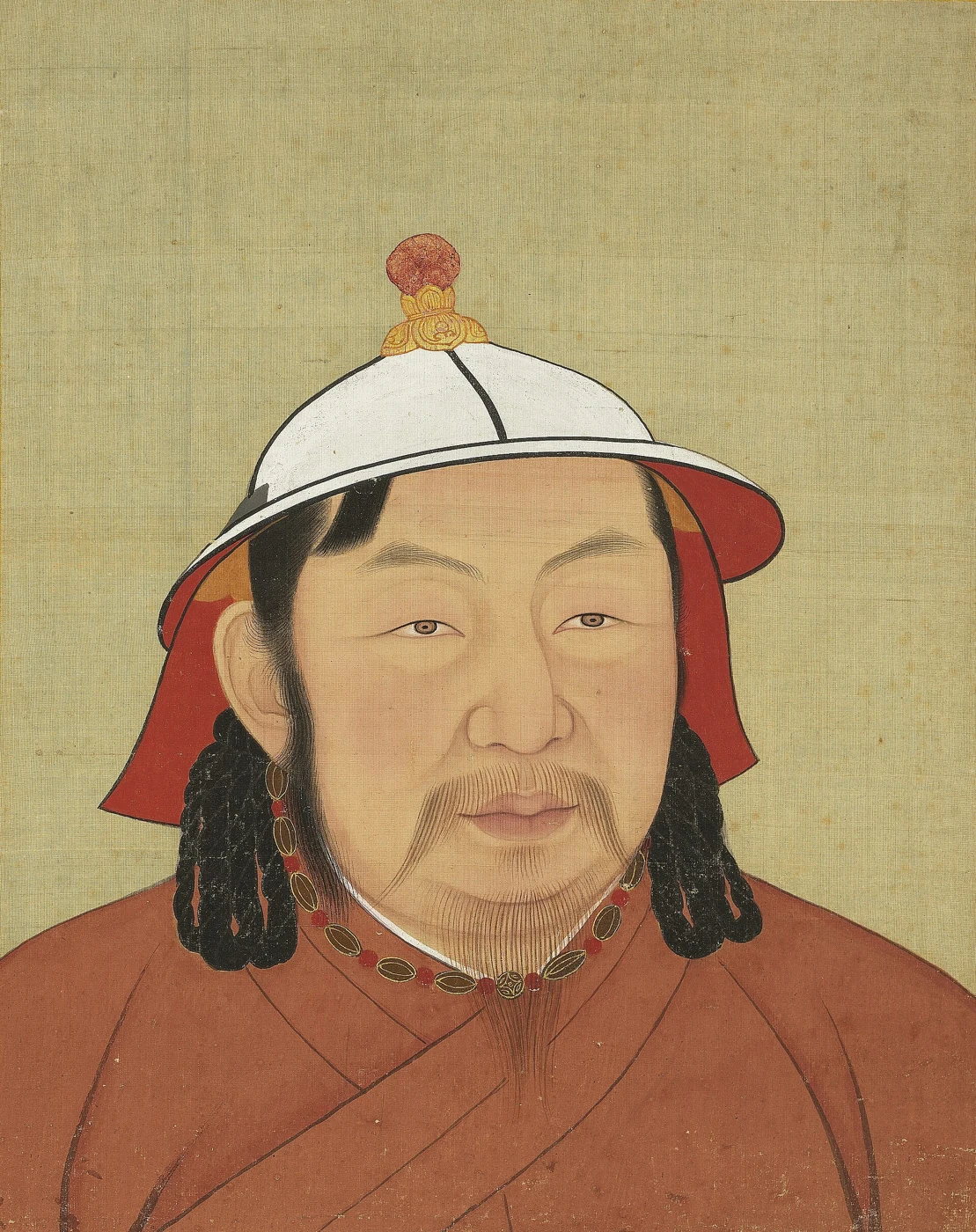
Borjigin Ayurbarwada (1285–1320), posthumously known by the temple name Renzong, was a younger full brother of Khaishan, Emperor Wuzong of Yuan. After Emperor Chengzong died in 1307 (eleventh year of Yuan Dade), Ayurbarwada, his mother Dagi, and the councilor Harahasun secured Dadu and welcomed Khaishan to the throne. Khaishan then made him crown prince; the brothers agreed that succession would later return to Khaishan's…
1285 CE–1320 CEYuan Dynasty
PROFILE
Borjigin Ayurbarwada (1285–1320), posthumously known by the temple name Renzong, was a younger full brother of Khaishan, Emperor Wuzong of Yuan. After Emperor Chengzong died in 1307 (eleventh year of Yuan Dade), Ayurbarwada, his mother Dagi, and the councilor Harahasun secured Dadu and welcomed Khaishan to the throne. Khaishan then made him crown prince; the brothers agreed that succession would later return to Khaishan's sons. Ayurbarwada succeeded Khaishan in 1311 (fourth year of Yuan Zhida), abolished the separate Shangshu Secretariat, withdrew Zhida silver notes, and appointed scholars to reorganize government. He ordered restoration of the civil examinations in 1313 (second year of Yuan Huangqing), and the first palace examination followed in 1315 (second year of Yuan Yanyou). His government also surveyed land and began compiling laws. Later he made his own son Shidibala crown prince, departing from the arrangement with Khaishan's line. The restored examinations gave scholars another route to office, whereas the Yanyou land survey encountered corruption and resistance; the policies had markedly different results.
- Other names
- Ayurbarwada; Emperor Renzong of Yuan; Buyantu Khan (provisional as a separate title)
- Period
- Middle Yuan period
- Date of Birth
- April 9, 1285 CE(22nd year of the Zhiyuan era, Yuan)
- Date of Death
- March 1, 1320 CE(7th year of the Yanyou era, Yuan)
- State
- Yuan Dynasty and Mongol Empire
- Position
- Fourth emperor of the Yuan Dynasty and Great Khan
- Ethnic affiliation
- Mongol
- Clan
- Borjigin
- Ancestral home
- Not clearly recorded in the available two encyclopedia sources
- Birthplace
- Xiangshuiyuan temporary palace, Jinshan County (present-day Jiuxian Village, Yanqing District, Beijing)
- Place of death
- Guangtian Palace, Dadu
- Reign
- April 7, 1311 (eighteenth day of the third lunar month, fourth year of Yuan Zhida) to March 1, 1320 (twenty-first day of the first lunar month, seventh year of Yuan Yanyou)
- Era names
- Huangqing and Yanyou
- Temple name
- Renzong
- Posthumous name
- Emperor Shengwenqinxiao
- Tomb
- Qiniangu; the precise grave site is unconfirmed
- Predecessor
- His elder brother Borjigin Khaishan, Emperor Wuzong of Yuan
- Successor
- His son Borjigin Shidibala, Emperor Yingzong of Yuan
- Main activities
- Reorganized institutions and currency inherited from Wuzong, restored the civil examinations, promoted classical education, and began a legal compilation
LIFE TIMELINE
Borjigin Ayurbarwada (1285–1320) | Borjigin Ayurbarwada (1285–1320), posthumously known by the temple name Renzong, was a younger full brother of Khaishan, Emperor Wuzong of Yuan.
Residence in Huai Prefecture | He left Dadu under Emperor Chengzong's order.
Support for Wuzong | After Chengzong's death he, Dagi, and Harahasun welcomed Khaishan; he was later appointed crown prince.
Accession | He succeeded Khaishan in Dadu and soon abolished the Shangshu Secretariat and Zhida silver notes.
Examinations restored by decree | The decree set subjects and methods of selection.
Provincial examinations and land survey | Provincial examinations resumed while land registers were checked in Jiangzhe, Jiangxi, and Henan.
December 6, 1313 CE(2nd year of the Huangqing era, Yuan, 11th month, 18th day) | First palace examination | Candidates including Hududar and Zhang Qiyan succeeded; land surveys ceased after Cai Wujiu's uprising in Jiangxi.
Crown prince appointed | He named Shidibala heir, contrary to the earlier succession understanding with Wuzong's line.
Death | He died at Guangtian Palace in Dadu, and Shidibala succeeded him.
An initial compilation existed by 1316 (third year of Yuan Yanyou) | An initial compilation existed by 1316 (third year of Yuan Yanyou), but the work was finalized and issued as Da Yuan Tongzhi under his son Yingzong in 1323 (third year of Yuan Zhizhi).
Death | He died in Dadu in 1320 (seventh year of Yuan Yanyou), and Shidibala succeeded.
He died in Dadu in 1320 (seventh year of Yuan Yanyou) | He died in Dadu in 1320 (seventh year of Yuan Yanyou), and Shidibala succeeded.
BIOGRAPHY
Biography
Imperial family and succession Ayurbarwada was a great-grandson of Kublai Khan, grandson of Zhenjin, and son of Darmabala and Dagi. His elder brother was Khaishan. As a young man he studied the Confucian classics under Li Meng and also encountered Buddhist writings. He was ordered to live in Huai Prefecture in 1305 (ninth year of Yuan Dade). Emperor Chengzong died without an heir in 1307 (eleventh year of Yuan Dade). Ayurbarwada and Dagi returned to Dadu, joined Harahasun and others in defeating the claims of Ananda and Akhutai's group, and welcomed Khaishan, then commanding troops in the north. After taking the throne, Khaishan made his brother crown prince and involved him in the central secretariat and military administration. Although styled crown prince, his appointment meant succession from elder to younger brother; the two also agreed that Khaishan's sons would subsequently inherit. ### Accession and administrative changes Khaishan died in 1311 (fourth year of Yuan Zhida), and Ayurbarwada succeeded in Dadu. He removed the Shangshu Secretariat added under Wuzong, restored the Zhongshu Secretariat as the principal central administrative body, withdrew Zhida silver notes, reduced redundant posts, and halted major works, including the construction of a central capital. Wuzong's close advisers Sanbaonu and Tuohutuo were executed. His changes to institutions and currency were intended to address the previous reign's fiscal and administrative policies, but also reflected a transfer of power at court; they cannot be described simply as benevolent government. Renzong brought Confucian scholars such as Li Meng and Wang Yue into government and promoted the collection of laws and the education of officials. In 1311 (fourth year of Yuan Zhida), he ordered the central secretariat to gather administrative regulations dating from Kublai's reign. An initial compilation existed by 1316 (third year of Yuan Yanyou), but the work was finalized and issued as Da Yuan Tongzhi under his son Yingzong in 1323 (third year of Yuan Zhizhi). The latter act must not be assigned to Renzong's reign. ### Examinations and the land survey Restoration of the civil examinations involved legislation and implementation. Renzong's decree of 1313 (second year of Yuan Huangqing) made Zhu Xi's commentaries on the Four Books and the classics central to the examinations and allocated places among Mongols, Semu, Han, and southern Chinese candidates. Provincial examinations took place in 1314 (first year of Yuan Yanyou); metropolitan and palace examinations followed in Dadu in 1315 (second year of Yuan Yanyou), producing fifty-six successful candidates. They gave some scholars a regulated route into office, though the numbers were limited and hereditary appointment and sponsorship remained. In 1314 (first year of Yuan Yanyou), the court also surveyed fields in Jiangzhe, Jiangxi, Henan, and other areas to establish holdings and tax liabilities. Local officials concealed wealthy households' property while inflating assessments on others, provoking opposition. After Cai Wujiu rose in Jiangxi in 1315 (second year of Yuan Yanyou), the court suspended the survey and reduced related tax demands. Its outcome contrasted with the continuing examination system and exposed the gap between central design and local administration. ### The succession dispute and death Khaishan and Ayurbarwada had envisaged succession from elder to younger brother and then to the elder brother's sons. After taking the throne, Renzong titled Khaishan's elder son Kusala Prince of Zhou and sent him toward Yunnan. Worried about the succession, Kusala fled west while traveling. In 1316 (third year of Yuan Yanyou), Renzong made his own son Shidibala crown prince instead. Later historians connected this breach with subsequent imperial contests, though the many later coups cannot each be attributed directly to Renzong alone. He died in Dadu in 1320 (seventh year of Yuan Yanyou), and Shidibala succeeded.
Family, Confucian Training and the Coup That Made a Khan
Ayurbarwada, born on the ninth day of the fourth month of 1285, was a great-grandson of Kublai, third son by the principal wife of Darmabala, nephew of Emperor Chengzong, and son of the empress dowager Xing sheng (Dagi). He read the Confucian books from youth and was drawn to Buddhist texts; he had the Greater Learning Expounded abridged and translated into Mongolian for his ministers, saying that "to govern the empire this one book is enough," and had the Essentials of Government of the Zhenguan Era and other works rendered into Mongolian for Mongols and Semu to recite. In 1307, on Chengzong's death, he and his mother returned to Dadu for the mourning, plotted with the chancellor of the right to kill the prince of Anxi who meant to set himself up, and raised to the throne his elder brother Haishan, prince of Huaining, who commanded in the north — Emperor Wuzong. Wuzong made him crown prince (in fact heir as younger brother), gave him the secretariat and the privy council, and the brothers agreed that "the brother should succeed on the brother's death and the uncle pass the throne to the nephew." He then studied under Confucian ministers, Wang Yue repeatedly advising him not to show his edge, which laid the ground for the benevolent government he later practised.
Reform on the Throne and the Restoration of the Examinations
On Wuzong's death in the first month of 1311 the crown prince succeeded as Buyantu Khan, Emperor Renzong of Yuan, and at once undertook sweeping reform: he put to death Wuzong's favourites Sanbao Nu, Tohuto and Leshi, abolished the abuses of the (Shangshu) secretariat, stopped the building of the Central Capital, discontinued the Zhida silver notes, employed Chinese civil officials, cut redundant posts, and straightened the government, "reversing the decline of the Chengzong and Wuzong reigns." In culture he specially appointed (a Confucian) grand scholar of the Jixian Academy and raised the proposal for examinations to the level of an ordinance. In the tenth month of 1313 he required the secretariat to discuss holding examinations, and on the eighteenth day of the eleventh month of that year issued the edict restoring them. On the twentieth day of the eighth month of 1314 the provincial examinations were held throughout the empire; in the second month of 1315 three hundred successful candidates sat the metropolitan examination at Dadu, of whom a hundred were chosen; and on the seventh day of the third month a hundred candidates sat the palace examination, from whom fifty-six were made presented scholars. Following the old Tang and Song models and honouring Confucian learning, the examinations thus reopened a "long-closed" road to office — the "restoration of 1315" coming thirty-six years after the fall of Song and eighty-one after that of Jin, so that "Chinese scholars once more had a normal path to advancement" and national tensions eased.
In 1314 he also had land registered and acreage surveyed in Jiangsu, Jiangxi and Henan to increase revenue, but when the "management" began in the tenth month of that year, "because of the manipulation of the officials it was carried out ineffectively: many rich men bribed officials to conceal their holdings, and many poor peasants and landholding rich were given arbitrary additions to their acreage, so that the peasants suffered greatly," which led in 1315 to the rising of Cai Wujiu in Ganzhou, Jiangxi; though put down within two months, the emperor was forced by circumstances to stop the survey and to remit the taxes on the concealed land found, and the measure "ended in failure."
The Change in the Succession, and His End
By the agreement with Wuzong, since Renzong had made the coup, the younger brother was to be heir with the throne to pass from uncle to nephew; but Renzong once on the throne could not decide between nephew and son, and the empress dowager and others urged him to pass it to his own son. In the eleventh month of 1315 Wuzong's eldest son Heshila was made prince of Zhou and in the third month of the next year moved to Yunnan, on the way to which Wuzong's old ministers plotted to raise him in revolt; the plot failed and the prince fled to the Jinshan mountains. In the twelfth month of 1316 Renzong made his own son Shidibala crown prince, "breaking the oath of uncle to nephew," and "this step brought on the political confusion and court strife that lasted twenty years in Yuan." In the first month of 1320 Renzong died at the Guangtian palace in Dadu at the age of thirty-five and was buried (at Qinian valley), Shidibala (Yingzong) giving him the temple name Renzong and the posthumous name emperor Shengwen Qinxiao.
Major Activities
Restoration of the Yanyou examinations The return of civil examinations was Renzong's most durable institutional change. The curriculum centered on Zhu Xi's interpretation of the Four Books, while Yuan categories of status governed separate allocations of places. The system therefore combined classical education with the existing imperial order. Renzong also ordered Mongolian translations of the Essentials of Government in the Zhenguan Era, Extended Meaning of the Great Learning, and Zizhi Tongjian for Mongol and Semu officials, using accounts of earlier governance and Confucian arguments as political instruction. The measures did not replace inheritance and bureaucratic service as paths to office. ### Legal compilation and official training Renzong's government collected edicts, administrative rules, and judicial decisions from earlier Yuan reigns, producing an early version of Da Yuan Tongzhi; Yingzong issued the final code. Renzong also required some officials entering posts by hereditary privilege to pass examinations in the classics and histories, and adjusted limits on the promotion of clerks. These efforts at training did not fundamentally remove the judicial and regional powers of imperial princes. ### Land survey and departure from the succession agreement The failed land survey showed how efforts to define holdings and raise revenue were undermined by local corruption. After suspending it, Renzong did not establish a stable new land-tax system. Naming Shidibala heir altered the succession agreement between Wuzong and Renzong's lines; it was another lasting and controversial decision of his reign.
Confucianising the Bureaucracy, the Examination System and the Code
Confucianising the bureaucracy was among his most important institutional reforms. Previously Confucian scholars had played little part in Yuan government chiefly because no reign "had taken their learning as a basic standard for selecting officials": most high officials came by inheritance or by the privilege of yin, most middle and lower officials from clerical service, so that "most officials had no Confucian education and no Confucian political outlook." To improve the education of those who came by yin, in 1311 he decreed that "the sons and grandsons of Chinese officials who inherit by yin must be examined in one classic and one history, and those who pass shall take office at once without probation"; Mongol and Semu inheritors might choose to be examined, and those who passed would be given office one grade above that inherited; and, "perhaps to reduce competition for Confucian officials, the highest post open to those who began as clerks in local offices was lowered from the fourth grade to the fifth."
The design of the examinations was likewise significant. The new system promulgated in 1313 and first applied in the two following years "put weight on the classics and little on literary composition," designating Zhu Xi's commentary on the Four Books as the standard text for all candidates and Zhu Xi's and other Song Confucians' commentaries on the classics as the standard for the additional papers of Chinese candidates; "this change helped establish Neo-Confucianism as the state orthodoxy, with a historical significance beyond the examinations themselves, and was in the main followed by the Ming and Qing." The system also reflected the multi-ethnic character of Yuan rule: the examinations for Mongols and Semu were simpler than those for Chinese and southerners, and under the ethnic system they enjoyed "equal places," the quota of candidates passing the provincial examinations to the metropolitan examination being "seventy-five for each of the four classes"; and so as not to injure the hereditary privileges of the old noble houses or disturb the existing bureaucracy, "the number admitted at the palace examination was kept low, not more than a hundred at each," and sixteen examinations were held thereafter. Its significance was at once cultural, social and political: taking Confucian learning as the standard for selecting an elite gave Chinese scholars a normal path to office, especially benefiting the Jiangnan scholars largely excluded from it, and encouraged Mongols and Semu to study Chinese learning, "and so accelerated the Sinicisation of the conquerors."
Codification was another field. Whether because a uniform code was insurmountably difficult in a multicultural society, or because the Mongol elite thought a uniform code would limit its power, the Yuan never made a standard code for the whole empire, which caused Chinese officials great anxiety; the earliest remedy was a collection of statutes issued in 1291, and the efforts at codification under Temür and Haishan "were almost wholly without result." In the very month of his accession in 1311 Ayurbarwada ordered the secretariat to collect the statutes and ordinances from the beginning of (Kublai's) reign, a compilation finished in 1316; but the review took far longer than expected, so that only two years after Shidibala's accession (1323) was the "Comprehensive Institutions of the Great Yuan" formally promulgated. The new code contained more than twenty-four hundred articles from the founding of the dynasty, in four divisions: decided cases, regulations, edicts and miscellaneous. In the view of modern legal historians it "marks the maturity of Yuan law, having substantial content and adopting the structure of the traditional Chinese codes represented by the Taihe Code" of the Jin, itself modelled on Tang codes; but as the code of a conquest dynasty it did not wholly copy earlier Chinese codes, "reflecting in many ways Mongol customs and the institutional features peculiar to Yuan." His love of Chinese culture and his ministers' — especially Mongol and Semu ministers' — appetite for Confucian political doctrine and Chinese historical experience can be seen in the number and nature of the works he ordered translated or published, among them, in Mongolian, Confucian classics and two works connected with Tang Taizong (r. 627-649): Wu Jing's Essentials of Government of the Zhenguan Era and Taizong's own Mirror for Heirs.
Personal Relations
- Zhenjin: grandfather, son of Kublai Khan, posthumously honored as Emperor Yuzong of Yuan.
- Darmabala: father, posthumously given the temple name Shunzong of Yuan.
- Dagi: mother and later grand empress dowager who remained influential in imperial politics.
- Borjigin Khaishan: full elder brother and Emperor Wuzong; Renzong helped him ascend the throne and made an agreement on succession.
- Kusala: Khaishan's son and Renzong's nephew, belonging to the Wuzong line originally designated to inherit.
- Borjigin Shidibala: son of Renzong and Anashshiri, later Emperor Yingzong.
- Li Meng and Wang Yue: scholars and policy advisers from his early life and reign.
- Harahasun: key ally in the establishment of Khaishan in 1307 (eleventh year of Yuan Dade).
- Temüder: influential official under Renzong whose political circle remained powerful at the beginning of Yingzong's reign.
Historical Assessment
The History of Yuan describes Renzong as versed in Confucian learning and praises his frugality and concern for judicial affairs; these judgments can be considered alongside the restoration of examinations and compilation of laws. Wei Yuan's New Compilation of Yuan History likewise commends his correction of problems from Wuzong's reign, but faults his breach of the succession agreement and his failure to restrain Temüder. Any assessment must include the examinations' persistence, the failure of the land survey, and the unresolved succession dispute.
FIGURES ASSOCIATED WITH THIS DYNASTY
Bibliography
Bibliographic information is not yet available for this entry.