Imperial Birth
Born in Dadu as the eldest son of Prince Dharmapala and Lady Dagi.
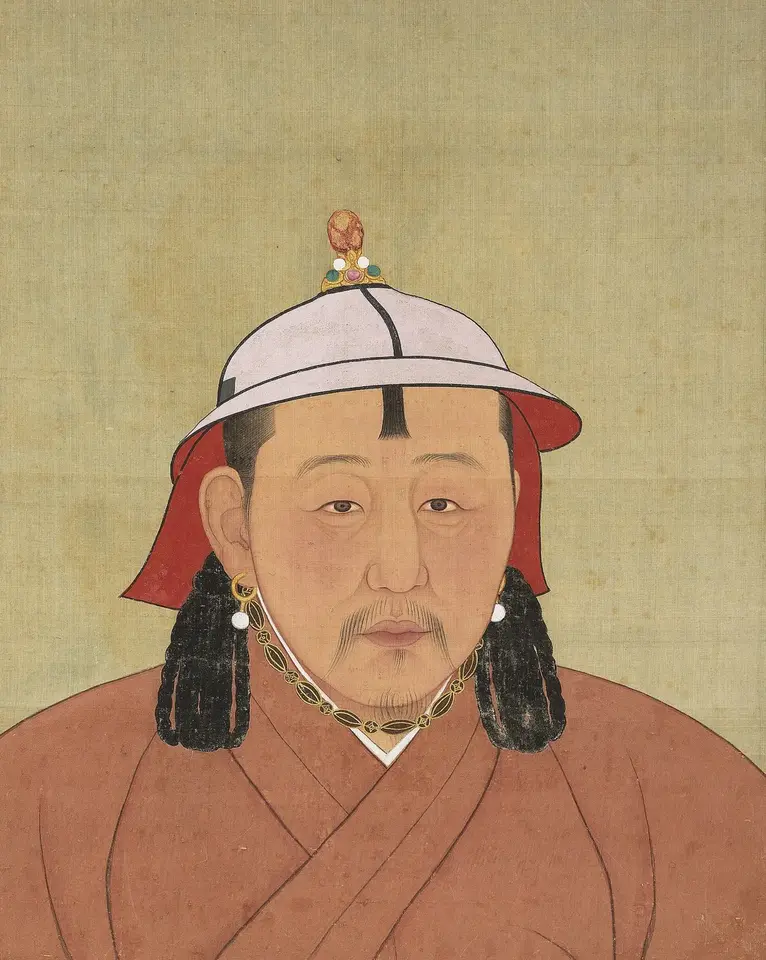
1281 CE–1311 CE
孛儿只斤·海山
Borjigin Khayishan (孛儿只斤·海山, August 4, 1281 – January 27, 1311), of the Borjigin clan of the Mongols, was the great-grandson of Kublai Khan (Emperor Shizu), the eldest son of Dharmapala (posthumously Emperor Shunzong), and the son of Empress Dowager Dagi. He reigned as the third emperor of the Yuan Dynasty and the seventh Khagan of the Mongol Empire from 1307 to 1311, bearing the title Kulug Khan. In his youth, he led the…
Borjigin Khayishan (孛儿只斤·海山, August 4, 1281 – January 27, 1311), of the Borjigin clan of the Mongols, was the great-grandson of Kublai Khan (Emperor Shizu), the eldest son of Dharmapala (posthumously Emperor Shunzong), and the son of Empress Dowager Dagi. He reigned as the third emperor of the Yuan Dynasty and the seventh Khagan of the Mongol Empire from 1307 to 1311, bearing the title Kulug Khan. In his youth, he led the northern imperial armies across the Mongolian steppe against the rebellion of Kaidu of the Chagatai and Ogodei realms, shattering the rebel confederation at Mount Tiekengu and being enfeoffed as Prince of Huaining. Following Temur Khan's death in 1307, Khayishan marched south with thirty thousand northern cavalry, ascended the throne at Shangdu, forged a fraternal succession compact with his younger brother Ayurbarwada, and named him crown prince. During his reign, Khayishan initiated bold reforms known as the Zhida New Policies: establishing the Department of State Affairs (Shangshu Sheng) to centralize imperial revenues, issuing Zhida silver notes, casting copper cash coins, and constructing the grandiose Yuan Central Capital at Ongguchatu. In ideology, he exalted Confucianism by conferring upon Confucius the supreme honorific title of Great Completer Supreme Sage King of Literary Propagation. However, aggressive fiscal extractions and currency debasement led to severe inflation and political friction. In January 1311, he passed away abruptly in Dadu at the age of thirty-one, receiving the temple name Wuzong and the posthumous title Emperor Renhui Xuanxiao.
Born in Dadu as the eldest son of Prince Dharmapala and Lady Dagi.
Commissioned by Emperor Chengzong to lead imperial armies to pacify northern border rebellions.
Defeated the combined rebel forces of Kaidu and Duwa at Mount Tiekengu, mortally wounding Kaidu.
Enfeoffed as Prince of Huaining with a golden seal following the submission of the Chagatai Khanate.
Marched thirty thousand cavalry south following Temur Khan's death and ascended the throne at Shangdu.
Issued an imperial edict granting Confucius the supreme title of Great Completer Supreme Sage King of Literary Propagation.
Decreed the construction of Yuan Central Capital (Zhongdu) at Ongguchatu and adopted the era name Zhida.
Re-established the Department of State Affairs (Shangshu Sheng) to enforce state fiscal monopolies and mint Zhida silver notes.
Cast Zhida Tongbao copper coins and Dayuan Tongbao with 'Phags-pa script inscriptions.
Passed away suddenly at Yude Palace in Dadu at the age of thirty-one; buried in Qinian Valley.
Khayishan was born in July 1281 in the imperial capital of Dadu as the great-grandson of Kublai Khan and the grandson of Crown Prince Zhenjin. Possessing a tall and stalwart physique, an openhearted disposition, and a generous character, he was deeply cherished by his great-grandfather during his childhood. Following Kublai Khan's passing in 1294, his uncle Temur ascended the imperial throne as Emperor Chengzong. In the early Dade era, Chengzong appointed the renowned Confucian scholar Li Meng to serve as Khayishan's tutor. Alongside equestrian archery and steppe warfare training, Khayishan studied classical Chinese dynastic histories and moral governance, developing a profound appreciation for administrative order and statecraft.
During this period, Prince Kaidu of the House of Ogodei and ruler Duwa of the Chagatai Khanate marshaled rebel princes across the northwest, igniting protracted warfare along the Altai Mountains and the Hangai ranges, which gravely imperiled the northern frontier of the Yuan Dynasty. In 1299, observing that imperial commanders stationed on the steppe were repeatedly outmaneuvered, Emperor Chengzong entrusted the nineteen-year-old Khayishan with supreme military command over the northern frontier armies. Accepting the imperial mandate, Khayishan crossed the vast Gobi Desert, established headquarters in the Altai mountains, enforced stringent military discipline, and rejuvenated the fighting morale of the northern garrisons.
Upon his arrival at the frontlines, Khayishan demonstrated extraordinary operational acumen and personal courage under enemy fire. In encounters around Lake Onjir and Burkhan Khaldun, he routinely led elite heavy cavalry charges in person, drawing powerful bows and striking down hostile commanders. Furthermore, he distributed captured horses, livestock, and plunder lavishly among his soldiers rather than hoarding spoils, uniting fractured Mongol clans into an unyielding vanguard that halted rebel advances and reversed decades of strategic defensive inertia across the northern frontier.
While garrisoning the Jinshan forward base, Khayishan paid meticulous attention to supply lines and harsh steppe winters. Northern winters brought blinding blizzards and sub-zero temperatures, which frequently severed supply caravans. Khayishan supervised the construction of dozens of fortified granaries and forage stations along both slopes of the Hangai Mountains, while trading silk and iron implements with local nomadic tribes in exchange for sheep and horses. This steady logistical foundation ensured that tens of thousands of northern frontier cavalry maintained prime combat readiness year-round, ending the vulnerable pattern of seasonal winter retreats.
In commanding multi-ethnic forces, Khayishan exhibited remarkable political magnanimity and egalitarian meritocracy. Breaking free from traditional aristocratic prejudices among Mongol princes, he treated valiant commanders from the Uyghur, Kipchak, and Asud peoples on equal terms. Renowned generals such as Chogur and Yesun Temur developed deep personal devotion toward him, eager to risk their lives in frontline assaults. This multi-ethnic coalition of elite shock troops served as Khayishan's invincible shield in combat and his indispensable leverage during the eventual succession struggle.
In the autumn of 1301, Kaidu assembled an army of over one hundred thousand elite cavalry from both the Ogodei and Chagatai realms to launch an all-out offensive aimed at capturing the imperial nomadic palaces and threatening Dadu. Emperor Chengzong dispatched Jin Prince Gammala and Khayishan to intercept the invasion. Khayishan commanded the central strike force at Mount Tiekengu along the southern slopes of the Hangai Mountains, colliding directly with Kaidu's vanguard in the fiercest and most consequential battle of middle Yuan history.
During the engagement, Kaidu's elite riders utilized elevated topography to launch wave after wave of crushing downhill cavalry charges, encircling the Yuan vanguard. Remaining calm amidst chaos, Khayishan led heavy shock cavalry across both flanks, shattering enemy formations and toppling commander standards while subordinate generals fought with suicidal tenacity. Although wounded multiple times by arrows, Khayishan refused to withdraw from the battlefield, inspiring the entire Yuan army to surge forward. The rebel coalition collapsed into catastrophic rout; Kaidu suffered fatal wounds during the retreat and died shortly thereafter, while Duwa was struck by a stray arrow and fled west in panic.
The triumph at Mount Tiekengu destroyed the military foundation of the Ogodei Khanate in Central Asia, terminating four decades of armed conflict that had plagued the empire since Kublai Khan's accession. In 1304, Duwa dispatched envoys to acknowledge Yuan suzerainty, bringing the Chagatai, Golden Horde, and Ilkhanate back under the supreme umbrella of the Great Yuan Khagan. In recognition of this monumental frontier stabilization, Emperor Chengzong enfeoffed Khayishan as Prince of Huaining, granting him a golden seal and supreme military command over northern peoples, elevating his prestige to unrivaled heights.
In the final phase of the battle, both armies had engaged in relentless hand-to-hand combat amidst freezing gale-force winds and snowstorms. Kaidu personally commanded suicide squads against the Yuan center, causing immense casualties. Mounted on a white charger, Khayishan advanced through arrow storms, felling multiple hostile chieftains while ordering Chogur's Asud heavy cataphracts to encircle the enemy rear. Bleeding through his armor, Khayishan stood firm, commanding his troops forward until Kaidu's veteran guards broke and fled in disarray.
Following the victory, Khayishan refrained from reckless deep pursuits across the desert, executing instead a refined strategy of political disintegration. He dispatched envoys deep into Chagatai territory offering imperial amnesties, generous gifts of silk and gold, and hereditary guarantees to surrendered tribal chieftains. This policy persuaded Duwa to abandon the anti-Yuan alliance completely. Combining crushing military force with strategic conciliation, Khayishan pacified thirty years of northwest warfare at minimal cost, securing an enduring foundation for northern peace.
In February 1307, the thirty-nine-year-old Emperor Chengzong died abruptly at Yude Palace in Dadu without an imperial heir. Empress Bulugan usurped court authority, conspiring with Left Grand Councillor Aqutai to conceal the emperor's death while maneuvering to enthrone Prince Ananda of Anxi, a devout Muslim. In response, Khayishan's younger brother Ayurbarwada and his mother Lady Dagi launched a preemptive palace coup in Dadu orchestrated by scholar Li Meng and Right Grand Councillor Harghasun, arresting and executing Ananda and Aqutai while deposing Empress Bulugan.
Upon receiving news of the coup, Khayishan mobilized thirty thousand veteran northern cavalry and marched south from the steppe. His forces included battle-hardened Mongol, Kipchak, and Asud units that commanded absolute tactical superiority. Advancing to the northern outskirts of Shangdu, Khayishan encamped his vast host, demonstrating overwhelming martial leverage that compelled the Dadu court factions to abandon independent ambitions and seek a negotiated political compromise.
Faced with Khayishan's formidable military presence, Ayurbarwada and Lady Dagi traveled to Shangdu to pledge allegiance. At the Da'an Pavilion, Khayishan held an imperial assembly where he and Ayurbarwada swore a solemn oath establishing a fraternal succession compact: Khayishan would reign first, followed by Ayurbarwada, whose crown would subsequently pass back to Khayishan's sons. On June 21, 1307, Khayishan ascended the throne as the third Yuan emperor and seventh Mongol Khagan, granting a general amnesty, appointing Ayurbarwada as crown prince and head of the Central Secretariat, and inaugurating the Zhida era.
Khayishan's southern march displayed masterful psychological deterrence. Maintaining strict discipline, his troops refrained from looting civilian settlements, winning widespread acclaim among Mongol nobles and Han officials alike. By holding his forces in reserve outside Shangdu without initiating hostilities, he established decisive political dominance without shedding fraternal blood, forcing the court to accommodate his authority peacefully.
At the coronation ceremony in Shangdu, Khayishan revealed his charismatic and generous demeanor. Before assembled dignitaries and steppe chieftains, he clasped Ayurbarwada's hand, publicly confirming him as crown prince and granting generous titles, estates, and treasury rewards to his brother's loyal retainers. This blend of familial affection and strategic realism averted a catastrophic civil war that could have torn the empire apart, illustrating his statecraft in balancing factional rivalries.
Following his accession, Khayishan took bold measures to legitimize his imperial authority through cultural and administrative patronage. In August 1307, he issued an imperial decree honoring Confucius with the supreme title of Great Completer Supreme Sage King of Literary Propagation, elevating Confucian ideology to the pinnacle of state orthodoxy. He ordered imperial subventions to renovate the ancestral temple of Confucius in Qufu, granted hereditary court privileges and tax exemptions to the Kong lineage, and sponsored the Mongolian translation and publication of canonical classics such as the Classic of Filial Piety.
Simultaneously, Khayishan initiated the monumental construction of Yuan Central Capital (Zhongdu) at Ongguchatu on the Mongolian plateau. Situated between Dadu and Shangdu, the new capital was envisioned as a geopolitical hinge connecting the sedentary agricultural plains of China with the nomadic grasslands of the northern steppe. Employing over one hundred thousand soldiers, artisans, and corvee laborers, the construction produced expansive rammed-earth ramparts, marble palace terraces, and elaborate underground ceramic drainage systems that symbolized the grandeur of a dual nomadic-sedentary world empire.
In fiscal administration, Khayishan encountered massive treasury deficits caused by imperial rewards, military mobilizations, and court extravagances. In 1309, he bypassed the entrenched Central Secretariat by re-establishing the Department of State Affairs (Shangshu Sheng), appointing trusted generals such as Sanbaonu and Tuotuo to oversee nationwide taxation, salt monopolies, and mining revenues. He initiated currency reforms by issuing Zhida silver notes and minting Zhida Tongbao and Dayuan Tongbao copper cash coins, attempting to construct a bimetallic monetary system to stabilize commerce.
To revitalize bureaucratic governance, Khayishan established examination quotas to recruit talented Han scholars while reforming regional administrative circuits. He ordered the compilation of legal codes and cadastral surveys across the realm. Furthermore, he patronized Tibetan Buddhism and Nestorian communities, granting tax exemptions to monasteries to foster social cohesion across diverse faiths, ensuring widespread religious endorsement for his sovereign rule.
In the intellectual sphere, Khayishan frequently summoned prominent Confucian scholars to the court to lecture on classic principles of benevolent governance. He promoted the widespread dissemination of Neo-Confucian commentaries formulated by the Cheng-Zhu school, mandating their inclusion in state curriculum. These cultural policies alleviated deep-seated suspicions among northern Han literati toward Mongol governance, cementing an essential intellectual bridge between steppe rulers and Chinese civil administrative traditions.
The re-establishment of the Department of State Affairs marked a profound structural shift toward centralized bureaucratic extraction. Sanbaonu, Tuotuo, and Baoba wielded unprecedented executive power, overhauling salt taxation networks across the Huai and Zhejiang circuits and revoking tax exemptions previously exploited by wealthy commercial guilds. These measures rapidly replenished imperial grain stores and gold bullion reserves, providing abundant funding for frontier garrisons, canal dredgings, and capital construction.
However, the rapid execution of the Zhida reforms provoked fierce political backlash and widespread economic distress. The Department of State Affairs relied heavily on predatory revenue quotas and coercive fiat edicts, bypassing standard administrative review. In monetary affairs, the overissuance of Zhida silver notes lacking adequate physical reserves triggered hyperinflation, causing market commodity prices to skyrocket and commercial traders to shutter operations in major trading cities.
Tensions mounted between the Department of State Affairs and the Central Secretariat faction loyal to Crown Prince Ayurbarwada and scholar Li Meng. Conservative Confucian courtiers condemned Sanbaonu's policies as tyrannical extortion that violated ancestral customs, while regional aristocrats resented imperial audits into private estates. Despite Khayishan's steadfast protection of his ministerial appointees, political fractures deepened between the monarch's inner court and the crown prince's bureaucracy.
To enforce compliance, the court dispatched military commissioners to inspect merchant warehouses in Dadu and Jiangnan, confiscating private hoards of silver bullion and penalizing vendors who rejected fiat currency. These heavy-handed interventions destabilized credit networks and alienated wealthy gentry elites. Although revenues surged in the short term, the absence of fractional banking stability transformed monetary innovations into a disruptive economic crisis.
Furthermore, court expenditures multiplied as Khayishan lavishly bestowed titles, imperial robes, and silver bullion upon northern military commanders to maintain frontier allegiances. These lavish distributions cancelled out administrative revenue gains, trapping the regime in a destructive spiral of continuous printing and fiscal depletion that heightened resentment among civil bureaucrats.
Khayishan's relentless military campaigns in the frozen northern wilderness had severely compromised his physical health. Following his accession, the combined pressures of governing an immense empire, unresolved factional disputes, and deep indulgence in court banquets took a heavy toll. Known for his robust love of fermented spirits and feastings with military comrades, he frequently engaged in prolonged drinking sessions that exacerbated his internal ailments despite physician warnings.
In January 1311, Khayishan fell critically ill at Yude Palace in Dadu. On January 27, he passed away suddenly at the youthful age of thirty-one, having reigned for only three years and seven months. His untimely death sent shockwaves through the empire and triggered an immediate, ruthless political counter-revolution orchestrated by Crown Prince Ayurbarwada, Empress Dowager Dagi, and senior Confucian courtiers.
Within days of Khayishan's death, Ayurbarwada dismantled the Department of State Affairs, arrested Sanbaonu, Tuotuo, and dozens of top reform officials, and executed them on treason charges. The Zhida currency reforms were terminated, Zhida silver notes withdrawn, and construction on the Yuan Central Capital halted permanently. Ayurbarwada ascended the throne as Emperor Renzong, eventually violating the fraternal pact by banishing Khayishan's sons Kusala and Tuq Temur to the distant borderlands, igniting decades of bitter dynastic civil strife.
The physical collapse of the emperor stemmed from accumulated battlefield wounds, exhaustion from administrative burdens, and an unrestrained lifestyle. Accustomed to the Spartan rigors of nomadic frontier camps, Khayishan struggled to adapt to the sedentary seductions of imperial palace life. His untimely demise cut short an ambitious program of administrative modernization, leaving his reform agenda vulnerable to complete dismantling.
The subsequent purge eradicated the administrative legacy of the Zhida era. By executing Khayishan's closest advisors and repudiating his fiscal measures, Emperor Renzong sought to restore conservative balance between Mongol nobility and Han civil bureaucrats. Yet the repudiation of the succession compact planted seeds of enduring legitimacy crises, ensuring that the middle Yuan dynasty would be plagued by repeated palace coups, assassinations, and dynastic turmoil.
Khayishan's eight-year stewardship over northern defense stands as one of the most brilliant and strategically consequential military campaigns in Mongol history. The hostile confederation led by Kaidu and Duwa controlled vast central Asian pastures and elite cavalry, repeatedly inciting northern Mongol tribes to revolt against the Sinicized Yuan court. Operating across the unforgiving steppe, Khayishan established a defensive network of fortified garrisons, supply stations, and mobile shock units stretching from the Altai Mountains to the Khentii ranges, successfully thwarting rebel incursions.
In pivotal battles such as Mount Tiekengu, Khayishan displayed mastery of large-scale cavalry maneuver warfare. He coordinated heavy infantries and armored cavalry to form defensive redoubts against frontal charges, following up with deep flanking thrusts by elite strike forces that shattered hostile formations. The pacification of the northwest removed the existential threat of two-front warfare against the Yuan Dynasty and restored vital overland trade arteries along the Eurasian Silk Road.
To guarantee operational mobility, Khayishan extensively rebuilt military courier post-roads (Jam) across the Gobi Desert. He constructed deep wells, way-stations, and camel-supply depots that allowed military dispatches and ordnance shipments from Dadu to reach forward outposts in fifteen days. This logistical infrastructure gave the imperial army decisive operational flexibility over nomadic adversaries.
Moreover, Khayishan implemented combined agro-pastoral military settlements (Tuntian) across the Hangai region. Distributing livestock and seeds to surrendered rebel pastoralists, he forbade imperial garrisons from plundering nomadic civilian encampments. Impressed by his benevolence, thousands of pastoralist families defected from Kaidu's banner to settle peaceably under Yuan jurisdiction, systematically eroding the demographic base of rebel resistance.
The re-establishment of the Department of State Affairs and the introduction of the Zhida currency system represented a bold institutional endeavor to resolve deep-seated fiscal deficits. Confronting treasury exhaustion inherited from Chengzong's later years, Khayishan sought to bypass conservative bureaucratic bottlenecks by consolidating fiscal authority directly beneath imperial supervision. He issued Zhida silver notes pegged to metallic values and minted copper cash coins, attempting to construct a flexible, dual-medium monetary architecture.
Although the reform ultimately collapsed due to overissuance and administrative heavy-handedness, its concepts exerted a profound influence on late imperial Chinese financial history. The principle of parallel circulation between paper currency and copper coins, alongside state monopolies over salt and mineral resources, anticipated fiscal strategies later adopted by the early Ming Dynasty under the Hongwu Emperor.
In standardizing state monopolies, Khayishan dispatched special commissioners to regulate salt distribution across the Huai and Zhejiang production centers. By reclaiming state oversight from private gentry syndicates and enforcing mandatory quota sales, the treasury briefly accumulated substantial reserves of silver bullion. These measures demonstrated an advanced understanding of centralized mercantile taxation.
To support paper fiat valuation, the court enacted strict prohibitions against speculative bullion hoarding. Although coercive enforcement caused temporary market paralysis, the experiment highlighted the necessity of maintaining sound metallic reserves for paper currencies. The structural lessons learned from the Zhida currency experiment shaped subsequent monetary debates throughout the Yuan and Ming eras.
Khayishan's imperial decree in 1307 conferring the title of Great Completer Supreme Sage King of Literary Propagation upon Confucius marks an enduring milestone in Chinese intellectual history. Following the Mongol conquest of the Song, steppe rulers had largely treated Confucianism as an expedient instrument for taxation and regional pacification. By elevating Confucius to a rank superior to temporal monarchs, Khayishan publicly recognized Confucian moral governance as the indispensable ideological bedrock of the realm.
In conjunction with this honorific elevation, Khayishan institutionalized broad legal protections for Confucian educators. He banned military and civil officers from encroaching on Confucian academy lands, granted sweeping tax exemptions to registered scholars, and sponsored the translation of classical texts into Mongolian and 'Phags-pa script. This farsighted cultural patronage reconciled northern Han literati to Mongol imperial rule, providing the essential ideological foundation for the eventual revival of imperial civil service examinations under Emperor Renzong.
Furthermore, Khayishan extended aristocratic peerages to principal Confucian disciples, including Yan Hui, Zengzi, Zisi, and Mencius, conferring upon them hereditary dukedoms and marquisates. He allocated imperial treasury funds to renovate the Grand Temple of Confucius at Qufu, granting hereditary administrative authority to direct descendants of the sage, thereby cementing their venerable aristocratic status.
In regional education, Khayishan actively supported the northern transmission of Cheng-Zhu Neo-Confucian philosophy. He summoned secluded scholars to the court to deliver lectures and standardized classic commentary curricula across prefecture academies. By encouraging Mongol and Semu aristocratic youths to master Confucian canons, Khayishan fostered profound cultural assimilation and bureaucratic sophistication across diverse imperial elites.
Khayishan's ambitious decision to erect Yuan Central Capital (Zhongdu) at Ongguchatu demonstrated exceptional geopolitical vision. While Dadu was an immense commercial metropolis, it was situated far from nomadic ancestral pastures, and Shangdu was restricted by severe alpine weather. Ongguchatu occupied an ideal ecotone between the Mongolian steppe and the North China plains, possessing fertile grasslands, temperate climate, and direct strategic control over vital north-south transit corridors.
The layout of Zhongdu harmonized traditional Chinese palace architecture with steppe nomadic aesthetics. Archaeological excavations have revealed monumental elevated terraces, ornate marble balustrades, glazed ceramic roof tiles, and sophisticated underground water networks that reflected the peak of Yuan architectural engineering. Although abandoned after Khayishan's demise, the preserved ruins remain a celebrated monument to the imperial synthesis of nomadic and sedentary urbanism.
The construction of Zhongdu stimulated regional economic development across the northern frontier. Over one hundred thousand craftsmen, soldiers, and merchants settled in Ongguchatu, transforming a desolate grassland into a bustling trade emporium where grain from the south met fur and horses from the steppe, fostering dynamic cross-cultural integration.
From a defensive perspective, Zhongdu was designed as an impregnable military citadel capable of sheltering imperial mobile armies while commanding the key passes of the Yan Mountains. Khayishan's bold blueprint to establish a grand tripartite capital network—uniting Dadu, Shangdu, and Zhongdu—reflected an expansive vision of universal imperial rule spanning nomadic and sedentary civilizations.
FIGURES ASSOCIATED WITH THIS DYNASTY