Steppe Birth
Born on the seventeenth day of the fourth lunar month in northern territories near Yingchang to Kuśala and Mailaiti.
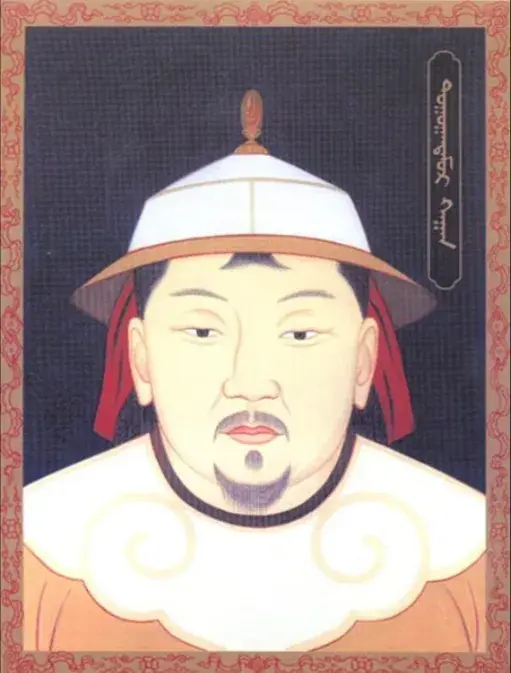
1320 CE–1370 CE
孛儿只斤·妥懽帖睦尔
Borjigin Toghon Temür (孛儿只斤·妥懽帖睦尔, May 25, 1320 – May 23, 1370), also known as Emperor Huizong of Yuan or Emperor Shun of Yuan, was the eleventh and final emperor of the unified Yuan dynasty in China, the fifteenth Khagan of the Mongol Empire, and the founding monarch of the Northern Yuan. The eldest son of Emperor Mingzong (Kuśala), his youth was marked by intense political persecution following his father's murder during…
Borjigin Toghon Temür (孛儿只斤·妥懽帖睦尔, May 25, 1320 – May 23, 1370), also known as Emperor Huizong of Yuan or Emperor Shun of Yuan, was the eleventh and final emperor of the unified Yuan dynasty in China, the fifteenth Khagan of the Mongol Empire, and the founding monarch of the Northern Yuan. The eldest son of Emperor Mingzong (Kuśala), his youth was marked by intense political persecution following his father's murder during the Tianli Coup, enduring protracted exile on Daecheong Island off the Korean coast and in Guilin. Ascending the imperial throne in Dadu in 1333 following the premature death of Emperor Ningzong, he patiently endured the regency of the anti-Han grand chancellor Bayan before orchestrating a palace coup with Bayan's nephew Toqto'a in 1340 to seize personal rule. Inaugurating the Zhizheng era, he championed administrative revitalization: restoring the imperial civil service examinations, supervising the compilation of the official histories of the Song, Liao, and Jin dynasties, codifying the Zhizheng Code, and executing monumental hydraulic projects along the Yellow River. However, catastrophic hyperinflation, bureaucratic corruption, and devastating floods triggered the nationwide Red Turban rebellions. In his later reign, Toghon Temür alienated his regime by executing Toqto'a on the brink of decisive victory, sinking into Esoteric Buddhist rituals and constructing ingenious mechanical water clocks and dragon boats, earning the moniker the Carpenter Emperor. When Ming armies captured Dadu in 1368, he fled north to preserve the dynastic lineage in the steppe, dying at Yingchang in 1370 at the age of fifty-one.
Born on the seventeenth day of the fourth lunar month in northern territories near Yingchang to Kuśala and Mailaiti.
Emperor Mingzong was poisoned at Ongghuchatu; Toghon Temür became a vulnerable victim of succession purges.
Banished by Emperor Wenzong to remote Daecheong Island off Goryeo for seventeen months in harsh isolation.
Relocated to Jingjiang (modern Guilin, Guangxi) to reside under surveillance at Dayuan Buddhist Monastery.
Returned to Dadu following Emperor Ningzong's death; enthroned as emperor on July 19 under grand chancellor El Temür.
Chancellor Bayan seized tyrannical power, executing El Temür's kin and abolishing the imperial examination system.
Allied with Bayan's nephew Toqto'a to stage a bloodless coup, banishing Bayan and initiating direct personal governance.
Promulgated the Zhizheng era; reinstated civil service examinations and commissioned the compilation of the Three Dynastic Histories.
Engineering conscription along the Yellow River ignited the White Lotus and Red Turban uprisings led by Han Shantong and Liu Futong.
Dismissed and poisoned Chancellor Toqto'a while he was besieging Gaoyou, destroying the core imperial field army.
Northern Red Turban armies launched a three-pronged northern expedition, penetrating the immediate suburbs of Dadu.
Empress Gi and Crown Prince Ayushiridara plotted to force the emperor's abdication, triggering warlord civil wars across north China.
Ming general Xu Da captured Tongzhou; Toghon Temür evacuated Dadu through the Jiande Gate at midnight, fleeing to Shangdu.
With Ming forces seizing Shangdu, the emperor retreated northeastward to establish his court at Yingchang near Lake Dali Nor.
Died of dysentery at Yingchang on May 23 at the age of fifty-one; posthumously named Emperor Shun by the Hongwu Emperor.
Toghon Temür was born on May 25, 1320, in the northern steppe regions near Yingchang. His father was Kuśala, Prince of Zhou (the eldest son of Emperor Wuzhong, later reigning as Emperor Mingzong), who was living in exile in the Altai mountains of the Chagatai Khanate, and his mother was Mailaiti, a noblewoman from the Karluk Turkic tribe. Mailaiti passed away shortly after childbirth, leaving the infant prince to be raised amidst the nomadic camps of the western steppe.
In 1329, the War of the Two Capitals erupted over the imperial succession. Kuśala was proclaimed Emperor Mingzong in the steppe and marched south toward Dadu. However, at Ongghuchatu north of the capital, he was poisoned during a banquet by agents of his younger brother Tugh Temür (Emperor Wenzong) and Grand Chancellor El Temür. Following Wenzong's restoration, the imperial court determined to eliminate potential threats from Mingzong's direct heirs, singling out the nine-year-old Toghon Temür for severe persecution.
In 1330, Wenzong issued an imperial edict questioning Toghon Temür's legitimacy, stripping him of imperial privileges and exiling him to desolate Daecheong Island off the western coast of Goryeo (modern Ongjin County, South Korea). For seventeen months, the young prince endured harsh coastal winds and acute physical deprivation in isolation, attended only by a handful of elderly servants. In 1332, Wenzong transferred him to Jingjiang (modern Guilin, Guangxi) in southern China, confining him within Dayuan Monastery under local military surveillance. In Guilin, Toghon Temür studied classical Confucian literature under Buddhist scholar Qiujiang, acquiring profound familiarity with Chinese literary traditions.
In late 1332, Emperor Wenzong passed away, expressing deathbed remorse over the murder of his elder brother and instructing that Mingzong's son should succeed him. Seeking a pliant child whom he could easily manipulate, El Temür passed over Toghon Temür in favor of his six-year-old half-brother, Rinchinbal (Emperor Ningzong). However, Ningzong died of illness after reigning for merely forty-three days, creating another constitutional crisis.
Fearing that Toghon Temür would avenge his father's murder, El Temür delayed his return from Guilin for months. In April 1333, the thirteen-year-old prince arrived in Dadu, displaying extraordinary diplomatic caution by treating the regent with outward deference and never mentioning past grievances. In May 1333, El Temür died suddenly from dissipation. On July 19, 1333, Toghon Temür formally ascended the imperial throne in Dadu, inaugurating the Yuantong era.
Following El Temür's death, supreme executive power was seized by Chancellor Bayan of the Merkit clan. Bayan established a despotic regime, exterminating El Temür's family and reversing decades of administrative integration. He abolished the imperial civil service examinations, banned Han and Southern subjects from holding iron tools or learning Mongolian, and even contemplated the absurd massacre of Chinese bearing the common surnames Zhang, Wang, Liu, Li, and Zhao. Unable to challenge the dictator openly, the youthful emperor feigned indifference, biding his time while cultivating loyal allies within the palace.
By 1340, Bayan's insolence had alienated the imperial family and military aristocracy. Toghon Temür formed a covert alliance with Bayan's scholarly nephew, Toqto'a, and Grand Preceptor Shijieban of the imperial guard. In February 1340, while Bayan was hunting outside the capital, the emperor barred the city gates and promulgated an imperial decree stripping Bayan of all offices and exiling him to Guangdong, where he died en route.
Assuming direct personal governance, Toghon Temür proclaimed the Zhizheng era in 1341, appointing Toqto'a as Right Chancellor to spearhead the Zhizheng Reforms. The administration rescinded Bayan's discriminatory edicts, restored the civil service examinations, rehabilitated officials persecuted under previous regimes, and launched rigorous audits against bureaucratic corruption.
Most enduringly, Toghon Temür ordered the compilation of the official histories of the Song, Liao, and Jin dynasties under Toqto'a's supervision. Overcoming decades of factional debates over dynastic legitimacy, the emperor embraced a pluralistic policy that recognized all three states as legitimate dynasties possessing equal status. Completed in barely two years, the monumental Song History, Liao History, and Jin History preserved thousands of vital primary records, establishing a landmark achievement in traditional Chinese historiography.
Despite administrative improvements, deep structural crises crippled the Yuan state. Decades of land monopolization by Mongol princes and Buddhist monasteries had rendered millions of Han peasants landless sharecroppers. In May 1344, the Yellow River burst its dykes in Henan, devastating millions of acres across Shandong, Henan, and northern Jiangsu, severing the Grand Canal grain supply to Dadu.
In April 1351, Toghon Temür authorized Hydraulic Commissioner Jia Lu to undertake a vast river diversion project, conscripting one hundred and fifty thousand laborers and twenty thousand troops. To finance the project, the government issued vast quantities of unbacked paper currency (Zhizheng Jiaochao), precipitating runaway hyperinflation that wiped out the savings of urban and rural populations.
Exploiting popular fury, White Lotus leaders Han Shantong and Liu Futong buried a stone statue with a single eye in the work trenches, circulating prophetic verses foretelling imminent revolt. In May 1351, Han Shantong and Liu Futong launched the Red Turban rebellion in Yingzhou. Within months, insurgent movements erupted across the empire: Xu Shouhui established the Tianwan regime in Hubei, Guo Zixing rebelled in Haozhou, Zhang Shicheng led salt smugglers in Jiangsu, and Fang Guozhen raided the Zhejiang coast, plunging the Central Plains into civil war.
Confronting nationwide rebellion, Toghon Temür reinstated Toqto'a as commander-in-chief in 1352. Toqto'a demonstrated formidable military ability, recapturing Xuzhou and reestablishing imperial communications across the Central Plains. In autumn 1354, Toqto'a assembled an imperial field army of one million soldiers—composed of Mongol, Jurchen, Tangut, and Han contingents—besieging insurgent leader Zhang Shicheng inside the fortress of Gaoyou.
With Gaoyou on the verge of capitulation and the southern rebellions facing total suppression, court rival Hama manipulated the emperor's insecurities, falsely alleging that Toqto'a intended to usurp the throne with his massive army. In November 1354, Toghon Temür committed his most catastrophic strategic blunder, dispatching imperial envoys to strip Toqto'a of command on the battlefield, exiling him to Yunnan where he was subsequently poisoned.
The sudden purge caused the imperial army before Gaoyou to disintegrate overnight. Commanders dispersed to carve out private domains, while insurgent armies surged forward to conquer regional centers. The removal of Toqto'a destroyed the last effective military instrument of the central government, reducing northern China into a fragmented battleground of competing warlords.
Concurrently, vicious dynastic factionalism paralyzed the court. Empress Gi and Crown Prince Ayushiridara plotted repeatedly to coerce Toghon Temür into abdication. The conflict drew in competing regional generals—Chaghan Temür, Köke Temür (Wang Baobao), and Bolad Temür—who waged protracted civil warfare in Shanxi and Hebei, frequently storming Dadu and reducing the imperial government to complete impotence.
In January 1368, Zhu Yuanzhang declared the founding of the Ming dynasty in Nanjing, dispatching generals Xu Da and Chang Yuchun with a northern expeditionary force of two hundred and fifty thousand veterans. Ming forces advanced rapidly through Shandong and Henan, capturing Tongzhou in July and threatening the capital.
On the night of September 10, 1368, with Ming drums sounding outside the walls, Toghon Temür assembled his imperial consorts, crown prince, and remaining guards, opened the Jiande Gate in tears, and fled northward toward Shangdu (Kaiping). His evacuation ended ninety-eight years of Mongol imperial rule over China proper.
Maintaining the dynastic title of Great Yuan (Northern Yuan), Toghon Temür established a defensive capital at Shangdu. In June 1369, Ming general Chang Yuchun stormed Shangdu, compelling the court to retreat further northeast into the steppe to Yingchang (near Lake Dali Nor). Exhausted by decades of turmoil and flight, Toghon Temür contracted acute dysentery, dying at Yingchang on May 23, 1370, at the age of fifty-one. Crown Prince Ayushiridara succeeded him, conferring the temple name Huizong. In Nanjing, the Hongwu Emperor bestowed upon him the posthumous title Emperor Shun, acknowledging that his peaceful flight had preserved civilian life in Dadu.
Toghon Temür's primary domestic accomplishment was the successful execution of the Zhizheng Reforms during the 1340s. Following the autocratic excesses of Bayan, he revitalized classical civil governance by reestablishing the imperial examination system, enabling hundreds of educated Han scholars to enter central and provincial administrations.
His most celebrated cultural contribution was commissioning the compilation of the official histories of the Song, Liao, and Jin dynasties. Directed by Chancellor Toqto'a, the historiographical bureau completed the three massive chronicles in record time: Liao History (116 volumes), Jin History (135 volumes), and Song History (496 volumes). By recognizing the dynastic legitimacy of all three predecessors equally, the emperor established a non-partisan, multiethnic historiographical model that preserved irreplaceable primary archives of medieval Asian civilization.
Confronting the catastrophic inundation of the Yellow River after 1344, Toghon Temür demonstrated remarkable engineering determination. Overriding conservative court opposition, he backed Hydraulic Commissioner Jia Lu with supreme executive authority and hundreds of thousands of conscripted laborers to divert the floodwaters back into their original riverbed.
Completed over seven months of intense labor in 1351, Jia Lu's hydraulic works successfully sealed the breach at Bamao, redirecting the Yellow River eastward to the sea and restoring navigability to the Grand Canal. Although the fiscal burdens of the project contributed to social unrest, the technical scale and hydraulic ingenuity of the diversion project represented a monumental achievement in imperial Chinese hydraulic engineering.
Toghon Temür stood out among Chinese monarchs for his astonishing natural talent in mechanical horology, architectural geometry, and naval engineering. Working directly in palace workshops, he drafted precise engineering schematics and assembled complex gearing systems with his own hands.
He created an automated mechanical palace clepsydra measuring over six feet in height. Powered by internal water conduits and escapement mechanisms, the clock featured mechanized copper figurines that emerged to beat gongs at half-hour intervals, while mechanical lions jumped and deities struck bells on the hour. He also designed a monumental motorized imperial dragon boat over one hundred and twenty feet in length, propelled by internal pedal-wheel mechanisms operated by oarsmen, featuring articulated dragon heads that moved in rhythm with the water. These mechanical creations showcased extraordinary empirical grasp of kinetic mechanics centuries ahead of his era.
In statutory jurisprudence, Toghon Temür oversaw the compilation of the Zhizheng Tiaoge, the definitive legal code of the late Yuan dynasty. Promulgated in 1346, the code comprised 150 imperial edicts, 1,700 administrative regulations, and 1,059 judicial precedents, synthesizing Mongolian customary law with traditional Chinese statutory jurisprudence and providing a comprehensive legal framework for Fourteenth-century China.
Throughout his reign, Toghon Temür maintained extensive diplomatic relations across Eurasia. In 1338, he dispatched an official embassy to the Papal See in Avignon. In response, Pope Benedict XII appointed Giovanni de' Marignolli as papal legate, who arrived in Dadu in 1342, presenting the emperor with a magnificent European warhorse. Toghon Temür commissioned court artist Zhou Lang to paint the steed and scholar Jie Xisi to compose the Odes to the Celestial Horse, documenting direct Eurasian diplomatic exchange on the eve of the Ming transition.
FIGURES ASSOCIATED WITH THIS DYNASTY