Birth
Born into an aristocratic Sayyid family in Bukhara, Central Asia.
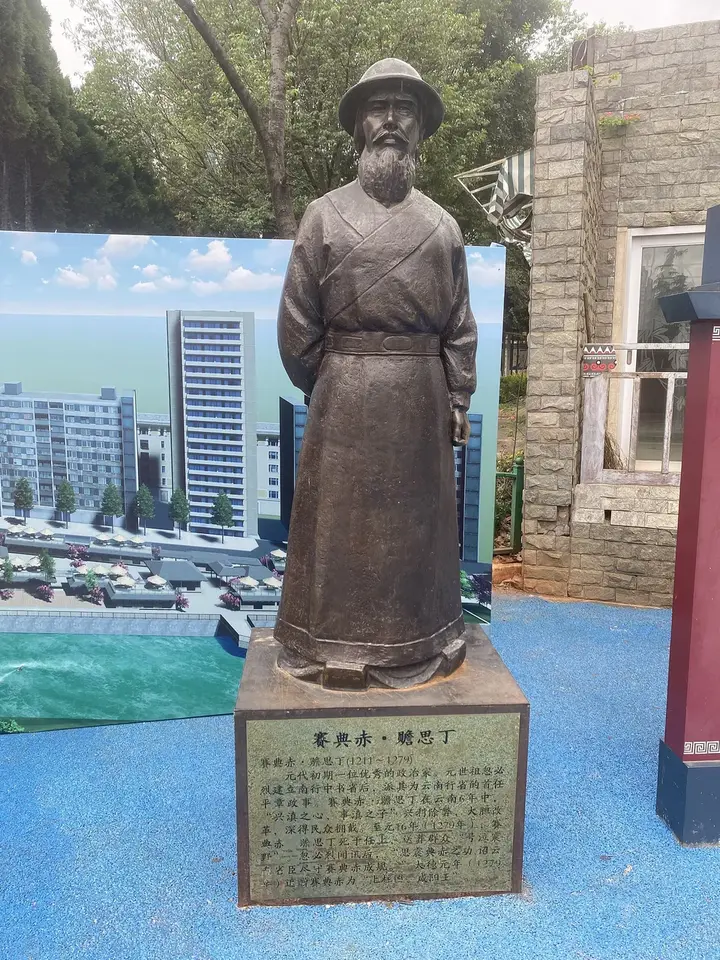
1211 CE–1279 CE
赛典赤·赡思丁·乌马儿
Sayyid Ajall Shams al-Din Omar (赛典赤·赡思丁·乌马儿, 1211–1279), a Huihui (回回人) native of Bukhara in Central Asia (modern Bukhara, Uzbekistan), was a celebrated Muslim statesman of the early Yuan dynasty, commonly referred to in Chinese historical records as Sayyid Ajall Shams al-Din. In Arabic, "Sayyid Ajall" signifies "Illustrious Descendant of the Prophet," "Shams al-Din" means "Sun of Religion," and his given name was Omar.…
Sayyid Ajall Shams al-Din Omar (赛典赤·赡思丁·乌马儿, 1211–1279), a Huihui (回回人) native of Bukhara in Central Asia (modern Bukhara, Uzbekistan), was a celebrated Muslim statesman of the early Yuan dynasty, commonly referred to in Chinese historical records as Sayyid Ajall Shams al-Din. In Arabic, "Sayyid Ajall" signifies "Illustrious Descendant of the Prophet," "Shams al-Din" means "Sun of Religion," and his given name was Omar. During Genghis Khan's western campaign against Khwarazm, the young Sayyid Ajall accompanied his father in submitting to the Mongol Empire at the head of a thousand cavalrymen, entering the imperial bodyguard (keshig) and serving across the reigns of Genghis Khan, Ögedei Khan, Möngke Khan, and Kublai Khan. After serving as Darughachi of Feng, Jing, and Yunnei Prefectures, Darughachi of Taiyuan and Pingyang Circuits, and Governor-General of Yanjing Circuit, he was appointed Grand Councilor of the Central Secretariat upon Kublai Khan's accession and subsequently governed Shaanxi and Sichuan for ten years. In 1274, Kublai Khan appointed him the first Grand Councilor of the Yunnan Branch Secretariat; over six years in Yunnan, he replaced military rule with civil circuits, prefectures, and counties, constructed the Songhuaba reservoir and dredged the Haikou River to end the flooding of Dianchi Lake, introduced advanced agricultural techniques, permitted tax payments in cowrie shells, and founded Yunnan's first Confucian temple and academy. He died in office in Kunming in 1279 at the age of sixty-nine and was posthumously enfeoffed as Prince of Xianyang with the posthumous title Zhonghui in 1297.
Born into an aristocratic Sayyid family in Bukhara, Central Asia.
Accompanied his father Qulmadin at the head of a thousand horsemen to submit to Genghis Khan during the capture of Bukhara, entering the imperial guard under the honorific title "Sayyid Ajall."
Appointed Chief Darughachi of Fengzhou, Jingzhou, and Yunneizhou upon Ögedei Khan's accession, and later transferred to serve as Darughachi of Taiyuan and Pingyang Circuits.
Appointed Associate Governor-General and soon promoted to Governor-General of Yanjing Circuit under Möngke Khan, reducing harsh levies, resettling displaced households, and supplying grain for the Sichuan campaign.
Appointed Pacification Commissioner of Yanjing by Kublai Khan and promoted in 1261 to Grand Councilor of the Central Secretariat.
Appointed Grand Councilor of the Shaanxi and Sichuan Branch Secretariat, expanding arable land, tax revenues, and military provisions over ten years while forbidding the slaughter of surrendered Song populations.
Appointed by Kublai Khan as the first Grand Councilor of the Yunnan Branch Secretariat; defused tensions with the Mongol prince Toghru and established thirty-seven civil circuits, prefectures, and counties alongside native chieftains.
Directed Zhang Lidao and Alawadin to dredge the Haikou outlet of Dianchi Lake and build the Songhuaba dam, reclaiming over 10,000 qing of farmland, while founding Yunnan's first Confucian temple.
Died of illness in the eighth month at Zhongqing Circuit (Kunming) at the age of sixty-nine, mourned across Yunnan; posthumously enfeoffed as Prince of Xianyang with the title Zhonghui in 1297.
Sayyid Ajall Shams al-Din Omar was born into a distinguished family in Bukhara (modern Uzbekistan), tracing his lineage as a thirty-first-generation descendant of the Islamic Prophet Muhammad. In 1220, when Genghis Khan led the Mongol western expedition to Bukhara, Sayyid Ajall's father Qulmadin led one thousand cavalrymen bearing leopards and white falcons to offer submission. Pleased by their allegiance, Genghis Khan admitted the young Sayyid Ajall into his personal bodyguard (keshig) in charge of ceremonial guards; out of respect for his noble lineage, the court addressed him by his title "Sayyid Ajall" rather than his personal name.
Following the accession of Ögedei Khan in 1229, Sayyid Ajall received his first regional appointment as Chief Darughachi (Imperial Overseer) of the three prefectures of Fengzhou, Jingzhou, and Yunneizhou, and was subsequently transferred to serve as Darughachi of Taiyuan and Pingyang Circuits, where he curbed the pillaging of civilians by military officers and restored public order. After Möngke Khan ascended the throne in 1251, Sayyid Ajall was appointed Associate Governor-General and soon Governor-General of Yanjing Circuit (modern Beijing). Finding Yanjing devastated by decades of warfare and arbitrary exactions by noble appanage holders, he reduced excessive taxes, recalled displaced peasant families to their land, and established local schools. During Möngke Khan's campaign against the Southern Song in Sichuan, Sayyid Ajall oversaw logistics and grain transport from the north, ensuring uninterrupted provisions for the front lines.
When Kublai Khan claimed the throne in the first year of the Zhongtong era (1260), he appointed Sayyid Ajall as Pacification Commissioner of Yanjing and in the fifth month of 1261 promoted him to Grand Councilor of the Central Secretariat (Zhongshu Pingzhang Zhengshi). In the first year of the Zhiyuan era (1264), Kublai dispatched him to serve as Grand Councilor of the Branch Secretariat for the Five Circuits of Shaanxi and Sichuan. Over ten years of administration in Shaanxi and Sichuan, Sayyid Ajall rectified official discipline, repaired mountain plank roads, and promoted agriculture, increasing registered households by more than 9,500, expanding military forces by over 12,000 troops, and raising paper-currency tax revenues by more than 15,000 ingots. In 1271, he led forces to support the siege of Xiangyang and advanced on Jiading (modern Leshan, Sichuan); when the Song commander Zan Wanshou surrendered Jiading, Sayyid Ajall strictly forbade his troops from killing a single inhabitant, winning deep trust among the people of Sichuan.
After the Mongol conquest of the Dali Kingdom, Yunnan had remained under fragmented military rule by Mongol imperial princes and thousand-household and ten-thousand-household commanders, whose heavy exactions provoked frequent uprisings among the local ethnic groups. In the tenth year of Zhiyuan (1273), Kublai Khan resolved to establish a formal Branch Secretariat in Yunnan and summoned Sayyid Ajall to court, appointing him Grand Councilor of the Yunnan Branch Secretariat with full authority over civil and military affairs in the southwest. Before setting out, Sayyid Ajall consulted travelers familiar with Yunnan's topography and customs to compile a detailed map of the region and presented a comprehensive administrative blueprint to Kublai Khan.
When Sayyid Ajall arrived at the provincial capital of Zhongqing Circuit (modern Kunming, Yunnan) in 1274, the resident Mongol imperial prince Toghru—fearing that the new Branch Secretariat had come to strip him of power—mobilized troops at Qujing in preparation for armed resistance. Unfazed, Sayyid Ajall sent his eldest son Nasir al-Din to Toghru's camp to assure the prince that the Secretariat was established to assist him in stabilizing the frontier, and invited Toghru to appoint his own trusted retainers as senior judicial officers (duanshiguan) within the Branch Secretariat to deliberate jointly on all major military and civil matters. Reassured and delighted, Toghru immediately stood down his troops and welcomed Sayyid Ajall with full honors. Having peacefully transitioned Yunnan from military rule to civil administration, Sayyid Ajall abolished the nineteen autonomous myriad-household commands (wanhufu) and reorganized Yunnan into thirty-seven circuits (lu) subdivided into prefectures, subprefectures, and counties, while retaining native chieftains as local hereditary officials in a dual system of indigenous and court-appointed governance.
Confronted with frequent floods and droughts in the Kunming basin, Sayyid Ajall made water conservancy and agricultural development his foremost priorities. At the time, mountain streams poured into Dianchi Lake while its sole southwestern outlet, the Haikou River, was choked with silt and rock reefs; every summer and autumn, floodwaters inundated Kunming and its surrounding farmland. After personally surveying the terrain, Sayyid Ajall commissioned Zhang Lidao, Commissioner for Encouraging Agriculture in Dali, and the engineer Alawadin to mobilize thousands of laborers over three years to blast away the reefs and dredge the Haikou River channel, draining the excess waters into the Tanglang and Jinsha rivers. Simultaneously, he constructed the Songhuaba reservoir dam on the upper reaches of the Panlong River along with six major irrigation canals—including the Jinzhi and Yinzhi rivers—permanently eliminating flooding around Kunming and creating more than ten thousand qing of fertile, irrigated farmland.
To improve local livelihoods, Sayyid Ajall introduced superior strains of rice, wheat, mulberry, and hemp as well as iron plowshares and waterwheels from Shaanxi and Sichuan, distributing seeds and tools to peasant households and assigning agricultural instructors to teach cultivation and sericulture. Recognizing that the people of Yunnan had used cowrie shells (dan) as currency for centuries and lacked silver or paper money, he petitioned the imperial court to allow Yunnan residents to pay taxes directly in cowrie shells at a fixed conversion rate. He also established a network of postal relay stations (yizhan) and fortified guard posts along the trunk roads linking Yunnan with Sichuan, Guizhou, Guangxi, Burma, and Annam, providing free lodging and protection to traveling merchants.
Although a devout Muslim himself, Sayyid Ajall actively promoted Confucian education and interreligious harmony in Yunnan. Between 1274 and 1276, he founded Yunnan's first Confucian temple (Wenmiao) and academy on the southern slope of Wuhua Hill in Kunming, purchased copies of the Five Classics and other Confucian texts from Sichuan, invited accomplished scholars to instruct students of all ethnic backgrounds, and endowed the academy with five qing of school land. Through education and ritual guidance, he gradually reformed local customs such as leaving deceased relatives unburied and settling disputes through blood feuds, while establishing granaries to care for widows and orphans. When dealing with rebellions among the Luopandian, Luobiandian, Jinchi (Golden Teeth), and Baiyi tribes, he consistently prioritized persuasion over force, punishing only the ringleaders while pardoning surrendered tribesmen and supplying them with oxen and farm tools, which prompted neighboring polities including Annam and Pagan Burma to send tribute missions. In the eighth month of the sixteenth year of Zhiyuan (1279), Sayyid Ajall died of overwork in Kunming at the age of sixty-nine. People of all ethnic groups closed the markets and wept in the streets, and the King of Annam sent twelve envoys in mourning dress to offer sacrifices hailing him as their "compassionate father and mother." In 1297, Emperor Chengzong posthumously enfeoffed him as Prince of Xianyang with the title Zhonghui.
FIGURES ASSOCIATED WITH THIS DYNASTY