Age 1 | Born in Jiangling to Emperor Xiaoming of Western Liang and Empress Zhang; raised successively by her paternal uncle Xiao Ji and maternal uncle Zhang Ke due to the southern taboo against infants born in the second lunar month
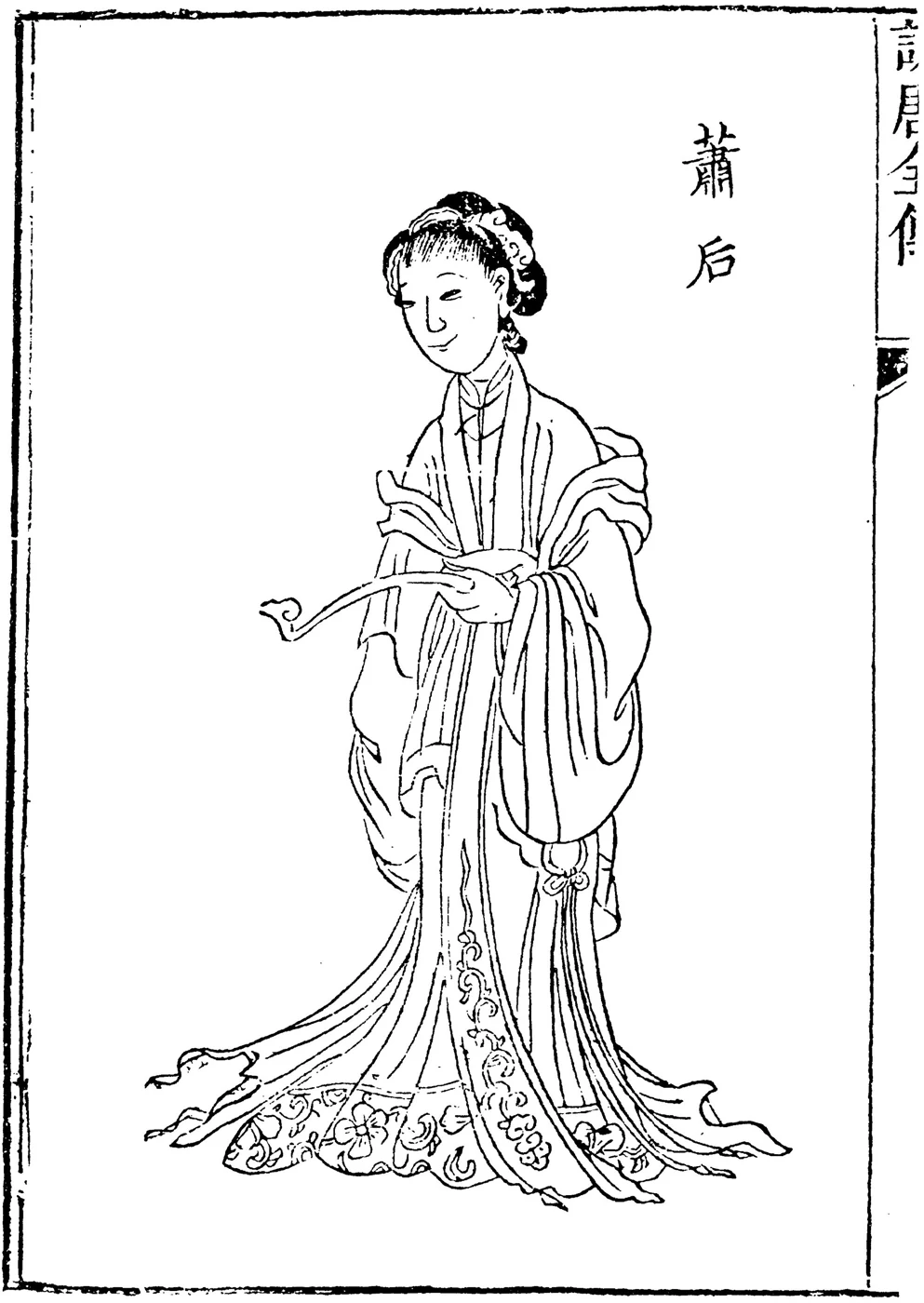
585 CE–648 CE
Princess of Western LiangConsort of the Prince of JinCrown Princess of SuiEmpress Consort of Emperor Yang of Sui
Lady Xiao(Empress Xiao)
萧氏(隋炀帝皇后)
Date-precision limit: former exact death dates and locations below that are not explicitly supported by this cache remain unconfirmed. The source-recorded death year and age are retained, without a new calendar conversion. Empress Xiao(567-647), posthumously honored as Empress Min, was a native of Southern Lanling(present-day Changzhou, Jiangsu Province), daughter of Emperor Xiaoming of Western Liang(Xiao Kui), and the…
585 CE–648 CESui Dynasty
PROFILE
Date-precision limit: former exact death dates and locations below that are not explicitly supported by this cache remain unconfirmed. The source-recorded death year and age are retained, without a new calendar conversion. Empress Xiao(567-647), posthumously honored as Empress Min, was a native of Southern Lanling(present-day Changzhou, Jiangsu Province), daughter of Emperor Xiaoming of Western Liang(Xiao Kui), and the empress consort of Emperor Yang of Sui(Yang Guang). Following her death during the Zhenguan reign of the Tang dynasty, Emperor Taizong bestowed upon her the posthumous name "Empress Min." Descended from the imperial house of the Southern Qi and Liang dynasties, she was a central court figure witnessing the unification of China, the rise and fall of the Sui dynasty, and the flourishing foundation of the Tang dynasty. Empress Xiao was gentle, intelligent, deeply learned, and proficient in divination and classical scholarship. In 582(2nd year of Kaihuang), when Emperor Wen of Sui(Yang Jian) and Empress Wenxian(Dugu Qieluo) sought a consort for their second son Yang Guang, Prince of Jin, divinations regarding southern princesses yielded unfavorable results except for Lady Xiao, who was consequently chosen as Princess Consort of Jin. In the Sui capital, Consort Xiao won the profound affection of Empress Dugu through her filial piety, modest demeanor, and avoidance of lavishness, serving as an indispensable confidante in Yang Guang's successful campaign to depose Crown Prince Yang Yong and secure the heirship. In 604(4th year of Renshou), Yang Guang ascended the throne as Emperor Yang and invested her as Empress Consort. Distressed by Emperor Yang's reckless squandering of resources, monumental construction projects, and disastrous military campaigns against Goguryeo, Empress Xiao composed the acclaimed Rhapsody on Expressing My Resolve(Shuzhi Fu) to subtly admonish him. Emperor Yang held her in deep esteem throughout his life, ensuring she accompanied him on all royal progresses. In April 618(3rd lunar month, 14th year of Daye), the Jiangdu Mutiny erupted; rebel troops led by Yuwen Huaji assassinated Emperor Yang, trapping Empress Xiao and the imperial women. Amid the chaotic collapse of the empire, Empress Xiao was captured by warlord Dou Jiande, and was subsequently escorted to the northern steppe upon the request of Princess Yicheng(wife of the Tujue Chuluo Qaghan). Under the protection of Chuluo Qaghan and Illig Qaghan, Empress Xiao spent a decade in the steppe diligently raising Emperor Yang's orphaned grandson Yang Zhengdao and preserving the remaining Sui loyalist lineage. In 630(4th year of Zhenguan), Tang general Li Jing crushed the Eastern Tujue at the Yin Mountains, and Emperor Taizong of Tang dispatched a high-level mission to welcome Empress Xiao and Yang Zhengdao back to Chang'an. Emperor Taizong treated her with the highest courtesy, granting her a grand mansion in the Xingdao Quarter. In 647(21st year of Zhenguan), Empress Xiao passed away peacefully in Chang'an at eighty-one. Emperor Taizong decreed that she be buried with empress honors alongside Emperor Yang at Leitang in Jiangdu, conferring upon her the posthumous title "Empress Min."
- Aliases
- Empress Xiao, Empress Xiao of Emperor Yang of Sui, Empress Min of Sui, Princess of Liang
- Era
- Late Southern and Northern Dynasties to Sui-Tang transition
- Dynasty/Regime
- Western Liang, Sui dynasty, Tang dynasty
- Identity
- Princess of Western Liang, Consort of the Prince of Jin, Crown Princess of Sui, Empress Consort of Emperor Yang of Sui, Empress Min of Tang
- Date of Birth
- 567 CE(2nd year of the Xiliangtianbaoliunian/chenguangdayuannian/beizhoutianhe era)
- Date of Death
- 647
- Ethnicity
- Huaxia(Han)
- Ancestral Home
- Southern Lanling(present-day Changzhou, Jiangsu Province, alternatively Danyang)
- Place of Birth
- Jiangling(present-day Jingzhou, Hubei Province)
- Place of Death
- Residence at Xingdao Quarter, Chang'an(present-day Xi'an, Shaanxi Province)
- Age at Death
- 81
- Reign/Tenure
- 582-600(Consort of the Prince of Jin); 600-604(Crown Princess); 604-618(Empress Consort)
- Posthumous Title
- Empress Min(bestowed by Emperor Taizong of Tang)
- Mausoleum
- Tomb of Emperor Yang at Leitang(present-day Caozhuang joint tomb of Emperor Yang and Empress Xiao, Hanjiang District, Yangzhou, Jiangsu Province)
- Key Relatives
- Father Emperor Xiaoming of Western Liang(Xiao Kui), mother Empress Zhang, husband Emperor Yang of Sui(Yang Guang), father-in-law Emperor Wen of Sui(Yang Jian), mother-in-law Empress Wenxian(Dugu Qieluo), eldest son Crown Prince Yuande(Yang Zhao), second son Prince of Qi(Yang Jian), daughter Princess Nanyang, grandson King of Sui(Yang Zhengdao)
- Major Achievements
- Born into the southern imperial Xiao clan of Lanling; highly educated in literature, history, and divination; assisted Yang Guang in earning the favor of Emperor Wen and Empress Dugu to secure the position of Crown Prince; served as Empress Consort with grace and composed the Rhapsody on Expressing My Resolve(Shuzhi Fu) to tactfully admonish Emperor Yang against tyrannical extravagance; survived the Jiangdu Mutiny, warfare among warlords, and ten years in the Tujue steppe while resolutely shielding the surviving imperial bloodline of the Sui dynasty; received with high honors by Emperor Taizong of Tang upon her return to Chang'an in 630; died at the advanced age of eighty-one and was interred with full empress honors beside Emperor Yang in Yangzhou, standing as an enduring symbol of maternal resilience and aristocratic culture across three dynasties.
LIFE TIMELINE
Age 16 | Selected as Princess Consort of Jin for Yang Guang following auspicious divination results overseen by Emperor Wen and Empress Dugu
Age 18 | Gave birth to her eldest son Yang Zhao(later invested as Crown Prince and posthumously honored as Crown Prince Yuande)
Age 19 | Gave birth to her second son Yang Jian(later created Prince of Qi)
Age 23 | Yang Guang commanded the conquest of the Chen dynasty, unifying China; Consort Xiao assisted in winning the allegiance of southern aristocratic families
Age 34 | Emperor Wen deposed Crown Prince Yang Yong and created Yang Guang Crown Prince; Consort Xiao was invested as Crown Princess
Age 38 | Emperor Wen passed away and Yang Guang ascended the throne as Emperor Yang; invested as Empress Consort in the following month
Age 40 | Crown Prince Yang Zhao died prematurely; grieving deeply, Empress Xiao composed the Rhapsody on Expressing My Resolve(Shuzhi Fu) to subtly admonish the Emperor against tyranny
Age 49 | Besieged with Emperor Yang at Yanmen Pass by Shibi Qaghan of Tujue; assisted in defense and secretly sent an emissary to Princess Yicheng to secure a lifting of the siege
Age 52 | The Jiangdu Mutiny broke out; Yuwen Huaji assassinated Emperor Yang and royal kin; Empress Xiao and court ladies were captured and forced north
Age 53 | Dou Jiande defeated Yuwen Huaji at Liaocheng and took custody of Empress Xiao, honoring her as Empress Zhuangxian
Age 54 | Chuluo Qaghan of Tujue dispatched an armed embassy to bring Empress Xiao and Yang Zhengdao to Dingxiang in the northern steppe
Age 64 | Tang general Li Jing routed the Eastern Tujue and captured Illig Qaghan; Emperor Taizong sent emissaries to escort Empress Xiao back to Chang'an, providing a mansion in Xingdao Quarter
Age 81 | Passed away peacefully in Chang'an at eighty-one; Emperor Taizong ordered an empress-grade funeral procession to inter her beside Emperor Yang in Jiangdu, posthumously naming her "Empress Min"
Age 64 | ### Return to Tang and Joint Interment at Leitang In 630(4th year of Zhenguan), Tang general Li Jing launched a lightning cavalry strike against the Eastern Tujue at the Yin Mountains, capturing Illig Qaghan and dismantling the nomad khaganate.
Age 81 | On April 17, 647(Gengzi day, 2nd lunar month, 21st year of Zhenguan), Empress Xiao passed away in her Chang'an residence at eighty-one.
BIOGRAPHY
Biography
Aristocratic Lineage and Upbringing in Obscurity Lady Xiao was born in 567(6th year of Tianbao, Western Liang) with ancestral roots in Southern Lanling(present-day Changzhou, Jiangsu Province). Her father was Emperor Xiaoming of Western Liang(Xiao Kui), a ruler renowned for classical learning, and her mother was Empress Zhang. Western Liang was a client state established at Jiangling by the descendants of Emperor Wu of Liang under Northern Zhou sponsorship. When Lady Xiao was born in the second lunar month, her birth collided with an ancient southern superstition holding that children born in that month brought misfortune upon their parents. Emperor Xiaoming, troubled by this taboo, entrusted the infant to his cousin, Eastern Han Grand Commandant Xiao Ji. Within a few years, Xiao Ji and his wife passed away, and the young girl was transferred to the care of her maternal uncle, Zhang Ke. Zhang Ke's family lived in straitened circumstances. Although an imperial princess by blood, Lady Xiao grew up performing manual chores and experiencing the hardships of commoners. Far from succumbing to despair, she developed a resilient, modest, and gentle character. During these formative years, she immersed herself in classical literature, historical chronicles, Daoist and Buddhist canons, and the esoteric art of celestial divination, acquiring the deep literary refinement characteristic of southern noble houses. ### Marriage to the Prince of Jin and the Succession Struggle In 582(2nd year of Kaihuang), having recently founded the Sui dynasty, Emperor Wen(Yang Jian) and Empress Wenxian(Dugu Qieluo) sought a noble consort for their second son Yang Guang, Prince of Jin. Sui emissaries traveled to Jiangling to propose marriage to the Western Liang royal court. Emperor Xiaoming had court diviners assess all his resident daughters, but every reading returned unfavorable. In distress, the King recalled his second daughter living among commoners and had her brought back to court. The divination for Lady Xiao yielded an extraordinarily auspicious prophecy of supreme fortune and virtue. In the winter of 582, the sixteen-year-old Lady Xiao was welcomed to Chang'an and formally invested as Princess Consort of Jin. During the Kaihuang era, Yang Guang served as Area Commander of Bingzhou and Yangzhou, overseeing the decisive campaign that overthrew the Chen dynasty in 589. Consort Xiao combined remarkable grace with deep discretion and filial devotion. At court, Emperor Wen practiced strict frugality, while Empress Dugu despised concubinage and ostentation. Crown Prince Yang Yong had alienated his parents through extravagant living and favoring concubines over his principal wife. Consort Xiao astutely recognized her in-laws' sentiments: within the Prince of Jin's household, she led an austere lifestyle, avoided jealousy, and treated Empress Dugu with utmost deference. In Yang Guang's calculated campaign to displace his elder brother, Consort Xiao provided impeccable moral credit. In November 600(10th lunar month, 20th year of Kaihuang), Emperor Wen deposed Yang Yong and proclaimed Yang Guang Crown Prince, elevating Consort Xiao to Crown Princess. ### Middle Palace Elevation and the Rhapsody on Expressing My Resolve In August 604(7th lunar month, 4th year of Renshou), Emperor Wen passed away at Renshou Palace, and Yang Guang ascended the throne as Emperor Yang. In the following month, Emperor Yang invested Lady Xiao as Empress Consort. Deeply devoted to his empress, Emperor Yang lavished honors upon the Xiao clan, posthumously honoring Xiao Kui and Empress Zhang, and elevating her brother Xiao Yu and cousin Xiao Zhou to high offices. However, once seated upon the throne, Emperor Yang grew increasingly megalomaniacal and despotic. He constructed the luxurious Xianren Palace, built the Eastern Capital of Luoyang, excavated the Grand Canal, embarked on lavish southern cruises, and launched three ruinous campaigns against Goguryeo, triggering peasant rebellions across the empire. Residing in the inner palace, Empress Xiao watched the erosion of the imperial foundation with acute foreboding. Yet knowing Emperor Yang's fiery temper and intolerance of criticism, direct remonstrance would only invite wrath. Following the tragic death of her eldest son Crown Prince Yang Zhao in 606, Empress Xiao poured her sorrow and subtle political admonitions into the celebrated literary masterpiece Rhapsody on Expressing My Resolve(Shuzhi Fu): > "Inheriting the fragrant legacy of accumulated virtue, entrusted to the honored gate of glory... Mourning the endless toil of the common people, lamenting the mounting sorrows of the eastern suburbs... I pray the imperial chariot will rest, following the will of Heaven to protect the people." Using classical allusions on cosmic balance and dynastic rise and fall, Empress Xiao tactfully pleaded with the Emperor to halt overworking the populace and restrain his extravagant desires. Emperor Yang was moved by her literary genius and treated her with heightened personal respect, yet he persisted unchanged in his destructive policies. ### Siege at Yanmen and the Jiangdu Mutiny In August 615(8th lunar month, 11th year of Daye), Empress Xiao accompanied Emperor Yang on a northern inspection tour to Fanyang Palace when Shibi Qaghan of Eastern Tujue launched a surprise attack with hundreds of thousands of cavalry, trapping the imperial entourage within Yanmen Pass. Tujue arrows reached the Emperor's pavilion, and food supplies dwindled to twenty days. Emperor Yang wept openly while embracing his youngest son Yang Gao. Empress Xiao remained composed, helping maintain discipline among the garrison and advising the Emperor to dispatch a covert messenger to Princess Yicheng, a Sui princess married to the Qaghan. Princess Yicheng falsely informed the Qaghan that northern tribes were revolting, inducing the Tujue to lift the siege in September. By 616(12th year of Daye), rebellions raged across China, prompting Emperor Yang to flee south to Jiangdu(present-day Yangzhou). In April 618(3rd lunar month, 14th year of Daye), officers of the imperial Xiaoguo Army led by Yuwen Huaji and Sima Dekan staged a mutiny. Prior to the uprising, a palace maid warned Empress Xiao, who sighed: "The state has reached this pass; events are beyond salvage. Speaking of it will accomplish nothing and only torment the Emperor with terror!" On April 11(Bingchen day), mutineers breached the palace and strangled Emperor Yang before Empress Xiao, executing royal princes including Yang Gao. In this harrowing crisis, Empress Xiao maintained dignity; with her attendants, she dismantled sandalwood bed frames to fashion makeshift coffins, secretly burying Emperor Yang beneath the West Courtyard's Liuzhu Hall to preserve his remains from desecration. ### Captivity under Warlords and Exile in the Steppe Following the massacre, Yuwen Huaji proclaimed Prince Yang Hao a puppet emperor and forced Empress Xiao and the imperial harem north. At Liaocheng, warlord Dou Jiande crushed Yuwen Huaji's army and executed him. Entering the city, Dou Jiande appeared before Empress Xiao in mourning garb, treated her with courtly reverence, and addressed her as "Empress Zhuangxian." Upon learning of Emperor Yang's death and Empress Xiao's plight, Princess Yicheng urged her husband Chuluo Qaghan to rescue them. In 620(3rd year of Wude, Tang dynasty), Chuluo Qaghan sent an armed mission to demand the surrender of the imperial family. Unable to resist, Dou Jiande escorted Empress Xiao and Emperor Yang's orphaned grandson Yang Zhengdao into the northern steppe. Chuluo Qaghan received Empress Xiao with full imperial honors, establishing a Sui administrative command at Dingxiang(in modern Inner Mongolia) and proclaiming Yang Zhengdao the "King of Sui." For a decade amidst the harsh northern steppe, Empress Xiao, now past fifty, preserved the last remnant of the Sui imperial lineage and educated Yang Zhengdao in classical rites and governance. ### Return to Tang and Joint Interment at Leitang In 630(4th year of Zhenguan), Tang general Li Jing launched a lightning cavalry strike against the Eastern Tujue at the Yin Mountains, capturing Illig Qaghan and dismantling the nomad khaganate. Emperor Taizong of Tang sent an imperial delegation to escort Empress Xiao and Yang Zhengdao back to Chang'an. When the sixty-four-year-old Empress Xiao reached the capital, Emperor Taizong received her with an elaborate ceremony at the Taiji Palace. Cognizant of Empress Zhangsun's maternal kin connection to the Sui house and admiring Empress Xiao's noble endurance, Emperor Taizong granted her lavish stipends, appointed Yang Zhengdao as a court gentleman, and bestowed an opulent residence in the Xingdao Quarter. In her final seventeen years in Chang'an, Empress Xiao lived peacefully in secluded Buddhist contemplation. On April 17, 647(Gengzi day, 2nd lunar month, 21st year of Zhenguan), Empress Xiao passed away in her Chang'an residence at eighty-one. Deeply moved, Emperor Taizong suspended court audiences, bestowed the posthumous name "Empress Min," and ordered the Ministry of Rites to conduct an imperial funeral. A military guard escorted her bier to Leitang in Jiangdu to be buried alongside Emperor Yang. In 2013, archaeological excavations at Caozhuang in Yangzhou uncovered the tomb of Emperor Yang and Empress Xiao, discovering Empress Xiao's well-preserved nanmu coffin, skeletal remains, an exquisite phoenix headdress, bronze chimes, and pottery figurines, providing physical confirmation of the historical accounts of her grand joint burial.
Major Activities
Moral and Diplomatic Support in Securing the Crown During the Kaihuang reign, Consort Xiao's exemplary modesty and filial conduct earned the unwavering praise of Emperor Wen and Empress Dugu. Her flawless moral standing served as a primary asset in Yang Guang's ascendancy to Crown Prince in 600. ### Composition of the Rhapsody on Expressing My Resolve Faced with Emperor Yang's escalating tyranny and monumental hubris, Empress Xiao chose not complicity or flattery, but created the poignant Rhapsody on Expressing My Resolve(Shuzhi Fu), employing classical metaphors to counsel peace and compassion for the realm. ### Strategic Leadership during the Yanmen Siege During the perilous siege of Yanmen Pass by hundreds of thousands of Tujue cavalry in 615, Empress Xiao assisted in organizing resistance and orchestrated the covert appeal to Princess Yicheng that secured the withdrawal of the nomadic army. ### Preserving Imperial Kin and Dignified Return Surviving the violent collapse of the empire and captivity under rival factions, Empress Xiao tenaciously shielded Emperor Yang's grandson Yang Zhengdao for a decade in the northern steppe. Her return to Chang'an under Emperor Taizong's personal veneration exemplified maternal fortitude transcending dynastic transitions.
Personal Relations
- Husband: Emperor Yang of Sui(Yang Guang), 2nd emperor of the Sui dynasty; assassinated in 618, buried together at Leitang in 647
- Father: Emperor Xiaoming of Western Liang(Xiao Kui), 2nd emperor of Western Liang, noted scholar
- Mother: Empress Zhang, empress of Western Liang
- Father-in-Law: Emperor Wen of Sui(Yang Jian), founder of the Sui dynasty
- Mother-in-Law: Empress Wenxian(Dugu Qieluo), empress of Emperor Wen
- Younger Brother: Xiao Yu, prominent chancellor of Sui and Tang, honored among the 24 Meritorious Officials of Lingyan Pavilion
- Adoptive Father / Uncle: Xiao Ji, Grand Commandant of Western Liang who fostered her in infancy
- Adoptive Father / Maternal Uncle: Zhang Ke, brother of Empress Zhang who raised her in childhood
- Eldest Son: Yang Zhao, Crown Prince Yuande of Sui, passed away in 606
- Second Son: Yang Jian, Prince of Qi, killed in the Jiangdu Mutiny
- Youngest Son: Yang Gao, Prince of Zhao, killed during the Jiangdu Mutiny
- Daughter: Princess Nanyang, wife of Yuwen Shiji; became a Buddhist nun after the Jiangdu Mutiny
- Grandson: Yang Zhengdao, posthumous son of Yang Zhao; created King of Sui by Tujue, served as court official in Tang
- Honored Host: Emperor Taizong of Tang(Li Shih-min), welcomed her back to Chang'an in 630 and arranged her joint burial at Leitang
Historical Assessment
Wei Zheng's Judgment in the Book of Sui Wei Zheng praised her in the Book of Sui(Suishu, "Biographies of Empresses and Consorts"): "Empress Xiao was gentle, intelligent, and fond of learning, proficient in divination. Whenever the Emperor attended court, the Empress accompanied him with solemn dignity. Seeing the Emperor falter in virtue, she knew it was wrong yet dared not rebuke him harshly, composing the Rhapsody on Expressing My Resolve to admonish him with elegant diction... Although Emperor Yang was dissolute and tyrannical, he treated the Empress with special reverence; enduring chaotic dislocations, she maintained her resolve unshaken, truly possessing the illustrious virtue of an era." ### Sima Guang's Assessment in Zizhi Tongjian In Zizhi Tongjian, Sima Guang observed: "Yang Guang cultivated an image of humility, and Princess Xiao fully matched him in wifely virtue, pleasing Empress Dugu. In Emperor Yang's attainment of the realm, the Empress contributed greatly. Later amidst the extravagance of Daye, she expressed her concerns through her rhapsody; though the Emperor did not heed her, his reverence never waned. When weapons clashed at Jiangdu, she buried the Emperor's remains, endured exile in the northern desert, and preserved the Sui heir; she may indeed be called one endowed with both benevolence and wisdom." ### Modern Historiographical and Archaeological Perspective Modern historians, reinforced by the 2013 archaeological findings at Caozhuang in Yangzhou, view Empress Xiao as an exceptional cultural bridge between the aristocratic heritage of the Southern Dynasties and the unified institutions of the Sui-Tang era. Crowned an imperial princess in the south, elevated as empress in the north, and surviving decades of turmoil across the Great Wall, she preserved both the cultural elegance of Lanling and the dignity of the imperial house. Her peaceful final years and formal burial under Tang auspices demonstrate the inclusive dynastic legitimacy that characterized the early Tang empire.
FIGURES ASSOCIATED WITH THIS DYNASTY
Bibliography
- Wei Zheng, Zhangsun Wuji, et al.: Book of Sui(Suishu), Volume 36, "Biographies of Empresses and Consorts: Empress Xiao of Emperor Yang"
- Wei Zheng, Zhangsun Wuji, et al.: Book of Sui(Suishu), Volumes 3–4, "Annals of Emperor Yang"
- Li Yanshou: History of the Northern Dynasties(Beishi), Volume 14, "Biographies of Empresses and Consorts: Empress Xiao of Emperor Yang"
- Liu Xu et al.: Old Book of Tang(Jiu Tangshu), Volumes 2–3, "Annals of Emperor Taizong"
- Ouyang Xiu, Song Qi, et al.: New Book of Tang(Xin Tangshu), Volume 76, "Biographies of Empresses and Consorts"