Approximately in her twenties | While serving as a singer in Princess Yang'a's household, she was seen by Emperor Cheng during an incognito excursion, summoned into the palace, and made Jieyu.
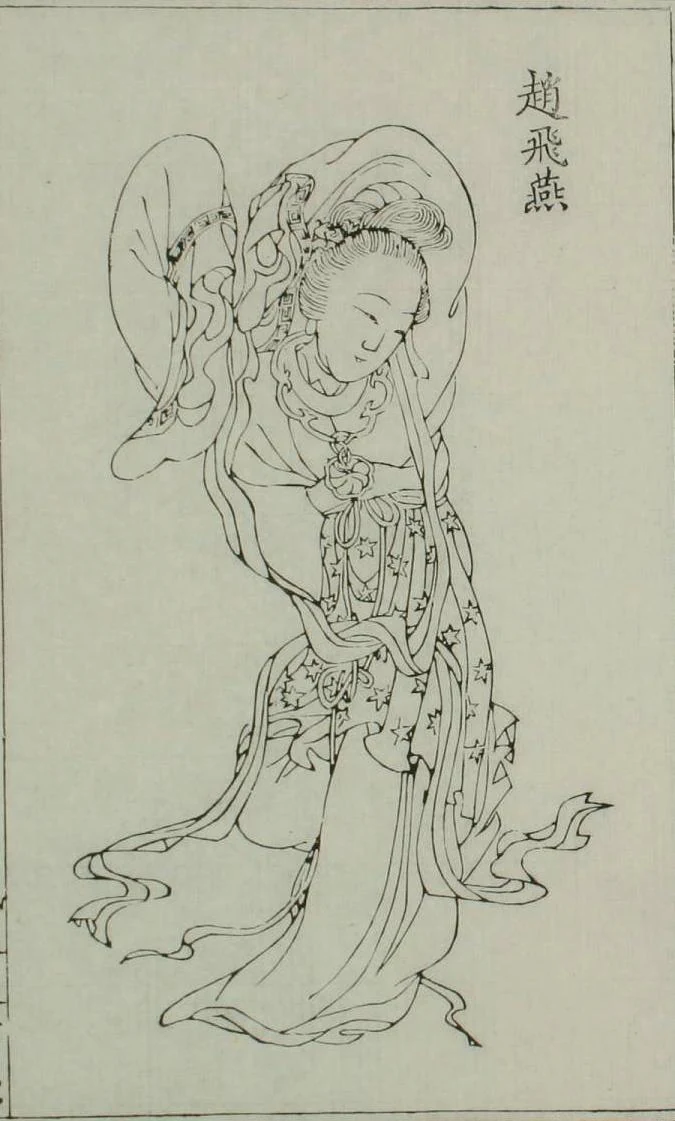
?–前?
Empressregent
Zhao Feiyan
赵飞燕
Zhao Feiyan (d. 1 BCE), originally named Yizhu and known by the name Feiyan, was from Chang'an in the Western Han and became the second empress of Liu Ao, Emperor Cheng of Han. Born to a family of very low status, she first worked as a singing and dancing woman in the household of Princess Yang'a. Her graceful dancing was said to be as light as a flying swallow, giving rise to the name "Feiyan." In 18 BCE, the third year of…
?–前?Western Han
PROFILE
Zhao Feiyan (d. 1 BCE), originally named Yizhu and known by the name Feiyan, was from Chang'an in the Western Han and became the second empress of Liu Ao, Emperor Cheng of Han. Born to a family of very low status, she first worked as a singing and dancing woman in the household of Princess Yang'a. Her graceful dancing was said to be as light as a flying swallow, giving rise to the name "Feiyan." In 18 BCE, the third year of Hongjia, Emperor Cheng summoned her into the palace, and in 16 BCE, the first year of Yongshi, she became empress. Zhao Feiyan and her younger sister Zhao Hede monopolized imperial favor for more than a decade, but neither had children. In 8 BCE, the first year of Suihe, Zhao Feiyan helped Liu Xin, Prince of Dingtao, become crown prince. After Emperor Cheng died, Liu Xin succeeded as Emperor Ai of Han and honored Zhao Feiyan as Empress Dowager. In 1 BCE, the second year of Yuanshou, Emperor Ai died. After Wang Mang gained power, Zhao Feiyan was reduced to commoner status and committed suicide while assigned to guard Emperor Cheng's mausoleum. Famous for her light body and dancing skill, she was associated in later tradition with the "jubu" step and the "dance on the palm," and became an important figure in accounts of ancient Chinese dance.
- Other name
- Empress Zhao Feiyan of Emperor Cheng of Han
- Art name
- Feiyan
- Period
- Western Han
- Date of Birth
- Not recorded in historical sources
- Date of Death
- 1 BCE
- Dynasty/Polity
- Western Han
- Identity
- Empress; regent
- Ethnicity/People
- Han Chinese
- Native place
- Chang'an, Western Han
- Place of birth
- Chang'an
- Tenure as empress
- Not recorded in historical sources
- Posthumous name
- Not recorded in historical sources
- Major achievements
- Empress of Emperor Cheng; renowned for her light build and dancing; she and her younger sister dominated the inner palace, and after Emperor Cheng's death Zhao Feiyan was eventually demoted and committed suicide
LIFE TIMELINE
Approximately in her twenties | Reported that Empress Xu's elder sister Xu Ye had used witchcraft to curse women in the palace, contributing to Empress Xu's deposition.
Approximately in her twenties | In the fourth month Emperor Cheng made her father Zhao Lin Marquis of Chengyang; in the sixth month Zhao Feiyan was made empress and Zhao Hede became Zhaoyi.
BCE – 8 BCE(1st year of the Yongshi era, Han – 1st year of the Suih
16 BCE – 8 BCE(1st year of the Yongshi era, Han – 1st year of the Suihe era) | Approximately her twenties to thirties | Zhao Feiyan and Zhao Hede monopolized imperial favor for more than ten years, but neither had children.
Approximately in her thirties | Accepted gifts from Empress Dowager Fu, grandmother of Liu Xin, Prince of Dingtao, and helped Liu Xin become crown prince.
Approximately in her thirties | Emperor Cheng died suddenly; Zhao Hede was blamed and committed suicide. Liu Xin became Emperor Ai of Han and honored Zhao Feiyan as Empress Dowager.
Approximately in her thirties | Xie Guang, metropolitan inspector, impeached Zhao Hede for killing Emperor Cheng's sons. Emperor Ai demoted Zhao Qin and Zhao Xin to commoner status, while Zhao Feiyan was not punished because of her role in supporting his succession.
Age thirty-seven | Emperor Ai died. Wang Mang gained power and demoted Zhao Feiyan to the title Empress Xiaocheng, moving her to the Northern Palace. One month later she was further reduced to commoner status and sent to guard Emperor Cheng's mausoleum at Yanling; she committed suicide that day.
BIOGRAPHY
Biography
Family background and early years
Zhao Feiyan was born in the imperial capital Chang'an. According to the "Traditions of the Empresses and Imperial In-Laws" in the Book of Han, her parents initially did not wish to raise her and abandoned her at birth. After she remained alive for three days, they took her back and raised her. Her original name was Zhao Yizhu. Her father Zhao Lin was a government slave, and the family occupied a very low social position.
When Zhao Feiyan grew up, she became exceptionally beautiful and entered the household of Princess Yang'a as a singer and dancer. She trained intensely in song and dance. The source says that she concentrated so deeply that she could listen and practice through the day without eating. Because her dancing was light and graceful, like a swallow or phoenix in flight, she became known as "Feiyan." The Book of Han records that when she grew up she entered Princess Yang'a's household, learned song and dance, and was called Feiyan.
Later unofficial literature gave her origins a more romanticized account. The Feiyan Waizhuan claimed that her biological father was the musician Feng Wanjin and her mother a granddaughter of Liu Jian, Prince of Jiangdu, known as Princess Gusu, and that an illicit relationship produced Zhao Feiyan and Zhao Hede. This story does not appear in the official histories and is found only in fictionalized tradition.
Entry into the palace and imperial favor
In 18 BCE, the third year of Hongjia, Emperor Cheng had already reigned for more than a decade and was about thirty years old but had no surviving son. During an incognito excursion, he visited Princess Yang'a's residence. The princess summoned the women in her household to perform. Zhao Feiyan's appearance, voice, and graceful dancing immediately attracted the emperor. He brought her into the palace and favored her heavily. The Book of Han states that Emperor Cheng saw Feiyan while traveling incognito, was pleased by her, summoned her to the palace, and greatly favored her.
According to later accounts, when Zhao Feiyan first entered the palace she refused the emperor's summons three times in succession, deliberately increasing his interest. To consolidate her position she recommended her younger sister Zhao Hede. Emperor Cheng heard that Zhao Hede was exceptionally beautiful and gentle and ordered her brought into the palace. The sisters were both made Jieyu and became the dominant favorites of the inner palace. Other consorts, including Empress Xu and Ban Jieyu, fell from favor.
Appointment as empress and dominance of the palace
In 18 BCE, Empress Xu's elder sister Xu Ye was discovered using witchcraft to curse pregnant women in the palace. She had cursed the pregnant Lady Wang and members of the Wang imperial in-law family, including Wang Feng. Zhao Feiyan used the incident to accuse Empress Xu and Xu Ye of sorcery intended to harm palace women and secure favor for themselves. Empress Dowager Wang Zhengjun ordered an investigation. Empress Xu was deposed, Xu Ye was executed, and members of the Xu family were exiled. Ban Jieyu then voluntarily withdrew to serve the Empress Dowager.
After Empress Xu's deposition, Emperor Cheng wanted to make Zhao Feiyan empress, but Empress Dowager Wang Zhengjun objected because Zhao Feiyan came from a humble family rather than a noble house. Chunyu Zhang, the empress dowager's nephew and a Palace Attendant trusted by her, repeatedly argued on Zhao Feiyan's behalf until Wang Zhengjun agreed.
In the fourth month of 16 BCE, the first year of Yongshi, Emperor Cheng first made Zhao Feiyan's father Zhao Lin Marquis of Chengyang, raising the family's formal status. In the sixth month he appointed Zhao Feiyan empress and made Zhao Hede Zhaoyi, issuing a general amnesty. The Book of Han records that the Empress Dowager had initially objected because of Zhao Feiyan's humble origins, but after Chunyu Zhang repeatedly conveyed messages between her and the emperor, Zhao Lin was enfeoffed and Zhao Feiyan became empress a little more than a month later.
After Zhao Feiyan became empress, she had attained the highest rank available to a woman at court, but Emperor Cheng's personal favor toward her gradually declined and shifted even more strongly toward Zhao Hede. The Book of Han states that once Zhao Feiyan was established as empress, favor toward her diminished somewhat while her younger sister was exceptionally favored and made Zhaoyi.
Zhao Hede's residence, the Zhaoyang Hall, was described as extraordinarily luxurious. Its courtyard was painted in rich red tones; the interior was newly lacquered; thresholds were decorated with brass and gold; the steps were made of white jade; exposed beams were ornamented with golden rings, Lantian jade, pearls, and kingfisher feathers. The source describes it as more splendid than any other palace residence known before it.
The sisters remained favored for more than a decade but had no children. The Feiyan Waizhuan later explained their infertility by claiming that they used a cosmetic drug called xiji wan to preserve youthful appearance, though this explanation comes from unofficial literature.
Support for Liu Xin and the death of Emperor Cheng
In 8 BCE, the first year of Suihe, Liu Xin, Prince of Dingtao, came to Chang'an. His grandmother Empress Dowager Fu privately gave Zhao Feiyan and Zhao Hede large quantities of gold, silver, jewels, luxury goods, and textiles to win their support. Because the sisters had no children, the source says they supported Liu Xin's succession in order to protect their own position. With their assistance, Emperor Cheng, who had no son, made his nephew Liu Xin crown prince.
In the spring of 7 BCE, the second year of Suihe, the forty-six-year-old Emperor Cheng suddenly died in Weiyang Palace. The source describes him as previously healthy. On the evening before his death he had reportedly been well, and on the morning of his death he rose and dressed to receive Liu Yan, Prince Si of Chu, and Liu Li, King of Liang, who were about to depart. After putting on his lower garments but before fully dressing, he suddenly stiffened, lost the ability to speak, collapsed, and died soon afterward. The court was shocked. Officials including Qiao Xuan, an assistant in the Court of Imperial Sacrifices, denounced the Zhao sisters, and pressure at court forced Zhao Hede to commit suicide.
Empress Dowager and death
Liu Xin, the crown prince and adoptive son of Emperor Cheng, succeeded as Emperor Ai of Han. Grateful for Zhao Feiyan's support in securing the succession, he honored her as Empress Dowager according to ritual. He made her younger brother Zhao Qin, who served as Palace Attendant and Commandant-Escort, Marquis of Xincheng, and her nephew Zhao Xin Marquis of Chengyang. Two men of the Zhao family thus held marquisates.
Several months later, Xie Guang, the metropolitan inspector, impeached Zhao Hede and accused her of having encouraged the emperor to kill sons born by Lady Xu and the palace official Cao Gong. He charged that Zhao Hede had thrown the dynasty into disorder and personally destroyed the succession, and argued that her family should receive punishment. Emperor Ai then removed Zhao Qin and Zhao Xin from their positions and reduced them to commoner status, exiling them to Liaoxi Commandery.
The court gentleman Geng Yu submitted a memorial defending Zhao Feiyan. He expressed doubt about Xie Guang's accusations concerning the deaths of the imperial sons and condemned the attack as an attempt to exploit the fallen Zhao family. Because Zhao Feiyan had played an important role in Emperor Ai's succession and also had close ties with his grandmother Empress Dowager Fu, Emperor Ai did not pursue the matter further. Zhao Feiyan retained her position as Empress Dowager, but the affair deepened the hostility of Grand Empress Dowager Wang Zhengjun and the Wang family toward her.
In the sixth month of 1 BCE, the second year of Yuanshou, Emperor Ai died. The Wang imperial in-law group, which had been out of favor under Emperor Ai, regained power and harshly attacked the late emperor's favorites and relatives. Wang Mang, acting through Grand Empress Dowager Wang Zhengjun, issued an edict accusing Zhao Feiyan and Zhao Hede of monopolizing imperial favor, harming the imperial succession, and endangering the ancestral temple. Zhao Feiyan was demoted from Empress Dowager to Empress Xiaocheng and moved to the Northern Palace. One month later another edict reduced both Zhao Feiyan and Empress Fu of Emperor Ai to commoner status and ordered them to guard the mausoleums of their husbands. Both committed suicide that day. Zhao Feiyan was thirty-seven. The source states that she may have been buried near Yanling.
Zhao Feiyan was born in the capital Chang'an. Her parents did not wish to raise her and abandoned her at birth, but she did not die after three days and they took her back. Originally named Zhao Yizhu, she became a singing girl in the household of the Princess of Yang'a and learned song and dance; it is recorded that she applied herself so intently to her lessons that she would listen all day and forget her meals, and her dancing was so light that she was called Feiyan, "the flying swallow."
After more than ten years on the throne and at the age of thirty, Emperor Cheng had no living son in the palace. Once, traveling in disguise for pleasure, he came to the Princess of Yang'a's house, and she brought out the singing girls she kept there; the emperor was much taken with Zhao Feiyan and summoned her into the palace, where she became a great favorite. Her younger sister Zhao Hede was summoned afterward, and both were made Favored Beauties, towering over the palace and favored beyond Empress Xu and the Consort Ban before them.
Empress Xu was deposed in 18 BCE, and in 16 BCE Zhao Feiyan was made empress with her sister as Brilliant Companion. The sisters long bore no children and would not let other consorts bear the emperor's sons: the Han History records that sons born in the palace were commonly done away with, a matter later called "the swallow pecking the emperor's grandsons." Cheng accordingly left no heir and died suddenly in the Weiyang Palace in 7 BCE.
His nephew Liu Xin succeeded as Emperor Ai, and Zhao Feiyan was honored as empress dowager. On Ai's death in 1 BCE Wang Mang took power, reduced her to commoner status, and she killed herself at once. Many legends grew up about her, of dancing on a palm or a dress that would not fly away, most of which belong to literary elaboration; as history, her career is a case of palace politics and the succession problem interwoven in the late Western Han.
The account of the Zhao sisters in the Han History is the basic material on her origins, its content on their entry into the palace, their favor and the harm to the imperial offspring carrying a clearly critical standpoint. That Cheng's palace produced no heir is directly connected with their conduct, a point recurring in the record.
After Zhao Feiyan became empress her family rose with her: her father received posthumous honors and her brothers Zhao Qin and Zhao Xin were enfeoffed, the house briefly great. Their eminence rested wholly on the emperor's favor, a very unstable base. After Cheng's death and Ai's accession she was honored as empress dowager, but her real political weight had fallen greatly; Ai's checking of the Wangs did not benefit the Zhaos, who rather lost their political support.
On Ai's death Wang Mang returned to power and at once took up the harm done to the imperial offspring against the Zhaos, so that Zhao Feiyan was reduced to commoner and killed herself. The outcome shows that palace politics in the late Western Han was always tied to the struggles at court: the fortunes of a consort depended not only on the emperor's favor but on the rise and fall of the contending factions.
Later accounts of her dwell on her dancing and beauty, giving rise to legends of dancing on a palm or a dress that would not fly away; the literary figure is far from the historical record. For historical study her career matters chiefly for what it shows of the severity of the succession problem in Cheng's reign and of the general character of palace politics at the end of the Western Han.
Her entry into the palace is recorded in the Han History: the emperor, traveling in disguise, came to the Princess of Yang'a's house and was given singing girls to entertain him; he was much taken with her and summoned her into the palace, where she became a favorite. Her sister was summoned afterward, the two made Favored Beauties with gifts and favor beyond the ordinary.
The emperor's favor to the Zhaos is connected with his earlier marriages: both Empress Xu and the Consort Ban were once favored but bore no children, and he therefore kept seeking new favorites in the palace, a setting in which the Zhaos rose. Their favor, the deposition of Empress Xu and the retirement of the Consort Ban to the Changxin Palace form three stages in the palace changes of his reign.
After the Zhaos' rise the Consort Ban withdrew to the Changxin Palace to serve the empress dowager and wrote rhapsodies lamenting her lot, works representative of Western Han court literature. These stand against the Zhaos' favor, and later ages often set the two names together in discussing the palace politics of Cheng's reign.
The end of the Zhao sisters carries symbolic weight in the politics of the middle and late Western Han: their eminence and their failure were both tied to the rise and fall of consort factions at court, and their reduction and suicide came after Wang Mang took power. The Han History record is markedly moralizing and must be used with that in mind, while the legends and literary images reflect later interest in and imagination about the palace story of the Western Han.
The Han History says little of her origins, later genealogies and local traditions adding more of uneven reliability. What is fairly certain is this: she came of humble stock, rose through song and dance, passed from Favored Beauty to empress, her sister was favored with her, the emperor's lack of an heir was connected with her, and she was forced to kill herself after Emperor Ai's death.
Her contrast with the Consort Ban is the frame later ages commonly use in discussing the palace of Cheng's reign: Ban known for rhapsody and virtue, Zhao favored for dance and beauty, each with a place in Western Han court letters and politics. The contrast carries moral judgment, but with the sources as limited as they are it remains one way of understanding the palace situation of the period.
Her story was retold through the following thousand years: the Tang produced the Outer Traditions of Zhao Feiyan, and later drama and fiction elaborated her image. Their popularity made "Feiyan" a byword for a light dancer while covering the historical figure with literary imagination. In studying Han palace history these layers must be distinguished from the sources themselves.
The sources differ on her family and her father's name: the Han History calls him Zhao Lin while another record gives Zhao Man, and the family's enfeoffments under Cheng cannot be fully established from the brief material. Such discrepancies are a common problem in studying Han consort families.
The manner of Cheng's death is the key to this part of the story: he is said to have died suddenly one night in Zhao Hede's quarters, upon which the court took the Zhaos to account, Zhao Hede killed herself, and Zhao Feiyan was protected for a time by being honored as empress dowager under Emperor Ai. Complex dealings followed among the Zhaos and the Fu and Ding consort families of Ai. After Ai's death Wang Mang took the government in the name of the grand empress dowager Wang Zhengjun and the titles of Zhao Feiyan and her house were stripped at once.
The sequence shows that palace consorts and their families were not isolated forces in the late Western Han but were tightly bound to the political struggles at court: a consort's elevation usually brought her family up with her, and its fall in turn affected her position. Zhao Feiyan's life is a typical instance of that cycle.
Her position in Cheng's palace follows on the careers of Empress Xu and the Consort Ban, the three together making up the basic pattern of the palace in his reign.
Where she was buried is not recorded, later notices of it belonging mostly to anecdote.
Her dozen years in Cheng's palace were exactly the period in which the Wang consort family kept expanding, the changes in the palace and in the government moving together.
As history, her career matters chiefly for what it shows of the seriousness of the palace and succession problems of the late Western Han.
The palace pattern of her years occurred alongside the expansion of the Wang consort family under Cheng, the two together forming the picture of political decay at the end of the Western Han.
Her name became a byword in later ages for lightness in dance.
The transmission of her story is closely bound to how Han palace history has been narrated.
In the sequence of Western Han consort politics her name follows the Xu, Ban and Wang families.
Her name in life and after is bound up with the political course of Cheng's reign.
The distance between the sources' account of her and her later image is worth noting in reading Han palace history.
Major Activities
Dance
Zhao Feiyan became famous in later tradition for her dancing. The Zhao Feiyan Biezhuan describes her as having a slender waist and being skilled in a special "jubu" step, moving like a flower branch trembling in a person's hand and in a way others could not imitate. The dance was characterized by delicate hand movement and a body that seemed to drift lightly in the wind.
She was also associated with the "dance on the palm," or "dance in the palm," named for the idea that her body was so light that she seemed able to dance in a person's hand. Accounts say that Zhao Feiyan performed on an imperial boat at Taiye Pond and was famed for extraordinary lightness of movement. The Tang poet Xu Ning later wrote in "Song of the Han Palace" that Zhao Feiyan attended the Zhaoyang residence and that after her dance on the palm, even the sound of flutes ceased. The "dance on the palm" became one of the most enduring symbols associated with Zhao Feiyan.
Zhao Feiyan was also said to be skilled at the qin. The Miscellaneous Records of the Western Capital states that she owned an instrument called the "Precious Phoenix Qin." After the court attendant Qing Anshi played a piece called "Twin Phoenixes Part from the Luan," Zhao Feiyan was deeply moved and played her own "Tune of the Returning Wind Sending One Afar." She later presented Qing Anshi with two valuable qin instruments called "Autumn Words and Sparse Rain" and "White Crane."
Literary activity
According to the Miscellaneous Records of the Western Capital, Zhao Feiyan composed the "Tune of the Returning Wind Sending One Afar," also known as the "Song of the Returning Wind Sending One Afar." Its surviving text describes a cool wind rising, frost falling from the sky, longing for a distant gentleman, and a heart filled with emotion. The source interprets the piece as an autumn lament marked by strong and melancholy feeling and presents it as evidence that Zhao Feiyan was not only a singer and dancer but also possessed literary talent.
Political activity
Zhao Feiyan's most consequential political intervention was her support for Liu Xin, Prince of Dingtao, as crown prince. In 8 BCE, Liu Xin came to Chang'an and his grandmother Empress Dowager Fu privately gave Zhao Feiyan and Zhao Hede extensive gifts. Zhao Feiyan praised Liu Xin's abilities before Emperor Cheng and proposed that he be made crown prince. Liu Xin's own performance, together with Zhao Feiyan's support, helped his succession advance smoothly. After Emperor Cheng died without a son, the nineteen-year-old Liu Xin became emperor as Emperor Ai of Han.
After Emperor Ai's accession he honored Zhao Feiyan as Empress Dowager and rewarded members of her family. This alliance did not last. When Emperor Ai died in 1 BCE, Grand Empress Dowager Wang Zhengjun and her nephew Wang Mang gained power. Zhao Feiyan, already at odds with the Wang family, was accused of harming imperial heirs, first reduced to Empress Xiaocheng, then made a commoner and sent to guard Emperor Cheng's mausoleum, where she committed suicide.
Places and movement
Zhao Feiyan's life was centered on Chang'an. She first served in Princess Yang'a's household and later entered Emperor Cheng's palace. A later story places her dancing on an imperial boat at Taiye Pond during a sudden strong wind. Someone, acting on the emperor's order, seized her skirt, yet she allegedly continued to sing and dance. Tradition further claimed that Emperor Cheng built an imperial boat and a jewel-decorated wind-shelter platform at Taiye Pond for her performances.
Relations with contemporaries
Zhao Feiyan was closely associated with her younger sister Zhao Hede; together they dominated the inner palace for more than a decade. Her relationship with Emperor Cheng changed from intense favor to relative decline as the emperor increasingly preferred Zhao Hede. She competed with Empress Xu, Ban Jieyu, and other palace women and played a role in accusing Empress Xu in the witchcraft affair. Her relationship with Empress Dowager Wang Zhengjun was strained because the latter objected to Zhao Feiyan's humble birth. She formed a political alliance with Empress Dowager Fu, grandmother of Emperor Ai, and accepted gifts from her while supporting Liu Xin. Chunyu Zhang also acted on her behalf by persuading Wang Zhengjun to accept her appointment as empress.
Personal Relations
- Zhao Lin (father), Zhao Hede (younger sister), Zhao Qin (younger brother), Zhao Xin (nephew)
- Qing Anshi (court attendant and qin player)
- Liu Ao, Emperor Cheng of Han (husband); Liu Xin, Emperor Ai of Han (adopted son); Wang Zhengjun (mother-in-law and Grand Empress Dowager); Wang Mang (political enemy)
- Empress Xu (palace rival); Ban Jieyu (palace rival); Xie Guang (metropolitan inspector and accuser); Geng Yu (court gentleman who defended her)
- Empress Dowager Fu (grandmother of Emperor Ai); Chunyu Zhang (Palace Attendant)
Historical Assessment
Han period and contemporaries
Ban Gu in the Book of Han wrote that the "baleful charm of Feiyan" brought disaster through her younger sister, treating Zhao Feiyan as a destructive palace favorite while placing the most direct responsibility on Zhao Hede.
The "Narrative Account" in the Book of Han similarly grouped Zhao Feiyan with the Ding and Fu imperial relatives and other figures associated with disorder in the final decades of the Western Han.
Xie Guang accused the Zhao sisters of throwing the court into disorder and destroying the imperial succession, demanding punishment for their family.
Geng Yu, by contrast, defended Zhao Feiyan and argued that Xie Guang was exposing obscure accusations about matters that could no longer be properly investigated and attacking the fallen.
Tang and Song periods
The Tang poet Li Bai wrote in the second of his "Qingping Tunes," "Who in the Han palace could compare? Poor Feiyan leaning against new adornment," using Zhao Feiyan as a standard of beauty in comparison with Yang Yuhuan.
Li Bai's "Song of Resentment" also invoked Zhao Feiyan as an archetype of a woman who displaced another favorite.
The Tang poet Xu Ning, in "Song of the Han Palace," praised the lightness of her dance and made the "dance on the palm" a central image.
The Northern Song poet Zhang Lei wrote a poem titled "Zhao Feiyan" reflecting on the uncertainty of her fate and fortune.
The Southern Song poet Xin Qiji, in the lyric "Moyu'er," paired Zhao Feiyan with Yang Yuhuan in the line warning that both had ultimately returned to dust.
Ming and Qing periods and later literary tradition
The Liao empress and poet Xiao Guanyin, in a poem on the past, portrayed Zhao Feiyan as a beautiful woman whose presence misled the Han ruler.
From the Ming and Qing periods onward, a seal inscription associated with a Jieyu and concubine was for a long time misidentified as the "seal of Zhao Feiyan," illustrating the extent of her fame.
Fictional works such as the Feiyan Waizhuan, Zhao Feiyan Biezhuan, and Zhaoyang Qushi increasingly portrayed Zhao Feiyan as a seductive and dangerous palace woman who manipulated favor, deceived the ruler, and acted ruthlessly. These literary portrayals made her a conventional example of the destructive beauty in popular culture.
Modern period
Modern scholarship has often discussed Zhao Feiyan through the history of dance, emphasizing the traditions of the "jubu" step and "dance on the palm," whose lightness and distinctive technique were said to be difficult to imitate.
Stories about Zhao Feiyan have circulated widely in Chinese popular culture. In the surviving early printed picture commonly called the Four Beauties, one of the depicted women is Zhao Feiyan. Writers throughout later history repeatedly invoked her image when describing beautiful women, making her one of the best-known archetypes of female beauty in ancient Chinese literature and culture. The expression commonly rendered as "plump Huan and slender Yan" contrasts the full figure of Yang Yuhuan with Zhao Feiyan's light, slender body; "slender Yan" later became a phrase for a slim, graceful beauty.
FIGURES ASSOCIATED WITH THIS DYNASTY
Bibliography
- Ban Gu, Book of Han, "Traditions of the Empresses and Imperial In-Laws"
- Ban Gu, Book of Han, "Narrative Account"
- Miscellaneous Records of the Western Capital*