Youth | Served as a local pavilion chief in Wan County; after a guest committed an offense, fled with fellow townsman Peng Chong to Yuyang in You Province
44 CE
General
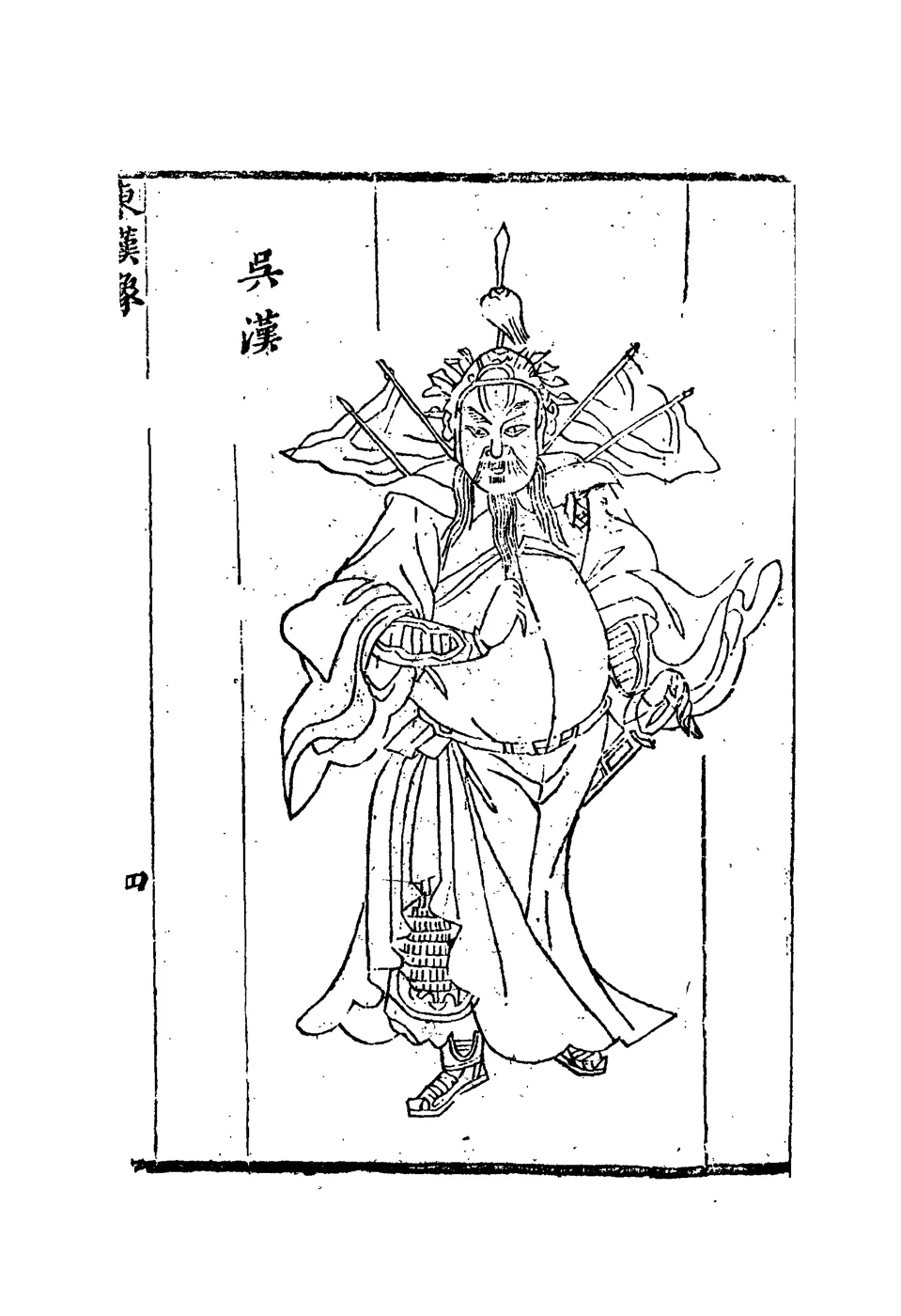
Wu Han
吴汉
Wu Han (?-44), courtesy name Ziyan, was a native of Wan County, Nanyang, in present-day Nanyang, Henan. He was a leading founding general of the Eastern Han and ranked second among the Twenty-Eight Generals of Yuntai. Born into humble circumstances, he fled to Hebei near the end of the Xin dynasty and made a living trading horses. During the Gengshi period he became magistrate of Anle County. He later strongly urged Peng…
44 CEEastern Han
PROFILE
Wu Han (?-44), courtesy name Ziyan, was a native of Wan County, Nanyang, in present-day Nanyang, Henan. He was a leading founding general of the Eastern Han and ranked second among the Twenty-Eight Generals of Yuntai. Born into humble circumstances, he fled to Hebei near the end of the Xin dynasty and made a living trading horses. During the Gengshi period he became magistrate of Anle County. He later strongly urged Peng Chong, Administrator of Yuyang, to join Liu Xiu, personally led the Yuyang cavalry south to help defeat Wang Lang, was appointed Deputy General and enfeoffed as Marquis of Jiance. After the Eastern Han was founded, he became Grand Marshal and was enfeoffed as Marquis of Guangping with a fief of four counties. In 36, the twelfth year of Jianwu, he commanded the campaign that destroyed Gongsun Shu and pacified Ba and Shu. He died of illness in 44, the twentieth year of Jianwu, and received the posthumous title Zhong. Wu Han was resolute and composed in war, decisive in command, and able to remain calm in crises and inspire his troops, repeatedly turning defeat into victory, although at times his forces lacked discipline. During the Tang and Song he was enshrined in the Temple of King Wucheng as a representative famous general of antiquity.
- Other names
- Courtesy name Ziyan
- Courtesy name
- Ziyuan
- Period
- Eastern Han
- Dynasty / polity
- Eastern Han
- Identity
- General
- Ethnicity / affiliation
- Han Chinese
- Native place
- Wan County, Nanyang (present-day Nanyang, Henan)
- Date of birth
- 521 BCE
- Place of birth
- Unknown
- Date of death
- 481 BCE
- Place of death
- Unknown
- Highest office
- See Biography and Major Activities
- Major achievements
- Ranked second among the Yuntai generals; Grand Marshal and Marquis of Guangping; one of the most meritorious commanders in the founding of the Eastern Han
LIFE TIMELINE
Youth | Made a living trading horses, traveling between Yan and Ji and forming ties with local men of ability
About age thirty | Appointed magistrate of Anle County by Han Hong
About age thirty-one | Strongly urged Peng Chong to join Liu Xiu; led Yuyang cavalry south, joined Liu Xiu at Guang'e, and was appointed Deputy General
About age thirty-one | Followed Liu Xiu in capturing Handan and received the title Marquis of Jiance
About age thirty-one | Appointed General-in-Chief and sent north with an imperial tally to mobilize troops from ten commanderies of You Province; killed You Province Governor Miao Zeng
About age thirty-one | Followed Liu Xiu in defeating and accepting the surrender of the Tongma forces; later seized Ye and killed Xie Gong
About age thirty-two | Liu Xiu proclaimed himself emperor; Wu Han was appointed Grand Marshal and enfeoffed as Marquis of Wuyang
About age thirty-three | Reenfeoffed as Marquis of Guangping, with a fief of four counties
Ages thirty-three to thirty-six | Led troops to suppress the Tanxiang, Wuxiao, and other peasant forces and destroyed the separatist regimes of Liu Yong, Dong Xian, and others
Ages thirty-seven to thirty-nine | Campaigned west against Wei Xiao and took part in the Longyou campaigns
Ages forty-two to forty-three | Led the invasion of Shu; destroyed Gongsun Shu in 36 and pacified Ba-Shu
Ages forty-four to fifty | Fought the Xiongnu in the north and guarded the northern frontier
About age fifty-one | Died of illness while serving as Grand Marshal and received the posthumous title Zhong
Posthumous | Emperor Ming of Han had his portrait placed on the Yuntai, ranking him second among the Twenty-Eight Generals of Yuntai
BIOGRAPHY
Biography
Family Background and Early Life
Wu Han came from humble circumstances and was a native of Wan County in Nanyang Commandery. His family was poor, and he once served as a pavilion chief responsible for local security. Near the end of the Xin dynasty, one of his retainers committed an offense. Fearing implication, Wu fled with his fellow townsman Peng Chong to Yuyang Commandery in You Province, Hebei. Lacking resources, he traded horses for a living and traveled between Yan and Ji, forming ties with local strongmen wherever he went. The source states that this experience familiarized him with Hebei's geography and local conditions and trained him in judging circumstances and building alliances.
Joining Liu Xiu
In 23, the first year of Gengshi, the Lülin forces enthroned Liu Xuan and established the Gengshi regime. Liu Xuan sent Han Hong to secure the commanderies and kingdoms of Hebei. Han Hong and Peng Chong were old acquaintances from the same locality, and Han therefore appointed Peng as Administrator of Yuyang. Someone recommended Wu Han to Han Hong as an "extraordinary man." Han summoned Wu, was delighted by the meeting, and immediately appointed him magistrate of Anle County in Yuyang Commandery.
In 24, the second year of Gengshi, the diviner Wang Lang falsely claimed to be a son of Emperor Cheng of Han and proclaimed himself emperor at Handan, throwing Hebei into disorder. Liu Xiu had been sent to operate in Hebei and competed with Wang Lang for control. Wang Lang sent envoys to Yuyang seeking Peng Chong's support, and most commandery officials favored joining him. Wu Han had long heard that Liu Xiu had the bearing of a humane elder and strongly urged Peng to support Liu Xiu. He proposed an alliance with Shanggu Commandery in which the cavalry of both commanderies would aid Liu Xiu against Handan. Peng Chong hesitated.
After leaving the meeting, Wu encountered a refugee scholar outside the city and learned that the commanderies and counties through which Liu Xiu passed were submitting to him. Wu then devised a plan: he forged a proclamation in Liu Xiu's name, had the scholar deliver it to Peng Chong, and instructed him to describe what he had seen on the road, praising Liu Xiu and criticizing Wang Lang. Wu then again lobbied Peng Chong. At the same time, Geng Kuang, Administrator of Shanggu, sent his officer Kou Xun to contact Peng, offering two thousand cavalry and one thousand infantry from each of the two commanderies to aid Liu Xiu. Peng finally decided to act. He appointed Wu Han acting chief clerk, and Wu, together with Gai Yan and Wang Liang, led three thousand infantry and cavalry south to join the Shanggu force led by Geng Yan, Kou Xun, and Jing Dan.
Campaigns to Pacify Hebei
Wu Han, Geng Yan, and the combined Yuyang-Shanggu army attacked southward. They first took Ji city and killed Wang Lang's general Zhao Hong and others, then captured twenty-two counties in Zhuo, Zhongshan, Julu, Qinghe, Hejian, and other commanderies. They killed more than four hundred of Wang Lang's commanders and are said to have taken thirty thousand enemy heads before finally meeting Liu Xiu at Guang'e. Liu Xiu was delighted and appointed Wu Han and the others as Deputy Generals, allowing them to retain command of their troops. Wu then followed Liu Xiu in capturing Handan and destroying Wang Lang and received the title Marquis of Jiance for his service.
Wu Han was plain and sincere in manner and not eloquent, and at first did not attract Liu Xiu's attention. Deng Yu, however, understood his ability and repeatedly recommended him. Liu Xiu gradually came to value Wu and made him one of his trusted generals.
After Liu Xiu destroyed Wang Lang, Liu Xuan made him Prince of Xiao and ordered him to disband his forces and return to Chang'an. Liu Xuan also sent Miao Zeng as Governor of You Province to take over the troops. Liu Xiu refused on the grounds that Hebei was not yet pacified and prepared to suppress the peasant armies there, but he lacked troops and wanted to mobilize soldiers from the commanderies of You Province. He summoned Deng Yu at night for advice. Deng recommended Wu Han, saying that he was "fierce, courageous, and intelligent in strategy, and few among the generals can match him." Liu Xiu therefore appointed Wu General-in-Chief and sent him north with an imperial tally to mobilize the cavalry of ten commanderies in You Province.
Miao Zeng secretly obstructed the mobilization and ordered the commanderies not to respond. Wu Han rode with only twenty horsemen to Miao's base at Wuzhong and attacked suddenly when Miao came out to receive him, capturing and killing him on the spot and taking over his forces. The commanderies of You Province were shocked and submitted, allowing Wu to complete the mobilization. He then led the army south to meet Liu Xiu at Qingyang. When other generals saw his strong cavalry and horses, they assumed he would refuse to divide them, but Wu immediately handed the troop registers to Liu Xiu and allowed him to allocate the men freely, shaming the others.
Wu thereafter led cavalry with Liu Xiu against the Tongma army and then moved south to Shequan against the Qingdu forces. While Xie Gong was absent, Liu Xiu ordered Wu Han and Cen Peng to seize Ye. Wu first sent a persuasive speaker who induced the defender Chen Kang to surrender, allowing Ye to be occupied without bloodshed. Xie Gong returned after defeat, but Wu set an ambush, captured and killed him, and absorbed his troops.
Tenure as Grand Marshal
In 25, the first year of Jianwu, Liu Xiu proclaimed himself emperor and appointed Wu Han Grand Marshal, enfeoffing him as Marquis of Wuyang. Wu remained Grand Marshal for many years and directed major military operations in the Eastern Han wars of unification.
In 26, the second year of Jianwu, Wu led troops to suppress the Tanxiang peasant forces and was enfeoffed as Marquis of Guangping with a fief of four counties. Over the next several years he repeatedly commanded campaigns against separatist powers, suppressing Liu Yong, Dong Xian, and others east of the passes. From 30 to 32 he campaigned west against Wei Xiao and participated in the Longyou war. In 35 he led an expedition against Shu, and in 36 destroyed Gongsun Shu and pacified Ba-Shu. He later fought the Xiongnu in the north and guarded the northern frontier.
Wu Han died of illness in 44, the twentieth year of Jianwu, while still serving as Grand Marshal. He received the posthumous title Marquis Zhong.
Major Activities
Military Contributions
Wu Han was one of the most meritorious military commanders of the Eastern Han founding. His leadership of Yuyang cavalry in support of Liu Xiu's campaign against Wang Lang was a key force in establishing Liu Xiu's position in Hebei. He then served for many years as Grand Marshal and directed campaigns of unification, suppressing the Tanxiang and Wuxiao peasant armies, destroying separatist leaders such as Liu Yong and Dong Xian, campaigning against Wei Xiao, defeating Gongsun Shu, and fighting the Xiongnu. These campaigns gave him a major role in the military unification of the Eastern Han.
Wu was firm and composed in warfare and decisive in command. During the 36 campaign against Shu, he confronted Gongsun Shu's forces despite not holding a numerical advantage, encouraged his troops, and eventually defeated the Shu army. He could remain calm in crises and several times turned defeat into victory. The source also notes that discipline in his army was sometimes poor, a weakness in his generalship.
Political Activity
During Liu Xiu's struggle with Wang Lang for Hebei, Wu Han strongly urged Yuyang Administrator Peng Chong to join Liu Xiu and forged a proclamation in Liu Xiu's name in order to help bring about the southward march of the combined Yuyang and Shanggu army. He was therefore one of the key figures in Liu Xiu's establishment of a base in Hebei. He later carried an imperial tally north to mobilize the forces of ten You Province commanderies and killed Governor Miao Zeng when Miao obstructed the levy, ensuring the manpower Liu Xiu needed for further campaigns. After the founding of the Eastern Han, Wu remained Grand Marshal and Liu Xiu's most trusted military commander.
Travels and Campaign Routes
In his youth Wu fled to Hebei and made a living trading horses, traveling between Yan and Ji. After joining Liu Xiu, he campaigned across Hebei and took part in the meeting at Guang'e, the battle for Handan, the reunion at Qingyang, fighting at Shequan, and the seizure of Ye. After the Eastern Han was founded, he campaigned widely east and west, traveling through the regions east of the passes, Longyou, Ba-Shu, and the northern frontier.
Relations with Contemporaries
Wu Han and Peng Chong were fellow townsmen and fled together to Yuyang in their youth; Wu later persuaded Peng to join Liu Xiu. Wu had close ties with Deng Yu, who repeatedly recommended him to Liu Xiu. He campaigned south together with Geng Yan, Kou Xun, Gai Yan, Wang Liang, Jing Dan, and others and became an important member of Liu Xiu's Hebei military group. He also cooperated with Cen Peng in the seizure of Ye.
Personal Relations
Family
- Wu Han: himself, courtesy name Ziyan, native of Wan County, Nanyang
- Son: Wu Cheng, who inherited the title Marquis of Guangping
Friends and Associates
- Peng Chong: fellow townsman; fled to Yuyang with Wu in youth; later persuaded by Wu to join Liu Xiu
- Deng Yu: repeatedly recommended Wu Han to Liu Xiu
- Geng Yan: led the combined Yuyang-Shanggu forces south with Wu in support of Liu Xiu
- Kou Xun: officer of Shanggu who contacted Peng Chong to coordinate support for Liu Xiu
- Gai Yan: Yuyang military officer who led troops south with Wu
- Wang Liang: magistrate of Hunu who led troops south with Wu
- Jing Dan: chief clerk of Shanggu who led troops south with Wu
Ruler and Minister
- Liu Xiu: Emperor Guangwu of the Eastern Han; Wu Han served as his Grand Marshal and most trusted commander
- Liu Xuan: Gengshi Emperor; Wu had earlier served under his regime as magistrate of Anle County
Conflicts
- Miao Zeng: Gengshi governor of You Province who obstructed troop mobilization and was killed by Wu Han
- Xie Gong: Gengshi Prefect of the Masters of Writing, killed by Wu at Ye
- Wang Lang: claimant who proclaimed himself emperor at Handan and was defeated with Wu's participation
- Gongsun Shu: ruler of a separatist regime in Shu whom Wu defeated and destroyed
Historical Assessment
Eastern Han and Contemporary Views
- Liu Xiu reportedly said of Wu Han: "Lord Wu is more than adequate; he stands imposing as though he alone were an enemy state." (Book of the Later Han: Biography of Wu Han)
- Deng Yu described him as "fierce and courageous, with intelligence and strategy; few among the generals can match him." (Book of the Later Han: Biography of Wu Han)
- Fan Ye wrote that "Wu Han was simple and sincere, with little literary refinement, and in sudden situations could not express himself in words." (Book of the Later Han: Biography of Wu Han)
Wei, Jin, and Northern and Southern Dynasties
- Chen Shou used Wu Han several times in the Records of the Three Kingdoms as a model famous general, including the comparison that "Wu Han was to Guangwu what Han Xin was to Gaozu."
- Eastern Jin historian Yuan Hong wrote that "Wu Han's merit and virtue may be called flourishing." (Annals of the Later Han)
Tang and Song Periods
- In 782, the third year of Jianzhong under Emperor Dezong of Tang, Yan Zhenqing proposed that sixty-four famous generals of antiquity receive posthumous honors and temple sacrifices. Among them was "Grand Marshal Wu Han, Marquis of Guangping."
- In 1123, the fifth year of Xuanhe under Emperor Huizong of Song, temples for ancient generals were established following Tang precedent; Wu Han was again included among seventy-two famous commanders.
- Northern Song historian Sima Guang commented that Wu Han was simple and sincere and lacked literary refinement, but understood the methods of warfare and was a capable general. (Comprehensive Mirror in Aid of Governance)
Modern Period
- Modern historian Lü Simian wrote that Wu Han was one of Emperor Guangwu's principal military arms and that his campaigns east and west produced especially distinguished achievements. (Qin-Han History)
- Qian Mu wrote that although Wu Han lacked literary cultivation, he was steadfast in warfare and was the foremost commander in the founding of the Eastern Han. (Outline of National History)
- Modern military historians generally regard Wu Han as one of the most accomplished Eastern Han founding generals and compare his military abilities with those of early Han commanders such as Han Xin and Ying Bu.
FIGURES ASSOCIATED WITH THIS DYNASTY
Bibliography
- Book of the Later Han, juan 18, "Biography of Wu Han"
- Book of the Later Han, juan 1, "Annals of Emperor Guangwu"
- Book of the Later Han, juan 12, "Biography of Peng Chong"
- Book of the Later Han, juan 19, "Biography of Geng Yan"
- Book of the Later Han, juan 22, "Biography of Jing Dan"