Birth | Born into a poor scholarly family in Houguan County, Fujian, present-day Fuzhou
1820 CE–1879 CE
Statesmanmilitary officialdiplomat
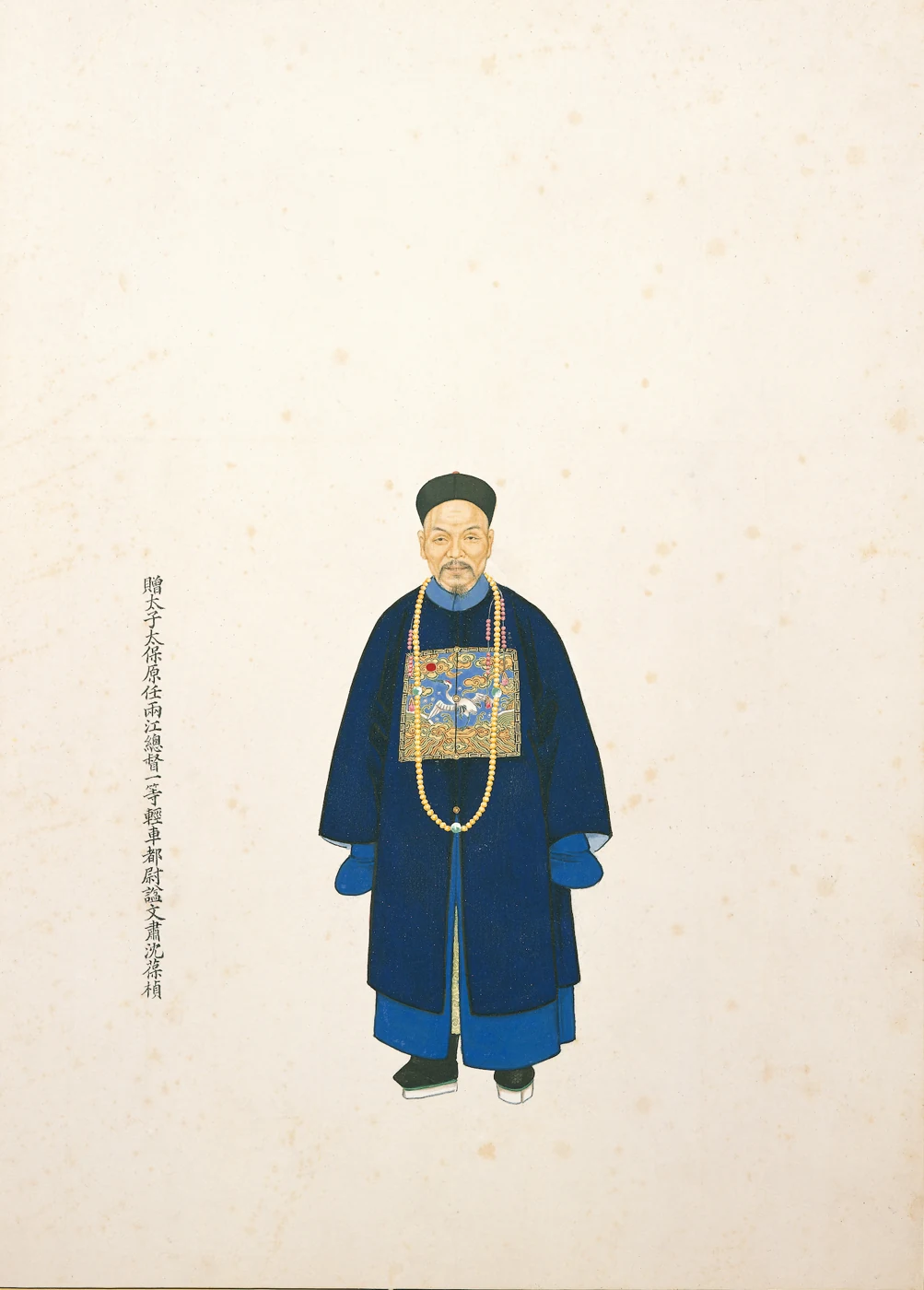
Shen Baozhen
沈葆桢
Shen Baozhen (1820–1879), whose examination name was Zhenzong, whose courtesy names were Hanyu and Youdan, and whose posthumous title was Wensu, was a native of Houguan County in Fujian, present-day Fuzhou. He was a statesman, military official, and diplomat of the late Qing. He was both the nephew and son-in-law of Lin Zexu. He successively served as Governor of Jiangxi, Minister of the Fujian Shipyard, Imperial Commissioner…
1820 CE–1879 CEQing Dynasty
PROFILE
Shen Baozhen (1820–1879), whose examination name was Zhenzong, whose courtesy names were Hanyu and Youdan, and whose posthumous title was Wensu, was a native of Houguan County in Fujian, present-day Fuzhou. He was a statesman, military official, and diplomat of the late Qing. He was both the nephew and son-in-law of Lin Zexu. He successively served as Governor of Jiangxi, Minister of the Fujian Shipyard, Imperial Commissioner for Taiwan coastal defense, and Governor-General of Liangjiang concurrently serving as Superintendent of Southern Trade. He was one of the founders of modern Chinese shipbuilding, navigation, and naval development. Shen directed the establishment of the Fuzhou Shipyard, founded the Fujian Shipyard School, described in the source as China's first naval school, and organized what the source calls China's first modern fleet. During his service in Taiwan he implemented policies involving the opening of mountain routes and pacification of Indigenous communities, the creation of new prefectures and counties, and the abolition of restrictions on migration to Taiwan, exerting a lasting influence on Taiwan's modern development.
- Alternative name
- Shen Youdan
- Courtesy name
- Hanyu
- Era
- Qing
- Dynasty / polity
- Qing
- Identity
- Statesman, military official, diplomat
- Date of Birth
- April 9 1820
- Date of Death
- December 18 1879
- Ethnicity / group
- Not reliably confirmed by historical sources
- Native place
- Houguan County, Fujian (present-day Fuzhou, Fujian)
- Place of birth
- A poor scholarly family in Houguan County, Fujian (present-day Fuzhou)
- Place of death
- Unknown
- Highest office
- See Biography and Major Activities
- Major achievements
- Governor of Jiangxi and Minister of the Fujian Shipyard; later appointed imperial commissioner to Taiwan to oversee coastal defense and development
- Age at Death
- Unconfirmed; not explicitly stated in the
LIFE TIMELINE
Age sixteen | Passed the local examination and became a xiucai
Age twenty | Passed the provincial examination in the same cohort as his teacher Lin Changyi and married his cousin Lin Puqing
Age twenty-seven | Passed the jinshi examination, was selected as a Hanlin probationer, and appointed a Compiler in the Hanlin Academy
Age thirty-four | Appointed Investigating Censor of the Jiangnan Circuit; transferred the following year to the Guizhou Circuit
Age thirty-six | Became Prefect of Guangxin in Jiangxi and successfully defended the city against a Taiping siege
Age thirty-seven | Promoted to the Guang-Rao-Jiu-Nan Circuit of Jiangxi
Age thirty-nine | Requested leave from office because of his parents' illnesses and returned home to visit them
Age forty-one | At Zeng Guofan's invitation, went to the Anqing military headquarters and was soon recommended for appointment as Governor of Jiangxi
Age forty-four | Captured and executed the Taiping Heavenly Kingdom's Young Heavenly King Hong Tianguifu, Hong Rengan, and others
Age forty-five | Left office for mourning after his mother's death
Age forty-six | Strongly recommended by Zuo Zongtang to take over the Fujian shipyard project
Age forty-seven | Became Minister of the Fujian Shipyard and directed construction of the Fuzhou Shipyard
Age forty-nine | The first domestically built steamship, Wannianqing, was launched
Age fifty-four | During the Japanese expedition to Taiwan, appointed imperial commissioner for Taiwan coastal defense and sent to Taiwan
Age fifty-five | Promoted to Governor-General of Liangjiang concurrently serving as Superintendent of Southern Trade, with responsibility for southern coastal defense
Age fifty-nine | Died in office at Jiangning, present-day Nanjing, and was posthumously granted the title Crown Prince's Grand Guardian
BIOGRAPHY
Biography
Family Background and Early Life Shen Baozhen's ancestral home was in Hangzhou, Zhejiang. Because Hangzhou was historically known as Wulin, his family was known as the Wulin Shen clan. During the Yongzheng reign, his great-great-grandfather Shen Zichang traveled to Fujian with his son Shen Xijiu while serving in official staffs, and the family subsequently settled in Fuzhou. Shen Baozhen was born into a poor scholarly household. His father, Shen Tingfeng, made a living as an impoverished private-school teacher and supported the family on a meager income. His mother, Lin Huifang, was the sixth younger sister of Lin Zexu. She was capable and industrious, taking in needlework during the day to supplement the household income and providing Shen Baozhen's elementary education at night. Her method of teaching was described as practical and direct: she first helped her children correct faults and then taught primers such as the Three Character Classic and Hundred Family Surnames, regularly explaining their meaning instead of relying on rote recitation. Shen Baozhen frequently visited the attic study in the home of his maternal uncle Lin Zexu. There he read many works from China and abroad and, through conversations with Lin, gained his first understanding of what later came to be called “Western Affairs.” He often discussed with his uncle ideas derived from his reading and on one occasion expressed views on the promotion of Western-style enterprises. These experiences had a deep influence on his later direction of the shipyard and participation in the Self-Strengthening movement. ### Imperial Examinations and Service in Jiangxi In 1836, the sixteenth year of Daoguang, the sixteen-year-old Shen Baozhen became a xiucai. In 1840 he passed the provincial examination in the same cohort as his teacher Lin Changyi and in the same year married his cousin Lin Puqing. Lin Puqing was Lin Zexu's second daughter and had been betrothed to Shen Baozhen at age ten. Shen went to Beijing for the metropolitan examination in 1841 but failed. In 1844 he traveled to the capital with his father Shen Tingfeng for another examination; neither passed. His father vowed never to sit for the examination again and returned home to continue teaching, while Shen Baozhen resolved to study for another three years. In 1847 he passed the jinshi examination, was selected as a Hanlin probationer, appointed Compiler, and later promoted to Investigating Censor. In 1854 he was appointed to the Jiangnan Circuit and one year later transferred to the Guizhou Circuit. In 1856 the court promoted him to Prefect of Hangzhou, but Shen declined on the grounds that his ancestors had lived there and that he had too many relatives in the city. He was instead appointed Prefect of the more remote Guangxin in Jiangxi, present-day Shangrao. By this time Taiping forces had twice attacked Jiangxi and occupied more than fifty counties in eight prefectures. The Qing government retained only Nanchang, Raozhou, Guangxin, Ganzhou, and Nan'an, leaving the province in a precarious position. In the eighth month, Taiping commander Yang Fuqing led more than ten thousand troops against Qing positions, taking Luxi, Guixi, and Yiyang in succession and advancing toward Guangxin. At the time, Shen Baozhen was away with Lian Zhaolun, Right Vice Minister of the Ministry of Works, requisitioning grain and military funds. Only four hundred defenders remained in Guangxin. On hearing that Yiyang had fallen, many fled, leaving only the county magistrate, an assistant brigade commander, a company commander, and Shen's wife Lin Puqing. Lin, described as displaying the qualities of a woman from a military family, encouraged the inhabitants to close and hold the city gates while sending for help from General Rao Tingxuan, then stationed at Yushan in Zhejiang. Shen returned to Guangxin the next day as reinforcements also arrived. After consulting Rao Tingxuan, they adopted tactics of surprise attacks and raids on the enemy's supplies. They won seven successive engagements and repelled Yang Fuqing. The defense brought Shen Baozhen considerable official recognition. In 1857 Shen was promoted to the Guang-Rao-Jiu-Nan Circuit of Jiangxi. In the third month, Shi Dakai attacked Guangxin, and Shen and Rao Tingxuan led the defenders in several days of hard fighting before Shi withdrew toward Zhejiang. In 1859 Shen requested leave because of his parents' illnesses and returned home after fifteen years away. In 1860 he was recalled and appointed Circuit Intendant of Ji'an, Ganzhou, and Nan'an, but declined because of his parents' age. He remained in his native area to organize local militia, and Zeng Guofan came to regard him highly. ### Governor of Jiangxi and Suppression of the Taiping Forces In 1861 Zeng Guofan invited Shen Baozhen to the Anqing military headquarters for important service and soon recommended him for appointment as Governor of Jiangxi. Shen relied on Xiang Army commanders such as Wang Debiao and Xi Baotian in campaigns against the Taiping forces. In 1864, the third year of Tongzhi, he captured and executed the Young Heavenly King Hong Tianguifu, Hong Rengan, and others. In 1865 his mother died, and Shen left office and returned home for the prescribed mourning period. ### Direction of the Fujian Shipyard In the spring of 1866, the fifth year of Tongzhi, Zuo Zongtang was appointed Governor-General of Min-Zhe and established his headquarters at Fuzhou. In the eighth month, the court approved Zuo's memorial proposing the creation of a steamship manufacturing establishment at the foot of Sanqi Hill on the Mawei River, the future Fuzhou Shipyard. In the tenth month, Zuo was transferred to become Governor-General of Shaan-Gan because of the Muslim uprising in Shaanxi. Before leaving, he strongly recommended Shen Baozhen, then at home in mourning, to take over the shipyard and personally visited him to make the request. Shen twice declined, citing the seriousness of his mourning obligations. Zuo memorialized that no one other than Shen Baozhen could perform the task. In 1867 Shen succeeded Zuo Zongtang as Minister of the Fujian Shipyard. Immediately after assuming office, he began construction of docks and machine workshops and attached a school for young technical students. In the first month of 1868 he established a training workshop with a five-year course of study to prepare supervisory personnel. On June 10, 1869, the first steamship constructed by the Mawei shipyard, Wannianqing, was completed and launched. It was a wooden-hulled steam vessel 238 chi long and 27.8 chi wide, drawing 14.2 chi, displacing 1,370 tons and carrying 450 tons. It used screw propulsion with auxiliary sails and had a speed of ten knots. On September 25 Shen Baozhen boarded the ship for successful sea and gun trials. By 1870 the Fujian Shipyard had built four armed steamships. Together with three warships purchased overseas, seven vessels were organized with court approval into a squadron known as the “Shipyard Steamships,” described in the source as China's first modern fleet. During his management of the shipyard, Shen insisted on the principle that authority had to remain in Chinese hands. He argued in substance that purchasing ships placed control in the hands of others, whereas manufacturing them placed control in one's own hands. The shipyard employed many foreign officials, craftsmen, and instructors and paid them generously, but Shen refused to yield political authority. He enforced a policy that Chinese officials retained control, rewarding or punishing foreign employees according to performance and dismissing those who refused Chinese direction. ### Mission to Taiwan and Coastal Defense In the twelfth month of 1871, two Ryukyu tribute vessels were blown to Taiwan. Fifty-four people were killed by inhabitants of the Kuskus and Mudan communities, while twelve escaped and were rescued. The Qing government sent the survivors home through Fuzhou. The Japanese government, seeking to ease domestic tensions and the political crisis caused by the debate over an expedition to Korea, seized on the incident as a pretext for military action. On April 4, 1874, Japan formally established an office for the Taiwan expedition and organized an expeditionary force. On May 10, Lieutenant General Saigō Tsugumichi landed at Langqiao in Taiwan with more than 3,600 men. On May 14 the Qing court appointed Shen Baozhen, then Minister of the Fujian Shipyard, as imperial commissioner and ordered him to take ships and troops to Taiwan, granting him broad military and diplomatic authority to deal with the Japanese expedition. After arriving in Taiwan in mid-June, Shen negotiated with the Japanese military authorities for their withdrawal while simultaneously strengthening the island's defenses. He expanded fortifications in Taiwan Prefecture and the Penghu Islands and mounted large Western cannon; installed a submarine telegraph cable between Anping and Xiamen; transferred thirteen battalions, about 6,500 men, of elite Huai Army troops to Taiwan and deployed them in Fengshan; placed northern land defense under the Taiwan garrison commander and southern defense under the Taiwan circuit intendant; and stationed the warships Yangwu, Feiyun, Anlan, Qingyuan, Zhenwei, and Fubo at Penghu, with Fuxing No. 1 at Taipei, Wannian No. 1 at Xiamen, and Ji'an No. 1 at Fuzhou. At the same time he pushed road construction into Indigenous areas and sent officials to bring different communities under Qing administration. The Qing government shipped twenty Western cannon, forty thousand pounds of Western gunpowder, and thirty thousand pounds of additional powder, greatly raising morale among soldiers and local inhabitants. At the same time, severe malaria spread in southern Taiwan. Japanese troops, unaccustomed to the environment, suffered disease, with daily deaths ranging from several men to several dozen and morale falling sharply. Japanese plenipotentiary Ōkubo Toshimichi and his adviser Charles Le Gendre arrived in Beijing in September and conducted seven rounds of negotiation. Under mediation by Britain, the United States, and France, the Qing government decided to compromise. On October 31, 1874, the twenty-second day of the ninth month of the thirteenth year of Tongzhi, it signed the three-article agreement concerning the Taiwan incident, also known as the Beijing Agreement. Besides payments totaling 500,000 taels for “relief,” road construction, and buildings, the agreement contained language referring to “Japanese subjects” who had been wrongfully harmed by Taiwan's “aboriginals,” thereby treating the Japanese expedition as an action to “protect subjects” and, in effect according to the source, recognizing Ryukyu as belonging to Japan. Japanese troops withdrew from Taiwan in the twelfth month of the same year. ### Modern Development Measures in Taiwan After securing Taiwan, Shen Baozhen immediately turned to further development and implemented four broad measures: lifting restrictions, creating administrative units, opening roads, and developing mineral resources. Creation of prefectures and counties: In the Langqiao region where Japanese troops had landed, Hengchun County was established. Shen requested the creation of Taipei Prefecture in northern Taiwan, with Tamsui and Kavalan subprefectures reorganized as Tamsui and Yilan counties. The area south of the Touqian River formerly under Tamsui was separated as Hsinchu County, while the Keelung area became a separate subprefecture renamed Keelung Subprefecture. The territory north of the Dajia River was organized under the new Taipei Prefecture, which administered Tamsui, Hsinchu, and Yilan counties together with Keelung Subprefecture. In central and southern Taiwan, the part of Zhuluo County south of the Zengwen River was incorporated into Taiwan County; the Puli area of Changhua County became Pulishe Subprefecture; and Beinan Subprefecture was established in eastern Taiwan. Strengthening military defense: A fort was built at Erkunshen in Tainan, later known as Eternal Golden Castle, and equipped with large Western cannon. A fort was also established at Qihou, present-day Cijin District, and the city walls of Hengchun County were constructed. Opening mountain routes and pacifying Indigenous communities: Three routes were built across the mountains to eastern Taiwan. The northern route ran 205 li from Su'ao in Kavalan to Qilai in Hualien; the central route ran 265 li from Linqipu in Changhua to Pushige in Hualien; and the southern route ran 214 li from Sheliao, now Checheng in Pingtung, to Beinan in Taitung. At the same time, officials sought to pacify and assimilate Indigenous communities. Abolition of restrictions on migration to Taiwan: In February 1875, Shen memorialized the throne requesting removal of various prohibitions governing passage to Taiwan. The court approved the request, allowing large numbers of Han migrants to move to the island. Commemoration of loyalists: After Shen arrived in Taiwan, the Taiwan jinshi Yang Shifang and others petitioned for Zheng Chenggong to receive a posthumous title and for a shrine to be built. Shen transmitted the request to the throne, which approved it. A dedicated shrine was constructed in Taiwan Prefecture, Zheng Chenggong received the posthumous title “Zhongjie,” and 114 Southern Ming officials were associated with the sacrifices. Shen personally wrote a couplet praising Zheng's unprecedented achievement in establishing a world for Ming loyalists amid an undeveloped landscape and describing him as a uniquely complete man whose life's circumstances had nevertheless been filled with irreversible regret. ### Governor-General of Liangjiang and Later Years In 1875, the first year of Guangxu, Shen Baozhen was ordered to Beijing and promoted to Governor-General of Liangjiang concurrently serving as Superintendent of Southern Trade. He took charge of southern coastal defense, expanded the Southern Fleet, participated in the administration of the China Merchants Steam Navigation Company, and sent students from the Fujian Shipyard School to Britain and France for further study. Believing that limited court funds were insufficient to build both northern and southern fleets at once, he voluntarily proposed concentrating resources first on the Northern Fleet. In the eleventh month of 1879, the fifth year of Guangxu, Shen Baozhen died in office at Jiangning, present-day Nanjing. He was posthumously granted the title Crown Prince's Grand Guardian and the posthumous name Wensu.
Family, Early Years and the Defence of Guangxin
Shen Baozhen's family was originally of Hangzhou in Zhejiang, and since Hangzhou was anciently also called Wulin, the Shen of Gong Lane were known as the "Wulin Shen"; his great-grandfather Shen Zichang had gone to Fujian as a private secretary and settled at Fuzhou. He was born in 1820 into a poor family of scholars; his father taught for a living and supported the household on a small monthly income, while his mother Lin Huifang, deft and diligent, not only sewed for others to add to the family's means but took charge of her son's early education. Her method was distinctive, direct and effective: she first corrected some faults of the small Youdan and then taught him the Four Books and other primers, "not reading the text through with him but often explaining the reasons." He was also a constant visitor to the study in his uncle's upper room, where he read many works ancient and modern, Chinese and foreign, and where, in talk with his uncle, he first came to understand the word "foreign affairs," telling his uncle in one conversation what he thought about the promotion of Western-style undertakings. In 1836, at sixteen, he passed the first examination; in 1840 he passed the provincial examination in the same list as his teacher, being then just twenty, and in that same year his uncle Lin Zexu was stripped of office, while he himself married, at the wish of both families, his cousin Lin Puqing, Lin Zexu's second daughter, to whom he had been betrothed at ten. In 1841 he went to the capital for the metropolitan examination and failed; in 1844 he went up with his father Shen Tingfeng and both failed, at which his father swore never to sit again and returned home to teach, while Shen Baozhen resolved to stake everything on three more years of study. In 1847 he passed as a presented scholar, was chosen a bachelor of the Hanlin Academy, and a year later was transferred to be investigating censor of the Guizhou circuit. In 1855 he took office in Jiangxi; in 1856, when the court would have promoted him to be prefect of Hangzhou, he declined on the ground that his forebears had lived there and he had too many kin in the city, and instead took the remote post of prefect of Guangxin in Jiangxi.
The defence of Guangxin was the affair that made his name in official life. The Taiping had by then twice attacked Jiangxi and taken more than fifty counties in eight prefectures, leaving the court only five commanderies including Nanchang, and the province's position was desperate. In the eighth month of 1856 the Taiping general Yang Fuqing advanced with more than ten thousand men and took several towns in succession; Shen Baozhen was away with Lian Zhaolun, vice-minister of works, collecting grain and funds, and of the four hundred defenders of Guangxin, hearing that Yiyang had fallen, all fled, leaving in the city only the magistrate, a minor officer and the prefect's wife Lin Puqing. They organized the people to shut the gates and hold out to the death, and in the crisis Lin Puqing showed the spirit of a great minister's daughter, encouraging the people while sending for help to Rao Tingxuan, who was stationed in Zhejiang and had served under Lin Zexu. The next day Shen Baozhen hurried back to Guangxin and the relief force arrived soon after; conferring with Rao Tingxuan he adopted the tactics of striking where the enemy was unprepared and raiding his transport, and "won seven battles out of seven," beating off Yang Fuqing's attack, and by this action Shen Baozhen won his name in official circles. In 1857 he was promoted to the Guangrao Jiunan circuit; in the third month, when Shi Dakai attacked Guangxin, Shen Baozhen and Rao Tingxuan held out stubbornly for several days and Shi Dakai withdrew into Zhejiang. In 1859, pleading the illnesses of his parents, he asked leave to go home — he had not been back for fifteen years; called out again in 1860 as intendant of Jigan, he declined again on the ground of his parents' age and was kept in his native place to organize militia; in 1861 Zeng Guofan summoned him to the Anqing headquarters and soon recommended him as governor of Jiangxi. On his mother's death in 1865 he left office and went home, with his headquarters at Fuzhou; in the eighth month the court approved Zuo Zongtang's memorial for a steamship works and decided to build the dockyard below Sanqi hill on the Mawei river, whereupon Zuo Zongtang, before leaving, strongly recommended the mourning Shen Baozhen to take it over and called on him in person, though Shen twice put him off on the ground that he was in heavy mourning.
Major Activities
Fuzhou Shipyard and Modern Naval Development After taking office as Minister of the Fujian Shipyard, Shen Baozhen built docks and machine workshops, established a school for young technical students, and founded a training workshop to prepare supervisory personnel. By 1870 the Fujian Shipyard had built four armed steamships, which together with three purchased warships were organized with court approval into the “Shipyard Steamships” squadron, described in the source as China's first modern fleet. The Mawei shipyard also established front and rear schools described in the source as China's first naval school, which trained specialized personnel for modern naval service. Shen insisted that sovereignty and control remain in Chinese hands. He argued that purchasing placed power in others' hands, whereas manufacturing placed it in one's own. Foreign employees were paid generously but were not granted political authority over the enterprise. ### Taiwan Defense and Development During the Japanese expedition to Taiwan in 1874, Shen Baozhen was appointed imperial commissioner for coastal defense. He negotiated for a Japanese withdrawal while fortifying the island, adding artillery positions in Taiwan Prefecture and Penghu, laying a submarine telegraph cable between Anping and Xiamen, bringing thirteen elite Huai Army battalions totaling about 6,500 troops to Taiwan, and stationing six ships at Penghu. After the crisis, he undertook Taiwan development through four measures—lifting restrictions, creating administrative units, opening roads, and developing mineral resources—which had a long-lasting influence on the island's modernization. ### Sending Students Abroad In his later years Shen sent students of the Fujian Shipyard School to Britain and France. Among those who later became important specialists in modern China were Yan Fu and Zhan Tianyou. ### Transfer of the Shipyard Project from Zuo Zongtang In 1866 Zuo Zongtang was transferred to become Governor-General of Shaan-Gan. Before leaving he strongly recommended Shen Baozhen, then at home in mourning, to take over the shipyard and memorialized that no one else could perform the task. Shen twice declined because he was still observing deep mourning, but in 1867 he accepted the appointment. The transfer ensured the continued construction of the Fuzhou Shipyard.
The Dockyard and the Settlement of the Taiwan Affair
In 1867 Shen Baozhen took over as minister of the dockyard. He at once built the docks and the machine shops and attached a school for apprentices; in the first month of 1868 he founded the Yipu, an artisan school with a five-year course, to train overseers, while the front and rear schools at Mawei became China's first naval college. Zuo Zongtang and Shen Baozhen made the training of naval men the foundation of "learning from the barbarians," and the school, very strict with its students, produced both engineers and numbers of officers for the modern navy. By 1870 the Fuzhou dockyard had built four warships and, with three bought abroad, Shen Baozhen obtained approval to form the seven into a squadron called the "Dockyard Steam Fleet," the first modern fleet in China. In the dockyard he insisted on the principle that "sovereignty is ours," holding that "what is purchased has its control in others' hands, whereas what is built has its control in our own," and for that reason employed many foreign officers, artisans and teachers, giving them generous pay but yielding not an inch of authority, with strict rewards and punishments — those who would not obey being dismissed and sent home. On the tenth of the sixth month of 1869 the first ship built by the Mawei yard, the Wan Nian Qing, was launched: a wooden-hulled vessel two hundred and thirty-eight feet long, twenty-seven point eight feet in beam and fourteen point two feet in draught, of thirteen hundred and seventy tons displacement and four hundred and fifty tons burden, screw-driven with sails to assist, and a speed of ten knots; on the twenty-fifth of the ninth month Shen Baozhen went aboard and successfully tested her engines and guns, marking the beginning of China's modern naval industry.
In 1874 Japan, using as a pretext the killing of Ryukyu castaways by the highland peoples of Taiwan, launched a war of invasion. On the fourth of the fourth month Japan set up the Taiwan commandery as an invading organ and formed an expedition, landing on the tenth of the fifth month, chiefly against the Botan and Gaoshifo communities, taking a key point on the twenty-second, with the Botan chief Alu and his son among the dead. The Qing court knew nothing of it until the nineteenth of the fourth month, when it learned of it through the British minister, and on the fourteenth of the fifth month ordered Shen Baozhen, minister of the dockyard, to proceed to Taiwan as imperial commissioner with steamers and troops, giving him military and diplomatic authority over the affair. Arriving, he negotiated for withdrawal while vigorously arranging the island's defence: building forts and mounting Western heavy guns at the prefectural city; laying a submarine cable between Anping and Xiamen; sending thirteen battalions, sixty-five hundred men, of the picked Wuyi Ming troops to be stationed at Fengshan; raising the southern force from one to six battalions and the northern from one to two, and having the former Taiwan brigade commander raise militia north and south and engage guides from the eastern hills. He inherited from his uncle Lin Zexu the idea that "the people's hearts can be used," holding that fishermen "live among wind and waves," that to "take such men in place of the regular garrisons opens a livelihood for the people and is especially effective for defence," and that "the hearts of the people of Taiwan can be used; if the authorities can soothe and encourage them they will suffice to repel the enemy," urging that officials and people share one fate so that "the whole island stands like a great wall." In the tenth month of 1874 he completed the first Western-style fort at the Anping roadstead, "able to strike enemy ships from afar and to guard the prefectural seat close at hand," and memorialized for the purchase of advanced warships and boldly proposed to build ironclads himself, saying that "what is bought has its control in others' hands, whereas what is built has its control in our own." The Japanese force, caught among a resisting people and ravaged by disease, "four or five dead a day and the sick past counting," could not win and had to negotiate; the Qing court, under mediation by Britain, the United States and France, gave ground step by step, and on the thirtieth of the tenth month of 1874 signed a three-article agreement which, besides an indemnity of five hundred thousand taels under the name of "compensation" and payment for roads and buildings, contained the words that "the Taiwan aborigines had wantonly injured subjects of Japan," calling Japan's expedition "a righteous act to protect its people" — in effect recognizing Ryukyu as Japanese territory; the Japanese withdrew from Taiwan on the first of the twelfth month. In the fourth month of 1875 the court issued an edict appointing Shen Baozhen director of the southern naval defence, and the building of China's modern navy was set on course. Having held Taiwan, he turned at once to its development, carrying out the four measures of lifting the bans, establishing a prefecture, opening roads and opening mines, and in the first month of 1875 memorialized to abolish the old prohibition on mainlanders crossing to Taiwan and the old restrictions on iron-smelting households and the export of iron and bamboo, in order to promote the opening of Taiwan's land, especially the cultivation of the eastern hills. In the same year he withdrew his troops to the mainland, was ordered to the capital and promoted to governor-general of Liangjiang, and died in office in the eleventh month of 1879.
Personal Relations
- Mother: Lin Huifang, sixth younger sister of Lin Zexu, who was responsible for Shen Baozhen's childhood education
- Maternal uncle and father-in-law: Lin Zexu, an important late Qing official who strongly influenced Shen's thinking on Western Affairs
- Wife: Lin Puqing, Lin Zexu's second daughter and Shen Baozhen's cousin; helped defend Guangxin during the siege
- Sons: Shen Weiqing, Shen Yingqing, Shen Linqing, Shen Yuqing, Shen Xuanqing, Shen Yaoqing, and Shen Wanqing ### Teachers, Friends, and Colleagues - Lin Changyi: Shen Baozhen's teacher; passed the provincial examination in the same cohort as Shen in 1840
- Zeng Guofan: valued Shen, invited him to the Anqing headquarters, and recommended him as Governor of Jiangxi
- Zuo Zongtang: recommended Shen to succeed him as Minister of the Fujian Shipyard
- Rao Tingxuan: former subordinate of Lin Zexu; led reinforcements during the defense of Guangxin
- Li Hongzhang: fellow high official involved in Self-Strengthening enterprises; the two separately oversaw northern and southern coastal defense ### Ruler–Subject Relations - Tongzhi Emperor: appointed Shen Baozhen imperial commissioner for coastal defense in Taiwan
- Empress Dowager Cixi: approved a number of Shen Baozhen's memorials ### Conflicts - Taiping forces: commanders such as Yang Fuqing and Shi Dakai attacked Guangxin and fought Shen's defenders
- Japan: Shen confronted and negotiated with the Japanese expeditionary force during the Mudan incident
Historical Assessment
Qing and Contemporary Assessments - Zuo Zongtang memorialized that “no one other than Shen Baozhen can undertake this office,” highly praising his ability to direct the shipyard.
- Zeng Guofan held Shen in high regard, invited him to the Anqing headquarters, and recommended him as Governor of Jiangxi.
- The Biographies of Qing Officials, vol. 53, recorded his work in Taiwan coastal defense and described his approach as traveling to Indigenous areas under the pretext of inspection, observing conditions without creating alarm, and making arrangements according to circumstances. ### Late Qing and Republican Period - Lian Heng, also known as Yatang, wrote in his General History of Taiwan that Shen divided territories and added officials, opened mountain routes, pacified Indigenous communities, and laid foundations for wealth and strength, praising his constructive achievements in Taiwan.
- Scholars of Taiwan history have generally regarded Shen Baozhen as an important initiator of Taiwan's modernization, emphasizing the lasting impact of his administrative reorganization, road building, Indigenous policy, and removal of migration restrictions. ### Modern Assessments - Scholarship commonly recognizes Shen Baozhen as one of the founders of China's modern naval development. The Fuzhou Shipyard and its schools trained many personnel for the modern navy.
- Modern studies of Taiwan acknowledge his contributions to development while also examining the suppression and killing of Indigenous peoples during policies of “opening the mountains and pacifying the Indigenous communities,” including the Jialiwan conflict, in which the Sakizaya and Kavalan peoples suffered near-destruction according to the source.
- Scholars also regard Shen's work as Governor-General of Liangjiang, including salt administration and water management, as evidence of a practical and capable style of governance.
FIGURES ASSOCIATED WITH THIS DYNASTY
Bibliography
- Draft History of Qing*, Biography of Shen Baozhen
- Lian Heng, General History of Taiwan