Birth | Born into the Huan clan of Longkang in Qiao Commandery; his father Huan Yi served as Administrator of Xuancheng.
312 CE–373 CE
Officialpolitician
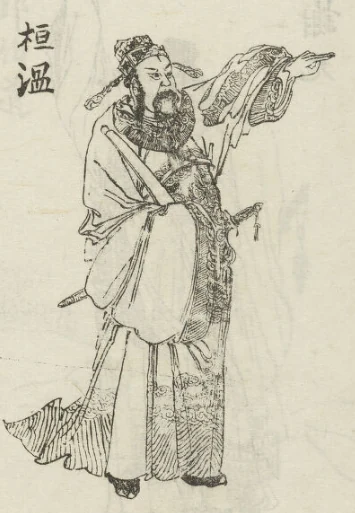
Huan Wen
桓温
Huan Wen (312–August 18, 373), courtesy name Yuanzi, was a native of Longkang County in Qiao Commandery (present-day Longkang Town, Huaiyuan County, Anhui Province). He was a powerful Eastern Jin statesman, politician, and military commander, and a leading member of the Huan clan of Qiao. He married a daughter of Emperor Ming of Jin, Sima Shao, and rose to the offices of Grand Marshal, commander of all military affairs inside…
312 CE–373 CEEastern Jin
PROFILE
Huan Wen (312–August 18, 373), courtesy name Yuanzi, was a native of Longkang County in Qiao Commandery (present-day Longkang Town, Huaiyuan County, Anhui Province). He was a powerful Eastern Jin statesman, politician, and military commander, and a leading member of the Huan clan of Qiao. He married a daughter of Emperor Ming of Jin, Sima Shao, and rose to the offices of Grand Marshal, commander of all military affairs inside and outside the capital, and Director of the Department of State Affairs. He was enfeoffed as Duke of Nanjun and received the posthumous title Xuanwu. After his son Huan Xuan founded Huan Chu, Huan Wen was posthumously honored as Emperor Xuanwu with the temple name Taizu.
- Other name
- Huan Yuanzi
- Courtesy name
- Yuanzi
- Era
- Eastern Jin
- Dynasty/Regime
- Eastern Jin
- Identity
- Official, politician
- Ethnicity/Ethnic affiliation
- Not reliably confirmed in surviving sources
- Native place
- Longkang County, Qiao Commandery (present-day Longkang Town, Huaiyuan County, Anhui Province)
- Date of birth
- 312
- Place of birth
- Place of birth unknown
- Date of death
- August 18, 373
- Major achievements
- Leader of the Huan clan of Longkang in Qiao Commandery and the most powerful strongman of the Eastern Jin; launched three Northern Expeditions, deposed the Prince of Haixi and monopolized power, but ultimately failed to achieve an imperial succession.
LIFE TIMELINE
Less than one year old | The eminent scholar Wen Jiao saw him and remarked that “this child has extraordinary bones”; Huan Wen was therefore named “Wen” after Wen Jiao.
Age sixteen | His father Huan Yi was killed by Han Huang during the Su Jun Rebellion; Jiang Bo, magistrate of Jing County, had taken part in the plot.
Age nineteen | Disguised himself as a mourner, entered the mourning hut, killed Jiang Biao, and pursued and killed Jiang Biao's two younger brothers, thereby avenging his father.
Age twenty-three | Appointed Administrator of Langya.
Age thirty-one | Served as a forward sub-commander with acting imperial authority, assisted Yu Yi's northern campaign, and was later promoted to Inspector of Xuzhou.
Age thirty-three | Promoted to General Who Pacifies the West and Inspector of Jingzhou, with authority over military affairs in Jing, Si, Yong, Yi, Liang, and Ning provinces, taking command of military power on the upper Yangtze.
Age thirty-four | Submitted a memorial in the eleventh month requesting a campaign against Shu and led his army west before receiving a court reply.
Age thirty-five | Destroyed Cheng Han in the third month and captured Li Shi; subsequently received the titles General Who Conquers the West, Cavalier Attendant with Separate Office, and Duke of Linhe Commandery.
Age thirty-seven | After Later Zhao ruler Shi Hu died, submitted a memorial requesting a northern campaign but received no reply.
Age thirty-nine | Departed after submitting a memorial, led troops to Wuchang, and was persuaded by Sima Yu to return to his base.
Age forty-two | Memorialized for the dismissal of Yin Hao, after which internal and external power concentrated in his hands; in the second month, campaigned against Former Qin, advanced to Bashang, and withdrew when provisions ran out.
Age forty-four | Launched his second Northern Expedition, defeated Yao Xiang at the Yi River, recovered Luoyang, and paid respects at and repaired the imperial tombs.
Age forty-eight | Advanced in rank to Duke of Nanjun.
Age fifty-one | Granted the additional titles Palace Attendant, Grand Marshal, commander of all military affairs inside and outside the capital, Director of the Department of State Affairs, and acting holder of the Yellow Axe.
Age fifty-two | Moved his headquarters to Zheqi while holding the title Governor of Yangzhou from afar.
Age fifty-three | Moved his headquarters to Gushu, controlling the southern approach to Jiankang.
Age fifty-seven | Launched his third Northern Expedition against Former Yan, was defeated at Fangtou, and suffered a major loss of prestige.
Age fifty-nine | Suppressed Yuan Jin's rebellion at Shouchun, deposed Sima Yi as Prince of Haixi, and enthroned Sima Yu as Emperor Jianwen.
Age sixty | Emperor Jianwen died; contrary to Huan Wen's expectations, the edict entrusted the government to Xie An and Wang Tanzhi.
Age sixty-one | Died at Gushu at the age of sixty-two by traditional reckoning; posthumously awarded the office of Grand Councilor and the posthumous title Xuanwu.
BIOGRAPHY
Biography
Family Background and Early Life
Huan Wen's family belonged to the Huan clan of Longkang in Qiao Commandery. According to the Book of Jin, Huan Wen was a descendant of the Eastern Han scholar Huan Rong. Historian Tian Yuqing argued that Huan Wen's great-grandfather—or a collateral great-granduncle—was Huan Fan, the Cao Wei Minister of Agriculture who was executed by the Sima clan during the Jiaping Incident. The Huan clan of Longkang thus became a family associated with criminal punishment and was not counted among the great aristocratic houses of the Western Jin. After moving south, Huan Wen's father Huan Yi associated with eminent men, became one of the “Eight Unrestrained Men South of the Yangtze,” and aspired to win merit. He took part in Emperor Ming's plans to suppress Wang Dun's rebellion, which raised the family's standing, though it remained a second-rank aristocratic house.
Huan Wen was born in 312, the sixth year of Yongjia. Before he was a year old, the eminent scholar Wen Jiao saw him, remarked that he possessed extraordinary bones, and, on hearing his cry, praised him as an extraordinary talent. Because Wen Jiao was renowned for judging character, Huan Yi was delighted and named his son “Wen” after Wen Jiao's surname. Wen Jiao later joked, “Then my surname will have to be changed in the future,” alluding to the possibility that Huan Wen might one day become emperor and force others to avoid the name. Huan Wen was frugal in youth and differed markedly from other sons of aristocratic families.
Avenging His Father and Early Career
In 328, the third year of Xianhe, Huan Yi was killed by the rebel general Han Huang during the Su Jun Rebellion, while Jiang Bo, magistrate of Jing County, had participated in the plot. Huan Wen was only sixteen by Western age at the time. He slept beside his weapons and wept, vowing to avenge his father. In 331, the sixth year of Xianhe, Jiang Bo died. His sons Jiang Biao and his two brothers, fearing Huan Wen's revenge, kept weapons in their mourning hut. Huan Wen disguised himself as a mourner, entered the hut, killed Jiang Biao, then pursued and killed his two younger brothers. His revenge won contemporary admiration.
Huan Wen was described as bold and openhearted, physically imposing, and possessed of an impressive bearing; seven marks were said to appear on his face. He later married Sima Xingnan, the Princess Nankang, and was appointed Imperial Son-in-Law Commandant, while inheriting his father's title as Baron of Wanning County. Yu Yi once told Emperor Cheng of Jin that Huan Wen had the talent of a hero and should be taken as a son-in-law. In 335, the first year of Xiankang, Huan Wen became Administrator of Langya and was later additionally appointed General Who Assists the State. In the seventh month of 343, the first year of Jianyuan, the court appointed him forward sub-commander with acting imperial authority and ordered him to hold Linhuai while assisting Jingzhou Inspector Yu Yi's northern campaign. In the tenth month of that year he was promoted to Inspector of Xuzhou and given command over the military affairs of Qing, Xu, and Yan provinces. Huan Wen and Yu Yi were friendly and once agreed to work together to restore order to the realm.
Taking Control of Jingzhou
Yu Yi died in 345, the first year of Yonghe, and before his death asked that his son Yu Yuanzhi succeed him in Jingzhou. He Chong, the Palace Attendant then assisting in government, instead recommended Huan Wen, arguing that “Huan Wen's heroic strategy surpasses others; he possesses both civil and military discernment, and there is no one better suited to the western regions.” Liu Tan, Intendant of Danyang, believed that Huan Wen was indeed exceptionally talented but also ambitious. He warned against allowing him to control the strategically important Jingzhou region and recommended that Sima Yu, Prince of Kuaiji, take the post himself. Sima Yu did not accept the proposal. In the eighth month of that year, Huan Wen was promoted to General Who Pacifies the West and Inspector of Jingzhou, with authority over the military affairs of Jing, Si, Yong, Yi, Liang, and Ning provinces, while concurrently serving as Colonel for the Southern Man tribes. He thereby gained control of military power on the upper Yangtze.
Destruction of Cheng Han
After taking command in Jingzhou, Huan Wen planned to campaign west against the declining Cheng Han regime in Ba and Shu in order to establish military merit. Cheng Han ruler Li Shi was described as dissolute and incompetent. Yuan Qiao, Chancellor of Jiangxia, strongly supported a campaign and proposed that Huan Wen lead ten thousand elite troops in a rapid advance directly on Chengdu. He also argued that Later Zhao in the north would not dare exploit the opportunity. Huan Wen therefore decided to attack Shu.
In the eleventh month of 346, the second year of Yonghe, Huan Wen submitted a memorial requesting permission to campaign against Shu. Before receiving a reply, he marched west with General Who Attacks the Caitiffs Zhou Fu and Sima Wuji, appointing Yuan Qiao to lead two thousand men as the vanguard. The court was deeply worried, believing that his force was too small and had penetrated too far into dangerous territory, and feared that he would be defeated. Liu Tan alone predicted that Huan Wen would certainly conquer Shu.
In the second month of 347, the third year of Yonghe, Huan Wen reached Qingyi, north of present-day Mingshan in Sichuan. Li Shi ordered Li Fu and Zan Jian to proceed to Heshui to resist the Jin army. Zan Jian crossed the river from Yuanyangqi on the northern bank and advanced toward Qianwei, taking a route different from Huan Wen's. In the third month, Huan Wen reached Pengmo. He left his staff officers Zhou Chu and Sun Sheng to guard the baggage and personally led infantry toward Chengdu. Li Fu returned to attack Pengmo but was repulsed. Huan Wen won three successive engagements against Li Quan and others and approached Chengdu. Li Shi assembled all available forces for a decisive battle at Zhaoqiao. The fighting was fierce; the Jin vanguard faltered, staff officer Gong Hu was killed, and arrows landed in front of Huan Wen's horse. The commanders feared defeat and wanted to withdraw, but a drummer accidentally sounded the advance. Yuan Qiao seized the opportunity, drew his sword, and urged the soldiers forward. The Jin army rallied and decisively defeated the Cheng Han forces. Huan Wen then entered Chengdu and burned the lesser city. Li Shi fled by night for ninety li, but eventually surrendered with his hands bound behind him and a coffin-cart in attendance. Huan Wen released him from his bonds, burned the coffin-cart, and sent Li Shi to Jiankang, bringing Cheng Han to an end.
Huan Wen remained in Chengdu for a month after the conquest. He appointed capable men locally, including former Cheng Han officials Wang Shi, Wang Yu, Deng Ding, and Chang Qu as staff officers, and successfully pacified the region. Wang Shi and Deng Ding soon rebelled, but both uprisings were suppressed. In 348, the fourth year of Yonghe, the court debated rewards for the conquest. It initially intended to make Huan Wen Duke of Yuzhang Commandery, but Assistant Director of the Left Xun Rui opposed the proposal. Huan Wen ultimately received the titles General Who Conquers the West, Cavalier Attendant with Separate Office, and Duke of Linhe Commandery.
Forcing the Dismissal of Yin Hao and Concentrating Power
The conquest of Shu greatly enhanced Huan Wen's reputation, causing the court to fear that he would become impossible to control. Sima Yu, Prince of Kuaiji, brought Yin Hao, Inspector of Yangzhou, into the central government in an attempt to balance Huan Wen. Although dissatisfied, Huan Wen knew Yin Hao's abilities and did not regard him as a serious threat. Huan Wen controlled eight provinces, recruited troops, and allocated resources on his own authority. His domain gradually developed a semi-independent character and his disloyal ambitions increasingly became apparent. The court could no longer command him at will and could do little more than keep him nominally attached.
After Later Zhao ruler Shi Hu died in 349, the fifth year of Yonghe, northern China fell into disorder. Huan Wen immediately submitted a memorial requesting a northern campaign but received no reply. In the twelfth month of 351, the seventh year of Yonghe, he “submitted his memorial and departed on his own authority,” leading fifty thousand troops downstream to Wuchang. The court was alarmed, and Sima Yu personally wrote to dissuade him. Huan Wen returned to his base. Over the following two years, Yin Hao launched several campaigns against Former Qin, seeking to occupy Luoyang and repair the imperial mausoleums, but repeatedly failed. Military supplies were lost and resentment spread through court and country. In the first month of 354, the tenth year of Yonghe, Huan Wen submitted a memorial enumerating Yin Hao's faults and forced the court to reduce Yin Hao to commoner status. From then on, both internal and external power effectively passed into Huan Wen's hands.
Three Northern Expeditions
First expedition against Former Qin (354): In the second month of 354, Huan Wen led forty thousand infantry and cavalry north from Jiangling against Former Qin, ordering Liangzhou Inspector Sima Xun to emerge from the Ziwu Valley for a coordinated attack. The Jin army captured Former Qin general Guo Jing, defeated Prince of Huainan Fu Sheng, and entered Guanzhong. In the fourth month Huan Wen personally supervised battle at Lantian and defeated the Qin army, advancing to Bashang. People of Guanzhong came along the roads carrying cattle and wine to welcome the Jin troops, and elderly residents wept, saying, “We never expected to see the imperial army again in our lifetime.” Huan Wen intended to harvest the local wheat to supply his army, but the Qin forces harvested it first and implemented a scorched-earth strategy. The Jin army ran short of provisions and in the ninth month withdrew south after relocating more than three thousand households from Guanzhong. Former Qin forces pursued the retreating army, and tens of thousands were killed or went missing. During the campaign Huan Wen met the recluse Wang Meng. Wang Meng concluded that Huan Wen's true concern lay south of the Yangtze rather than in Guanzhong and that his hesitation at the Ba River showed that he sought political prestige more than genuine territorial recovery. Huan Wen invited Wang Meng to accompany him south during the withdrawal, but Wang Meng declined. Huan Wen's subordinate Xue Zhen, Administrator of Shunyang, criticized him for hesitating instead of attacking Chang'an, touched on a sensitive point, and was executed.
Second expedition against Yao Xiang and recovery of Luoyang (356): In the third month of 356, the twelfth year of Yonghe, Huan Wen repeatedly requested that the court move the capital back to Luoyang and restore the imperial mausoleums. The proposal was rejected more than ten times, but the court appointed him commander-in-chief of the expedition. In the seventh month he marched from Jiangling, and in the eighth month reached the Yi River south of Luoyang. The Qiang leader Yao Xiang, then besieging Luoyang, withdrew from the siege to confront him. Huan Wen decisively defeated Yao Xiang at the Yi River, forcing him to flee. Zhou Cheng, who held Luoyang, surrendered the city, allowing Huan Wen to recover the former capital. Huan Wen visited the imperial tombs and repaired those that had been damaged. He left Administrator of Yingchuan Mao Muzhi and Administrator of Henan Dai Shi to defend Luoyang, then moved more than three thousand households of surrendered inhabitants south to the Yangtze and Han river regions before returning to Jingzhou. In 360, the fourth year of Shengping, he was promoted to Duke of Nanjun.
In 362, the first year of Longhe, Former Yan general Lü Hu attacked Luoyang. Huan Wen sent Yu Xi and Deng Xia to assist Chen You in defending the city. He again memorialized that the Jin court should return its capital to Luoyang and proposed that aristocratic families that had moved south return to their ancestral homes. The court feared Huan Wen and did not openly oppose the plan, but southern aristocratic families had grown accustomed to life in the south and had no desire to return. Wang Shu, Inspector of Yangzhou, argued that Huan Wen was using the issue of restoring the capital merely to pressure the court and did not sincerely intend the move; the court therefore needed only to appear compliant. Although an edict was issued, the Jin court never returned to Luoyang.
Third expedition against Former Yan and defeat at Fangtou (369): In 369, the fourth year of Taihe, Huan Wen launched his third Northern Expedition and requested that Xi Yin, Inspector of Xu and Yan provinces, and others join him against Former Yan. Huan Wen led fifty thousand infantry and cavalry from Gushu through Yanzhou. In the seventh month he reached Fangtou, southwest of present-day Xun County in Henan. Former Yan emperor Murong Wei and Grand Tutor Murong Ping were so alarmed that they considered fleeing to Helong. During Huan Wen's advance, however, Former Yan had already harvested local grain, and its forces cut the Jin supply route. With provisions running out, Huan Wen burned his boats, abandoned his baggage, and retreated. At Xiangyi, present-day Sui County in Henan, his army was caught between forces led by Murong Chui and Murong De and suffered a crushing defeat in which thirty thousand men were killed. The defeat at Fangtou severely damaged Huan Wen's prestige.
Deposing and Enthroning Emperors; Power in His Final Years
Although his prestige suffered after Fangtou, Huan Wen retained great power. In 371, the sixth year of Taihe, he suppressed Yuan Jin's rebellion at Shouchun. In the eleventh month he entered Jiankang, deposed Emperor Fei Sima Yi and reduced him to Prince of Haixi, then enthroned Sima Yu, Prince of Kuaiji, as Emperor Jianwen. Huan Wen was appointed Grand Councilor and Grand Marshal, although he did not actually take up the office of Grand Councilor. Emperor Jianwen fell seriously ill less than a year after accession and issued a final edict entrusting government to Xie An and Wang Tanzhi. Huan Wen had expected the regency to be given to him and was deeply disappointed.
Emperor Jianwen died in 372, the second year of Xian'an, and Crown Prince Sima Yao succeeded as Emperor Xiaowu. In his final illness, Huan Wen hinted that the court should grant him the Nine Bestowments. Xie An and Wang Tanzhi deliberately delayed the matter. Xie An ordered Yuan Hong to draft the edict, then repeatedly demanded revisions on various pretexts. Huan Wen died before it could be issued. He died at Gushu in the eighth month of 373, the first year of Ningkang, aged sixty-two by traditional reckoning. The court posthumously awarded him the office of Grand Councilor and the title Xuanwu. His son Huan Xuan later usurped the Jin and established Huan Chu, posthumously honoring Huan Wen as Emperor Xuanwu with the temple name Taizu.
Major Activities
Destruction of Cheng Han
In 347, the third year of Yonghe, Huan Wen took advantage of internal disorder in Cheng Han and the misrule of Li Shi to campaign against Shu with ten thousand elite troops. At the decisive battle of Zhaoqiao, the Jin vanguard faltered and staff officer Gong Hu was killed. An accidental advance signal from the drummer turned into an opportunity: Yuan Qiao drew his sword, led the troops forward, and ultimately defeated the Cheng Han army. Huan Wen entered Chengdu, and Li Shi surrendered with his hands bound and a coffin-cart in attendance. Cheng Han was destroyed. Huan Wen then employed capable former Cheng Han officials as staff officers and pacified Shu. The campaign greatly increased his prestige and established his position as a dominant strongman.
Three Northern Expeditions
Huan Wen launched three Northern Expeditions in 354, 356, and 369. The first, against Former Qin, reached Bashang but withdrew because of shortages of food. The second defeated Yao Xiang at the Yi River, recovered the former capital Luoyang, and restored the imperial mausoleums; it was the only clearly successful one of the three expeditions. The third, against Former Yan, ended in a disastrous defeat at Fangtou, with thirty thousand dead and a major loss of prestige. Although the expeditions did not achieve full restoration of the north, they temporarily recovered Luoyang, placed pressure on northern regimes, and increased Huan Wen's political standing at court.
Deposition and Enthronement of an Emperor
In 371, the sixth year of Taihe, Huan Wen deposed Emperor Fei Sima Yi and reduced him to Prince of Haixi, then enthroned Sima Yu, Prince of Kuaiji. This was the first successful deposition and enthronement of an emperor by a powerful minister in the Eastern Jin after the disorders of Wang Dun and Su Jun. The act demonstrated Huan Wen's extraordinary control over the court, but also exposed his disloyal ambition and generated resentment among aristocratic families, contributing to later resistance to his pursuit of the Nine Bestowments.
Failure to Obtain the Nine Bestowments
When Huan Wen became gravely ill, he hinted that the court should grant him the Nine Bestowments. Xie An and Wang Tanzhi deliberately delayed the process. Xie An ordered Yuan Hong to draft the edict but repeatedly demanded revisions, and Huan Wen died before the document was issued. Because the Nine Bestowments were conventionally associated with the final stage before a dynastic succession, this delay prevented Huan Wen from completing his ambition before death.
Personal Associations
Huan Wen was friendly with Yu Yi, with whom he once pledged to restore order to the realm. In youth, he and Yin Hao were regarded as comparable talents, but later became political rivals. Before Huan Wen's campaign against Shu, Liu Tan predicted that he would succeed; Liu Tan was also among the first to recognize Huan Wen's ambition and warned Sima Yu not to let him occupy a strategically dominant region. During the Former Qin campaign, Huan Wen met the recluse Wang Meng. Wang Meng perceived that Huan Wen's real interests lay south of the Yangtze and did not accompany him south. In Huan Wen's final years, Xie An and Wang Tanzhi jointly delayed his receipt of the Nine Bestowments until his death.
Personal Relations
Family
- Father: Huan Yi, Administrator of Xuancheng, killed by Han Huang during the Su Jun Rebellion.
- Mother: Lady Kong.
- Wife: Sima Xingnan, Princess Nankang, daughter of Emperor Ming of Jin.
- Younger brothers: Huan Yun, Huan Huo, Huan Mi, and Huan Chong.
- Sons: Huan Xi, Huan Ji, Huan Xin, Huan Yi, Huan Wei, and Huan Xuan. Huan Xuan later usurped the Jin, founded Huan Chu, and posthumously honored Huan Wen as Emperor Xuanwu.
Teachers and Associates
- Wen Jiao: eminent scholar; Huan Wen's given name was derived from Wen Jiao's surname, and Wen Jiao called him “a truly extraordinary person.”
- Yu Yi: Inspector of Jingzhou; a friend of Huan Wen, with whom he pledged to restore order to the realm.
- Yuan Qiao: Chancellor of Jiangxia; strongly advocated the campaign against Shu and won distinction as vanguard commander.
- Liu Tan: Intendant of Danyang; recognized Huan Wen's ambition and advised limiting his power.
- Wang Meng: recluse associated with Former Qin; met Huan Wen, who appointed him military adviser, but did not follow him south.
Ruler–Subject Relations
- Emperor Ming of Jin, Sima Shao: Huan Wen's father-in-law.
- Emperor Mu of Jin, Sima Dan: ruler during Huan Wen's conquest of Cheng Han and early Northern Expeditions.
- Emperor Fei of Jin, Sima Yi: deposed by Huan Wen and reduced to Prince of Haixi.
- Emperor Jianwen of Jin, Sima Yu: enthroned by Huan Wen and earlier wrote to persuade him to halt his movement toward Wuchang.
- Emperor Xiaowu of Jin, Sima Yao: ruler at the time of Huan Wen's death.
Political Allies and Opponents
- He Chong: recommended that Huan Wen be entrusted with Jingzhou in order to counter the Yu clan's influence.
- Yin Hao: political rival, reduced to commoner status after Huan Wen's memorial.
- Xie An: opponent who delayed Huan Wen's receipt of the Nine Bestowments.
- Wang Tanzhi: joined Xie An in delaying the Nine Bestowments.
- Sun Chuo: opposed Huan Wen's proposal to move the capital.
Historical Assessment
Eastern Jin and Contemporary Assessments
- The Book of Jin, in the biography of Huan Wen, records Liu Tan as saying that “Huan Wen must not be allowed to occupy a strategically dominant region; his rank and titles should always be restrained,” reflecting Liu Tan's recognition of Huan Wen's ambitions.
- The same biography records He Chong as praising Huan Wen's exceptional strategy and combined civil and military abilities and recommending him for Jingzhou.
- A New Account of the Tales of the World records Huan Wen asking, “If one becomes a loyal minister, can one not also be a filial son? What is to be done?” expressing his own sense of tension between loyalty and filial duty.
Southern Dynasties to Tang
- Pei Songzhi's commentary to the Records of the Three Kingdoms, citing the Jinyang Qiu, records Huan Wen's northern campaigns and contains favorable descriptions of his military ability.
- The Tang-compiled Book of Jin described Huan Wen as possessing “the unrestrained spirit of a hero” and “extraordinary civil and military talent,” while also criticizing him for harboring rebellious intentions and for deposing a ruler and wielding life-and-death power on his own authority.
- The appraisal in the Book of Jin called Huan Wen “an outstanding man of his age,” while condemning his disloyal ambition.
Song and Yuan Periods
- Sima Guang's Comprehensive Mirror in Aid of Governance gives a detailed account of the defeat at Fangtou and presents Huan Wen's northern campaigns as driven in part by the pursuit of political prestige rather than solely by a desire to restore the Central Plains.
- Su Shi's Dongpo Zhilin discusses Huan Wen's campaign against Shu and comments on his military judgment, but the phrase “an outstanding man of his age” later attributed to Su Shi is not accepted in the Chinese source and should not be treated as authentic.
- Zhu Xi's Classified Conversations of Master Zhu is said to contain the judgment that “Huan Wen had talent but lacked virtue, and therefore ultimately failed to accomplish his designs”; the Chinese source itself notes that the attribution requires verification and should be cited cautiously.
Ming and Qing Periods
- Wang Fuzhi's Du Tongjian Lun regarded Huan Wen as ambitious but not simply equivalent to rebels such as Wang Dun and Su Jun, arguing that he also possessed a genuine desire to achieve political and military merit.
- Zhao Yi's Notes on the Twenty-Two Histories discussed Huan Wen alongside Wang Dun and Su Jun and viewed his deposition of an emperor as an important precedent in Eastern Jin politics.
- Gu Yanwu's Rizhilu criticized Huan Wen's Northern Expeditions as overambitious and insufficiently supported by ability, noting that three campaigns failed to restore the Central Plains.
Modern Scholarship
- Tian Yuqing's Aristocratic Politics in the Eastern Jin closely examines the Huan family's background, arguing that the Huan clan of Qiao descended from a family disgraced by punishment and lacked a high aristocratic pedigree, and that Huan Wen rose through military achievement within the structure of Eastern Jin aristocratic politics.
- Lü Simian's History of the Jin and Northern and Southern Dynasties described Huan Wen's strategic ability as outstanding within the Eastern Jin but judged that defects in character prevented him from achieving greater ambitions.
- Wang Zhongluo's History of the Wei, Jin, and Northern and Southern Dynasties argued that although Huan Wen's Northern Expeditions ultimately failed, the recovery of Luoyang and the pressure placed on northern regimes had historical significance.
FIGURES ASSOCIATED WITH THIS DYNASTY
Bibliography
- Book of Jin, “Biography of Huan Wen,” compiled by Fang Xuanling and others in the Tang dynasty.
- Book of Jin, biographies of Yu Yi, Yin Hao, Yuan Qiao, Liu Tan, and others, compiled by Fang Xuanling and others in the Tang dynasty.
- Tian Yuqing, Aristocratic Politics in the Eastern Jin, Peking University Press.
- Lü Simian, History of the Jin and Northern and Southern Dynasties, Shanghai Classics Publishing House.
- Wang Zhongluo, History of the Wei, Jin, and Northern and Southern Dynasties, Shanghai People's Publishing House.