Zhu Yuanzhang instructed the commanders that | Zhu Yuanzhang instructed the commanders that, if they encountered a major enemy, Chang Yuchun and Feng Sheng were to “divide into the left and right wings and each lead elite troops to strike.” In 1368(1st year of Hongwu), Zhu Yuanzhang proclaimed himself emperor.
1395 CE
General
Feng Sheng
冯胜
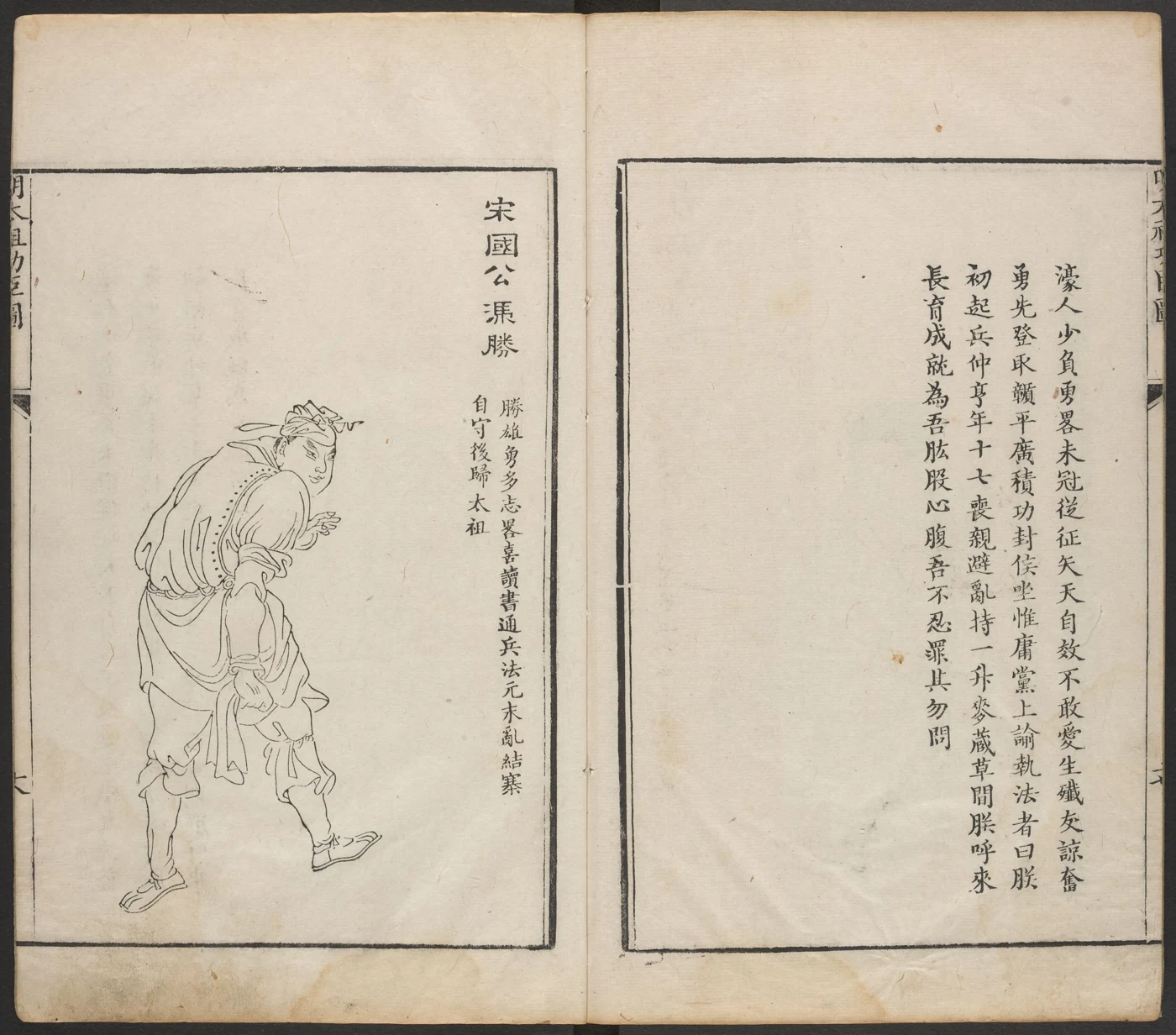
Feng Sheng (birth date unknown; died in 1395, the 28th year of the Hongwu era), originally named Guosheng and also known as Zongyi, was a native of Dingyuan and a founding general of the Ming dynasty. He was the younger brother of Feng Guoyong. In the late Yuan, the brothers organized a fortified local force for self-defense and later submitted to Zhu Yuanzhang. Feng Sheng took part in the campaigns against Chen Youliang and…
1395 CEMing Dynasty
PROFILE
Feng Sheng (birth date unknown; died in 1395, the 28th year of the Hongwu era), originally named Guosheng and also known as Zongyi, was a native of Dingyuan and a founding general of the Ming dynasty. He was the younger brother of Feng Guoyong. In the late Yuan, the brothers organized a fortified local force for self-defense and later submitted to Zhu Yuanzhang. Feng Sheng took part in the campaigns against Chen Youliang and Zhang Shicheng and in the northern campaigns into the Central Plains. He later served as General-in-Chief Who Conquers the Barbarians and was enfeoffed as Duke of Song. In 1387(20th year of Hongwu), he led the campaign that compelled Naghachu to surrender and participated in the pacification of Liaodong. In his later years Zhu Yuanzhang became suspicious of him and stripped him of military command. Feng Sheng died in 1395; he was ordered to die, while The Hongguang Emperor of the Southern Ming posthumously created him Prince of Ningling and granted him the posthumous name Wuzhuang.
- Other Name
- Duke of Song
- Period
- Ming
- Date of Birth
- Not recorded in historical sources
- Date of Death
- 1395 CE(28th year of the Hongwu era, Ming)
- Dynasty/Polity
- Ming
- Identity
- General
- Ethnicity/People
- Not reliably confirmed in the historical sources
- Native Place
- Dingyuan (present-day Dingyuan, Anhui)
- Place of Birth
- Unknown
- Place of Death
- Unknown
- Highest Office
- See Biography and Major Deeds
- Major Achievement
- Major founding general of the Ming; senior in age and standing among many commanders; ordered to die after being wrongfully accused, with his case later rehabilitated
- Ancestral Origin
- Dingyuan (present-day Dingyuan, Anhui);Year unknown
- Birthplace
- Unknown;1395(28th year of the Hongwu era of the Ming)
- Major Achievements
- Participated in the wars of unification in the early Ming; joined the northern campaigns into the Central Plains and took Shaanxi and Gansu; campaigned against and accepted the surrender of Naghachu and helped pacify Liaodong
LIFE TIMELINE
Submission at Miaoshan | With his elder brother Feng Guoyong he led his troops to meet Zhu Yuanzhang at Miaoshan and entered his service.
Capture of Chuzhou | He took part in the capture of Chuzhou and fought at Sancha River, Banmen Fort and Jilong Mountain, distinguishing himself in each.
Submission and early campaigns | Feng Sheng and Feng Guoyong led their followers to submit to Zhu Yuanzhang; Feng Sheng later took part in the crossing of the Yangtze and the capture of Caishi and Taiping, for which he was appointed Commander of Ten Thousand.
After submitting to Zhu Yuanzhang in 1354(14th year of Zhizheng) | After submitting to Zhu Yuanzhang in 1354(14th year of Zhizheng), he participated in the capture of Chuzhou, Hezhou, Taiping, Yingtian, and other key places.
Campaigns in the south | He took part in attacks on Zhenjiang, Danyang, Ningguo, Taixing and Yixing and was appointed a marshal.
Took command of the personal troops | After Feng Guoyong died, Feng Sheng was ordered to take over his brother's men and serve in the central guard.
Taking Over the Personal Troops and Pacifying Jiangnan In 1359(19th year of Zhizheng) | ### Taking Over the Personal Troops and Pacifying Jiangnan In 1359(19th year of Zhizheng), Feng Guoyong died of illness.
Battle of Longwan | Alongside Chang Yuchun, ambushed Chen Youliang's forces, helped defeat the Han army, and recovered Taiping.
In 1360(20th year of Zhizheng) | In 1360(20th year of Zhizheng), after Chen Youliang captured Taiping and proclaimed himself emperor, he advanced eastward against Yingtian Prefecture.
Attack on Jiangzhou | Participated in taking Anqing and Jiangzhou and was appointed Protector of the Personal Army.
In 1361(21st year of Zhizheng) | In 1361(21st year of Zhizheng), he joined the campaign against Chen Youliang, broke the water stockades at Anqing, advanced rapidly to Jiangzhou, and was promoted to Protector of the Personal Army.
Relief of Anfeng | Promoted for merit to Co-Administrator of the Bureau of Military Affairs; before the Battle of Lake Poyang, his vessel capsized in a storm and Zhu Yuanzhang sent him back.
In 1363(23rd year of Zhizheng) | In 1363(23rd year of Zhizheng), he helped relieve the siege of Anfeng and was promoted to Co-Administrator of the Bureau of Military Affairs.
Campaigns around Wuchang and Luzhou | Participated in taking Wuchang, Luzhou, and various routes in Jiangxi.
Campaign against Wuchang | He joined the campaign against Wuchang, took Luzhou, and moved his troops to secure the circuits of Jiangxi.
Took eastern Huai and western Zhejiang | Participated in attacks on Zhang Shicheng's forces and later took Huai'an, Anfeng, Jiuguan, Gaoyou, Huzhou, and other places.
In 1365(25th year of Zhizheng) | In 1365(25th year of Zhizheng), Zhu Yuanzhang ordered Xu Da, Chang Yuchun, Hu Tingrui, Feng Sheng, and others to attack Zhang Shicheng.
Huai’an and Huzhou | He took Huai’an, Anfeng, Jiuguan and Huzhou and was transferred to be vice commissioner of the Chief Military Commission.
Held the capital and joined the northern campaign | Remained to guard Yingtian and later joined Xu Da's northern campaign as a participating general.
Northern Campaign and Enfeoffment as Duke In 1367(1st year of Wu) | ### Northern Campaign and Enfeoffment as Duke In 1367(1st year of Wu), Zhu Yuanzhang formally launched the northern campaign.
Northern campaign in Henan and Shaanxi | Took Bianliang, Luoyang, Shanzhou, Tong Pass, and other places and served as Right Vice General Who Conquers the Barbarians.
Zhu Yuanzhang instructed the commanders that | Zhu Yuanzhang instructed the commanders that, if they encountered a major enemy, Chang Yuchun and Feng Sheng were to “divide into the left and right wings and each lead elite troops to strike.” In 1368(1st year of Hongwu), Zhu Yuanzhang proclaimed himself emperor.
Campaigns in Shanxi and Shaanxi | Participated in taking Shanxi, Shaanxi, and Qingyang; Zhu Yuanzhang severely reprimanded him for returning without authorization.
In 1369(2nd year of Hongwu) | In 1369(2nd year of Hongwu), Feng Sheng crossed the Yellow River and advanced directly into Shaanxi, taking Fengxiang.
Battle of Dingxi and enfeoffment | Defeated Köke-Temür, was enfeoffed as Duke of Song, and received a hereditary iron tally.
In the first month of 1370(3rd year of Hongwu) | In the first month of 1370(3rd year of Hongwu), Feng Sheng, as Right Vice General, departed Xi'an with Xu Da and struck directly at Dingxi.
Western expedition to Gansu | Served as General Who Conquers the West and led the western army into Gansu; returned victorious but received no reward.
Western Expedition to Gansu and the Liaodong Campaign In 1372(5th year of Hongwu) | ### Western Expedition to Gansu and the Liaodong Campaign In 1372(5th year of Hongwu), a Ming army of 150,000 advanced toward the northern steppe in three columns.
Campaign against Naghachu | Served as General-in-Chief Who Conquers the Barbarians and led an army that compelled Naghachu to surrender; after returning, his command seal was confiscated and he was ordered to reside in Fengyang.
In 1387(20th year of Hongwu) | In 1387(20th year of Hongwu), Zhu Yuanzhang appointed Feng Sheng General-in-Chief Who Conquers the Barbarians and ordered him to lead Fu Youde, Lan Yu, and an army of 200,000 infantry and cavalry against Naghachu.
Stationed at Yongning | Ordered to mobilize troops for a campaign against Qujing and then charged with pacification after frontier troops rebelled.
Final Years and Ordered Death In 1388(21st year of Hongwu) | ### Final Years and Ordered Death In 1388(21st year of Hongwu), Feng Sheng was ordered to mobilize frontier troops from Dongchang for a campaign against Qujing.
Recruitment and military colonies | Ordered to recruit civilians as soldiers in Taiyuan and Pingyang and establish guards with military farms.
In 1392(25th year of Hongwu) | In 1392(25th year of Hongwu), he was ordered to recruit civilians as soldiers in Taiyuan and Pingyang and establish guards with military farms.
Death | The Hongguang Emperor posthumously created Feng Sheng Prince of Ningling and granted the posthumous name Wuzhuang.
Zhu Yuanzhang summoned Feng Sheng to drink wine and told him | Zhu Yuanzhang summoned Feng Sheng to drink wine and told him, “I will not concern myself with this matter.” After Feng Sheng returned, he was ordered to die in 1395(28th year of Hongwu).
In 1644(17th year of Chongzhen) | In 1644(17th year of Chongzhen), the Hongguang Emperor of the Southern Ming posthumously created him Prince of Ningling and granted the posthumous name Wuzhuang.
BIOGRAPHY
Biography
Family Background and Early Years Feng Sheng was a native of Dingyuan. He and his elder brother Feng Guoyong “both enjoyed reading and understood military methods.” During the disorder of the late Yuan, the Feng brothers organized local fighters and fortified themselves for self-defense. In 1354(14th year of Zhizheng), as Zhu Yuanzhang advanced south from Haozhou toward Dingyuan, the brothers led their followers to submit voluntarily. Feng Guoyong proposed the strategy of “first taking Jinling as the base and then sending generals in all directions,” for which Zhu Yuanzhang valued him highly, treating him as a trusted subordinate and placing him in command of the troops before his headquarters. Feng Sheng followed his brother in taking Chuzhou and Hezhou and fought at Sancha River, Banmen Stockade, and Jilong Mountain, earning merit in each action. He crossed the river with the army, helped take Caishi and Taiping, and was appointed Commander of Ten Thousand. He later took part in campaigns at Zhenjiang, Danyang, Ningguo, Taixing, Yixing, Jinhua, and Shaoxing and rose through accumulated merit to the rank of military marshal. ### Taking Over the Personal Troops and Pacifying Jiangnan In 1359(19th year of Zhizheng), Feng Guoyong died of illness. Because his son Feng Cheng was still young, Zhu Yuanzhang ordered Feng Sheng to take over his men. Feng Sheng became Chief Commander of the Headquarters Personal Army and served in the central guard. In 1360(20th year of Zhizheng), after Chen Youliang captured Taiping and proclaimed himself emperor, he advanced eastward against Yingtian Prefecture. Feng Sheng and Chang Yuchun led 30,000 troops from the five wings of the headquarters army into an ambush beside Shihui Mountain. Together with other Ming forces they attacked the Han army from inside and outside, inflicted a major defeat, captured several hundred warships, and took more than 20,000 soldiers prisoner. Feng Sheng then joined Xu Da, Zhang Desheng, and others in pursuit, defeated the Han army again at Caishi, and recovered Taiping Prefecture. In 1361(21st year of Zhizheng), he joined the campaign against Chen Youliang, broke the water stockades at Anqing, advanced rapidly to Jiangzhou, and was promoted to Protector of the Personal Army. In 1363(23rd year of Zhizheng), he helped relieve the siege of Anfeng and was promoted to Co-Administrator of the Bureau of Military Affairs. Before the Battle of Lake Poyang, Feng Sheng accompanied Zhu Yuanzhang southward, but his vessel overturned in a strong wind during the march. Zhu Yuanzhang regarded this as an unfavorable start and sent him back to Jiankang. The following year Feng Sheng joined the attack on Wuchang, took Luzhou, and then moved his troops to seize various routes in Jiangxi. In 1365(25th year of Zhizheng), Zhu Yuanzhang ordered Xu Da, Chang Yuchun, Hu Tingrui, Feng Sheng, and others to attack Zhang Shicheng. Feng Sheng led his troops into eastern Huai, taking Hai'an Dam and Taizhou. When Xu Da failed to take Gaoyou and turned back to relieve Yixing, he ordered Feng Sheng to supervise the Gaoyou front. The defenders feigned surrender. Feng Sheng sent Commander Kang Tai and several hundred men into the city first; the gates were then shut and all were killed. Zhu Yuanzhang was furious, recalled Feng Sheng to the capital, had him beaten ten strokes, and ordered him to return to the Gaoyou front on foot as punishment. Ashamed and angry, Feng Sheng intensified the attack. Xu Da also returned from Yixing with reinforcements, and Gaoyou was finally taken. Feng Sheng subsequently took Huai'an and Anfeng, captured the Wu general Lü Zhen at Jiuguan, and took Huzhou. During the campaign against Pingjiang, Feng Sheng was recalled to Yingtian Prefecture to hold the capital and bore sole responsibility for military and administrative affairs there. Zhu Yuanzhang considered his merit second only to Chang Yuchun's and promoted him to Silver-Blue Grand Master for Splendid Happiness and Right Chief Military Commissioner of the Bureau of Military Affairs. ### Northern Campaign and Enfeoffment as Duke In 1367(1st year of Wu), Zhu Yuanzhang formally launched the northern campaign. Feng Sheng took part with his troops as a participating general. Zhu Yuanzhang instructed the commanders that, if they encountered a major enemy, Chang Yuchun and Feng Sheng were to “divide into the left and right wings and each lead elite troops to strike.” In 1368(1st year of Hongwu), Zhu Yuanzhang proclaimed himself emperor. Feng Sheng concurrently served as Right Supervisor of the Heir Apparent's Household. After committing a minor offense, he was demoted to Joint Chief Military Commissioner. He then led troops upstream along the Yellow River, took Bianliang and Luoyang, captured Shanzhou, advanced directly on Tong Pass, and took the pass after its defender fled by night. He then captured Huazhou. On returning to Bianliang he was appointed Right Vice General Who Conquers the Barbarians and left to hold the city. He then followed Xu Da into Shanxi, moving from Wuzhi to Huaiqing, crossing the Taihang Mountains, taking Wanzi City, Zezhou, and Luzhou, and capturing the Yuan Right Chancellor Jia Cheng at Yishi. He also took Pingyang and Jiangzhou, captured Yuan Left Chancellor Tian Baobao and others, and took more than five hundred soldiers prisoner. In 1369(2nd year of Hongwu), Feng Sheng crossed the Yellow River and advanced directly into Shaanxi, taking Fengxiang. He crossed the Long River, took Gongchang, advanced on Lintao, and received the surrender of the Yuan commander Li Siqi. Returning to join Xu Da in the siege of Qingyang, he held Yimagu Pass, repelled one of Köke-Temür's commanders, took Qingyang, and captured Zhang Liangchen alive. After Shaanxi had been pacified, Zhu Yuanzhang recalled Xu Da to the capital and ordered Feng Sheng to remain at Qingyang and exercise command over the various armies. Feng Sheng, however, considered the Guanzhong-Shaanxi region secure and led the entire army back without authorization. Zhu Yuanzhang was furious and sternly reprimanded him. In view of Feng Sheng's great merit, he pardoned him without further punishment, but the gold and silver he awarded him amounted to less than half Xu Da's reward. In the first month of 1370(3rd year of Hongwu), Feng Sheng, as Right Vice General, departed Xi'an with Xu Da and struck directly at Dingxi. They defeated Köke-Temür and captured tens of thousands of troops and horses. Feng Sheng then detached forces south from Huizhou through Yibaidu, advanced through Lüeyang, captured the Branch Secretariat official Cai Lin, and entered Mianzhou. He also sent another force along the Lianyun plank road to take Xingyuan and transferred troops toward Tibet. After returning from the campaign, he received the honorifics Founding Meritorious Military Minister Who Assisted Fortune, Advanced Sincerity, Proclaimed Strength, Specially Advanced Grand Master for Splendid Happiness, and Right Pillar of State. He was enfeoffed as Duke of Song with a stipend of 3,000 shi and received a red-inscribed iron tally. The certificate praised the Feng brothers as having been “as close as flesh and bone,” having removed threats near the ruler, rendered the service of claws and teeth for more than ten years, pacified the Central Plains, and assisted in completing the conquest of the realm. ### Western Expedition to Gansu and the Liaodong Campaign In 1372(5th year of Hongwu), a Ming army of 150,000 advanced toward the northern steppe in three columns. Feng Sheng served as General Who Conquers the West, with Chen De, Fu Youde, and others as deputy generals, and commanded the western army into Gansu. At Lanzhou, Fu Youde led picked cavalry as the vanguard and defeated Yuan forces again; Feng Sheng then defeated another force at Saolin Mountain. On reaching Gansu, the Yuan commander Shangdulu came out to surrender. At Yijinai Route, the defender Buyan Temür also surrendered. Feng Sheng camped at Biedu Mountain, while Prince Dorjiban fled. Feng Sheng pursued, capturing the prince's Branch Secretariat official Changjianu and twenty-six others, together with more than 100,000 horses, camels, cattle, and sheep. In the same campaign Xu Da's central army was badly defeated by Köke-Temür at Lingbei, while Li Wenzhong advanced rashly, fought fiercely against the Yuan commander Qarajang, and eventually withdrew for lack of provisions. Feng Sheng's column alone returned with a complete victory and many killed and captured. Because some people accused him of privately retaining camels and horses, however, he received no reward. Thereafter Feng Sheng repeatedly went to Linqing and Beiping to train troops, led armies from Datong against the Northern Yuan, and held Shaanxi and Henan. His daughter was invested as consort of the Prince of Zhou. In 1387(20th year of Hongwu), Zhu Yuanzhang appointed Feng Sheng General-in-Chief Who Conquers the Barbarians and ordered him to lead Fu Youde, Lan Yu, and an army of 200,000 infantry and cavalry against Naghachu. Feng Sheng's army marched through Songting Pass, separately built four fortified cities at Daning, Kuanhe, Huizhou, and Fuyu, left 50,000 men to hold Daning, and advanced with the main army toward Jinshan. Nailawu, a subordinate of Naghachu sent by Zhu Yuanzhang, arrived, and Naghachu then sent his Left Chancellor Tanmachi to present horses and reconnoiter the Ming army. Feng Sheng crossed Jinshan and reached the Jurchen settlement of Kutun, where he received the surrender of Guantong, Duke of Quan under Naghachu. Seeing himself outnumbered, Naghachu asked to surrender. Feng Sheng sent Lan Yu with light cavalry to accept it. Lan Yu offered Naghachu wine, but Naghachu refused to wear a garment Lan Yu had taken off for him and attempted to leave. Feng Sheng's son-in-law Chang Mao, who was present, sprang up and wounded Naghachu in the arm with a blade. More than 100,000 of Naghachu's soldiers and their wives and children, encamped along the Songhua River, panicked at the news and scattered. Feng Sheng sent Guantong to summon them to surrender and received more than 200,000 people, while captured cattle, sheep, horses, camels, and baggage stretched for more than a hundred li. On the return march at Yimi River, he captured another force of more than 20,000 and 50,000 carts and horses. Chief Military Commissioner Pu Ying, commanding the rear guard, was killed. When the army returned, Feng Sheng submitted the victory report and also reported the disturbance caused by Chang Mao. Zhu Yuanzhang was delighted and sent envoys to greet and reward the army, while ordering Chang Mao shackled. Other men, however, accused Feng Sheng of concealing fine horses, sending a retainer to Naghachu's wife to offer wine and seek pearls, forcibly marrying Naghachu's daughter only two days after a prince's death and thereby damaging the willingness of the surrendered people to submit, and causing the loss of Pu Ying and three thousand cavalry. Zhu Yuanzhang became furious, confiscated Feng Sheng's seal as general-in-chief, ordered him to build a residence in Fengyang, and required him to attend court periodically. The soldiers and commanders received no rewards. Feng Sheng never again commanded a major army. ### Final Years and Ordered Death In 1388(21st year of Hongwu), Feng Sheng was ordered to mobilize frontier troops from Dongchang for a campaign against Qujing. When those troops rebelled on the way, he was stationed at Yongning and charged with pacification. In 1392(25th year of Hongwu), he was ordered to recruit civilians as soldiers in Taiyuan and Pingyang and establish guards with military farms. After the imperial grandson was designated heir, Feng Sheng was promoted to Grand Preceptor of the Heir Apparent and, together with Duke of Ying Fu Youde, went to Shanxi and Henan to train troops; all dukes and marquises there were placed under their direction. Of eight eminent meritorious officials named in the imperial order at that time, Feng Sheng ranked third. As Zhu Yuanzhang aged, his suspicions deepened. In the same month in which Lan Yu was killed, Feng Sheng was summoned back to the capital. Feng Sheng had buried many large-bellied, narrow-mouthed ceramic jars beneath his threshing ground. More than a year after the Case of Lan Yu, one of his relatives accused him to Zhu Yuanzhang of secretly burying weapons. Zhu Yuanzhang summoned Feng Sheng to drink wine and told him, “I will not concern myself with this matter.” After Feng Sheng returned, he was ordered to die in 1395(28th year of Hongwu). Another account says that he killed himself. None of his sons was permitted to inherit his title. In 1475(11th year of Chenghua), a “Feng Sheng Shrine” stood in Xiangfu Xinchang Ward. In 1644(17th year of Chongzhen), the Hongguang Emperor of the Southern Ming posthumously created him Prince of Ningling and granted the posthumous name Wuzhuang.
Joining at Miaoshan and His Brother's Plan for the Empire
Feng Sheng, originally named Guosheng and also called Zongyi, was a man of Dingyuan and the younger brother of Feng Guoyong, duke of Ying. He understood the art of war from his youth; when the empire fell into disorder at the end of the Yuan he and his brother organized the local braves and fortified a stockade for their own defence. In 1354 the two brothers came together to pay their respects to Zhu Yuanzhang at Miaoshan, and the Ming History records that when the founder came raiding the land as far as Miaoshan, Feng Guoyong came over with Feng Sheng and was greatly trusted. The founder once asked him at leisure for a plan for the empire, and Feng Guoyong answered that "Jinling, where the dragon coils and the tiger crouches, is the capital of emperors; take it first as your foundation, and then campaign in all four directions, upholding benevolence and righteousness and winning men's hearts, without coveting their women and their goods, and the empire will be settled without trouble"; and the founder was delighted and placed him in the headquarters. Thereafter he took part in the capture of Chuzhou and Hezhou and fought at Sancha river, Banmen stockade and Jilong mountain with merit; he crossed the river and took Taiping, whereupon the founder made him commander of the personal troops and entrusted him with his confidence; at the attack on Jiqing he vied to be first over the wall, and with the other generals he took Zhenjiang, Danyang, Ningguo, Taixing and Yixing and campaigned in Jinhua and attacked Shaoxing, rising to be commander of the personal army. According to the spirit-path stele by Liu Sanwu, Feng Sheng came with his brother to pay his respects at Miaoshan and then took Chuzhou, San Yihe and Hezhou, received the surrender of Men stockade, crossed the river to take Caishi and Taiping; when Chen Esen came against Hezhou, Feng Sheng was first to break into the enemy ranks, the host followed and scattered them, and Chen Esen was captured; in the second month of 1356 he helped break the water stockade of the Yuan grand councillor Manjihaya at Caishi, and in the third month attacked and took the walled town, and returning with the army took Zhenjiang, Dantu and Ningguo and was made a myriarch; in the following years he took Ganlu, Songshan and Wangting, then Taixing and Yixing, and was made a marshal and garrison commander. In 1356, when Zhu Yuanzhang first established his base at Yingtian, he set up the personal guards and made Feng Guoyong their general controller and commander; and when Feng Guoyong died in 1359, Feng Sheng took over his troops and the command of the personal guards.
Breaking Chen Youliang at Longwan, the Capsized Boat at Poyang, and the Beating at Gaoyou
At the battle of Longwan, Zhu Yuanzhang ordered Feng Guosheng with Chang Yuchun to hide thirty thousand men of the five wings of the personal army on the flank of Shihui mountain, Xu Da to camp outside the south gate, Yang Jing to station at Dasheng port, and Zhang Desheng and Zhu Hu to bring the fleet out of the Longjiang pass, the founder himself commanding the main army on Lulong mountain. Chen Youliang did indeed bring his fleet down east to Dasheng port; Yang Jing drew up his troops against him, the ambush sprang up and Xu Da's men also arrived, and attacking from within and without they broke him utterly, taking more than twenty thousand prisoners, with his generals Zhang Zhixiong, Liang Xuan, Yu Guoxing and Liu Shiyan surrendering, and capturing more than a hundred great ships with names like River-Mixing Dragon, River-Blocking, Mountain-Toppler and Sea-Falcon, and hundreds of war galleys. Chen Youliang escaped in a separate boat, and the founder sent Xu Da, Feng Guosheng and Zhang Desheng after him; at Caishi they fought again and Zhang Desheng was killed, while Feng Guosheng pressed him with the five wings, and Chen Youliang with his general Zhang Dingbian and the black-banner corps called the Black Whirlwind met them and was beaten again, so that he could not rest day or night, gathered his remnant, abandoned Taiping and fled, Xu Da pursuing him to Chizhou and returning. Afterwards Feng Sheng took Anqing with the army, where Chen Youliang's generals Ding Pulang and Fu Youde came over; and pressing to Hukou he defeated Chen Youliang at Jiangzhou and took the town, so that Chen Youliang fled to Wuchang. At the battle of Poyang lake in 1363, the president of the right Xu Da, the assistant administrator Chang Yuchun, the commander of the personal guards Feng Guosheng, the associate of the bureau of military affairs Liao Yongzhong and Yu Tonghai all accompanied the founder; but on the march "the wind capsized Feng Guosheng's boat," and the founder, taking this as inauspicious, sent him back to Jiankang, so that he took no part in the closing stages of the battle.
In the tenth month of 1365 the court ordered the president of the left of the Secretariat, Xu Da, with the grand councillors Chang Yuchun and Hu Tingrui, the associate of the bureau of military affairs Feng Guosheng and the president of the left Hua Gao to advance by land and water and take Taizhou and the rest of Huaidong: for the commanderies held by Zhang Shicheng reached south to Shaoxing, where they bordered Fang Guozhen, and north to Tong, Tai, Gaoyou, Huai'an, Xu, Su, Hao and Si, and further north to Jining, and the founder wished first to take Tong and Tai to clip his wings and then to take Zhexi alone. Feng Sheng with the other generals took Huaidong, capturing Hai'an dam and Taizhou, and joined Xu Da in besieging Gaoyou; but Xu Da, going back to relieve Yixing, left Feng Sheng to command there. The defender of Gaoyou offered a false surrender, and Feng Sheng sent the commander Kang Tai with several hundred men into the town, where the defenders shut the gates and killed them all. The founder, hearing of it, was furious, recalled Feng Sheng, gave him ten strokes of the heavy rod and made him walk back to the front; and Feng Sheng, in shame and anger, attacked the harder, while Xu Da also returned from Yixing with reinforcements, so that Gaoyou fell in the third month of the following year, and Huai'an was taken, Anfeng broken, the Wu general Lü Zhen captured at Jiuguan and Huzhou reduced. In 1367, when the army that had pacified Wu returned, rewards were given at the halberd gate, Li Shanchang being made duke of Xuan, Xu Da duke of Xin and Chang Yuchun duke of E; and the founder told the generals that "whether a man serves in the field or plans and orders at home, his office differs but his labour is one — Feng Zongyi held the capital, and the business of the military offices was his labour alone, and he too should be rewarded." Thus though he had no part in the taking of Pingjiang, he shared in the rewards for holding the capital and bearing alone the work of the military government.
The Northern Campaign, the Victory at Dingxi, and the Title of Duke of Song
Before the northern campaign set out, the founder told his generals that if they met a great enemy, "Chang Yuchun shall lead the vanguard and with the assistant commander Feng Zongyi divide the left and right wings, each leading picked troops to strike," while Xu Da should hold the centre and direct the commanders. In the first month of 1368, when the heir apparent was set up, the founder had the palace offices of past dynasties examined and chosen men of old virtue and new worth to hold them concurrently, and Feng Zongyi, as commander of the right, was made concurrently junior steward of the heir apparent. He campaigned in Shanxi, taking Huaiqing from Wuzhi, crossing the Taihang mountains, capturing Wanzi city, taking Ze and Lu, capturing the Yuan president of the right Jia Cheng at Yishi, and taking Pingyang and Jiangzhou and capturing the Yuan president of the left Tian Baobao and others with more than five hundred officers and men; and the founder, delighted, decreed that the assistant general of the right, Feng Sheng, should rank below Chang Yuchun, that the subordinate general Tang He should rank below Feng Sheng, and that the subordinate general Yang Jing should rank below Tang He. In 1369 he crossed the river toward Shaanxi, took Fengxiang, crossed the Long mountains and took Gongchang, pressed on Linzhao and received the surrender of Li Siqi; returning with the grand general he besieged Qingyang, and when Kökö Temür sent a general against Yuanzhou to support Qingyang, Feng Sheng held the Yima pass, beat his general and so took Qingyang, capturing Zhang Liangchen, and all Shaanxi was pacified. In the ninth month the founder recalled the grand general to the capital and ordered Feng Sheng to hold Qingyang and direct the armies; but Feng Sheng, thinking Shaanxi settled, brought the whole army home without orders. The founder was furious and reproached him sharply, but pardoned him for his great services and did not punish him, though the money and silk given him were less than half of the grand general's.
In 1370 Feng Sheng again served as assistant general of the right in the conquest of the north, and with Xu Da's western army marched from Xi'an straight on Dingxi, heavily defeating Wang Baobao at Chedaoxian and taking several tens of thousands of men and horses, so that Wang Baobao fled to Karakorum; he also divided his forces to come south from Huizhou by the Hundred-Degree Crossing, raided Lüeyang, captured the Yuan grand councillor Cai Lin, entered Mianzhou, and sent a detached general by the Lianyun plank road to take Xingyuan, moving his troops into Tubo and pushing his scouts to the far north-west. On his return his services were rewarded with the title of founding auxiliary and sincere servant, special advance to the rank of glorious and happy grand master, right pillar of state, and participation in the military affairs of state, and he was enfeoffed duke of Song with three thousand piculs of revenue and a deed of inheritance; the patent said that the brothers Feng were as close as flesh and bone, that in some ten years they had removed the danger at the elbow and armpit, built the merit of claw and fang, pacified the central plain and helped complete the unification, and praised him in the highest terms. In 1372, when Kökö Temür at Karakorum repeatedly raided the frontier and the founder was troubled by it, he sent out a great army in three routes beyond the passes and made Feng Sheng general of the western expedition with the assistant generals Chen De and Fu Youde by the western road to take Gansu: at Lanzhou Fu Youde with light cavalry went ahead and beat the Yuan troops again, and Feng Sheng beat them once more at Saolin mountain; at Gansu the Yuan general Shangdu Lü came out to surrender, and at the Yijinai circuit the commander Buyan Temür also surrendered; and halting at Biedu mountain, when the prince of Qi, Duo'erzhiban, fled, he pursued and captured his grand councillor Zhangjianu and twenty-six others with more than a hundred thousand horses, camels, cattle and sheep. In this campaign Xu Da's army fared ill and Li Wenzhong's killed and lost in equal measure, while Feng Sheng alone took many prisoners and brought his whole force home; but as some said he had concealed camels and horses, no reward was given. Thereafter he several times went out to train troops at Linqing and Beiping, led armies from Datong against Yuan remnants, and garrisoned Shaanxi and Henan, and his daughter was made princess of Zhou.
His Tie to the Prince of Zhou and His Exclusion in Old Age
Feng Sheng's military career was bound up throughout with Zhu Yuanzhang's political suspicion. After the pacification of Liaodong in 1387 he was stripped of military command, and at the same time deprived of his fief in Henan; the move effectively cut the close connection between him and the prince of Zhou, Zhu Su (1361–1425), who lived at Kaifeng. Zhu Su was the fifth son of Zhu Yuanzhang, and his wife was a daughter of Feng Sheng; they had married in 1378, when Feng Sheng was stationed there as garrison commander, and the unusual closeness of their contact may be seen from the fact that in 1389 the emperor severely rebuked the prince of Zhou for secretly meeting Feng Sheng at Fengyang. Feng Sheng's exclusion may therefore have arisen from the emperor's suspicion that a dangerous military alliance existed between the prince and the general. After losing his command he still trained troops and opened military farms on order, but never again led a great army; in 1395 he was ordered to die because a relative accused him of concealing weapons, and his sons were not allowed to inherit his title. Under the Hongguang emperor of the Southern Ming he was posthumously made prince of Ningling with the posthumous name Wuzhuang.
Major Activities
Military Campaigns Feng Sheng was one of the central commanders in the wars of unification during the founding of the Ming. After submitting to Zhu Yuanzhang in 1354(14th year of Zhizheng), he participated in the capture of Chuzhou, Hezhou, Taiping, Yingtian, and other key places. At the Battle of Longwan, he and Chang Yuchun led the five wings of the headquarters army into an ambush beside Shihui Mountain and inflicted a major defeat on Chen Youliang's forces; the action captured several hundred warships and more than 20,000 prisoners. He later joined campaigns that took Anqing and Jiangzhou, participated in the attack on Wuchang, and helped pacify various parts of Jiangxi. In the campaigns against Zhang Shicheng, he took Taizhou, Gaoyou, Huai'an, Anfeng, Huzhou, and other places, and his merit was regarded as second only to Chang Yuchun's. During the northern campaigns, Feng Sheng followed Xu Da through Henan, Shanxi, and Shaanxi, received Li Siqi's surrender, and took Qingyang. In 1370(3rd year of Hongwu), he joined Xu Da in defeating Köke-Temür at Dingxi and captured tens of thousands of troops and horses. In 1372(5th year of Hongwu), as General Who Conquers the West, he led the western army into Gansu and returned with a complete victory, the only one of the Ming's three columns to do so. In 1387(20th year of Hongwu), as General-in-Chief Who Conquers the Barbarians, he led an army of 200,000 against Naghachu, compelled him to surrender, received more than 200,000 surrendered people, and helped pacify the Liaodong frontier. ### Political Fortunes Feng Sheng's military career was repeatedly intertwined with Zhu Yuanzhang's political suspicion. In 1369(2nd year of Hongwu), he was sternly reprimanded for returning without authorization and received less than half as much gold and silver as Xu Da. In 1372(5th year of Hongwu), he received no reward because of accusations that he had privately retained camels and horses. After the Liaodong campaign in 1387(20th year of Hongwu), allegations that he had concealed fine horses, forcibly taken Naghachu's daughter as a wife, and committed other misconduct led to the loss of his military command and his removal to Fengyang. He continued to receive orders for training troops and establishing military farms but never again commanded a major army. In 1395(28th year of Hongwu), after a relative accused him of secretly burying weapons, he was ordered to die. ### Relations with Contemporaries Feng Sheng submitted to Zhu Yuanzhang together with his elder brother Feng Guoyong and took over his brother's troops after Feng Guoyong died. Feng Sheng's daughter married Zhu Yuanzhang's fifth son Zhu Su, Prince of Zhou, creating a marriage tie with the imperial house. His son-in-law was Chang Mao, Duke of Zheng. During the campaign against Naghachu, Chang Mao wounded Naghachu and caused a disturbance; Feng Sheng reported the incident, and Chang Mao was put in shackles. Feng Sheng served alongside Xu Da, Chang Yuchun, Fu Youde, Lan Yu, and other major early-Ming generals over many years of campaigning.
Compelling the Surrender of Nahacu and Pacifying Liaodong
In 1387, Xu Da, the grand general, and Li Wenzhong, assistant general of the left, being both dead, and the Yuan grand commandant Nahacu holding Jinshan with several hundred thousand men and repeatedly doing harm on the Liaodong frontier, the founder made Feng Sheng general for the conquest of the east, with Fu Youde, duke of Ying, and Lan Yu, marquis of Yongchang, as assistant generals of the left and right, and generals from Zhao Yong, marquis of Nanxiong, down, twenty thousand horse and foot, to conquer him, Chang Mao, duke of Zheng, Li Jinglong, duke of Cao, and Deng Zhen, duke of Shen, all accompanying; and he sent Nahacu's former general Nalaiwu, taken in an earlier campaign, with the seal and letter to proclaim pardon. Feng Sheng went out by the Songting pass, and built the four towns of Daning, Kuanhe, Huizhou and Fuyu in division, and after holding Daning for more than two months, leaving fifty thousand men to garrison it, he pressed on Jinshan with his whole army. When Nahacu saw Nalaiwu he cried in amazement, "Are you still alive?" and Nalaiwu recounted the emperor's grace and virtue; Nahacu was pleased and sent his president Tanmachi and others with horses as tribute, and to spy out Feng Sheng's army. Feng Sheng had by then gone deep, crossed Jinshan and reached the Nüzhen stockade at Kutun, where Nahacu's general Guan Tong, duke of the Whole Realm, submitted; and with the great army suddenly upon him Nahacu judged himself outmatched and asked to surrender through Nalaiwu. Feng Sheng sent Lan Yu with light cavalry to receive him, and Lan Yu feasted him with wine; in the warmth of the drinking Lan Yu took off his own robe and gave it to Nahacu, who would not put it on, but turned to his followers and muttered, meaning to flee. Feng Sheng's son-in-law, Chang Mao, duke of Zheng, who was present, sprang up and cut at his arm, and the assistant commander Geng Zhong brought him to Feng Sheng. Nahacu's officers, soldiers, wives and children, more than a hundred thousand, were camped at the Songhua river, and hearing that he was wounded they broke up in terror; Feng Sheng sent Guan Tong to proclaim pardon and they surrendered, some two hundred thousand of them, with cattle, sheep, horses, camels and baggage strung out for more than a hundred li. Returning to the Yimi river he gathered in more of their stragglers, more than twenty thousand men and fifty thousand horses and carts, while the assistant commander Pu Ying, bringing up the rear, was killed by the enemy. On the army's return Feng Sheng reported the victory, and with it the circumstances of Chang Mao's provocation, and brought all two hundred thousand surrendered men through the pass; the founder was delighted and sent envoys to welcome and comfort him, and had Chang Mao put in irons. Afterwards it was said that Feng Sheng had hidden many good horses, had his gatekeeper pour wine for Nahacu's wife one by one in quest of great pearls and rare treasures, and had forced a marriage with the prince's daughter two days after the prince's death, losing the hearts of the surrendered and attached, and had also lost Pu Ying's three thousand horse; and Chang Mao too accused him. The founder, in anger, took back his seal as general, ordered him to his residence at Fengyang to attend court on occasion, and gave the officers and men no rewards. From that time Feng Sheng never again commanded a great army, though he still trained troops and worked military farms on order.
His Family, Marriages and Ranking Among the Generals
Feng Sheng came over to Zhu Yuanzhang together with his elder brother Feng Guoyong, who rose to be general controller and commander of the personal guards; when Feng Guoyong died in 1359 Feng Sheng took over his troops, and thereafter campaigned for many years beside such early Ming commanders as Xu Da, Chang Yuchun, Fu Youde, Lan Yu, Tang He and Yang Jing. In 1368, when Xu Da and Chang Yuchun were to lead the vanguard and the centre in the northern campaign, the founder expressly ordered that "the assistant general of the right, Sheng, shall rank below Chang Yuchun; the subordinate general Tang He shall rank below Sheng; and the subordinate general Yang Jing shall rank below Tang He," so that his place among the generals was second only to Chang Yuchun's. His daughter married Zhu Su, fifth son of Zhu Yuanzhang and prince of Zhou, the marriage being made in 1378, and through this alliance with the imperial house Feng Sheng stood out conspicuously among the generals of the early Ming; his son-in-law was Chang Mao, duke of Zheng, who cut Nahacu's arm in the Liaodong campaign and, when Feng Sheng reported the circumstances of his provocation, was put in irons. After his death he was recorded as founding auxiliary and sincere servant, special advance to the glorious and happy grand master, right pillar of state and duke of Song, with three thousand piculs of revenue and a deed of inheritance, and had his spirit-path stele composed by Liu Sanwu with three generations posthumously ennobled; and after the fall of the Ming the Hongguang emperor posthumously made him prince of Ningling with the posthumous name Wuzhuang.
Personal Relations
- Feng Guoyong (elder brother, Duke of Ying)
- Feng Cheng (nephew, son of Feng Guoyong)
- Feng's daughter (married Zhu Su, Prince of Zhou)
- Chang Mao (son-in-law, Duke of Zheng) ### Friends and Colleagues - Xu Da (colleague and commander of the northern campaigns)
- Chang Yuchun (colleague and partner at the Battle of Longwan)
- Fu Youde (colleague and deputy commander in the western expedition to Gansu and the Liaodong campaign)
- Lan Yu (colleague and Right Vice General in the Liaodong campaign)
- Geng Zhong (colleague who accompanied the Liaodong campaign) ### Ruler and Subject - Zhu Yuanzhang (ruler)
- Zhu Su (son-in-law; Feng Sheng’s daughter was his consort; Prince of Zhou) ### Opposing Figures - Chen Youliang (leader of an opposing power)
- Zhang Shicheng (leader of an opposing power)
- Naghachu (leader of an opposing force who later surrendered)
- Köke-Temür (commander of an opposing force)
- Li Siqi (commander of an opposing force who later surrendered)
Anecdotes
During Naghachu’s surrender, Lan Yu offered him wine and took off a garment for him to wear. Naghachu refused the garment and rose to leave. Chang Mao, Feng Sheng’s son-in-law, sprang up and wounded him with a blade, alarming Naghachu’s followers and causing them to scatter. Feng Sheng then sent Guantong to summon them to submit. The episode is recorded in juan 129 of the History of Ming and shows how a breach of protocol during the surrender quickly affected the newly submitted forces.
Historical Assessment
Ming and Contemporary Assessments - In the hereditary iron certificate, Zhu Yuanzhang praised the Feng brothers as having been “as close as flesh and bone,” having removed threats near the ruler, rendered the service of claws and teeth for more than ten years, pacified the Central Plains, and assisted in completing the conquest of the realm.
- The Veritable Records of the Ming Taizu Emperor records Zhu Yuanzhang's appraisal of Feng Sheng's service in holding Yingtian Prefecture: “Feng Zongyi stayed behind to guard the capital and alone bore the labor of military and administrative affairs; he too should receive a reward.” ### Later Historiography - The History of Ming, juan 129, records both Feng Sheng's high standing among the meritorious officials and his loss of military command and execution late in life.
- The Cambridge History of China, vol. 7, notes that Feng Sheng's close relationship with Prince Zhu Su may have heightened Zhu Yuanzhang's suspicions. The source presents this as a possible explanation, not an established sole cause of his death.
FIGURES ASSOCIATED WITH THIS DYNASTY
Bibliography
- Zhang Tingyu et al., History of Ming, juan 129, “Biography of Feng Sheng.”
- Veritable Records of the Ming Taizu Emperor*, juan 8, 12, 18, 25, and 236.
- Frederick W. Mote and Denis Twitchett, eds., The Cambridge History of China, vol. 7, The Ming Dynasty, 1368–1644, Part 1.