Birth | Born in Linzi County, Qi Prefecture
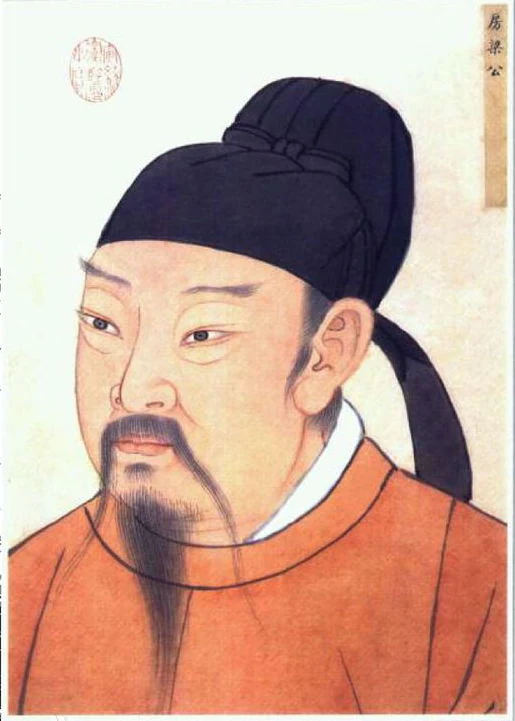
579 CE–648 CE
Tang Grand Councilor and statesman
Fang Xuanling
房玄龄
Fang Xuanling (579–August 18, 648), personal name Qiao and courtesy name Xuanling, was generally known by his courtesy name; his spirit-way stele, however, gives his personal name as Xuanling. During the Qing dynasty his name was also written Fang Yuanling to avoid the personal-name taboo of the Kangxi Emperor. A native of Linzi County in Qi Prefecture (present-day Linzi District, Zibo, Shandong), he was a leading Grand…
579 CE–648 CETang Dynasty
PROFILE
Fang Xuanling (579–August 18, 648), personal name Qiao and courtesy name Xuanling, was generally known by his courtesy name; his spirit-way stele, however, gives his personal name as Xuanling. During the Qing dynasty his name was also written Fang Yuanling to avoid the personal-name taboo of the Kangxi Emperor. A native of Linzi County in Qi Prefecture (present-day Linzi District, Zibo, Shandong), he was a leading Grand Councilor of the early Tang and one of the Twenty-four Meritorious Officials of the Lingyan Pavilion. Fang was especially known for planning and, together with Du Ruhui, gave rise to the expression “Fang plans, Du decides”; the two were regarded as exemplary ministers of the Zhenguan era. He assisted Emperor Taizong of Tang, Li Shimin, for more than twenty years, working tirelessly in government and contributing substantially to the establishment of the “Zhenguan era of good government.”
- Also known as
- Duke of Liang
- Courtesy name
- Xuanling
- Period
- Tang
- Date of Birth
- 579
- Date of Death
- August 18 648
- Dynasty / polity
- Tang
- Identity
- Tang Grand Councilor and statesman
- Ethnicity / people
- Not recorded in historical sources
- Ancestral origin
- Not recorded in historical sources
- Birthplace
- Linzi County, Qi Prefecture
- Place of death
- Not recorded in historical sources
- Highest office
- See “Life” and “Major Deeds”
- Major achievements
- A leading Grand Councilor of the Zhenguan era; renowned for strategic planning; paired with Du Ruhui in the saying “Fang plans, Du decides”
LIFE TIMELINE
Age eighteen | Recommended locally as a jinshi; appointed Feathered Cavalry Commandant and then magistrate of Xicheng County
Age thirty-nine | Joined Prince of Qin Li Shimin in the Weibei region, advising him and managing written affairs
Age forty-eight | Took part in the Xuanwu Gate Incident; ranked first in merit together with Du Ruhui, Zhangsun Wuji, Yuchi Jingde, and Hou Junji
Age forty-nine | Became Secretariat Director
Age fifty-one | In the second lunar month became Left Vice Director of the Department of State Affairs
Age fifty-nine | Enfeoffed as Duke of Liang
Age sixty-four | In the seventh lunar month promoted to Minister of Works while continuing to oversee state affairs
Age seventy | Died of illness on the guimao day, the 24th day of the seventh lunar month (August 18); posthumously named Wenzhao and granted the office of Grand Commandant
After his death | His second son Fang Yi'ai and Princess Gaoyang were accused of rebellion, and Fang Xuanling’s privilege of being enshrined in the imperial ancestral temple was revoked
BIOGRAPHY
Biography
Family Background and Early Years
Fang Xuanling came from an official family with a strong scholarly tradition. His great-grandfather Fang Yi, a grandson of Fang Fashou, served in Northern Wei as General Who Guards Afar and administrator of Song'an Commandery, and inherited the title Earl of Zhuangwu. His grandfather Fang Xiong, courtesy name Ziyi, served as a prefectural secretary. His father Fang Yanqian was devoted to learning, had mastered the Five Classics, and served under the Sui as magistrate of Jingyang County and Inspector of the Capital Region; he has a biography in the Book of Sui. This family background gave Fang Xuanling a strong education from childhood, while his natural intelligence made his talent evident at an early age.
In 595, the 15th year of the Kaihuang era, Fang Xuanling was eighteen. He was recommended locally as a jinshi and appointed Feathered Cavalry Commandant. Gao Gou, then Vice Minister of Personnel, had evaluated many men but considered none comparable to Fang and predicted that Fang would achieve extraordinary distinction, lamenting only that he himself would not live to see it. Fang was soon appointed magistrate of Xicheng County. As the Sui descended into disorder and rival powers arose, he judged that the dynasty’s fortunes were exhausted and resolved to seek a worthy ruler.
Joining a Ruler in an Age of Disorder and Service in the Prince of Qin’s Establishment
In 617, the 13th year of Daye under the Sui, Li Yuan and his sons rose against the dynasty. Fang Xuanling joined Prince of Qin Li Shimin in the Weibei region. Thereafter he became one of the prince’s key strategists, advising Li Shimin and managing documentary affairs. In the following years, Fang accompanied the prince on campaigns across north and south, including the major operations that defeated Xue Rengao, Liu Wuzhou, Dou Jiande, and Wang Shichong, and made important contributions to Tang unification.
During his service in the Prince of Qin’s establishment, Fang displayed not only military strategic ability but also notable political foresight. Recognizing Li Shimin’s great ambitions and willingness to recruit talented men, he served him wholeheartedly. Whenever a territory was taken, others competed to collect valuables, while Fang instead sought out talented people, recommending local strategists and commanders to Li Shimin and thereby helping build the prince’s pool of capable followers.
The Xuanwu Gate Incident and a Leading Grand Councilor of Zhenguan
In 626, the ninth year of Wude, conflict between Crown Prince Li Jiancheng and Prince of Qin Li Shimin intensified. Fang Xuanling and Du Ruhui strongly urged Li Shimin to act first and participated actively in planning the Xuanwu Gate Incident. On the fourth day of the sixth lunar month, Li Shimin launched the coup at Xuanwu Gate and killed Crown Prince Li Jiancheng and Prince of Qi Li Yuanji. Afterward Fang, Du Ruhui, Zhangsun Wuji, Yuchi Jingde, and Hou Junji were jointly ranked first in merit.
After Li Shimin became Emperor Taizong of Tang, Fang Xuanling served as Secretariat Director. In the second lunar month of 629, the third year of Zhenguan, he became Left Vice Director of the Department of State Affairs and oversaw state administration. In 637, the 11th year of Zhenguan, he was enfeoffed as Duke of Liang. In the seventh lunar month of 642, the 16th year of Zhenguan, he was promoted to Minister of Works while continuing to manage court affairs. During more than twenty years as a Grand Councilor, Fang worked conscientiously and fulfilled his duties with care, making major contributions to the political, economic, and cultural development of the early Tang and to the creation of the “Zhenguan era of good government.”
Later Years and Posthumous Events
On the guimao day, the 24th day of the seventh lunar month in the 22nd year of Zhenguan (August 18, 648), Fang Xuanling died of illness. He received the posthumous name Wenzhao and was posthumously granted the office of Grand Commandant. His posthumous fortunes, however, were unsettled. In 652, the third year of Yonghui under Emperor Gaozong of Tang, his second son Fang Yi'ai and Princess Gaoyang were accused of rebellion. Fang Yi'ai was executed, the princess was ordered to commit suicide, and their sons were exiled to Lingnan. Fang Xuanling’s heir Fang Yizhi was also implicated and demoted to county commandant of Tongling. Fang Xuanling’s privilege of being enshrined in the imperial ancestral temple was consequently revoked.
Family and Entry into the Qin Princely Household
Fang Xuanling, whose given name was Qiao and whose courtesy name was Xuanling, was a native of Linzi in Qizhou and came of the Fang clan of Qinghe; his father was Fang Yanqian, magistrate of Jingyang under the Sui. Clever from childhood, he read widely in the classics and histories, was skilled in cursive and clerical script and good at composition. At eighteen he passed the examination as a presented scholar and was made a cavalry commandant, collating books in the secretariat. The vice minister of personnel Gao Xiaoji, who was a good judge of men, saw him and thought him remarkable, saying that he had read many men but had never seen one like this youth, who must become a great vessel. When disorder rose at the end of Sui, Fang Xuanling entered the service of Li Shimin, becoming clerk of the household of the Prince of Qin and taking part in all counsels, great and small.
From Army Secretariat to Chancellor
For more than ten years in the household of the Prince of Qin Fang Xuanling held the office of secretary, and whenever there was a military dispatch or a memorial he would finish it standing by his horse, spare in words and rich in sense. Emperor Gaozu of Tang, Li Yuan, admired him greatly and told his attendants that this man understood the essentials deeply and could well be entrusted with heavy charge, and that whenever he spoke for the Prince of Qin he understood men's minds, so that a thousand li away was like speaking face to face. At the change at the Xuanwu Gate Fang Xuanling took part with Zhangsun Wuji and Du Ruhui. When Li Shimin took the throne he was created Duke of Liang and served successively as director of the secretariat, left vice director of the department of state affairs and minister of works, presiding over all the bureaus and holding the government for twenty years. He died in the twenty-second year of Zhenguan, 648; at the end Taizong came to his sickbed, took his hand in farewell and at once granted his son Fang Yiai the title of imperial son-in-law. His portrait was later placed in the Lingyan Pavilion, among the twenty-four founding meritorious ministers.
Family and Entry into Tang Service
Fang Xuanling's ancestral home was in Qizhou of that time, and his father Fang Yanqian was magistrate of Jingyang and a scholar of note, posthumously made commander of Xuzhou and Duke of Linzi with the posthumous name Ding; his great-grandfather Fang Yi had been general of distant defence under the Northern Wei and governor of Song'an commandery, holding the title of Baron of Zhuangwu. Fang Xuanling was clever from childhood, good at poetry and prose, widely read in the classics and histories, versed in the Confucian canon, and learned from his father a fine hand at calligraphy, being skilled in cursive and clerical script. At eighteen he was recommended by Qizhou as a presented scholar and was given successive offices including cavalry commandant. At the end of the Sui, when the realm fell into disorder and the Duke of Tang, Li Yuan, held Jinyang and led his troops into the passes, Fang Xuanling went over to Li Shimin north of the Wei river and was made clerk of the household of the Prince of Qin, recommending men of talent during the campaigns and taking part in plans as keeper of the records.
Ten Years in the Princely Household and the Xuanwu Gate
For more than ten years in Li Shimin's household Fang Xuanling managed the great matters of war and was charged with the household's dispatches; the papers of the household were finished at his horse's side, spare in words and complete in sense, with no draft needed. To repay Li Shimin's recognition he spent himself in planning military and civil affairs, and he drew in men of talent: seeing Du Ruhui to be spirited and resourceful, he recommended him to Li Shimin, who made him a chariot and cavalry general of the household of the Prince of Qin and entrusted him as a heart and backbone; and others of quick mind, such as Zhang Liang, were all brought to Li Shimin's use after Fang Xuanling recommended them and afterwards rose to the highest offices. In the planning of the change at the Xuanwu Gate Fang Xuanling took part, helping Li Shimin to win the throne, and Li Shimin praised him for planning within the tent and settling the altars of the state; when merit was rewarded, Fang Xuanling and four others were placed in the first rank, and for his merit he was advanced to be Duke of Xing.
The Chancellorship and the Fate of His House
In the second month of the third year of Zhenguan, 629, Fang Xuanling was transferred to be Duke of Wei; after Li Shimin took the throne he was created Duke of Liang and held the offices of director of the secretariat, left vice director of the department of state affairs and minister of works, presiding over all the bureaus and holding the government for twenty years, during which he was also charged to remain in the capital and manage all business. In the ninth year of Zhenguan, 635, he had charge of the rules for the burial of Emperor Gaozu and was advanced for his merit. In the eighteenth year of Zhenguan, 644, when Li Shimin went in person against Liaodong, Fang Xuanling remained in the capital. On the twenty-fourth day of the seventh month of the twenty-second year of Zhenguan, 648, Fang Xuanling died at the age of seventy; Li Shimin suspended court for three days and granted him posthumous honours, and in his lifetime he had been able to see his two sons rise to eminence. His wife was of the Lu family; when he was still poor and fell ill, she put out one of her own eyes to show her constancy, and when he was made Duke of Liang she became by custom Lady of Liang. In the third year of Yonghui, 652, his second son Fang Yiai and his wife Princess Gaoyang were accused of treason; Fang Yiai was put to death, the princess ordered to take her own life, his sons banished to Lingnan, and his heir Fang Yizhi degraded to commoner, and the sacrifices of Fang Xuanling in the imperial temple were therefore stopped.
Major Activities
Political Contributions
As the leading Grand Councilor of the Zhenguan era, Fang Xuanling directed state affairs for more than twenty years. He understood administration clearly while tempering it with cultivated learning; in discussing law and issuing orders, he strove for leniency and fairness. He did not judge others by his own strengths and did not demand perfection in selecting people; even those of humble status were allowed to use their abilities to the fullest. He was skilled at coordinating among different groups, helping produce a Zhenguan court rich in talent where people could make use of their strengths. Emperor Taizong once praised him: “Before Zhenguan, when I was building the realm, Xuanling’s contribution was decisive.”
Literary and Scholarly Contributions
Fang Xuanling supervised the compilation of the Book of Jin, one of the Twenty-Four Histories. Despite his high position as Grand Councilor, he personally directed the historical compilation, leaving an important cultural legacy. He also participated in the construction of a range of cultural institutions and helped advance cultural undertakings under the Tang.
Travels and Movements
In his early years Fang Xuanling accompanied Prince of Qin Li Shimin on campaigns across the empire, traveling through Guanzhong, Hedong, Henan, Hebei, and other regions. After becoming Grand Councilor he resided in Chang'an, but continued to think of his home region of Qi Prefecture. Records state that in his later years he submitted a memorial asking to retire and return home. Although permission was not granted, the request reflected his attachment to his native place.
Relations with Contemporaries
Fang Xuanling had a close friendship with Du Ruhui. Both were core strategists in the Prince of Qin’s establishment and later served together as Grand Councilors, cooperating so closely that contemporaries referred to them jointly as “Fang and Du.” He also maintained close relations with such Xuanwu Gate figures as Zhangsun Wuji, Yuchi Jingde, and Hou Junji. Fang was related to Li Xuandao. The Old Book of Tang and New Book of Tang record that Fang Xuanling was Li Xuandao’s maternal cousin’s son, while the Zizhi Tongjian reverses the relationship and states that Li Xuandao was Fang Xuanling’s maternal cousin’s son.
Arms, Government and the Choosing of Men
In all his campaigns, when a regional power was destroyed, the men of the army all sought treasure and rare things, but Fang Xuanling alone gathered men of talent first, placing the resourceful and the valiant in his secretariat and privately making friends of them, to serve Li Shimin together. He held the military secretariat and drafted memorials at his horse's side, and Li Yuan repeatedly admired him. In the Zhenguan years he governed with Du Ruhui, and it was said that in deliberation Fang Xuanling was good at planning and Du Ruhui at deciding, which history remembers as the planning of Fang and the deciding of Du.
Administration, Law and History
On the choosing of officials Fang Xuanling carried out Taizong's principle of apportioning office to ability and sparing the number of officials, holding that the disorder of administration was the root of the search for order and that the fairness and uprightness of officials was the great road of government; he therefore simplified government greatly and merged offices, so that the civil and military officials appointed came to six hundred and forty in all. For the early Tang, after the great disorder at the end of Sui and the sharp fall of population, this measure cut away redundant and useless posts, avoided the evil of ten shepherds for nine sheep, raised the efficiency of the departments of the court and at the same time spared the state's expenses and lightened the people's burden. He took part in framing the statutes, presided over the revision of the codes, ordinances and edicts, and in discussing law and deciding orders was always for leniency and fairness; he did not measure others by his own strengths and did not require men to be complete, so that even the lowly could do all that they were able. He also supervised the compilation of the national history, on which the statutes of a whole age rested. In the twenty-second year of Zhenguan, when he was dangerously ill, Fang Xuanling still sent up a memorial remonstrating and begging Li Shimin to stop the campaign against Koguryo out of care for the people of the realm; and Taizong, seeing the memorial, was moved and told his daughter-in-law, Princess Gaoyang, that the man was dying and could still care for his country, and came in person to his sickbed to take leave of him. The court historians said of him that he laboured night and day, gave himself wholly to the public service, could not bear that a single thing should be out of place, was free from envy, and took the good of others as if it were his own.
The Statutes and the Code
Fang Xuanling was deeply versed in the statutes and ordinances. In the early Zhenguan years, when the realm had just been settled and the court's rules and ceremonies were still far from complete, he and Du Ruhui governed together, and the scale of palaces and pavilions, together with the laws, rites, music, institutions and the things of worth left by earlier ages, were all fixed by the two of them, to great praise at the time; the edict appointing Fang Xuanling and Du Ruhui left and right vice directors of the department of state affairs is the instrument of that appointment. In revising the laws he held to the principle of examining and fixing the laws and orders with leniency and fairness as their aim, simplifying the code and removing the cruel punishments of the Sui; and after the codes, ordinances, regulations and forms were revised by Fang Xuanling and others, they underwent no great change throughout the Tang, laying the ground for the Tang code with its commentary. He also took part in revising the Tang rites and in adjusting the machinery of government, merging central offices. He held the government for more than twenty years and led the framing of the Tang institutions, and his portrait stands among the twenty-four meritorious ministers of the Lingyan Pavilion.
Supervising the Histories and Using Men of Worth
Fang Xuanling also had charge of the national history office and supervised the completion of the Book of Jin and other histories, and for long supervised the national history. He gave himself wholly and rose early and slept late; and being clear in administrative matters, lenient and fair in law, and using men of worth without regard to rank, giving office according to ability and not requiring men to be complete, he was called by his contemporaries a good chancellor. He was always deeply self-effacing and did not dare display himself, and as his daughter became Princess of Han and his sons rose to eminence he became the more retiring, repeatedly sending up memorials to state his wish to stop. Li Shimin said of him that in diligent service to the state and in knowing what should be done and doing it, he, the emperor, was not his equal; and again that Fang Xuanling had served him longest, was careful and cautious, and that of every secret stratagem he had been told, yet never a word had leaked, so that unless there were great cause he should not be cast off. A household matter of his also passed into common talk: Taizong once gave Fang Xuanling a beauty, and his wife would not accept her even at the cost of death, drinking what Taizong had in jest given as poison and finding afterwards that it was vinegar, whence jealousy came to be called drinking vinegar.
Personal Relations
- Great-grandfather: Fang Yi, Northern Wei General Who Guards Afar and administrator of Song'an Commandery; inherited the title Earl of Zhuangwu
- Grandfather: Fang Xiong, courtesy name Ziyi; prefectural secretary
- Father: Fang Yanqian, Sui magistrate of Jingyang County and Inspector of the Capital Region
- Wife: Lady Lu, known for a strong temperament and associated with the famous anecdote about “drinking vinegar”
- Eldest son: Fang Yizhi, Grand Master of Palace Accordance, acting Director of the Directorate of Education, Minister of Rites, and Duke of Liang
- Second son: Fang Yi'ai, married Princess Gaoyang and was later executed for rebellion
- Sons: Fang Yize, Fang Yicheng, Fang Yizhong, and Fang Yiyi
- Daughters: the eldest married Li Yuanjia, Prince of Han; the second married Zheng Renkai, Inspector of Bo Prefecture; the third married Wang Yue, Military Adjutant in the Left Gate Guard Command
- Gao Gou: Sui Vice Minister of Personnel who recognized Fang’s talent while he was still young and predicted that he would become a great man
- Du Ruhui: close colleague and friend; paired with Fang in the phrase “Fang plans, Du decides”
- Li Xuandao: relative; the sources give reciprocal descriptions of which man was the other’s maternal cousin’s son
- Emperor Taizong of Tang, Li Shimin: a celebrated ruler-minister partnership lasting more than twenty years
- Emperor Gaozong of Tang, Li Zhi: ruler assisted by Fang Xuanling late in Fang’s life
- Zhangsun Wuji: colleague and participant in the Xuanwu Gate Incident, later a regent minister
- Li Jiancheng and Li Yuanji: political opponents in the Xuanwu Gate Incident
- Fang Yi'ai and Princess Gaoyang: Fang’s second son and daughter-in-law; their rebellion case brought decline upon the Fang family
Historical Assessment
Tang / Contemporary
- Emperor Taizong of Tang, Li Shimin: “Before Zhenguan, when I was building the realm, Xuanling’s contribution was decisive.”
- Tang historian Liu Fang: “Xuanling assisted Taizong in settling the realm and remained in the highest ministerial office for thirty-two years; the empire called him a worthy minister, yet there was no visible trace by which his merit could be singled out—his virtue had reached the highest point. Thus, when Taizong settled disorder, Fang and Du did not claim the achievement; when Wang and Wei excelled in remonstrance, Fang and Du yielded the reputation to them; when Li Jing and Li Shiji excelled at commanding armies, Fang and Du enabled their policies to function. Government reached great peace, while credit was attributed to the ruler. How fitting that they were great ministers of the Tang!”
- The biography in the New Book of Tang: “When Xuanling governed the state, he labored diligently day and night, devoted himself to public duty, and did not wish a single matter to be left out of place. He was free of jealousy; when he heard of another’s excellence, he treated it as if it were his own. He understood administration clearly and adorned it with cultivated learning; in discussing law and issuing orders, he strove for leniency and fairness. He did not expect others to match his own strengths and did not demand perfection in choosing men; even those of humble status could fully use their abilities. When reprimanded over an affair, he would always bow his head and ask forgiveness, fearful and uneasy as though there were no place for him to stand.”
Song and Yuan Periods
- Song Qi, author of the New Book of Tang: “When Taizong settled disorder, Fang and Du did not claim the achievement; when Wang and Wei excelled in remonstrance, Fang and Du yielded the reputation to them; when Li Jing and Li Shiji excelled at commanding armies, Fang and Du enabled their policies to function. Government reached great peace, while credit was attributed to the ruler.”
- Sima Guang, Zizhi Tongjian: “Xuanling assisted Taizong in settling the realm and remained in the highest ministerial office for thirty-two years; the empire called him a worthy minister.”
- Ouyang Xiu: “Fang Xuanling and Du Ruhui were known to the age as worthy Grand Councilors, yet there was no visible trace by which their merit could be singled out; their virtue had reached the highest point.”
Ming and Qing Periods
- Wang Fuzhi, Du Tongjian Lun: “Fang Xuanling was to Taizong as Guan Zhong was to Duke Huan. His talent did not match Guan Zhong’s, but his virtue exceeded it.”
- Li Zhi: “Fang Xuanling was a worthy Grand Councilor of the Tang. His achievements were perhaps less conspicuous than those of Yao Chong and Song Jing, but his magnanimity and breadth showed the bearing of a great minister.”
- Zhao Yi, Notes on the Twenty-Two Histories: “In the Zhenguan era of good government the ruler was enlightened and his ministers worthy; Fang Xuanling, Du Ruhui, and the others were all among the finest men of their time.”
Modern Period
- Fan Wenlan, A Concise General History of China: “Fang Xuanling was the most capable Grand Councilor of the Zhenguan period. He was skilled at planning and also knew how to yield to others, making him an exemplary worthy minister of the imperial age.”
- Cen Zhongmian, History of the Sui and Tang: “Fang Xuanling and Du Ruhui were jointly praised as worthy Grand Councilors. Fang excelled at planning and Du at decision; each complemented the other, and together they made major contributions to the Zhenguan era of good government.”
- Qian Mu, Outline of Chinese National History: “The Tang dynasty’s Zhenguan era of good government depended greatly on the assistance of such worthy Grand Councilors as Fang Xuanling and Du Ruhui; their contribution cannot be overlooked.”
FIGURES ASSOCIATED WITH THIS DYNASTY
Bibliography
- Old Book of Tang, “Biographies of Fang Xuanling and Du Ruhui,” chapter 16
- New Book of Tang, “Biographies of Fang and Du,” chapter 21
- Book of Sui, “Biography of Fang Yanqian”
- Fan Wenlan, A Concise General History of China
- Cen Zhongmian, History of the Sui and Tang
- Qian Mu, Outline of Chinese National History