Birth | Born at Juxian, Beihai.
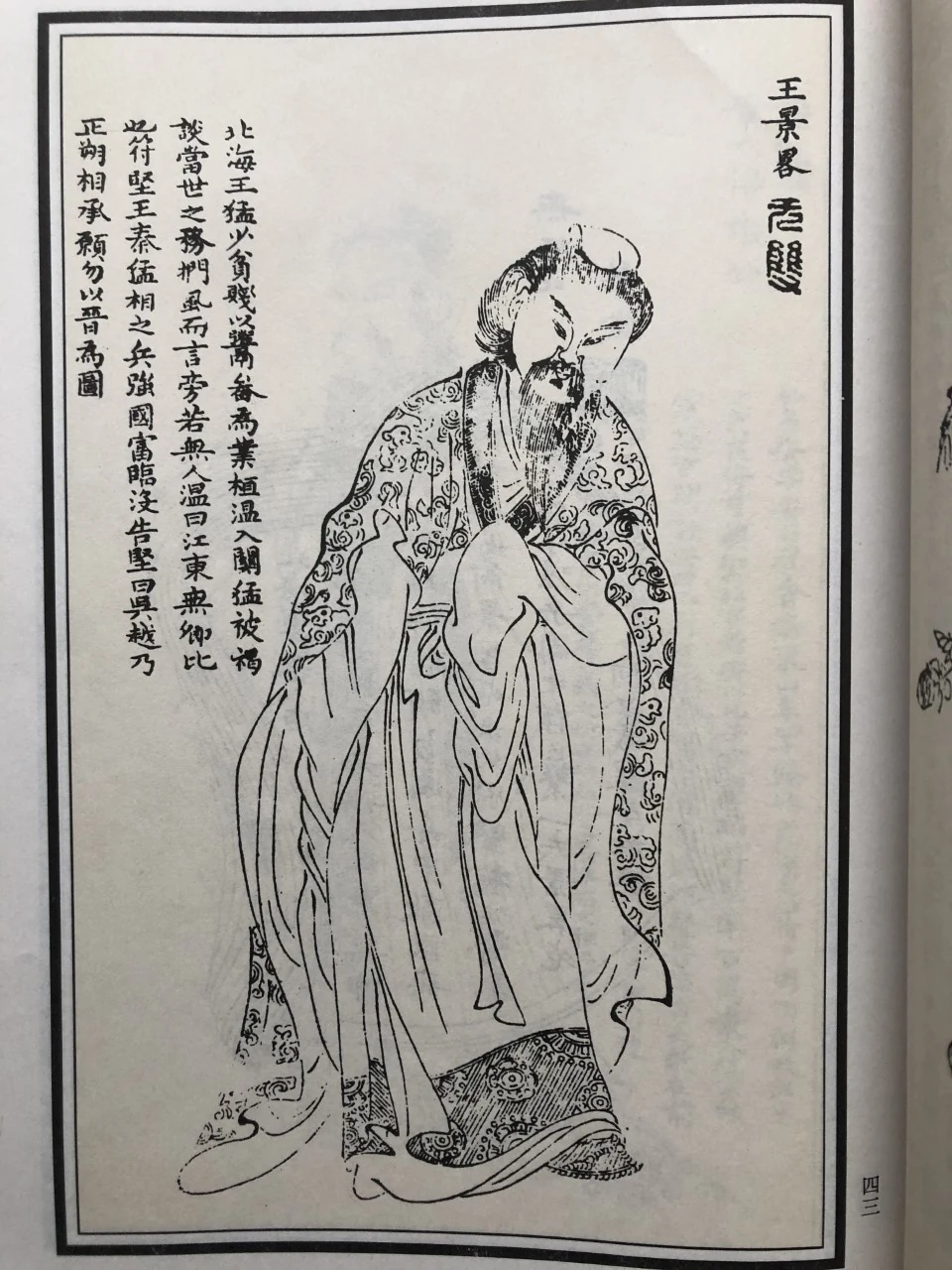
Statesman and military commander of the Sixteen Kingdomschancellor of Former Qin
Wang Meng
王猛
Wang Meng (325 – July 1, 375), courtesy name Jinglüe, a native of Juxian in Beihai Commandery (west of Changle, Weifang, Shandong) who later moved to Wei Commandery, was a major statesman and strategist of the Sixteen Kingdoms era, serving as chancellor of Former Qin with the title Marquis of Qinghe. Poor and obscure in his youth but broadly learned with a taste for military books, prudent and dignified, he lived as a hermit…
Former Qin
PROFILE
Wang Meng (325 – July 1, 375), courtesy name Jinglüe, a native of Juxian in Beihai Commandery (west of Changle, Weifang, Shandong) who later moved to Wei Commandery, was a major statesman and strategist of the Sixteen Kingdoms era, serving as chancellor of Former Qin with the title Marquis of Qinghe. Poor and obscure in his youth but broadly learned with a taste for military books, prudent and dignified, he lived as a hermit on Mount Huayin awaiting an enlightened lord. In 354, when Huan Wen's northern expedition reached Bashang, Wang Meng—"delousing himself as he talked"—discoursed on the affairs of the day and won Huan Wen's admiration; in 357, introduced by Lü Polou, he met Fu Jian and they took to each other at first sight, Fu Jian likening the encounter to Liu Bei finding Zhuge Liang. After Fu Jian proclaimed himself Heavenly King of Great Qin, Wang Meng served successively as Gentleman-Consultant of the Central Secretariat, Magistrate of Shiping, Vice Director of the Masters of Writing, Libationer of the Capital, Minister of Personnel, Vice Director, General Who Supports the State, and Libationer of the Capital Investigations, restoring law and order, crushing the magnates, and enriching the state. In 370 (the fifth year of Taihe) he commanded the army that destroyed Former Yan, winning 157 commanderies, 2.46 million households, and 9.9 million people in a single campaign. As chancellor for over eighteen years he was decisive in Former Qin's prosperity and the unification of the north; the Song Shu records that "when Wang Meng served as Fu Jian's chancellor, the northerners compared him to Zhuge Liang." He died of illness in 375 (the third year of Ningkang) with the posthumous name Wu, leaving a dying injunction not to attack Jin. He was enshrined in the Tang dynasty's Temple of War among the sixty-four generals, and in the Song among the seventy-two.
- Courtesy Name
- Jinglüe
- Era
- Sixteen Kingdoms (Former Qin)
- Ethnicity
- Han
- Place of Origin
- Juxian, Beihai Commandery (west of Changle, Weifang, Shandong), later moved to Wei Commandery
- Identity / Occupation
- Statesman and military commander of the Sixteen Kingdoms; chancellor of Former Qin
- Sovereign
- Fu Jian (Emperor Xuanzhao of Former Qin)
- Title
- Marquis of Pingyang, then Marquis of Qinghe (Qinghe Wuhou)
- Principal Offices
- Chancellor, Director of the Central Secretariat, Director of the Masters of Writing, Commander of All Military Affairs Within and Without
- Posthumous Name
- Wu ("Martial")
- Major Achievements
- Restored law and discipline, curbed the magnates, enriched and strengthened the state; quelled the Five Lords' revolt; destroyed Former Yan, winning 157 commanderies and 2.46 million households in a single campaign
- Date of Birth
- 325 CE(3rd year of the Taining era, Eastern Jin)
- Date of Death
- 375 CE(11th year of the Jian era, Former Qin)
LIFE TIMELINE
Retired on Mount Huayin awaiting an enlightened lord. | Retired on Mount Huayin awaiting an enlightened lord.
Met Huan Wen | Met Huan Wen, delousing while discoursing; declined to go south.
Aided Fu Jian's coup via Lü Polou's introduction | Aided Fu Jian's coup via Lü Polou's introduction; Gentleman-Consultant of the Central Secretariat.
Magistrate of Shiping | Magistrate of Shiping, Libationer of the Capital, and more; restored law and crushed the magnates.
Subdued Li Yan and the Five Lords' revolt. | Subdued Li Yan and the Five Lords' revolt.
Destroyed Former Yan | Destroyed Former Yan, winning 157 commanderies and 2.46 million households.
Chancellor commanding the six eastern provinces at Ye. | Chancellor commanding the six eastern provinces at Ye.
CE(5th year of the Taihe era, Eastern Jin; 5th year of the Jianyua
369 CE(5th year of the Taihe era, Eastern Jin; 5th year of the Jianyuan era, Former Qin) | Died at Chang'an | Died at Chang'an, leaving a dying injunction against attacking Jin; posthumous name Wu.
Destruction of Former Yan | He commanded Former Qin forces in taking Huguan and Jinyang and defeated the main Former Yan army at Luchuan, then took Ye and ended Former Yan.
Chief ministership | He was promoted to Chancellor, Director of the Palace Secretariat and President of the Department of State Affairs, and gradually took overall command of military affairs at home and abroad.
Later years | During his final illness he memorialised Fu Jian to guard the realm prudently and not attack Jin; he died in Chang'an in the seventh month of the same year and was given the posthumous name Marquis Wu.
BIOGRAPHY
Biography
Years of Retirement
Wang Meng was born in 325 (the third year of Taining of Emperor Ming of Eastern Jin); his ancestors were the Tian clan of Qi, who took the surname Wang after the Qin unification. Poor and of low station in his youth, he was nevertheless broadly learned and loved books of strategy; prudent, dignified, and indifferent to trifles, he kept few friends and was despised by the gentry of the day—he cared not at all. In the Zhao capital Ye only Xu Tong recognized his worth and offered him a post as Merit Officer, but Wang Meng withdrew to Mount Huayin to live in retirement, cherishing the ambition to aid a true lord in bringing great order to the realm.
In 349, Shi Hu, the Martial Emperor of Later Zhao, died; the Zhao throne changed hands five times in three years and the state perished, and the champions contended for the Central Plains.
Meeting Huan Wen
In 354 (the tenth year of Yonghe), the Jin General Who Conquers the West, Huan Wen, marched north with forty thousand foot and horse, smashed Former Qin at Lantian, and advanced to Bashang southeast of Chang'an. Wang Meng went to see him, picking lice as he discoursed on the great affairs of the day as though no one else were present. Astonished, Huan Wen asked why none of the worthies of the Three Qins had come to pay homage; Wang Meng replied: "You have come a thousand li deep into enemy territory, yet with Chang'an within reach you will not cross the Ba River—the people have not seen your resolve, and so they do not come." Huan Wen was silenced and could only say: "Jiangdong has no man like you." When lack of grain forced Huan Wen to withdraw, he appointed Wang Meng a high commandery commissioner and asked him to return south; Wang Meng consulted his master on Mount Huayin, who said: "How could you and Huan Wen share one age? Here you may win wealth and honor—why seek it afar?" Wang Meng declined.
Minister to Fu Jian
In 357 (the first year of Shengping), the tyranny of the Qin emperor Fu Sheng moved the renowned Prince of Donghai, Fu Jian, to depose him; on the recommendation of the Minister Lü Polou, Wang Meng was brought to him. The two took to each other at once, and Fu Jian, having discoursed with him, likened himself to Liu Bei meeting Zhuge Liang. In the sixth month Fu Jian deposed and killed Fu Sheng and proclaimed himself Heavenly King of Great Qin, appointing Wang Meng Gentleman-Consultant of the Central Secretariat to manage the secrets of state.
As the Di magnates terrorized Shiping, northwest gateway to Chang'an, Wang Meng was made its magistrate; he promulgated the law, applied stern punishments, distinguished good and evil, and crushed the magnates. For flogging an official to death he was indicted and imprisoned, and Fu Jian asked why he had not taught with virtue but governed with harsh law; Wang Meng explained that "one governs a peaceful state by ritual and a disordered state by law," and that the man he had killed was but one of tens of thousands of the wicked. Fu Jian told his court: "Jinglüe is truly a Guan Zhong, a Zichan!" and pardoned him. In the twelfth month, for his good management of the archives and his merits at Shiping, Wang Meng rose to Vice Director of the Masters of Writing, thereafter serving as Controller of Xianyang, Palace Attendant, Director of the Central Secretariat, Libationer of the Capital, Minister of Personnel, Grand Steward of the Heir, Vice Director, General Who Supports the State, and Libationer of the Capital Investigations. The Di elder statesman Fan Shi, insolent in his merits, publicly humiliated Wang Meng, and Fu Jian had him put to death on a pretext—the Di were awed. As Libationer of the Capital Wang Meng arrested and punished the lawless magnates such as Qiang De, brother of the empress dowager; within ten days the powerful kept to the paths and lost goods were left unclaimed on the roads. Fu Jian sighed: "Only now do I learn that the realm has law!"
The Campaigns
In 366 (the first year of Taihe) Wang Meng campaigned against the Qiang rebel Lian Qi of Longxi; in 367 he subdued Li Yan and joined Yang An and others in taking Lüeyang. In 368 (the third year of Taihe), when the imperial princes Fu Liu, Fu Shuang, Fu Sou, and Fu Wu rebelled (the revolt of the Five Lords), Wang Meng and the other generals suppressed it by separate routes; he then pacified the tribes of the western marches.
In 369 (the fourth year of Taihe), Huan Wen of Jin invaded Former Yan, which appealed to Qin, promising to cede the lands west of Hulao; after the Qin-Yan forces defeated the Jin army the Yan reneged, and Fu Jian sent Wang Meng against Yan. In 370 (the fifth year of Taihe), with sixty thousand foot and horse Wang Meng drove deep into Yan territory, crushed the Yan army of four hundred thousand at Luchuan, took Ye, and captured the Yan ruler Murong Wei—destroying Former Yan and winning in one campaign 157 commanderies, 2.46 million households, and 9.9 million people.
The Chancellorship
Wang Meng rose to chancellor, Director of the Central Secretariat, and Commander of All Military Affairs Within and Without, administering the government of Former Qin for more than eighteen years. Within, he restored law and discipline, selected the worthy, built waterworks, and curbed the great clans to strengthen central authority, so that Guanzhong's fields were tilled and its treasuries full and Former Qin flourished. Fu Jian told the crown prince: "Serve Lord Wang as you would serve me."
In 372 (the second year of Xian'an), as chancellor he commanded all military affairs of the six eastern provinces, as General of Chariots and Cavalry and Governor of Jizhou with the honors of opening offices, garrisoning Ye, simplifying government and comforting the people.
Dying Yet Anxious for the State
In the sixth month of 375 (the third year of Ningkang), gravely ill, Wang Meng memorialized his last injunctions: Jin, though remote among Wu and Yue, held the legitimate succession—"to cherish the good and befriend one's neighbors is the treasure of a state; after I am gone, I pray Your Majesty will not scheme against Jin. The Xianbei and the Qiang are our foes and will be our peril in the end; remove them by degrees." He died at Chang'an in the seventh month. Fu Jian visited his coffin three times, telling the crown prince: "If Heaven did not wish me to unify the world, why did it take my Jinglüe so soon?" His posthumous name was Wu.
Eight years after Wang Meng's death, Fu Jian, ignoring the dying injunction, launched the Battle of Fei River and was crushingly defeated, and Former Qin fell apart—men of the age marveled at Wang Meng's foresight.
His Birth, Poverty and Retirement
Wang Meng, courtesy name Jinglüe, was a man of Ju in Beihai and lived at Weijun. In youth he was poor and low and earned his living by selling winnowing baskets. Once when he was selling baskets in Luoyang a man wished to buy them at a high price but said he had no money with him and asked Wang Meng to come to his house for the price; and Wang Meng, taken by the high price, went with him, and not noticing how far they went, suddenly came into deep mountains and saw an old man with white hair and beard sitting on a folding chair with some ten attendants about him, and one of them led Wang Meng in to bow. The old man said, "Why should the lord Wang bow?" and then paid him ten times the price of the baskets and sent men to see him off; and when Wang Meng had come out and looked back he saw it was Mount Song. Wang Meng was of noble figure and fine appearance, widely learned and fond of books of war, careful, grave and firm, of a spirit lofty and far, and small matters did not disturb his thoughts; and unless a man touched his spirit he would scarcely associate with him at all, so that the showy scholars all slighted and laughed at him, while Wang Meng was easy and unconcerned and took it not to heart. In youth he travelled to the capital of Ye and few of the men of the time could recognize him; only Xu Tong saw and thought him strange and called him to be clerk of merit, but he fled and would not answer, and hid himself on Mount Huayin, cherishing the will to aid the age and hoping for a lord with a dragon's countenance, folding his wings to await the hour and to move when the wind and clouds came.
Brushing the Lice, Talking of the Realm, and Huan Wen
When Huan Wen entered the passes Wang Meng, in a short coat of coarse cloth, went straight to Huan Wen's camp to seek an audience, and at the first meeting talked of the affairs of the day, brushing the lice from him as he spoke, as if no one were by. Huan Wen watched him and thought him strange, and asked how it was that he, having the Son of Heaven's command and leading a hundred thousand picked troops to punish the rebels on behalf of the people, found no hero of the three Qin coming to him. Wang Meng answered bluntly that Huan Wen had come thousands of li into the enemy's country, and that Chang'an was within a foot and he did not cross the Ba river, so that the people had not seen his heart and therefore did not come. Huan Wen was silent and had no answer. He had meant to gather army grain on the spot when the wheat ripened, but the Qin troops cut down all the wheat and cleared the country, so that the army went short of food and the men lost heart, and the army was beaten back at Bailuyuan by Fu Xiong, the prince of Donghai of the Former Qin, and he had to withdraw. Before going he gave Wang Meng a fine carriage and good horses and the high office of commander, and asked him to come south with him. But Wang Meng thought that in the Eastern Jin court held by the great clans he could do little, and that to follow Huan Wen would be to help him usurp the Jin and would stain his clean name; and he went back to Mount Hua to consult his teacher, who said that he and Huan Wen were not of the same age, and that here he might be rich and honoured of himself, so why go far; and so Wang Meng stayed and went on reading in retirement.
Fu Jian's Recognition and the Magistracy of Shiping
Fu Jian had great designs and, hearing of Wang Meng's fame, sent Lü Polou to summon him; and at the first meeting they were as friends of a lifetime, and speaking of the great matters of rise and fall they were as tally and seal, like Xuande meeting Kongming. When Fu Jian usurped the throne he made Wang Meng gentleman of the secretariat. At that time Shiping was full of the people who had come west from Fangtou, with strongmen running riot and robbers everywhere, and so Fu Jian made Wang Meng magistrate of Shiping. Wang Meng on arrival made the law clear, punished severely, examined good and evil and restrained the powerful; and there was an old and deep-rooted wicked clerk of much evil whom he had beaten to death in public. The people memorialised against him and the office concerned asked that he be punished, and he was brought back in a prison cart and given to the commandant of justice for trial. Fu Jian, hearing of it, questioned him himself, saying that in government virtue and transformation came first, and asking how it was that in so short a time he had killed so many, and how cruel this was; and Wang Meng answered calmly that he had heard that one governs a settled state by the rites and a disordered state by law; that the emperor had not thought him useless but had given him a difficult district, and that he had meant with all his heart to cut away the fierce and cunning for a wise lord, and that having killed one villain there were still tens of thousands; that if the emperor would punish him for failing to root out all cruelty and clear away all lawlessness he would willingly accept the cauldron to atone for betraying his trust, but that as matters stood he dared not accept the charge of cruel government and the punishment. Fu Jian, hearing it, both sighed and praised, and told the civil and military ministers present that Wang Jinglüe was indeed of the company of Yiwu and Zichan; and so he pardoned him.
Five Promotions in a Year and the Striking down of the Powerful
Wang Meng was made left assistant of the secretariat, internal historian of Xianyang and governor of the capital region, and presently master of personnel and junior tutor of the heir apparent, and then left vice-president of the secretariat, general who supports the state, and colonel of the capital, with the rank of cavalry commandant, attending the palace within. Wang Meng was then thirty-six, and in one year was promoted five times, his power leaning against all within and without, and the imperial kin and old ministers all envied his favour. The master of the secretariat Qiu Teng and the chief secretary of the chancellor Xi Bao slandered and belittled him several times, and Fu Jian, greatly angered, dismissed Qiu Teng as protector of the Gansong troops and made Xi Bao chief secretary in white, and thereafter high and low all submitted and none dared speak. Presently Wang Meng was made master of the secretariat and grand tutor of the heir apparent with the rank of cavalier attendant in ordinary, and though he memorialised again and again declining, Fu Jian would not allow it; and he was made minister over the masses and president of the secretariat, but Wang Meng declined on the ground that he had no merit and would not accept. At that time there were in the court a group of Di grandees who, relying on kinship with the imperial house or on service to the dynasty, held the key posts and acted at will without law, and Wang Meng aimed at them first. The grandee of brilliant emolument Qiang De was the empress dowager's brother and by his power oppressed the good people and seized their wealth, doing every evil, and Wang Meng at once arrested him and had him put to death before he could memorialise, so that when Fu Jian, for the empress dowager's sake, sent a messenger at full gallop with a pardon, Qiang De had long since been exposed in the market. Close after, Wang Meng with the assistant censor-in-chief Deng Qiang worked together to examine thoroughly the ministers who harmed the people and disordered the government, and in a breath, without scruple, swept away more than twenty of the powerful who had run lawless, so that the hundred officials were shaken into order, the strongmen held their breath, nothing dropped on the road was picked up, and orders were obeyed and prohibitions kept. Fu Jian sighed that only now did he know that the realm had law and that the Son of Heaven was honoured. Fan Shi, who had merit with the Fu house, was the first to leap out and insult Wang Meng in public, saying that they had risen in the great work with the late emperor and yet had no share in the government of the time, and asking by what merit Wang Meng, without sweat of horse, presumed to manage great affairs; and Wang Meng sneered that not only should Fan Shi sow but he should also be made to cook for him. Fan Shi flew into a rage and stamped and roared that he would hang Wang Meng's head on the gate of Chang'an or not live in the world; and Fu Jian, hearing it, said firmly that this old Di must be killed before the hundred officials could be set in order, and had him put to death. Qiu Teng and Xi Bao and their like used their office to slander Wang Meng again and again, and Fu Jian drove the two from the court; and to the Di officials great and small who spread tales he even gave blows and kicks in open hall, so that they were afraid and dared speak no more nonsense.
The System of Recommendation, Reward and Punishment, and the Use of Men
While exacting punishment for guilt, Wang Meng also strove that talent should always be employed. Before taking up such new offices as colonel of the capital he had strongly recommended a group of serving officials and famous scholars east of the pass for office in the court or as governors and magistrates. From his own experience Wang Meng knew well how talent is envied, and so, like Fu Jian, he protected the worthy and used ability without suspicion: a man clever and clear, of civil and military excellence, good at deciding hard cases and of far sight, who was uneasy over a small fault, Wang Meng pardoned and did not question, trusting him as before; and a minister of Yan who after the fall of his state would not bend his will and so had not been employed, Wang Meng, not shunning suspicion, recommended to be his own important subordinate. Those, on the other hand, who were unfit in office he threw away like a rotten rat. Wang Meng understood that the problems of administration and employment could only be solved by institutions, and he helped Fu Jian to found the system of recommendation with reward and punishment and new standards for assessing officials: the local officers were to recommend by categories men known for filial piety and brotherly love, for honesty and uprightness, for letters, and for affairs, reporting them to the centre; the court was to examine each and give office to those found fit; where the men recommended answered to their name the recommender was rewarded, and where not, punished; and every officer whose yearly stipend was a hundred shi of grain or more must master one classic and perfect one art, and those who did neither were to be dismissed to the people. These provisions struck heavily at the nine-grade system, long the tool of the great clans' monopoly of government, and denied the backward notions of many Hu warlords of the Sixteen Kingdoms who trusted in arms and despised learning; they effectively raised the quality of the state's officers at every level, so that a new state of things in which talent was fully used and office matched the man came daily into being; and the manners and peace of society changed with them, bribery and private requests and wilful disorder dying away while the sense of honour and the zeal to learn and work flourished.
The Four Dukes' Rebellion and the Advance on Luoyang
In the fifth month of the second year of Jianyuan of the Former Qin certain tribes submitted one after another; in the seventh month of that year Wang Meng led troops against the commanderies north of Jingzhou of the Eastern Jin, won the first battle and carried off more than ten thousand households north; and in the second month of the next year he put down a rebellion. Earlier Wang Meng had advised Fu Jian to remove Fu Liu and the others, and Fu Jian, unwilling to harm his brothers, had not listened; and now they rose at once with a threatening air, boasting that they would take Chang'an at a blow. In the spring of the next year Wang Meng with the generals went against them, and Fu Sou, hearing of it, went so far as to surrender Shancheng to Yan and ask for troops to help him attack Qin; and Fu Jian ordered the eastern armies to camp thirty li from the city, hold their walls and not fight, until the rebels of Qin and Yong were put down. Wang Meng with seven thousand picked troops ambushed Fu Liu's army, which was beaten and fell back only to be ambushed again by Wang Meng's whole force, so that of twenty thousand men only Fu Liu with several hundred riders got into Puban and the rest were all taken; and presently Wang Meng's army broke Puban, Fu Liu's head was cut off, and the other three dukes were taken or killed. With the four dukes' rebellion put down, the Former Qin cleared the obstacles on the road to the central plains and prepared eagerly to destroy its strong neighbour the Former Yan. When the ministers opposed saving Yan, Wang Meng secretly advised Fu Jian to send troops first to drive back the Jin with Yan, and then to take Yan when it was weak, which was the plan of saving first and taking after, for otherwise, if Huan Wen held the central plains, Qin's great affair was lost; and Fu Jian agreed and sent troops to save Yan. In the ninth month of that year the Yan and Qin armies beat the Jin utterly, killing more than forty thousand, and Huan Wen fled in confusion; and afterwards Yan broke the agreement and gave Qin no land, which gave Qin a pretext for attacking Yan. In the twelfth month Wang Meng led thirty thousand troops against Yan, and in the first month of the next year the Qin army took Luoyang, the western stronghold of the Former Yan, and Wang Meng sent a general to drive off the prince of Le'an of Yan. In the first month of the sixth year of Jianyuan Wang Meng led thirty thousand against Yan and came to Luoyang, where he set out the case and won over the defending general, and then broke the Yan army heavily at Shimen and Xinle, withdrawing for want of grain; and in the fourth month of that year he led sixty thousand against Yan again, and Fu Jian himself came to Bashang, gave him the imperial sword and entrusted him with full powers.
The Destruction of the Former Yan
The Qin army pressed on the Huguan pass, and the lord of Yan called up three hundred thousand men to meet them; but Wang Meng moved so swiftly that the Yan army had not arrived when he had taken Huguan, and the neighbouring commanderies and counties surrendered one after another, so that the Yan army, hearing of it, halted at Luchuan. Wang Meng left part of his troops to hold Huguan and led picked men against Jinyang; and Jinyang being high-walled and deep-moated, Wang Meng had his soldiers dig a tunnel by night into the city and took it at a blow, then returned to Luchuan against the main Yan army. The Yan commander Murong Ping held that the Qin army, deep in enemy country, could not last, and so kept to his walls and would not fight, meaning to wear the Qin out; but Wang Meng, having found his intent, sent a general with five thousand men round behind the Yan camp to strike at their baggage. The Yan were unprepared and in their sudden confusion abandoned camp and fled, and the Qin burnt all their baggage, the flames reaching the sky so that the people of Ye saw them; and so Murong Ping was forced to fight. On the morning of the battle Wang Meng swore his troops before the lines, saying with passion that he, Wang Jinglüe, had received the state's great favour and held high office within and without, and that now with them he had come deep into the enemy's land; that they should strive to the death, advance and not retreat, and together win great merit to repay the state; and that if they could overcome the enemy they would receive rewards and titles in the court of a wise lord and feast and drink in their parents' houses, than which nothing could be more glorious. His words, like fire, kindled the blood of the officers and men, and they all leapt up, broke the cauldrons and threw away the grain, and shouting rushed forward. It is recorded that Wang Meng had sent Xu Cheng to observe the Yan array and find its weakness, and Xu Cheng returned at dusk, far past the noon fixed, and by the military law should have died; and the assistant censor-in-chief Deng Qiang insisted that Xu Cheng be spared and asked to atone in battle, but Wang Meng would not allow it, and Deng Qiang, not getting his way, went back to his camp and set his troops in order to attack Wang Meng; and Wang Meng, seeing that Deng Qiang had courage and also honour toward his comrade, made an exception and pardoned Xu Cheng, praising Deng Qiang for being so faithful to an officer of his own commandery and asking what he would not do for the state, and saying that he had no more fears for the enemy. Before the battle Deng Qiang asked that after it he be given the office of colonel of the capital, and Wang Meng, finding it hard, said nothing; and Deng Qiang went back to his tent and covered his head and slept, and Wang Meng galloped into his camp and granted the condition; and Deng Qiang, delighted, leapt up, seized the wine jar and drank deep, then mounted and couched his lance and with the fierce generals Xu Cheng and Zhang Hao hurled himself at the enemy array, charging back and forth as if into an unpeopled land. By noon the Yan army was utterly beaten with more than fifty thousand lost, and Wang Meng followed up the victory and destroyed more than a hundred thousand more. Murong Ping fled alone to Ye, and the remnant of the Yan army scattered. Wang Meng led his army east and besieged Ye; and the country about Ye, where robbers had once swarmed, became quiet near and far, for Wang Meng's orders were strict and none of his officers or men dared touch the people, and his laws were simple and his government mild, so that the people of Yan rejoiced and told one another, and in the eleventh month of that year Fu Jian came in person with a hundred thousand picked troops to join him and the ministers of Yan opened the gates and surrendered. After the destruction of the Former Yan Fu Jian raised Wang Meng's rank and enfeoffed him as marquis of Qinghe, gave him Murong Ping's mansion and bestowed on him fifty-five concubines and singing girls, a hundred good horses and ten fine carriages, all of which Wang Meng firmly declined. Afterwards he chose the worthy, raised the able, swept away the old and brought in the new, steadied men's hearts and enlarged production, so that the people of the six provinces of the old Yan land were as seedlings in drought meeting rain; and he entered the court as chancellor and commander of all military affairs within and without. Under his direction the Qin realm was peaceful and every household well provided, and the people sang that in the great street of Chang'an the poplars and locusts were green, that fine carriages ran below and phoenixes perched above, and that the talented gathered like clouds to teach the people.
His Illness and Death
In the sixth month of the eleventh year of Jianyuan Wang Meng fell ill. Fu Jian prayed for him in person and sent his attendants to pray at the famous mountains and great rivers; and it happened that Wang Meng mended, at which Fu Jian was overjoyed and proclaimed an amnesty for all below the death penalty. Wang Meng memorialised that he had not thought the emperor would impair the virtue of Heaven and Earth for the poor life of a humble servant, such as had never been since Heaven and Earth were parted, which made him both grateful and uneasy; that he had heard that the best way to repay kindness was to speak out and remonstrate, and that he would offer his dying sincerity; that the emperor's majesty shook the eight far regions and his fame and virtue shone within the six directions; that of the nine provinces and hundred commanderies seven parts in ten were his, and that the pacification of Yan and Shu was like picking up grass; and yet that a good maker was not always a good finisher, nor a good beginner a good ender, and that the wise kings and sage lords of old, knowing well how hard it is to begin and to keep, were all trembling as on the brink of a deep gulf; and he begged the emperor to take them as his model, for which the realm would be fortunate. In the seventh month of that year, when Fu Jian saw that Wang Meng was dying, he quickly asked him of his after-affairs; and Wang Meng opened his eyes, looked at Fu Jian and said that Jin, though tucked away south of the Jiang, carried the legitimate succession and was at peace above and below, and that after his death the emperor must on no account set his mind on destroying Jin; and that the Xianbei and the western Qiang, subdued lords whose treacherous hearts were not dead, were the enemies of their state and would in the end be its calamity, and should be gradually removed for the good of the altars of state; and having said this he stopped breathing. Fu Jian came three times to the coffin to sacrifice and wept bitterly, and told the heir apparent that Heaven did not mean him to unite the realm, or it would not so soon have taken his Jinglüe away. And he buried Wang Meng with the highest honours and gave him the posthumous name of marquis Wu; and the cries of mourning of Qin rose to the fields and did not cease for three days.
Major Activities
Reforming the Administration and Selecting Talent
While serving at Shiping, Jingzhao and elsewhere Wang Meng used strict enforcement of the law to bring the powerful and local disorder to order; the histories also record his recommendations of talent and his handling of official assessments and local appointments. These deeds show that he made legal enforcement and the appointment of officials an important part of Former Qin government, though the whole body of institutions later summarised by historians should not be attributed to him alone.
Suppressing Revolts and Campaigns in the West
Wang Meng took part in Former Qin campaigns against the Qiang and the Former Liang and in 368 (4th year of the Jianyuan era) joined the generals in putting down a revolt of Fu family clansmen. Such military actions maintained Fu Jian's control of Guanzhong and the west and created the conditions for the Former Qin's later expansion eastwards.
Conquering the Former Yan
In 370 (6th year of the Jianyuan era) Wang Meng led troops to take important cities of the Former Yan, defeated its main force at Luchuan and went on to capture Ye. After the fall of the Former Yan the Former Qin obtained most of its territory. This campaign was the most important action of Wang Meng's military career and markedly extended the Former Qin's rule in the north.
His Rule by Law and His Even-handed Government
Wang Meng in government set his weight on ruling by law, rewarding good and punishing evil, so that he dared put to death even so great a man as Qiang De, while men of talent he would raise; and he drew near to the poor and the suffering, so that at his death the people of the Qin realm wailed without ceasing. He set weight also on requiting good and evil, repaying the smallest kindness and also the smallest grudge, so that some of his time blamed him for it. His government was called even-handed; he decided matters firmly and worked with dispatch, never dragging things out. Ma Si of Guangping, an official in the passes, having lost his mother at home, asked leave to bury her in his native place, and Wang Meng told him he might set out at once, for he had already made the arrangements; and by the time Ma Si had passed the Tong pass the offices along the road had all received notice and were examining his papers and arranging his food and lodging. In Wang Meng's government Fu Jian let him decide all matters military and civil within and without while he himself sat with folded hands in the hall; and he told Wang Meng that he toiled night and day and grieved over ten thousand matters as King Wen had done when he got the grand duke, so that Fu Jian himself might take his ease to the end of his years. And he often charged his heir apparent Hong and the duke of Changle, Pi, and the others that they should serve the lord Wang as they served him. Under the joint rule of Fu Jian and Wang Meng the Former Qin became the most vital of the states and dared contend with the heroes, growing stronger with every war, so that in ten years it united the north.
The Winning over of Liangzhou and the Affair of Murong Chui
The Former Qin had once taken the Liang general Yin Ju with five thousand armoured men, and Wang Meng sent them home, carrying a letter in his own hand to Zhang Tianxi. In the letter Wang Meng drew on past and present and set out clearly the general situation and the perilous state of Liang, urging Zhang Tianxi to turn back from his course; and Zhang Tianxi, greatly afraid, lost his appetite and sleep and at last made his submission and acknowledged himself a vassal. Afterwards the Qifu tribe of the Xianbei was also brought to submission by a famous Qin general. Before Murong Chui came over to the Former Qin, Wang Meng had been much on his guard against him, telling Fu Jian that Murong Chui and his son were as dragon and tiger and could not be tamed, and that if they should one day borrow the times they could not be controlled, so that it were better to remove them early; but Fu Jian refused. And when Wang Meng set out in the fifth year of Jianyuan against Luoyang, Murong Chui, drinking with Wang Meng, gave him his own sword; and because of the affair of Murong Chui's eldest son Murong Ling, Wang Meng memorialised that Murong Ling would rebel and return east to Qin, which frightened Murong Chui into fleeing to Lantian; but Fu Jian brought him back and punished him not at all, still treating him well; while Murong Ling was never trusted by the Former Yan and at last rose in arms, was defeated and killed.
The Revival of Learning and His Memory Afterward
Under Fu Jian and Wang Meng the Former Qin restored the imperial college and the schools of every level throughout the realm, built halls of learning widely, engaged scholars to teach and compelled the sons and grandsons of the ministers and below to enter school; and Fu Jian himself came once a month to the imperial college to examine the students in the meaning of the classics and grade them, and discoursed on learning with the erudites and instructors, so supervising the schools and widening his appeal. Wang Meng, a Chinese, serving the Former Qin with all his loyalty and being to Fu Jian a minister in name and a brother in truth, set a good example of the union of the Di and the Chinese; and the Former Qin established the policy that the common people should be soothed and the barbarians reconciled, the several peoples dwelling together and blending, and when someone advised driving all the Di of the northwest into the capital and expelling the great families of the passes to the frontier, Wang Meng advised Fu Jian to put the man to death. Posterity judged Wang Meng very highly: in the third year of Jianzhong the Tang emperor Dezong, on Yan Zhenqing's advice, made posthumous grants to sixty-four ancient generals and set up a shrine for their offerings, among them Wang Meng, chancellor of Fu Qin; and in the fifth year of Xuanhe the Song house, following the Tang precedent, set up a shrine to the generals of antiquity, and among the seventy-two was still Wang Meng, chancellor of Fu Qin.
Personal Relations
- | Relation | Person | Notes |
- |---| --- |---|
- | Son | Wang Yong | Left chancellor of Former Qin, Duke of Qinghe |
- | Son | Wang Pi | Cavalier Attendant of the Retinue |
- | Sons | Wang Xiu, Wang Yao | |
- | Daughter | Lady Wang | Married Wei Pi, Marquis of Gaomi and General Who Pacifies the Far Reaches of Northern Wei |
- | Great-great-grandson | Wang Zhen'e | Famed general of Liu Song, marched north with Liu Yu |
Historical Assessment
Prudent and dignified, rigorous in law and impartial in reward and punishment, he held that "one governs a peaceful state by ritual and a disordered state by law"; frugal in life, he held no private estate. His contemporaries likened him to Guan Zhong and Zichan, and posterity to Zhuge Liang.
"Delousing While Discoursing" (Men Shi Er Tan)
Meeting Huan Wen, Wang Meng picked lice from his clothes as he discoursed on the great affairs of the day, untroubled by the presence of the great commander. The phrase now describes a man of unruffled, unconventional ease discoursing on affairs of state.
- Song Shu: "When Wang Meng served as Fu Jian's chancellor, the northerners compared him to Zhuge Liang."
- Fu Jian: "Jinglüe is truly the peer of Guan Zhong and Zichan!"
- Enshrined among the Tang Temple of War's sixty-four generals and the Song Temple of War's seventy-two; included in the Northern Song's Biographies of a Hundred Generals from the Seventeen Histories.
FIGURES ASSOCIATED WITH THIS DYNASTY
Bibliography
- Book of Jin, scroll 114, Annals of Fu Jian with the account of Wang Meng; Shiliu Guo Chunqiu; Zizhi Tongjian
- Fang Xuanling et al., Book of Jin, Annals of Fu Jian (with Wang Meng)