Birth and Naming
Born into the Longkang Huan clan as the eldest son of Huan Yi; named "Wen" after Wen Jiao heard him cry before his first birthday and called him a true hero.
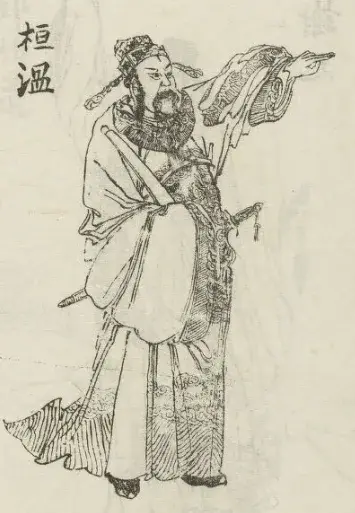
312 CE–373 CE
桓温
Huan Wen (桓温, 312–373), courtesy name Yuanzi, a native of Longkang in Qiao Commandery (modern Longkang Town, Huaiyuan County, Anhui Province), was the paramount military commander and powerful regent of the mid-Eastern Jin, and the eldest son of Xuancheng Administrator Huan Yi. Named "Wen" in infancy after being praised by the renowned statesman Wen Jiao, he avenged his father's death at age eighteen in 331 by personally…
Huan Wen (桓温, 312–373), courtesy name Yuanzi, a native of Longkang in Qiao Commandery (modern Longkang Town, Huaiyuan County, Anhui Province), was the paramount military commander and powerful regent of the mid-Eastern Jin, and the eldest son of Xuancheng Administrator Huan Yi. Named "Wen" in infancy after being praised by the renowned statesman Wen Jiao, he avenged his father's death at age eighteen in 331 by personally slaying Jiang Biao and his two brothers, and subsequently married Emperor Ming's eldest daughter Princess Nankang, inheriting the title Baron of Wanning County. Recommended by He Chong against the warnings of Liu Tan to succeed Yu Yi as Inspector of Jingzhou in 345, Huan Wen took command of the upper Yangtze armies. In 346–347, adopting the counsel of Yuan Qiao, he led a daring expedition into Sichuan, routed the Cheng-Han army at Zaqiao outside Chengdu, and forced the surrender of the last Cheng-Han ruler Li Shi (Huan Wen's Conquest of Cheng-Han). After compelling the court to depose his rival Yin Hao in 354, Huan Wen launched three famous northern campaigns (Huan Wen's Northern Expeditions): marching into Guanzhong to Bashang against Former Qin in 354 (where he met Wang Meng), defeating Yao Xiang at the Yi River to recover the old capital Luoyang in 356, and advancing to Fangtou against Former Yan in 369. In domestic governance, he submitted his Seven-Point Memorial on state reform (touching upon historiography such as the Jinyang Qiu and literati like Sun Chuo) and implemented the Gengxu Residence Determination (Gengxu Tuduan) in 364, registering northern émigrés and curbing aristocratic tax evasion. Appointed Grand Marshal in 363, he crushed Yuan Jin's rebellion at Shouchun in 371, deposed Emperor Feidi (Sima Yi) to enthrone Emperor Jianwen (Sima Yu), and purged the Yu clan and Prince of Wuling Sima Xi. Dying of illness at Gushu in the seventh month of 373 while pressing the court for the Nine Bestowments, he was posthumously named Imperial Chancellor and Duke Xuanwu, and left his military command to his brother Huan Chong while his brothers Huan Huo and others held key provinces.
Born into the Longkang Huan clan as the eldest son of Huan Yi; named "Wen" after Wen Jiao heard him cry before his first birthday and called him a true hero.
At age eighteen, disguised as a mourner, he entered the mourning hut of Jiang Biao (son of Jingxian Magistrate Jiang Bo, who had helped kill Huan Yi) and slew Jiang Biao and his two brothers; later married Princess Nankang.
Stationed at Linhuai as General Who Supports the State to back Yu Yi's northern plans, rising in the tenth month to Inspector of Xuzhou.
Recommended by He Chong despite Liu Tan's warnings, he was appointed General Who Pacifies the West, Commander-in-Chief of Six Provinces, and Inspector of Jingzhou in the eighth month.
Following Yuan Qiao's strategy, he marched into Sichuan, defeated Li Shi's army at Zaqiao in the third month, and extinguished the Cheng-Han regime, advancing in 348 to General-in-Chief Who Conquers the West and Duke of Linhe Commandery.
Compelled the court to depose Yin Hao in the first month; invaded Former Qin in the second month, reached Bashang outside Chang'an, met Wang Meng, and withdrew in the sixth month due to lack of grain.
Launched his second northern expedition in the eighth month, routed Yao Xiang at the Yi River, recovered Luoyang, and repaired the Western Jin imperial tombs; created Duke of Nan Commandery in 360.
Appointed Grand Marshal, Commander-in-Chief of All Military Affairs, and Holder of the Yellow Battle-Axe; carried out the Gengxu Residence Determination in the third month of 364 and moved his headquarters to Gushu in 365.
Led 50,000 troops on his third northern expedition against Former Yan in the fourth month, reaching Fangtou; forced to retreat in the ninth month when his supply route at Shimen was cut, suffering heavy losses against Murong Chui at Xiangyi.
Stormed Shouchun and executed Yuan Jin in the first month; in the eleventh month, acting on Xi Chao's counsel, he deposed Sima Yi (Duke of Haixi) and enthroned Emperor Jianwen (Sima Yu).
Demoted Sima Xi and wiped out Yu Xi's clan at Jingkou; when Emperor Jianwen died in the seventh month leaving an edict for Huan Wen to assist in government rather than take the throne, Huan Wen was deeply resentful.
Paid court at Jiankang in the second month, fell ill after returning to Gushu, and repeatedly demanded the Nine Bestowments, which Xie An and Wang Tanzhi delayed until Huan Wen died in the seventh month at age sixty-two.
Huan Wen descended from the Longkang Huan clan of Qiao Commandery, tracing his lineage to the Eastern Han Confucian master Huan Rong and the Cao Wei Minister of Agriculture Huan Fan. Because Huan Fan was executed with his clan by Sima Yi after the Gaopingling coup of 249, the Longkang Huan family fell into disgrace during the Western Jin. After crossing the Yangtze, Huan Wen's father Huan Yi gained renown among the "Eight Comprehenders South of the Yangtze," helped Emperor Ming suppress Wang Dun's rebellion, and served as Administrator of Xuancheng. Before Huan Wen was a year old, the statesman Wen Jiao visited the household, marveled at the infant's bone structure, asked to hear him cry, and declared, "This is truly an extraordinary creature!" Huan Yi accordingly named the boy "Wen."
In the third year of the Xianhe era (328), during Su Jun's rebellion, Huan Yi raised loyalist troops in Xuancheng and was killed by Su Jun's general Han Huang when the city fell, a plot in which Jingxian Magistrate Jiang Bo had participated. Only fifteen at the time, Huan Wen slept with a spear and wept blood, vowing to avenge his father. In 331, when Huan Wen was eighteen, Jiang Bo had died, and his trzy sons led by Jiang Biao were observing mourning while hiding blades inside their mourning staffs out of fear of Huan Wen's vengeance. Disguising himself as a condolence guest, Huan Wen entered the mourning hut, slew Jiang Biao on the spot, and hunted down and killed his two younger brothers, winning wide acclaim for his filial valor. Tall, imposing, and bold in spirit, Huan Wen was chosen to marry Emperor Ming's eldest daughter Princess Nankang (Sima Xingnan), receiving the title Commandant-Escort and inheriting his father's barony of Wanning County.
Appointed Administrator of Langxie in 335 and later General Who Supports the State, Huan Wen was stationed at Linhuai in the seventh month of 343 to support his friend Yu Yi, Inspector of Jingzhou, in preparing a northern campaign, and rose in the tenth month to Inspector of Xuzhou. When Yu Yi died in the eighth month of the first year of the Yonghe era (345) and requested that his son Yu Yuanzhi succeed him in Jingzhou, Palace Attendant He Chong argued that Huan Wen possessed extraordinary strategic talent and civil-military breadth unmatched for defending the western provinces. Although Danyang Governor Liu Tan admired Huan Wen's abilities, he perceived his unruly ambitions and warned Prince of Kuaiji Sima Yu not to place Huan Wen in a strategic stronghold like Jingzhou; Sima Yu ignored the warning and appointed Huan Wen General Who Pacifies the West, Commander-in-Chief of Six Provinces, and Inspector of Jingzhou.
Once in command of the upper Yangtze, Huan Wen resolved to conquer the decaying Cheng-Han regime in Sichuan, then ruled by the tyrannical Li Shi (Huan Wen's Conquest of Cheng-Han). While most officers feared the perilous terrain and distance, Jiangxia Administrator Yuan Qiao strongly backed the plan, arguing that a rapid thrust by 10,000 elite troops would catch Li Shi unprepared before Later Zhao in the north could react. In the eleventh month of 346, Huan Wen submitted a memorial and marched west immediately without waiting for court approval, accompanied by Zhou Fu, Sima Wuji, and Yuan Qiao. While the court feared disaster, Liu Tan alone predicted certain victory (an anecdote later celebrated in Su Shi's Dongpo Zhilin).
In the second month of 347, Huan Wen reached Qingyi, and the Cheng-Han commander Zan Jian took the northern bank of the Min River toward Qianwei, missing Huan Wen's army as it advanced along the southern bank. In the third month, leaving Zhou Chu and Sun Sheng (author of the Jinyang Qiu) to guard the baggage at Pengmo, Huan Wen led his infantry straight toward Chengdu, winning three consecutive battles. When Zan Jian's troops learned that Huan Wen was already ten miles from Chengdu, they scattered without a fight. Li Shi marshaled his entire army for a desperate stand at Zaqiao outside Chengdu; when the Jin vanguard faltered, an aide was killed, and arrows struck before Huan Wen's horse, the terrified officers wanted to retreat, but the drummer boy mistakenly beat the advance drum in panic. Seizing the moment, Yuan Qiao drew his sword to rally the troops in a fierce charge that shattered the Cheng-Han lines. Huan Wen stormed into Chengdu and burned its inner citadel; Li Shi fled by night to Jiameng before returning bound with a coffin to surrender, ending the forty-four-year Cheng-Han regime. Retaining talented former Cheng-Han officials such as Chang Qu on his staff and suppressing local revolts by Wang Shi and Deng Ding, Huan Wen returned in triumph to Jiangling and was promoted in 348 to General-in-Chief Who Conquers the West and Duke of Linhe Commandery.
Alarmed by Huan Wen's towering prestige after the conquest of Sichuan, Sima Yu brought Yangzhou Inspector Yin Hao into the central government to counterbalance him. Controlling eight provinces along the upper Yangtze, Huan Wen treated the court as a mere nominal suzerain. After the death of Later Zhao ruler Shi Hu in 349 threw northern China into chaos, Huan Wen repeatedly petitioned to march north; receiving no reply, he sailed downriver to Wuchang with 50,000 troops in late 351, throwing Jiankang into panic until Sima Yu wrote a personal letter persuading him to return to Jingzhou. When Yin Hao's own northern expeditions ended in catastrophic defeats and the loss of all military supplies, Huan Wen submitted a memorial in the first month of 354 impeaching Yin Hao, forcing the court to reduce Yin Hao to a commoner and concentrating all military and political power in Huan Wen's hands, thus initiating Huan Wen's Northern Expeditions.
In the second month of 354, Huan Wen led 40,000 infantry and cavalry from Jiangling on his first northern expedition against Former Qin, marching via Xichuan toward Wuguan while Sima Xun advanced through the Ziwu Valley. Capturing Shangluo and Qingni Pass, Huan Wen engaged 50,000 Former Qin troops under Crown Prince Fu Chang and Fu Sheng at Lantian in the fourth month. Despite Fu Sheng's fierce charges, Huan Wen rallied his troops to rout the Qin army while his younger brother Huan Chong defeated Fu Xiong at Bailuyuan, enabling Huan Wen to encamp at Bashang east of Chang'an. Residents across the Guanzhong plain welcomed the Jin army with cattle and wine, weeping that they had never expected to see imperial troops again. During his stay at Bashang, the scholar Wang Meng visited Huan Wen in coarse robes, picking lice while discussing the affairs of the realm; deeply impressed, Huan Wen offered him high office to accompany him south, though Wang Meng declined. Having counted on harvesting the ripening Guanzhong wheat for provisions, Huan Wen lingered at Bashang until Former Qin ruler Fu Jian reaped the fields and enforced scorched-earth tactics; defeated at Bailuyuan and short of grain, Huan Wen retreated in the sixth month with over 3,000 Guanzhong households, suffering heavy losses to Qin pursuit on the return march.
In the seventh month of 356, after the court rejected more than ten memorials urging the relocation of the capital to Luoyang, Huan Wen launched his second northern expedition as Grand Commander-in-Chief of Expeditions. Reaching the Yi River south of Luoyang in the eighth month, he encountered the Qiang warlord Yao Xiang, who was besieging Luoyang. Donning armor in person to lead Huan Chong and his generals across the river, Huan Wen crushed Yao Xiang's forces, entered the old palace complex at Jinyong Fortress, repaired the desecrated Western Jin imperial mausoleums, and resettled over 3,000 surrendered families in the Jiang-Han region, receiving the title Duke of Nan Commandery in 360.
In the fifth month of the first year of the Xingning era (363), Huan Wen was appointed Palace Attendant, Grand Marshal, Commander-in-Chief of All Military Affairs Inside and Outside the Court, and Holder of the Yellow Battle-Axe. He submitted his famous Seven-Point Memorial proposing the suppression of factional cliques, consolidation of redundant offices, strict deadlines for official documents, promotion of upright officials, and compilation of the state history (criticizing empty pure-talk trends represented by figures whom literati such as Sun Chuo evaluated). On the first day of the third month of 364 (Gengxu day), he carried out the Gengxu Residence Determination (Gengxu Tuduan), abolishing temporary "white registers" for northern émigrés, incorporating them into local tax-paying household registers, and prosecuting powerful aristocrats who concealed dependents—recovering over 30,000 unregistered persons in Kuaiji Commandery alone and greatly strengthening state finances. Moving his seat to Gushu (modern Dangtu, Anhui Province) in 365, he also recruited talented men across social strata, including Xie An, Xi Chao, Che Yin, Xi Zaochi, Yuan Hong, and Gu Kaizhi.
In the fourth month of the fourth year of the Taihe era (369), after taking over Xuzhou and Yanzhou with Xi Chao's help, Huan Wen led 50,000 troops alongside Huan Chong and Yuan Zhen on his third northern expedition against Former Yan. Digging a 300-li canal through Juye to enter the Yellow River, he routed several Yan armies and reached Fangtou near the Yan capital Ye in the seventh month. Rejecting Xi Chao's advice either to strike directly at Ye or secure river supply lines for the following summer, Huan Wen stalled at Fangtou while Murong Chui took command of 80,000 Yan troops, Murong De cut the Jin water supply route at Shimen, and Former Qin sent reinforcements to Yingchuan. With his grain exhausted in the ninth month, Huan Wen burned his ships and retreated overland; ambushed and pursued by Murong Chui at Xiangyi and attacked by Qin troops at Qiao, Huan Wen lost over 30,000 men.
Humiliated by the disaster at Fangtou, Huan Wen shifted the blame onto Yuzhou Inspector Yuan Zhen, provoking Yuan Zhen and his son Yuan Jin to rebel at Shouchun with Qin and Yan support. After besieging Shouchun and defeating Qin relief forces, Huan Wen stormed the city and executed Yuan Jin in the first month of 371. When Huan Wen asked Xi Chao that night whether the victory at Shouchun sufficed to wipe away the shame of Fangtou, Xi Chao replied that it did not, and urged him to imitate Yi Yin and Huo Guang by deposing the reigning emperor to reestablish his awe over the empire. In the eleventh month of 371, Huan Wen marched into Jiankang, fabricated charges that Emperor Feidi (Sima Yi, Duke of Haixi) was impotent and that his sons were fathered by favorites, coerced Empress Dowager Chu into deposing Sima Yi, and enthroned Prince of Kuaiji Sima Yu as Emperor Jianwen. He then purged the court, demoting and exiling Grand Chancellor Sima Xi (Prince of Wuling) and slaughtering the powerful Yingchuan Yu clan at Jingkou in 372.
Long harboring ambitions to usurp the throne, Huan Wen once remarked on his couch that if he remained obscure he would be laughed at by Sima Shi and Sima Zhao, adding: "If a man cannot leave a fragrant name for a hundred generations, why can he not leave a foul stench for ten thousand years!" Yet out of wariness toward the entrenched Jiankang aristocratic clans, he returned to his military base at Gushu rather than remain at court. When Emperor Jianwen fell mortally ill in the seventh month of 372 and issued four edicts in a single night summoning him, Huan Wen refused to go, expecting the dying emperor either to abdicate to him or name him regent after the model of the Duke of Zhou. Instead, Wang Tanzhi tore up the draft edict in the emperor's presence and rewrote it to instruct Huan Wen merely to assist in government after the precedent of Zhuge Liang and Wang Dao, while Wang Biaozhi promptly enthroned Crown Prince Sima Yao (Emperor Xiaowu), leaving Huan Wen furious.
In the second month of the first year of the Ningkang era (373), Huan Wen marched into Jiankang with a large force to attend Emperor Jianwen's funeral. Amid widespread terror that he intended to massacre the Wang and Xie clans and seize the throne, Xie An and Wang Tanzhi greeted him calmly at Xinting, defusing the crisis. Falling ill during his fourteen-day stay in the capital, Huan Wen returned to Gushu. As his illness worsened, he repeatedly pressured the court to grant him the Nine Bestowments (Jiuxi); knowing he was dying, Xie An and Wang Tanzhi instructed the drafter Yuan Hong to revise the text endlessly to delay its completion. In the seventh month of 373, before the edict was finished, Huan Wen died at Gushu at the age of sixty-two. He was posthumously appointed Imperial Chancellor with the posthumous name "Xuanwu," passing his military command to his younger brother Huan Chong (while his brother Huan Huo governed Jingzhou) and his dukedom to his youngest son Huan Xuan, who briefly usurped the Jin throne in 403.
FIGURES ASSOCIATED WITH THIS DYNASTY