Birth | Born in the Zhangnan area of Beizhou Prefecture; modern geographical identification is disputed
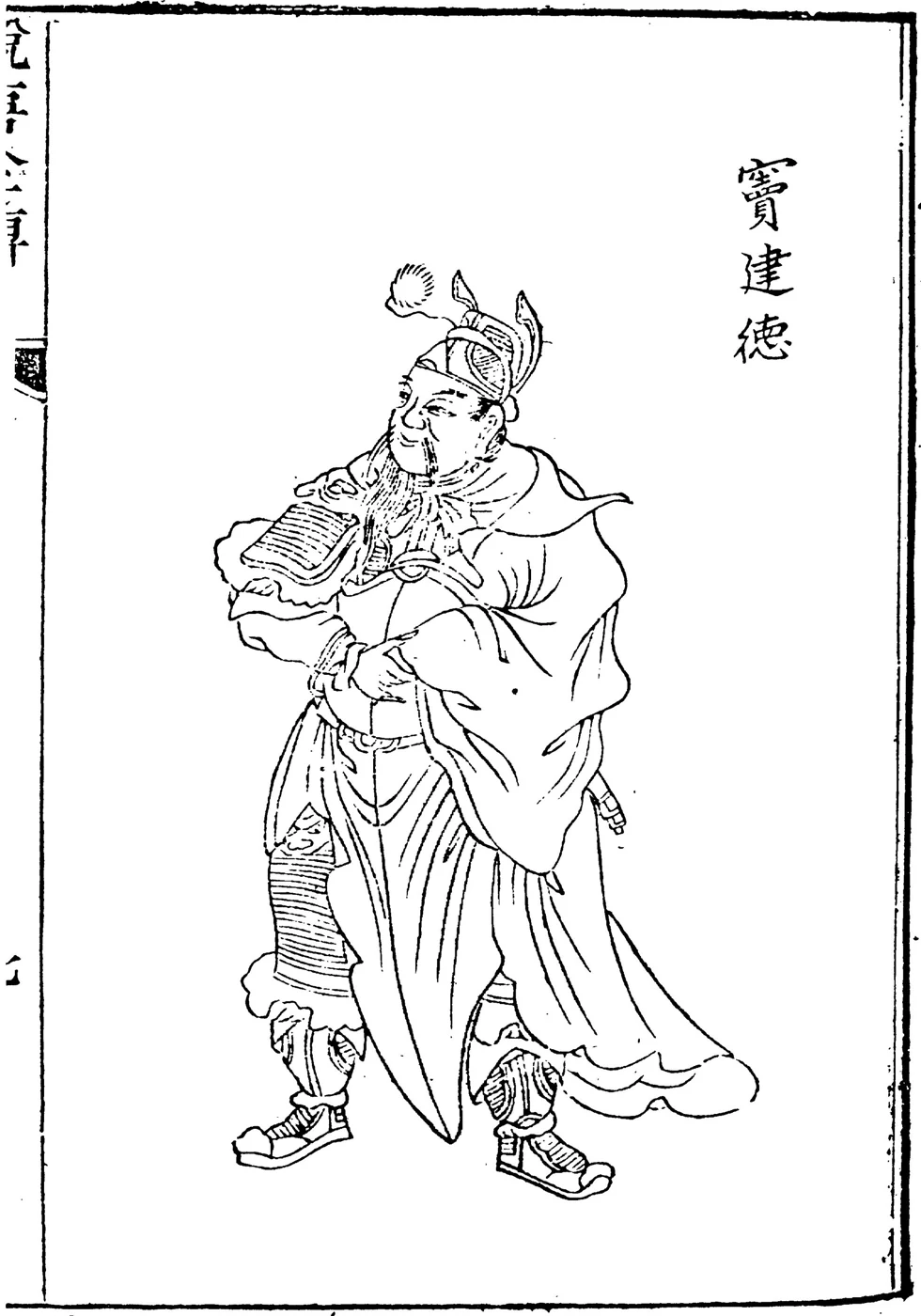
573 CE–621 CE
Leader of a late-Sui uprisingPrince of Xia
Dou Jiande
窦建德
Dou Jiande was born in 573 (4th year of Wuping, Northern Qi) and was executed on August 3, 621 (11th day of the 7th month, 4th year of Wude, Tang). A native of Zhangnan in Beizhou, he was a leader of the Hebei rebel armies at the end of the Sui and the beginning of the Tang, and styled himself King of Changle and later King of Xia. He farmed and served as a village head in his early years; during the Daye era he joined Gao…
573 CE–621 CESui Dynasty
PROFILE
Dou Jiande was born in 573 (4th year of Wuping, Northern Qi) and was executed on August 3, 621 (11th day of the 7th month, 4th year of Wude, Tang). A native of Zhangnan in Beizhou, he was a leader of the Hebei rebel armies at the end of the Sui and the beginning of the Tang, and styled himself King of Changle and later King of Xia. He farmed and served as a village head in his early years; during the Daye era he joined Gao Shida after helping Sun Anzu rise and losing his family to execution. After Gao Shida fell in battle he gathered the remnants and extended his power in Hebei. In 617 (13th year of Daye) he took the title King of Changle, and in 618 (1st year of Wude) he founded the Xia regime. By taking Sui officials into service, employing old subordinates and kinsmen, and dealing with the Turks and with Wang Shichong and others, Xia gradually controlled parts of Hebei and Shandong; its policy towards Li Tang and Zheng changed with the fortunes of war. In 621 (4th year of Wude) he marched to the relief of Wang Shichong and fought the Tang army at Hulao, was defeated and captured, and was executed at Chang’an on the eleventh day of the seventh lunar month.
- Also known as
- Prince of Xia (Emperor of Great Xia)
- Period
- Sui
- Date of Birth
- 573 CE(4th year of Wuping, Northern Qi)
- Date of Death
- August 3, 621 CE(11th day of the 7th month, 4th year of Wude, Tang)
- Dynasty / polity
- Sui Dynasty
- Identity
- Leader of a late-Sui uprising; Prince of Xia
- Ethnicity / group
- Not reliably established in surviving sources
- Native place
- Zhangnan County, Beizhou (northeast of present-day Gucheng County, Hengshui, Hebei)
- Place of birth
- Zhangnan County, Beizhou (northeast of present-day Gucheng County, Hengshui, Hebei)
- Place of death
- Unknown
- Highest office
- See Biography and Major Activities
- Major achievements
- Major leader of the late-Sui uprising in Hebei; established the Xia state and assumed imperial status; captured by Li Shimin at the Battle of Hulao and subsequently executed
LIFE TIMELINE
Rebellion against Sui | Helped Sun Anzu gather followers in rebellion; after his family was executed by the Sui court, he joined Gao Shida
Rise to prominence | Served as Army Major and defeated Guo Xuan by a feigned-surrender stratagem; after Gao Shida was killed, he gathered the remaining troops
Establishment of a regime | Built an altar in the Hejian-Leshou area, proclaimed himself Prince of Changle, and established government offices
Expansion in Hebei | Defeated forces under Xue Shixiong, after which several parts of Hebei submitted
Proclaimed Prince of Xia | Took the title Prince of Xia at Leshou, named the state Xia, and adopted the era name Wufeng
Capture of Xiangzhou | Captured Xiangzhou and continued south, taking Li Shentong, Princess Tong'an, and the general Xu Shiji prisoner
Capture of Liaocheng | Captured and killed Yuwen Huaji, then moved the capital to Ming Prefecture and adjusted relations with Sui loyalists, Tang, and the Eastern Turkic Khaganate
Youzhou campaign | Fought Luo Yi, initially suffered defeat and later counterattacked, but failed to take Youzhou and withdrew to Ming Prefecture
Henan military operations | Led troops against Meng Haigong, expanding Xia influence in Henan before intervention in the conflict between Wang Shichong and Tang
Aid to Zheng against Tang | Captured Zhouqiao City, took Meng Haigong prisoner, and mobilized his forces in preparation to aid Wang Shichong
Standoff at Hulao | Li Shimin crossed the river to reconnoiter and induced the Xia army to leave a favorable position
Battle of Hulao | Xia forces were defeated by Tang troops at Hulao; Dou Jiande was wounded and captured, and Tang later released large numbers of prisoners
Death | Taken to Chang'an and executed; the Xia state and its rule in Hebei collapsed
BIOGRAPHY
Biography
Early Life and Joining Gao Shida Dou Jiande came from a farming family in the Zhangnan area of Beizhou Prefecture and once served as a village head. he claimed descent from Dou Chong, Marquis of Ancheng and father of Empress Dowager Dou, but this genealogy was his own claim and cannot be treated as independently verified lineage. Historical records describe him as placing value on trust and obligations within his local community. Many people came to mourn when his father died, and he is also said to have given an ox to a poor fellow villager to help meet funeral expenses. In 611(the seventh year of Sui Daye), the court levied men for war against Goryeo, and Dou Jiande was chosen to command two hundred men. Sun Anzu, a man from the same county, killed the county magistrate amid flooding, famine, and conscription and fled to Dou for refuge. Dou sheltered him and discussed gathering followers at Gaojibo. The Sui authorities subsequently arrested and executed members of Dou’s family, after which Dou led his followers to join Gao Shida. Sun Anzu was later killed by Zhang Jincheng, and his followers joined Dou Jiande’s force. These experiences connect local disaster, compulsory levies, and the formation of rebel groups, but one personal biography alone does not justify reducing the broader causes of late-Sui uprisings to a single factor. ### Expansion and the Establishment of the Xia State In 616(the twelfth year of Sui Daye), Gao Shida appointed Dou Jiande Army Major and ordered him to face Guo Xuan, the administrator defending Zhuo Commandery. Dou pretended to be at odds with Gao Shida and offered a false surrender to Guo, drawing him forward before attacking, defeating, and killing him. He seized horses and greatly increased his reputation. When the Sui general Yang Yichen advanced, Dou advised Gao Shida to avoid the enemy’s strength and wait until the opposing army was exhausted. Gao did not follow the advice and was killed. Dou had left forces in reserve beforehand; after the defeat, he escaped with more than a hundred horsemen, took Raoyang, gathered scattered troops, held funeral rites for Gao Shida, and buried the dead. Many Sui officials and literati subsequently surrendered. Dou treated them with courtesy, and his forces grew to more than one hundred thousand. On 15 February 617(the fifth day of the first lunar month, thirteenth year of Sui Daye), Dou Jiande built an altar on the border between Hejian and Leshou, proclaimed himself Prince of Changle, and established government offices. When the Sui general Xue Shixiong advanced against him, Dou combined withdrawal from settlements, a display of weakness, and ambush tactics. He attacked the Sui army in mist, and Xue’s force collapsed. Hejian later surrendered after running out of grain, and the commandery vice administrator Wang Cong led local officials in submission. Dou received Wang Cong and appointed him Inspector of Yingzhou, rejected a proposal to boil him alive, and used strict military orders to prevent reprisals by his followers. This policy encouraged additional local officials to submit, but it does not mean that Dou treated every captive in the same manner. In 618(the first year of Tang Wude), Dou Jiande proclaimed himself Prince of Xia at Leshou, named his state Xia, and adopted the era name Wufeng. He later defeated Wei Dao'er and absorbed his forces, expanding Xia control. The regime’s external policy was neither consistently hostile to Tang nor consistently allied with Wang Shichong; it shifted with the changing balance among rival powers. Dou at one point maintained friendly relations with Wang Shichong and submitted a memorial to Yang Tong, the Sui Prince of Yue in Luoyang. After Wang deposed Yang Tong and took the throne himself, relations changed, and Dou turned to maintaining ties with the Eastern Turkic Khaganate. ### Liaocheng, Expansion into Shandong, and Government In 619(the second year of Tang Wude), Dou Jiande campaigned against Yuwen Huaji on the grounds that Yuwen had killed Emperor Yang of Sui and usurped power. Xia forces broke into Liaocheng. Dou entered the city, paid respects to Empress Xiao, and executed Yuwen Huaji and key participants in the regicide. He then escorted Empress Xiao toward the Eastern Turkic Khaganate and presented Yuwen Huaji’s head to Princess Yicheng. The operation employed the political symbolism of former Sui officials and the imperial house and also changed the strategic position of Xia beyond Hebei. After Xia forces entered Liaocheng, Dou released palace women and a group of former Sui officials and soldiers; those unwilling to continue serving were allowed to leave. He appointed former Sui officials such as Pei Ju, Cui Junsu, and He Chou according to their abilities and had Pei Ju take part in selecting officials and establishing court ceremonial. The further records that former Sui personnel accepted by Xia ranged from minor local clerks to high-ranking officials. They held different roles before and after the regime’s establishment, while the military authority of some former officials was restricted. At the same time, high military and political posts in Xia were also held by Dou’s old followers and relatives by marriage. The available materials therefore show a governing structure that combined former officials, old followers, and kin, rather than one that can be reduced either to pure meritocracy or solely to personal ties. After the Xia army captured Ming Prefecture, Dou moved his capital there and continued to employ old followers in military and civil administration. The placement of former Sui officials, the use of veteran subordinates, and appointments of relatives by marriage together formed part of Xia government. one account also summarizes practices such as distributing war booty, restraining his own lifestyle, and encouraging agriculture and sericulture. These accounts help illustrate his governing style but are insufficient to prove that his territory was consistently free of banditry or social conflict. ### Changing Policies toward Tang and Zheng Relations between the Xia state and Tang moved from contact and temporary accommodation to armed conflict. In the ninth lunar month of 619(the second year of Tang Wude), Dou moved south against Xiangzhou, drove back Tang forces, and captured Xiangzhou, Weizhou, and Liyang. He took Princess Tong'an, daughter of Emperor Gaozu of Tang, the imperial clansman Li Shentong, Prince of Huai'an, and the general Xu Shiji prisoner. After Wang Gui was killed, a household servant brought Wang’s head to Dou. Dou executed the servant for killing his master and sent Wang Gui’s head back to Huazhou; local officials then submitted. Dou later released Xu Shiji and allowed him to continue defending Liyang. In the first lunar month of 620(the third year of Tang Wude), Xu Shiji escaped back to Tang. Relations among the Sui remnants, Xia, and Tang were still changing. Some at the Xia court asked that Xu Shiji’s father be executed, but Dou refused on the grounds that Xu Shiji had been loyal to his former lord. He also released Princess Tong'an and Li Shentong, treated them courteously, and sent them back to the Tang court. At the same time, Dou attacked places including Zhaozhou and captured officials such as Zhang Ang, Chen Junbin, and Zhang Daoyuan. Ling Jing urged him not to kill defenders merely because they had remained loyal to their former rulers, and Dou eventually released these officials. Such cases show that he sometimes accepted remonstrance while also demonstrating that his policy depended on the circumstances of each episode. In 620(the third year of Tang Wude), Xia forces besieged Youzhou but were repulsed by Luo Yi. Dou later counterattacked and again approached Youzhou but failed to capture it and withdrew to Ming Prefecture. In the same year he killed the successful general Wang Fubao after the latter became the target of jealousy among other commanders, and he also executed Head of the Chancellery Song Zhengben after listening to slander against this outspoken remonstrator. Both one account and the Old Book of Tang place these deaths in narratives of later military setbacks and declining willingness among officials to remonstrate. Xia policy toward Wang Shichong’s Zheng state also shifted between cooperation and encroachment. Xia forces took Caozhou, Daizhou, and other areas in Henan while also mobilizing troops under old followers such as Xu Yuanlang and Meng Haigong to help Wang Shichong. Assistance to Zheng therefore proceeded alongside Xia’s own expansion and should not be described simply as aid to an ally. ### Aid to Wang Shichong and Defeat at Hulao In 621(the fourth year of Tang Wude), Dou Jiande captured Zhouqiao City and took Meng Haigong prisoner, then marched west to aid Wang Shichong, who was under siege by Li Shimin. His force was claimed to number three hundred thousand, while other records put it at more than one hundred thousand. Tang troops intercepted and attacked Xia grain transport near Hulao. Ling Jing proposed crossing the river to take Huaizhou and Heyang, then entering Shangdang through the Taihang Mountains and threatening Guanzhong, thereby forcing Tang troops to return west. Dou initially prepared to accept this plan, but Wang Shichong’s envoys secretly bribed Xia commanders, who opposed Ling Jing’s proposal, and Dou ultimately decided to continue toward Hulao. His wife Lady Cao also proposed advancing through Fukou and making a turning movement against the Tang rear, but Dou did not adopt her proposal. On 27 May 621(the first day of the fifth lunar month, fourth year of Tang Wude), Li Shimin crossed the river to observe the Xia army and left warhorses as bait. The Xia army later formed ranks between Banzhu and Niukou. Tang troops first used limited engagements to delay them, then crossed the Si River and attacked after the Xia army had stood in formation until noon and its soldiers had become tired. Xia commanders and court officials became crowded together, disrupting the formation. Tang troops struck from the flank and rear, and the Xia army collapsed. Dou was wounded and fled toward Niukouzhu, where Tang forces captured him. Different sources give inconsistent figures for troop strength, casualties, and pursuit distance, so the article does not combine them into a single numerical conclusion. After the battle, Tang forces captured large numbers of Xia soldiers, and Li Shimin ordered that many be released to return home. Dou’s wife Lady Cao, Qi Shanxing, and others withdrew with part of the cavalry to Ming Prefecture. Pei Ju and others then surrendered the Shandong territories, treasury, and official seals to Tang. The Xia state consequently collapsed and control of Hebei passed to the Tang Dynasty. Dou Jiande was taken to Chang'an and executed on 3 August 621(the 11th day of the seventh lunar month, fourth year of Tang Wude). His former subordinate Liu Heita later rebelled in Hebei, but this occurred after Dou’s death and should not be conflated with Dou’s own defeat at Hulao.
The Rising at Gaojibo and the Mergers among the Bands
In 611, when the court levied men against Goguryeo, Dou Jiande took in Sun Anzu after the latter killed the magistrate of his county and fled to him, and set out the situation for him in words recorded as: in the reign of Emperor Wen the realm was prosperous and a million men were raised against Liaodong and were still beaten by Goguryeo; now with floods and famine the common people are destitute while the sovereign takes no thought for them and comes in person to Liaodong, and after the western campaign of former years the wounds are not healed and the people are worn out, the campaigns of many years have left those who marched unreturned, and to raise troops again now is to be easily shaken; a man should not die without leaving a great work behind, nor be a fugitive captive; he knew that in the Gaojibo marshes several hundred li across, with dense reeds and rushes, a man might take refuge and sally out to plunder and so support himself; having gathered men, and watching for the turn of the times, he would surely do a great work in the world. Sun Anzu agreed; Dou Jiande lured deserters and men without property, several hundred of them, and had Sun Anzu lead them into the marshes as bandits, calling himself general. At the same time Zhang Jincheng of Shu gathered a hundred men at Hezu, and Gao Shida of Tiao raised more than a thousand in the borders of Qinghe; and while the bandit bands passing through Zhangnan killed and plundered the inhabitants and burned their houses wherever they went, they alone did not enter Dou Jiande's lane. The commandery and county therefore suspected him of dealings with the bandits, arrested his household and killed them, young and old alike; and Dou Jiande, learning that his family had been massacred, led the two hundred men under him to join Gao Shida. Gao Shida styled himself Duke of the Eastern Sea and made Dou Jiande his master of soldiers; and Sun Anzu being later killed by Zhang Jincheng, his several thousand troops all went over to Dou Jiande. His following then grew to more than ten thousand, still moving about the Gaojibo; and it is recorded that he "threw himself into dealings with others and shared the toil of the ranks with his soldiers, and so could get from men the utmost of their strength."
The Choices in the Three Battles against Guo Xuan, Yang Yichen and Xue Shixiong
In 616 the commandant of Zhuojun, Guo Xuan, came against Gao Shida with more than ten thousand men; and Gao Shida, thinking his own capacity below Dou Jiande's, made him military director and gave him all the troops. Dou Jiande, then first in command, wished to establish a signal service to overawe the bands, and so asked Gao Shida to guard the baggage while he chose seven thousand picked men against Guo Xuan, pretending to have fallen out with Gao Shida and rebelled; and Gao Shida likewise proclaimed that Dou Jiande had turned runaway and took a captured woman and falsely called her Dou Jiande's wife and killed her in the camp. Dou Jiande sent Guo Xuan a letter of pretended surrender, offering to be his vanguard and break Gao Shida to prove himself; and Guo Xuan believed it, led his troops with Dou Jiande to the borders of Changhe and agreed to make a covenant with him against Gao Shida, so that his army grew slack and unguarded, and Dou Jiande fell on and broke it, killing several thousand and taking more than a thousand horses, while Guo Xuan fled with some dozens of horse and Dou Jiande's men, pursuing to Pingyuan, cut off his head and presented it to Gao Shida. In the same year the court sent Yang Yichen with more than ten thousand men against Zhang Jincheng, broke him at Qinghe and "put all the bandits taken to the sword," the remnant scattered in the marshes gathering again and coming over to Dou Jiande; and Yang Yichen, following up his victory, reached Pingyuan and wished to enter the Gaojibo, whereupon Dou Jiande told Gao Shida that of all the Sui generals only Yang Yichen was good at war, that he had just broken Zhang Jincheng and was coming far to attack them and his edge could not be withstood, that they should draw off, deny him battle, waste his time until officers and men were weary and then strike, which would be a great service, whereas to cross swords with him now would be more than Gao Shida could match. Gao Shida would not follow him, but left Dou Jiande to hold the rampart while he took picked troops to meet Yang Yichen; gaining a small success he drank and feasted and came to slight his enemy, and Dou Jiande, judging that the Duke of the Eastern Sea had made himself great before breaking the bandits and that disaster would soon come, left men on the rampart and took a hundred picked men to hold a strong position against Gao Shida's defeat. Five days later Yang Yichen indeed broke Gao Shida, killed him in the field and, following up, was about to surround Dou Jiande, whose garrison, few in number and hearing of Gao Shida's defeat, scattered; and Dou Jiande fled with more than a hundred horse, and reaching Raoyang and finding it unguarded took it, comforting the soldiers so that most were willing to follow him, and gained more than three thousand more. Yang Yichen, having killed Gao Shida, thought Dou Jiande nothing to worry about; but Dou Jiande returned to Pingyuan, gathered and buried the slain, held mourning for Gao Shida with the whole army in white, and collecting the fugitives to the number of several thousand revived his army and first styled himself general. Whereas the bands had killed the Sui officials and the scholars of Shandong they took, Dou Jiande alone always treated the scholars he took with favour, and when he first got Song Zhengben, magistrate of Raoyang, he made him an honoured guest and consulted him; and thereafter the Sui governors and magistrates came over to him city by city, his army growing to "more than a hundred thousand effective troops." In 617 the court sent the right Yiwai general Xue Shixiong with thirty thousand men, who camped at Qijing south of Hejian; and Dou Jiande chose several thousand picked men to lie in the marshes on the southern border of Hejian, withdrew the garrisons of the cities in pretended flight and gave out that they had gone into the Douzi marshes, so that Xue Shixiong, thinking Dou Jiande feared him, took no precautions; and Dou Jiande, having watched him, attacked with a thousand men ready to die, and as mist and cloud darkened the day so that the two armies could not tell each other apart, the Sui army broke utterly and trampled itself, more than ten thousand dying, Xue Shixiong fleeing with several hundred horse and the rest taken.
The Title of Prince of Changle, the Era Name Wufeng, and His Treatment of Those Who Came Over
In the first month of 617 Dou Jiande built an altar on the border of Hejian and Leshou, styled himself Prince of Changle with the era name Dingchou, and set up his offices. At the winter solstice of 618, feasting in the Jincheng palace, "five great birds came down at Leshou and tens of thousands of birds followed them and left after a day," and for this he changed the era name to Wufeng; and when a man of Zongcheng presented a black jade tablet, the assistant of Jingcheng, Kong Deshao, said that when Yu the Great received the register Heaven had given him a black jade tablet, and that the omen being the same as Yu's he should call his state Xia, which Dou Jiande followed. Earlier Wang Xuba, a bandit chief of Shanggu who called himself Mantian and had tens of thousands of men, raiding Youzhou, was struck by a stray arrow and died, and his subordinate Wei Dao'er took over his following, styled himself Lishan Fei and held Shenze with a hundred thousand men; Dou Jiande made peace with him, and Wei Dao'er, relaxing his guard accordingly, was surprised and broken by Dou Jiande, whose territory he also took in. In attacking Yuwen Huaji, Dou Jiande told his director of speech Song Zhengben and his inner secretary Kong Deshao that he had been a subject of Sui for decades and Sui had been his sovereign for two generations, that Yuwen Huaji had now killed the emperor in monstrous treason and was his personal enemy, and he asked whether they should not join him in punishing him; and Kong Deshao answered that with the realm masterless and heroes contending, the prince had risen from among the common people at Zhangpu and Sui's governors and magistrates had vied to come over to him because he acted in accord with Heaven and gave the realm peace by righteousness, whereas Yuwen Huaji, allied by marriage to the house of Sui and with father, sons and brothers all recipients of its grace, standing in a place beyond suspicion, had committed the crime of regicide and usurped Sui to take its place, being the thief of the realm, and that if such a man were not punished, what was an overlord for. Dou Jiande approved and led his troops out that day, defeating him in successive battles. Yuwen Huaji held Liaocheng, and Dou Jiande, with battering cars and stone-throwing engines of most ingenious device, attacked on four sides and took it; and entering the city he first went to salute the Sui empress Xiao, speaking to her as a subject, and then seized all who had conspired to kill Emperor Yang — Yuwen Zhiji, Yang Shilan, Yuan Wuda, Xu Hongren and Meng Jing — assembled the Sui civil and military officials, had them killed in their presence and their heads hung outside the camp gate, while Yuwen Huaji and his two sons were carried together in a cage cart to Dalu county and beheaded. Of the palace women he took at Liaocheng, more than a thousand and all of them beautiful, he dismissed them at once; and of the Sui officials and guards he took, nearly ten thousand, he likewise released them to go where they would, giving clothes and grain and a military escort out of his territory to those who wished to go to Guanzhong or the eastern capital. He then took Mingzhou and its governor Yuan Zigan, moved his capital to Mingzhou and called it the Wanchun palace, sent envoys to Guanji to sacrifice at the tomb of Dou Qing and set twenty households to keep it; he had also been on good terms with Wang Shichong and sent envoys to pay court to the Sui prince of Yue, Yang Tong, at Luoyang, but when Wang Shichong deposed Yang Tong and took the throne himself he broke with him and began to give himself airs: he set up the imperial banners, kept the clearing of the way and the closing of the gates, and issued documents as edicts, gave Emperor Yang the posthumous name Min and made Yang Jian's son Yang Zhengdao duke of Yun. He also leant on the Turks: the Sui princess of Yicheng had married into the Turks, and Dou Jiande now sent envoys to bring the empress Xiao and escorted her into the steppe with more than a thousand horse, sending on Yuwen Huaji's head as a gift to the princess; and "being thus joined to the Turks, his military edge grew still greater."
His Personal Conduct, the State of Remonstrance, and the Make-up of the Xia Court
It is recorded that "whenever he took a city or broke a line, the goods he gained he gave all to his officers and took nothing himself," that he ate no meat and "his constant food was only vegetables and hulled rice," and that his wife lady Cao wore no silk and had only a dozen or so maids. Against this self-command stands the decline of remonstrance in his last years: Song Zhengben, director of speech, loved to speak out, and was afterwards killed on slander, "and from that time men took it as a warning and there were no more who offered advice," so that rewards, punishments and instruction declined by the day; and the meritorious Wang Fubao was killed as well, out of his officers' envy. Ling Jing once pleaded for captured defenders of a city, saying that a dog barks at any man who is not its master, and that the men of a neighbouring district who held out and were taken alive for want of strength were loyal men, and that to kill them would leave the prince nothing with which to encourage his own servants; Dou Jiande answered in anger that he was before the walls and they would not surrender, putting his army to trouble, and that their crime could not be pardoned, whereupon Ling Jing asked what he thought of the case of the general Gao Shixing, who was resisting at the Yi river but surrendered as soon as Luo Yi's army arrived; and Dou Jiande understood and ordered them released, the histories judging that "his generosity and his following of remonstrance were mostly of this kind." The power of selecting officials and of directing and moving the army in Xia belonged wholly to Dou's old officers: Qi Shanxing was president of the left of the chancellery and Cao Dan minister of war, and some of the high offices given were to connexions by marriage — the president of the left being Dou Jiande's sister's husband and the minister of war the brother of his wife lady Cao, a man with no capacity for command. His relations with Tang likewise passed through three stages: from 619 to the eve of the battle of Hulao in 621 his diplomacy aimed chiefly at peaceful development, consolidation and awaiting an opportunity to contend with Tang; from the ninth month of 619 to the eighth month of 620 it was bent on union, seeking by peaceful means a chance of joining with Tang; while before that, in the ninth month of 619, he had moved swiftly against Tang, raiding south into Xiangzhou and taking Li Ji, Li Shentong and the princess Tong'an, a war lasting over two months that in effect cleared Tang's power from Shandong and left Xia holding the whole of it. After Li Yuan marched against Wang Shichong, Dou Jiande first refused union with Wang Shichong and then agreed to join him against Tang, yet did not at once break with Tang, and while supporting Wang Shichong went on seizing Caozhou and Daizhou in Henan; the inner secretary Liu Bin advised him to join Wang Shichong, settle the immediate crisis and afterwards nibble away at Henan, and though Dou Jiande accepted the advice he did not go at once to the rescue but first took Cao and Dai, and even with Wang Shichong in extremity Xia did not send its own army first but had his old officer Fan Yuan send Xu Yuanlang, long since surrendered, and the newly broken Meng Haigong.
The Field Details of the Defeat at Hulao and the End of Xia
The field details of Hulao are richly preserved: Li Shimin first crossed the Yellow River northward and moved south towards Guangwu to observe the enemy, then left more than a thousand horses grazing on a sandbar in the river as a lure and returned to Hulao in the evening; next day Dou Jiande indeed came with all his strength, forming up from Banzhu to Niukou with the Yellow River behind, the Si river to the west and Que mountain to the south, in a line twenty li long. In his ranks Wang Wan rode Emperor Yang's blue-white charger with armour and weapons of great brilliance and rode out before the line to show himself, and Li Shimin said it was a fine horse indeed; Yuchi Jingde asked leave to go and take it, and Li Shimin checked him, asking whether they should lose a brave general for a horse, but Yuchi Jingde would not obey and with Gao Zengsheng and Liang Jianfang rode straight into the Xia ranks, took Wang Wan alive and led the horse back, and none in the Xia army dared stop them. In the battle Dou Jiande, struck by a lance, fled to hide at Niukou shoal, where the Tang chariot and cavalry generals Bai Shirang and Yang Wuwei came up with him; falling from his horse, with Bai Shirang raising his lance to strike, Dou Jiande cried out not to kill him, that he was the prince of Xia and could make them rich, and Yang Wuwei dismounted, took him, carried him on a spare horse and brought him before Li Shimin, who reproached him, asking what his own campaign against Wang Shichong had to do with him, that he had come across the border and affronted his weapons; and Dou Jiande answered that if he had not come himself, Li Shimin would have had the trouble of going far to fetch him. His officers and men scattered utterly, the Tang took fifty thousand in all and Li Shimin dismissed them that same day to go home. After the battle Dou Jiande's wife lady Cao with the president of the left Qi Shanxing fled to Mingzhou with several hundred horse; and the remaining party wished to set up Dou Jiande's adopted son as their lord, whereupon Qi Shanxing said that the prince of Xia had pacified Heshuo with strong men and good horses and had been taken thus in a moment, and was this not the decree of Heaven having its home, so that they should rather submit and ask for punishment and not bring further suffering on the living people. The wealth of the treasury was then divided among the soldiers and they were sent their ways; and Qi Shanxing with Dou Jiande's president of the right Pei Ju, the acting office chief Cao Yidan and Dou Jiande's wife led the officials to surrender the land of Shandong and brought the eight seals including the seal of state. In the seventh month of 621 Li Shimin brought Dou Jiande to the capital and had him beheaded in the market of Chang'an at the age of forty-nine; from his rising to his fall was six years, and all Hebei was pacified.
Major Activities
Organizing Anti-Sui Forces in Hebei After uprisings led by Sun Anzu, Gao Shida, and others, Dou Jiande gradually became an important leader of anti-Sui forces in Hebei. Under Gao Shida he served as Army Major and defeated Guo Xuan. After Gao was killed, Dou gathered defeated troops, buried the dead, and reorganized the army. When Xue Shixiong advanced against him, Dou used ambushes and a display of weakness to win, and then accepted the surrender of local officials, allowing military expansion and local administration to develop together. ### Establishing and Governing the Xia State After assuming a princely title, Dou established government offices, employed former Sui officials and veteran followers, and continued building military and civil institutions after moving the capital to Ming Prefecture. The power structure included former Sui officials, long-serving Dou retainers, and relatives by marriage. Xia relied on former officials to handle civil affairs while also limiting the military authority of some of them. The distribution of war booty, release of some captives, and decisions not to kill Wang Cong or Xu Shiji’s father are based on specific recorded episodes. At the same time, relatives and old followers also occupied military and political posts and should be presented as part of the same appointment system. ### Adjusting Diplomatic and Military Policies toward Tang and Zheng Early in its history, Xia had contacts with Yang Tong, the Sui Prince of Yue, and with Wang Shichong and also experienced a period of relative accommodation with Tang. It later attacked Xiangzhou and Weizhou and captured members of the Tang imperial clan and Tang generals. After Tang attacked Wang Shichong, Dou both allied with Wang and continued to expand Xia influence in Henan, finally sending an army to aid Zheng. The Youzhou campaign of 620(the third year of Tang Wude) shows that his military operations remained active in Hebei, while relations with Tang, Zheng, and the Eastern Turkic Khaganate shifted with political and military circumstances. ### The Battle of Hulao and the Fall of Xia When Dou Jiande moved to aid Wang Shichong, he ultimately accepted his commanders’ preference for continuing toward Hulao rather than adopting the indirect strategies proposed by Ling Jing and Lady Cao. Li Shimin attacked Xia grain transport, induced the Xia army to expend its strength, and then launched an assault. The Xia formation was disrupted and defeated. After Dou was captured, Tang released many Xia prisoners, while Lady Cao, Qi Shanxing, Pei Ju, and others surrendered territory and resources to Tang. The Xia state came to an end. The reasons for defeat included the rejection of indirect operational plans, the environment in which commanders gave advice, logistics, and battlefield deployment; the outcome should not be reduced to a single “strategic error.”
The Composition of the Xia Regime, Dou Jiande's Political Methods, and the Several Causes of His Fall
Dou Jiande's Xia regime had two clearly traceable sides to its composition. The first was its absorption of Sui officials: those taken in before and after the founding of the regime ranged from local clerks of the eighth rank or so — the revenue officer of Jingcheng, the magistrate of Raoyang, the assistant of Jing county, a scribe — whom Dou Jiande raised to the high posts of governor, director of speech, grand secretary and grand secretary's secretary, men mostly of clean character, with a good base among the people and considerable ability, so that taking them in "was of great benefit in expanding his power"; and after killing Yuwen Huaji he gained Pei Ju, Yu Shinan, Ouyang Xun, He Chou, Cui Junsu and Liu Diao, all of them descendants of the official and noble houses of the Northern and Southern Dynasties and holders of important political place under Sui, whose acquisition "played a positive part in the political propaganda of Dou Jiande's regime and also an important part in its internal construction." Dou Jiande generally appointed them according to the posts they had held under Sui, and treated the Sui yellow gate attendant Pei Ju with particular favour, making him specially responsible for the selection of officials of Xia and the fixing of court ceremony. The second was his caution with military power and his reliance on old officers and in-laws: with the military power of the old Sui house he was "very cautious, using the method of promoting in name while demoting in fact, as when he stripped Cui Junsu of command"; while the power of selecting officials and of directing and moving the army belonged wholly to Dou's old officers, Qi Shanxing as president of the left and Cao Dan as minister of war, the president being Dou Jiande's sister's husband and the minister the brother of his wife lady Cao and a man without capacity for command, so that in appointment "part was out of closeness of relationship rather than strength of ability." The two kinds used together made up the basic pattern of Xia's government.
In political method he was notably consistent in his handling of those who came over: he did not kill Wang Cong but made him governor of Yingzhou and stopped his officers from revenge by the order that any who had a grudge against Wang Cong and dared move in the matter would be punished in the third degree; he did not kill Xu Shiji's father but called him a loyal servant of his old lord; he did not kill captured defenders of cities, likening them to dogs that bark only at strangers; he put to death the household slave who killed his master and brought the head to him, and sent the head back to Huazhou; and he dismissed the palace women he had taken and nearly ten thousand Sui officials and guards, giving clothes, grain and an escort to those who wished to go to Guanzhong or the eastern capital. These measures had their effect in widening the circle of those who came over and drawing in Sui officials and scholars, and his division of spoils, his taking nothing for himself and his plain way of living accorded with the image of one who "won the countryside by righteousness." But his political judgement plainly failed in his later years: on slander he killed Song Zhengben, putting an end to outspoken remonstrance; he killed the meritorious Wang Fubao, estranging his officers; and he rejected Ling Jing's plan to change his line, cross the river, enter Shangdang and threaten Guanzhong, and his wife lady Cao's plan to march by the Fu pass, take advantage of Tang's emptiness to advance camp by camp and then, with Turkish help, turn westward on Guanzhong, accepting instead the word of bribed officers that Ling Jing was only a scholar, and answering at last that this was not a thing a woman could know.
As to his fall, it is not to be reduced to a single strategic error. The immediate cause at Hulao was his choice to press on towards Hulao and give battle: the Tang first struck at Xia's grain transport and then used the horses left north of the river as a lure to bring him into forming up; his army stood in line from morning to midday until the men were weary and the ranks disordered by the crowding of courtiers and officers, and the Tang then crossed the Si and struck the flank and rear so that the line collapsed. But even before that, Xia's strategic position had turned from a three-way balance into a passive two-front problem: he agreed to rescue Wang Shichong while continuing to seize Cao and Dai, so that rescue and expansion together tied down both his forces and his timing, and the rescue itself was not undertaken by his own army first but by old officers sending Xu Yuanlang, long surrendered, and the newly broken Meng Haigong. At the level of the regime, the deaths of Song Zhengben and Wang Fubao weakened its internal capacity for correction, while in-laws holding military and political posts without capacity for command left Xia without another usable option at the moment of decision. Had Ling Jing's plan been carried out its effect was disputed even then: one historical argument holds that "Ling Jing's plan was indeed a good one," yet even if Dou Jiande had taken the Huai and Meng region, Fen, Jin and Pujin were not to be had without fighting, and delay would only have left Luoyang the more isolated while the Tang pressed the siege harder and destroyed its enemies one by one, so that adopting the plan cannot be said to have necessarily changed the outcome. Contemporary historical argument also noted that Dou Jiande's mourning for Emperor Yang as a subject and his salutation of the empress Xiao were "applied where they were inappropriate, and how could they move men's hearts," that is, that there was an internal tension between his political posture towards the house of Sui and the man he was punishing. On the whole, his regime left a great body of traceable record in absorbing Sui officials, honouring scholars, restraining himself and dealing generously with those who surrendered; and its fall came of a combination of the dispositions on the field, the tying down of his forces caused by rescuing and expanding at once, the blocking of the channels of remonstrance within, and the structure of appointments at the core of the regime; and that his old officers rose again in Hebei after his death shows that his local influence did not vanish with his execution.
Personal Relations
- Dou Qing: father; Dou Jiande later sent envoys to sacrifice at his grave and assigned households to maintain the tomb.
- Lady Cao: wife; participated in political affairs, advised Dou to alter his route during the Hulao campaign, and withdrew to Ming Prefecture with Qi Shanxing and others after the defeat.
- Cao Dan: elder brother of Lady Cao; served as Minister of War in the Xia state and was one of Dou’s relatives by marriage among his veteran supporters.
- Sun Anzu: man from the same county; Dou sheltered him and helped him gather followers in rebellion, and Sun’s men later joined Dou after Sun’s death.
- Gao Shida: leader of the Gaojibo rebels; Dou joined him early in his career and served under him, then gathered Gao’s remaining troops after Gao was killed.
- Song Zhengben: Head of the Chancellery in the Xia state; remonstrated frankly and was later killed after Dou listened to slander against him.
- Wang Fubao: Xia general; known in the sources for courage, ability, and military achievements, but later killed after being slandered.
- Ling Jing: Chancellor of the Imperial University in the Xia state; advised Dou to avoid Hulao and take an indirect route against Tang, but his proposal was not adopted.
- Pei Ju: former Sui official and Left Vice Director of the Department of State Affairs in Xia; participated in selecting officials and establishing court ceremonial and surrendered to Tang after the defeat at Hulao.
- Wang Shichong: ruler of Zheng; had earlier dealings with Dou and later requested his aid when Tang attacked Zheng.
- Li Shimin: Tang commander; defeated Dou Jiande at the Battle of Hulao and captured him.
- Li Shentong: Tang imperial clansman; captured in the Xiangzhou and Liyang fighting of 619 and later treated courteously and released.
- Princess Tong'an: daughter of Emperor Gaozu of Tang; captured by Dou and later released and returned to the Tang court.
- Xu Shiji: Tang general; after capture by Xia he was allowed to continue defending Liyang and later escaped back to Tang.
- Liu Heita: former subordinate of Dou Jiande; led a new uprising in Hebei after Dou’s death.
Anecdotes
In its “Anecdotes and Allusions” section, one account recounts that, while still a commoner, Dou Jiande fought off bandits who entered his home at night. This episode does not appear in the another account text or the standard historical works cited here, so it is retained only as a story attributed to one account, not as a verified event or proof of his martial reputation. the source also includes the stories “No Fourth Watch” and the woman from Ye; because they lack corroboration in the historical sources reviewed, they are not presented as historical deeds.
Historical Assessment
The historians of the Old Book of Tang regarded Dou Jiande as capable of managing soldiers and gathering talented men. The same account records his killing of Yuwen Huaji, release of Xu Shiji’s father, and courteous treatment of Li Shentong, while also noting the deaths of Wang Fubao and Song Zhengben and the rejection of the proposals of Ling Jing and Lady Cao, and concluding that he failed to bring his career to a good end. The New Book of Tang instead places him among the separatist powers of the late Sui period and criticizes him for assuming royal authority while presenting an appearance of benevolence and righteousness. Yin Mou’s Stele of Dou Jiande praises his respect for talent, leniency, and the memory of him among people in Hebei, while treating the mistake at Hulao as the turning point of his fall. These judgments come from different historians and commemorative texts and should not be treated as a single contemporaneous consensus. Modern scholarship also differs on how to classify his anti-Sui struggle. Research cited Baike includes both the traditional description of a “peasant war” or “peasant uprising” and Xiang Yijun’s argument that the participants included both ordinary subjects and Sui officials and are more accurately described collectively as an “uprising of officials and commoners.” This dispute is retained rather than treating either scholarly label as the sole conclusion. Folk bandit stories, the legend of a woman in Ye, and relationships invented in films or popular historical fiction are not used as evidence for historical assessment.
FIGURES ASSOCIATED WITH THIS DYNASTY
Bibliography
- Liu Xu, Zhao Ying, et al., Old Book of Tang, vol. 54, “Biography 4: Dou Jiande.”
- Ouyang Xiu, Song Qi, et al., New Book of Tang, vol. 85, “Biography 10: Dou Jiande.”