Birth | Born at Xia Ruo Li in Changcheng County, Wuxing Commandery
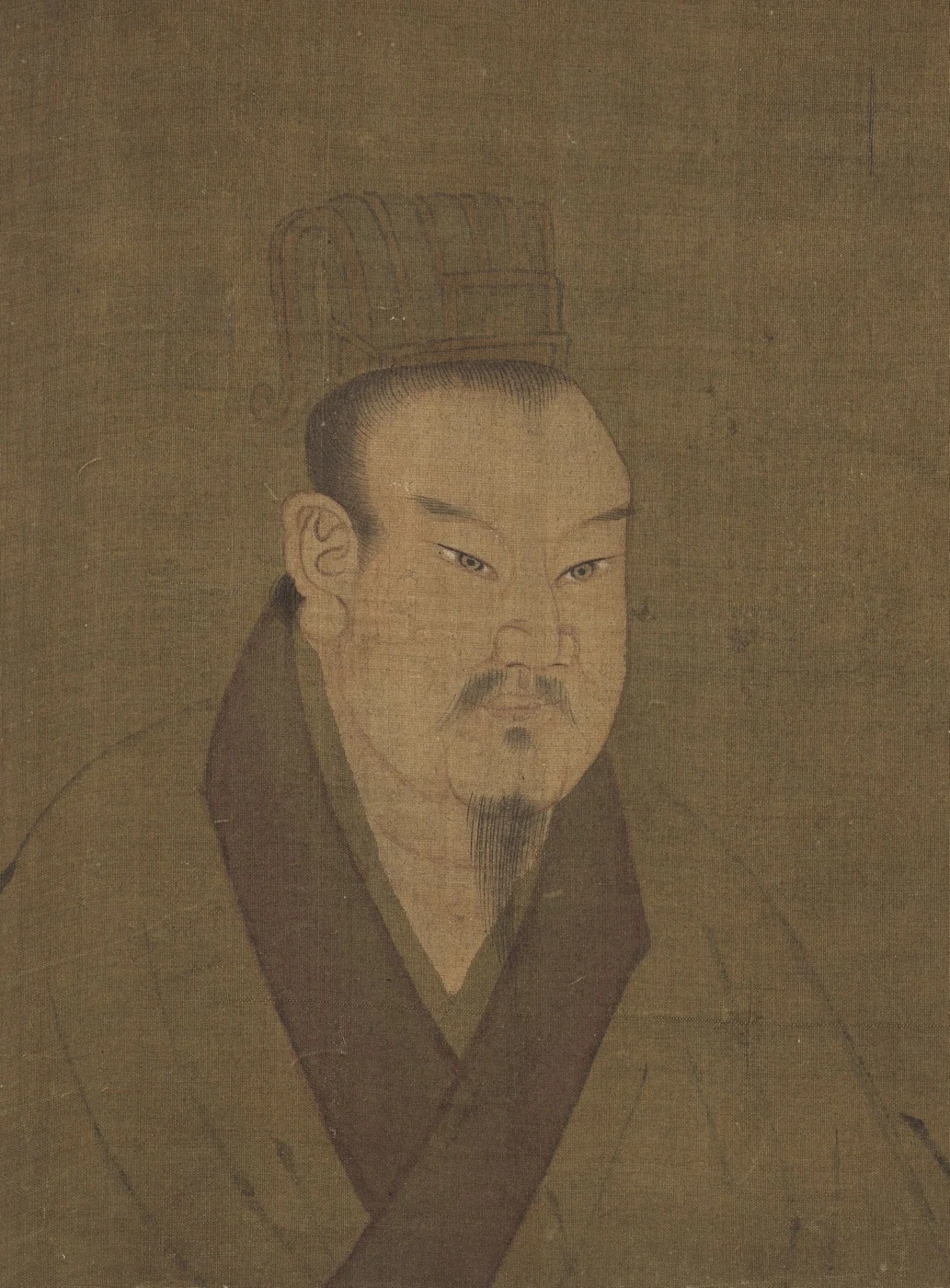
503 CE–559 CE
Emperor
Chen Baxian
陈霸先
Chen Baxian (503(2nd year of Tianjian under Liang) – 9 August 559(3rd year of Yongding under Chen)), courtesy name Xingguo and childhood name Fasheng, was a native of Xia Ruo Li in Changcheng County, Wuxing Commandery (present-day Changxing, Zhejiang) and the founding emperor of the Southern Chen. Early in his career he gained the favor of Xiao Ying, Marquess of Xinyu, and followed him to serve in Guangzhou, rising through…
503 CE–559 CEChen dynasty
PROFILE
Chen Baxian (503(2nd year of Tianjian under Liang) – 9 August 559(3rd year of Yongding under Chen)), courtesy name Xingguo and childhood name Fasheng, was a native of Xia Ruo Li in Changcheng County, Wuxing Commandery (present-day Changxing, Zhejiang) and the founding emperor of the Southern Chen. Early in his career he gained the favor of Xiao Ying, Marquess of Xinyu, and followed him to serve in Guangzhou, rising through the ranks after suppressing a local military mutiny and the rebellion of Lý Bí in Jiaozhou. During the Hou Jing Rebellion, Chen Baxian raised troops in Lingnan and marched north. In 552(1st year of Chengsheng under Liang), he joined Wang Sengbian in capturing Jiankang and defeating Hou Jing. He later opposed Wang Sengbian's decision to enthrone Xiao Yuanming with Northern Qi support, killed Wang Sengbian in a surprise attack, enthroned Xiao Fangzhi, and took control of Liang military and political affairs. In 557(2nd year of Taiping under Liang / 1st year of Yongding under Chen), Chen Baxian accepted the abdication of the Liang emperor, proclaimed himself emperor, and founded the Chen dynasty. He continued to face Wang Lin and other opponents backed by Northern Qi; his forces suffered a defeat at Dunkou in which several of his generals were captured, and he maintained the new regime through continued warfare and negotiation. Chen Baxian died of illness in Jiankang in 559(3rd year of Yongding under Chen). His temple name was Gaozu, his posthumous name was Emperor Wu, and he was buried at Wan'an Mausoleum.
- Alternative name
- Emperor Wu of Chen
- Courtesy name
- Xingguo
- Period
- Chen dynasty
- Date of Birth
- 503 CE(2nd year of the Liangtianjian era)
- Date of Death
- August 9, 559 CE(3rd year of the Chenyongding era, 6th month, 21st day)
- Dynasty / regime
- Liang dynasty
- Identity
- Emperor
- Ethnicity / ethnic affiliation
- Not reliably established in the available sources
- Native place
- Xiaruo Village, Changcheng County, Wuxing Commandery (present-day Changxing, Huzhou, Zhejiang)
- Place of birth
- Unknown
- Reign
- November 16, 557 – August 9, 559
- Era name
- Not reliably established in the historical sources
- Temple name
- Gaozu
- Posthumous name
- Emperor Wu
- Major achievements
- A military man of humble Wuxing origins who rose after suppressing the Hou Jing Rebellion and founded the Chen dynasty, the last Southern Dynasty.
- Other name
- Emperor Wu of Chen
- Childhood name
- Fasheng
- Dynasty / polity
- Chen dynasty
- Ethnicity / affiliation
- Not reliably established in the available sources
- Ancestral home
- Xia Ruo Li, Changcheng County, Wuxing Commandery (present-day Changxing County, Huzhou, Zhejiang)
- Birthplace
- Xia Ruo Li, Changcheng County, Wuxing Commandery
- Place of death
- Xuanji Hall, Jiankang
- Mausoleum
- Wan'an Mausoleum
- Predecessor
- Xiao Fangzhi, Emperor Jing of Liang
- Successor
- Chen Qian, Emperor Wen of Chen (a son of his elder brother who succeeded him)
LIFE TIMELINE
Early career | Followed Xiao Ying to Guangzhou and served as a military adjutant in his retinue, with orders to recruit troops
Suppression of unrest in Lingnan | Led 3,000 troops to relieve Guangzhou and defeated the mutinous forces of Du Tianhe and Du Sengming, after which Emperor Wu of Liang promoted him
Campaign in Jiaozhou | Appointed military adjutant of Jiaozhou and accompanied Yang Qian in the campaign against Lý Bí
Suppression of remaining forces | After Lý Bí was killed by local people, Chen Baxian also suppressed the forces of Lý Thiên Bảo and Li Shaolong
Raising troops in Lingnan | Attacked and killed Guangzhou Inspector Yuan Jingzhong, aided Ouyang Wei, and later accepted the authority of Xiao Yi, Prince of Xiangdong
March north to aid the dynasty | Set out from Shixing, defeated Cai Luyang, and advanced to Nankang
Joining forces and supplying grain | Captured and executed Li Qianshi; before joining Wang Sengbian, transferred 300,000 shi of military grain to support the western army
Suppression of the Hou Jing Rebellion | Joined Wang Sengbian in capturing Jiankang; Hou Jing fled and was killed; Chen Baxian then guarded Jingkou
Reorganization of the Liang court | After Western Wei forces killed Xiao Yi, Emperor Yuan of Liang, Chen Baxian and Wang Sengbian supported Xiao Fangzhi
Control of Liang military and political affairs | Killed Wang Sengbian in a surprise attack and enthroned Xiao Fangzhi; subsequently suppressed the rebellions of Du Kan, Wei Zai, and others and repelled Northern Qi attacks
Continued suppression of opposition | Defeated Du Kan, Zhang Biao, and other forces; when Xiao Bo and Yu Xiaoqing rose against Chen, sent Zhou Wenyu, Hou Andu, and others against them
Foundation of the Chen dynasty | After defeating Xiao Bo, Yu Xiaoqing, and other opponents, accepted the abdication of Emperor Jing of Liang and founded the Chen dynasty
Wang Lin's resistance | Wang Lin refused to accept Chen Baxian's political settlement involving Xiao Fangzhi; Hou Andu and Zhou Wenyu were defeated and captured by Wang Lin's army at Dunkou
CE(2nd year of the Taiping era, Liang; 1st year of the Yongding er
557 CE(2nd year of the Taiping era, Liang; 1st year of the Yongding era, Chen) | Negotiations with Wang Lin | Wang Lin enthroned Xiao Zhuang and sought Northern Qi assistance; Chen Baxian sent Hou Tian, Xu Du, and others against him and later used an envoy to negotiate, prompting Wang Lin to withdraw
Death | Died of illness at Xuanji Hall in Jiankang; his will provided for succession by Chen Qian, a son of his elder brother
In 558(2nd year of Yongding under Chen) | In 558(2nd year of Yongding under Chen), Wang Lin advanced to Pencheng and sought aid from Northern Qi.
Death | On 9 August 559(3rd year of Yongding under Chen), the twenty-first day of the sixth month in the third year of Yongding, he died at Xuanji Hall in Jiankang.
BIOGRAPHY
Biography
Family Background and Early Life Chen Baxian was born in 503(2nd year of Tianjian under Liang) at Xia Ruo Li in Changcheng County, Wuxing Commandery. The historical sources give differing accounts of his ancestry. The Book of Chen describes him as a descendant of Chen Shi, magistrate of Taiqiu in the Eastern Han, and states that his ancestor Chen Da migrated south during the Yongjia era and settled in Changcheng. The History of the Southern Dynasties, by contrast, says that his family was originally very humble. Chen Baxian himself claimed descent from Chen Shi, but the available material is insufficient to verify the entire lineage independently. His father, Chen Wenzan, was later posthumously honored as Emperor Jing with the temple name Taizu of the Chen dynasty. Chen Baxian's family was poor when he was young, but he enjoyed reading military works, later read historical texts, and practiced martial arts. He first served as a village clerk and later worked in Jiankang as a clerk in an oil storehouse. Early in the Datong era of Emperor Wu of Liang, Xiao Ying, Marquess of Xinyu and governor of Wuxing, took notice of Chen Baxian and told members of his staff that he had a promising future. Around 540(around the 6th year of Datong under Liang), when Xiao Ying became governor of Guangzhou, Chen Baxian followed him there and served as a military adjutant in his retinue. Xiao Ying ordered him to recruit soldiers, and his following grew to about one thousand. Chen Baxian was then placed in charge of Songlong Commandery and used force to suppress resistance in the two counties of Anhua under his authority. He later became Protector of the West River and Administrator of Gaoyao Commandery, beginning to build a military and political base in Lingnan. ### Relief of Guangzhou and the Jiaozhou Campaign In 541 (seventh year of Datong under Liang), the local leader Lý Bí rose in Jiaozhou and drove out Xiao Zi, the Liang inspector of Jiaozhou. The Liang court sent Sun Jiong, Lu Zixiong, and others to campaign against him, but their troops suffered heavy losses from miasmatic disease and other causes. After Lu and Sun were ordered executed by the Liang court, their former followers Du Tianhe, Du Sengming, and others turned on Guangzhou. In 544(10th year of Datong under Liang), Chen Baxian learned of the attack while at Gaoyao and led 3,000 elite troops on a rapid march to relieve the city. He defeated the besieging forces; Du Tianhe was killed and Du Sengming was captured. Emperor Wu of Liang rewarded Chen Baxian for this victory by appointing him General of the Direct Guard, enfeoffing him as Viscount of Xin'an, and ordering an artist to paint his portrait. Xiao Ying died in the winter of 544(10th year of Datong under Liang). The following year, Chen Baxian escorted his coffin back toward Jiankang. While on the journey, he received an imperial order appointing him military adjutant of Jiaozhou and Administrator of Wuping Commandery, and he joined Jiaozhou Inspector Yang Qian in the southern campaign against Lý Bí. Chen Baxian argued that because Lý Bí's rebellion had already spread across several prefectures and counties, the army should advance promptly. In June 545(11th year of Datong under Liang), Liang forces reached Jiaozhou and Chen Baxian served as the vanguard, defeating Lý Bí's troops at the mouth of the Su Lich River. Lý Bí withdrew to Dianche Lake, where he built water palisades and assembled ships, and the Liang army temporarily halted at the lake entrance. Chen Baxian argued that the enemy had already suffered repeated defeats and had not yet stabilized, so the Liang forces should continue the attack. During the night the river rose sharply; he led an assault with the floodwaters, and Lý Bí's army collapsed. Lý Bí later fled into a cave in the Quliao area and was killed by local people in 547(1st year of Taiqing under Liang). His elder brother Lý Thiên Bảo and Li Shaolong gathered 20,000 remaining troops, killed the Liang inspector of De Prefecture, and besieged Ai Prefecture. Chen Baxian again led troops against them and suppressed their forces. He subsequently received appointments including General Who Pacifies Afar, Protector of the West River, and Administrator of Gaoyao Commandery. ### The Hou Jing Rebellion and Expansion of Power In 548 (second year of Taiqing under Liang), Hou Jing rebelled against Liang and attacked Jiankang. Chen Baxian originally intended to lead troops to the capital's aid, but Guangzhou Inspector Yuan Jingzhong secretly plotted against him. In July 549(3rd year of Taiqing under Liang), Chen Baxian assembled loyal troops and issued a proclamation denouncing Yuan; Yuan Jingzhong was defeated and killed himself. Chen Baxian then welcomed Xiao Bo to govern Guangzhou and was ordered to relieve Ouyang Wei in Hengzhou. He captured Lan Yu and Lan Jingli, who had incited uprisings in Shixing and other commanderies. In November, Chen Baxian sent Du Sengming and Hu Ying to garrison the mountain passes. Hou Andu, Zhang Si, and others then joined him with more than one thousand followers. Xiao Bo opposed Chen Baxian's plan to march north against Hou Jing. Chen therefore sent envoys by indirect routes to Jiangling and accepted the authority of Xiao Yi, Prince of Xiangdong. In January 550(1st year of Dabao under Liang), he set out from Shixing, defeated Cai Luyang, and advanced to Nankang. Xiao Yi appointed him General of Illustrious Might, Inspector of Jiaozhou, and Count of Nanye County. Chen Baxian then fought repeated engagements around Nankang against Li Qianshi, whom Hou Jing had appointed inspector of Gao Prefecture. In 551(2nd year of Dabao under Liang), Li Qianshi's forces were defeated; he was captured and then executed by Chen Baxian. During the Hou Jing Rebellion, Wang Sengbian and other generals serving Xiao Yi advanced from the west, while Chen Baxian marched north along the Gan River. Because Chen had substantial grain supplies, he transferred 300,000 shi to relieve the western army's shortages, helping establish cooperation between the two forces. In 552(1st year of Chengsheng under Liang), Chen Baxian led 30,000 armored troops, 5,000 powerful crossbows, and 2,000 vessels from Yuzhang. He joined Wang Sengbian at Baimaowan, where the two forces formed an alliance. Their combined army captured Wuhu and Gushu and advanced on Jiankang. Hou Jing had established defenses along the Huai River. Chen Baxian advocated crossing the river and building a fortified position west of Shitou Fortress, after which the allied forces advanced by separate routes. Fighting repeatedly shifted around fortified positions including an orchard. Chen Baxian personally led troops into the attack, and Hou Jing's army eventually collapsed. Hou Jing abandoned the city and fled, and was later killed by his own subordinate. Chen Baxian was rewarded with offices including General Who Conquers the Enemy, Commander Unequalled in Honor, and Minister of Works; he also served as Inspector of Yangzhou and was stationed at Jingkou. ### Killing Wang Sengbian and Suppressing Late-Liang Opposition In 554(3rd year of Chengsheng under Liang), Western Wei captured Jiangling and killed Xiao Yi, Emperor Yuan of Liang. Chen Baxian, Wang Sengbian, and others brought Xiao Fangzhi, Prince of Jin'an, to Jiankang and had him assume authority. In 555(4th year of Chengsheng / 1st year of Shaotai under Liang), Northern Qi sent Xiao Yuanming, Marquess of Zhenyang, back to Liang territory. Despite Chen Baxian's opposition, Wang Sengbian enthroned Xiao Yuanming and made Xiao Fangzhi crown prince. Chen Baxian regarded this as submission to Northern Qi. After repeated remonstrations through envoys failed, he coordinated forces with Xu Du, Hou Andu, Zhou Wenyu, and others, marched from Jingkou to Shitou Fortress, and killed Wang Sengbian and his son Wang Wei in a surprise attack. He deposed Xiao Yuanming and enthroned Xiao Fangzhi as Emperor Jing of Liang. Chen Baxian then became Prefect of the Masters of Writing and Commander-in-Chief of All Military Affairs, Internal and External, taking control of the Liang court. Wang Sengbian's former subordinates and Northern Qi supporters immediately rose against him. In 555(4th year of Chengsheng / 1st year of Shaotai under Liang), Du Kan, Wei Zai, Wang Sengzhi, and others held fortified positions in opposition. Du Kan sent Du Tai against Changcheng, but Du Tai failed to take the city defended by Chen Qian. Zhou Wenyu's first attack on Yixing went badly, prompting Chen Baxian to lead an eastern campaign himself. Xu Sihui, inspector of Qiao and Qin prefectures, defected to Northern Qi and joined Ren Yue in attacking Jiankang and occupying Shitou Fortress. Northern Qi forces later crossed the Yangtze, first occupying Gushu and then shipping grain from Hushu toward Shitou Fortress. Chen Baxian ordered Hou Andu and others to raid Hushu by night, burn the Northern Qi vessels, cut the grain route, and establish fortified positions around Jiankang. When Xu Sihui's forces attacked the Yecheng stockade, Chen Baxian personally led armored cavalry against them and drove them back. Hou Andu and others also attacked with naval forces, while Chen Baxian besieged Shitou Fortress and cut its water route. Northern Qi general Liu Damo sought peace, and the two sides swore an agreement; Xu Sihui and Ren Yue then withdrew north with Liu. In 556(2nd year of Shaotai / 1st year of Taiping under Liang), Chen Baxian continued to suppress opposition. Chen Qian and Zhou Wenyu captured Wuxing, and Du Kan was defeated and killed. Hou Andu and others captured Kuaiji and killed Zhang Biao, the inspector of Yangzhou. Xiao Bo, Yu Xiaoqing, and other opponents nevertheless remained active. ### Xiao Bo, Yu Xiaoqing, Wang Lin, and the Foundation of Chen In February 557(2nd year of Taiping under Liang / 1st year of Yongding under Chen), Xiao Bo raised troops in Guangzhou and marched north, while Yu Xiaoqing rose at Xinwu in support. Chen Baxian sent Zhou Wenyu, Hou Andu, and others along separate routes. Zhou Wenyu initially ran out of provisions at Yuzhang, but obtained grain from Zhou Di and continued the campaign. He feigned a retreat to lull his opponents, then occupied Qianshao and cut communications among the forces of Xiao Zi, Ouyang Wei, Fu Tai, Yu Xiaoqing, and others. Zhou Wenyu's army captured Ouyang Wei and Fu Tai. Xiao Bo's officers Chen Fawu and Tan Shiyuan killed Xiao Bo and surrendered. Hou Andu and others defeated the position held by Xiao Zi, while Yu Xiaoqing fled and finally surrendered in May. Chen Baxian subsequently appointed Ouyang Wei and others to office, after which the Lingnan commanderies shifted their allegiance to him. Wang Lin, a former subordinate of Wang Sengbian, rejected Chen Baxian's political settlement involving Xiao Fangzhi. In 557(2nd year of Taiping under Liang / 1st year of Yongding under Chen), Wang Lin prepared ships for war, and Chen Baxian sent Zhou Wenyu, Hou Andu, and others with a fleet against him. In October of that year, Chen Baxian accepted the abdication of Emperor Jing of Liang, proclaimed himself emperor, founded the Chen dynasty, and adopted the era name Yongding. Wang Lin's forces defeated Hou Andu and Zhou Wenyu at Dunkou and captured both generals. Wang then occupied Ying Prefecture and enthroned Xiao Zhuang, Prince of Yongjia. In 558(2nd year of Yongding under Chen), Wang Lin advanced to Pencheng and sought aid from Northern Qi. Chen Baxian sent Hou Tian, Xu Du, and others against him and also dispatched Xie Zhe to negotiate. In August, Wang Lin withdrew to Xiangzhou, and Chen Baxian recalled part of his forces. Wang Lin and Xiao Zhuang's regime were not eliminated, and the political situation in the western part of the Chen realm remained unstable. After becoming emperor, Chen Baxian still faced the military security problems of a newly founded regime. Sources state that he personally decided urgent military affairs, while in ordinary administration he favored leniency and simplicity and generally avoided mobilizing troops for matters that were not urgent military needs. His daily food and court utensils were also described as frugal. Claims that he stabilized the south or restored the economy must therefore be understood in light of his short reign and the fact that Wang Lin and other forces still held the upper Yangtze region. ### Death and Posthumous Events In the sixth month of 559(3rd year of Yongding under Chen), Chen Baxian became seriously ill. On 9 August 559(3rd year of Yongding under Chen), the twenty-first day of the sixth month in the third year of Yongding, he died at Xuanji Hall in Jiankang. His surviving son Chen Chang was then detained by Northern Zhou, so Chen Baxian's will provided for succession by his nephew Chen Qian, Prince of Linchuan, who became Emperor Wen of Chen. In the eighth month, court officials conferred on Chen Baxian the posthumous title Emperor Wu and temple name Gaozu. He was buried at Wan'an Mausoleum. After the Sui conquered Chen, Wang Ban, a son of Wang Sengbian, avenged his father by digging up Wan'an Mausoleum, burning Chen Baxian's remains, and casting the ashes into water. This account appears in the Book of Sui and concerns the destruction of the tomb after the fall of Chen.
His Family and Early Years
Chen Baxian, courtesy name Xingguo, childhood name Fasheng, was a man of Xiaruo lane in Changcheng of Wuxing, a descendant of Chen Shi, the grand chief of Taiqiu of the Han, whose family had long lived in Yingchuan. By the History of Chen his line ran thus: Chen Shi's great-great-grandson Chen Zhun was grand commandant of the Jin; Zhun begot Kuang, and Kuang begot Da, who in the Yongjia period moved south and, becoming a clerk of the chancellor and in turn master of the heir's horses, went out as magistrate of Changcheng and "delighted in its hills and waters, and so made his home there," telling those close to him that the country there was fine and that a king must arise in it, and that in two hundred years his descendants would surely meet that fortune. Da begot Kang, who was again a clerk of the chancellor; and at the land settlement of the Xianhe period the family became men of Changcheng. Kang begot Ying, governor of Xuyi; Ying begot the gentleman of the secretariat Gongbi; Gongbi begot the colonel of foot Ding; Ding begot the cavalier attendant in ordinary Gao; Gao begot Yong, magistrate of Huai'an; Yong begot Meng, governor of Ancheng; Meng begot the chief of the imperial sacrifices Daoju; and Daoju begot his late father Wenzan. But the genealogy in the History of Chen has no corroboration and is very doubtful, and what can be traced begins with his father Chen Wenzan, of whom the Veritable Record of Jiankang says that he held no office, which settles the difficulty. By the History of the Southern Dynasties "his origin was very humble, and he claimed to be a descendant of the grand chief of Taiqiu of the Han"; the History of Zhou calls his forebears petty officers under the princes of Liang; and a proclamation against Chen preserved in the Finest Flowers of the Garden of Letters calls him a man of burning and flooding fields, the son of a wicker gate and a round doorway, of no conduct in his village, enrolled as a servant of a border lord. Of his early years the History of Chen says little, but the Veritable Record of Jiankang supplies the gap, recording that "he first served in his village as a headman, then fled to Yixing, and the governor of Wuxing, Xiao Ying, passing by took him to Jianye, where Xiao Ying employed him as a clerk and he was presently made keeper of the oil store." A village headman is not an office but a kind of corvée, so that Chen Baxian had nothing to do with the great clans and came of a humble house. Poor as his family was, he had great ambitions from boyhood; and when grown he read histories, loved military books above all, understood the arts of prognosticating by the stars, of the void and the full, and of the hidden stem, and trained himself in arms, being "intelligent, decided and resolute, and held in esteem by his contemporaries." He is said to have been seven feet five inches tall, with a prominent forehead and hands hanging below his knees, the marks of a sovereign.
His Service under Xiao Ying and the Pacification of Li Ben
Early in the Datong period, when Xiao Ying, marquis of Xinyu, was governor of Wuxing, he thought much of Chen Baxian and, pointing him out to his officers, said that this man would go far. And when Xiao Ying became inspector of Guangzhou, Chen Baxian went with him as military adviser of the central guard. Xiao Ying had him raise troops and horses, a thousand in all, and gave him charge of Songlong commandery; and the two counties of Anhua under him not submitting to the Liang, Chen Baxian led troops and reduced them, and was soon made protector of the western river and governor of Gaoyao. Earlier, when the marquis of Wulin, Xiao Zi, was inspector of Jiaozhou and by his harshness lost the people's hearts, the native Li Ben joined the chiefs of several prefectures in rebellion, and the court sent the inspector of Gaozhou, Sun Jiong, and of Xinzhou, Lu Zixiong, against him, who failing to advance were both executed at Guangzhou; and Lu Zixiong's brother's son Zilue with Sun Jiong's sons and nephews and their commanders Du Tianhe and Du Sengming raised troops, seized the protector of the southern river Shen Yi and raided Guangzhou, attacking day and night so that the province was in terror. Chen Baxian with three thousand picked troops, marching in armour without rest, came to the rescue and won battle after battle, so that Du Tianhe was killed by a stray arrow and the rebels broke, and Du Sengming surrendered. Emperor Wu of Liang marvelled greatly and made him general of the palace gate, enfeoffing him as viscount of Xin'an with three hundred households, and sent a painter to take his likeness and look at it. Afterwards Xiao Ying died and Chen Baxian took his coffin home; and reaching the Dayu ridge he received an edict making him master of horse of Jiaozhou and governor of Wuping, to go south with the new inspector Yang Qian against Li Ben. Returning to Guangzhou, he gathered troops and prepared stores, and with Yang Qian's army reached Jiaozhou in the twelfth month. Yang Qian asking his officers for counsel, Chen Baxian answered that the revolt of Jiaozhi was the fault of the imperial kin, that it had spread over several prefectures for years, and that Dingzhou, coveting present profit, cared nothing for the great plan; that the commissioner had been sent to punish crime and must stake his life on it, and could not fear the imperial kin and slight the law of the realm; and so he set the troops in order and advanced with drums. In the sixth month of the eleventh year of Datong, 545, the army reaching Jiaozhou while Li Ben with several tens of thousands made a walled camp at the mouth of the Suli river to hold off the Liang, Yang Qian made Chen Baxian's troops the van, and he broke Li Ben's array, so that Li Ben fled to the Dianche lake; and there Li Ben built a camp in the Quliao country and made great ships filling the lake, at which the Liang troops were afraid and halted at the mouth of the lake. Chen Baxian told his generals that their army was old and the men weary, that years of standoff could not be good policy, and that being alone without relief and deep in the enemy's heart, if one battle failed they could not hope to live; and he added that taking advantage of the enemy's repeated flight, with men's hearts unsettled and the barbarians a rabble, they might be crushed with ease, and that they should go out to a hundred deaths and decide it by force, for if they stayed idle the hour would pass. His generals were all silent and none answered. That night the river suddenly rose seven fathoms and poured into the lake in a rushing torrent; and Chen Baxian, setting his own troops in order, went first with the current while all the armies advanced with drums and shouts, and the rebels broke utterly. Afterwards Li Ben's brother Li Tianbao fled to Jiuzhen and with the robber chief Li Shaolong gathered twenty thousand men, killed the inspector of Dezhou Chen Wenjie and besieged Aizhou, and Chen Baxian again led troops and reduced them. Emperor Wu of Liang then made him general of the distant garrison, protector of the western river, governor of Gaoyao and commander of the military affairs of seven commanderies.
The Rebellion of Hou Jing and His March North to the Rescue
In the second year of Taiqing, 548, Hou Jing rose in rebellion, and the next year the rebels took the Liang capital Jiankang and Emperor Wu of Liang was starved to death. When Hou Jing raided the capital Chen Baxian meant to march to the rescue, but the inspector of Guangzhou, Yuan Jingzhong, had other designs and meant to make away with him; and Chen Baxian, knowing his plan, secretly agreed with the inspector of Chengzhou, Wang Huaiming, and the selecting gentleman Yin Waichen to put the province under martial law. In the seventh month of the third year he gathered the righteous troops at Nanhai and sent out a proclamation against Yuan Jingzhong, who being driven to extremity hanged himself in his chamber, and Chen Baxian brought Xiao Bo to hold Guangzhou. At that time the internal historian of Linhe, Ouyang Wei, held Hengzhou, and Lan Yu and Lan Jingli lured the ten commanderies of Shixing and others to attack him, so that Ouyang Wei asked help of Xiao Bo, who ordered Chen Baxian to relieve him; and Chen Baxian took Lan Yu and the rest and was given charge of Shixing commandery. In the eleventh month he sent Du Sengming and Hu Ying with two thousand men to camp on the ridge and made close friends of the chiefs of Shixing for the righteous cause, and Hou Andu and Zhang Si came over with more than a thousand men. Xiao Bo, prince of Qujiang of the Liang house, holding Guangzhou, hearing that Chen Baxian meant to rise against Hou Jing, sent Zhong Xiuyue to dissuade him, saying that Hou Jing was a hero of valour unmatched in the realm and asking where with so small a force he would go, and advising him rather to stay at Shixing, make a show of strength from afar and keep his mountain safe. And Chen Baxian, weeping, told Zhong Xiuyue that he was a common and empty man whom the state had made, and that hearing of Hou Jing's crossing of the river he had wished at once to go to the rescue; that the capital being now overthrown and the sovereign in dust, when the lord is shamed the servant dies and none could grudge his life; and that his plan was decided, and he sent envoys by side roads to Jiangling to receive the orders of the campaign. When Cai Luyang rose and held Nankang, Xiao Bo sending his confidant Tan Shiyuan as magistrate of Qujiang to join him and block the righteous army, Chen Baxian in the first month of the first year of Dabao set out from Shixing and came to the Dayu ridge, where Cai Luyang posted troops at Nanye and made four walled camps among the hills and waters to hold him; and Chen Baxian fighting him broke him utterly and advanced to Nankang. The prince of Xiangdong, Xiao Yi, by imperial authority made him cavalier attendant in ordinary, holder of the tally, general of manifested majesty and inspector of Jiaozhou, changing his fief to viscount of Nanye. In the sixth month he repaired the old city of Qitou and moved there; and when the inspector of Gaozhou, Li Qianshi, held Dagao and sent his commander Du Pinglu with a thousand men into the Ganshi and Yuliang, Chen Baxian had Zhou Wenyu drive them off, and Li Qianshi fled to Ningdu.
The Joint Campaign that Destroyed Hou Jing
In the first year of Shengsheng, 552, Chen Baxian joined Wang Sengbian and together they put down the rebellion. In the sixth month he set out from Nankang; and the Ganshi rapids of Nankang having twenty-four shoals with great boulders that travellers found hard, when he set out "the water rose suddenly several fathoms and within three hundred li all the boulders were drowned," and advancing to Xichang he saw "a dragon by the waterside, five fathoms high and of bright five colours," which tens of thousands of soldiers and people came to see. The court then sending the general of the eastern expedition Wang Sengbian to command the armies against Hou Jing, in the eighth month Wang Sengbian's army halted at Pen city and Chen Baxian with Du Sengming and the other armies and the chiefs of Nancuan, thirty thousand in all, came to join him; and the western army being short of food, Chen Baxian, who had stored five hundred thousand shi, gave them three hundred thousand, so that Wang Sengbian's fears were removed and Chen Baxian won credit in all the western armies. In the first month of the third year Chen Baxian set out from Yuzhang with thirty thousand armoured men, five thousand strong crossbows and two thousand ships; in the second month he halted at Sangluo island, where by imperial authority a band of drummers and pipers was granted him; and Wang Sengbian, having set out from Pen city, joined him at Baimao bay, where they landed, built an altar and slaughtered victims to make their covenant, and advancing to Wuhu the defender of Hou Jing's city, Zhang Hei, abandoned it and fled. In the third month Chen Baxian with the other armies took Gushu and halted at Caizhou; and Hou Jing climbing the Shitou city to look at the situation was much displeased and told those about him that there was a purple vapour over that army which could not easily be withstood, and so he had stones sunk to block the mouth of the Huai and built walls along the Huai from Shitou to Qingxi, more than ten li, with towers and battlements joined. His generals being undecided, Wang Sengbian sent Du Ze to ask Chen Baxian's counsel, and he said that formerly Liu Zhongli with several hundred thousand had sat across the water, and Wei Can at Qingxi had never crossed to the bank, so that the rebels could look down on them and see all within and without, and spread their cruelty and destroy the royal army; and that now, to invest Shitou, they must cross to the north bank, and that if the generals could not face the enemy's edge he would go first and set up a stockade. So he built a stockade on the long ridge west of Shitou city, and the armies joined in eight camps straight out to the northeast; and the rebels, fearing the western road would be cut, made five camps in the fruit woods to the northeast to hold the great road. Hou Jing led more than ten thousand men and eight hundred odd armoured horse in array and advanced; and Chen Baxian said that the military writers had it that a good commander is like the snake of Mount Chang, head and tail answering each other, and that their army being now many and the rebels few, they should divide the enemy's strength and overcome the strong by the weak, not gather their own edge to make them fight to the death; and he had his generals dispose their troops in separate quarters. Thereafter Hou Jing's host broke utterly and Chen Baxian pursued them north to the Ximing gate, and Hou Jing, reaching the palace, dared not enter the terrace and sent his confidants to fetch his two sons and fled. Chen Baxian led his troops out to Guangling to support him, and when Hou Jing's general Guo Yuanjian fled to Qi, Chen Baxian took in three thousand of his troops and returned; and Wang Sengbian memorialised that Chen Baxian should hold Jingkou.
The Repulse of the Northern Qi, the Killing of Wang Sengbian, and His Accession
In the eleventh month of the third year of Shengsheng, 554, the Western Wei took Jiangling, and Chen Baxian with Wang Sengbian memorialised to Jiangzhou asking the prince of Jin'an to act as regent by imperial authority. In the fifth month of the fourth year the Northern Qi sent back the marquis of Zhenyang, Xiao Yuanming, to rule, and Wang Sengbian took him up, enthroned him and changed the era to Tiancheng, making the prince of Jin'an heir apparent; but at first, when Qi asked that Zhenyang be taken up, Chen Baxian held it wrong and sent envoys to Wang Sengbian to contend earnestly for it again and again, and Wang Sengbian would not listen. In the ninth month of that year Chen Baxian with Xu Du, Hou Andu and Zhou Wenyu killed Wang Sengbian, deposed Xiao Yuanming and set up Xiao Fangzhi as emperor, changing the era to Shaotai: on the day renyin Chen Baxian summoned Xu Du, Hou Andu and Zhou Wenyu to concert, disposed the officers and men, gave out gold and silk and advanced by land and water, and that night set out from Nanxuzhou against Wang Sengbian; on the day jiachen his foot reached in front of Shitou and he sent brave men over the wall from the north of the city, and Wang Sengbian, then at his business and hearing that there were troops without, presently saw them come out from within, fled hastily with his third son Wang Wei out of the pavilion, with several dozen attendants still fighting; and Chen Baxian's main force arriving, Wang Sengbian, unequal to their number, fled up the south gate tower, where Chen Baxian set fire with the wind, so that Wang Sengbian, driven to extremity, was taken, and that night he and Wang Wei were strangled. In the tenth month the prince of Jin'an took the throne and changed the fourth year of Shengsheng to the first year of Shaotai, and Chen Baxian was made palace attendant, commander-in-chief of all military affairs within and without, general of chariots and cavalry and inspector of Yang and Nanxuzhou, with an edict allowing him a hundred armed men to come and go about the palace, so holding the real power of the Liang. After Wang Sengbian's death his remaining partisans rose against Chen Baxian: the inspector of Zhenzhou Du Kan holding Wuxing rebelled with the governor of Yixing Wei Zai, and Chen Baxian sent Zhou Wenyu against Wei Zai, breaking his water stockade; and the inspector of Qinzhou Xu Sihui holding his city went over to Qi and asked the inspector of Nanyuzhou Ren Yue to join him in support of Du Kan and Wei Zai, Qi furnishing them with troops and food, and Xu Sihui and the rest, the capital being then empty, came with five thousand picked troops to the palace gate, where Hou Andu with five hundred braves went out against them and they fell back on Shitou. In the eleventh month the Northern Qi sent five thousand men across to hold Gushu, and also sent the inspector of Anzhou Zhai Zichong and others with ten thousand men to cross at Hushu with thirty thousand shi of rice and a thousand horses into Shitou; and Chen Baxian sent Hou Andu by night to raid Hushu and burn more than a thousand Qi ships, sent Zhou Tiehu with the fleet to cut Qi's transport, and in the twelfth month sent Hou Andu with the fleet to raid Xu Sihui's household at Qinzhou, taking several hundred; and the government troops linking their ships blocked the mouth of the Huai to cut off the rebels' waterway, and all the armies were ordered to set out armoured troops in divisions, to ferry them across on a bridge of boats opposite the Ye city and attack the two stockades south of the water. Liu Dama and the rest crossing the Huai and forming their line, Chen Baxian urged his troops to a swift fight and burned the stockades with fire so that smoke and dust filled the sky, and the rebels breaking, struggling for the boats and crowding one another, drowned by the thousand; and that day Xu Sihui and Ren Yue with more than ten thousand Qi troops by land and water went back to Shitou, and Chen Baxian sent Hou Andu with the fleet to surprise and break them, taking all their stores and weapons. Chen Baxian invested Shitou city and cut off its water, and the city having no water, the Qi general Liu Dama sent to ask for peace, which Chen Baxian granted, slaughtering victims to the covenant outside the gate and asking nothing of their officers and men; and on the day xinyou Chen Baxian went out by the south gate of Shitou and drew up several tens of thousands of troops to send the Qi men home to the north. Afterwards the magistrate of Jiangning, Chen Si, and the yellow-gate vice-director Cao Lang holding Gushu rebelled, and Chen Baxian sent Hou Andu and Xu Du to put them down, taking several thousand heads and heaping them in a mound of victory; and Shitou, Caishi and Nanzhou were all pacified, and that month Du Kan surrendered his city, while in the first month of the next year Chen Baxian had him executed at Wuxing. Afterwards he twice broke the Northern Qi's invasions and was in turn enfeoffed as duke and then prince of Chen. In the eighth month of the first year of Yongding, 557, the Liang court raised the chancellor Chen Baxian to be grand tutor with the yellow battle-axe and special honours; on the fifth day of the ninth month raised him to be chancellor of state with the whole government, enfeoffing him as duke of Chen with the nine bestowals and a government of his own; and on the third day of the tenth month advanced the duke of Chen to be prince with an enlarged fief; and on the day yihai of the tenth month of the winter of the first year of Yongding Chen Baxian took the throne in the southern suburb, proclaimed a general amnesty and changed the second year of Taiping of Liang into the first year of Yongding, founding the Chen.
His Reign, His Death and the Wan'an Tomb
At the founding of Chen, "his orders did not reach beyond a thousand li of Jiankang." He made friends with the great houses of Jiangzuo and restored the economy of the south on the one hand, and on the other campaigned against the Northern Qi and recovered lost ground, so that his rule grew steady and the capital of Jiankang was rebuilt. In his reign, whenever a great military decision came he could always find the way to victory, while in ordinary government he loved mildness and simplicity and would not lightly move the troops except for urgent military business. He was frugal and disciplined, and by the histories "his ordinary meals were but a few dishes, and at private feasts all was of earthenware and clam shells, the meats and dainties no more than enough, with no waste; after the pacification of Hou Jing and the setting up of Shaotai he gave the children, jade and silk to the officers and men; those who filled his chamber wore no double brocade nor gold and jade ornaments, and bells and singing girls were not set before him; and on the throne he was yet more reverent and frugal." In the first month of the second year of Yongding, 558, when Wang Lin led a hundred thousand troops to Pen city and camped at Baishui, wishing to come east and asking help of the Northern Qi, which sent back Xiao Zhuang and made Wang Lin chancellor of Liang and president of the secretariat, Chen Baxian ordered the master of works Hou Tian and the general of the guards Xu Du with the fleet as van against him and in the seventh month of autumn went in person to Shitou to see them off; on the day jihai the inspector of Jiangzhou Zhou Di took Wang Lin's generals Li Xiaoqin, Fan Meng and Yu Xiaoqing at Gongtang; and in the eighth month Chen Baxian decreed that the prince of Linchuan, Chen Qian, should go west with fifty thousand sailors from the capital, and went in person to the Ye city temple to see him off. And when the former inspector of Nanyuzhou Zhou Wenyu and the former inspector of Nanxuzhou Hou Andu escaped from Wang Lin and impeached themselves, Chen Baxian pardoned them and decreed their restoration. On the twelfth day of the sixth month of the third year of Yongding, 559, Chen Baxian fell ill, and on the twenty-first day died in the Xuanji hall at fifty-seven, leaving a testament summoning the prince of Linchuan, Chen Qian, to succeed; and in the eighth month the ministers gave him the posthumous name of the martial emperor and the temple name Gaozu, and he was buried in the Wan'an tomb. That tomb was broken open after the fall of Chen: by the history of the Sui, after Chen fell the son of his enemy Wang Sengbian, Wang Ban, gathered his father's old soldiers, opened the tomb by night, broke the coffin and burned the corpse, threw the ashes into a pond, and the tomb was utterly destroyed, a matter that stirred the age. It stood at Shangfang in Jiangning district of Nanjing and has long vanished, leaving a pair of stone beasts, both hornless males: the northern, like a tianlu, 2.50 metres long and 2.57 high, fairly whole; the southern, like a qilin, 2.72 long and 2.28 high, its carvings much effaced by the weather.
Major Activities
Suppression of Unrest in Lingnan and the Jiaozhou Campaign Chen Baxian's early military power took shape gradually in Lingnan. During the mutiny at Guangzhou, he led 3,000 elite troops on a rapid relief march, broke the siege, and captured Du Sengming and Zhou Wenyu; the Liang court then granted him offices and a noble title. In the rebellion of Lý Bí, Chen Baxian both took part in the expedition to Jiaozhou and directly commanded the fighting at the mouth of the Su Lich River and at Dianche Lake. At Dianche Lake, Liang troops were initially blocked by Lý Bí's water palisades and ships. Chen Baxian judged that prolonged stalemate would be unfavorable and used the sudden rise of the river to launch an attack. After Lý Bí's death, his elder brother Lý Thiên Bảo and Li Shaolong continued the resistance, and Chen Baxian led another campaign against them. These operations transformed him from a regional official and commander into a military leader capable of directing forces in Lingnan independently. ### Suppression of Hou Jing and the Struggle for Power in Liang During the Hou Jing Rebellion, Chen Baxian raised troops at Shixing, defeated Cai Luyang and Li Qianshi, and then led land and naval forces north. Before joining Wang Sengbian's western army he supplied it with 300,000 shi of grain. In 552(1st year of Chengsheng under Liang), he brought 30,000 men and 2,000 vessels to the Jiankang campaign, participated in the fighting around Shitou Fortress and the Huai River, and ultimately helped Wang Sengbian defeat Hou Jing. After the rebellion was suppressed, Chen Baxian was stationed at Jingkou and gradually became one of Liang's most powerful military and political figures. After Western Wei killed Emperor Yuan of Liang, Chen Baxian and Wang Sengbian supported Xiao Fangzhi. Wang Sengbian later accepted Xiao Yuanming, whom Northern Qi had sent back, as emperor. Chen Baxian considered this submission to Northern Qi, killed Wang Sengbian in a surprise attack, deposed Xiao Yuanming, and enthroned Xiao Fangzhi. This changed the structure of power in Liang and made Chen Baxian the effective ruler. He then defeated Du Kan, Wei Zai, Wang Sengzhi, Xu Sihui, Ren Yue, Zhang Biao, and other opponents and used tactics such as burning vessels, cutting grain routes, building fortified positions, and blockading Shitou Fortress against Northern Qi forces. His side did not win every battle, however: Hou Andu and Zhou Wenyu were defeated and captured by Wang Lin at Dunkou. ### Defeating Xiao Bo and Yu Xiaoqing and Founding the Chen Dynasty After Xiao Bo raised troops in Guangzhou, Chen Baxian sent Zhou Wenyu, Hou Andu, and others to attack along separate routes. Zhou Wenyu transported the old and weak on boats to create the appearance of retreat, then occupied Qianshao and cut the communications of the opposing armies. Chen Fawu and Tan Shiyuan killed Xiao Bo and submitted; Xiao Zi surrendered, and Yu Xiaoqing eventually also submitted. Opposition in Lingnan and Yuzhang was thereby weakened, enabling Chen Baxian to accept the Liang emperor's abdication and proclaim himself emperor in 557(2nd year of Taiping under Liang / 1st year of Yongding under Chen). The Chen dynasty was founded, but it did not immediately achieve political unity. Wang Lin still supported Xiao Zhuang in the upper Yangtze region and defeated Chen forces at Dunkou. During Chen Baxian's lifetime, war and negotiation temporarily stabilized the situation, but he did not completely eliminate his opponents. ### Government and Personal Style Chen Baxian's reign was short, and the new regime's military security remained his foremost concern. Sources record that he personally decided military emergencies but generally favored leniency and simplicity in ordinary government, avoiding troop mobilization unless there was an urgent military need. His food, utensils, and the dress of the inner palace were described as frugal. The Book of Chen by Yao Silian records that his usual meals had no more than a few dishes and that earthenware and shell dishes were used at banquets; it also says that after the defeat of Hou Jing and the enthronement of Emperor Jing of Liang, he distributed women, jade, and textiles to his soldiers. Such descriptions reflect historical praise for his frugality and lenient government, but they do not demonstrate that a comprehensive economic recovery had been completed during his brief reign.
His Magnanimity in Using Men and the Forces He Relied On
Chen Baxian rose from humble beginnings to the realm in a few years, and of his generals, apart from Hou Andu, Huang Faqu, Hu Ying, Xu Du, Du Leng and Wu Mingche, the rest of his meritorious officers came from among his enemies: Du Sengming and Zhou Wenyu had risen in arms and besieged Guangzhou and been taken by him; Ouyang Wei had served Xiao Bo and been taken and sent to him by Zhou Wenyu; Hou Tian, Zhou Tiehu and Cheng Lingxi were old officers of Wang Sengbian; Lu Xida, Sun Yang, Zhou Jiong, Fan Yi and Fan Meng were old officers of Wang Lin. Some were taken in battle, some came over when their strength failed, and Chen Baxian released and employed them all, entrusting them with his heart, and at last had their service to make his partial peace, his largeness of measure and his knowledge of men being indeed beyond the common. As to the forces he relied on, in the troubles of Hou Jing he raised troops to aid the court and became closely bound to the cave-dwelling chiefs of Lingnan, who formed the greatest local group of the late Southern Dynasties; and "leading the hundred Yue himself and halting his army at Jiujiang," he founded the Chen with Lingnan as its core. Many of the political forces he relied on came from the strongmen, tribal chiefs and bandit leaders of the lower and middle ranks of society, some of them outside the Chinese network. Among those who entered the ruling class in the last years of Liang and the beginning of Chen there were fifteen barbarian chiefs, eleven Chinese of the common landlord class, eight Chinese commoners, and only twelve of the great houses.
The Duck Meat and the Buddha's Tooth
In the sixth month of the first year of Taiping of Liang, 556, when the Northern Qi armies advanced on the Liang capital Jiankang, Chen Baxian wished to rouse his soldiers, but they were so famished that they could not fight; and when he was at his wits' end Chen Qian miraculously sent three thousand hu of rice and a thousand ducks. Chen Baxian, overjoyed, had them boiled at once and gave each man a packet of rice wrapped in lotus leaves with a few pieces of duck between, and the soldiers, filled, took heart and fought to the death, so that a war of such unequal strength ended in the victory of the southern government. Battles won against odds are not rare in military history, but to hearten troops with a piece of duck meat is very rare. Moreover, in the tenth month of the first year of Yongding, 557, Chen Baxian announced the finding of the Buddha's tooth lost in the third year of Putong of Emperor Wu of Liang; by the second volume of the History of Chen, "on the day gengchen he decreed that the Buddha's tooth be brought out at the house of Du Lao, and gathering the four assemblies held a feast without barriers, the emperor himself coming out before the gate to bow." Inheriting the Liang, most devoted of dynasties to Buddhism, he had to use a Buddhist portent to win the people's hearts and proclaim his mandate.
Personal Relations
- Chen Shi: a claimed distant ancestor; the Book of Chen traces Chen Baxian's lineage to Chen Shi, magistrate of Taiqiu in the Eastern Han.
- Chen Wenzan: father; posthumously honored after the foundation of Chen as Emperor Jing with the temple name Taizu.
- Lady Dong: mother; posthumously honored as Empress An.
- Chen Daotan: elder brother; his son Chen Qian later succeeded Chen Baxian.
- Chen Xiuxian: younger brother; father of Chen Tanlang.
- Xiao Ying: early superior; recognized Chen Baxian's abilities while serving as governor of Wuxing and later took him to Guangzhou.
- Xiao Yan, Emperor Wu of Liang: Liang emperor who appointed Chen Baxian General of the Direct Guard and enfeoffed him as Viscount of Xin'an.
- Yang Qian: Liang inspector of Jiaozhou; Chen Baxian accompanied him in the southern campaign against Lý Bí.
- Lý Bí: leader of the rebellion in Jiaozhou; Chen Baxian took part in suppressing his forces.
- Lý Thiên Bảo: elder brother of Lý Bí; continued armed resistance after Lý Bí's defeat and was later suppressed by Chen Baxian's forces.
- Yuan Jingzhong: inspector of Guangzhou; secretly plotted against Chen Baxian and killed himself after being defeated.
- Xiao Bo: Liang imperial clansman; opposed Chen Baxian's northern campaign and later raised troops against him in Guangzhou.
- Xiao Yi: Prince of Xiangdong and later Emperor Yuan of Liang; Chen Baxian accepted his authority during the Hou Jing Rebellion.
- Hou Jing: initiator of the Hou Jing Rebellion; Chen Baxian and Wang Sengbian jointly defeated his army.
- Wang Sengbian: ally during the suppression of the Hou Jing Rebellion; later split with Chen Baxian over the enthronement of Xiao Yuanming and was killed in Chen's surprise attack.
- Xiao Fangzhi, Emperor Jing of Liang: Liang emperor supported by Chen Baxian and Wang Sengbian; abdicated in favor of Chen Baxian in 557(2nd year of Taiping under Liang / 1st year of Yongding under Chen).
- Xu Sihui: late-Liang general; defected to Northern Qi and joined Ren Yue in attacking Jiankang, later withdrawing with Northern Qi forces.
- Du Kan: former subordinate of Wang Sengbian; rose against Chen and was defeated and killed by Chen forces.
- Zhou Wenyu: Chen Baxian's general; took part in many campaigns and was later captured by Wang Lin at Dunkou.
- Hou Andu: Chen Baxian's general; took part in suppressing opposition and campaigning against Wang Lin and was captured at Dunkou.
- Wang Lin: former subordinate of Wang Sengbian; fought Chen Baxian for an extended period, defeated Chen forces at Dunkou, and enthroned Xiao Zhuang.
- Xiao Zhuang: Liang imperial clansman enthroned by Wang Lin in 558(2nd year of Yongding under Chen); headed a rival regime to Chen in the south.
- Chen Chang: biological son; detained by Northern Zhou and therefore unable to inherit the throne.
- Chen Qian, Emperor Wen of Chen: son of Chen Baxian's elder brother and his successor under Chen Baxian's will.
- Empress Zhao, of the Qian family: first wife.
- Zhang Yao'er, Empress Xuan: later wife; mother of Chen Chang and other children.
Historical Assessment
Historians of Chen and Tang-Era Historical Works Yao Cha, authorial predecessor of the Book of Chen, described Chen Baxian as possessing broad-minded military talent and limitless adaptability, and compared him with Emperor Gaozu of Han and Emperor Wu of Cao Wei. Yao Silian wrote that Chen Baxian “won over people through wisdom, pacified disorder through force, and independently directed brilliant plans.” Li Yanshou's assessment in the History of the Southern Dynasties likewise emphasizes his martial ability, benevolence, leniency, simplicity, and frugality. These assessments come from historians of the Chen court and later compilers and reflect the favorable founding narrative surrounding the dynasty's creator. ### Later Assessments and Limits of the Sources Sima Guang wrote in the Comprehensive Mirror in Aid of Governance that Chen Baxian “won victories in war and independently directed brilliant plans,” and also described his government as lenient and simple and his lifestyle as frugal. Wang Fuzhi, by contrast, criticized him from the perspective of dynastic legitimacy and the transfer of the Liang throne, arguing that Chen Baxian later “took advantage of the situation and seized it.” These views address different questions—military ability, governing style, and the legitimacy of dynastic succession—and should not be merged into a single claim of unanimous praise across the ages.
FIGURES ASSOCIATED WITH THIS DYNASTY
Bibliography
- Yao Silian, Book of Chen, vols. 1–2, “Basic Annals of Gaozu”.
- Li Yanshou, History of the Southern Dynasties, vol. 9, “Basic Annals of Chen, Part One”.