Birth | Born in Qiao County, Pei Commandery
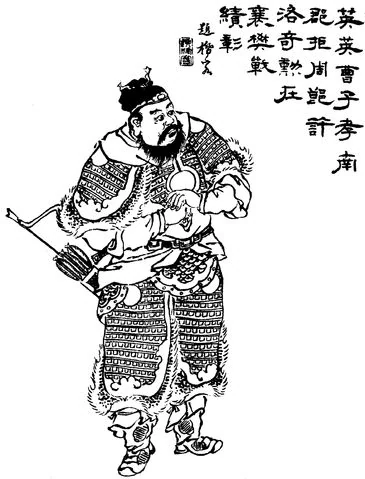
168 CE–223 CE
General
Cao Ren
曹仁
Cao Ren (168–May 6, 223), courtesy name Zixiao, was a native of Qiao County, Pei Commandery (present-day Bozhou, Anhui). He was a prominent Cao Wei general of the late Eastern Han and Three Kingdoms periods and a younger paternal cousin of Emperor Wu of Cao Wei, Cao Cao. From the beginning of Cao Cao's uprising, Cao Ren led his own followers to join him and repeatedly served as a cavalry vanguard. As a commander he was…
168 CE–223 CECao Wei
PROFILE
Cao Ren (168–May 6, 223), courtesy name Zixiao, was a native of Qiao County, Pei Commandery (present-day Bozhou, Anhui). He was a prominent Cao Wei general of the late Eastern Han and Three Kingdoms periods and a younger paternal cousin of Emperor Wu of Cao Wei, Cao Cao. From the beginning of Cao Cao's uprising, Cao Ren led his own followers to join him and repeatedly served as a cavalry vanguard. As a commander he was strict, orderly, and observant of military law, and was capable both in defense and attack. He resisted Zhou Yu for about a year in the Battle of Jiangling and later held the endangered city of Fancheng against Guan Yu until Xu Huang's relief force arrived and the two forces together drove Guan Yu back. After the establishment of Cao Wei, Cao Ren rose to Grand Marshal, was enfeoffed as Marquis of Chen, and received the posthumous title Marquis Zhong. He died in 223, the fourth year of Huangchu, at the age of fifty-six by traditional reckoning.
- Aliases
- Courtesy name Zixiao; Grand Marshal
- Courtesy name
- Zixiao
- Period
- Cao Wei
- Date of Birth
- 168 CE(1st year of the Jianning era)
- Date of Death
- May 6, 223 CE(4th year of the Huangchu era, 3rd month)
- Dynasty/Polity
- Cao Wei
- Role
- General
- Ethnicity
- Not recorded in historical sources
- Ancestral home
- Qiao County, Pei Commandery (present-day Bozhou, Anhui)
- Place of birth
- Not recorded in historical sources
- Major achievements
- Kinsman of Cao Cao and one of the foremost Cao clan commanders; resisted Guan Yu at the Battle of Fancheng and eventually rose to Grand Marshal.
LIFE TIMELINE
In his twenties | Secretly gathered more than a thousand young men and operated between the Huai and Si rivers
Age twenty-six | Joined the campaign in Xu Province, defeated Tao Qian's subordinate Lü You, and rejoined the main army at Pengcheng
Age twenty-eight | Separately attacked Juyang and captured Lü Bu's officer Liu He alive
Age twenty-nine | Appointed Administrator of Guangyang; Cao Cao valued his courage and strategy and kept him close as a Consultant supervising cavalry rather than sending him to the commandery
Age thirty-one | Joined the campaign against Zhang Xiu and raided surrounding counties; when Cao Cao's withdrawing army was hard pressed, rallied the troops and helped defeat Zhang Xiu
Age thirty-three | During the Battle of Guandu drove off Liu Bei, defeated Han Xun at Jiluo Mountain, and joined Shi Huan in burning Yuan Shao's grain transports
Age thirty-eight | Took part in the siege of Huguan; advised Cao Cao to leave the defenders a route to surrender, after which the city capitulated; enfeoffed as Marquis of Duting
Age forty-one | Joined the pacification of Jing Province and acted as General Who Conquers the South; after the Battle of Red Cliffs was left to defend Jiangling
Age forty-two | In the Battle of Jiangling rescued Niu Jin from encirclement; his troops admired his courage and he was enfeoffed as Marquis of Anpingting
Age forty-four | Acted as General Who Pacifies the West, commanded generals defending Tong Pass, and helped defeat Ma Chao at Weinan
Age forty-five | Acted as General of Agile Cavalry and commanded seven armies in defeating the rebellion of Su Bo and Tian Yin
Age forty-nine | Joined the campaign against Sun Quan
Age fifty-one | Garrisoned Fancheng and guarded Jing Province; in the tenth month Hou Yin rebelled at Wan, and Cao Ren besieged the city
Age fifty-two | Took Wan after a four-month siege, killed Hou Yin, and was formally appointed General Who Conquers the South
Age fifty-two | Took Wan after a four-month siege, killed Hou Yin, and was formally appointed General Who Conquers the South
Age fifty-three | After Cao Pi succeeded to power, appointed General of Chariots and Cavalry and advanced to Marquis of Chen
Age fifty-four | Appointed General-in-Chief
Age fifty-five | Promoted to Grand Marshal and led troops against Wu; defeated by Zhu Huan at the Battle of Ruxu
Age fifty-six | Died of illness and received the posthumous title Marquis Zhong
BIOGRAPHY
Biography
Family Background and Early Life
Cao Ren was from Qiao County in Pei Commandery and belonged to the prominent Cao clan. His grandfather Cao Bao served as Administrator of Yingchuan. His father Cao Chi served as Palace Attendant and Commandant of the Changshui Cavalry and, because of Cao Ren's achievements, was later granted the posthumous title Marquis Mu of Chen, with ten households assigned to maintain his tomb. Cao Ren and Cao Cao were paternal cousins; his full younger brother Cao Chun also became a Cao Wei general. In youth Cao Ren was not known for disciplined conduct. He enjoyed archery, horsemanship, and hunting and paid little attention to conventional standards of behavior. When the Eastern Han fell into disorder, he privately gathered more than a thousand young men and operated between the Huai and Si rivers, becoming the leader of a local armed group. He later led his followers to join Cao Cao, serving as a Detached Major and acting Colonel of Sharp Vanguard. From then on he became one of the core clan officers of Cao Cao's early rise.
Campaigns across the Realm (193–207)
After joining Cao Cao, Cao Ren immediately took part in military campaigns. In 193, the fourth year of Chuping, he fought in Cao Cao's campaign against Yuan Shu and took many captives. Later that year, when Cao Cao campaigned east in Xu Province, Cao Ren frequently commanded cavalry as a front-line vanguard. He separately attacked Tao Qian's subordinate Lü You, defeated him, and then rejoined the main army at Pengcheng, where Cao Cao inflicted a major defeat on Tao Qian's forces. Cao Ren then joined attacks on Fei, Hua, Jimo, Kaiyang, and other places. Tao Qian sent separate forces to relieve the counties, but Cao Ren defeated them with cavalry. In 195, the second year of Xingping, during Cao Cao's campaign against Lü Bu, Cao Ren separately attacked Juyang, captured the city, and took Lü Bu's officer Liu He alive.
In 196, the first year of Jian'an, after Cao Cao had pacified Yellow Turban forces and received Emperor Xian at Xu County, Cao Ren was appointed Administrator of Guangyang in recognition of repeated military achievements. Cao Cao, however, valued his courage and strategy and did not send him to assume the commandery post, instead keeping him nearby as a Consultant supervising cavalry. In 198, the third year of Jian'an, Cao Ren joined the campaign against Zhang Xiu and separately raided surrounding counties, capturing more than three thousand men and women. When Cao Cao withdrew and Zhang Xiu pursued, morale fell. Cao Ren rallied the soldiers and restored their fighting spirit, helping bring about Zhang Xiu's defeat. Cao Cao praised his actions. In 199, Cao Ren crossed the Yellow River with Shi Huan, Yue Jin, Yu Jin, Xu Huang, and others to attack Sui Gu. They defeated him decisively; Shi Huan killed Sui Gu, and his followers were taken over.
In 200, the fifth year of Jian'an, the Battle of Guandu began. Yuan Shao sent Liu Bei to operate around Yinxiang, and many counties south of Xu County rose in response, greatly troubling Cao Cao. Cao Ren argued that Liu Bei had only recently taken command of Yuan Shao's troops and had not yet gained their full loyalty, so a quick strike could defeat him. Cao Cao agreed and sent Cao Ren with cavalry. Liu Bei was driven off, and Cao Ren recovered all the rebellious counties. Yuan Shao then sent the general Han Xun to threaten the Cao army's western communications, but Cao Ren defeated him at Jiluo Mountain. Yuan Shao thereafter did not again dare to send out a separate force in that direction. Cao Ren and Shi Huan also intercepted Yuan Shao's grain convoys and burned the supplies.
In 205, after Hebei had been largely pacified, Cao Ren joined the siege of Gao Gan at Huguan. Cao Cao announced that everyone in the city would be buried alive once it fell, but months of assault failed. Cao Ren remonstrated that a besieged city had to be shown a route of survival: if the defenders believed surrender meant certain death, they would fight to the end. Since the city was strong and well supplied, a direct assault would merely cost soldiers and keep the army stalled before a fortified place. Cao Cao accepted the advice, and the defenders then surrendered. In recognition of his accumulated achievements, Cao Ren was enfeoffed as Marquis of Duting.
Holding Jiangling against Zhou Yu (208–209)
In 208, the thirteenth year of Jian'an, Cao Cao campaigned south into Jing Province and Cao Ren accompanied him, acting as General Who Conquers the South. After Cao Cao's defeat at the Battle of Red Cliffs, Cao Ren was left to defend Nan Commandery, whose seat was Jiangling. Zhou Yu and Cheng Pu led tens of thousands of troops and confronted Cao Ren across the river. Zhou Yu first sent Gan Ning to occupy Yiling. Cao Ren detached troops to attack Yiling, but Zhou Yu, Lü Meng, and others defeated them. Zhou Yu then crossed the river, established his army on the northern bank, and continued the confrontation.
In 209, the fourteenth year of Jian'an, Zhou Yu brought tens of thousands of troops against Nan Commandery, with several thousand in the vanguard. Cao Ren watched from the city wall, recruited three hundred men, and sent his subordinate commander Niu Jin to meet the attack. Vastly outnumbered, Niu Jin became surrounded. Seeing Niu Jin and his men in danger, Cao Ren became furious and ordered his attendants to bring his horse. Chief Clerk Chen Jiao and others tried to restrain him, but Cao Ren ignored them, put on his armor, mounted, and led several dozen elite riders out of the city. He crossed the defensive ditch, broke into the encirclement, and rescued Niu Jin. Seeing that not all the trapped soldiers had escaped, he charged back in again and brought out the remainder, losing only a few men before the Wu troops withdrew. Chen Jiao and the others exclaimed that the general was “truly a man of heaven.” The entire army admired his courage, and Cao Cao, valuing him all the more, enfeoffed him as Marquis of Anpingting.
Later Zhou Yu and Cao Ren agreed on a date for battle. Zhou Yu rode forward to inspect the lines and was struck in the right side by a stray arrow, suffering a serious wound and withdrawing to camp. When Cao Ren learned that Zhou Yu could not rise because of the injury, he personally led troops before Zhou Yu's camp. Zhou Yu then forced himself to appear before his soldiers and encouraged them, whereupon Cao Ren withdrew. The two sides remained opposed for more than a year, with heavy Cao army losses. Cao Ren ultimately abandoned Jiangling, and Nan Commandery passed to Sun Quan.
Opposing Ma Chao in the West and Guarding Jing Province in the South (211–218)
In 211, the sixteenth year of Jian'an, Cao Cao campaigned in the Guanzhong region. Cao Ren acted as General Who Pacifies the West and commanded the generals defending Tong Pass. Cao Cao warned the defenders that the western troops were fierce and that they should hold their fortifications rather than engage prematurely. Cao Ren held until Cao Cao's main force arrived and took part in the Battle of Weinan, in which Ma Chao was defeated. Later, Su Bo and Tian Yin rebelled in Hejian, Ji Province. Cao Ren acted as General of Agile Cavalry and commanded seven armies in suppressing the revolt.
In the tenth month of 216, the twenty-first year of Jian'an, Cao Ren joined Cao Cao's campaign against Sun Quan. In the third month of the following year, Sun Quan sent an envoy seeking submission, and Cao Cao left Xiahou Dun, Cao Ren, Zhang Liao, and others at Juchao. Cao Ren later left Juchao, garrisoned Fancheng, and assumed responsibility for the defense of Jing Province. He was strict and orderly in command and kept written regulations beside him, conducting affairs according to them. In 218, while Cao Pi was still in the Eastern Palace, he wrote to admonish Cao Zhang: “In commanding an army and observing the law, should one not be like the General Who Conquers the South?” Cao Ren was thus held up as an example among the imperial clan's generals.
Suppressing the Rebellion at Wan (218–219)
In the tenth month of 218, the twenty-third year of Jian'an, heavy corvée demands were imposed in Jing Province under Cao Ren's authority. Hou Yin, the defender of Wan, and local officials and residents, unable to bear the burden, rebelled together. They seized several thousand people from nearby commanderies and counties and allied themselves with Guan Yu. Cao Ren was then campaigning against Guan Yu and stationed at Fancheng. On hearing of the rebellion, he led troops to besiege Wan. In the first month of 219, after a four-month siege, he took and sacked the city, killed Hou Yin, returned to Fancheng, and was formally appointed General Who Conquers the South.
The Defense of Fancheng (219)
In 219, the twenty-fourth year of Jian'an, Guan Yu launched his northern campaign, attacking Xiangyang, defended by Lü Chang, and Fancheng, defended by Cao Ren. Cao Ren ordered Pang De to camp ten li north of Fancheng, but the ground there was low and especially vulnerable to flooding in the rainy season. Guan Yu took advantage of the swollen Han River and used naval forces to surround the city. Yu Jin's seven armies, numbering thirty thousand men, were inundated and destroyed. Fancheng itself was flooded. Cao Ren had only several thousand men and placed planks on the portions of the city not yet submerged while Guan Yu surrounded it by boat. Supplies were nearly exhausted, relief had not arrived, communication with the outside was cut, and morale fell.
Cao Ren considered withdrawing, but Man Chong argued that Fancheng was strategically vital and that the floodwaters would not last, urging him to hold out for relief. Cao Ren therefore rallied the defenders and declared his determination to die in place. Morale recovered. Xu Huang eventually arrived with a relief army, and as the waters began to recede, Cao Ren and Xu Huang attacked from different directions. Guan Yu withdrew, and the siege of Fancheng was lifted.
Founding of Cao Wei and Final Years (220–223)
In 220, the twenty-fifth year of Jian'an, Cao Cao died and Cao Pi succeeded as King of Wei. Cao Ren was appointed General of Chariots and Cavalry, given command over military affairs in Jing, Yang, and Yi Provinces, and advanced to Marquis of Chen. Two thousand households were added to his fief, bringing the total to 3,500, and he later returned to garrison Wan. During Guan Yu's earlier siege, Sun Quan's general Chen Shao had occupied Xiangyang. Cao Ren was ordered to attack him and, together with Xu Huang, decisively defeated Chen Shao and entered Xiangyang. He then sent General Gao Qian and others to relocate people south of the Han River to its northern bank.
On the ji-mao day of the eleventh month of 221, the second year of Huangchu, Cao Pi appointed Cao Ren General-in-Chief and ordered him to move his garrison to Linying. In 222, the third year of Huangchu, Cao Ren was promoted to Grand Marshal, commanded troops at Wujiang, and later stationed at Hefei.
That same year Cao Pi launched a campaign against Wu, and Cao Ren led an army against Ruxukou. The Wu general Zhu Huan held the city. Cao Ren ignored Jiang Ji's remonstrance and attacked rashly, suffering a severe defeat at Zhu Huan's hands and heavy losses. The Chinese source states that Cao Ren was deeply ashamed and distressed and soon fell ill. On the ding-wei day of the third month of the fourth year of Huangchu (May 6, 223), he died at the age of fifty-six and received the posthumous title Marquis Zhong. On the ren-shen day of the fifth month of the first year of Qinglong (June 7, 233), Cao Rui honored Cao Ren, Xiahou Dun, and Cheng Yu for their achievements with sacrificial placement in Cao Cao's ancestral temple.
Cao Ren, courtesy name Zixiao, was a cousin of Cao Cao. Fond of bow and horse and of hunting as a youth, at the collapse of the Han he gathered a thousand young men in secret and moved about between the Huai and the Si; he then followed Cao Cao as marshal of a detached command and acting colonel of the sharp edge. He took many heads in Cao Cao's campaign against Yuan Shu; in the campaign against Xu he often led the armoured horse as vanguard, and with a detached force broke Lü You, a general of Tao Qian, the governor of Xu, after which he rejoined the main army at Pengcheng and heavily defeated Tao Qian's troops. He then helped take the counties of Fei, Hua, Jimo and Kaiyang, beating the officers Tao Qian sent to their relief.
Against Lü Bu, Cao Ren took Juyang by storm and captured Lü Bu's general Liu He alive. When Cao Cao put down the Yellow Turbans and brought the emperor to Xu, Cao Ren, having won merit repeatedly, was made governor of Guangyang; but Cao Cao, prizing his courage and skill, would not send him to his commandery and kept him with the rank of counsellor in charge of cavalry. In the campaign against Zhang Xiu he raided the neighbouring counties and took more than three thousand men and women; and when Cao Cao's army withdrew and was pursued by Zhang Xiu so that the troops lost heart, Cao Ren roused and encouraged his officers and men, and Cao Cao, admiring it, broke Zhang Xiu at last.
In the fourth month of 199 the army advanced to the Lin river, and Cao Ren with Shi Huan, Yue Jin, Yu Jin and Xu Huang crossed to attack Sui Gu. Sui Gu left Zhang Yang's former chief secretary in Shequan and went north himself to seek help from Yuan Shao, but met Cao Ren and the others at Quancheng; battle was joined, Cao's side won heavily and Sui Gu was killed. When others afterwards rose for Yuan Shao and raided the country about Xu, and Yuan Shao sent Liu Bei to take Yinjiang, the neighbouring counties coming over to him in numbers so that the officials and people south of Xu were much alarmed, Cao Ren advised that the southern counties thought the army had its hands full at Guandu and could not help them, and that having Liu Bei with a great army at their borders their defection was natural; but that Liu Bei had only lately taken command of Yuan Shao's troops and could not yet use them well, so that one blow would break him. Cao Cao agreed, sent Cao Ren with cavalry against Liu Bei, drove him off and recovered all the rebel counties.
In the years that followed Cao Ren was one of the commanders on whom Cao Cao most relied, holding a front on his own. After the battle of the Red Cliffs he was charged with holding Jiangling and stood for a year against the allied forces of Sun and Liu; though he finally withdrew from the south of Jingzhou, he held the Xiangyang line for Wei. In 211, when the generals within the passes rose, he went west with Cao Cao; and in 219, when Guan Yu marched north and besieged Fancheng, Cao Ren as general of the south held the city and with the relieving force under Xu Huang beat Guan Yu off, saving Xiangyang and Fancheng. The action bore heavily on the situation of the time: Guan Yu's downfall and the change of hands in Jingzhou are bound up with the failure to take Fancheng.
After Cao Pi took the throne in 220 Cao Ren was made general of chariots and cavalry, then general-in-chief, and at last grand marshal and marquis of Chen, one of the highest of the imperial kinsmen in arms at the founding of Wei. Strict in discipline and steady in the field, he was relied on by two generations. He died in 223 with the posthumous name Zhonghou. In the Records of the Three Kingdoms he appears as the veteran of weight and steadiness, one of the great generals of Wei with Zhang Liao and Xu Huang; in later fiction and opera his figure centres on the defence of Fancheng.
His defence of Jiangling after the Red Cliffs best shows his standing in the army. Zhou Yu came against the city with tens of thousands; Cao Ren sent his officer Niu Jin out with three hundred men, and Niu Jin was surrounded. Cao Ren, seeing it from the wall, rode out himself with a few dozen horsemen, broke into the ring, brought Niu Jin and the survivors out, charging in and out three times and carrying all before him. The officers and men in the city were aghast to see him go out in person, and when he came back unharmed the whole army admired him; Chen Jiao and the others said that the general was a man of Heaven. Unable to hold on with his numbers, he afterward gave up Jiangling and fell back on Xiangyang, keeping the Jing and Xiang line for Wei.
In 211, when Cao Cao went west against the region within the passes, Cao Ren as general of the west commanded the generals holding Tongguan and took part in the campaign against Ma Chao and Han Sui. In 219 Guan Yu marched north from Jingzhou and besieged Fancheng; the Han river rose and the seven armies of Yu Jin were drowned and destroyed, and Fancheng stood alone with only a few thousand men and walls much of them under water. Cao Ren with Man Chong encouraged the garrison to hold to the death, and only when Xu Huang came up with the relief did they beat Guan Yu off together. After that action Wei's defence at Xiangyang and Fancheng was secure, and Guan Yu fell through the loss of his rear.
After Cao Pi took the throne Cao Ren was made general of chariots and cavalry, then general-in-chief, and at last grand marshal and marquis of Chen, the highest of the imperial kinsmen in arms. He died in 223 with the posthumous name Zhonghou, his son Cao Tai inheriting. Among the generals of Wei he was known for steadiness and fidelity to his charge, holding a front for long periods with few defeats; later discussion of Wei's military affairs commonly sets him with Xiahou Dun and Zhang Liao as a chief support of Cao Cao's establishment.
Cao Ren's family carried weight in the early Wei: his younger brother Cao Chun and his kinsman Cao Hong were likewise great ministers of the house, and his son Cao Tai inherited his rank and held office under Wei. Later judgment of Cao Ren dwells chiefly on his daring in rescuing his officer at Jiangling and his composure in holding Fancheng, holding him a commander of both courage and judgment and one of the steadier leaders in Cao Cao's following. His biography in the Records of the Three Kingdoms records that he won merit repeatedly and that he roused his officers and men with vigour, words often cited by later ages for the authority he held in the army.
Major Activities
Military Ability
Cao Ren participated in many of the crucial military operations of Cao Wei, from Cao Cao's early campaigns in Xu Province and against Lü Bu and Zhang Xiu, through the Battle of Guandu and the defense of Jiangling after Red Cliffs, to the campaign against Ma Chao at Weinan and the defense of Fancheng against Guan Yu. The Chinese source characterizes him as both an able attacker and an especially strong defender, capable of stabilizing morale and reversing dangerous situations. At Jiangling he led only several dozen riders into an enemy encirclement to rescue Niu Jin, prompting Chen Jiao to call him a “man of heaven.” At Fancheng he held a flooded and nearly isolated city with only a few thousand exhausted men until relief arrived. Fu Xuan's Fuzi states that even the legendary warriors Meng Ben and Xia Yu could not surpass the courage of Grand Marshal Cao, with Zhang Liao ranked next.
Strategic Advice
Cao Ren was not merely courageous but also capable of strategic judgment. During the Battle of Guandu, he correctly assessed that Liu Bei had only recently taken command of Yuan Shao's troops and had not secured their full loyalty, and he recommended a rapid attack. Cao Cao accepted the proposal and defeated Liu Bei, stabilizing the area south of Xu. At Huguan, Cao Ren urged Cao Cao to “show a besieged city a route of survival,” replacing a strategy of costly assault with one that encouraged surrender. Both recommendations were accepted and produced practical results.
Frontier Defense
Cao Ren spent long periods responsible for Cao Wei's southern defenses, successively guarding Jiangling, Fancheng, Xiangyang, and other strategic places and helping construct the regime's southern defensive line. As General Who Conquers the South, he was strict in the observance of military law, keeping regulations close at hand and acting according to them. Cao Pi explicitly used Cao Ren as an example when admonishing Cao Zhang on lawful military command.
Suppression of Rebellions
Cao Ren repeatedly suppressed regional revolts. After the sixteenth year of Jian'an, Su Bo and Tian Yin rebelled in Hejian, Ji Province; Cao Ren acted as General of Agile Cavalry and commanded seven armies in defeating them. From the twenty-third to the twenty-fourth years of Jian'an, Hou Yin's rebellion at Wan was besieged for four months; Cao Ren took and sacked the city, killed Hou Yin, and stabilized Jing Province.
Personal Relations
- Grandfather: Cao Bao, Administrator of Yingchuan
- Father: Cao Chi, Palace Attendant and Commandant of the Changshui Cavalry; posthumously Marquis Mu of Chen
- Paternal cousin: Cao Cao, Emperor Wu of Cao Wei
- Younger brother: Cao Chun, full younger brother and Cao Wei general
- Elder sister: Lady Cao, married Song Qi (brother of Empress Song of Emperor Ling of Han)
- Sons: Cao Tai (succeeded to the marquisate and rose to General Who Guards the East), Cao Kai, Cao Fan
- Grandson: Cao Chu (son of Cao Tai)
- Xu Huang: fought alongside Cao Ren in the Jiangling and Fancheng campaigns
- Man Chong: urged Cao Ren to hold Fancheng until relief arrived
- Shi Huan: joined Cao Ren in intercepting Yuan Shao's grain convoys at Guandu
- Yu Jin: led the seven armies sent to relieve Cao Ren at Fancheng and was overwhelmed by the flood
- Pang De: ordered by Cao Ren to camp north of Fancheng and later killed during the Fancheng campaign
- Niu Jin: subordinate commander rescued by Cao Ren from encirclement at Jiangling
- Chen Jiao: Cao Ren's Chief Clerk, who praised him as a “man of heaven” at Jiangling
- Zhou Yu: opposed Cao Ren for about a year in the Battle of Jiangling
- Guan Yu: flooded Yu Jin's seven armies and besieged Cao Ren at Fancheng
- Zhu Huan: defeated Cao Ren at the Battle of Ruxu
- Liu Bei: driven off by Cao Ren during the Guandu campaign
- Ma Chao: defeated by Cao Ren and other commanders at Weinan
Historical Assessment
Wei and Jin Periods
- Chen Shou in the Records of the Three Kingdoms wrote that the Xiahou and Cao families had long been related by marriage and that Xiahou Dun, Xiahou Yuan, Cao Ren, Cao Hong, Cao Xiu, Xiahou Shang, Cao Zhen, and others, as intimate kinsmen and trusted retainers, were highly honored and all rendered notable service. He also wrote that Cao Ren, though undisciplined in youth, became a strict commander who observed laws and regulations and kept military statutes beside him for ready reference.
- Chen Jiao: “The general is truly a man of heaven!”
- Cao Pi: “In commanding an army and observing the law, should one not be like the General Who Conquers the South?”
- Cao Zhi praised Cao Ren's combined civil and military qualities, timely judgment, moderation in luxury and frugality, service as a pillar of the imperial house, and ability to govern the eastern regions as a great lord.
- Fu Xuan's Fuzi: “The courage of Grand Marshal Cao was not surpassed by Meng Ben or Xia Yu. Zhang Liao came next.”
Northern and Southern Dynasties through Tang and Song
- Chu Liang compared Cao Ren's intelligence and courage favorably with celebrated commanders of antiquity.
- Li Shangyin, in a later literary assessment, invoked Cao Ren among historical commanders in reflecting on talent, opportunity, defeat, and the fate of military men.
Song, Yuan, Ming, and Qing Periods
- Hao Jing used Cao Ren's defense of Fancheng, together with Hao Zhao's defense of Chencang and Zhang Te's defense of Xincheng, as examples of how a commander should hold a fortified city: stabilize morale, preserve strength, maintain supplies and discipline, and demonstrate a willingness to die rather than abandon the position.
- The Shuchao quotes a text attributed to Cao Zhi praising Cao Ren's civil and military brilliance, timely wisdom, moderation, and service as a pillar of the imperial house and protector of the eastern regions.
Modern Assessments
- Modern scholars commonly regard Cao Ren as one of the most militarily capable members of the Cao clan, with defensive ability among the strongest of the Three Kingdoms period. The Chinese source characterizes his months-long defense of Fancheng under extremely unfavorable conditions as buying crucial time for Cao Wei's Jing Province defense and as an important episode in the formation of the tripartite balance of power.
- Zhu Huan of Eastern Wu argued before the Battle of Ruxu that victory depended on the commander rather than numbers, claimed that Cao Ren was neither wiser nor braver than himself, and emphasized the fatigue of Cao Ren's troops and Wu's strong defensive terrain. Although the speech was intended to encourage Wu morale, the source notes that it indirectly reflects Cao Ren's formidable reputation.
FIGURES ASSOCIATED WITH THIS DYNASTY
Bibliography
- Records of the Three Kingdoms, Book of Wei, Biography of Cao Ren
- Records of the Three Kingdoms, Book of Wei, WuDiJi
- Records of the Three Kingdoms
- Records of the Three Kingdoms, Book of Wu, Biography of Zhu Huan