Chinese Coordinates
—
Western / Mediterranean Coordinates
From the commercial zenith of the Macedonian dynasty in the Byzantine Empire to the rise of merchant credit at the Champagne fairs in medieval Europe, extending to the 1789 French Revolutionary assignat crisis
TL;DR · Core Takeaways
- During the early Northern Song, the imperial court withdrew bronze coins from Sichuan and compelled residents to trade with heavy iron coinage, prompting wealthy merchants to issue paper deposit receipts that the state soon nationalized into history's first government-backed fractional-reserve currency.
- Prolonged frontier wars generated massive budget deficits, driving the court to abandon its own reserve rules, overprint unbacked currency for military provisions, and refuse to accept those depreciated notes at full face value in tax collections.
- Because imperial China lacked an independent central bank or public fiscal oversight, note bureaus operated as wartime cash registers for the throne, turning convenient commercial bills into engines of hyperinflation.
> Historical Coordinates
> - Chinese Historical Coordinates: 1st year of the Tiansheng era of the Northern Song (1023 CE, establishment of the official Jiaozi agency in Yizhou) to the 16th year of the Zhizheng era of the Yuan Dynasty (1356 CE, complete breakdown of the Zhizheng banknotes)
01. Statutory Intent vs. Ground-Level Reality: From Private Deposit Receipts to Imperial Cash Register
At first, imperial officials established strict legal rules to protect paper money. In 1023 CE, the first year of the Tiansheng era, the government opened an official Jiaozi agency in Yizhou to take over the private promissory system pioneered by sixteen wealthy merchant houses in Sichuan. Under this statute, each batch of notes expired after a three-year cycle, requiring holders to exchange worn bills for freshly printed issues.
To preserve market confidence, the court capped each cycle at 1,256,340 strings of cash while holding 360,000 strings of iron coins in state vaults—a 28.65 percent reserve ratio. By law, Jiaozi Paper Money functioned simply as a lighter stand-in for bulky iron coins, and any merchant could walk into an official exchange desk to redeem his paper notes for metal coinage on demand.
Frontier warfare quickly shattered those statutory promises as military expenditure soared. During the Chongning era under Emperor Huizong, the court dismantled the strict three-year redemption limit to raise fast cash for border campaigns and grand palace projects. Instead of retiring expired issues, finance ministers circulated multiple cycles simultaneously and flooded the market with unbacked paper. Notes that had once traded at par across the Chengdu plain were now shipped by the cartload to northwestern garrison forts to pay frontier troops.
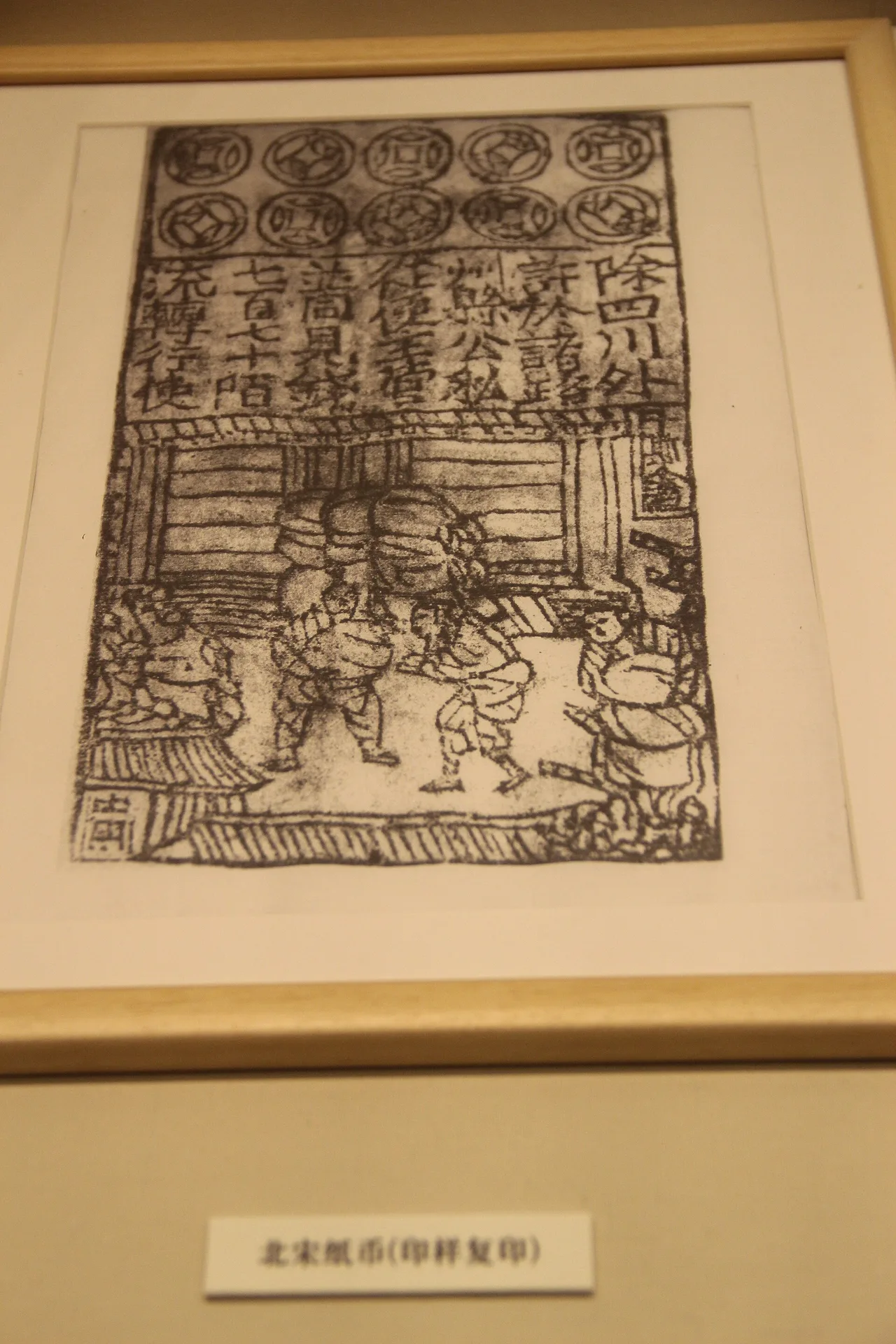
For local weavers, merchants, and farming households along the Shaanxi frontier and inside Sichuan, the vanishing metal reserves triggered immediate losses. When a silk weaver delivered fine textiles worth twenty thousand iron coins, army quartermasters paid him in heavily discounted paper notes that local markets refused to accept at face value.
Worse still, when that same weaver settled his grain taxes under the Ever-normal Granary system, state collectors demanded hard bronze or iron coin—or cut the paper note's accepted value in half. By paying suppliers in depreciating paper while insisting on metallic coin for taxes, the court systematically destroyed public confidence in its own currency.
The evolution of Jiaozi exposed a fundamental vulnerability in early fiat currency: while it began as a clever commercial solution to spare merchants from hauling heavy iron coins, placing the printing plates under unchecked imperial control turned paper currency into a covert mechanism for extracting private wealth.
02. Balancing the Ledger: Micro and Macro Balance Sheets Across the Song, Jin, and Yuan Dynasties
The rise and fall of paper money under the Song, Jin, and Yuan dynasties followed cold numbers. It was not just about moral failure. The ledger split into two stories: family survival and state survival.
The Microeconomic Ledger of Households and Local Officials: Depreciation Taxes and Forced Requisition
For free peasants, craft workers, and small traders, holding state paper was like paying a hidden tax.
Daily life suffered from three direct blows:
- Exchange fees: When people traded worn notes for fresh ones, officials took thirty coins per string. That was a three percent fee. Corrupt clerks often made up excuses during trade-in days. Real losses ran between five and eight percent.
- Forced grain sales: Under Emperor Lizong of Song, the state spent huge sums on resistance to the Mongols. It forced farmers in western Zhejiang and Jiangdong to sell grain to the army. The court paid them with weak Southern Song huizi notes. During the Baoyou era, a bushel of rice cost over three strings of bronze coin. In paper, that meant dozens or hundreds of old notes. Yet the state forced farmers to meet crop quotas at fixed, cheap paper rates. This policy pushed many family farms into ruin.
- Extra discounts by clerks: When folks tried to pay taxes with paper money, clerks made excuses. They said the paper was dirty, torn, or from an old cycle. They forced taxpayers to take a thirty to forty percent cut. Many smallholders had to sell land in a hurry just to get silver or bronze coins for tax bills.
Clerks and front-line troops suffered too. The Song military paid army wages in paper notes. In the late Northern Song, and later along the Yangtze in the late Southern Song, soldiers got pay in eighteenth-cycle huizi. A month of pay could not buy three days of food. Soldiers sold their pay slips to private money shops for pennies just to buy bread. As money lost value, soldiers deserted and army morale died.
The Macroeconomic Ledger of the Imperial Treasury: Seigniorage Windfalls and Military Deficits
Ministers loved paper money because it cost almost nothing to print, but bought real goods right away.
Minting bronze coins cost a lot of work and metal. Making a string of 770 to 1,000 bronze coins took pounds of copper, lead, and tin. It also took mining, carting, and coal. Making the coin cost seventy to eighty percent of its face value. Iron coins were even worse. Often, the iron cost more than the coin was worth.
Printing a one-string paper note was cheap. It took only mulberry paper, red seal paste, and ink. That cost under one percent of its face value. This gave the court a profit of over ninety-nine percent on every new note it put into the street.

When enemy armies marched on the border, the court stopped counting the cost and started printing:
| Dynasty and Paper Currency | Initial Reserves and Statutory Rules | Inflationary Shift and Peak Issuance | Market Depreciation | Final Fiscal Liquidation |
|---|---|---|---|---|
| Northern Song · Jiaozi Paper Money / Qianyin | Three-year cycles; quota fixed at 1.256 million strings; 360,000 strings in iron coin reserves (28.6% reserve ratio) | In 1105 (4th year of Chongning), official Cai Jing abolished cash reserves to fund frontier conflicts, printing over 26 million strings annually | Notes fell to 1% to 2% of face value; merchants rejected paper; commerce returned to bartering silk and grain | Northern Song collapsed in the Jingkang Incident; qianyin notes became worthless |
| Southern Song · Huizi | Quotas set during the Shaoxing era; pledged redemption funds and dedicated reserve pools | Massive military expenditure against the Mongols during the Jiaxi and Chunyou eras; cycle 18 surpassed 650 million strings with no coin backing | Each string bought only a few bronze coins; late Southern Song markets discounted paper completely; salaries became worthless | Southern Song fell after the Battle of Yamen in 1279; huizi paper became entirely void |
| Jin Dynasty · Jiaochao / Baoquan | Seven-year cycles shifted to indefinite currency; state vaults originally promised coin and silver redemption | Following the southward relocation of the capital to Kaifeng under Mongol siege, Jin officials renamed notes constantly, printing unbacked Zhenyou Baoquan | Ten thousand strings could not buy a bowl of soup or flatbread; troops burned notes on receipt; shops shuttered | Jin Dynasty fell in 1234; jiaochao paper money vanished from circulation |
| Yuan Dynasty · Zhongtong Banknotes / Zhizheng Banknotes | Kublai Khan established silver reserve balances; state exchanged notes for silver and prohibited private bullion trade | In 1350, Emperor Shun of Yuan issued Zhizheng Banknotes to finance Yellow River works and suppress the Red Turban Army | Millions of strings could not buy a peck of grain; populace traded in silver or bartered goods, treating notes as scrap paper | Ming northern campaign took the capital; the Yuan court fled north, leaving notes as worthless paper |
The fall of early paper money followed a clear path:
Border war grows worse / Imperial Court building costs drain vaults
       ↓
Regular land taxes run short (Treasury runs out of coin)
       ↓
Print limits dropped, coin payouts stopped (Unbacked printing starts)
       ↓
State buys military provisions and pays troops with paper notes
       ↓
Prices jump, money loses value, shops turn away paper notes
       ↓
Court threatens harsh jail terms, but tax desks refuse paper notes
       ↓
Public trust dies, trade goes back to silver and barter, paper fails
03. Shared Fiscal Traps: Structural Parallels Between Song Jiaozi and French Revolutionary Assignats
The crash of paper money was not unique to East Asia. Centuries later, the assignats printed during the French Revolution followed the very same path.
When the French Revolution began in 1789, the National Assembly faced huge royal debts and empty vaults. To keep the state afloat, lawmakers seized lands from the Church and the crown. They named them national property (Biens nationaux). In April 1790, the assembly issued 400 million livres of interest-paying notes called assignats.
These notes were backed by the seized land. The plan looked much like early Northern Song Jiaozi. Buyers could use assignats to buy church land at public sales. Then the state would burn the used notes. This was supposed to keep the money supply safe.
Yet war broke the French plan too. When foreign kings attacked, French army costs soared. The assembly dropped the interest payments and made assignats legal tender by force. It lifted print limits from 400 million livres to 800 million, then to 1.2 billion. By 1796, France had printed over 45 billion livres.
As prices soared, the French Republic tried the same fixes as the Song and Jin courts:
- Price caps and harsh laws: The Jacobin rulers passed the Law of the General Maximum (Loi du maximum général). They sent shopkeepers to the blade for refusing paper or saving gold. This was just like rules under Emperor Lizong of Song. His courts sent merchants into exile if they turned away huizi.
- Killing the currency: By 1795, an assignat was worth less than half a percent of its first price. A day of work could not buy a loaf of bread. In February 1796, the government broke the printing plates in public. It cast out the assignat and tried new land notes (mandats territoriaux). Those failed within months too.
Beneath these matching events lay two big differences in how power worked:
First, the backing assets were not equally liquid. Early Song and Jin notes sat on real coin reserves in state vaults. You could trade paper for iron or bronze coins on the spot. The assignat was tied to fixed real estate. Land took months to survey, split, and sell. You could not turn an acre of woods into food for a hungry soldier in an hour. So the assignat was hard to cash in from day one.
Second, budget checks were built differently. The French Assembly argued in public before printing notes. Men like Abbé Maury warned everyone that easy money would kill business credit. The assembly printed too much only after wartime fear silenced open debate.
In the Song, Jin, and Yuan states, note printing rested with the emperor, the Grand Councilor, and the Bureau of Military Affairs. Vault totals and print runs were palace secrets. There was no parliament, no free press, and no independent bank. When war threatened the dynasty, the court had nothing to stop it from running the printing press day and night.
Both medieval China and revolutionary France proved an enduring rule of monetary history: paper currency never derives its true stability from vault reserves or seized estates alone, but from institutional restraints that prevent a desperate government from paying its debts with the printing press.
Primary Sources & Historical Bibliography
- History of Song, "Treatise on Food and Money, Part 3: Huizi" (compiled by Tuotuo et al., Yuan Dynasty): Systematically records Southern Song fiscal data, detailing how issue limits collapsed, state reserve funds dried up, and market prices climbed from the Shaoxing era through the Baoyou and Chunyou periods.
- Long Draft of the Continuation of the Comprehensive Mirror to Aid in Government, Vol. 101 (compiled by Li Tao, Southern Song): Contains the historical entry for the first year of the Tiansheng era: "In the eleventh month, on the wuwu day, Xue Tian requested the abolition of private jiaozi bans... and established the official Jiaozi Oversight Agency in Yizhou." Preserves the original Memorials fixing the initial reserve of 360,000 strings of iron cash.
- History of Jin, "Treatise on Food and Money, Part 3: Paper Currency" (compiled by Tuotuo et al., Yuan Dynasty): Provides a comprehensive account of Jin currency experiments, covering the launch of jiaochao in 1154 through the hyperinflationary emissions of Zhenyou and Yuanguang notes during the Mongol invasions.
- History of Yuan, "Treatise on Food and Money, Part 5: Paper Currency" (compiled by Song Lian et al., Ming Dynasty): Documents the silver-backed reserve mechanism of the Zhongtong Yuanbao Jiaochao under Kublai Khan, alongside the fiscal failure of the Zhizheng Banknotes issued under Emperor Shun of Yuan in 1350.
- Peng Xinwei, A Monetary History of China (Shanghai People's Publishing House, 1958/2007 edition): Chapter 4, "Paper Money in the Song, Jin, Yuan, and Ming Dynasties," reconstructs commodity price indexes and purchasing power calculations for medieval paper currencies.
- Florin Aftalion, The French Revolution: An Economic Interpretation (Cambridge University Press, 1990): Analyzes the fiscal dynamics of the assignat, tracking its descent from asset-backed bond to unbacked paper currency and hyperinflation.