Merchant Consortium Founding Jiaozi Shops
Sixteen wealthy Chengdu merchant houses established a formal syndicate to standardize the private issuance of jiaozi.
Northern Song Dynasty (北宋) · HISTORICAL EVENT
交子
The Jiaozi (交子) was the earliest circulating paper currency in human history, originating in Yizhou (modern Chengdu, Sichuan) during the Northern Song dynasty and officially institutionalized by the imperial government between 1008 and 1024 (Tiansheng reign era). Following the conquest of Later Shu, the Song court prohibited copper coinage in Sichuan, mandating the exclusive circulation of heavy iron currency. Due to the minimal intrinsic value of iron…
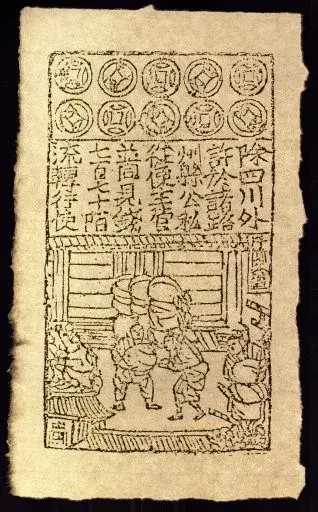
The Jiaozi (交子) was the earliest circulating paper currency in human history, originating in Yizhou (modern Chengdu, Sichuan) during the Northern Song dynasty and officially institutionalized by the imperial government between 1008 and 1024 (Tiansheng reign era). Following the conquest of Later Shu, the Song court prohibited copper coinage in Sichuan, mandating the exclusive circulation of heavy iron currency. Due to the minimal intrinsic value of iron relative to its weight, purchasing a single bolt of silk required roughly one hundred pounds of iron coin strings, severely impeding commerce across the thriving Sichuan Basin. To overcome this currency bottleneck, private Chengdu merchants developed lightweight credit deposit receipts called jiaozi. Around 1008, sixteen wealthy merchant houses organized a joint monopoly to standardize note issuance, which eventually collapsed due to reserve diversion and liquidity crises. In late 1023 (first year of Tiansheng), adopting the recommendations of Fiscal Vice-Commissioner Xue Tian, the imperial court established the official Yizhou Jiaozi Office, issuing sovereign banknotes backed by dedicated cash reserves in early 1024. The birth of Jiaozi marks the formal establishment of fiat paper currency in human civilization, representing a foundational milestone in global monetary and banking history.
Sixteen wealthy Chengdu merchant houses established a formal syndicate to standardize the private issuance of jiaozi.
Private shops diverted metal reserves into real estate, causing default crises and widespread legal disputes across Sichuan.
Prefect Kou Jian outlawed private jiaozi shops, inadvertently inducing a severe currency contraction and commercial paralysis.
Fiscal Vice-Commissioner Xue Tian memorialized the court to establish a state monopoly; Emperor Renzong approved the Yizhou Jiaozi Office.
The Yizhou Jiaozi Office distributed the first official banknotes, supported by a 360,000-string cash reserve and a three-year tranche cycle.
The Jiaozi Office standardized note production into fixed denominations of five and ten strings to facilitate retail commerce.
Emperor Shenzong expanded official jiaozi circulation into Shaanxi circuits to finance military operations along the Western Xia frontier.
Following the conquest of Later Shu in 975, the founder of the Song dynasty ordered all copper coins transferred from Sichuan to the imperial capital Kaifeng to prevent regional secession, mandating that Sichuan function as an exclusive iron-coin currency zone. However, iron coins possessed minimal intrinsic value relative to their substantial physical bulk. A standard string of one thousand large iron coins weighed twenty-five pounds, while a string of small iron coins weighed over ten pounds. Purchasing common bolts of silk or tea required hundreds of pounds of iron currency, forcing merchant caravans to hire oxcarts and dozens of porters solely to transport coin strings. Transportation costs routinely exceeded the value of traded commodities, creating a structural bottleneck for the regional economy.
The fertile Sichuan Basin had long been celebrated as the "Land of Abundance," leading the empire in sericulture, silk weaving, tea plantations, papermaking, and salt production. Chengdu functioned as one of China's premier commercial metropolises, serving as the central clearinghouse for regional trade and southwestern border tea-horse transactions with Tibet and the northwest. Specialized fairs for silk, herbal medicine, and silkworms operated continuously, transacting tens of thousands of coin strings daily. Heavy iron currency proved completely inadequate for supporting high-volume, rapid commercial turnover, organically driving market actors to devise innovative credit instruments.
The emergence of Jiaozi was rooted in earlier institutional practices of commercial credit. During the reign of Emperor Xianzong in the middle Tang, imperial agencies established "Flying Money" (Feiqian), enabling merchants to deposit metallic currency at capital treasuries in exchange for paper receipts redeemable across provincial commanderies. In the late Tang and Five Dynasties, private pawnbrokers, goldsmiths, and merchant houses widely utilized handwritten credit vouchers (chujuan and bianqian) bearing merchant seals and countermarks. These widespread commercial practices laid the structural foundation for transitioning from simple warehouse receipts to negotiable credit currency fulfilling the core functions of a circulating medium.
Between the Jingde and Dazhong Xiangfu eras of Northern Song, reputable merchant shops in Chengdu markets began offering specialized currency custody services, establishing proto-banking establishments termed jiaozi shops. Initially, jiaozi functioned purely as deposit warehouse receipts. Traveling merchants deposited heavy iron coins with trustworthy merchants, who transcribed the deposited sum onto sheets of high-grade paper, affixed proprietary seals and secret countermarks, and returned the voucher to the depositor. Depositors could redeem their metal currency upon demand for a standard service commission of thirty iron coins per string (a three percent fee).
As local familiarity expanded, market participants realized that carrying lightweight paper vouchers was vastly superior to hauling thousands of pounds of metallic coinage. Merchants began transferring the certificates directly to third parties to settle wholesale transactions without withdrawing physical coins. Through this informal market adaptation, jiaozi evolved from a passive warehouse custody receipt into an active credit currency possessing both payment and circulation functions, commonly designated as "Private Jiaozi."
Around 1008 (first year of Dazhong Xiangfu), widespread abuses arose as opportunistic individuals issued counterfeit notes or absconded with customer deposits, creating severe financial disruptions. To standardize market practices and restore commercial confidence, sixteen of Chengdu's wealthiest merchant houses, led by figures like Wang Changyin and Li Deshun, established a joint commercial guild with local government sanction, creating an exclusive cartel for note issuance.
The sixteen merchant houses established strict operating protocols. They agreed to print all notes on uniform sheets of premium mulberry paper using copper plates featuring elaborate motifs of buildings, human figures, and hidden countermarks. Notes required the joint signatures and seals of all sixteen member houses and were supported by pooled metallic reserves. This consolidation transformed jiaozi from fragmented shop receipts into a regulated, standardized commercial paper currency backed by substantial private capital reserves.
To prevent counterfeiting by opportunistic forgers, the sixteen Chengdu merchant houses invested substantial resources in material quality and security engraving. Notes were manufactured exclusively on high-grade mulberry bark paper produced in western Sichuan. This paper was remarkably tough, flexible, and resistant to wear and insects, creating an initial material barrier against forgery that ordinary rough hemp paper could not replicate.
For printing, the guild commissioned master woodblock carvers to produce intricate plates featuring complex depictions of pavilions, human figures, landscapes, and merchant caravans. Crucially, each note required handwritten signatures and secret countermarks in specialized ink by issuing merchants, alongside matching registry stamps across ticket margins, creating a multi-layered security system that made unauthorized duplication exceedingly difficult.
However, in the absence of external state auditing and mandatory cash reserve requirements, private financial syndicates proved susceptible to speculative greed. As jiaozi achieved near-universal circulation across Sichuan, the sixteen guild masters faced vast vaults filled with idle iron currency. Gradually disregarding prudent reserve margins, the merchants diverted customer deposits into speculative ventures, purchasing landed estates, erecting commercial hostelries, and issuing high-interest merchant loans.
Between 1017 and 1021 (Tianxi era), several prominent guild members suffered catastrophic investment losses, depleting the metallic reserves in their vaults. When seasonal merchants arrived during peak trade periods demanding physical iron currency, the guild defaulted, locking their doors. A massive financial panic erupted across Sichuan, sparking runs on banks and hundreds of lawsuits before magistrate courts. Public confidence in private notes collapsed, paralyzing regional commerce.
Confronting this financial turmoil, the Northern Song court appointed renowned administrator Zhang Yong as Prefect of Yizhou. Familiar with Sichuan's local conditions, Zhang punished defaulting merchants who embezzled customer deposits while attempting to establish municipal oversight over the guild. He assembled merchant leaders, ordered municipal registers established, and supervised debt repayments, stabilizing commercial panic.
Zhang recognized that paper credit was an organic development of the Sichuan economy that should not be impulsively eradicated. He experimented with granting official licenses and enforcing mutual liability among merchants, providing valuable precedents for subsequent state monopolies. However, following his reassignment, merchant disputes flared anew, culminating in civil riots where depositors stormed insolvent shops, demonstrating that voluntary private commercial discipline was insufficient.
In 1020 (fourth year of Tianxi), unyielding official Kou Jian assumed the prefecture of Yizhou. Observing continuous litigation and civil disorder, Kou concluded that paper vouchers were inherently fraudulent instruments that enabled wealthy merchants to exploit commoners. Without evaluating the broader economic repercussions, Kou enacted a draconian ban, forcibly closing all sixteen jiaozi shops, confiscating printing blocks, and criminalizing private note circulation.
Kou's prohibition triggered an immediate monetary contraction across Sichuan. Wholesale trade in tea, horses, silk, and herbal medicine collapsed as merchants found it impossible to transport hundreds of pounds of iron currency for major transactions. Commodities sat unsold and markets languished. The economic paralysis conclusively proved that paper money had become an indispensable structural component of Sichuan's economy that could not be suppressed by administrative decrees.
In 1022 (first year of Qianxing), seasoned administrator Xue Tian arrived as Fiscal Vice-Commissioner of Yizhou, working alongside new Prefect Ling Ce. Conducting extensive market surveys among merchants and commoners, Xue recognized the core reality: "The people of Sichuan cannot function without jiaozi; banning it paralyzes trade and depletes tax revenues. The underlying problem lies in private issuance lacking public trust. If the state monopolizes production with government credit, fraudulent defaults will vanish while state fiscal revenues expand."
In 1023 (first year of Tiansheng), Xue Tian and Ling Ce submitted their landmark memorial requesting the establishment of an official state agency in Chengdu to manage paper money. The memorial highlighted the severe economic damage caused by prohibition and the immense benefits of state monopolization. The proposal was reviewed by the State Finance Commission and endorsed by Chancellor Wang Zeng. On January 12, 1024 (twenty-eighth day of the eleventh month of Tiansheng 1), Emperor Renzong officially approved the petition, establishing the state-run Yizhou Jiaozi Office.
The founding of the Yizhou Jiaozi Office marked the establishment of the first specialized government agency in human history dedicated to the administration and issuance of sovereign paper currency. Situated in the commercial core of Chengdu, the office was directed by the Prefect or Vice-Prefect, supported by dedicated supervisors, printing masters, accounting officers, and security guards, organized into separate departments for paper manufacture, printing, treasury reserves, and redemption.
On March 13, 1024 (twentieth day of the second month of Tiansheng 2), the agency printed and distributed the first official legal tender banknotes (Guan Jiaozi). The initial issue was capped at 1,256,340 strings. Bearing official government endorsements, imperial reign marks, and fiscal seals, the notes were granted statutory legal tender status across Sichuan, accepted for tax payments and commercial trade alike.
To guarantee the unshakeable credibility of official banknotes and prevent private default panics, the Northern Song court established the earliest metallic cash reserve mechanism in global banking history. The imperial treasury allocated an initial cash reserve of 360,000 strings of iron coins into the vaults of the Jiaozi Office, establishing a solid reserve ratio of nearly twenty-nine percent against total circulation.
The agency instituted strict redemption rules: holders could redeem notes for physical iron coinage at face value upon demand at any time without discount or fees. Furthermore, during periods of monetary tightness, the government actively intervened in markets to repurchase notes and maintain price stability. Combining sovereign state backing with guaranteed cash convertibility, official jiaozi gained immense public confidence, banishing financial panic across southwestern China.
To prevent note degradation and restrain inflationary expansion, the Jiaozi Office devised the rigorous Tranche Rotation System (Jiefen). Notes were issued for three-year operational lifecycles, after which expired issues had to be redeemed for physical coin or exchanged for newly printed series. The maximum statutory issuance per tranche remained strictly capped at 1.25 million strings, with overlapping circulation windows to facilitate smooth redemption.
The tranche system functioned as the earliest macroeconomic mechanism for controlling money supply and limiting inflation in monetary history. By enforcing cyclical cancellations of expired currency, the state maintained transparent accounting of active money supplies and curbed administrative over-issuance, ensuring that Northern Song official jiaozi preserved stable purchasing power without depreciation over decades of use.
In manufacturing and security technology, the Jiaozi Office established global benchmarks for security printing. The court founded a dedicated imperial paper mill (Chaozhi Yuan) in Chengdu, enforcing strict security protocols over raw material sourcing, steaming, and sheet formation. The resulting mulberry paper was remarkably durable and bore subtle watermarks, with private manufacture punishable by capital execution under imperial law.
Printing was executed using high-precision bronze intaglio plates. Notes featured the agency's official title and denomination across the top, elaborate depictions of multi-story pavilions, landscapes, and processions in the center, and strict penal statutes against counterfeiting across the bottom. The office deployed an advanced two-color printing process combining vermilion and black inks with hand-signed official countermarks, creating an impregnable security barrier against unauthorized reproduction.
The success of official jiaozi in Sichuan inaugurated a centuries-long development of paper currency across East Asia. In 1072, during the Xining reforms of Emperor Shenzong, jiaozi circulation was extended into Shaanxi circuits to support logistics against the Western Xia. In 1107, the currency was reorganized as Qianying and distributed across the empire. Although late Northern Song fiscal mismanagement undermined reserve disciplines, the foundational mechanisms of Jiaozi remained enduring.
From a global perspective, Yizhou Jiaozi preceded the earliest European official banknotes issued by the Bank of Stockholm in 1661 by 637 years, and the Bank of England's notes by nearly seven centuries. It provided the institutional prototype for modern fiduciary paper currency and fractional reserve banking, demonstrating the extraordinary sophistication of Chinese civilization in monetary theory and financial governance.
The introduction of official jiaozi permanently eliminated the physical burden of transporting thousands of pounds of iron currency across mountain passes. Transaction costs decreased exponentially, enabling merchants to transfer capital across regional borders with lightweight vouchers. Jiaozi catalyzed large-scale trade in silk, tea, salt, and horses, cementing Chengdu's status as a preeminent commercial center and providing sustained liquidity for the Northern Song economy.
The Yizhou Jiaozi Office established institutional mechanisms that anticipated modern central banking by six centuries: first, enforcing a statutory twenty-nine percent cash reserve backing ratio; second, instituting the three-year tranche rotation system to prevent hyperinflationary expansion; and third, developing secure specialized paper mills and multi-colored intaglio copperplate printing. This sophisticated regulatory framework demonstrated an advanced understanding of monetary velocity and fiat circulation.
The success of Jiaozi laid the foundation for subsequent paper currency developments throughout East Asia. The system evolved into the Southern Song Huizi, the Jurchen Jin Jiaochao, and the unbacked national fiat currency of the Mongol Yuan dynasty (Zhongtong Baochao), which circulated across Eurasia. When Venetian merchant Marco Polo encountered Yuan banknotes, he described the printing process with wonder in his travels, introducing the concept of fiat credit currency to European merchants and scholars.
In Long Draft of the Comprehensive Mirror in Aid of Governance (Xu Zizhi Tongjian Changbian), Southern Song historian Li Tao documented the transition: "Originally, the people of Sichuan used heavy iron coins and privately created vouchers called jiaozi to facilitate commerce. Sixteen wealthy houses managed the trade, but as their fortunes declined, they defaulted, prompting continuous litigation. Xue Tian requested an official Jiaozi Office to eliminate private fraud. The court approved, the people found it convenient, and all under Heaven praised it as an excellent institution."
In Dream Pool Essays (Mengxi Bitan), Northern Song polymath Shen Kuo analyzed paper money security: "In the Sichuan jiaozi system, specialized mulberry bark paper is utilized, combining vermilion and black inks in alternating impressions to render forgery nearly impossible."
Modern economic historian Quan Hansheng observed in The Origin and Evolution of Paper Money in the Song Dynasty: "The creation of Jiaozi in Northern Song Sichuan constitutes one of the most brilliant landmarks in Chinese and global economic history. It not only shattered the millennia-old assumption that precious metals were the sole valid medium of exchange, but established the principles of fractional reserves, cyclical redemption, and sovereign credit management a thousand years ago, representing an extraordinary contribution to human civilization."