TL;DR · Core Takeaways
- Unilateral disarmament of regional defense: Emperor Wu of Jin dismantled provincial standing armies to avoid regional warlordism. Yet he granted twenty-seven imperial princes private armies and regional commands. This hollowed out the center while privatizing military force.
- Dynastic civil war introduces nomadic cavalry: The sixteen-year War of the Eight Princes exhausted food reserves and state funds. Rival princes hired Xiongnu and Xianbei cavalry. This destroyed the frontier shield.
- Irreversible systemic collapse: Between the slaughter of the imperial field army at Ningping in early 311 CE and the fall of Luoyang that summer, the central state lost its monopoly on violence. This shattered northern China and triggered the southward flight of the elite.
Historical Context
- Chinese Timeline: First year of the Taikang era (280 CE, Western Jin conquers Eastern Wu to unify China) to the first year of the Jianwu era (317 CE, Sima RuiSima Rui ascends the throne in Jiankang, inaugurating the Eastern Jin).
- Mediterranean / Western Timeline: Diocletian establishes the Tetrarchy (284–305 CE) to Constantine the Great convening the Council of Nicaea and preparing Byzantium as his new capital (313–324 CE).
01. Paper Prosperity and Structural Paralysis: The Self-Destruct Switch
In 280 CE, the Western Jin conquered Eastern Wu. This victory ended nearly a century of division following the fall of the Han dynasty. Archival records showed an empire in full bloom. During the Prosperity of the Taikang Era, census numbers reached twenty-five million people. State granaries were full, and Emperor Wu declared an empire-wide pardon. Yet only thirty-one years later, this unified realm fell apart. Fierce warfare and famine turned the Central Plains into an empty wasteland.
This rapid fall came from bad choices about the control of armed forces. When looking back at the fall of the Cao Wei dynasty, Emperor Wu thought the Cao emperors made a big mistake. They had stripped royal kin of military posts, leaving the throne with no defenders. Emperor Wu wanted to protect his own family line. In the very year of reunification, he enacted two conflicting policies:
[Emperor Wu's Strategic Paradox (280 CE)]
       |
       +---> Disarm Commandery Armies ---> Local magistrates retain only 50-100 constables
       |                                  (Regional administration left defenseless)
       |
       +---> Enfeoff 27 Sima Princes  ---> Grant standing princely armies (up to 5,000 men)
                                          Appoint princes as Prefectural Chiefs & Regional Commanders
                                          (Military command privatized in royal hands)
The court ordered the abolition of provincial and commandery garrisons. Large commanderies kept only one hundred constables. Small ones kept only fifty. Civilian magistrates had no real defense against bandits or surprise raids. At the same time, Emperor Wu enfeoffed twenty-seven Sima clan princes. He broke old Han and Wei customs that kept princes from ruling lands or leading troops. He gave senior principalities up to five thousand soldiers. He also named princes as Regional Commanders and Prefectural Chiefs. This concentrated military command, local taxation, and civil authority in royal hands.
This mix took away regional defenses. It also encouraged royal princes to turn private troops against Luoyang. Meanwhile, the Nine-Rank Controller SystemNine-Rank System for picking officials fell under the control of powerful magnates. A closed network formed. Top jobs went only to elite lineages, while lower scholars stayed at the bottom. The Western Jin court could not draft reliable foot soldiers. It also lacked the power to stop rich clans from grabbing taxable farmland.
02. Power Failure: The Chronological Chain of Collapse (308–313 CE)
The War of the Eight Princes (291–306 CE) ruined northern farming lands. Peasant levies ran dry. Princes like Sima Ying (the Prince of Chengdu) and Sima Yue (Prince of Donghai) hired settled Xiongnu allies and northern Xianbei horsemen as shock troops. Through years of bitter fighting, nomadic chiefs saw that the court was broke, divided, and weak.
flowchart TD
    Phase1["Phase 1 (308-310 CE)<br/>Fiscal Isolation & Siege of Luoyang"] --> Phase2["Phase 2 (Spring-Summer 311 CE)<br/>Ningping Slaughter & Fall of Luoyang"]
    Phase2 --> Phase3["Phase 3 (311-313 CE)<br/>Western Refuge Collapses & Southern Migration"]
Phase 1 (Winter 308 – Winter 310 CE): Fiscal Severance and Nomadic Encirclement
- Winter 308 CE: In Pingyang, the Xiongnu leader Liu Yuan named himself emperor of Han Zhao. Claiming descent from the Han royal line, he rallied displaced Chinese peasants and non-Han cavalry under his banner. His general Shi Le swept across Hebei, seizing granaries and absorbing local people.
- Autumn 309 CE: Han Zhao armies pushed to the gates of Luoyang twice. Guards fought off the attacks, but the invaders cut off grain routes from the Huai and Yangtze river valleys.
- November 310 CE: Facing famine and constant enemy pressure, General-in-Chief and Grand Tutor Sima Yue abandoned Emperor Huai of Jin (Sima ChiSima Chi). Sima Yue marched over forty thousand veteran troops east to Xuchang to find supplies. He left the capital guarded by sick, starving retainers. Central control collapsed outside the palace walls.
Phase 2 (Spring 311 – Summer 311 CE): The Ningping Annihilation and the Fall of Luoyang
- April 311 CE: Sima Yue died of illness in Xiangxian. With no unified leader, the officers began moving his coffin east toward his home fief in Donghai. They took most of the imperial court with them.
- May 311 CE: Shi Le trapped this slow column of over one hundred thousand soldiers, ministers, and refugees at Ningping City in Ku County. Mounted archers encircled the dense ranks of retreating troops, shooting down thousands. The imperial host fell into stampedes and faced total slaughter. Shi Le captured top officials, including Grand Commander Wang Yan and the Crown Prince of Chen. He killed them that night by knocking down a heavy earth wall over them. The Western Jin lost its last field army in one day.
- July 13, 311 CE: Han Zhao generals Huyan Yan and Liu Yao broke through the Daxia and Xuanyang gates of Luoyang. Emperor Huai of Jin tried to escape west toward Chang'an by boat along the Luo River, but cavalry captured him on the bank. Han Zhao troops sacked the capital, killed over thirty thousand princes, ministers, and commoners, looted ancestral tombs, and burned the imperial palace halls. The northern capital ceased to exist.
Phase 3 (Autumn 311 – Spring 313 CE): Collapse in the West and Southern Realignment
- Late 311 to 312 CE: Northern China broke into isolated pieces. In Bingzhou, Regional Inspector of Bingzhou Liu Kun formed a frontier alliance with Xianbei leader Tuoba YiluTuoba Yilu. But their ruined base at Jinyang lacked the supplies to move south. In Chang'an, loyalist remnants proclaimed Sima Ye as Crown Prince. They crowned him in 313 CE as Emperor Min of Jin.
- March 313 CE: In Pingyang, Liu Cong forced the captive Emperor Huai of Jin to serve wine to steppe chiefs in servant clothes during a banquet. He then killed him with poison.
- December 316 CE: Liu Yao laid siege to Chang'an. Food ran out, and the city fell into starvation and horror. Emperor Min of Jin surrendered bare-chested with a sheep on a lead. This ended the Western Jin royal line.
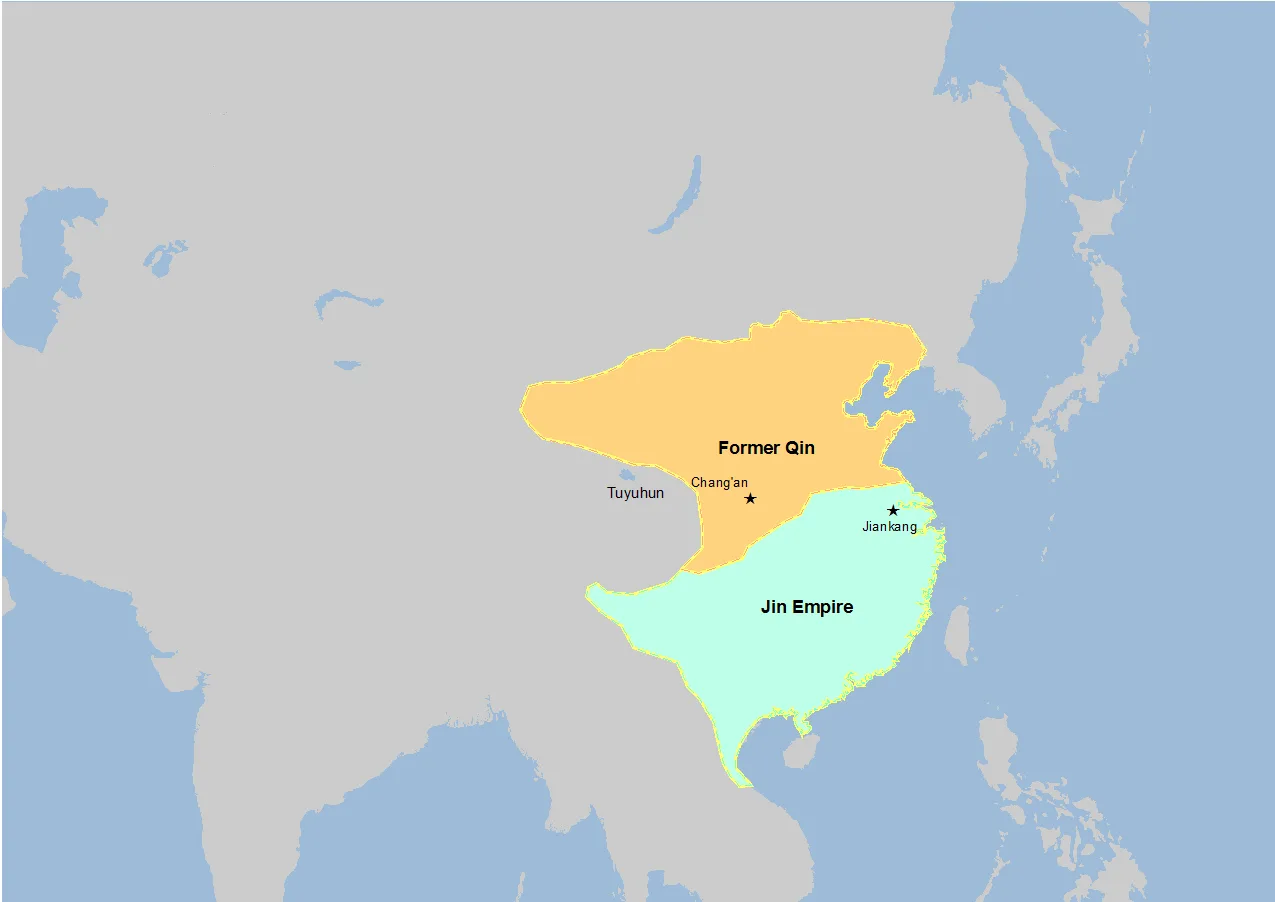
During these crises, Sima RuiSima Rui, the Prince of Langya and General Who Pacifies the East based at Jiankang, relied on emigrant clans like Wang Dao and Wang Dun. In 317 CE, Sima Rui founded the Eastern Jin. Northern gentry families and displaced commoners crossed the Yangtze River. This migration became known as the Southward Migration of the Jin NobilitySouthward Flight of the Nobility.
03. Breakdown of the Structural Safety Locks: Factional Power Matrix
The collapse was total because all four safety locks—legitimacy, military command, fiscal base, and strategic intelligence—broke at the same time.
| Political Faction / Power Bloc | Source of Legitimacy | Operational Military Command | Fiscal & Economic Foundation | Strategic Intelligence & Logistics | Root Cause of Structural Failure |
|---|---|---|---|---|---|
| Isolated Crown at Luoyang (Emperor Huai of Jin) | Nominal holder of Heaven's mandate; sole authority to issue imperial edicts | Reduced to several thousand starving palace guards; zero strategic reserves | Complete exhaustion of treasuries; canal transport cut; city descends into famine | Edicts cannot travel beyond 50 miles; blind to troop movements beyond passes | Divorce of Legitimacy and Coercion: Without taxable territory or an imperial army, the emperor became a prize for warlords. |
| Imperial Regent Faction (Prince of Donghai Sima Yue) | Wielded regent titles and acted Acting with the Imperial Tally; undermined by royal regicide | Commanded the last field army of 100,000 professional guards | Relied on remnants of Henan estates and redirected local grain taxes | Fragmented by prince rivalries; couriers ambushed by mobile cavalry | Privatization of Coercive Force: National troops served as personal factional muscle, abandoned the capital, and perished in retreat. |
| Nomadic Warlord Coalitions (Han Zhao / Liu Yuan & Shi Le) | Claimed legacy of Han dynasty emperors; combined Chinese imperial titles with steppe chancellorships | High-mobility Xiongnu and Jie horse archers; outmatched peasant levies in field battles | Sustained by mobile foraging and raids; later established fixed regional tax bases | Forward reconnaissance screen; tracked and encircled the slow Jin funeral column | Blowback from Outsourced Coercion: Using tribal auxiliaries in civil wars dismantled border defense and exposed state weaknesses. |
| Southern Emigrant Aristocracy (Sima Rui & Wang Clan) | Royal bloodline tied to the Sima clan; framed leadership around civilizational preservation | Supported by southern magnate militias and refugee garrisons | Untouched agrarian estates and extensive river trade in the lower Yangtze | Matrimonial networks with southern clans; monitored northern destruction from safety | Centrifugal Flight of Capital: Northern elites abandoned the central tax base to build an oligarchic partnership in the south. |
This breakdown went beyond battlefield mistakes. Dynastic princes turned public garrisons into private guards. They made regional commands into family estates. Frequent changes of regents ruined good governance and made long-term defense impossible.
04. Comparative Analysis: The Western Jin and the Roman Crisis of the Third Century
Looking at the Western Jin alongside the Mediterranean world reveals shared patterns. Similar problems appeared in the Roman Empire during the Crisis of the Third Century (235–284 CE) and the fifth-century fall of the Western Roman Empire.
Three common structural flaws drove both downfalls:
First, outsourced defense and mercenary blowback. Long civil wars wrecked the old citizen-soldier base in both empires. Rome hired Germanic federates to fill legion ranks, creating warlords inside its borders. Jin princes also brought settled Xiongnu and Xianbei cavalry into the Central Plains to fight rivals. This gave foreign generals direct access to the interior.
Second, environmental stress and fiscal decay. Rome suffered bad coins, plagues, and lost taxes from rebel lands. The Western Jin faced droughts, locusts, and crop failures across the Yellow River basin during the Yongjia years. When the central granaries emptied, the court could neither feed hungry citizens nor supply frontier outposts.
Third, elite abandonment of the central state. Facing death, Jin Grand Commander Wang Yan refused to take blame for court troubles. His actions showed an elite that cared only about family survival, not the empire. Rather than using their wealth to defend Luoyang, northern lineages moved south across the Yangtze River. There they established the political formula known as The Wang and Sima Clans Share the Realm. This created an oligarchic rule that traded national unity for regional safety.
Primary Sources & Historical Bibliography
- Standard Dynastic Histories:
- Fang Xuanling et al., Book of Jin (Jin Shu), Vol. 5 ("Annals of Emperor Xiaohuai"), Vol. 43 ("Biography of Wang Yan"), Vol. 59 ("Biography of Sima Yue"), Vol. 101 ("Records of Liu Yuanhai"), and Vol. 104 ("Records of Shi Le").
- Sima Guang, Comprehensive Mirror to Aid in Government (Zizhi Tongjian), Vols. 87–88 ("Jin Chronicles IX–X"), detailing the destruction at Ningping and the sack of Luoyang.
- Li Daoyuan, entity:event.《-shui-jing-zhu-》-cheng-shuCommentary on the Water Classic (Shui Jing Zhu), Vol. 16 ("Gu River Treatise"), recording the physical layout of Luoyang's Daxia Gate, the Jinyong Fortress, and surviving defensive works.
- Institutional History Records:
- Ma Duanlin, Wenxian Tongkao, Vol. 142 ("Music Treatise XV"), recording the loss and capture of court ritual instruments during the Disaster of Yongjia.
- Zhao Yi, Notes on the Twenty-Two Histories (Nian'ershi Zhaji), Vol. 7 ("Book of Jin"), examining archival loss and historiographical gaps following the sack of the imperial library.
- Shen DefuShen Defu, Wanli Yehuo Bian, Supplementary Vol. 4 ("Jin Carved Seals"), tracking the loss and southern recovery of the Heirloom Seal of the Realm.
- Modern Scholarly Studies:
- Tian Yuqing, Aristocratic Politics of the Eastern Jin (Dong Jin Menfa Zhengzhi), Beijing: Peking University Press, 1989. Analyzes the emergence of elite power-sharing during the imperial power vacuum.
- Tang Changru, Essays on the History of the Wei, Jin, and Northern and Southern Dynasties (Wei Jin Nanbeichao Shi Luncong), Beijing: Sanlian Bookstore, 1955. Details provincial disarmament and royal fiefdoms as prime institutional drivers of military collapse.