Birth | Born in Fangcheng, Fanyang; his father Zhang Ping served as Administrator of Yuyang Commandery under Cao Wei
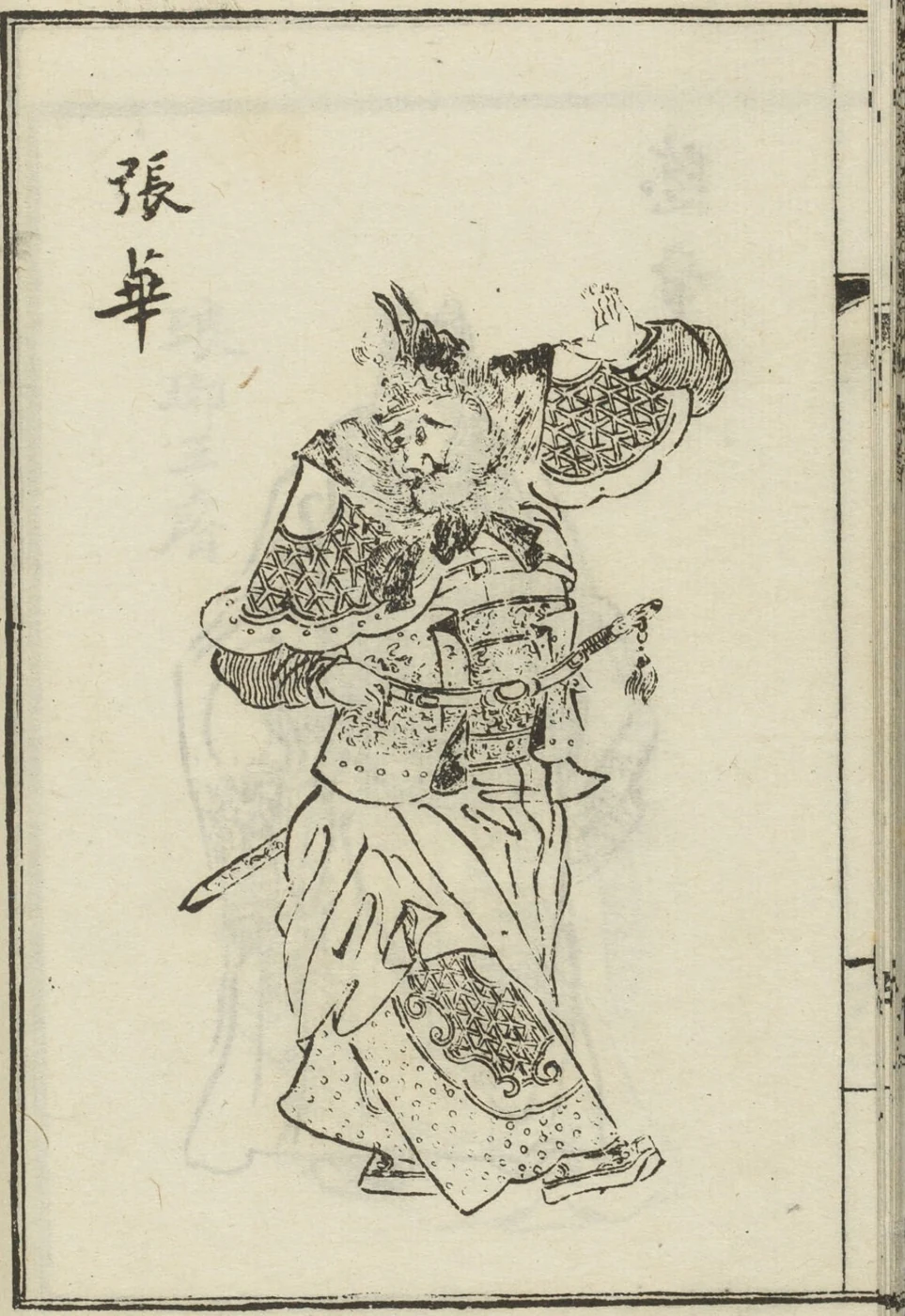
232 CE–300 CE
Officialpolitician
Zhang Hua
张华
Zhang Hua (232–300), courtesy name Maoxian, was a native of Fangcheng in Fanyang Commandery (present-day Gu'an County, Hebei). He was a writer, poet, and politician of the Western Jin dynasty. Recommended by Xianyu Si, Administrator of Fanyang Commandery, Zhang Hua entered office as a Erudite of the Court of Imperial Sacrifices and was later promoted through posts including Assistant in the Directorate of Authors, Chief…
232 CE–300 CEWestern Jin
PROFILE
Zhang Hua (232–300), courtesy name Maoxian, was a native of Fangcheng in Fanyang Commandery (present-day Gu'an County, Hebei). He was a writer, poet, and politician of the Western Jin dynasty. Recommended by Xianyu Si, Administrator of Fanyang Commandery, Zhang Hua entered office as a Erudite of the Court of Imperial Sacrifices and was later promoted through posts including Assistant in the Directorate of Authors, Chief Clerk, and concurrently Gentleman of the Secretariat. After Western Jin replaced Cao Wei, he was promoted to Yellow Gate Gentleman-in-Attendance, enfeoffed as Marquis of Guangwu County, and eventually rose to the office of Sikong. During the reign of Emperor Hui of Jin, he was killed by Sima Lun.
- Alternative name
- Zhang Maoxian
- Courtesy name
- Maoxian
- Period
- Western Jin
- Dynasty / regime
- Western Jin
- Identity
- Official, politician
- Native place
- Not reliably recorded
- Date of birth
- 232 (sixth year of the Taihe era)
- Place of birth
- Unknown
- Date of death
- 300 (first year of the Yongkang era)
- Place of death
- Unknown
- Highest office
- Minister of Works (Sikong)
- Major achievements
- Senior Western Jin statesman and polymath; strongly advocated the conquest of Eastern Wu, long served in central government, and compiled Bowuzhi
LIFE TIMELINE
Childhood | Lost his father at a young age; despite poverty, studied diligently and read widely
Youth | Wrote the Rhapsody on the Wren; Ruan Ji praised him as “a talent fit to assist a ruler,” bringing him early fame
Entered official service | Recommended by Xianyu Si, Administrator of Fanyang, and appointed Erudite of the Court of Imperial Sacrifices; later served as Assistant in the Directorate of Authors and Chief Clerk concurrently serving as Gentleman of the Secretariat
Founding of Western Jin | Promoted to Yellow Gate Gentleman-in-Attendance and enfeoffed as Marquis Within the Passes
Advocated the conquest of Wu | Firmly urged Emperor Wu of Jin to attack Eastern Wu and took part in military decision-making
Conquest of Wu completed | Advanced to Marquis of Guangwu County and granted an additional fief of ten thousand households
Posted to Youzhou | Because of slander by Xun Xu and others, sent out as an envoy bearing imperial authority and Commander of the Military Affairs of Youzhou; pacified frontier peoples and achieved notable administrative results
Transferred to the Court of Imperial Sacrifices | Following slander by Feng Dan, reassigned as Minister of the Court of Imperial Sacrifices, an office with little real authority
Entered top government | Helped Emperor Hui of Jin eliminate Sima Wei, Prince of Chu; appointed Right Guanglu Grand Master, Palace Attendant, and Director of the Secretariat
Appointed Sikong | Rose to one of the Three Excellencies
Killed | Refused to participate in Sima Lun's coup and was executed on charges of siding with Empress Jia; two of his sons were killed with him
Posthumously rehabilitated | Sima Jiong, Prince of Qi, memorialized on his behalf, and the court restored his title and property
BIOGRAPHY
Biography
Family Background and Early Life
Zhang Hua lost his father while still young, and his family declined into poverty. Nevertheless, he was devoted to learning from childhood. According to the History of Jin, he was broadly learned and had studied books on prognostication, technical arts, and many other subjects in detail. While still young, he became locally known for his learning. He farmed and studied on his own, continuing to read the classics despite hardship, while also acquiring knowledge of astronomy, prognostication, mathematics, and related subjects. This broad learning later provided an intellectual foundation for his compilation of Bowuzhi.
In the final years of Cao Wei, Zhang Hua was troubled by the Sima clan's dominance and by aristocratic extravagance. He therefore composed the Rhapsody on the Wren, using the small bird—which needs only a single branch for its nest and a few grains for food—as a contrast to the dangers brought by excessive desire, and expressing an ideal of preserving oneself through quiet restraint. The work circulated widely. After reading it, Ruan Ji reportedly exclaimed that “Zhang Maoxian is a talent fit to assist a ruler.” Zhang Hua's reputation consequently rose, paving the way for his entry into official service.
Entry into Office and the Founding of Western Jin
During the Jingyuan era of Cao Wei (260–264), Xianyu Si, Administrator of Fanyang Commandery, recommended Zhang Hua for appointment as a Erudite of the Court of Imperial Sacrifices. He later held such posts as Assistant in the Directorate of Authors and Chief Clerk concurrently serving as Gentleman of the Secretariat, thereby beginning to take part in central government affairs. In 265, the first year of the Taishi era, Sima Yan replaced Wei with Jin. Because of his learning and official performance, Zhang Hua was promoted to Yellow Gate Gentleman-in-Attendance and enfeoffed as Marquis Within the Passes. In the early Jin court he became known for his extraordinary breadth of knowledge. Emperor Wu of Jin once discussed with him Han palace institutions and the numerous gates and halls of Jianzhang Palace; Zhang Hua answered readily and could even sketch the layout on the ground, greatly impressing the assembled officials.
Advocating the Conquest of Wu and Rising to Prominence
By 275, the first year of the Xianning era, Western Jin had destroyed Shu twelve years earlier and replaced Wei ten years earlier. Its national strength was growing, while Eastern Wu had been weakened by the harsh rule of Sun Hao. Yang Hu, General Who Conquers the South, submitted a memorial urging an attack on Wu, but most court officials opposed the proposal. Yang Hu died in 278 and recommended Du Yu as his successor. The following year, Wang Jun, Inspector of Yizhou, also advocated attacking Wu, but officials led by Jia Chong continued to resist, citing frontier threats in the west and garrison burdens in the north. Zhang Hua at this point persistently urged an offensive. He argued to Emperor Wu that the emperor was capable, the realm was peaceful, the state prosperous and militarily strong, while the ruler of Wu was cruel and had killed able men; the opportunity to conquer Wu was therefore favorable. His argument strengthened Emperor Wu's resolve.
In the winter of 279, the Jin armies launched a six-pronged campaign against Wu. When the early fighting went poorly, Jia Chong and Director of the Secretariat Xun Xu submitted memorials asking that Zhang Hua be executed as punishment for the failed policy. Zhang Hua alone continued to insist that victory was certain. The Jin armies ultimately captured Jianye and destroyed Eastern Wu. After the conquest, Emperor Wu issued an edict praising Zhang Hua for having helped formulate the plan with the late Yang Hu, supervised military affairs, coordinated the different fronts, and contributed strategic planning to victory. Zhang Hua was advanced to Marquis of Guangwu County with an additional fief of ten thousand households; one of his sons was also made a village marquis, and Zhang Hua received ten thousand bolts of silk.
Factional Strife and Posting to Youzhou
After the conquest of Wu, Zhang Hua's growing prestige provoked the jealousy of Xun Xu, Director of the Secretariat. Xun Xu came from a powerful lineage and enjoyed Emperor Wu's favor, and repeatedly sought to push Zhang Hua aside. Zhang Hua had also recommended the emperor's younger brother Sima You, Prince of Qi, whom Emperor Wu distrusted. As a result, Zhang Hua mildly offended the imperial will and was sent out with authority to oversee the military affairs of Youzhou while concurrently serving as Colonel Protecting the Wuhuan and General Who Pacifies the North. Although formally charged with pacifying frontier peoples, the assignment removed him from court politics.
Once in Youzhou, Zhang Hua quickly demonstrated administrative ability. He sent Yan Xun against the Xianbei leader Murong Shegui and defeated him at Changli. He also received and pacified both old and new subjects, winning support among Chinese and non-Chinese populations alike. More than twenty polities, including Mahan and Xinmi from thousands of li away, sent envoys with tribute. The History of Jin describes Youzhou under him as secure on all sides, enjoying successive abundant harvests and strong troops and horses. His achievements were considerable. Nevertheless, Feng Dan, an associate of Jia Chong who had earlier opposed the conquest of Wu, resented Zhang Hua and compared him before the emperor to the rebel Zhong Hui. Emperor Wu accepted this slander and recalled Zhang Hua to court, appointing him Minister of the Court of Imperial Sacrifices, a prestigious but politically powerless position.
Final Years, High Office, and Violent Death
After Emperor Hui of Jin succeeded to the throne, court politics became unstable. In 291, the first year of the Yuankang era, Sima Wei, Prince of Chu, acted under forged orders to kill Yang Jun and then appeared ready to cause further disorder. Zhang Hua advised Emperor Hui on how to deal with him; Sima Wei was subsequently arrested and executed. Real power, however, lay with Empress Jia Nanfeng. Although Zhang Hua held one of the highest offices, he could do little beyond attempting to support and correct the government. He composed nine sections of the Admonitions of the Instructress to the Court Ladies to admonish Empress Jia, without effect.
In 299, the ninth year of Yuankang, Empress Jia arranged for Crown Prince Sima Yu to be made drunk and induced him to write a text suggesting rebellion. She then circulated it among the ministers and demanded his death. Most officials agreed, but Zhang Hua firmly opposed the proposal. When comparison of the handwriting showed that it was indeed the crown prince's, Zhang Hua could not refute the evidence, but continued to warn that the affair would bring great disaster to the state and urged careful consideration. The crown prince was nevertheless demoted to commoner status.
Zhang Hua neither joined nor exposed the political maneuvering that followed, apparently hoping that Sima Lun would remove Empress Jia. The next day, Sima Lun launched a coup and arrested Zhang Hua on charges of supporting the empress. Before his execution, Zhang Hua asked Zhang Lin whether he intended to kill a loyal minister. Zhang Lin replied that Zhang Hua, as a chief minister, had failed to die for the crown prince when the latter was deposed. Zhang Hua answered that his remonstrating memorial from the court discussion at Shiqian Hall still existed. When Zhang Lin asked why he had not resigned after the emperor refused to listen, Zhang Hua could not answer directly and lamented that he was an old servant of the former emperor whose loyalty remained unwavering, and that he feared not death but the unpredictable calamities facing the imperial house. He was then killed together with his sons Zhang Yi, a Regular Mounted Attendant, and Zhang Wei, a Mounted Attendant Gentleman. Other sons escaped.
In 303, the second year of the Taian era, after Sima Jiong, Prince of Qi, and others eliminated Sima Lun, Sima Jiong petitioned to clear Zhang Hua's name. The court restored his title and property.
Major Activities
Literary Contributions
Zhang Hua was one of the leading literary figures of the Western Jin. Thirty-two of his poems survive. His five Love Poems describe longing between husband and wife during separation in delicate language and with restrained emotion. His early Rhapsody on the Wren, which used the bird as a vehicle for personal reflection, won Ruan Ji's praise and established his literary reputation. Zhang Hua also compiled the ten-juan miscellany Bowuzhi, which records geography, unusual creatures and objects, anecdotes, immortals, and technical arts, and later exerted considerable influence on Chinese tales of the strange. The bibliographic treatise of the Book of Sui recorded a ten-juan Collected Works of Zhang Hua, now lost; in the Ming period, Zhang Pu compiled the Collected Works of Zhang Maoxian.
Political Activities
Zhang Hua was a key advocate of the Western Jin conquest of Eastern Wu. During court deliberations he resisted widespread opposition, analyzed the strategic situation for Emperor Wu, and strengthened the decision to attack. After the campaign began, he supervised military affairs and coordinated the different fronts, working with Wang Jun, Du Yu, and others to support the successful campaign. In his later years as Sikong, although constrained by Empress Jia, he continued to seek political correction and opposed the deposition of the crown prince, demonstrating his political principles.
Travels and Places of Activity
Zhang Hua's career was centered mainly on the imperial capitals and Youzhou. During his posting to Youzhou, he pacified the Xianbei and attracted distant peoples to the Jin court, helping stabilize the frontier. The History of Jin states that he “received and pacified old and new subjects, and both the Rong and the Xia cherished him,” highlighting his administrative ability.
Relations with Contemporaries
Zhang Hua maintained close relations with supporters of the conquest of Wu such as Yang Hu, Du Yu, and Wang Jun. He recognized Chen Shou's talent and praised the Records of the Three Kingdoms, intending to recommend Chen Shou as a Gentleman of the Secretariat, though Xun Xu's hostility prevented this. Ruan Ji appreciated Zhang Hua's talent and called him “a talent fit to assist a ruler.” Zhang Hua's relations with political rivals including Jia Chong, Xun Xu, and Feng Dan were tense, and he ultimately died amid factional conflict.
Personal Relations
Family
- Father: Zhang Ping, Administrator of Yuyang Commandery under Cao Wei
- Wife: Lady Liu of Zhuo Commandery (the History of Jin records only “Lady Liu of Zhuo Commandery” and does not identify her father)
- Sons: Zhang Yi (Regular Mounted Attendant), Zhang Wei (Mounted Attendant Gentleman), and other sons who escaped
- Grandson: Zhang Yu, son of Zhang Yi, who inherited the title
Friends and Associates
- Ruan Ji: praised his Rhapsody on the Wren and called him “a talent fit to assist a ruler”
- Yang Hu: jointly planned the conquest of Wu; Yang Hu recommended Du Yu before his death, and Zhang Hua carried forward his policy
- Chen Shou: Zhang Hua appreciated his abilities and sought unsuccessfully to recommend him as a Gentleman of the Secretariat
Rulers and Ministers
- Emperor Wu of Jin, Sima Yan: trusted Zhang Hua, but later accepted slander against him
- Emperor Hui of Jin, Sima Zhong: Zhang Hua assisted his government and helped eliminate Sima Wei, Prince of Chu
- Jia Nanfeng: Zhang Hua opposed her monopolization of power but was compelled to serve under her political dominance
Conflicts
- Xun Xu: pushed Zhang Hua aside out of jealousy
- Feng Dan: resented Zhang Hua because of the earlier dispute over the conquest of Wu
- Sima Lun: killed Zhang Hua during his coup
Historical Assessment
Western Jin / Contemporary
- Ruan Ji: “Zhang Maoxian is a talent fit to assist a ruler.” (History of Jin: Biography of Zhang Hua)
- Edict of Emperor Wu of Jin: praised him for “calculating strategy, planning for victory, and contributing to state policy.” (History of Jin: Biography of Zhang Hua)
- Zhang Lin, his political opponent: criticized him as one who “held the rank of chief minister, yet could not die for the crown prince when he was deposed.” (History of Jin: Biography of Zhang Hua)
Eastern Jin and Northern and Southern Dynasties
- Gan Bao's Chronicle of Jin criticized him for failing to withdraw from politics early enough and thus bringing disaster on himself (as preserved in later encyclopedic quotations such as the Taiping Yulan).
- Liu Xie wrote in the “Talent and Strategy” chapter of The Literary Mind and the Carving of Dragons that Zhang Hua's short compositions were “brilliant and lucid.”
- Xiao Tong included his poetry and rhapsodies in the Wen Xuan, affirming his literary standing.
Tang and Song Periods
- The History of Jin, compiled under Fang Xuanling and others, described Zhang Hua as broadly learned and a worthy minister of his age, while lamenting that he could not escape political disaster.
- Liu Zhiji's Shitong recognized his encyclopedic learning but criticized his inability to keep himself distant from danger.
Modern Period
- Chen Yinke, in lectures on the history of the Wei, Jin, Northern and Southern Dynasties, treated Zhang Hua as a representative figure who rose from a relatively humble background to high office, and used his political failure to illustrate problems in Western Jin aristocratic politics (summary of the argument).
- Qian Mu, in Outline of National History, used Zhang Hua when discussing Western Jin politics to illustrate the effect of tensions between great clans and men of less powerful backgrounds on government (summary of the argument).
FIGURES ASSOCIATED WITH THIS DYNASTY
Bibliography
- History of Jin: Biography of Zhang Hua, compiled by Fang Xuanling and others
- Bowuzhi, by Zhang Hua, edition collated by Fan Ning
- Chen Yinke, Lectures on the History of the Wei, Jin, Northern and Southern Dynasties, Huangshan Publishing House
- Qian Mu, Outline of National History, Commercial Press