Age one | Born on the fifteenth day of the second lunar month in Xiaoti Village, Yonghe Township, Tangyin County, Xiangzhou, Hebei West Circuit
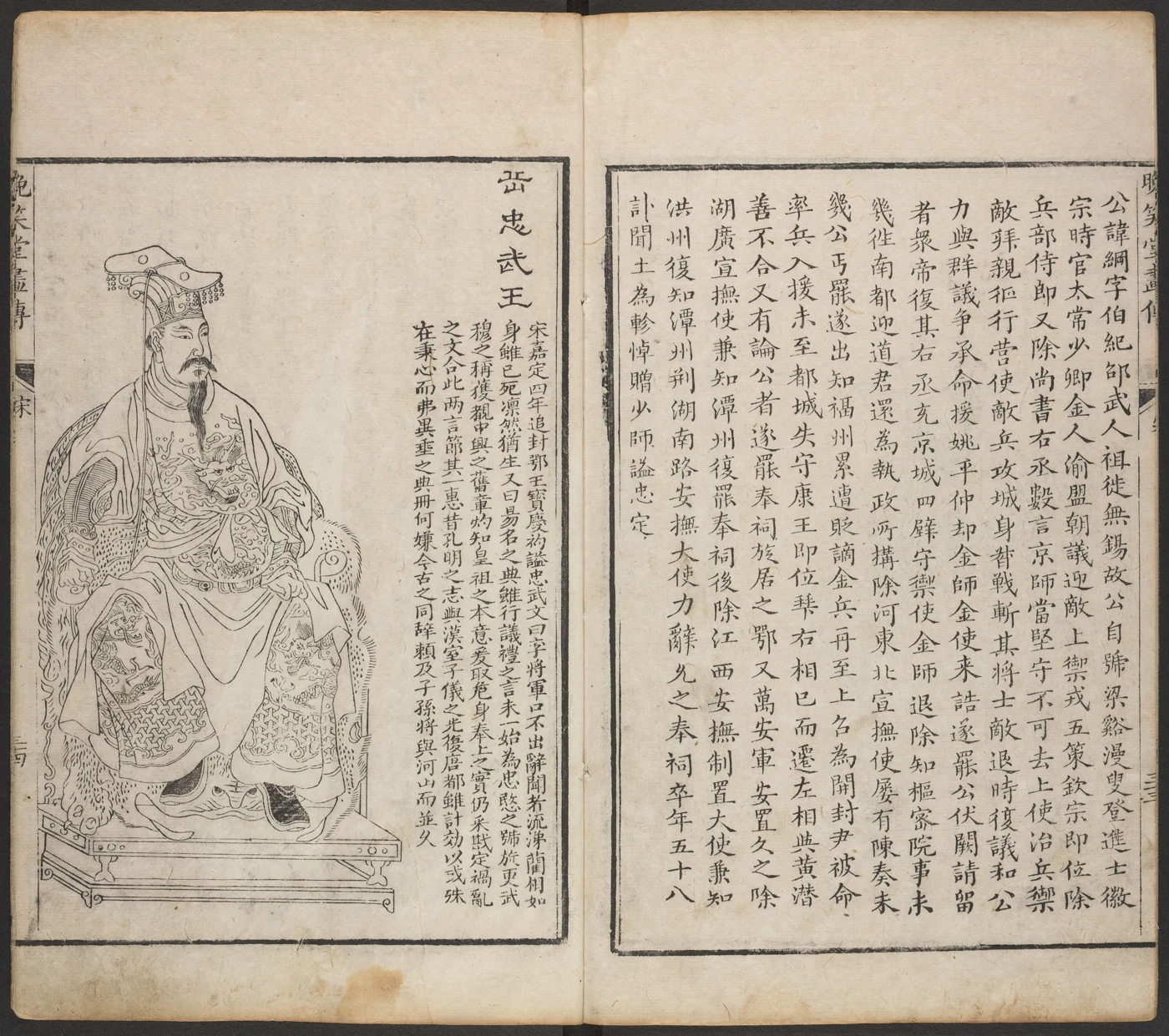
1103 CE–1142 CE
General
Yue Fei
岳飞
Yue Fei (March 24, 1103–January 27, 1142), courtesy name Pengju, was a native of Tangyin in Xiangzhou (present-day Tangyin, Henan), with ancestral roots in Dongchang (present-day Liaocheng, Shandong). He was a renowned Southern Song general who fought the Jin, as well as a military commander, strategist, calligrapher, and poet, and is remembered as a national hero. Born into a farming family, Yue entered military service in…
1103 CE–1142 CESouthern Song
PROFILE
Yue Fei (March 24, 1103–January 27, 1142), courtesy name Pengju, was a native of Tangyin in Xiangzhou (present-day Tangyin, Henan), with ancestral roots in Dongchang (present-day Liaocheng, Shandong). He was a renowned Southern Song general who fought the Jin, as well as a military commander, strategist, calligrapher, and poet, and is remembered as a national hero. Born into a farming family, Yue entered military service in the final years of the Northern Song. From his service under Zong Ze in 1128, the second year of the Jianyan era, to 1141, the eleventh year of Shaoxing, he led the Yue Family Army in hundreds of engagements against Jin forces. In 1140, the tenth year of Shaoxing, after Wanyan Zongbi, fourth son of the Jin founder, broke the peace and invaded the Song, Yue Fei launched a northern campaign, recovering places including Zhengzhou and Luoyang and inflicting major defeats on Jin forces at Yancheng and Yingchang before advancing toward Zhuxian Town. Emperor Gaozong of Song, however, was determined to negotiate peace and ordered the army back by twelve gold-lettered commands. Isolated and without support, Yue Fei was forced to withdraw. During negotiations that led to the Treaty of Shaoxing, Yue Fei was accused by Qin Gui, Zhang Jun, and others and imprisoned. In January 1142, the twelfth year of Shaoxing, he was killed in prison on a charge of treason described by the phrase “perhaps there is.” His eldest son Yue Yun and his subordinate Zhang Xian were also executed. After Emperor Xiaozong of Song came to the throne, Yue Fei was exonerated and ceremonially reburied at Qixia Ridge beside West Lake.
- Other Names
- Courtesy name Pengju; Yue Wumu
- Courtesy Name
- Pengju
- Period
- Song · Southern Song
- Date of Birth
- March 24 1103
- Date of Death
- January 27 1142
- Dynasty/Regime
- Song · Southern Song
- Identity
- General
- Ethnicity/People
- Not recorded in historical sources
- Native Place
- Tangyin, Xiangzhou (present-day Tangyin, Henan)
- Place of Birth
- Not recorded in historical sources
- Major Achievement
- Leading general of the Southern Song restoration; commander of the Yue Family Army; repeatedly successful in northern campaigns against Jin; executed after being accused of treason on the charge of “perhaps there is” under Qin Gui.
LIFE TIMELINE
Age sixteen | Married Lady Liu
Age twenty | Enlisted among the elite fighters recruited by Liu Ge, pacification commissioner of Zhending Circuit; captured the major Xiangzhou bandits Tao Jun and Jia Jin; returned home to mourn after the death of his father Yue He
Age twenty-two | After completing mourning, enlisted in the Pingding army as an auxiliary soldier and was promoted to junior commander
Age twenty-four | Conducted dangerous reconnaissance near Yuci County and was promoted for merit to Deputy Commandant of Jinyi; in winter joined Zhao Gou's Grand Marshal's headquarters, secured the surrender of Ji Qian and more than 380 men, and received the rank Chengxinlang; later followed Liu Hao in relieving the siege of the eastern capital, fought at Huazhou, and was promoted to Bingyilang
Age twenty-five | Fought at Kaide Prefecture in the first lunar month and was promoted to Xiuwulang; fought at Caozhou in the second lunar month and was promoted to Wuyilang; in the fifth lunar month memorialized Emperor Gaozong urging a return to Kaifeng and recovery of lost territory and was stripped of military office
Age twenty-five | In the eighth lunar month joined Zhang Suo, pacification commissioner of Hebei West Circuit, and was provisionally restored as Xiuwulang; in the ninth lunar month crossed the Yellow River under Wang Yan to fight the Jin, then separated from Wang after disagreements and later went south to join Zong Ze, who pardoned him
Age twenty-six | Zong Ze died in the seventh lunar month and Du Chong succeeded him as defender of the eastern capital; in the eighth lunar month Yue defeated Jin forces at Sishui Pass and was promoted to Wugonglang; later promoted through Wujing Dafu, Wulüe Dafu, and Wude Dafu and formally appointed Prefect of Yingzhou
Age twenty-seven | Du Chong withdrew toward Jiankang in the sixth lunar month despite Yue's bitter objections, and Kaifeng was lost; after Jin forces moved south and Du Chong surrendered, Yue withdrew to Zijin Mountain and later recovered Changzhou through four engagements
Age twenty-eight | Won a first victory at Qingshui Pavilion in the fourth lunar month and recovered Jiankang in the fifth; in the sixth was promoted to Wugong Dafu and Defense Commissioner of Changzhou and appointed pacification commissioner of Tongzhou concurrently administering Taizhou; in the tenth was promoted to Qinwei Dafu and Surveillance Commissioner of Jianzhou; in the twelfth became deputy commander-in-chief of the Shenwu Auxiliary Army
Age thirty | At the end of the first lunar month was appointed prefect, pacification commissioner of Jinghu East Circuit, and general commander, and campaigned against Cao Cheng
Age thirty-one | Suppressed rebellions in Ji and Qian prefectures; Emperor Gaozong presented him with a banner inscribed “Jingzhong Yue Fei”
Age thirty-two | Led troops north, defeated Jin and puppet Qi forces, recovered Yingzhou, Xiangyang Prefecture, Suizhou, and other areas, and was promoted to military commissioner
Age thirty-three | Promoted to military commissioner of two commands and then to campaign commander
Age thirty-four | Again campaigned north, taking Zhenru Military Prefecture, Guozhou, Shangzhou, and Yiyang and Changshui in the Western Capital's Henan Prefecture
Age thirty-five | Planned another northern expedition and proposed that Gaozong designate an heir, arousing suspicion from Gaozong, Qin Gui, and others; the court cancelled the campaign
Age thirty-eight | After Jin broke the peace and invaded south, Yue advanced under the strategy of “linking up with Hebei,” divided his forces to take broad areas as far north as Zhengzhou and the Western Capital's Henan Prefecture, defeated Jin armies at Yancheng and Yingchang, and advanced to Zhuxian Town; Emperor Gaozong recalled him with twelve gold-lettered commands
Age thirty-nine | Stripped of military command and made Deputy Military Affairs Commissioner; imprisoned in the tenth lunar month
Age thirty-nine | Killed in the Court of Judicial Review prison on the charge of treason described as “perhaps there is”; his eldest son Yue Yun and subordinate Zhang Xian were also killed
— | Emperor Xiaozong came to the throne, exonerated Yue Fei, reburied him with ceremony at Qixia Ridge beside West Lake, and conferred the posthumous title Wumu
BIOGRAPHY
Biography
Family Background and Early Life
Yue Fei was born in 1103, the second year of the Chongning era under Emperor Huizong of Song, into a farming household in Xiaoti Village, Yonghe Township, Tangyin County, Xiangzhou, Hebei West Circuit. His father, Yue He, came from a family that had migrated from Liaocheng in Shandong and had farmed for generations. The household owned only several hundred mu of poor land, whose harvest barely supported the family. Hebei West Circuit suffered repeatedly from flooding by the Yellow River, and a famine struck again in the spring of Yue Fei's birth year. Although Yue He's own household was not wealthy, he still aided neighbors and even reduced his own daily food intake to help starving villagers. The local community therefore respected the Yue family. According to a traditional story, a large bird like a swan flew from the southeast and cried above the chamber when Yue Fei was born. Yue He considered it an auspicious sign and named the child Fei, with the courtesy name Pengju.
As a youth Yue Fei was ambitious and principled, calm and straightforward, sparing of speech, and uncompromising in character. He had a quick memory and read widely, especially enjoying the Zuo Tradition of the Spring and Autumn Annals and Sun Wu's military writings, sometimes reading through the night. Because the family was poor and could not always afford candles, he gathered dry branches by day and burned them at night for light. His reading was not confined to phrases and commentaries; once he grasped the essential meaning, he did not remain tied to the wording. Before the age of twenty he could draw a bow of three hundred jin and use his waist to span a crossbow rated at eight shi. He studied archery under the local expert Zhou Tong, who greatly admired him and taught him everything he knew. Yue later practiced until he could shoot with either hand and hit what he aimed at. After Zhou Tong died, Yue Fei grieved deeply. On the first and fifteenth days of each month he sold a piece of clothing, set out a cup of wine and a piece of meat before Zhou's grave, wept in sacrifice, and shot three arrows from the bow Zhou had left him, showing that he did not forget his teacher's instruction. Yue later studied spear and blade techniques under Chen Guang and became regarded as unmatched in martial skill within the county.
Entering Military Service and Early Resistance to Jin
In 1122, the fourth year of Xuanhe, Liu Ge, pacification commissioner of Zhending Circuit, recruited elite fighters in preparation for possible Liao incursions. Yue Fei enlisted for the first time. Liu Ge was immediately struck by him and appointed him a small-unit leader. The major Xiangzhou bandits Tao Jun and Jia Jin were plundering towns, killing and abducting officials and civilians, while government forces repeatedly failed to suppress them. Yue Fei asked to take one hundred cavalry against them, and Liu Ge gave him two hundred infantry and cavalry. Yue sent thirty men in altered clothing to enter the bandits' territory disguised as merchants. They pretended to be captured and were incorporated into the bandit ranks. One night Yue placed one hundred men in ambush below a hill and personally led several dozen cavalry against the bandit base. The bandits, contemptuous of his small force, came out to fight. Yue feigned retreat and drew them into pursuit. The hidden troops then attacked while the thirty infiltrators seized Tao Jun and Jia Jin amid the confusion. The bandits collapsed and most were captured. Wang Jing, prefect of Xiangzhou, memorialized the court on Yue's achievement, and Yue was selected for the rank Chengxinlang. Before the appointment could be issued, however, his father Yue He died. Yue hurried back to Tangyin and observed mourning so intensely that he became visibly emaciated. The court soon abolished the recruited elite units, and the earlier appointment was never formally delivered.
In the third lunar month of 1124, the sixth year of Xuanhe, the bandit leader Zhang Chao and several hundred followers surrounded the former residence of Han Qi. Yue Fei was at the Han estate seeking to purchase grain and angrily declared that bandits dared to violate territory he was defending. He went out to investigate, saw Zhang Chao advancing confidently, climbed a low wall, and shot him through the throat. Zhang fell dead and the bandits scattered, saving the Han estate. Later that year Yue enlisted at Pingding Military Prefecture as an auxiliary soldier and was soon promoted to junior commander.
In the sixth lunar month of 1126, the first year of Jingkang, a circuit military inspector who knew of Yue's courage ordered him to lead more than one hundred cavalry to reconnoiter Shouyang and Yuci. They suddenly encountered a Jin detachment, and Yue's cavalry drew back in fear. Yue alone charged into the enemy, entering and leaving their formation several times and killing several mounted officers. That night he put on Jin clothing and secretly entered the Jin camp, moving throughout the encampment and returning with full knowledge of its strengths and weaknesses. He was promoted for merit to Deputy Commandant of Jinyi. On a later night crossing he lost the certificate confirming his appointment; instead of reporting the matter, he quietly returned by side roads to Xiangzhou.
In the winter of 1126 Zhao Gou established a grand marshal's headquarters in the Hebei region and arrived at Xiangzhou. Yue Fei was summoned because he belonged to Liu Hao's command. Liu Hao ordered Yue to secure the surrender of bandit leaders Ji Qian and others and gave him one hundred cavalry. Yue departed late in the day, had his men camp and eat, and entered the bandit camp directly with only four horsemen. Ji Qian and the others already knew Yue's reputation and were moved by his sincerity. They prepared wine for him, and Yue drank freely without suspicion. One bandit suddenly rose and attacked. Yue struck him in the face, knocking him forward, then drew his sword and confronted the group. Ji Qian and the others surrounded Yue, bowed, and asked for pardon. They removed their armor and surrendered, bringing a total of more than 380 men into submission. The three grand marshals took notice of Yue and appointed him Chengxinlang. Soon afterward he received orders to follow Liu Hao to relieve the siege of the eastern capital and confronted the enemy on the southern bank near Huazhou. Riding Liu Hao's warhorse, Yue trained one hundred cavalry beside the Yellow River. The frozen river was sealed with ice when Jin forces suddenly arrived. Yue told his men that although the enemy was numerous, they did not know the Song force's strength; if attacked before they stabilized, they could be defeated. Yue rode forward alone. A fierce enemy officer advanced brandishing a large saber; Yue parried and cut off his head. Yue's cavalry then attacked and routed the enemy, reportedly taking several thousand heads. Yue was promoted to Bingyilang, and Zhao Gou placed his troops under Zong Ze, defender of the capital.
In the first lunar month of 1127, the second year of Jingkang, Yue fought at Kaide Prefecture and shot two Jin standard-bearers with two arrows before leading a cavalry charge that defeated the enemy. He was promoted to Xiuwulang. In the second lunar month he fought at Caozhou. With his hair loose, he brandished a four-edged iron club and charged directly into the Jin formation. His soldiers were encouraged and fought with exceptional determination, defeating the Jin and pursuing them for several dozen li. Yue was promoted to Wuyilang. Zong Ze was astonished by him and observed that Yue's bravery, intelligence, ability, and martial skill would not be surpassed even by celebrated generals of antiquity, but that Yue favored open-field fighting and did not follow ancient methods. Yue replied that the essence of warfare lay in surprise and unpredictability; on open ground, when unexpectedly meeting the enemy, there was no time to arrange a fixed formation, and if a subordinate commander with few troops stopped to form a rigid array the Jin cavalry would see through the dispositions and trample them. Zong Ze reflected for a long time and agreed.
Campaigns in the Lower Yangtze and Recovery of Jiankang
In the fifth lunar month of 1127 Zhao Gou ascended the throne as emperor and adopted the Jianyan era name. Yue Fei submitted a memorial of several thousand characters arguing that the emperor's accession had given the people and state a legitimate center and frustrated the enemy's political designs; as loyal armies gathered and the military position strengthened, the court should take advantage of Jin fatigue and attack. Yue criticized Li Gang, Huang Qianshan, Wang Boyan, and others for failing to fulfill the emperor's intention of recovering the old territories and bringing back the two captured emperors, and warned of a tendency toward passive security. The court stripped him of military office for “speaking beyond his official duties.”
In the eighth lunar month of 1127 Yue joined Zhang Suo, a court official then serving as pacification commissioner of Hebei West Circuit. Zhang valued him and provisionally restored him as Xiuwulang and Gate Office Presentation Officer, placing him in command of the central army. He was soon provisionally promoted to Wujinglang and became a central-army commander. In the ninth lunar month Zhang Suo ordered Commander-in-Chief Wang Yan to lead Yue and seven thousand men across the Yellow River against Jin. Zhang Suo was soon removed and exiled, and the Hebei West pacification command was abolished. During the advance Yue and Wang Yan disagreed. Yue eventually separated from Wang and acted independently, but was outnumbered. When he attempted to rejoin Wang, Wang refused him, so Yue went south to Zong Ze, who at that time was Hanlin academician of the Yankang Hall, defender of the capital, and mayor of Kaifeng. Yue was liable to execution for disobeying his commander, but Zong Ze pardoned him, merely removing his office pending judgment.
Zong Ze died in the seventh lunar month of 1128, and Du Chong succeeded him as defender of the eastern capital. In the eighth lunar month Yue again defeated Jin forces at Sishui Pass and was promoted to Wugonglang. Du Chong ordered him to suppress Zhang Yong, Cao Cheng, Wang Shan, and other forces that Zong Ze had previously accepted into submission but which no longer obeyed after Zong's death. Yue fought desperately with eight hundred men and was promoted to Wujing Dafu. He then relieved Dongming County, which was surrounded by the bandits Du Shuwu and Sun Hai, and was promoted to Wulüe Dafu and provisionally appointed Prefect of Yingzhou. He later relieved Huaining Prefecture from Wang Shan's siege, was promoted to Wude Dafu, and received the formal appointment as Prefect of Yingzhou.
In the sixth lunar month of 1129 Du Chong withdrew to Jiankang despite Yue's bitter remonstrance, and Kaifeng was lost. Soon afterward Wanyan Zongbi led Jin forces south toward Jiankang. Du Chong's troops were defeated and Du surrendered with three thousand personal soldiers. Yue withdrew to Zijin Mountain northeast of Jiankang and later recovered Changzhou through four battles. Emperor Gaozong fled by sea. Jin troops pursued for more than three hundred li along the coast but failed to capture him and eventually withdrew north after extensive plundering.
In the third lunar month of 1130 Gaozong returned from the sea to Yuezhou and appointed Zhang Jun as military commissioner for Zhejiang West and Jiangdong, ordering the various generals to accept his authority and recover Jiankang. In the fourth lunar month Yue won at Qingshui Pavilion. In the fifth he moved to Niutou Mountain and led three hundred cavalry and two thousand infantry to defeat Wanyan Zongbi fifteen li northwest of Jiankang, recovering the city. In the sixth lunar month he accompanied Zhang Jun against Qi Fang, a former military commander who had become a bandit, defeating him at Kuling, roughly seventy li southeast of Guangde Military Prefecture, with three thousand men. Qi Fang surrendered to Zhang Jun. On returning to court Zhang Jun strongly praised Yue's usefulness. Yue was therefore promoted to Wugong Dafu and Defense Commissioner of Changzhou and appointed pacification commissioner of Tongzhou concurrently administering Taizhou.
After moving north, Wanyan Zongbi joined Wanyan Chang to attack Chuzhou. Gaozong ordered Zhang Jun to relieve the city. Zhang Jun sent Yue Fei, who was not part of his own inner force, into battle and ordered Liu Guangshi to support him. Yue reached Chengzhou in the ninth lunar month but could not lift the siege, and Chuzhou fell. With no defensible position, Yue withdrew. In the tenth lunar month he was promoted to Qinwei Dafu and Surveillance Commissioner of Jianzhou. In the twelfth lunar month, Xin Qizong, deputy commander-in-chief of the Shenwu Auxiliary Army, was dismissed for failing to suppress Fan Ruwei's revolt in Fujian. Yue's “Right Shenwu Auxiliary Army” was renamed the “Shenwu Auxiliary Army,” and Yue was promoted to commander-in-chief.
Suppressing Internal Rebellion and the First Northern Campaign
At the end of the first lunar month of 1132, the second year of Shaoxing, Yue was appointed prefect, pacification commissioner of Jinghu East Circuit, and general commander and led troops toward Tanzhou. In the second lunar month Li Gang, the foremost advocate of active resistance, was restored to office as pacification commissioner for Jinghu and Guangnan circuits. Yue and other generals were placed under Li Gang and ordered to campaign against the rebel Cao Cheng in Hunan East Circuit. The Yue Family Army then numbered more than twelve thousand. Yue left two thousand men at Jizhou while Zhang Xian, Wang Gui, Xu Qing, and others led the remaining forces on separate routes against Cao Cheng. Cao Cheng repeatedly retreated before the attacks and eventually surrendered. Yue was promoted to Chengxuan Commissioner of the Wu'an Army.
In 1133 Yue suppressed rebellions in Ji and Qian prefectures. Emperor Gaozong presented him with a banner reading “Jingzhong Yue Fei” in recognition of his service. During the suppression Yue imposed strict military discipline; his troops were forbidden to take even the smallest property from the people and gained strong popular support.
In 1134 Yue led troops north, defeated the combined forces of Jin and the puppet Qi, and recovered Yingzhou, Xiangyang Prefecture, Suizhou, and other areas. He was promoted to military commissioner. This was the first major recovery of lost territory since the foundation of the Southern Song and greatly encouraged resistance to Jin. Yue stationed at Xiangyang and actively developed the area as a base for later campaigns.
In 1135 Yue became military commissioner of two commands and was promoted to campaign commander. He continued training troops and preparing in the Jingxiang region. The Yue Family Army expanded in size and steadily improved in combat effectiveness.
Northern Campaigns and the Victory at Yancheng
In 1136 Yue again campaigned north, taking Zhenru Military Prefecture, Guozhou, Shangzhou, and the counties of Yiyang and Changshui in the Western Capital's Henan Prefecture. The reputation of the Yue Family Army grew, while Jin and puppet Qi troops became increasingly wary. The campaign, however, was repeatedly constrained by Emperor Gaozong and Qin Gui, and supplies and reinforcements were often insufficient.
In 1137 Yue planned another northern campaign and proposed that Gaozong designate an heir, which aroused suspicion from Gaozong, Qin Gui, and others. The Song court cancelled the expedition. Yue was deeply disappointed but did not abandon his determination to resist Jin.
In 1140, the tenth year of Shaoxing, Jin broke the peace and invaded south. Yue advanced under a strategy of “linking up with Hebei,” dividing his forces to seize broad territories as far north as Zhengzhou and the Western Capital's Henan Prefecture. At Yancheng and Yingchang he inflicted major defeats on the Jin main forces, and the Jin commander Wanyan Zongbi nearly fell into Song hands. Yue advanced to Zhuxian Town, only forty-five li from the former Northern Song capital of Kaifeng. Emperor Gaozong, however, was determined to negotiate peace and ordered him back by twelve gold-lettered commands. Isolated and without support, Yue withdrew. In grief he declared that ten years of achievement had been destroyed in a single day; the recovered commanderies had all been lost at once, the state could not be restored, and the world offered no path to recover what had been lost.
Wrongful Death
In 1141, the eleventh year of Shaoxing, Emperor Gaozong and Qin Gui used promotion in title to remove effective command from Yue Fei, Han Shizhong, and other leading generals. Yue became Deputy Military Affairs Commissioner, but in practice he had been stripped of power. During the negotiations that produced the Treaty of Shaoxing, Qin Gui, Zhang Jun, and others accused Yue of wrongdoing, and he was imprisoned. Qin Gui directed Censor Moqi Xie and others to construct accusations of treason. Yue was subjected to severe interrogation in prison but did not confess to the charges.
On January 27, 1142, the twelfth year of Shaoxing, Yue Fei was killed in the prison of the Court of Judicial Review at age thirty-nine on a charge of treason described by the phrase “perhaps there is.” His eldest son Yue Yun and his subordinate Zhang Xian were also killed. Before his death, according to the account preserved in the source text, Yue wrote eight characters in prison: “The bright sun and heaven are clear; the bright sun and heaven are clear,” expressing his sense of injustice.
Rehabilitation
In 1162, the thirty-second year of Shaoxing, Emperor Xiaozong came to the throne and exonerated Yue Fei. Yue was ceremonially reburied at Qixia Ridge beside West Lake and was posthumously titled Wumu. Later Southern Song emperors further posthumously appointed him Grand Preceptor and enfeoffed him as Prince of E. Later generations commonly referred to him as Yue Wumu, Prince Wumu, or Prince Zhongwu Yue.
The "Hard Reconnaissance" at Yuci and the Summoning of Ji Qian at Xiangzhou
The first appearance of Yue Fei's abilities is recorded in the Xing Shi Bian Nian of the E Guo Jin Tuo Cui Bian. The first chapter records that in the bingwu year of the first year of Jingkang, when he was twenty-four, he reconnoitred a thousand enemy at Yuci; that the office of the Grand Marshal summoned Ji Qian, that he was given the rank of Chengxin Lang, fought at Shiyulin, was transferred to the nominal rank of Baoyi Lang, fought on the river at Huazhou, and was transferred to Bingyi Lang and attached to Zong Ze. In the sixth month of summer the commander Ji Tuanlian, knowing his courage, sent him with more than a hundred cavalry to reconnoitre the bandits in the county of Yuci in Qingyang, which was called a hard reconnaissance; meeting suddenly with a body of the enemy, his cavalry feared and fell back, and Yue Fei alone charged the enemy array, going in and out four times, killing several of their mounted commanders, so that the enemy broke and dared not press him. At night he entered their camp in barbarian dress and, meeting one beating the watch, answered in gibberish Hu speech, and so went all round the camp and brought back every detail of their dispositions, being given the rank of Jinyi Fuwei; but crossing by night he lost his credentials, and, caring nothing for them, made his way back to Xiangzhou. Afterwards, when the emperor opened the office of Grand Marshal of the world's horse and foot in Hebei and came to Xiangzhou, Yue Fei obtained audience through Liu Hao and was ordered to summon the various bands under Ji Qian, a hundred cavalry being given him. On the day of the order, at dusk, Yue Fei halted his troops and fed them, and himself with four riders went straight into the bandits' camp; the bandits were astonished, and Yue Fei called Ji Qian out and comforted and admonished him, saying that the barbarians had outraged the rightful order, and that instead of supporting righteousness to establish merit and fame they were living meanly in the grass; that he was now ordered by the Grand Marshal to summon them, and that this was the season to turn calamity into fortune. Ji Qian and the others, knowing Yue Fei's reputation of old and moved by his perfect sincerity, set out wine and entertained him, and Yue Fei drank heartily without suspicion. When the wine was deep Ji Qian said that having disturbed the prefectures and counties they now accepted the summons but feared they would not escape execution. Yue Fei reasoned with them again and again, and they had already submitted when one of the bandits suddenly rose and struck at him; Yue Fei slapped his cheek so that he fell at once, drew his sword and faced them, whereupon Ji Qian and the rest bowed around him begging pardon and laid down their arms one after another, three hundred and eighty in all. By this he came to the notice of the three great marshals, was given the rank of Chengxin Lang and three hundred iron cavalry.
The Battles of Shiyulin and the River at Huazhou, and of Kaide and Caozhou
Having been given three hundred iron cavalry, Yue Fei went to try the enemy at the Li Garden crossing and fought at Shiyulin, defeating them and killing their chief commander, being transferred to Chengzhong Lang; and shortly after he was ordered by Lu Hao to relieve the siege of the eastern capital, holding the enemy at the south of Huazhou. Yue Fei, riding Liu Hao's horse, practised his troops on the river with a hundred cavalry; the river froze and closed with ice, and the enemy suddenly appeared, whereupon Yue Fei waved his men on, saying that though the enemy were many they did not know his strength or weakness, and that if they struck before the enemy was settled they might gain their aim. He galloped alone to meet them; a chief commander brandishing a sword came forward, and Yue Fei caught it with his own blade, which entered an inch or more into it, then drew his sword and struck, cutting off his head, so that the body fell upon the ice. The cavalry took advantage of it and the enemy was utterly defeated, several thousand heads being cut off and several hundred horses taken, and for his merit he was advanced to Bingyi Lang. When the Grand Marshal moved north to Beijing, Yue Fei's army was attached to the guard Zong Ze. The Xing Shi Bian Nian also records that in the first month of the spring of the second year of Jingkang he fought at Kaide, killing two standard-bearers of the Chin with two arrows, and loosed his cavalry in a sudden attack, defeating them and taking armour, horses, bows and swords to present, being transferred to Xiuwu Lang; and that in the second month he fought at Caozhou, with his hair unbound, wielding an iron mace with four edges, charging straight into the enemy array, so that all his soldiers took heart and none was not equal to a hundred, breaking the enemy utterly and pursuing them several tens of li, and being transferred to Wuyi Lang.
The Memorial of the First Year of Jianyan and the Loss of His Office
At the beginning of Emperor Gaozong's reign Yue Fei incurred guilt for memorialising on affairs of state as what was called a minor official overstepping his duty. The Xing Shi Bian Nian records that the Grand Marshal moved to Nanjing and again ordered the present emperor's subject to follow with his troops; that in the fifth month the Grand Marshal took the imperial throne and changed the era name to Jianyan; and that the subject sent up a memorial of several thousand words, whose gist was that the emperor had now ascended the precious throne, that the black-haired people had someone to turn to and the altars of state a lord, which was already enough to defeat the barbarians' schemes; that the loyal troops of the imperial camp were daily gathering and the armies growing strong, and that since the enemy took us for always weak and not likely to be able to resist, this was precisely the time to strike while they were slack; but that Li Gang, Huang Shanqian, Wang Boyan and their like could not carry out the emperor's will to restore the old frontiers and welcome back the two sages, but served the imperial carriage in going ever further south and ordered Chang'an, Weiyang and Xiangyang to prepare for the carriage's return, so that there was the beginning of a base contentment and no far-reaching plan, which could not bind the hopes of the central plain; and that though the generals and commanders exerted themselves abroad, in the end there would be no success. For the plan of the day, he said, nothing was better than to beg the emperor to return to the capital, to annul the edict on the progress to the three prefectures, and, while the two sages had not long been in the dust and the enemy's camp was not yet firm, to lead the six armies in person across the river northward in slow array, whereupon, with the awe of Heaven upon them, generals and commanders of one mind and the soldiers in high spirit, the land of the central plain might be recovered at the appointed time. On the memorial being presented it greatly offended the ministers in power, who held that a minor official had overstepped his duty and spoken what he ought not, and he was deprived of office and sent back to his fields. That a low-ranking military official should memorialise several thousand words on the great plans of state and rebuke the chief ministers to their faces, and so be stripped of office, was a small matter in itself, yet his purpose of welcoming back the two sages and recovering the central plain was already visible at this time.
The Crossing of the River with Wang Yan and the Battle of Xinxiang
Yue Fei's becoming an independent commander began with his friction with the commandant Wang Yan. The Xing Shi Bian Nian records that the subject was ordered to cross the river with the commandant Wang Yan, and reaching Xinxiang county in Weizhou, where the enemy was strong, Wang Yan's army lay below Shimen Mountain; the subject asked Wang Yan to fight, but Wang Yan did not advance; and the subject, suspecting that Wang Yan had other designs, cried out to him that the two emperors were in the dust and the enemy held the land north of the river, so that a subject should open the road to welcome the imperial carriage, and that if they did not fight quickly but only looked on, did he truly mean to go over to the enemy? Wang Yan was silent and forced himself to set out wine; and in his tent there was a man surnamed Liu who several times wrote the character for "behead" on his palm to show Wang Yan, who did not respond. The subject in anger rose and led his own troops alone into desperate battle, seized the enemy's great banner and waved it, whereupon all the armies shouted and strove, and Xinxiang was taken and the thousand-man commander Alibo taken alive; and he fought the ten-thousand-man commander Wang Suo and defeated him. The next day, about to fight at Houzhaochuan, the subject warned his soldiers beforehand that he had already won two victories and the enemy would surely come with united strength, and that though they were few they must plan for certain victory, and that whoever did not obey would be beheaded. In the fighting the soldiers were gravely wounded and the subject himself took more than ten wounds, and all fought to the death, breaking the enemy at last and taking countless men and horses. At night they camped below Shimen Mountain, and when word came that enemy cavalry had returned the whole army was alarmed, but the subject lay still and did not move; and the enemy in the end did not come. With provisions exhausted they killed the horse he rode over several days to feed the troops; and going by side paths to Wang Yan's camp to beg grain, Wang Yan would not give it, so he led his troops further north and entrenched against the enemy; and he fought again in the Taihang Mountains, taking several dozen horses and capturing several of the Tuoba Yawuju; and some days later, meeting the enemy again, the subject rode out alone with a long iron mace and killed the enemy commander the Great King of the Black Wind, putting to flight twenty thousand of his men and terrifying the enemy army. Knowing that he was suspected by Wang Yan, the subject made his own separate army and returned to Zong Ze, who made him a controller of the guard office; and not long after Zong Ze died and Du Chong took his place.
The Defeat at Majiadu and the Holding of Zhongshan
In the winter of the third year of Jianyan the Chin crossed the river, and Yue Fei fought with a single army and preserved his troops. The Xing Shi Bian Nian records that in the eleventh month of winter the Chin raised a great army and with Li Cheng raided Wujiang county; Du Chong shut his doors and would not come out, and to the repeated requests of his generals gave no answer. The subject knocked at the door of his sleeping chamber and remonstrated, saying that the great enemy was near in the Huai region, looking askance at the Yangzi with no shallow design, and that never was the position of one sleeping on brushwood more urgent than now; yet the lord passed his days in ease, unheeding military matters, and if the enemy spied out their slackness and took up arms against them, and the lord himself took no hand in the business, could he answer for the generals obeying orders; that if the generals did not obey, and Jinling fell, could the lord still sleep at ease there; and that though he himself served with a single army, it would be no help to the state. He wept so that his face was covered and begged him earnestly to come out and inspect the troops; Du Chong answered vaguely that he would come to the river bank the next day, but in the end did not come out. On the eighteenth day the enemy crossed at Majiadu, and Du Chong at last sent the subject and sixteen others with twenty thousand troops to meet the enemy with the commandant Chen Cui; and while the fighting was at its height the great general Wang Xie fled with several tens of thousands, so that all the generals broke away, and the subject alone fought on until evening, when relief did not come and the baggage had been carried back by the fleeing generals, and the soldiers had no food; and so the whole army camped by night at Zhongshan and fought out again at dawn, cutting off several thousand heads.
Blood Shed to Rouse the Troops and the Gathering of the Remnant
After the defeat at Majiadu the generals wished to rebel, and Yue Fei roused them by loyalty and righteousness and gathered their troops. The Xing Shi Bian Nian records that the generals, in turmoil, wished to rebel, and Qi Fang was the first to desert and turn bandit, and some under the subject followed him; and the subject, shedding blood, roused his men, saying that they had received the state's great favour and should repay it with loyalty and righteousness, establishing merit and name and writing it on bamboo and silk, so that in death they should be immortal; that if they surrendered to the barbarians and broke up into bandits, living meanly and in hiding, they would die in body and name would perish, and how could that be a good plan; that Jiankang was ground of strategic strength on the left of the river, and if the barbarians stole it, on what could a state be founded; and that in the business of the day there was death and no second thought, and whoever went out of that gate would be beheaded. His words and looks were generous and moved the soldiers to tears, so that none dared think of another course. He summoned the remaining generals and said that whoever was not a Red Turban should follow him. Thereupon Fu Qing and Liu Jing took their troops and followed Du Chong, who in the end crossed the river with the Jinling treasury and his household and surrendered to the enemy. The remaining soldiers were all men of the northwest who had long admired the subject's kindness and good faith, and some secretly told him that they wished to ask him to be their commander and rebel together, and the subject pretended to agree; and presently the leaders of their units came each with the rolls of their ranks, and the subject, calling them by the rolls, said that with their numbers and strength they could establish extraordinary merit for the court, take the central plain, receive high reward in their own persons and return to their old homes, which would surely be glory; that they must wash away their old thoughts before they could attach themselves to him; and that if any would not listen they had better kill him first, for he could never follow them in rebellion. All with one accord shouted that they would obey the controller's orders, and he took them all in. To turn danger into safety and gather troops to stand firm amid a broken rout shows his power of command.
The Campaign Against Qi Fang and the Victory at Kuling
After the fourth year of Jianyan Yue Fei put down the rebel commander Qi Fang, the whole course appearing in the Xing Shi Bian Nian and the Jin Tuo Cui Bian. At first Qi Fang had carried off the old and young of Hu Cheng's army, and Hu Cheng reproached him; and Qi Fang outwardly apologised, made a covenant with Hu Cheng and returned those he had carried off, and Hu Cheng, not perceiving the deceit, went to the meeting, where Qi Fang had bravos hidden who killed him and slaughtered his household. On Hu Cheng's death his troops came over one after another to Yue Fei, and the officials of Guangde also sent a letter to inform him of Qi Fang's misdeeds. It happened that an edict ordered Yue Fei to attack him, and he camped at Kuling with three thousand men. Qi Fang then sent troops to break the official bridge and hold himself secure, and Yue Fei shot an arrow into the bridge post; and Qi Fang, getting the arrow, fled, and Yue Fei sent Fu Qing and the others after him without success; presently he came again with more troops, and Yue Fei went out himself with a thousand men and in more than ten engagements won every time, and he fled again and was pursued without ceasing. Qi Fang's way of life was near its end when Zhang Jun came to join forces, and Qi Fang surrendered to Zhang Jun by a side road. Zhang Jun pleaded for him, and Qi Fang came out to bow and wept begging for his life, and Zhang Jun pleaded hard for him; and Yue Fei said that the commissioner's order he must indeed obey, but that he and Qi Fang had been colleagues and Qi Fang had suddenly revolted and gone; that he had sent men to reason with him of obedience and rebellion and he had not listened; that he had slaughtered and plundered the living and disturbed the prefectures and counties; that he had lured the general Hu to death and slaughtered his household; and that he had refused the order and would not submit, worse than other wicked men, and how could he be forgiven? Zhang Jun pleaded again and again, and Yue Fei called Qi Fang and told him that since the commissioner had spared him death he should think of some way to repay the state. Qi Fang bowed twice and stood on the left. In the fighting at Guangde Yue Fei had been first among his soldiers, and Qi Fang had shot him with a crossbow, striking his saddle; and Yue Fei put the arrow in his quiver and said that when he took that brigand another day he would make him break it in atonement for death. Now he took out the arrow and gave it to Qi Fang, who broke it inch by inch with all respect, and Yue Fei and Zhang Jun both laughed aloud, while Qi Fang sweated and trembled and dared not look up. So the barbarians and bandits in the near regions were killed or surrendered.
Shao Wei's Memorial Praising Yue Fei's Achievements
Of Yue Fei's achievements there were those who memorialised at the time. The Xing Shi Bian Nian records that a certain Shao Wei, an editor of the court, sent a letter to the government saying that Yue Fei was valiant, martial, deep and resolute, yet mild as a scholar; that he had lately risen in Hebei, and had with several dozen cavalry held a dangerous and vital point and driven back an enemy army of ten thousand; that he had also outside the Nanxun Gate near the capital broken Wang Shan and Zhang Yong's five hundred thousand with eight or nine hundred men, so that his awe shook the barbarians and the Chinese, while he ate with his common soldiers among the people and did not disturb so much as a hair; and that if it were feared that the Chin would keep troops south of the river, checking the imperial armies and being a great danger to the southeast, he had then, regardless of himself, recovered Jiankang and taken for the state the throat of its strategic ground, so that the rebels were swept away and not a horseman remained, and who was it whose strength pacified Jiangsu and Zhejiang? He recounted his achievements in no fewer than several thousand words, and the government presented his letter to the throne, whereby there was an intention to advance him.
The Campaign Against Li Cheng in Jiangxi
In the first year of Shaoxing Yue Fei joined forces with Zhang Jun against Li Cheng and broke him repeatedly in Jiangxi. The Xing Shi Bian Nian records that in the first month of spring Zhang Jun came to take leave and spoke at length of Li Cheng's host, and the emperor said that though Li Cheng's troops were many they were not to be feared; and he told Zhang Jun that among the generals of the day he alone had no merit, at which Zhang Jun quickly asked how he had no merit, and the emperor laughed and said that in seizing Miao Fu and Liu Zhengyan Han Shizhong was perhaps his superior. Zhang Jun, in fear, took the order and withdrew; and having withdrawn he was timorous and reckoned that he could certainly not win, and thinking that among the generals only the subject had plan and courage he asked that the subject's army be joined with his against the rebels, which the edict allowed. In the second month the subject reached Poyang and joined forces with Zhang Jun. On the third day of the third month they halted at Hongzhou, where the rebels had camps linked on the western hills so that the imperial army could not cross and none of the generals could face their edge; and Zhang Jun, much afraid, called the subject and told him that he had fought Li Cheng several times before and had lost every time, and asked him to plan for him. The subject answered that it was very easy: that the rebels were greedy and gave no thought to their rear, and that if three thousand cavalry were sent up the river to cross at Shengmi and take them unawares they must be broken; and that though he was without ability he begged to go as the van. Zhang Jun was delighted and followed him. On the ninth day the subject, in heavy armour, was first of all the armies to leap his horse across, at which all stared in amazement, and presently the rest crossed in order, the onlookers taking it for a divine act; and he came out secretly on the right of Ma Jin's army and was the first to break into the rebels' array, his troops following, so that the rebels were utterly defeated and fifty thousand of their soldiers surrendered. The subject pursued twenty-five li to the river and crossed a wooden bridge with a few dozen riders when the bridge broke so that the rear cavalry could not pass; and Ma Jin brought five thousand troops back against the subject, who killed his van commander with a single arrow and waved his cavalry in a sudden charge, whereupon Ma Jin's army scattered their arms at the sight and were broken again. Zhang Jun called the ditch and rampart officers to mend the bridge, and the rear cavalry also came, and Ma Jin fled to Yunzhou. The subject camped east of the city of Yun. On the eleventh day the rebels again led their troops out of the city and drew them up across fifteen li; and the subject, with a red gauze banner bearing the character Yue in white, at dawn led two hundred picked cavalry with banners and drums, and the rebels, despising their small number, closed with them, whereupon the ambush rose and they were broken and fled. The subject had it cried out that those who did not follow the rebels should sit down and strip off their armour and they would not be killed; and eighty thousand sat down at the word with countless dead; and of the maces, armour and weapons taken, the sound and whole were bound up and carried by the surrendered soldiers with the army, while the worn ones were put in the treasury of Yunzhou and the surrendered troops divided among the units, all being finished in three days.
The Victories at Zhujiashan, Louzizhuang and Qizhou
When Li Cheng's host was broken the subject pursued and defeated them again and again. The Xing Shi Bian Nian records that Ma Jin fled with his remnant to Li Cheng, who was then at Jianchang in Nankang; and the subject by night led troops with bits in their mouths to Zhujiashan and hid his men and furled his banners in the thick wood, and found them. When Ma Jin arrived the ambush rose from the wood at the first drum and the rebels were utterly defeated, five thousand foot being killed or taken and their commanders Zhao Wan and others beheaded, while Ma Jin fled first with a dozen or so riders and barely saved himself. Li Cheng in anger brought more than a hundred thousand of his own troops, and the subject met him at Louzizhuang and gave battle, breaking Li Cheng's army utterly, taking more than twenty thousand of his soldiers and two thousand horses; and pursuing from Wuning to Jiangzhou he killed or took thirty thousand on the way. Li Cheng fled by Dumudu toward Qizhou, and the subject pursued with cavalry and crossed his foot at Zhangjiadu to attack from both sides, killing Ma Jin, Sun Jian and the chiefs of their host; and Li Cheng's army fled in terror day and night without rest, fourteen or fifteen in ten dying of hunger and exhaustion. At Qizhou the subject took another fifteen thousand of their troops and more than two thousand horses, their abandoned weapons, armour, gold and silk beyond number; and Li Cheng fled and surrendered to the puppet Qi, and the Huai and the Yangzi were at peace. By the strength of one army to pass through the battles of Hongzhou, Yunzhou, Zhujiashan, Louzizhuang, Jiangzhou and Qizhou, and to drive Li Cheng's hundred thousand into surrender to the puppet Qi, was the greatest merit in all Zhang Jun's campaigns against the rebels, and so when Zhang Jun reported the merit the subject stood first.
The Pacification of Yang Yao and the Order Not to Kill
In the fifth year of Shaoxing Yue Fei pacified Yang Yao in Dongting, and the breadth of his settlement appears in the continuation of the Jin Tuo Cui Bian. The account of Yang Yao's affairs by an idler of Ding and Li records that Niu Gao reported to Yue Fei, saying that the great Yang Yao had occupied the double lake and troubled the court; that though the army of a prince and four wings, several tens of thousands, had gone against him the year before, it had been broken and returned empty; that now the commissioner had come with a great army to sweep his lair, and the rebels in fear of his tiger might had all come out and surrendered, only Yang Yao resisting and having been taken and killed; and that if some of his followers were not put to the sword the might of the army would not be shown, and he begged leave to make a slight slaughter so that those who came after should know to fear. Yue Fei said that the men of Yang Yao were villagers, first deluded by Zhong Xiang with monstrous tales and then, because the official Cheng harboured the grudge of the plundering of Dingjiang, never spared, but sought to kill all to wipe out his former shame, which had brought the bandits' strength to such growth; that in truth they only sought to preserve their lives and gather to escape; that now that the stockades had surrendered and the chief Yang Yao had been openly executed, the rest were all the emperor's own children, and to kill them would wound benevolence and what profit would it bring; that to bend an enemy's soldiers without fighting and to preserve the whole army was what the military writers prized; that slaughter and beheading were no good business; and that if the great matter were finished, so as to accord with the court's love of life and relieve the solicitude of a sage ruler and worthy minister, his own house would not fail in its heavy charge and he would have nothing to be ashamed of in his office. He said several times in succession, "You must not kill, you must not kill," and Niu Gao, having no answer, withdrew, and then pacified all the stockades, the whole being finished at once. To forbid slaughter on the ground that they were villagers and the emperor's own children was what distinguished his pacification of the Hu-Xiang troubles; and his merit in pacifying Yang Yao was one of the most notable of his campaigns in Xiang-Han and Hu-Xiang.
The Merit of Yang Yao's Pacification and the Suppression of Yue Yun
Yue Fei's merits were often shared by his son Yue Yun without being reported, as appears in the Supplements of the Jin Tuo Cui Bian: Yue Fei's son Yue Yun followed the campaigns and repeatedly won extraordinary merit, which he always concealed, so that all his promotions came from the court's own examination or the emperor's special order; his merit in the Xiang-Han campaign was the first, and not being reported for more than a year the board of selection discovered it and he was at last advanced to Wuyi Lang; in the pacification of Yang Yao he was again first, and it was again not reported; and Zhang Jun, learning the truth, said that Yue the marquis avoiding favour and honour to such a degree was indeed incorrupt but not yet public-spirited; and he memorialised that in the Hu-Xiang campaign Yue Yun had in fact won extraordinary merit and that because he was Yue Fei's son it had not been reported, and begged that he be specially advanced beyond the ordinary. The subject still would not accept. When an imperial order advanced him three grades the subject declined, saying that it was the soldiers who braved arrows and stones, and that when a man killed a general or broke an enemy array and won extraordinary merit he had only then set out his deeds and received a single grade; and that for his son Yun to leap suddenly to high rank without cause was to set him out of step with the soldiers, and how could he command men; and he said that this was not the way to show the soldiers a great and public and upright road. Memorial after memorial he would not accept, and the emperor, admiring his purpose, specially granted his request. On the nominal office of prefect he said that his son was only now learning what was right and still smelled of milk, and that though he had several times been in the battle line he had as yet shown no achievement; and that so sudden an advancement could only make his spirit idle; and he begged that the order be withdrawn so that his son might know the difficulty of rank and office, study the harder, and some day perhaps serve with all his strength. He said also that if his son did not know the weight of titles and honours he might become arrogant, failing above toward the emperor's grace and below drawing the slander of the officials, and that his own guilt would then be hard to escape. He said again that a man must rectify himself before he can rectify things, and govern himself before he can govern others; and if his son received reward without merit, then he himself could not rectify or govern himself, and how could he lead men? In the battle of Yingchang in the tenth year of Shaoxing, when his merit was first among the generals, he declined the post of defender of Zhongzhou, saying that a sovereign in governing his ministers need not grudge rich rewards, but a father in teaching his son should not demand near achievement; and that his son Yun, in following and meeting the enemy, had some small effect but no great merit, and he begged that the order be withdrawn. On the office of imperial arms-bearer he also firmly declined and was excused. The emperor once praised him by edict, saying that he resisted the sealed memorials and gave precedence to his officers and men, and that he did not merely cling modestly to the avoidance of shame like the Han generals contending for merit, but made his son establish his own service and showed again that Xiping had a son.
The Campaign of the Sixth Year of Shaoxing and the Victories at Guo and Shang
In the sixth year of Shaoxing Yue Fei marched north again, and his report appears in the memorial of Li Gang requesting troops to support Yue Fei, quoting Yue Fei's own dispatch. Chapter 92 of the Liangxi quanji records: on the twelfth day of this month four reports came from the controller Kou Cheng and others, saying that after the victory at Guozhou they had again settled and comforted the people of the region of Shang, Guo, Changshui, Fuchang, Yongning and Yiyang of the western capital; that on the twenty-seventh day of the tenth month scouts reported that the barbarian and puppet horses had invaded the Tieling pass, and that the commander of the local troops holding the defile reported that the enemy horse was heavy and he could not hold; and that Kou Cheng and the others, having few men, moved their camp to Hengjian and laid ambushes in readiness. On the twenty-ninth day more than a thousand enemy horse came to give battle and were beaten off, more than a hundred of the enemy killed and more than twenty horses taken, in which twenty or thirty barbarians were recognized; and on the thirtieth day more than a thousand horse came again to the charge, and Kou Cheng and the others led their officers and men forward to meet and cut them up, so that the enemy horse retired, several tens being killed and eight taken alive, of whom seven were barbarians who died in succession of grievous wounds so that the names of their chiefs could not be learned, and one was the Liu Yu man Gao Shoutong, who said that the barbarians had more than fifteen thousand men and three thousand horses, and Liu Yu more than twenty thousand men and two thousand horses, still commanded by the puppet Grand Guardian Wang, the Han observer, the Fu pacification commissioner and the grand governor Cheng; and that when they pursued, the enemy had ambushes in several directions coming on in separate columns. Kou Cheng and the others, seeing the enemy horse heavy, at once drew off their troops and camped to advantage at Wulichuan in Zhuyang, and begged the office to send troops with all speed by night to their rescue. On the same day a report came from Jia Yan, a preparation commander stationed at Shangzhou, that on the first day of the eleventh month more than ten thousand barbarian and puppet horse had invaded Shangluo county; and on the fourth day of the eleventh month a report from the controller Wang Gui that the puppet fifth great king had gathered heavy barbarian and puppet horse at the Hejia stockade, and that some had camped at old Tangzhou and invaded the borders of Xiangyang, while the bandits of the Zhenru army were heavy and were invading the borders of Dengzhou; and that though he had carried out the instructions sent by the office through the official Yu, he begged for troops to be sent quickly to join in the attack. And on the eleventh day of the eleventh month a report came from the controller Cui Bangbi that on the sixth day of this month the enemy horse had invaded Xin Yangjun, and that he had sent the commander Qin You, who scattered the enemy horse at Changtai town and pursued them to the great stockade at Wangminggang, but seeing the enemy numerous had drawn off to camp at Xinyangjun, and begged the office to send more troops quickly to join in cutting them up. Yue Fei, having examined the reports from all quarters that the enemy horse was coming in separate columns with the intent of deciding the upper waters, and although his eye trouble was not yet settled, took the troops in camp across the river to make dispositions, and informed the office accordingly. That he crossed the river though his eye trouble was unsettled was the actual condition of his campaign in the sixth year of Shaoxing.
The Northern Campaign of the Tenth Year of Shaoxing and the Response North of the River
In the tenth year of Shaoxing Yue Fei made a great northern campaign, the extent of which appears in the Xing Shi Bian Nian. At that time he obtained the full truth about the enemy chiefs' movements and the defiles of their mountains and rivers; and from Ci, Xiang, Kaide, Ze, Lu, Jin, Jiang, Fen and Xi the braves rose on the appointed day, and the banners they raised all bore the character Yue, answering at the news. This was the practical effect of his policy of joining with the region north of the river: while the great army marched north, the loyal levies north of the river were joined, so that the people of the central plain all answered under the name of Yue. Afterwards in the two battles of Yancheng and Yingchang the subject broke the main force of the Chin; and in the battle of Yingchang his son Yue Yun's merit was first among the generals, and Yue Fei declined the office of defender of Zhongzhou, saying that a sovereign in governing his ministers need not grudge rich rewards, but a father in teaching his son should not demand near achievement; and that his son Yun, in following and meeting the enemy, had some small effect but no great merit, and he begged that the order be withdrawn.
Yue Fei on the Battle Array and the Courage of the Banner Head
Yue Fei's courage and his methods of training appear in what he told Huang Zong, recorded in the Wenhlin lang Huang Yuanzhen bian of the continuation of the Jin Tuo Cui Bian. Yue Fei told Huang Zong that once the array is engaged, if a man can hold his spear steady in his hand and swallow the spittle in his mouth, that is already courage; that a scholar taken into the secretariat who has never seen a battle line will reach the central plain and, seeing a great battle, lose his nerve; and that such a man should first go with him into a small array to watch the fighting, and that he had him stand at a place where no harm could come to him; that if he needed to relieve himself he must on no account leave his horse, since in an army of hundreds of thousands all eyes were on a certain banner, and if one of the secretariat should move to and fro unsteadily a soldier would shoot him with a stray arrow, for they hated any confusion of their sight; and that only when the great array moved could one move with the rest. Huang Zong earnestly remonstrated that a cunning enemy might recognize him and mass strong bows to shoot him, and that though he was loyal and brave and the spirits protected him so that he could not be wounded, it was not the business of a great general. Yue Fei said that formerly when Du Chong held the capital as guard he had two thousand troops and came under Du Chong's command; that at his first arrival several tens of thousands of great bandits were outside the city, and Du Chong at once ordered him to go and fight; that Du Chong told him that Du would be beheaded, and that he did not dare plead that his troops were too few to face them, but went to the bandits and agreed on their surrender, and came back to report to Du Chong, who said that he had never ordered him to receive a surrender and that he must take them for him; and that he went back and reproved the bandits for being slow to come after agreeing to surrender, and told them he would no longer receive their surrender but would challenge them to battle; and that when their chief came out to fight he rode out alone and, swinging his great sword, split him from crown to waist in two, so that several tens of thousands were broken without fighting. He said that human strength could not have done this and that there was truly some divine help, and that his battles in his life had all been of this kind. To take the role of banner head himself, to be first among his soldiers as a matter of course, and to set as the standard of courage that a man can hold his spear steady and swallow his spittle, was bluntly said, yet his practice in training his troops appears in it.
The Case of the Twelfth Month of the Eleventh Year of Shaoxing and the Death of Yue Fei
The death of Yue Fei was one of the great unjust cases of the national history. The case was made out of the informings of Wang Gui and Wang Jun, Zhang Xian and Yue Yun being first arrested, and Yue Fei also summoned to the court and thrown into prison. The fabrication of the case appears in many sources such as the Jin Tuo Cui Bian and the Yaolu of the years since Jianyan; its end appears in the Song shi: on the twenty-ninth day of the twelfth month of the eleventh year of Shaoxing Yue Fei was given death in the prison of the Grand Court of Revision, and his son Yue Yun and his officer Zhang Xian were killed in the market, Yue Yun then being twenty-three. When Yue Fei died the Chin are said to have congratulated one another on hearing of it, while the officers and people of the Southern Song wept without exception. In the time of Emperor Xiaozong the case was cleared, his offices restored and the posthumous name Wumu conferred; under Emperor Ningzong he was posthumously enfeoffed as Prince of E and his posthumous name changed to Zhongwu. That the death of one general should leave a name that has not declined through a thousand years is why he became a national hero.
Dong Xian Holding the River Bridge and the Ambush of Liu Yu
The ability of the officers under Yue Fei appears in the account of Dong Xian in the Wenhlin lang Huang Yuanzhen bian of the continuation of the Jin Tuo Cui Bian: Dong Xian was the rear guard, and Liu Yu laid an ambush to fall upon the army when it withdrew. The rear of our army met one of the enemy's scouts who was a kinsman and had long heard of Yue Fei's virtue, and he disclosed their plan, saying that Yue the pacification commissioner had come with twenty thousand troops, seven parts armoured, carrying ten days' grain, and that their grain being now exhausted they were going home; that Liu Yu had sent Li Cheng and ten great generals each with ten thousand men, each first given a house and ten palace women, to fall upon that army, meaning to take them all and march straight to Ezhou; that his men each carried a rope, and taking the southern soldiers they would pass it through the palms of their hands, ten men to a string, and march eastward with drums, and were coming now. Dong Xian, seeing that the enemy had the full truth of our army, galloped to report to Yue Fei; and Dong Xian then chose dangerous ground and hid his troops in the thick wood, holding the river bridge alone in readiness. Presently Li Cheng and the others arrived and, seeing Dong Xian, showed him the ropes and told him everything as the scout had said, telling him not to run, for they would take him first. Dong Xian answered that he certainly would not run, and only feared that they would. The enemy, seeing Dong Xian wait at leisure, suspected an ambush and dared not advance directly, and each time they sent troops to fight Dong Xian would bring out one or two companies from the wood to meet them, and when they withdrew he returned to the wood, so that the enemy suspected the more; and while they held each other thus for a long time Yue Fei led the great army back, and Li Cheng and the others, seeing it come up out of the mountains like a silver mountain, fled in confusion; and Yue Fei crossing the river pursued them thirty li and stopped, taking several dozen of their commanders and several thousand of their troops and returning. The essence of this battle lay in using a part of the army as a decoy and the return of the main army as the surprise, and it succeeded through Dong Xian's steadiness and Yue Fei's seizing the moment.
The Outline of His Art of War
Taking Yue Fei's campaigns together, his art of war may be summed up in several points: first, to beat the many with the few without fear, as when he broke five hundred thousand with eight hundred outside the Nanxun Gate, and faced more than a hundred thousand with eight thousand at Guiling; second, to win by the unexpected without being bound to set methods, as in his answer to Zong Ze that the wonder of application lies in a single mind, and in going round the ridge at midnight to break Taipingchang; third, to lure the enemy by deceit, as in the false word that his grain was exhausted and he must return to Chaling, when he let the spy go, and in summoning to surrender by letter and receiving Zhang Yong's host; fourth, to attack by night and mingle black-clad men with the enemy camp, as at Niutoushan where a hundred men in black mingled with the Chin camp, and at Zhongshan where the army camped by night and fought out at dawn; fifth, to join the strategic ground to human feeling, as in his argument that Hebei was as the limbs, and in his policy of joining with the region north of the river, whereby the loyal levies of Hebei raised banners bearing the character Yue; and sixth, to be first among his soldiers as the banner head, as in his words to Huang Zong that in an army of hundreds of thousands all eyes are on a certain banner, and in the splitting of the bandit chief in two. That his army could win repeatedly was not by courage alone but by binding it with discipline and knitting it with kindness and good faith, so that when scattered it could be gathered again and those who surrendered could be made useful.
His Official Career from Jianyan to Shaoxing
Yue Fei's official career corresponded to his military achievements. In the first year of Jianyan, for summoning Ji Qian and three hundred and eighty others, he was given the rank of Chengxin Lang and three hundred iron cavalry; he fought at Shiyulin and was transferred to Chengzhong Lang, and on the river at Huazhou and was transferred to Bingyi Lang; in the second year of Jingkang he fought at Kaide and was transferred to Xiuwu Lang, and at Caozhou and was transferred to Wuyi Lang; in the third year of Jianyan, for breaking Wang Shan's five hundred thousand, he was transferred to Wujing Dafu and then Wulue Dafu and Wude Dafu, and given the real office of prefect; in the fourth year of Jianyan, for recovering Jiankang and presenting his captives at the court, he was given fifty sets of iron armour, a gold girdle, saddle and horse, and a robe of gilded mace and a hundred flowers; he was afterwards made pacification commissioner of Tong and Tai with the concurrent magistracy of Taizhou; in the first year of Shaoxing he joined Zhang Jun against Li Cheng in Jiangxi; in the second he pacified Cao Cheng in Jing and Hu; in the third he pacified the bandits of Qian and Ji; in the fourth he led troops north and broke the allied forces of the Chin and the puppet Qi, recovering Yingzhou, Xiangyangfu, Suizhou and other places and being advanced to military commissioner; in the fifth he was advanced to military commissioner of two circuits and made recruiting commissioner, pacifying Yang Yao in Dongting; in the sixth he marched north again, taking Zhenrujun, Guozhou, Shangzhou and Yiyang and Changshui of the western capital of Henanfu; in the seventh he planned a northern campaign and proposed that Gaozong settle the succession, whereupon he incurred the suspicion of Gaozong and Qin Gui and the court annulled the plan; and in the tenth year, when the Chin broke the agreement and invaded south, Yue Fei marched north under the policy of joining with the region north of the river and, dividing his forces, took a vast region reaching north to Zhengzhou and the western capital of Henanfu, breaking the main force of the Chin at Yancheng and Yingchang. From Chengxin Lang to military commissioner of two circuits and recruiting commissioner was no more than some ten years, his rapid advancement coming wholly from military merit.
The Clearing of His Name After Death and His Place in the Sacrifices
Yue Fei's wrong was gradually cleared after his death. On the twenty-ninth day of the twelfth month of the eleventh year of Shaoxing he was given death in the prison of the Grand Court of Revision, and his son Yue Yun and his officer Zhang Xian were killed in the market, Yue Yun being then twenty-three; in the time of Emperor Xiaozong the case was cleared, his offices restored and the posthumous name Wumu conferred; and under Emperor Ningzong he was posthumously enfeoffed as Prince of E with the posthumous name changed to Zhongwu. In the Ming dynasty he was further given a place among the sacrifices of the temple of the emperors of former ages: in the temple built in the Hongwu period of the Ming founder, among the ten of the second altar in the eastern gallery was Yue Fei, standing with Zhou Bo, Feng Yi, Fang Xuanling, Li Jing, Li Sheng, Pan Mei, Muqali, Borghul and Bayan as one of the famous ministers of all ages there sacrificed to. From the Southern Song through Ming and Qing the shrines of the Prince of Yue were found throughout the empire, and his name for loyalty and righteousness came to be named beside that of the Emperor Guan; and those who in later ages discussed the fall of the Southern Song always made the death of Yue Fei its key.
His Native Place, His Names and His Early Years
Yue Fei's courtesy name was Pengju; he was a man of Tangyin in Xiangzhou, that is Tangyin in Henan, his ancestral home being Dongchang, that is Liaocheng in Shandong. He was of a farming family; in the fourth year of Xuanhe, that is 1122, he joined the army for the campaign against the Liao; in the first year of Jingkang, 1126, he volunteered to serve against the Chin; and in the first year of Jianyan, 1127, he earnestly begged Emperor Gaozong to return to Kaifeng and recover the lost territory, and was deprived of his military office by the court, afterwards fighting the Chin under Zhang Suo, Wang Yan and Zong Ze and repeatedly winning merit. From his enlistment in the Xuanhe period to the case of the last years of Shaoxing was more than twenty years, and the advances and retreats of his life ran together with the war and peace between Song and the Chin: when the Chin invaded south his army turned north, and when the peace was made his own person suffered. That in his early years at Xiangzhou he obtained audience with the Grand Marshal through Liu Hao, and was given the rank of Chengxin Lang for summoning Ji Qian and the others to surrender, has been told above; and the purpose of his whole life was already fixed when he memorialised several thousand words in the first year of Jianyan.
An Outline of His Life
Yue Fei, whose courtesy name was Pengju, was a man of Tangyin in Xiangzhou, his ancestral home being Dongchang. In the fourth year of Xuanhe he joined the army for the campaign against the Liao, and in the first year of Jingkang volunteered to serve against the Chin; in the first year of Jianyan he memorialised asking Emperor Gaozong to return to the capital and recover the lost land, was deprived of his office, and afterwards served under Zhang Suo, Wang Yan and Zong Ze, becoming a controller of the guard office. In the fourth year of Jianyan he laid an ambush at Niutoushan and recovered Jiankang, being made pacification commissioner of Tong and Tai; in the first year of Shaoxing he joined Zhang Jun against Li Cheng in Jiangxi, in the second pacified Cao Cheng in Jing and Hu, in the third the bandits of Qian and Ji, and in the fourth led troops north against the allied forces of the Chin and the puppet Qi, taking Yingzhou, Xiangyangfu and Suizhou and being advanced to military commissioner; in the fifth year he was advanced to commissioner of two circuits and recruiting commissioner, pacifying Yang Yao in Dongting; in the sixth he marched north again, taking Zhenrujun, Guozhou, Shangzhou and Yiyang and Changshui; in the tenth year he marched north under the policy of joining with the region beyond the river, breaking the main force of the Chin at Yancheng and Yingchang; in the eleventh year he was removed from the deputy commissionership and on the twenty-ninth day of the twelfth month was killed in the prison of the Grand Court of Revision at Lin'an at the age of thirty-nine, being cleared under Xiaozong with the posthumous name Wumu and posthumously created Prince of E with the name Zhongwu under Ningzong.
Major Activities
Military Contributions
Yue Fei was the only early Southern Song commander described in the source text as successfully organizing large-scale offensive operations. He opposed Emperor Gaozong's passive defensive approach of merely holding positions and waiting for the enemy instead of attacking at distance for victory, and consistently advocated active operations. He attached importance to popular anti-Jin resistance and inherited Li Gang's and Zong Ze's strategy of “linking up with Hebei,” proposing coordination between local resistance forces in Hebei and the regular Song armies so that Jin forces could be attacked from both sides and lost territory recovered.
Yue Fei's discipline became especially famous. He led by example, distinguished reward and punishment clearly, maintained strict order, and cared for his troops. The “Yue Family Army” was said to follow the rule, “Freeze to death rather than tear down a house; starve to death rather than plunder.” Jin soldiers were reported to say, “It is easier to shake a mountain than to shake the Yue Family Army.” Yue was skilled at defeating larger forces with smaller ones and displayed strong command ability in repeated battles.
Northern Campaigns Against Jin
In 1134 Yue led troops north, defeated Jin and puppet Qi forces, and recovered Yingzhou, Xiangyang Prefecture, Suizhou, and other areas, earning promotion to military commissioner. This was the first large-scale recovery of lost territory after the establishment of the Southern Song.
In 1136 he again advanced north, taking Zhenru Military Prefecture, Guozhou, Shangzhou, and Yiyang and Changshui in the Western Capital's Henan Prefecture.
In 1140, after Jin broke the peace and invaded south, Yue advanced according to the “linking up with Hebei” strategy. His forces seized broad areas as far north as Zhengzhou and the Western Capital's Henan Prefecture, inflicted major defeats on the Jin at Yancheng and Yingchang, and advanced to Zhuxian Town. The campaign represented the high point of Yue Fei's northern expeditions and one of the most celebrated victories of Southern Song resistance to Jin.
Literary Achievements
Yue Fei was also noted for literary ability. The source text attributes to him the lyric “Man Jiang Hong: Xiehuai” and states that his writings were collected in the Collected Works of Prince Zhongwu Yue. “Man Jiang Hong” is described as forceful and impassioned, expressing his determination to recover lost territory and serve the state, and became one of the best-known lyrics associated with him.
Travels and Military Movements
Yue's military career took him across northern and southern China. Places associated with his campaigns include Xiangzhou and Zhending in Hebei, Kaifeng and Huazhou in Henan, Jiankang, Changzhou, and Yixing in the lower Yangtze region, and Xiangyang, Yingzhou, and other areas in Jingxiang.
Relations with Contemporaries
Yue interacted with Southern Song commanders including Zong Ze, Zhang Suo, Wang Yan, Han Shizhong, Zhang Jun, and Liu Guangshi. His relationship with Zong Ze was especially close, and Zong recognized and promoted him early in his career. Yue and Han Shizhong had a relatively good relationship and respected one another as leading anti-Jin commanders. He had conflicts with Zhang Jun, Liu Guangshi, and other commanders, circumstances that later contributed to the political hostility surrounding his prosecution.
Zong Ze's Discussion of the Battle Formation and Yue Fei's "Wonder of Application"
Yue Fei's military judgement appeared early in the passage where he discussed battle formations with Zong Ze. The first chapter of the Xing Shi Bian Nian records that Zong Ze, greatly marvelling at Yue Fei, told him that his courage, wisdom, ability and skill could not be surpassed even by the good generals of antiquity, but that he loved field battles and did not follow the ancient methods. The subordinate assistant commander Shang Ke also said that as a great general this was no sure plan. Zong Ze gave Yue Fei a diagram of formations, and Yue Fei, having looked at it, put it aside. When Zong Ze afterwards asked him about it, Yue Fei answered that the diagram the guard had given him he had examined closely, and that it was only a fixed disposition; that ancient and modern times differed, and the level or dangerous ground differed with the place, so how could one hold to a single fixed diagram; that the essence of the military art lay in producing the unexpected and being beyond calculation, and only so could one win; that if in the open plain one suddenly met the enemy, what leisure would there be to form the array; and that he himself, as a subordinate general under another's command with few troops, if the array were once fixed the enemy would see his strength and weakness and his iron cavalry would trample him on every side and not a man would be left. Zong Ze asked whether, by his account, battle formations were of no use. Yue Fei answered that to form up and then fight was the ordinary method of war, but that circumstance could not always be constrained, and that the wonder of application lay in a single mind, and he begged the guard to consider it. Zong Ze was silent a long while and said that his words were right. The phrase that the wonder of application lies in a single mind has been constantly cited by later ages in discussing war; and his argument against being bound to a diagram was of one piece with his later tactics of using cavalry against cavalry and winning by the unexpected.
Zhang Suo's Question and the Argument that Hebei is as the Limbs
Yue Fei's strategic vision appears further in his discussion with Zhang Suo, commissioner for the pacification of Hebei. The Xing Shi Bian Nian records that in the eighth month of autumn Yue Fei went to Zhang Suo, who at their first meeting treated him as a man of the state, gave him the nominal rank of Xiuwu Lang and the office of gate attendant and made him commander of the central army. Zhang Suo once asked him calmly, having heard that he had followed the guard Zong Ze and that his courage was first in the army, how many of the enemy he reckoned he could face. Yue Fei said that courage was not to be relied on, and that in war one must first settle the plan, for the plan is the hinge of victory and defeat; that therefore in the way of a general the fear was not want of courage but want of plan; and that the commanders of the day all said their strength could head three armies, yet before battle they had no settled design and after battle no accomplished work; and that so the highest soldier conquers by plan and the next by diplomacy. Zhang Suo, himself a Confucian, hearing Yue Fei's words started up and said that he was surely not a man of the ranks; and he made him sit and drew up close to discuss the times. Yue Fei, in generous emotion, wept and said that the business of the day was only to destroy the barbarians, welcome back the two sages and restore the old frontiers to repay sovereign and father. Zhang Suo asked again for the essentials of pacifying Hebei, and Yue Fei said that the ancients had said that Hebei was to the empire as a pearl and the empire to Hebei as the four limbs, meaning that in a man's body a pearl may be wanting but the limbs may not for a moment be lost; that the dynasty's capital at Bian had no such natural fastness as the two hundred defences of the passes of Qin, but was level plain and open country with a long river for a thousand li, its head and tail continuous without mutual support, relying on Hebei alone for its strength; and that if picked armour and strong horses were used to hold the vital points, with deep ditches and high ramparts and a line of strong garrisons, so that when the enemy entered our territory one city after another wore him down, and when one city was besieged the others either checked or relieved him, he could never be overcome; and that so the barbarians would not dare look toward Henan and the root and foundation of the capital would be firm. He said also that Henan and Hebei were just of this kind; that the court had now appointed a commissioner for Hebei under the name of pacification, yet beyond the river half was enemy country, and what ground would there be for pacification; that for the business of the office one must simply take the whole of Hebei as a support to the capital, for otherwise the four limbs of the empire would be cut off and the root endangered; and that when in time the barbarians had taken Hebei and then invaded Henan, with the vital ground lost and nothing left to hold, their advance would be unchecked and it could not be known whether the court would flee to the Yangzi or to the Huai. Zhang Suo was greatly pleased and gave him the nominal rank of Wujing Lang.
The Great Battle at the Capital in the Third Year of Jianyan and the Breaking of Wang Shan's Five Hundred Thousand
In the third year of Jianyan Yue Fei with eight hundred men broke a rebel host of five hundred thousand, the most famous of his early battles. The Xing Shi Bian Nian records that in the jiyou year of the third year of Jianyan, when he was twenty-seven, he fought a great battle at the capital and broke Wang Shan and others' five hundred thousand, being transferred to Wujing Dafu and taking Du Shuwu and Sun Hai; that he was transferred to Wulue Dafu with the nominal office of prefect of Yingzhou, relieved the siege of Chenzhou and took Sun Sheng and Sun Qing; and that he was transferred to Wude Dafu and given the real office of prefect. In the first month of spring the bandit chiefs Wang Shan, Cao Cheng, Zhang Yong, Dong Yanzheng and Kong Yanzhou led a host of five hundred thousand up to the Nanxun Gate with drums shaking the ground, and Du Chong, patting the subject, said that the survival of the capital lay in this one stroke. At that time the subject's troops were only eight hundred, and all feared they could not match the enemy, but the subject told them that though the bandits were many they were not in order, and that he would break them for them. With bow and arrows under his left arm and a long iron spear in his right hand he led a few riders straight across their army, and the bandit host fell into disorder while his own rear riders all fought to the death; from noon to the hour of the monkey the bandits were utterly defeated, and he was transferred to Wujing Dafu. When Du Shuwu, Sun Hai and the others besieged Dongming county the subject fought and took them, being transferred to Wulue Dafu with the nominal office of prefect of Yingzhou. In the second month, when Wang Shan besieged Chenzhou and loosed his troops to plunder, Du Chong ordered the subject with the commandant Chen Cui to attack him together; and the subject first ordered the subordinate commander Yue Heng with roving cavalry to cut off his plundering routes and took his provision carts and oxen and asses, so that Wang Shan's troops dared not come out again and their spirit sank the more; and on the twenty-first day he fought at the Qing River and broke them utterly, taking their commanders Sun Sheng and Sun Qing and others, with very many officers and men surrendering, being transferred to Wude Dafu and given the real office of prefect. On the twentieth day of the sixth month the subject halted west of Cuiqiao town and met Wang Shan's army again, defeated it, and rode deep in with Yue Heng alone, returning only when he had taken heads.
Yue Fei's Argument to Du Chong Against Abandoning the Capital
Yue Fei's grasp of the greater interest appears again in his argument to Du Chong. The Xing Shi Bian Nian records that when Du Chong abandoned the capital for Jiankang the subject argued to him that not a foot of the central plain could be given up, and that with the altars of state and the ancestral temple in the capital and the tombs in Henan it was beyond comparison with other ground; that the guard, with his heavy troops and great reputation, if he did not hold it, what would others do; that once the guard moved his foot this ground would no longer be ours, and that to retake it thereafter would cost the loss of hundreds of thousands of men; and he begged him to think again. Du Chong would not listen and went to Jiankang. The army halted at Tielubu and fought the bandit chief Zhang Yong, defeating him; and reaching Liuhe the subject was ordered to attack Li Cheng and broke him at Pancheng; Li Cheng fell back to hold Chuzhou, and Du Chong ordered Wang Xie to attack him, but Wang Xie advanced his troops to Lianglu and hesitated without advancing; his baggage was at Changlu, and Li Cheng sent five hundred light cavalry to seize it without success, plundering more than a hundred monks and common people and robbing the subject's officer Pei Lin of the silver and silk for rewarding the troops. The subject, just then crossing at Xuanhua town, heard of it and hurried his troops to a surprise attack, destroying the bandits entirely, taking their chief commander Feng Jin and returning the plundered people to Changlu; Li Cheng fled to Jiangxi, and Wang Xie in the end did not reach Chuzhou but turned back. In this may be seen the hesitation of the generals of the time and Yue Fei's advancing alone, and also the discipline and care for the people of his single army.
The Recovery of Jiankang and the Victory at Niutoushan
In the fourth year of Jianyan Yue Fei laid an ambush at Niutoushan and recovered Jiankang, the greatest of his early achievements. The Song shi, in his life, records that in the fourth year Wuzhu attacked Changzhou, and the magistrate of Yixing welcomed Yue Fei to move his camp there; that the bandit Guo Ji, hearing that Yue Fei had come, fled into the lake, and Yue Fei sent Wang Gui and Fu Qing in pursuit and broke him, and sent the eloquent Ma Gao and Lin Ju to bring over all his followers; that there was a Zhang Weiwu who would not submit, and Yue Fei rode alone into his camp and killed him; and that those who fled the troubles owed their safety to him and painted his image in shrines. When the Chin attacked Changzhou again Yue Fei won four battles; pursuing them east of Zhenjiang he won again; and fighting at the Qingshui Pavilion he won a great victory with corpses strewn fifteen li. Wuzhu hastened to Jiankang, and Yue Fei laid an ambush at Niutoushan for him; by night he had a hundred men in black mingle with the Chin camp and disturb it, so that the Chin soldiers were alarmed and attacked one another; and when Wuzhu halted at Longwan Yue Fei with three hundred cavalry and two thousand foot hastened to the new city and broke him utterly, so that Wuzhu fled to Huaixi and Jiankang was recovered. Yue Fei memorialised that Jiankang was ground of vital importance and picked troops should be chosen to hold it, and that more troops should hold the Huai to guard the heartland, which the emperor graciously approved. When Wuzhu withdrew Yue Fei attacked him at Jing'an and defeated him. The Xing Shi Bian Nian is fuller still: in the fifth month Wuzhu again fled to Jiankang and the subject laid an ambush on Niutoushan for him; by night he had his troops wear black and mingle with the enemy to disturb the camp, so that the enemy were alarmed and attacked one another, and set more patrols outside the camp to watch; and the subject secretly sent officers to the side to wait on their comings and goings and take them all. On the tenth day the subject with three hundred cavalry and two thousand foot came down from Niutoushan to the new city at the south gate and made a stockade, and then fought and broke Wuzhu utterly; those who had taken what they demanded and were carrying it aboard ship he killed with spears in the water, and the drowned were piled on the bank like a hill; more than three thousand shaven and earringed heads were cut off, corpses lay for more than ten li, more than a thousand of their troops surrendered, with more than twenty of the ten-thousand and thousand-man commanders, three hundred horses, and armour, weapons, banners and drums numbered by the tens of thousands, with much cattle, asses and baggage; and Wuzhu fled to Huaixi. The subject then entered the city and pacified the people and settled each in his calling, and not a single enemy horseman remained. In the sixth month he presented his captives at the court, and the emperor, questioning the captives, obtained news of the two sages and grieved long. The subject memorialised that Jiankang was ground of vital importance to the state's position and picked troops should be chosen to hold it; that Zhang Jun had wished to have him hold Poyang to guard against the enemy troubling the east and west of the Yangzi, but that he held that if the rebels crossed the river they would first go to the two Zhe, and that the east and west of the Yangzi were remote places, and that strong troops might cut off their retreat, so that they were not the direction of their advance; and that he begged to have more troops to hold the Huai and guard the heartland. The emperor graciously approved and gave him fifty sets of iron armour, a gold girdle, saddle and horse, and a robe of gilded mace and a hundred flowers, praising him several times.
The Holding of Tong and Tai and the Three Battles at Chengzhou
In the first year of Shaoxing Yue Fei was made pacification commissioner of Tong and Tai and relieved Chuzhou, winning three battles. The Xing Shi Bian Nian records that in the eighth month the Chin attacked Chuzhou urgently, and Zhao Ding, signatory of the Bureau of Military Affairs, sent Zhang Jun to relieve it, ordering the subject to be under Zhang Jun's command; and Zhang Jun declined, saying that the enemy's troops were not to be withstood, and that Zhao Li's isolated rampart was in peril from morning to evening, and that to give troops to it was like wrestling a tiger barehanded, with loss on both sides and no gain. Zhao Ding argued again and again and Zhang Jun declined again and again; and Zhao Ding memorialised the emperor that if Zhang Jun feared to go he would go with him. Zhang Jun again firmly declined, and so an edict ordered the subject to lead troops and attack front and rear, and Liu Guangshi to send troops, the subject being transferred to Liu Guangshi's command. The emperor several times had Liu Guangshi urged to cross the river in person, and Liu Guangshi was about to go when one of his staff stopped him and he desisted; and the emperor, hearing of it, turned to Zhao Ding and said that a dispatch was not enough to convey his meaning and that he might write to Liu Guangshi setting it out. Zhao Ding accordingly wrote, and Liu Guangshi again did not go. At that time the edict had been sent to the subject, who was on his way back from the court to Yixing and did not know of it. On the nineteenth day the subject set out from Yixing and on the thirteenth reached Jiangyin, waiting for boats and not yet crossing; and hearing of the alarm he went ahead with light cavalry, entering Taizhou on the twenty-sixth day; without looking to his seal of office he enrolled the brave men of the commandery and the officers and volunteers, requiring from them a written declaration whether they would serve, took all their horses and set them in the drill ground and had them shoot in competition, the best shots choosing a horse of their own; and when the shooting was done he had a hundred men, to whom he gave fifty sets of armour and fifty sets of padded armour, dividing them into four troops and keeping them always about him. On the second day of the ninth month he entered his seat of office, on the third he went out again to camp, on the ninth, when the army had all crossed, he led his troops that day to camp at Sandun to aid Chuzhou, and on the twentieth reached Chengzhou, fighting for a full month and winning great victories in all three battles, killing their great chief the Grand Guardian Gao, taking Chin, Khitan, Bohai and Han soldiers, and capturing Alibo Jin and the chiefs Lizhen, Azhuhe, Baidali and Pusuli, more than seventy in all, whom he sent to the court. The emperor gave him a letter saying that his integrity, righteousness, loyalty and courage were no disgrace to the ancients; that where he went he did not disturb the people so that they did not know there was an army, and that where he turned he always conquered, so that the enemy had begun to fear his might, at which he was much pleased; that the state's course being now difficult, without several men like him with whom should he plan the recovery of the central plain; and he gave him a set of gold-mounted bridle and ten cups to console his longing. Afterwards, when the Chin had taken Cheng and Chu, an edict ordered Liu Guangshi to arrange for the holding of Tong and Tai, and at that time Liu Guangshi again disobeyed the edict and sent no relief, of which the subject informed the court. With a single army winning three victories to face two hundred thousand of the Chin, his strength was exhausted, and yet his retreat was orderly: Tai had no natural defence to rely on, so he fell back on Chaixu and fought at the Nanba Bridge, where the Chin were utterly defeated, and ferried the people to the sand, the subject covering the rear with two hundred picked cavalry, so that the Chin dared not come near.
The Summoning of Zhang Yong and the Lady Yizhangqing
That Yue Fei could bring men over by a letter appears in the summoning of Zhang Yong. The Xing Shi Bian Nian records that Zhang Yong, a man of Xiangzhou of courage and strength surpassing others, was called Zhang Mangdang, and that his wife was braver than he, mounting in armour and matching a thousand men, calling herself Yizhangqing, and that with fifty thousand troops he raided Jiangxi; and Zhang Jun called the subject and told him that there was none to send but him, asking how many troops he would need. The subject said that if he went himself the brigand could be taken barehanded, and Zhang Jun insisted on adding three thousand foot. The subject reached Jinniu and halted his troops, sending one soldier with a letter to admonish him: that he was a man of his own village and told him in loyalty that the battles of the south Dong Gate and the railway steps were known to him; that he was now leading in person and was there, and that if he wished to fight he should come out and fight, and if not he should surrender; that if he surrendered the state would employ them and each would receive honour, while if he did not he would perish under the edge of weapons or be bound and brought to the court, when repentance would be too late. Zhang Yong and his wife, receiving the letter, bowed to the envoy and said that he was indeed their father and how dared they not surrender; and they both laid down their arms and the subject received them and returned. Zhang Jun told his staff that Yue the observer's courage and strategy he and they together could not match. He then brought over several tens of thousands of the remnant of Ma Jin's party who had scattered, and the subject, discarding the old and weak, took more than ten thousand picked troops back to Zhang Jun; and Zhang Jun reported the merit, and the subject stood first. To bring fifty thousand men to surrender with a single letter, and to keep the strong while discarding the weak to strengthen his army, shows another side of his use of troops.
The Pacification of Cao Cheng in Jing and Hu
In the second year of Shaoxing Yue Fei campaigned against Cao Cheng, and the ingenuity of his movements appears in the Xing Shi Bian Nian. At that time Cao Cheng had a host of a hundred thousand and held the prefectures of Dao and He with their defiles, and when Yue Fei's army reached the borders of Hezhou, Cao Cheng's force was encamped at Taipingchang, and before Yue Fei's army arrived the rebels had camped for several tens of li and set up stockades in strict array. It happened that a spy of Cao Cheng's was taken, and he was bound and made to kneel below the tent. After a while Yue Fei came out of the tent and called the army clerks to issue military grain, and the clerks asked what was to be done since the grain was now exhausted, and Yue Fei said to hurry those bringing grain, for otherwise they could only return to Chaling to replenish. And he turned and looked once at the spy, and pulling his ear and stamping his foot pretended to regret greatly that he had let slip his words, and then deliberately released the spy. The spy fled back to Cao Cheng's army and reported all he had heard, and Cao Cheng was delighted and reckoned how he would pursue when Yue Fei withdrew the next day. That night Yue Fei ordered his soldiers to eat early, and at midnight the whole army hurried round the ridge; and on the fifth day, before dawn, Yue Fei had broken the camp of Taipingchang, destroyed the soldiers guarding the defiles, burned the rebel camp at Taipingchang, and Cao Cheng was greatly alarmed. Advancing the next day he came within twenty li of Hezhou city, and Cao Cheng recruited thirty thousand willing rebels and at midnight, relying on the danger of the hills, met the imperial army, but Yue Fei attacked and the rebels were utterly defeated and pursued to the river bank east of the city, and Cao Cheng fled toward Guiling. Afterwards Yue Fei advanced to Guiling, where there were Beizangling, Shangwuguan and Pengling, called the three defiles; and Cao Cheng first led troops to hold Beizangling and Shangwuguan to await him, and Yue Fei waved his army in a swift charge, not forming array, but only rousing the soldiers to the charge, and the commander Wang Yuan whom Cao Cheng sent was utterly defeated; and Yue Fei, pressing his advantage, took Beizangling and Shangwuguan and Cao Cheng fled in confusion; and on the thirteenth day Cao Cheng, choosing brave men again, attacked from both sides, and Yue Fei met him and cut off more than fifteen thousand of his men. Cao Cheng then camped from Guiling to Beizangling for more than sixty li, holding only mountain defiles, river gorges and narrow roads where men and horses could not pass abreast; and Cao Cheng himself held Pengling in strict preparation, his host of more than a hundred thousand being all scattered soldiers of Hebei, Hedong and Shaanxi, brave and able in war, while Yue Fei had only eight thousand and more with few cavalry, not a tenth of Cao Cheng's. On the fifteenth day Yue Fei advanced to Pengling and disposed his men and horses below the ridge, and broke him. To lure the enemy by a false shortage of grain, to go round the ridge at midnight and to break the many with the few shows best the resourcefulness of his art of war in this campaign.
The Pacification of the Bandits of Qian and Ji and the Battle of Gushidong
In the third year of Shaoxing Yue Fei pacified the bandits of the two prefectures of Qian and Ji, and his settlement of them too was chiefly by summoning them to surrender. The Jin Tuo Cui Bian records that at that time bandits rose in great numbers within Qian and Ji; that in Ji they were led by Peng You and Li Dongtian, whose subordinate chiefs were called the Ten Great Kings, and in Qian by Chen Yong, Luo Xianshi and others, each leading his own, with combined forces of more than a hundred thousand and more than five hundred stockaded camps, aiding one another against the imperial armies and from time to time invading the prefectures of Xun, Mei, Guang, Hui, Ying, Shao, Nanxiong, Nan'an, Jianchang, Ting, Chao and Shaowu in separate columns, so that for years they came and went unchecked and their insolence was extreme. Li Hui therefore memorialised that in Jizhou the bandit Peng You and others were in rebellion, and asked that Yue Fei be sent to pacify them; and the commissioner for Guangdong, Ming Tuo, memorialised that the bandits of Qianzhou were the scourge of the two Guangs, and that gathering the opinion of the southerners he found that all said that the troops under Yue Fei were the most strictly disciplined of any and never disturbed the people where they passed, so that if the court pitied the people of the remote frontier it should send the army under Yue Fei, whereby not only would the disorder of the bandits be ended but those who had again rebelled after surrendering, such as Liu Ju and his like, might be settled in the ranks and restrained by discipline and made to serve; and the prefect of Wuzhou, Wen Yanming, memorialised that the salt bandits of Qianzhou entered Guangdong to plunder and asked that Yue Fei be sent to attack and seize them; and Liu Dazhong memorialised repeatedly, asking that Yue Fei be sent. The emperor therefore entrusted the pacification of Qian and Ji to Yue Fei. At the end of the fighting the bandits fell back to hold Gushidong, a cave at the summit of a high mountain with water on all sides and a single narrow path up, ground of great danger; and Yue Fei camped at Ruijin county and went with more than a thousand cavalry to Gushidong, sending also an eloquent man to persuade them, saying that though they held ground of danger, could they rely on it to keep them from defeat; and that if they surrendered only after being beaten he could no longer pardon them, and that if they meant to surrender they should do so quickly and not add to their guilt. The bandits would not listen, saying that if he could break their stockade they would die without regret. Yue Fei then drew up his troops below the mountain, all in heavy armour with bows full, and at dawn sent three hundred men ready to die to climb swiftly and storm it, at which the bandits fell into disorder; and with drums rolling and great shouting below the mountain the bandits could not tell how many men he had, and so left the mountain and, seeing that horsemen already surrounded it below, cried out for mercy, very many falling to their deaths in the press. Yue Fei ordered that not one of the soldiers should kill, and the bandits, learning of it, came down and surrendered, saying that when they had been warned they had not obeyed, and on what ground could they now beg pardon, and begging to be executed. Yue Fei frowned for a long while and said that though these men were fierce and stupid they were in truth foolish commoners, and what profit was there in killing them; and that moreover the emperor had already pardoned them, and otherwise how could the emperor's virtue of magnanimity be perfected. He had their stores of gold and silk registered and taken into the treasury for frontier defence and rewards, divided the boldest of the surrendered among the various armies and sent the rest back to their fields; and he ordered that the people everywhere should live and work in peace and cultivate the land, and those who had fled their villages all returned. He sent Xu Qing and others with troops, giving them plans and instructions, to seize the bandits of the other prefectures and defeat and take them in turn. In this campaign more than five hundred chiefs great and small were taken, not one escaping.
The Disbandment in the Eleventh Year of Shaoxing and the Journey to Chuzhou
In the eleventh year of Shaoxing the peace between Song and the Chin was settled, and Yue Fei and Zhang Jun together reviewed the troops at Chuzhou, their friction laying the ground of later disaster. Chapter 8 of the Xing Shi Bian Nian in the Jin Tuo Cui Bian records that on the eleventh day of the fifth month an edict left Han Shizhong at the court in office, and Zhang Jun and the subject were ordered to review the troops and dispose of war and defence in their own capacities, under the name of the travelling office of the Bureau of Military Affairs, and to pacify Han Shizhong's army at Chuzhou. Zhang Jun, knowing that Han Shizhong had offended Qin Gui by plotting to seize the barbarian envoy and break the peace, and taking Qin Gui's hint, wished to divide off Han Shizhong's bodyguard, and told the subject that the emperor kept Han Shizhong while having them divide his army, so that the court's mind might be known. The subject said that it was not so, for the men on whom the state relied for recovery were but their own three or four households, and that if the emperor should again put the Grand Guardian Han in command of troops, with what face would they meet him? Zhang Jun was much displeased. When they came to Chuzhou and went up on the wall to look about, Zhang Jun said to the subject that the wall should be repaired by way of preparation for defence; and the subject said that what they should do was to exert themselves to plan recovery, and how could they plan retreat? Zhang Jun's face changed with anger, and he vented it on two orderlies, beheading them for a trifling fault. The military clerk of Han Shizhong, Geng Zhu, said to the chief superintendent Hu Fang that the two privy councillors had come to Chuzhou and would surely divide Han Shizhong's army, and that what was meant to be no trouble had become trouble; and Hu Fang reported it to the court, whereupon Qin Gui arrested Geng Zhu and sent him to the Grand Court of Revision, choosing harsh officials to try the case, in order to slander Han Shizhong with stirring up trouble. The subject sighed and said that he and Han Shizhong served the same royal business, and that to let him suffer guilt without cause would be to fail him; and he sent a letter to tell him Qin Gui's mind. Han Shizhong was greatly afraid and urgently begged for audience, throwing himself on the ground to clear himself; and the emperor, startled, assured him that there was nothing of the kind. The next day, when the chief ministers reported business, the emperor questioned Qin Gui on the matter and pressed for the completion of the case of Geng Zhu; and so Geng Zhu was punished only for reckless speech, deprived of office, beaten on the spine and tattooed and sent to Jiyangjun, and the matter of dividing the army was not pursued.
The Case of Zhang Xian and the Informer "Wang the Eagle"
The making of the case of the eleventh year of Shaoxing appears in the Xing Shi Bian Nian: Qin Gui and Zhang Jun, their anger unabated, secretly tempted the subject's own troops, promising rich reward to whoever could inform against him, and none answered the call; and they sent men to watch for any of his subordinates with a small grudge against him and draw them over to their party, threatening disaster to those who refused. It was heard that Wang Gui had once been reproved by Yue Yun for cowardice at Yingchang, and that on his return in triumph the subject's anger had not ceased and he wished to behead him, being spared only at the earnest pleading of the other generals; and that when a house among the people caught fire and a soldier of Wang Gui's tent stole reeds to shelter his own house, the subject, seeing it by chance, beheaded him as an example and gave Wang Gui a hundred strokes. Qin Gui and Zhang Jun supposed that Wang Gui must resent the subject and his son and had him tempted; but Wang Gui would not, saying that a chancellor as a great general could hardly avoid using men by reward and punishment, and that if every such matter were taken for a grudge there would be no end of grudges. Unable to bend him, they sought out private matters of Wang Gui's household and coerced him, and Wang Gui in fear complied. There was also a Wang Jun, who had no merit in the campaigns and had long gone unpromoted and bore the subject a grudge, and being the deputy of Zhang Xian and repeatedly curbed by him for greed and wickedness had a quarrel with him. Wang Jun was a cunning soldier who at Dongpingfu had informed against his comrades Hu Qian and others and so been made a company commander, and from that time had made informing profitable, right or wrong, having obtained everything from his first appearance by informing, and was called in the army Wang the Eagle, eagle being the name for one who strikes without righteousness. Qin Gui and Zhang Jun had him instructed and he at once complied. From these several points it appears that the case was made not by public judgement but by concoction; and the death of Yue Fei became one of the great unjust cases thereafter.
His Army and Its Discipline
Yue Fei's military achievements were bound up above all with the discipline of his army. The Jin Tuo Cui Bian and the Song shi record that where his army went it did not disturb the people and men did not know there was an army, and his words that his soldiers would freeze rather than pull down a house and starve rather than plunder have been praised by later ages. At Taizhou he ate among the people with his common soldiers and did not disturb so much as a hair; in relieving Chuzhou he ferried the people to the sand and covered the rear with two hundred picked cavalry; in taking in the scattered soldiers of the northwest he called them by the rolls and urged them by loyalty and righteousness, so that the remaining soldiers were all men of the northwest who had long admired his kindness and good faith; in pacifying Yang Yao he forbade slaughter, saying that the men of Yang Yao were villagers; and in pacifying Qian and Ji he ordered that not one of his soldiers should kill, dividing the boldest of the surrendered among the various armies and sending the rest back to their fields. With the four words that slaughter was no good business he settled the harm of beheading and taking heads, and with the four words the emperor's own children he settled that the surrendered could not be killed; in these few matters his principle of governing his army and treating the people may be seen. Hence though his army was called the army of the Yue family, its strict discipline and its generous care for the people were in fact the root of its power to win repeatedly and to endure.
The Name of the Army of the Yue Family and the Response North of the River
Yue Fei's army was called by his contemporaries the army of the Yue family, and it came by the name through its discipline and its victories. The Xing Shi Bian Nian in the Jin Tuo Cui Bian records that in the tenth year of Shaoxing the subject obtained the full truth about the movements of the enemy chiefs and the defiles of their mountains and rivers; and that from Ci, Xiang, Kaide, Ze, Lu, Jin, Jiang, Fen and Xi the braves rose on the appointed day, and the banners they raised all bore the character Yue, answering at the news. Such was the actual condition of Yue Fei's northern campaign: once his army arrived, the braves of Hebei rose on the appointed day, and the banners they raised all bore the character Yue. And his policy of joining with the region north of the river was precisely to have this as the outer response to his northern march. Hence the Chin are said to have congratulated one another on Yue Fei's death, while the men of the Southern Song wept without exception at it. His army's name thus became joined to the three things of loyalty, discipline and care for the people, and has not declined through a thousand years.
The Reclaiming of the Three Great Generals' Military Power and the Making of the Peace
The disbandment of the eleventh year of Shaoxing went together with the peace between Song and the Chin. The Song shi and the Yaolu of the years since Jianyan record that in the fourth month of that year Han Shizhong and Zhang Jun were both made commissioners of military affairs and Yue Fei deputy commissioner, all the military commissions were abolished, the controllers and officers of each command were ordered to include the words imperial front in their titles, seals were cast and issued to them by the offices concerned, and the controllers were required to be received in audience in turn according to seniority; that from that time the troops of the generals became wholly imperial-front armies, garrisoned at Zhenjiang, Jiankang, Chizhou, Ezhou, Jiangzhou, Jiangling and in Sichuan and Shaanxi, each under a commander-in-chief, their promotion, pay and equipment all coming from the court. In the eleventh month the Chin envoys Xiao Yi and Xing Juzhan brought the terms of peace to the Southern Song; and on the last night of the twelfth month Yue Fei was killed at Lin'an. In the eighth month of the twelfth year of Shaoxing the Chin as agreed returned Huizong's coffin and the Empress Dowager Wei, and the peace was concluded. Yue Fei's removal from the deputy commissionership and the killing of Yue Yun and Zhang Xian both fell within the course of this peace: once his military power was taken his army was no longer his army; and once he held an idle office the fabricated case had nothing to fear. Hence those who later discussed Yue Fei's death have mostly not blamed Qin Gui alone but have extended the blame to the peace and the court of the time.
An Outline of His Deeds
Yue Fei's deeds turn on two heads, the war against the Chin and the governing of his army. In the war he defeated the Chin repeatedly at Shiyulin, on the river at Huazhou, at Kaide and at Caozhou; in the third year of Jianyan he broke Wang Shan's five hundred thousand with eight hundred men outside the Nanxun Gate; in the fourth year of Jianyan he laid an ambush at Niutoushan, mingling black-clad men with the enemy camp and breaking Wanyan Zongbi at Longwan with three hundred cavalry and two thousand foot, so recovering Jiankang; in the fourth year of Shaoxing he recovered the six commanderies about Xiangyang; and in the tenth year of Shaoxing he won successive victories at Yancheng and Yingchang, the braves beyond the river raising banners bearing his name in response. In governing his army his discipline was strict and he did not disturb the places he passed, so that men did not know there was an army; in pacifying Yang Yao he forbade slaughter, saying that Yang Yao's men were villagers; in pacifying Qian and Ji he ordered that not one of his soldiers should kill, dividing the surrendered among the various armies and sending the rest back to their fields; and he repeatedly declined rewards and honours and concealed the merit of his son Yue Yun, taking as his own aim that a man must rectify himself before he can rectify things. His art of war included striking after the enemy had spent himself, beating the many with the few, luring the enemy by a false shortage of grain, going round the ridge at midnight and summoning men to surrender by letter.
Personal Relations
- Yue He (father), Lady Yao (mother), Lady Liu (first wife), Lady Li (later wife), Yue Yun (eldest son), Yue Lei (second son), Yue Lin (third son), Yue Zhen (fourth son), Yue Ting (fifth son)
- Zhou Tong (archery teacher), Chen Guang (weapons teacher), Zong Ze (superior and mentor), Zhang Suo (superior), Wang Yan (colleague)
- Emperor Gaozong of Song, Zhao Gou (ruler); Emperor Xiaozong of Song, Zhao Shen (later rehabilitated him)
- Qin Gui (political enemy and accuser), Zhang Jun (colleague and accuser), Moqi Xie (accuser), Wanyan Zongbi (Jin commander and battlefield opponent)
Historical Assessment
Song / Contemporary
- Zong Ze: “Your courage, intelligence, talent, and skill could not be surpassed even by the good generals of antiquity.” (Eguo Jintuo Cuibian, vol. 4)
- Emperor Gaozong of Song: “With such a minister, what need is there to worry?” (History of Song, “Biography of Yue Fei”)
- Jin soldiers: “It is easier to shake a mountain than to shake the Yue Family Army.” (History of Song, “Biography of Yue Fei”)
- Zhang Jun: strongly praised Yue Fei as useful. (Eguo Jintuo Cuibian, vol. 4)
Song and Yuan Periods
- Emperor Xiaozong of Song: praised Yue's military discipline and methods, saying Zhang Jun and Han Shizhong were far inferior, and also praised Yue's son Yue Yun; he stated that he understood the achievements of both father and son. (Jintuo Xubian, vol. 28)
- Wen Tianxiang: said that in a time of national danger Yue had been able to exhaust his loyalty in service to the state and that though he died, he remained alive in moral memory. (Collected Works of Wen Tianxiang)
- Toqto'a and other compilers of the History of Song wrote that although famous generals had been common since the Western Han, few combined civil and military abilities and applied both benevolence and wisdom as Yue Fei did; they compared him favorably even with celebrated generals of antiquity and quoted his lament that ten years of achievement had been lost in a single day. (History of Song, “Biography of Yue Fei”)
Ming and Qing Periods
- The Hongwu Emperor Zhu Yuanzhang praised Prince Yue of E for loyalty bright as the sun and righteousness reaching heaven. (Collected Imperial Writings of the Hongwu Reign)
- Wang Fuzhi wrote that Yue Wumu's loyalty was revered by all under heaven and by later generations. (Discussions of the Song)
- The Qianlong Emperor wrote that Yue's loyalty defended the state, that the “long wall” was suddenly destroyed, and asked who could redress the wrongful case. (Imperially Composed Discussion of Yue Wumu)
Modern Period
- Sun Yat-sen described the “spirit of Yue Fei” as a representative of the Chinese national spirit.
- Mao Zedong described Yue Fei as a great patriotic hero in Chinese history.
- Fan Wenlan's Concise General History of China called Yue Fei the outstanding Southern Song general resisting Jin and praised his patriotic spirit as worthy of remembrance.
FIGURES ASSOCIATED WITH THIS DYNASTY
Bibliography
- History of Song, vol. 365, Biography 124