Age one|Born in Kunshan County, Suzhou Prefecture, Southern Zhili.
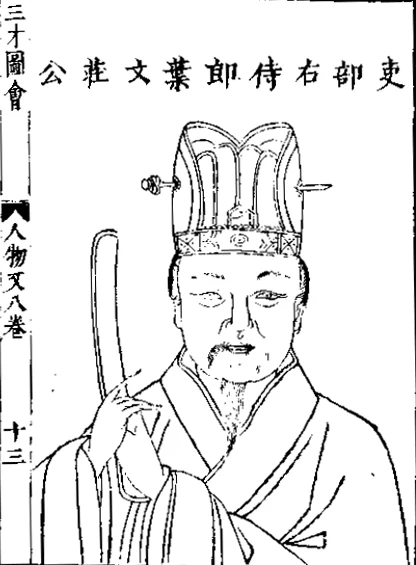
1420 CE–1474 CE
Official
Ye Sheng
叶盛
Ye Sheng (1420–1474), courtesy name Yuzhong, was a native of Kunshan in Suzhou Prefecture, Southern Zhili (now in Jiangsu). He received the jinshi degree in 1445, the tenth year of the Zhengtong era, and served under the Yingzong, Daizong, and Xianzong emperors, eventually becoming Left Vice Minister of Personnel. He was posthumously given the name Wenzhuang. Ye began his career as a remonstrance official and repeatedly…
1420 CE–1474 CEMing Dynasty
PROFILE
Ye Sheng (1420–1474), courtesy name Yuzhong, was a native of Kunshan in Suzhou Prefecture, Southern Zhili (now in Jiangsu). He received the jinshi degree in 1445, the tenth year of the Zhengtong era, and served under the Yingzong, Daizong, and Xianzong emperors, eventually becoming Left Vice Minister of Personnel. He was posthumously given the name Wenzhuang. Ye began his career as a remonstrance official and repeatedly submitted memorials addressing urgent policy needs during the crisis following the Tumu Crisis. He later served as Right Administration Commissioner of Shanxi, Right Assistant Censor-in-Chief and grand coordinator of Guangdong and Guangxi, and Left Assistant Censor-in-Chief and grand coordinator of Xuanfu. He distinguished himself in frontier affairs, military colonies, water control, and famine relief. Personally incorruptible and frugal, he admired Fan Zhongyan throughout his life and aspired to the model of the great ministers of antiquity. His works included Shuidong Riji, Lüzhu Tang Shumu, and Ye Wenzhuang Zoushu. He was an important political figure and scholar of the mid-Ming period.
- Other names
- Yuzhong
- Courtesy name
- Yuzhong
- Period
- Ming
- Dynasty/Regime
- Ming
- Identity
- Official
- Ethnicity
- Not reliably established in existing sources
- Native place
- Kunshan, Suzhou Prefecture, Southern Zhili (now in Jiangsu)
- Date of birth
- 1420
- Place of birth
- Kunshan County, Suzhou Prefecture, Southern Zhili
- Date of death
- 1474
- Place of death
- Unknown
- Highest office
- See “Life” and “Major Activities”
- Major achievements
- Served as Right Assistant Censor-in-Chief of the Censorate during the Chenghua reign and as grand coordinator in Jiangxi and Guangdong; known for personal integrity and diligence in water-control affairs.
LIFE TIMELINE
Age 22|Placed 21st in the Yingtian provincial examination and became a juren.
Age 26|Received the jinshi degree.
Age 28|Appointed Supervising Secretary in the Office of Scrutiny for War and took remonstrance as his responsibility.
Age 30|The Tumu Crisis occurred. Ye repeatedly memorialized on measures for resisting the enemy; after the Jingtai Emperor ascended the throne, Ye was promoted to Chief Supervising Secretary.
Age 31|Sent to pacify displaced people in Chenzhou, Henan; after returning to court, he memorialized on resettling displaced people and easing burdens in the capital region.
Age 32|Submitted eight measures for averting disasters and preventing trouble and requested restoration of the noon court audience; many proposals were adopted.
Age 33|Promoted to Right Administration Commissioner of the Shanxi Provincial Administration Commission and placed in charge of supplying Xuanfu; assisted Military Commissioner Sun An and helped restore frontier cities including Dushi and Maying.
Age 36|Returned home to observe mourning for his father.
Age 39|Summoned to the capital by relay on the Yingzong Emperor's order and promoted to Right Assistant Censor-in-Chief as grand coordinator of Guangdong and Guangxi; suppressed the Longshui Yao uprising and, with General Yan Biao, destroyed more than seven hundred rebel strongholds.
Age 43|Assigned sole responsibility for Guangdong.
Age 45|After the Xianzong Emperor's accession, entered the capital for deliberations; soon promoted to Left Assistant Censor-in-Chief and replaced Li Bing as grand coordinator of Xuanfu, reclaiming more than 4,000 qing of farmland and repairing more than seven hundred forts.
Age 48|Appointed Right Vice Minister of Rites; together with Supervising Secretary Mao Hong, investigated affairs in Nanjing.
Age 50|Returned to court and became Right Vice Minister of Personnel; in winter, carried an imperial commission to invest the Prince of Jishan in the household of the Prince of Shen.
Age 51|Conducted famine relief in Zhending and Baoding, discussed clearing estate lands, and established granaries at Zhuozhou and Tianjin.
Age 53|Ordered to join Governor-General Wang Yue and others in detailed deliberations on the Hetao; memorialized that defense was the best long-term strategy.
Age 54|Transferred to Left Vice Minister of Personnel.
Age 55|While working in a rear hall, suddenly fell ill; carried home to his private residence, where he died. He received the posthumous name Wenzhuang.
BIOGRAPHY
Biography
Family Background and Early Years
Ye Sheng was born in 1420, the 18th year of the Yongle era, in Kunshan, Suzhou Prefecture, Southern Zhili. His great-grandfather was Ye Mao, his grandfather Ye Ming, his grandmother Lady Guo, and his father Ye Chun. His father's former wife was Lady Tang, his birth mother was Lady Chen, and his stepmother was Lady Shen. Although the Ye family was not a household of high officials, it belonged to the local gentry. Ye Sheng showed unusual talent from an early age, was widely read, had a strong memory, and wrote with remarkable facility. His early education laid the foundation for his later achievements in both official life and scholarship.
In 1441, the sixth year of the Zhengtong era, at age 22, Ye placed 21st in the Yingtian provincial examination and became a juren. Four years later, in 1445, the tenth year of Zhengtong, he received the jinshi degree at age 26. In the fourth lunar month of 1447, the 12th year of Zhengtong, he was appointed Supervising Secretary in the Office of Scrutiny for War. Supervising Secretaries were remonstrance officials responsible for advising the court and correcting omissions and errors. From the outset Ye treated outspoken remonstrance as his duty and discussed affairs boldly without avoiding the powerful.
The Tumu Crisis and Career as a Remonstrance Official
In 1449, the 14th year of the Zhengtong era, the Yingzong Emperor personally campaigned against the Oirat forces, was defeated and captured at Tumu, an event known as the Tumu Crisis. News of the defeat shook the capital, and many generals fled back. Ye Sheng led colleagues in memorializing that those responsible for failures of military discipline in the imperial entourage should first be punished and that capable generals should be selected and troops trained for a counteroffensive. In the ninth lunar month, the Prince of Cheng, Zhu Qiyu, ascended the throne as the Jingtai Emperor. Although customary rewards were offered, Ye declined his on the grounds that the sovereign had been humiliated and captured; the Jingtai Emperor refused his request.
In the tenth lunar month of the same year, the Oirat leader Esen advanced toward the capital. Ye memorialized that military artisans attached to the palace workshops should be released for training and military service, that the responsible offices should stock grain for the soldiers, and that detached troops should be sent to Tianjin to obtain weapons and strengthen outside support. Over three days he submitted seven or eight memorials, many of which directly addressed urgent needs. After the Oirats withdrew, Ye was promoted to Chief Supervising Secretary. In one memorial he argued that reward and punishment had to be made clear: men such as Sun Tang who dared to fight, and Xie Ze and Han Qing who died in service, should be rewarded; those whose defenses were lax or who failed to respond vigorously to the crisis should be punished. His language was direct and uncompromising.
At the time, Chen Xun and other senior officials proposed recalling Censor-in-Chief Luo Tong, who was defending Juyong Pass, while retaining Xuanfu commander Yang Hong to control the capital forces. Ye opposed the plan, arguing that the frontier passes were the immediate priority. He pointed out that the fall of Zijing and Baiyang passes had allowed the enemy to approach the capital, and that the defenses of Xuanfu and Juyong could not be neglected. The Jingtai Emperor agreed. Ye was later sent to pacify displaced people in Chenzhou, Henan. After returning in 1450, the first year of Jingtai, he memorialized that the refugees came from many different regions and had different circumstances, so a dedicated official should be appointed to resettle them. He also noted repeated drought and locust damage in the capital region and requested greater relief. The emperor adopted many of his recommendations.
In the sixth lunar month of 1451, the second year of Jingtai, Ye submitted eight measures for averting disasters and preventing trouble. With military pressure temporarily reduced, the Jingtai Emperor had become more given to banquets and outings; Ye therefore asked that the traditional noon audience be restored, and the emperor immediately approved. During this period the emperor was receptive to remonstrance. Joint proposals from the Six Offices of Scrutiny were often led by Ye Sheng and Lin Cong. In court discussions Ye frequently spoke first and engaged in sustained argument. An irritated official once asked, “Is he the Junior Guardian?” and Ye consequently acquired the jocular nickname “Junior Guardian Ye.” Public opinion nevertheless held his abilities in high regard.
Frontier Service
In 1452, the third year of Jingtai, Ye was promoted to Right Administration Commissioner of the Shanxi Provincial Administration Commission and placed in charge of supplies for Xuanfu. Soon afterward, on Li Bing's recommendation, he assisted Military Commissioner Sun An in military affairs. Sun An had previously commanded the defenses of four frontier cities—Dushi, Maying, Longmen Guard, and its associated post. After the Yingzong Emperor had been carried north, Sun had argued that these positions were far outside the main line and too isolated to hold, and had requested their abandonment. By this time, however, the court ordered Sun to restore the four cities, and Ye took part in the work.
While serving on the frontier, Ye opened wasteland, repaired housing, maintained weapons, attracted displaced settlers, established relay lodgings for travelers, requested treasury funds to buy one thousand oxen for military colonists, founded community schools, established public burial grounds, and organized care for the sick and wounded. Within two years the four cities, together with forts at Chicheng, Diao'e, and elsewhere, were successively restored and put into good order. Sun An was consequently promoted to deputy regional commander.
The defending eunuch Gong Sheng was at odds with Sun An and tried to remove him, reporting that Sun was ill and should be replaced. When the Jingtai Emperor asked Ye about the matter, Ye replied directly that Sun's illness resulted from being constrained by Gong Sheng and that none of the current generals surpassed Sun. The emperor therefore retained Sun and sent a physician to treat him. Ye also impeached Gong Sheng, who was eventually transferred to another command.
Grand Coordinator of Guangdong-Guangxi and Xuanfu
During the Jingtai era Ye entered mourning for his father and returned home. In 1458, the second year of the Tianshun era, the restored Yingzong Emperor, recognizing his ability, summoned him to the capital by relay, praised him in person, and promoted him to Right Assistant Censor-in-Chief as grand coordinator of Guangdong and Guangxi. Ye asked to complete the full mourning period, but the emperor refused.
At the time, Feng Diji of the Longshui Yao was conducting raids. Ye supervised the generals who captured him alive. Banditry spread across Guangdong and Guangxi, with rebels taking cities and killing commanders. Many generals were too afraid to fight and instead killed civilians and claimed merit, driving the population to join the rebels. Ye argued that because such groups appeared and disappeared unpredictably, future reports should be required only when they attacked and seized walled towns, while lesser incidents could be summarized in periodic reports. The memorial was rejected. Ye and General Yan Biao destroyed more than seven hundred rebel strongholds, but Yan engaged in considerable indiscriminate killing, and critics blamed Ye for it as well.
In 1462, the sixth year of Tianshun, the court appointed Wu Zhen grand coordinator of Guangxi and made Ye solely responsible for Guangdong. In 1464, the eighth year of Tianshun, the Xianzong Emperor ascended the throne and Ye entered the capital to discuss affairs. Zhang Ning and others wanted to recommend him for the Grand Secretariat, but a remonstrance by Censor Lü Hong prevented the appointment; the court instead sent Han Yong to replace Ye in Guangdong. Earlier, compiler Qiu Jun had been on bad terms with Ye. Grand Secretary Li Xian, accepting Qiu's version of events, wrote in the edict appointing Han Yong, “Do not act like Ye Sheng in killing those who surrendered.” Ye did not defend himself against the accusation.
Ye was subsequently promoted to Left Assistant Censor-in-Chief and replaced Li Bing as grand coordinator of Xuanfu. There he requested a measured reduction in the grain price required for salt certificates in order to encourage merchants and strengthen frontier supply. He revived the system of government cattle and government land, reclaiming more than 4,000 qing of fields; used accumulated surpluses to buy 1,800 warhorses; and repaired more than seven hundred forts. Frontier conditions became more secure.
Later Court Service and the Hetao Debate
In the autumn of 1467, the third year of the Chenghua era, Ye was appointed Right Vice Minister of Rites and, together with Supervising Secretary Mao Hong, investigated affairs in Nanjing. In 1469 he returned to court and was transferred to Right Vice Minister of Personnel. That winter he carried an imperial commission to invest the Prince of Jishan in the household of the Prince of Shen.
In 1470, the sixth year of Chenghua, Ye conducted relief during famine in Zhending and Baoding, discussed the clearing of estate lands, distributed government breeding horses among civilian households, established granaries at Zhuozhou and Tianjin, and accumulated grain for future shortages. These measures directly addressed contemporary needs.
At the time, Mandulu's groups had long occupied the Hetao. Minister of War Bai Gui proposed sending one hundred thousand troops to drive them out, building fortified towns along the river as far as Dongsheng, and relocating civilians to cultivate and defend the region. The Xianzong Emperor admired the plan. In the spring of 1472, the eighth year of Chenghua, Ye was ordered to meet Governor-General Wang Yue and grand coordinators Ma Wensheng, Yu Zijun, and Xu Tingzhang for detailed deliberation. As a younger remonstrance official Ye had often discussed military strategy, but after years of experience along the three frontier zones he knew that capable generals were scarce, defenses had long been weak, and transport costs were heavy. He therefore believed that sweeping the Hetao and restoring Dongsheng should not be undertaken lightly. Together with the other officials he memorialized that defense was the best long-term strategy. If a decisive battle was unavoidable, they advised strengthening fortifications, clearing the countryside, waiting until the enemy became lax on the return journey, and then striking hard enough to deter another incursion. Alternatively, when the enemy entered to raid, elite troops could strike its base, forcing it to turn back and allowing attacks from within and without. But only after a sound defensive system was in place, they argued, should battle be considered. The Xianzong Emperor agreed with Ye's reasoning. Bai Gui nonetheless advocated recovering the Hetao, and the resulting campaign achieved nothing. Contemporaries admired Ye's foresight.
In 1473, the ninth year of Chenghua, Ye became Left Vice Minister of Personnel. On the eighth day of the third lunar month of 1474, the tenth year of Chenghua, while seated in a rear hall conducting official business, he suddenly fell ill and lost the ability to speak. He was carried back to his private residence and died there at age 55. The court granted funeral funds of thirty min in paper money and bestowed the posthumous name Wenzhuang.
Major Activities
Political Activity
Ye Sheng began his political career as a remonstrance official and was particularly prominent during the crisis after the Tumu Crisis. In three days he submitted seven or eight memorials covering urgent matters such as punishing generals responsible for military failures, selecting and training commanders, releasing palace military artisans for service, stockpiling grain, and obtaining weapons from Tianjin. Many directly addressed immediate needs. During the Jingtai era he continued to submit memorials on resettling displaced people, easing burdens in the capital region, selecting capable military officers in the capital garrisons, taxing the market activities of nobles and meritorious families, and the eight measures for preventing disasters and trouble. Many proposals were adopted. As Chief Supervising Secretary he repeatedly took the lead in court discussion and debate. Although some mocked him as “Junior Guardian Ye,” public opinion broadly respected his talent.
Frontier Affairs and Military Colonies
Ye held frontier assignments for many years and had notable achievements. From 1452 onward he assisted Sun An in restoring frontier cities such as Dushi and Maying, opened wasteland, repaired residences, maintained weapons, attracted displaced settlers, established lodgings, purchased oxen for military colonists, founded community schools, and established public burial grounds. Within two years the four cities and associated forts had been restored. As grand coordinator of Xuanfu he proposed reducing grain prices attached to salt certificates to encourage merchants and strengthen frontier supply, revived the system of government cattle and land to reclaim more than 4,000 qing, purchased 1,800 warhorses from accumulated surpluses, and repaired more than seven hundred forts, further stabilizing the frontier.
Water Control and Disaster Relief
In 1470 Ye relieved famine in Zhending and Baoding, discussed clearing estate lands, distributed breeding horses among civilians, established granaries at Zhuozhou and Tianjin, and accumulated grain against future shortages. He also achieved results in water-control work; diligence in such work became an important part of his later reputation.
Literature and Scholarship
Ye lived a disciplined and scholarly life, valued reputation and moral conduct, and had few material desires. At home he often traveled on foot. He admired Fan Zhongyan throughout his life and displayed Fan's portrait in both his hall and sleeping quarters. After official duties he was rarely without a book in hand. His writings included Shuidong Riji, Lüzhu Tang Shumu, and Ye Wenzhuang Zoushu. Shuidong Riji is a well-known Ming miscellany recording court precedents and the words and deeds of contemporaries and has considerable historical value. Lüzhu Tang Shumu is a catalogue of Ye's private library and reflects the nature of private book collecting in the mid-Ming.
Relations with Contemporaries
Ye Sheng and Lin Cong were leading remonstrance officials during the Jingtai era, and joint proposals from the Six Offices of Scrutiny were often headed by the two. Li Bing recommended Ye to assist Sun An in military affairs, and Ye later replaced Li as grand coordinator of Xuanfu. Ye was on poor terms with compiler Qiu Jun, who used the influence of Grand Secretary Li Xian to insert an oblique criticism of Ye for “killing those who surrendered” into Han Yong's appointment edict. Ye offered no rebuttal, a response later interpreted as evidence of broad-mindedness.
Personal Relations
Family
- Great-grandfather: Ye Mao
- Grandfather: Ye Ming
- Grandmother: Lady Guo
- Father: Ye Chun
- Father's former wife: Lady Tang
- Birth mother: Lady Chen
- Stepmother: Lady Shen
Teachers, Friends, and Colleagues
- Lin Cong: together with Ye, one of the leading remonstrance officials of the Jingtai era; the two often headed joint submissions from the Six Offices of Scrutiny.
- Li Bing: recommended Ye to assist Sun An and was later replaced by Ye as grand coordinator of Xuanfu.
- Sun An: military commissioner whose frontier work Ye assisted, including the restoration of fortified cities.
- Wang Yue, Ma Wensheng, Yu Zijun, and Xu Tingzhang: deliberated together with Ye on the Hetao in 1472.
- Zhang Ning: sought to recommend Ye for the Grand Secretariat.
- Lü Hong: censor whose remonstrance prevented Ye's appointment to the Grand Secretariat.
Ruler–Minister Relations
- Yingzong Emperor of the Ming: summoned Ye to the capital by relay in 1458 and promoted him to Right Assistant Censor-in-Chief and grand coordinator of Guangdong and Guangxi.
- Jingtai Emperor: adopted many of Ye's remonstrances during his reign.
- Xianzong Emperor of the Ming: called Ye to the capital for deliberations after ascending the throne and later entrusted him with the Hetao question.
Conflicts
- Gong Sheng: defending eunuch who tried to remove Sun An and was transferred after Ye impeached him.
- Qiu Jun: compiler who was on bad terms with Ye and used Li Xian's influence to criticize him indirectly for “killing those who surrendered.”
- Bai Gui: Minister of War who advocated recovering the Hetao, in opposition to Ye's view that “defense is the best long-term strategy.”
Historical Assessment
Ming and Contemporary Views
- Peng Shi, in the Spirit-Way Stele for Ye Sheng, Grand Master for Thorough Counsel, Left Vice Minister of Personnel, Posthumously Wenzhuang, praised him as refined, dignified, devoted to the Way and righteousness, respectful of reputation and integrity, aspiring to the ancients, filial and fraternal at home, cautious and diligent in office, balanced in debate, free of miscellaneous visitors, constantly reading after official duties, indifferent to sensual pleasures and material gain, and regrettably dead before his talents could be used to the full.
- The History of Ming stated that the Six Ministries were well staffed in the Tianshun and Chenghua periods and observed that Ye's achievements in remonstrance stood out; his reputation and accomplishments were substantial, and he enjoyed great respect both at court and outside it.
- Although some officials during the Jingtai era disliked his argumentative manner, contemporary opinion broadly “commended Ye Sheng's talent.”
Early to Mid-Qing
- The Qing-compiled History of Ming included a biography of Ye, affirming his style as a remonstrance official and his frontier achievements, and described him as disciplined and learned, attentive to reputation, restrained in pleasures, devoted to ruler and people rather than himself, and possessing the manner of a great minister of antiquity.
- In 1827, the seventh year of the Daoguang era, a portrait of Ye was carved for the Shrine of Five Hundred Worthies at Canglang Pavilion in Suzhou. Kong Jiyao produced the portrait, Shi Yunyu wrote the eulogy in regular script, and Tan Songpo carved it, demonstrating Ye's standing among Qing scholars.
Late Qing and Republican Period
- Republican-era reference works, including the Dictionary of Chinese Personal Names, included entries on Ye and summarized his offices and achievements.
- Ye's Shuidong Riji was printed repeatedly in the Ming and Qing, and late-Qing and early-Republican scholars frequently cited it as an important source for Ming history.
Modern Period
- Modern Ming historians often focus on Ye's remonstrance activity after the Tumu Crisis and his frontier administration, regarding him as a representative pragmatic official of the mid-Ming.
- Shuidong Riji was included in the Complete Library of the Four Treasuries and numerous other collections; modern scholars have collated and punctuated it as an important source for the politics, society, and culture of the early Ming.
- Ye's argument in the Hetao debate that “defense is the best long-term strategy,” and his opposition to rash large-scale offensives, are regarded as an important contribution to Ming frontier-strategy debates.
FIGURES ASSOCIATED WITH THIS DYNASTY
Bibliography
- History of Ming, “Biography of Ye Sheng” (Qing compilation by Zhang Tingyu et al., punctuated Zhonghua Book Company edition)
- Ye Sheng, Shuidong Riji (punctuated Zhonghua Book Company edition)