Birth | Born in Dingyuan, Haozhou.
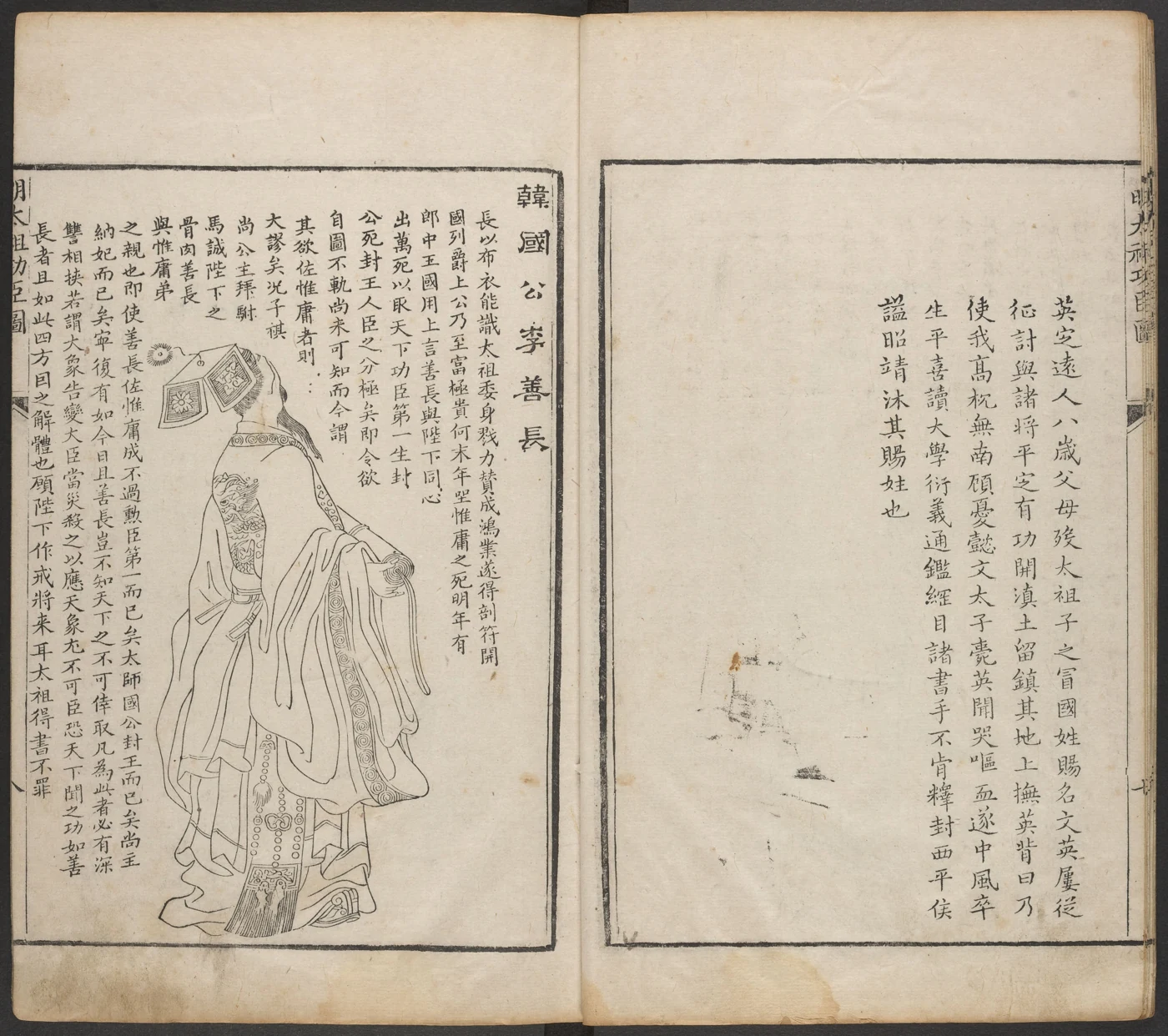
1314 CE–1390 CE
Founding meritorious official and Grand Councilor of the Ming dynasty
Li Shanchang
李善长
Li Shanchang (1314–July 6, 1390), courtesy name Baishi, is described in the source as having originally been named Li Shiyuan and as having changed his name to avoid the personal taboo of Ming Taizu Zhu Yuanzhang. He was from Dingyuan, Haozhou, in present-day Anhui. He was the foremost founding civil official of the early Ming, was praised as the “first founding meritorious official,” and was enfeoffed as Duke of Han. He…
1314 CE–1390 CEMing Dynasty
PROFILE
Li Shanchang (1314–July 6, 1390), courtesy name Baishi, is described in the source as having originally been named Li Shiyuan and as having changed his name to avoid the personal taboo of Ming Taizu Zhu Yuanzhang. He was from Dingyuan, Haozhou, in present-day Anhui. He was the foremost founding civil official of the early Ming, was praised as the “first founding meritorious official,” and was enfeoffed as Duke of Han. He joined Zhu Yuanzhang early, took charge of military and state correspondence and logistical coordination, and was compared by Zhu to Xiao He. In 1390, the twenty-third year of the Hongwu era, Li Shanchang became implicated in the Hu Weiyong case. Despite holding two iron certificates of immunity, he was ordered to die by Zhu Yuanzhang, and more than seventy members of three generations of his family were implicated.
- Alternative Names
- “First Founding Meritorious Official”; Duke of Han
- Courtesy Name
- Baishi
- Period
- Ming
- Date of Birth
- 1314
- Date of Death
- July 6 1390
- Dynasty/Polity
- Ming
- Identity
- Founding meritorious official and Grand Councilor of the Ming dynasty
- Ethnicity/People
- Not recorded in historical sources
- Native Place
- Dingyuan, Haozhou (present-day Anhui)
- Place of Birth
- Dingyuan, Haozhou
- Place of Death
- Not recorded in historical sources
- Highest Office
- See Biography and Major Deeds
- Major Achievements
- Joined Zhu Yuanzhang at an early stage; oversaw military and state documents; ranked first among the founding civil officials; later became implicated in the Hu Weiyong case.
LIFE TIMELINE
Age forty | Recommended by Ding Dexing, he joined Zhu Yuanzhang and was retained as a records secretary.
Age forty-one | After the capture of Heyang, he set an ambush and repelled a surprise Yuan attack.
Age forty-two | Strongly supported crossing the Yangzi; participated in the capture of Caishi and Taiping; became an administrative officer in the commander's headquarters.
Age forty-three | Participated in the capture of Zhenjiang and became a councillor in the Jiangnan Branch Secretariat.
Age fifty | Zhu Yuanzhang declared himself Prince of Wu and appointed Li Shanchang Right Chief Councillor.
Age fifty-three | For his service in defeating Wu, he was enfeoffed as Duke of Xuanguo and became Left Chief Councillor.
Age fifty-four | Zhu Yuanzhang proclaimed himself emperor; Li concurrently became Junior Preceptor of the Heir Apparent and supervised the compilation of the History of Yuan.
Age fifty-six | During the great enfeoffment of meritorious officials, he became Duke of Han, received an iron certificate granting immunity from death twice, and ranked first among the dukes.
Age fifty-seven | Retired because of illness; Zhu Yuanzhang granted him land near Linhao.
Age sixty-two | His son Li Qi married Princess Lin'an; Li Shanchang's annual stipend was reduced by 1,800 shi after an accusation of failing to attend court properly.
Age sixty-six | The Hu Weiyong case broke out. Li Shanchang remained in place and temporarily managed the Censorate.
Age seventy-one | His younger brother Li Cunyi was resettled in Chongming; Li Shanchang did not formally thank the emperor, which angered Zhu Yuanzhang.
Age seventy-seven | He was ordered to die on the charge of knowingly concealing Hu Weiyong's treason, and more than seventy members of three generations of his family were implicated.
BIOGRAPHY
Biography
Family Background and Early Years
Li Shanchang was born in 1314, the first year of the Yanyou era, in Dingyuan, Haozhou. Dingyuan lay west of the Huai River and was an important north-south strategic area in the late Yuan. Li loved reading from childhood. The History of Ming: Biography of Li Shanchang describes him as having “read from youth, possessed intelligence and strategy, studied Legalist teachings, and was often accurate in planning affairs.” He was familiar with Legalist thought, was regarded as skilled in judging circumstances, and was respected locally as a learned elder.
In 1354, the fourteenth year of the Yuan Zhizheng era, Zhu Yuanzhang was campaigning around Chuyang, present-day Chuzhou in Anhui. On Ding Dexing's recommendation, Li Shanchang went to meet him. Zhu treated him with respect and retained him as a records secretary. This appointment began Li's political career. Zhu's forces still lacked trained civil administrators, and Li became involved in confidential military and administrative affairs, showing his organizational ability.
Zhu Yuanzhang once asked him when warfare across the realm would end. Li answered by invoking Liu Bang, Emperor Gaozu of Han, arguing that Liu had risen from commoner status during the Qin collapse, had been broad-minded, used people according to ability, avoided excessive killing, and founded an empire within five years. With Yuan rule already disintegrating and Zhu's native Haozhou not far from Pei, Li urged him to follow that model. Zhu approved the advice.
The Chuyang and Heyang Period
Li Shanchang followed Zhu Yuanzhang in taking Chuzhou and served as an adviser responsible for planning and supplies. As more generals came over to Zhu, Li evaluated their abilities and recommended suitable men while also conveying Zhu's sincerity so that defectors would feel secure. When disputes arose among officers, he worked to mediate them. Guo Zixing, after hearing rumors, became suspicious of Zhu Yuanzhang, reduced his military authority, and tried to take Li Shanchang into his own service. Li firmly declined and remained with Zhu, deepening Zhu's trust in him.
In 1355, while Zhu Yuanzhang was stationed at Heyang and personally led troops against Jilong Mountain Stockade, only a small force remained with Li to guard the base. A Yuan commander learned of the situation and launched a surprise attack. Li improvised an ambush and defeated the attackers. Zhu regarded this as evidence of his ability, and it showed that Li possessed not only administrative but also military competence.
Crossing the Yangzi and Pacifying Jiangnan
After Zhu Yuanzhang obtained the Chaohu naval force, Li Shanchang strongly advocated crossing the Yangzi. Before the attacks on Caishi and Taiping, he drafted proclamations strictly restraining military misconduct. Once the city was taken, the orders were posted on major streets and soldiers did not dare violate them, sparing the inhabitants of Taiping from widespread wartime abuse. The source presents this as an early example of Zhu's army cultivating the image of a disciplined and benevolent force.
In 1356 Zhu captured Jiqing Circuit, present-day Nanjing. Before the attack on Zhenjiang, Zhu feared that his generals might allow troops to harm civilians and feigned anger in order to impose discipline; Li interceded to resolve the matter. After Zhenjiang fell, it was said that “the people did not know there were soldiers,” a result attributed in part to Li's prior military discipline. When Zhu became chief administrator of the Jiangnan Branch Secretariat, Li was appointed councillor. Although Song Siyan, Li Menggeng, Guo Jingxiang, and others were also staff officials, decisions on military movement, rewards, punishments, and regulations were frequently left to Li. After the Bureau of Military Affairs was reorganized as the Chief Military Commission, Li concurrently served in its administrative staff and later advanced to an assistant position in the provincial secretariat.
In 1364, when Zhu proclaimed himself Prince of Wu and established a full government, Li became Right Chief Councillor. He was described as thoroughly familiar with precedent, swift in decision-making, and skilled in drafting official documents. Whenever Zhu wished to recruit someone, Li drafted the letter; whenever Zhu personally went on campaign, Li was left behind to manage the rear. Officers obeyed him, residents remained settled, and military supplies were transferred without shortage. In economic policy, he adapted Yuan institutions while removing abuses: he proposed a salt monopoly in the Huai region, established regulations for tea, restored coinage, opened ironworks, and fixed taxes on fishing. The source states that state revenue increased without unduly burdening the people.
Zhu also used severe punishments in the early period after crossing the Yangzi. When he once questioned whether three forms of collective punishment were excessive, Li proposed abolishing all except those attached to high treason. Zhu then ordered Li and Censor-in-Chief Liu Ji and others to revise the laws and promulgate them. The source presents this as an important foundation of early Ming law.
In the ninth lunar month of 1367, Zhu rewarded service in the defeat of Wu and enfeoffed Li as Duke of Xuanguo. When the government reordered offices to give precedence to the left, Li became Left Chief Councillor.
Founding of the Ming and the Height of His Power
In the first lunar month of 1368, Zhu Yuanzhang proclaimed himself emperor and established the capital at Nanjing. For the posthumous honoring of imperial ancestors and the investiture of empresses, the heir apparent, and princes, Li Shanchang repeatedly served as grand ceremonial commissioner. He concurrently became Junior Preceptor of the Heir Apparent, received high civil and merit ranks, and was charged with major military and state affairs. He led ritual officials in determining rites for suburban sacrifices, the altars of soil and grain, and ancestral temples. When Zhu traveled to Bianliang, Li remained in Nanjing with authority to act as circumstances required. He also proposed the organization of the Six Ministries, discussed mourning dress for officials and commoners and ceremonial rules for congratulating the Eastern Palace, supervised the compilation of the History of Yuan, and participated in compiling the Ancestral Instructions and the Collected Rites of the Great Ming. The source states that matters ranging from the titles of sacred mountains and rivers to princely enfeoffment and rewards for meritorious officials were entrusted to Li and other learned officials, making him effectively the leading civil minister.
In 1370, during the great enfeoffment of meritorious officials, Zhu declared that although Li had not earned merit on horseback, he had served for many years and supplied the armies, and therefore deserved a great fief. Li received an extensive set of honorific and official titles, became Duke of Han with an annual stipend of four thousand shi and hereditary succession, and received an iron certificate granting him immunity from death twice and his son once. Only six men were enfeoffed as dukes at the time—Xu Da, Chang Mao, Li Wenzhong, Feng Sheng, Deng Yu, and Li Shanchang—and Li ranked first. The investiture text compared him with Xiao He.
The source then describes Li as becoming increasingly proud after reaching the height of wealth and rank, while Zhu began to dislike him. It characterizes Li as outwardly mild but inwardly harsh and jealous. Councillors Li Yinbing and Yang Xisheng, who encroached slightly on his authority, were accused and dismissed. Li also insulted Liu Ji during a dispute over law, after which Liu felt unsafe and asked to retire. Zhang Chang, Yang Xian, Wang Guangyang, and Hu Weiyong were all punished after being used by Zhu, while Li continued to hold trust and responsibility—an endurance that itself became a source of imperial suspicion.
In 1371 Li retired because of illness. Zhu granted him several qing of land near Linhao, 150 households to guard ancestral graves, 1,500 tenant households, and twenty households of ceremonial attendants. After he recovered the following year, Zhu ordered him to supervise construction of palace buildings at Linhao and the transfer of 140,000 wealthy Jiangnan households with land to Haozhou, and Li remained there for several years. In 1374 his younger brother Li Cunyi was promoted to an office in the Court of the Imperial Stud, and Cunyi's sons Li Shen and Li You received posts in the imperial livestock administration.
In 1376 Zhu Yuanzhang married Princess Lin'an to Li Shanchang's son Li Qi, who became an imperial son-in-law commandant. The marriage brought great prestige. Yet one month later the chief censors Wang Guangyang and Chen Ning impeached Li Shanchang for arrogance and failure to show concern while the emperor had been ill and absent from court, and accused Li Qi of failing to attend court for six days and then not admitting guilt when summoned. Li's annual stipend was reduced by 1,800 shi. Soon afterward he was again ordered, together with Duke of Cao Li Wenzhong, to oversee the Secretariat, Chief Military Commission, and Censorate, discuss military and state affairs, and supervise construction of the circular mound. His formal position appeared restored, but his practical power had greatly diminished.
Later Years and Conviction
Hu Weiyong had first served as magistrate of Ningguo after Li Shanchang recommended him and later rose to Left Chief Councillor. Li Shanchang's nephew Li You was also married to Hu Weiyong's niece. The two families were therefore closely connected.
In 1380 Hu Weiyong was executed for treason and many alleged associates were killed, but Li Shanchang remained untouched. When the Censorate lacked a chief censor, Li was even temporarily placed in charge of its affairs. The source portrays this apparent survival as masking a growing danger.
In 1385 someone accused Li Cunyi and his son of having belonged to Hu Weiyong's faction. Zhu spared their lives but resettled them in Chongming. Li Shanchang did not formally thank the emperor, which caused Zhu to hold resentment against him.
By 1390 Li was seventy-seven. Several incidents that year directly preceded his death. First, while building a residence, Li asked Duke of Xinguo Tang He to lend him three hundred guard soldiers; Tang secretly reported the request to Zhu. Second, in the fourth lunar month, when commoners convicted of crimes were to be exiled to the frontier, Li repeatedly asked that his relative Ding Bin and others be exempted. Zhu became furious and investigated Ding. Because Ding had once worked in Hu Weiyong's household, he testified about earlier contacts between Li Cunyi and Hu. When Li Cunyi and his son were arrested and interrogated, their statements implicated Li Shanchang. They alleged that Hu's followers had repeatedly tried to persuade Li to join a rebellion, that he initially rejected them, but later said, “I am old. After I die, you may do as you please.”
Another accusation stated that when General Lan Yu campaigned beyond the frontier and reached Buir Lake, he captured Feng Ji, an envoy allegedly sent by Hu Weiyong to the steppe, but Li Shanchang concealed the matter and did not report it. Censors submitted repeated impeachments, and servants including Lu Zhongqian also accused Li of exchanging bribes and private communications with Hu.
Zhu Yuanzhang ultimately ruled that Li had known of Hu Weiyong's treason but failed to report it, had watched events from both sides, and had committed high treason. At the time an astrological omen was interpreted as indicating disaster for a great minister. Li was ordered to die in 1390, and the source states that seventy-five members of his household, including wife, daughters, brothers, and nephews, were executed. Although his iron certificate granted immunity from death twice and once for his son, treason was outside its scope.
Zhu personally issued an edict and compiled the Three Records Proclaiming the Treacherous Faction for circulation throughout the realm. Li Qi and the princess were moved to Jiangpu. Li Qi later drowned himself during the Jingnan Campaign. His sons Li Fang and Li Mao escaped punishment because of their mother, the princess, but the hereditary title Duke of Han was abolished.
The following year, Wang Guoyong, a director in the Ministry of Works, submitted a memorial arguing that Li had been wronged. He pointed out that Li was related to Zhu Yuanzhang through the marriage of their children, while Hu Weiyong was only connected through a nephew's marriage; moreover, Li had already reached the highest possible rank and wealth, with a ducal title in life, the prospect of princely honor after death, a son married to a princess, and relatives holding offices. Helping Hu could not have brought him any higher reward, so rebellion made no rational sense. The source states that Zhu had no answer and did not punish Wang, but did not reverse Li's fate.
In 1644, the seventeenth year of the Chongzhen era, the Southern Ming Hongguang emperor posthumously awarded Li Shanchang the title Xiangmin.
Li Shanchang, courtesy name Baishi, was a native of Dingyuan. A reader from youth, he was shrewd and versed in legalist thought, and his predictions of events generally proved right. When Zhu Yuanzhang passed through Chuyang he went to greet him; Zhu, knowing him for a respected elder of the district, treated him with ceremony and kept him to manage documents. Once, asked in leisure when the disorders of the realm would end, he answered that in the troubles at the end of Qin, Han Gaozu rose from commoner stock, generous and open, knowing men and employing them well, no lover of slaughter, and made himself emperor in five years; that now the Yuan's order was in ruins and the realm had fallen apart, and that if Zhu followed that example the world would be easy to settle. Zhu thought him right.
Thereafter Li Shanchang took part in the capture of Chuzhou as a staff officer, joining in secret planning and managing the army's supplies, and was much trusted. As Zhu's fame grew, Li judged the talents of the generals who came over and reported them to him, and conveyed Zhu's sincerity to the new adherents so that they were at ease; where officers fell out he mediated. When Guo Zixing believed rumors about Zhu, stripped him of troops and tried to take Li Shanchang into his own service, Li firmly refused, and Zhu relied on him the more. When Zhu camped at Heyang and led a force in person against the Jilong stockade, leaving few troops with Li, a Yuan general came raiding by night and Li ambushed and beat him.
After the Chaohu fleet was won, Li strongly urged the crossing of the river. At the taking of Caishi and the advance on Taiping he had proclamations barring plunder written beforehand and posted in the thoroughfares the moment the city fell, so that the army kept strict order. As Zhu's marshal he was made office chief of the headquarters and took part in the capture of Jiqing. Before the attack on Zhenjiang, when Zhu feigned anger to bring his overbearing generals to book, Li's intercession settled the matter, and after the city fell the people scarcely knew an army had come. As Zhu became Pingzhang of the Jiangnan branch Secretariat, Li was made a counsellor; though such men as Song Siyan, Li Menggeng and Guo Jingxiang were on the staff, military decisions, rewards and regulations were largely settled by Li, and when the Bureau of Military Affairs became the Grand Commandery he held its senior post and rose to assistant administrator of the province.
Around the founding of the Ming, Li Shanchang presided over a great deal of institution-building: with the other ministers he settled the rites of the suburban and ancestral sacrifices, the official establishment and the statutes, supervised the compilation of the History of Yuan, and took part in fixing the calendar and ceremony. In 1370, when merit was richly rewarded, he was enfeoffed as Duke of Han and given the titles of founding minister of letters, grand master of glorious emoluments, left pillar of state, grand tutor and left chancellor of the Secretariat with four thousand shi a year and hereditary succession, the patent comparing him to Xiao He of the Han and praising him without stint, and he stood first among all the meritorious. In 1371 he retired on grounds of illness. Hu Weiyong afterward became chancellor through his recommendation, and the Hu case of 1380 implicated many; Li, though out of office, had a brother, Li Cunyi, and nephew entangled in it, and the emperor spared their lives at the time. In 1390, at seventy-seven, Li Shanchang was condemned for knowing of the conspiracy and not reporting it and was executed with more than seventy of his wives, daughters, brothers and nephews. His guilt has been argued over ever since and is generally read as part of the early Ming purge of founding ministers; the History of Ming preserves both his services in the founding and his ruin at the end.
His institutional work belongs chiefly to the years in which he held the chancellorship. At the founding of the Ming in 1368 he and the other ministers settled the rites of the suburban, ancestral and soil-and-grain sacrifices and the organization of the six ministries with the ranks of civil and military officials; in law the Great Ming Code of the early dynasty was drawn up by Li Shanchang and others at imperial order and revised repeatedly thereafter; in the calendar the Datong system was promulgated with his and Liu Ji's participation. For letters, in 1369 an edict called for the compilation of the History of Yuan, with Li as supervising editor and Song Lian and Wang Yi as chief editors, a supplementary revision following the next year and the whole finished in 1370 — a speed rare among the dynastic histories, reflecting the early Ming's eagerness to establish its own legitimacy by writing the history of the house it had replaced. He also organized the registers of meritorious enfeoffments and the setting up of offices, and the ceremonial of great court occasions, investitures and rewards was largely settled with his participation.
His end contrasts sharply with these services. His son Li Qi, a commandant by marriage to the Princess Lin'an, kept the family from immediate extinction, but most of his sons, brothers and nephews were implicated and the house declined. Discussion of his case has centered on two points: that he was indeed connected to Hu Weiyong by marriage and did not report the plot, and that the aging emperor had grown suspicious of his founding ministers; the two are not mutually exclusive. The History of Ming records both his shrewdness and his services in the founding and his ruin at the end, and its historians reflect on the fate of the dynasty's meritorious ministers.
At the distribution of rewards in 1370 Zhu Yuanzhang compared him to Xiao He of the Han and granted him an iron warrant of pardon sparing his own life twice and his son's once, a favor surpassed by no other minister of the founding. That comparison and his later end make an ironic pairing in the fate of the early Ming's founding ministers.
As Duke of Han and first among the meritorious, he held one of the highest ranks in the early Ming nobility, standing with the Duke of Wei, Xu Da, as the two men Zhu Yuanzhang most relied on, one in letters and one in arms.
The History of Ming records both the services that placed him first among the founders and his execution at the end, leaving the verdict open.
Major Activities
Building Political Institutions
Li Shanchang was one of the practical architects of early Ming political institutions. Major measures before and after Zhu Yuanzhang's accession that the source attributes to Li or to work he supervised include:
- Revision of laws: At the beginning of the Hongwu era, Li and Liu Ji revised laws, abolishing three forms of collective punishment except in cases of high treason and helping lay the foundations of early Ming law.
- Ritual institutions: He led ritual officials in defining rites for suburban sacrifices, the altars of soil and grain, and ancestral temples; helped determine titles for sacred mountains and rivers; and discussed mourning dress and Eastern Palace ceremonies.
- Government organization: He proposed the structure of the Six Ministries and central institutions, supervised the History of Yuan, and participated in the Ancestral Instructions and Collected Rites of the Great Ming.
- Imperial enfeoffment: He took part in enfeoffing princes and rewarding meritorious officials, with many details delegated to him and other learned officials.
- Economic policy: He adapted Yuan institutions by proposing the Huai salt monopoly, tea regulations, restored coinage, ironworks, and fish taxes, which the source says increased state resources without impoverishing the people.
Military Logistics and Discipline
Although Li Shanchang did not earn what the source calls “merit on horseback,” he was responsible throughout Zhu Yuanzhang's campaigns for logistical supply and military discipline.
- Rear-area coordination: When Zhu campaigned personally, Li was repeatedly left behind. Officers obeyed him, inhabitants remained settled, and military supplies were transferred without shortage.
- Military discipline: Before the attacks on Caishi and Taiping, he drafted prohibitions restraining soldiers, helping prevent harm to civilians.
- Coordination of officers: He assessed the abilities of defecting commanders, recommended them to Zhu, conveyed Zhu's sincerity, and mediated disputes within the army.
- Battle of Heyang: While left to defend the base, he ambushed and defeated a surprise Yuan attack, displaying battlefield command ability.
Drafting Documents and Recruiting Talent
Li Shanchang was described as thoroughly familiar with precedent, decisive in judgment, and skilled in formal writing. When Zhu Yuanzhang sought to recruit people, Li drafted the invitations and proclamations. The source presents this ability as an important factor in Zhu's success in attracting talent during the struggle among competing regimes.
Recommendations and Personnel
Li Shanchang recommended Hu Weiyong for the magistracy of Ningguo, from which Hu later rose through offices to become Left Chief Councillor. This recommendation eventually became one of the connections used against Li: although he was not immediately implicated when Hu was executed, the Hu Weiyong case remained a continuing political threat.
Implication in the Hu Weiyong Case
Li Shanchang's death formed part of the expansion of the Hu Weiyong case. Hu was executed in 1380 while Li initially remained safe; ten years later Li was ordered to die on charges including knowing of treason without reporting it and maintaining an ambiguous stance. More than seventy members of three generations of his family were implicated. The source connects this case with the later Lan Yu case and treats both as emblematic of the concentration of imperial power and systematic purges of founding officials under the Hongwu emperor.
Dynastic Marriage Alliance
In 1376 Li Shanchang's son Li Qi married Princess Lin'an. This marriage directly tied the Li family to the Ming imperial house and made Li Shanchang an imperial in-law. The source notes that the marriage did not bring lasting security and instead heightened the family's political sensitivity once Li lost favor.
Personal Relations
- Family
- Younger brother: Li Cunyi, official of the Court of the Imperial Stud, later resettled in Chongming because of the Hu Weiyong case
- Nephews: Li Shen and Li You, both officials in the imperial livestock administration
- Son: Li Qi, imperial son-in-law commandant and husband of Princess Lin'an
- Grandsons: Li Fang and Li Mao, spared because of their connection to the princess; Li Fang later held a guard command and Li Mao a guard-office post
- Wife, daughters, brothers, and nephews: more than seventy relatives were executed in the case
- Ruler and Minister
- Zhu Yuanzhang, Emperor Taizu of Ming: his ruler and founding emperor of the Ming
- Princess Lin'an: daughter of Zhu Yuanzhang and Li Shanchang's daughter-in-law
- Colleagues and Subordinates
- Song Siyan, Li Menggeng, and Guo Jingxiang: staff officials in the Jiangnan Branch Secretariat
- Li Yinbing and Yang Xisheng: councillors dismissed after infringing on Li's authority
- Wang Guangyang and Chen Ning: senior censors who impeached Li
- Rivalries and Conflicts
- Liu Ji: Censor-in-Chief; Li insulted him during a dispute over law, after which Liu requested retirement
- Hu Weiyong: Left Chief Councillor executed for treason; Li was later implicated because of his connections with Hu
- Old Associates
- Tang He, Duke of Xinguo: secretly reported Li's request to borrow guard soldiers
- Yang Wenyu: an old acquaintance who allegedly tried to persuade Li on Hu Weiyong's behalf
- Later Commemoration
- Wang Guoyong: official who memorialized in Li's defense after his death
- Zhu Yousong, the Hongguang emperor: posthumously awarded Li the title Xiangmin
Historical Assessment
Ming and Contemporary Views
- In his 1370 investiture edict, Zhu Yuanzhang compared Li Shanchang with Xiao He and praised him highly, stating that although Li had no mounted battlefield merit, his long service and provision of military supplies constituted great merit.
- In 1390 Zhu personally issued an edict accusing Li of knowing of treason but failing to report it, watching events from both sides, and committing high treason, and listed him among the leading members of a treacherous faction in the Three Records Proclaiming the Treacherous Faction.
- The following year Wang Guoyong memorialized in Li's defense, arguing that his kinship with Zhu Yuanzhang was much closer than his connection with Hu Weiyong and that Li had nothing further to gain from rebellion. The source states that Zhu did not punish Wang but did not overturn Li's conviction.
- Tan Qian's Guoque and Jiao Hong's Collected Biographies of the Dynasty, juan 11, both include biographies of Li and acknowledge his position as the foremost founding civil official.
- In 1644 the Hongguang emperor posthumously awarded Li the title Xiangmin. The source interprets the character xiang as carrying the sense of merit in opening territory and reflects the Southern Ming's renewed recognition of founding officials.
Early to Mid-Qing
- Zhang Tingyu's History of Ming: Biography of Li Shanchang describes him as “outwardly mild but inwardly jealous and harsh,” while also preserving Zhu Yuanzhang's praise of his long service and logistical contributions.
- Gu Yingtai's Major Events of Ming History Arranged by Topic places Li's death within the “Hu and Lan cases” and treats the principal accusation as knowing of treason without reporting it rather than personally rebelling, reflecting early Qing criticism of the treatment of Hongwu-era founding officials.
- Qing scholars often regarded Li's death as a classic example of the fate of meritorious officials under concentrated imperial power.
- Shangguan Zhou's illustrated Wanxiaotang Huazhuan included a portrait inscription for Li among the meritorious officials of Ming Taizu in its 1743 edition, indicating Qing recognition of his founding status.
Late Qing and Republican Period
- Late Qing and early Republican scholars frequently discussed the Li Shanchang case alongside other early Ming purges as evidence of Zhu Yuanzhang's suspicion of meritorious officials and the darker side of concentrated monarchical power.
- Modern thinkers including Liang Qichao cited the Li Shanchang case when discussing Chinese autocracy, criticizing the political logic that discarded meritorious followers after victory.
- Republican historians generally acknowledged Li's foundational contribution to early Ming institutions but often gave greater weight to the negative judgments surrounding his political career, viewing his fate as a tragedy of the imperial political system.
Modern Scholarship
- Modern Ming scholarship generally regards Li Shanchang as one of the core designers of early Ming political, ritual, legal, and economic institutions and argues that his contributions deserve full recognition. At the same time, many scholars consider the accusation that he knowingly concealed treason to have been shaped by later political construction and see his death as reflecting the severity of the Hongwu political environment.
- Wu Han's Biography of Zhu Yuanzhang treats Li as one of Zhu's most important civil officials and compares his institutional contribution to that of Xiao He.
- Contemporary historians commonly argue that the Li Shanchang case was not merely a personal tragedy but foreshadowed the political transformation associated with abolition of the Grand Councilorship and the strengthening of the Five Chief Military Commissions and Six Ministries, and that his death marked the beginning of a broader decline of the early Ming civil-official group.
FIGURES ASSOCIATED WITH THIS DYNASTY
Bibliography
- Zhang Tingyu et al., History of Ming, juan 127, “Biography of Li Shanchang”
- Veritable Records of Taizu, the Gao Emperor of the Great Ming*, relevant Hongwu-era juan
- Gu Yingtai, Major Events of Ming History Arranged by Topic
- Shangguan Zhou, Wanxiaotang Huazhuan, with Portraits of Meritorious Officials of Ming Taizu, 1743 edition
- Three Records Proclaiming the Treacherous Faction*, promulgated in 1390